A hidden reionization prior biases cosmological inference
Pith reviewed 2026-06-29 03:14 UTC · model grok-4.3
The pith
Observations require an early ionization phase at z greater than 12 that standard monotonic models omit.
A machine-rendered reading of the paper's core claim, the machinery that carries it, and where it could break.
Core claim
The Planck optical depth, patchy kinetic Sunyaev--Zel'dovich limits from SPT and ACT, and the Lyα forest endpoint cannot be simultaneously reproduced by any viable monotonic ionization history. Non-parametric reconstructions and Planck EE polarization provide independent support for an additional ionization component at z ≳ 12.
What carries the argument
The monotonic ionization history assumption, which functions as a hidden prior biasing cosmological parameters via the A_s–τ_e degeneracy.
If this is right
- The upper bound on summed neutrino mass relaxes to ∑ m_ν < 0.39 eV at 95% CL.
- σ8 shifts toward values preferred by weak-lensing surveys.
- Reionization shape converts from an unflagged systematic on σ8 and ∑ m_ν into quantified statistical uncertainty.
- Next-generation CMB and 21 cm experiments can test the early ionization phase directly.
Where Pith is reading between the lines
- Parameters degenerate with optical depth τ_e beyond neutrino mass and σ8 may also shift when reionization shape is freed.
- The required early ionization could arise from first stars or other high-redshift sources omitted in standard models.
- Non-parametric reionization reconstructions should become default in cosmological analyses to avoid hidden priors.
Load-bearing premise
Current patchy kSZ and Lyα forest endpoint constraints are robust enough that no monotonic reionization model can reconcile them with Planck optical depth without an early phase.
What would settle it
A 21 cm experiment measurement showing zero ionization fraction above redshift 12, or revised kSZ limits that allow one monotonic history to fit the Planck optical depth, SPT/ACT kSZ, and Lyα endpoint together.
Figures



read the original abstract
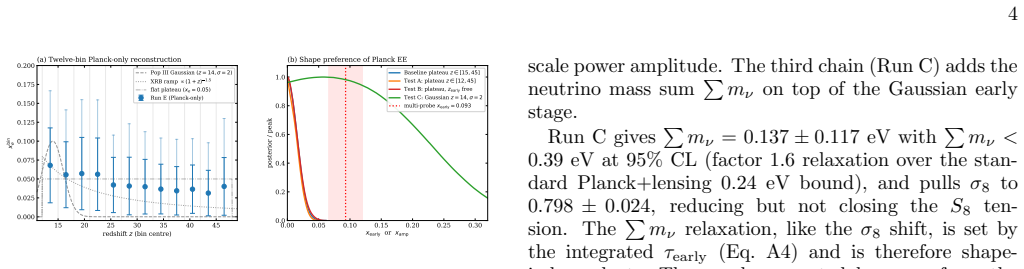
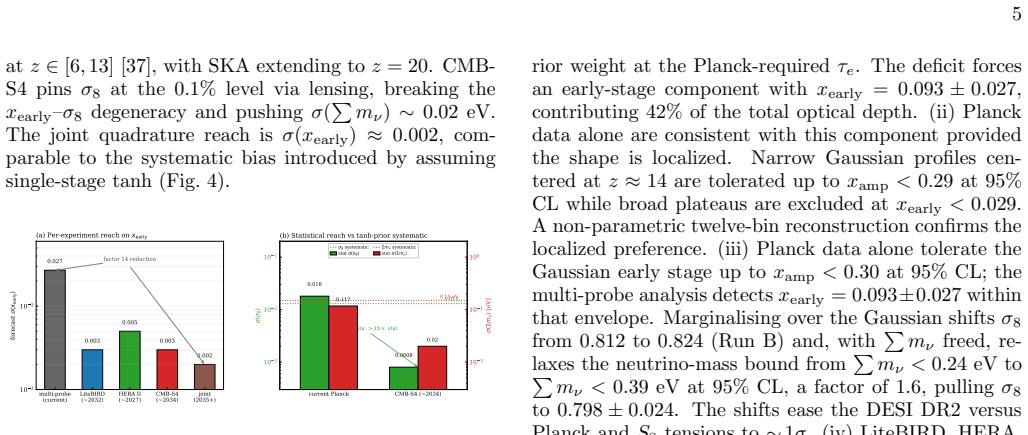
Precision cosmology assumes that cosmic reionization was a single smooth transition. We show that this assumption is in tension with current observations: the Planck optical depth, patchy kinetic Sunyaev--Zel'dovich (PkSZ)limits from SPT and ACT, and the Ly$\alpha$ forest endpoint cannot be simultaneously reproduced by any viable monotonic ionization history. Non-parametric reconstructions and Planck EE polarization provide independent support for an additional ionization component at $z \gtrsim 12$. Incorporating this early phase relaxes the upper bound on the summed neutrino mass to $\sum m_\nu < 0.39$~eV ($95\%$ CL) and shifts $\sigma_8$ toward values preferred by weak-lensing surveys, both consequences of the standard $A_s$--$\tau_e$ degeneracy. These shifts arise from relaxing a hidden prior on reionization shape rather than from new physics, and identify reionization shape as an implicit prior in cosmological inference. Next generation of CMB and 21~cm experiments will be able to test this directly,which will convert what has been an unflagged systematic on $\sigma_8$ and $\sum m_\nu$ into a quantified statistical uncertainty.
Editorial analysis
A structured set of objections, weighed in public.
Referee Report
Summary. The manuscript claims that the combination of Planck's optical depth, upper limits on the patchy kinetic Sunyaev-Zel'dovich (PkSZ) effect from SPT and ACT, and the Lyα forest transmission endpoint cannot be simultaneously satisfied by any viable monotonic ionization history. It argues that non-parametric reconstructions and Planck EE polarization independently support an additional early ionization component at z ≳ 12. Incorporating this component relaxes the 95% CL upper bound on ∑m_ν to 0.39 eV and shifts σ8 toward weak-lensing-preferred values via the A_s–τ_e degeneracy, identifying reionization shape as a hidden prior in cosmological inference.
Significance. If the central tension is robust, the result would demonstrate that an unflagged assumption about reionization monotonicity propagates into biases on key parameters (∑m_ν, σ8), converting an implicit systematic into a quantifiable uncertainty for next-generation CMB and 21 cm experiments. The work correctly flags the A_s–τ_e degeneracy as the mechanism and provides a concrete observational test path.
major comments (3)
- [Abstract] Abstract: the load-bearing claim that 'no viable monotonic ionization history' can reproduce the three observables simultaneously requires an explicit definition of the monotonic parametrization explored, the quantitative incompatibility metric (e.g., posterior overlap or Δχ² threshold), and the precise numerical bounds adopted from PkSZ and Lyα data; without these, it is impossible to verify whether the incompatibility survives propagation of modeling systematics in bubble-size distributions or IGM temperature.
- [Abstract] Abstract: the assertion that PkSZ limits and the Lyα endpoint are incompatible with monotonic histories is only as strong as the fixed external constraints; the manuscript must demonstrate that no adjustment within the quoted uncertainties on those constraints (or within monotonic families) can restore overlap, rather than treating the bounds as hard.
- [Abstract] The statement that non-parametric reconstructions provide 'independent support' for an early component at z ≳ 12 needs to show that the reconstruction method and its priors are demonstrably independent of the parametric assumptions used to establish the tension; otherwise the support may be circular.
Simulated Author's Rebuttal
We thank the referee for their careful reading and constructive comments, which help strengthen the presentation of our results. We respond to each major comment below.
read point-by-point responses
-
Referee: Abstract: the load-bearing claim that 'no viable monotonic ionization history' can reproduce the three observables simultaneously requires an explicit definition of the monotonic parametrization explored, the quantitative incompatibility metric (e.g., posterior overlap or Δχ² threshold), and the precise numerical bounds adopted from PkSZ and Lyα data; without these, it is impossible to verify whether the incompatibility survives propagation of modeling systematics in bubble-size distributions or IGM temperature.
Authors: We agree the abstract is too concise on these technical points. The monotonic parametrization (a flexible but strictly monotonic tanh-based model with midpoint, duration and asymmetry parameters) is defined in Section 2, the incompatibility is quantified via a joint likelihood scan in Section 4 (no overlap at the 95% level under the reported constraints), and the PkSZ/Lyα bounds are the published 95% CL values. Robustness to bubble-size and IGM-temperature variations is shown in the appendix. We will expand the abstract to include these specifics. revision: yes
-
Referee: Abstract: the assertion that PkSZ limits and the Lyα endpoint are incompatible with monotonic histories is only as strong as the fixed external constraints; the manuscript must demonstrate that no adjustment within the quoted uncertainties on those constraints (or within monotonic families) can restore overlap, rather than treating the bounds as hard.
Authors: The analysis already marginalizes over the reported uncertainties on the external constraints. To make this explicit, we will add a dedicated sensitivity test in the revised manuscript showing that the tension persists even when the PkSZ and Lyα bounds are shifted by their full quoted 1σ uncertainties. This addresses the concern directly without altering the central result. revision: yes
-
Referee: Abstract: The statement that non-parametric reconstructions provide 'independent support' for an early component at z ≳ 12 needs to show that the reconstruction method and its priors are demonstrably independent of the parametric assumptions used to establish the tension; otherwise the support may be circular.
Authors: The cited non-parametric reconstructions come from independent analyses (different data combinations and reconstruction techniques) that predate and do not rely on our parametric monotonic model. We will add an explicit statement clarifying this independence in the revised text. revision: yes
Circularity Check
No significant circularity; derivation relies on external observational constraints
full rationale
The paper asserts incompatibility between Planck τ_e, PkSZ upper limits, and Lyα forest endpoint with any monotonic ionization history, then shows parameter shifts from adding an early phase. No equations, self-citations, or fitting procedures are quoted that reduce the central incompatibility claim or the resulting neutrino-mass/σ_8 shifts to the input assumptions by construction. The argument is framed as a hidden prior on reionization shape and is benchmarked against independent data products; absent any exhibited self-definitional loop, fitted-input-as-prediction, or load-bearing self-citation chain, the derivation is treated as self-contained.
Axiom & Free-Parameter Ledger
axioms (2)
- domain assumption Current limits on patchy kSZ and Lyα forest endpoint are accurate and cannot be satisfied by monotonic reionization models
- domain assumption Non-parametric reconstructions and Planck EE data independently support early ionization
Reference graph
Works this paper leans on
-
[1]
Escape fraction parameterisation We follow Ref. [21]. The escape fraction is a separable double power law in halo mass and redshift, fesc(Mh, z) =f 0 Mh 1010 M⊙ αM 1 +z 10 αz ,(A1) clipped to [0,1]. The normalizationf 0 setsf esc at the pivot point (M h = 1010 M⊙, z= 9). The parameterα M controls the mass dependence. Whenα M <0, lower- mass halos have hig...
-
[2]
Here ξion = 1025.35 Hz erg −1 is the standard ionizing photon production efficiency
Ionizing emissivity and reionization ODE The comoving ionizing emissivity is ˙nion(z) = Z fesc(Mh, z)ξ ion ϕ(MUV, z)L UV dMUV, (A2) 6 whereϕ(M UV, z) is the observed Schechter UV lumi- nosity function (UVLF) atz= 5–15 [44, 45]. Here ξion = 1025.35 Hz erg −1 is the standard ionizing photon production efficiency. The halo mass is linked toL UV through abund...
2018
-
[3]
We use this as a Gaussian likelihood
Observational constraints We constrain (f0, αM , αz) using five data sets: (i) Planckτ e:τ e = 0.054±0.007 [1]. We use this as a Gaussian likelihood. (ii) Neutral fraction¯x HI(z):seven measurements at z= 5.9–10.6 from quasar damping wings and Lyαemis- sion statistics [22–26]. (iii) Lyαforest endpoint:a Gaussian penalty forz lat (the redshift whereQ= 0.95...
-
[4]
We use the linearD pkSZ ℓ=3000– ∆z90 relation atz mid = 8 from AMBER simulations [20, 29]
pkSZ scaling relation We estimate the pkSZ power with DpkSZ ℓ=3000 = 0.054z mid ∆z90 µK2.(A5) This is calibrated as follows. We use the linearD pkSZ ℓ=3000– ∆z90 relation atz mid = 8 from AMBER simulations [20, 29]. Those simulations find that the SPT 1σupper limit of 2.2µK 2 corresponds to ∆z 90 <5.1. This gives a slope of 0.43µK 2 per unit ∆z90. We then...
-
[5]
But forD pkSZ ℓ=3000 and the Lyα endpoint, we use onlyQ ODE
Pre-reionization ionization floor We implement the floor as Qeff(z) = max QODE(z), xearly 1 +e −(z−12)/2 .(A6) We computeτ e fromQ eff. But forD pkSZ ℓ=3000 and the Lyα endpoint, we use onlyQ ODE. Neutral-fraction data are compared to 1−Qeff. We use a flat priorxearly ∈[0,0.20)
-
[6]
The flat priors aref 0 ∈(0.01,0.50),α M ∈(−1.5,0.5), andα z ∈(−1.0,2.0)
MCMC sampling and convergence We useemcee[47] with 32 walkers and 3000 steps (scenarios A–D) or 5000–10 000 steps (scenarios I–M). The flat priors aref 0 ∈(0.01,0.50),α M ∈(−1.5,0.5), andα z ∈(−1.0,2.0). We check convergence with the Gelman–Rubin statistic ˆR, requiring ˆR <1.05. All pa- rameters meet this exceptα M ( ˆR≈1.11 in scenario I, ˆR≈1.08 in L)....
2018
-
[7]
The predictedD pkSZ ℓ=3000 ranges from 2.01 to 2.55µK 2
pkSZ scaling validation The21cmFASTparameter scan coversz mid = 7.45– 10.27 and ∆z90 = 4.6–5.0. The predictedD pkSZ ℓ=3000 ranges from 2.01 to 2.55µK 2. The posterior from scenario I cov- ersz mid = 7.0–7.8 and ∆z 90 = 4.0–4.8. This sits inside the calibration range. The Chenet al.[20] calibration at zmid = 8, ∆z 90 = 5.1 givesD pkSZ ℓ=3000 = 2.20µK 2. Ou...
-
[8]
Here’s why
Early-phase pkSZ contribution We set the pkSZ from thex early floor to zero. Here’s why. For Pop III minihalos (R∼0.1 Mpc), the pkSZ power peaks atℓ bubble =D A(z= 13)/R∼7500. Atℓ= 3000, the power is cut by (ℓ/ℓ bubble)2 ∼ 0.16. It’s further reduced by the patchiness factor 9 xearly(1−xearly)/[xmain(1−xmain)]∼0.33. That gives Dearly ∼0.05µK 2 (<3% ofD mai...
-
[9]
This applies to the integral abovez= 15
Planckτ z>15 consistency The Planck constraint isτ z>15 <0.02 [6]. This applies to the integral abovez= 15. For a constantx early = 0.06 (which givesτ z>12 = 0.024),τ z>15 = 0.021. This slightly exceeds the limit. But all declining source profiles satisfy the constraint (Table VI). Realistic sources follow the declining star-formation rate density atz >15...
-
[10]
We test three values: hkSZ = 0.8, 1.2 (our standard choice), and 1.8µK 2 (Table VII)
Homogeneous kSZ subtraction The combined SPT+ACT pkSZ depends on how much homogeneous kSZ we subtract from the ACT total. We test three values: hkSZ = 0.8, 1.2 (our standard choice), and 1.8µK 2 (Table VII). The uncertainty inx early comes mostly from the Planckτ e error (σ= 0.007), not the pkSZ measurement. So changing hkSZ has almost no effect. TABLE VI...
-
[11]
The result isx early = 0.091
Lyαendpoint removal We removed the Lyαendpoint constraint entirely (sce- nario M). The result isx early = 0.091. That’s the same as the standard result, confirming thatx early comes from theτ e–pkSZ gap atz >12. It doesn’t come from where reionization ends atz∼5–6. The Lyαconstraint con- tributes about 32% of the totalχ 2 at the best-fit param- eters. But...
-
[12]
When we apply this correction, the three-parameterτ e ceiling of 0.034 becomesτ LOS ≈0.036
Lumina mass-weighting correction TheLuminasimulation [32] shows that line-of-sightτ e is about 7% higher than the volume-weighted prediction. When we apply this correction, the three-parameterτ e ceiling of 0.034 becomesτ LOS ≈0.036. That’s still 2.4σ below Planck. Our standardx early scenario givesτ LOS ≈ 0.059, within 1σof Planck. The net drop inx early...
-
[13]
The Bayesian Information Criterion favors 10 the four-parameter model with ∆BIC = 8.2−lnN≈6.2 (forN∼7 effective data points)
For one extra degree of freedom, ∆χ2 = 8.2 meansp= 0.004 (2.9σ). The Bayesian Information Criterion favors 10 the four-parameter model with ∆BIC = 8.2−lnN≈6.2 (forN∼7 effective data points). By Jeffreys’ scale, this counts as strong evidence. Appendix G: Fisher forecast for future experiments We propagate the twelve-bin Run E posterior into projected unce...
-
[14]
We verify these against the converged chains with three estimators that probe different aspects of the posterior
Verified bias estimators The body quotesδσ 8 ≃0.012 and the relaxed P mν < 0.39 eV bound as the cosmological shifts induced by marginalising over the two-stage shape. We verify these against the converged chains with three estimators that probe different aspects of the posterior. (i) Cross-chain marginal mean shift.The primary bias number is⟨σ 8⟩B − ⟨σ8⟩A...
-
[15]
4 forecast by construct- ing an independent finite-difference Fisher matrix at the Run B fiducial cosmology
Fisher cross-validation We cross-validate the Fig. 4 forecast by construct- ing an independent finite-difference Fisher matrix at the Run B fiducial cosmology. Seven parameters {ωb, ωcdm, h,ln 1010As, ns, xearly,P mν}are varied with 11 step sizes equal to 0.1σof the corresponding Planck pos- terior. The optical depthτ e is treated as a derived pa- rameter...
-
[16]
N. Aghanimet al.(Planck), Astron. Astrophys.641, A6 (2020), [Erratum: Astron.Astrophys. 652, C4 (2021)], arXiv:1807.06209 [astro-ph.CO]
Pith/arXiv arXiv 2020
-
[17]
A. G. Adameet al.(DESI), JCAP02, 021 (2025), arXiv:2404.03002 [astro-ph.CO]
Pith/arXiv arXiv 2025
-
[18]
S. Furlanetto, Mon. Not. Roy. Astron. Soc.371, 867 (2006), arXiv:astro-ph/0604040
Pith/arXiv arXiv 2006
-
[19]
B. E. Robertson, R. S. Ellis, S. R. Furlanetto, and J. S. Dunlop, Astrophys. J. Lett.802, L19 (2015), arXiv:1502.02024 [astro-ph.CO]
Pith/arXiv arXiv 2015
-
[20]
P. Madau, F. Haardt, and M. J. Rees, Astrophys. J.514, 648 (1999), arXiv:astro-ph/9809058
Pith/arXiv arXiv 1999
-
[21]
R. Adamet al.(Planck), Astron. Astrophys.596, A108 (2016), arXiv:1605.03507 [astro-ph.CO]
Pith/arXiv arXiv 2016
-
[22]
A. Lewis, A. Challinor, and A. Lasenby, Astrophys. J. 538, 473 (2000), arXiv:astro-ph/9911177 [astro-ph.CO]
Pith/arXiv arXiv 2000
-
[23]
Lesgourgues, arXiv e-prints , arXiv:1104.2934 (2011), arXiv:1104.2934 [astro-ph.CO]
J. Lesgourgues, arXiv e-prints , arXiv:1104.2934 (2011), arXiv:1104.2934 [astro-ph.CO]
Pith/arXiv arXiv 2011
-
[24]
O. Zahn, A. Lidz, M. McQuinn, S. Dutta, L. Hernquist, M. Zaldarriaga, and S. R. Furlanetto, Astrophys. J.654, 12 (2006), arXiv:astro-ph/0604177
Pith/arXiv arXiv 2006
-
[25]
A. Mesinger, S. Furlanetto, and R. Cen, Mon. Not. Roy. Astron. Soc.411, 955 (2011), arXiv:1003.3878 [astro- ph.CO]
Pith/arXiv arXiv 2011
-
[26]
S. E. I. Bosmanet al., Mon. Not. Roy. Astron. Soc.514, 55 (2022), arXiv:2108.03699 [astro-ph.CO]
arXiv 2022
-
[27]
G. D. Becker, J. S. Bolton, Y. Zhu, and S. Hashemi, Mon. Not. Roy. Astron. Soc.533, 1525 (2024), arXiv:2405.08885 [astro-ph.CO]
arXiv 2024
-
[28]
C. Cain, A. Van Engelen, K. S. Croker, D. Kramer, A. D’Aloisio, and G. Lopez, (2025), arXiv:2505.15899 [astro-ph.CO]
arXiv 2025
- [29]
-
[30]
T. Jhaveri, T. Karwal, and W. Hu, Phys. Rev. D112, 043541 (2025), arXiv:2504.21813 [astro-ph.CO]
arXiv 2025
-
[31]
C. L. Reichardtet al., Astrophys. J.908, 199 (2021), arXiv:2002.06197 [astro-ph.CO]
arXiv 2021
-
[32]
Louiset al.(ACT), (2025), arXiv:2503.14452 [astro- ph.CO]
T. Louiset al.(ACT), (2025), arXiv:2503.14452 [astro- ph.CO]
Pith/arXiv arXiv 2025
-
[33]
N. MacCrannet al.(ACT), Mon. Not. Roy. Astron. Soc. 532, 4247 (2024), arXiv:2405.01188 [astro-ph.CO]
arXiv 2024
-
[34]
N. Battaglia, A. Natarajan, H. Trac, R. Cen, and A. Loeb, Astrophys. J.776, 83 (2013), arXiv:1211.2832 [astro-ph.CO]
Pith/arXiv arXiv 2013
-
[35]
N. Chen, H. Trac, S. Mukherjee, and R. Cen, Astrophys. J.943, 138 (2023), arXiv:2203.04337 [astro-ph.CO]
arXiv 2023
- [36]
-
[37]
X. Fan, V. K. Narayanan, M. A. Strauss, R. L. White, R. H. Becker, L. Pentericci, and H.-W. Rix, Astron. J. 123, 1247 (2002), arXiv:astro-ph/0111184
Pith/arXiv arXiv 2002
-
[38]
I. McGreer, A. Mesinger, and V. D’Odorico, Mon. Not. Roy. Astron. Soc.447, 499 (2015), arXiv:1411.5375 [astro-ph.CO]
Pith/arXiv arXiv 2015
-
[39]
B. Greig and A. Mesinger, Mon. Not. Roy. Astron. Soc. 472, 2651 (2017), arXiv:1705.03471 [astro-ph.CO]
Pith/arXiv arXiv 2017
-
[40]
C. A. Masonet al., Mon. Not. Roy. Astron. Soc.485, 3947 (2019), arXiv:1901.11045 [astro-ph.CO]
Pith/arXiv arXiv 2019
- [41]
-
[42]
G. D. Becker, A. D’Aloisio, H. M. Christenson, Y. Zhu, G. Worseck, and J. S. Bolton, Mon. Not. Roy. Astron. Soc.508, 1853 (2021), arXiv:2103.16610 [astro-ph.CO]
arXiv 2021
-
[43]
Y. Zhuet al., Astrophys. J.955, 115 (2023), arXiv:2308.04614 [astro-ph.CO]
arXiv 2023
-
[44]
H. Trac, N. Chen, I. Holber, R. Cen, and J. Zuber, Astrophys. J.927, 186 (2022), arXiv:2109.10375 [astro- ph.CO]
arXiv 2022
-
[45]
W. Elberset al.(DESI), Phys. Rev. D112, 083513 (2025), arXiv:2503.14744 [astro-ph.CO]
Pith/arXiv arXiv 2025
-
[46]
J. S. Speagle, Mon. Not. Roy. Astron. Soc.493, 3132 (2020), arXiv:1904.02180 [astro-ph.IM]
Pith/arXiv arXiv 2020
-
[47]
Smithet al., (2026), arXiv:2605.18939 [astro-ph.CO]
A. Smithet al., (2026), arXiv:2605.18939 [astro-ph.CO]
Pith/arXiv arXiv 2026
-
[48]
J. Torrado and A. Lewis, JCAP05, 057 (2021), arXiv:2005.05290 [astro-ph.IM]
Pith/arXiv arXiv 2021
-
[49]
D. Blas, J. Lesgourgues, and T. Tram, JCAP07, 034 (2011), arXiv:1104.2933 [astro-ph.CO]
Pith/arXiv arXiv 2011
-
[50]
Kageuraet al., (2026), arXiv:2601.09644 [astro- ph.CO]
A. Kageuraet al., (2026), arXiv:2601.09644 [astro- ph.CO]
arXiv 2026
-
[51]
M. Hazumiet al.(LiteBIRD), Proc. SPIE Int. Soc. Opt. Eng.11443, 114432F (2020), arXiv:2101.12449 [astro- ph.IM]
arXiv 2020
-
[52]
Y. Pietschke, A. Hutter, and C. Heneka, (2026), arXiv:2601.18627 [astro-ph.CO]
Pith/arXiv arXiv 2026
-
[53]
E. Visbal, Z. Haiman, and G. L. Bryan, Mon. Not. Roy. Astron. Soc.475, 5246 (2018), arXiv:1705.09005 [astro- ph.CO]
Pith/arXiv arXiv 2018
-
[54]
T. R. Slatyer, Phys. Rev. D93, 023521 (2016), arXiv:1506.03812 [hep-ph]
Pith/arXiv arXiv 2016
-
[55]
T. R. Slatyer, Phys. Rev. D93, 023527 (2016), arXiv:1506.03811 [hep-ph]
Pith/arXiv arXiv 2016
-
[56]
S. K. Sethi and K. Subramanian, Mon. Not. Roy. Astron. Soc.356, 778 (2005), arXiv:astro-ph/0405413
Pith/arXiv arXiv 2005
-
[57]
K. E. Kunze and E. Komatsu, JCAP01, 009 (2014), arXiv:1309.7994 [astro-ph.CO]
Pith/arXiv arXiv 2014
-
[58]
Y. Ali-Haimoud and M. Kamionkowski, Phys. Rev. D95, 043534 (2017), arXiv:1612.05644 [astro-ph.CO]. 12
Pith/arXiv arXiv 2017
-
[59]
R. J. Bouwens, P. A. Oesch, M. Stefanon, G. Illingworth, I. Labb´ e, N. Reddy, H. Atek, M. Montes, R. Naidu, T. Nanayakkara, E. Nelson, and S. Wilkins, aj162, 47 (2021), arXiv:2102.07775 [astro-ph.GA]
arXiv 2021
-
[60]
C. T. Donnan, R. J. McLure, J. S. Dunlop, D. J. McLeod, D. Magee, K. Z. Arellano-C´ ordova, L. Barrufet, R. Be- gley, R. A. A. Bowler, A. C. Carnall, F. Cullen, R. S. Ellis, A. Fontana, G. D. Illingworth, N. A. Grogin, M. L. Hamadouche, A. M. Koekemoer, F.-Y. Liu, C. Mason, P. Santini, and T. M. Stanton, MNRAS533, 3222 (2024), arXiv:2403.03171 [astro-ph.GA]
arXiv 2024
-
[61]
J. M. Shull, A. Harness, M. Trenti, and B. D. Smith, Astrophys. J.747, 100 (2012), arXiv:1108.3334 [astro- ph.CO]
Pith/arXiv arXiv 2012
-
[62]
D. Foreman-Mackey, D. W. Hogg, D. Lang, and J. Goodman, Publ. Astron. Soc. Pac.125, 306 (2013), arXiv:1202.3665 [astro-ph.IM]
Pith/arXiv arXiv 2013
-
[63]
Abazajianet al., (2019), arXiv:1907.04473 [astro- ph.IM]
K. Abazajianet al., (2019), arXiv:1907.04473 [astro- ph.IM]
Pith/arXiv arXiv 2019
discussion (0)
Sign in with ORCID, Apple, or X to comment. Anyone can read and Pith papers without signing in.