Bulgeless Evolution And the Rise of Discs (BEARD) II. The role of mergers in shaping the Milky Way analogues in TNG50
Pith reviewed 2026-05-20 08:46 UTC · model grok-4.3
The pith
Bulgeless Milky Way analogues in TNG50 form later and survive through gas-rich coplanar mergers that preserve discs.
A machine-rendered reading of the paper's core claim, the machinery that carries it, and where it could break.
Core claim
In TNG50, bulgeless galaxies with B/D below 0.08 form at z50 approximately 0.7, possess higher specific stellar angular momentum, and undergo at least one major merger in 74 percent of cases. Their structural evolution features gradual disc growth with D/T above 0.5 since z approximately 1 and minimal bulge growth since z approximately 1.5. They preferentially experience gas-rich, coplanar, and corotating mergers that promote disc survival, while bulge-dominated galaxies encounter a wider range of merger properties that disrupt discs. Structural differences persist even in the absence of major mergers, pointing to early gas accretion and alignment. Bulgeless galaxies also display younger, co
What carries the argument
Kinematic decomposition via Mordor to classify galaxies by bulge-to-disc mass ratio, followed by comparison of merger gas content, orbital orientation, and corotation between bulgeless and bulge-dominated samples.
If this is right
- Bulgeless galaxies form later and maintain higher specific angular momentum than bulge-dominated counterparts.
- They exhibit steady disc growth and minimal bulge increase from redshift one to the present.
- 74 percent experience at least one major merger, yet survive due to favorable merger properties.
- Differences in structure remain even without major mergers, implicating early gas accretion.
- They retain younger stellar populations and more extended star-formation histories.
Where Pith is reading between the lines
- Merger alignment and gas content may be as important as merger mass ratio for preserving galactic discs.
- The results connect to the broader question of how angular momentum is retained during hierarchical assembly.
- Similar analysis in other simulations could test whether the preference for aligned mergers is universal.
- Targeted observations of recent mergers in bulgeless systems could provide an empirical check.
Load-bearing premise
The kinematic decomposition correctly identifies bulgeless galaxies at B/D less than 0.08 in a way that matches both observational definitions and Milky Way constraints.
What would settle it
Finding that bulgeless galaxies experience merger gas fractions, inclinations, and spin alignments indistinguishable from or less favorable than those of bulge-dominated galaxies.
Figures




read the original abstract
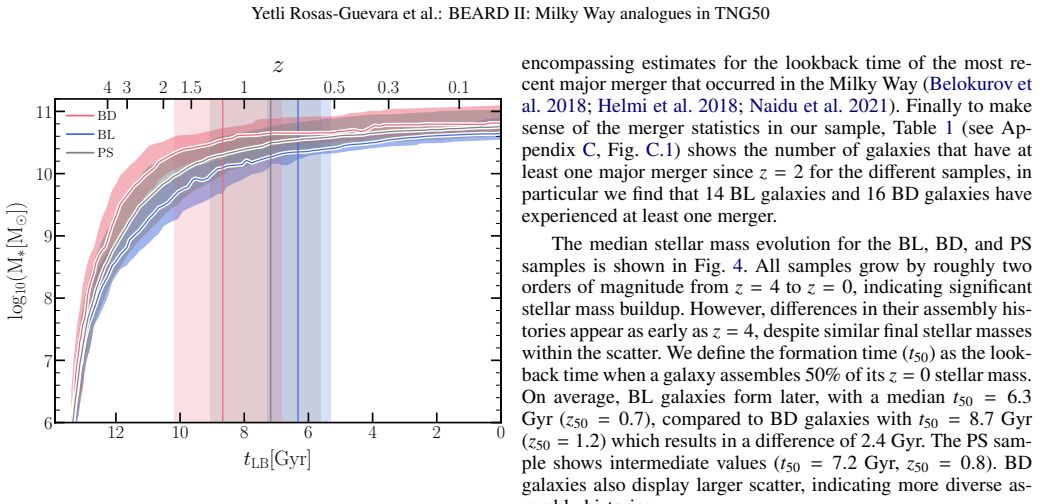
We study the formation and evolution of bulgeless galaxies within the Milky Way-Andromeda analogue sample of the TNG50 simulation. Through kinematic decomposition with Mordor, we identified bulgeless galaxies with a bulge-to-disc mass ratio of B/D<0.08, in line with the Bulgeless Evolution And the Rise of Discs (BEARD) survey and Milky Way constraints. We compared them to bulge-dominated galaxies (B/D>1). We find that 74% of bulgeless galaxies experience at least one major merger (stellar mass ratio 1:4) over their lifetime. Bulgeless galaxies form later ($z_{50}\sim 0.7$) than bulge-dominated counterparts ($z_{50}\sim1.2$). Bulgeless galaxies have lower-mass haloes and higher specific stellar angular momentum, compatible with Milky Way observations. However, specific star formation rates and hydrogen gas fractions are slightly higher than Milky Way observations. Our analysis of the redshift evolution of stellar components reveals that bulgeless galaxies have gradual disc growth with high thin disc-to-total mass ratios (D/T>0.5) since $z\sim 1$ and minimal bulge growth (B/T<0.1) since $z\sim1.5$. In contrast, bulge-dominated galaxies have earlier disc formation, which is disrupted, resulting in higher morphology evolution. Bulgeless galaxies are more likely to undergo gas-rich, coplanar, and corotating mergers, promoting disc survival, compared to bulge-dominated galaxies that encounter a broader spectrum of mergers. We also observed differences in galaxy structure between bulgeless and bulge-dominated galaxies without major mergers, suggesting the relevance of early gas accretion and alignment. Bulgeless galaxies have younger stellar populations and more extended star formation histories than bulge-dominated galaxies, which rapidly quench and have older stellar populations. These findings elucidate the distinct merger-driven and secular pathways that give rise to Milky Way galaxies.
Editorial analysis
A structured set of objections, weighed in public.
Referee Report
Summary. The paper analyzes bulgeless Milky Way analogues in TNG50 using kinematic decomposition with Mordor to select galaxies with B/D < 0.08 (compared to bulge-dominated systems with B/D > 1). It reports that 74% of bulgeless galaxies undergo at least one major merger, form later (z50 ~ 0.7), reside in lower-mass haloes with higher specific stellar angular momentum, and preferentially experience gas-rich, coplanar, corotating mergers that promote disc survival. Bulgeless galaxies show gradual disc growth (D/T > 0.5 since z ~ 1) with minimal bulge growth, younger stellar populations, and extended star formation histories, in contrast to bulge-dominated galaxies.
Significance. If the central results hold, the work provides a simulation-based distinction between merger-driven and secular pathways for maintaining bulgeless discs in Milky Way analogues, directly linking specific merger orbital and gas properties to disc preservation. This could inform interpretations of the BEARD survey and Milky Way observations. The use of a large-volume simulation with explicit merger history tracking is a strength.
major comments (2)
- [Sample selection and kinematic decomposition] The kinematic decomposition section: the B/D < 0.08 threshold for defining bulgeless galaxies is load-bearing for the entire comparison of merger properties (gas-rich, coplanar, corotating) and structural evolution. The manuscript should demonstrate that this cut, applied via Mordor, yields a sample whose structural and merger statistics are comparable to observational bulgeless definitions and Milky Way constraints; without robustness checks against resolution, recent star formation, or alternative decompositions, redshift-dependent misclassification could bias the reported differences in merger orbital parameters and gas fractions.
- [Merger history and orbital parameters] Merger analysis and results sections: the claim that bulgeless galaxies are more likely to undergo gas-rich, coplanar, and corotating mergers requires explicit definitions of these quantities (e.g., gas fraction threshold, orbital inclination and angular momentum alignment criteria) and quantitative comparison (with uncertainties or statistical tests) to the broader merger spectrum in bulge-dominated galaxies. The 74% major-merger fraction and the disc-preservation interpretation rest on these details.
minor comments (2)
- [Abstract] Abstract and results: concrete percentages (e.g., 74%) and trends (z50 values) are reported without accompanying sample sizes, error bars, or robustness tests; adding these would improve clarity.
- [Figures] Figure captions and text: ensure all panels comparing bulgeless vs. bulge-dominated populations include the number of galaxies in each subsample and any selection cuts applied.
Simulated Author's Rebuttal
We thank the referee for their constructive and detailed report. The comments have prompted us to clarify definitions, strengthen robustness checks, and improve the quantitative presentation of our results. We address each major comment below and will incorporate the revisions in the next version of the manuscript.
read point-by-point responses
-
Referee: [Sample selection and kinematic decomposition] The kinematic decomposition section: the B/D < 0.08 threshold for defining bulgeless galaxies is load-bearing for the entire comparison of merger properties (gas-rich, coplanar, corotating) and structural evolution. The manuscript should demonstrate that this cut, applied via Mordor, yields a sample whose structural and merger statistics are comparable to observational bulgeless definitions and Milky Way constraints; without robustness checks against resolution, recent star formation, or alternative decompositions, redshift-dependent misclassification could bias the reported differences in merger orbital parameters and gas fractions.
Authors: We agree that validating the B/D < 0.08 threshold is important for the robustness of our conclusions. This cut was selected to match the BEARD survey criteria and Milky Way observational constraints, as noted in the methods and introduction. In the revised manuscript we have added a dedicated subsection on sample robustness. This includes: (i) direct comparison of our sample's structural parameters and merger statistics to observational bulgeless definitions, (ii) resolution tests using matched lower-resolution TNG50 runs, (iii) checks for the influence of recent star formation on the Mordor decomposition, and (iv) an alternative decomposition using photometric bulge-disc fits. We also quantify the stability of the classification across redshift and show that any potential misclassification does not alter the reported differences in merger orbital parameters or gas fractions at a statistically significant level. These additions directly address the referee's concerns. revision: yes
-
Referee: [Merger history and orbital parameters] Merger analysis and results sections: the claim that bulgeless galaxies are more likely to undergo gas-rich, coplanar, and corotating mergers requires explicit definitions of these quantities (e.g., gas fraction threshold, orbital inclination and angular momentum alignment criteria) and quantitative comparison (with uncertainties or statistical tests) to the broader merger spectrum in bulge-dominated galaxies. The 74% major-merger fraction and the disc-preservation interpretation rest on these details.
Authors: We accept that explicit definitions and quantitative comparisons were insufficiently detailed. The revised manuscript now provides clear operational definitions: gas-rich mergers are those with gas-to-stellar mass ratio > 0.3 at coalescence; coplanar mergers have orbital inclination < 30° relative to the primary disc; corotating mergers satisfy angular-momentum alignment within 45°. We have added quantitative comparisons in the form of cumulative distribution functions for each parameter, together with Kolmogorov-Smirnov tests (including p-values) and bootstrap-derived uncertainties. These show statistically significant differences between the bulgeless and bulge-dominated populations. The 74% major-merger fraction is now presented with these supporting statistics, and the disc-preservation interpretation is tied directly to the orbital and gas properties of the mergers experienced by each population. revision: yes
Circularity Check
No significant circularity: direct simulation analysis with external alignment
full rationale
The paper selects a sample from TNG50 using Mordor kinematic decomposition and a fixed B/D<0.08 threshold chosen to match the BEARD survey and Milky Way constraints, then directly computes merger statistics, formation times, angular momentum, and structural evolution from the simulation outputs. No step reduces a claimed result to a fitted parameter, self-defined quantity, or load-bearing self-citation chain; the comparisons between bulgeless and bulge-dominated populations emerge from the data processing itself rather than being forced by construction. The BEARD reference supplies an observational benchmark for the cut but does not substitute for the independent statistical findings on merger gas fractions, orbital parameters, or disc survival.
Axiom & Free-Parameter Ledger
free parameters (1)
- bulge-to-disc mass ratio threshold =
<0.08
axioms (1)
- domain assumption TNG50 simulation subgrid models for star formation, feedback, and mergers accurately represent real galaxy physics
Lean theorems connected to this paper
-
IndisputableMonolith/Foundation/AlexanderDuality.leanalexander_duality_circle_linking unclear?
unclearRelation between the paper passage and the cited Recognition theorem.
Through kinematic decomposition with Mordor, we identified bulgeless galaxies with a bulge-to-disc mass ratio of B/D≤0.08... We split mergers into major and minor mergers... θspin = acos(ĵs* · ĵp*), θorb = acos(ĵorbital · ĵp*)
-
IndisputableMonolith/Cost/FunctionalEquation.leanwashburn_uniqueness_aczel unclear?
unclearRelation between the paper passage and the cited Recognition theorem.
Bulgeless galaxies are more likely to undergo gas-rich, coplanar, and corotating mergers, promoting disc survival
What do these tags mean?
- matches
- The paper's claim is directly supported by a theorem in the formal canon.
- supports
- The theorem supports part of the paper's argument, but the paper may add assumptions or extra steps.
- extends
- The paper goes beyond the formal theorem; the theorem is a base layer rather than the whole result.
- uses
- The paper appears to rely on the theorem as machinery.
- contradicts
- The paper's claim conflicts with a theorem or certificate in the canon.
- unclear
- Pith found a possible connection, but the passage is too broad, indirect, or ambiguous to say the theorem truly supports the claim.
Reference graph
Works this paper leans on
-
[1]
Belokurov V ., Erkal D., Evans N. W., et al., 2018, MNRAS, 478,
work page 2018
-
[2]
M., et al., 1996, ApJL, 458, L67
Bertola F., Cinzano P., Corsini E. M., et al., 1996, ApJL, 458, L67. Brooks A., Christensen C., 2016, ASSL, 418,
work page 1996
-
[3]
Cautun M., Benítez-Llambay A., Deason A
Cardona-Barrero S., Méndez-Abreu J., et al., 2026, A&A, 709, A125. Cautun M., Benítez-Llambay A., Deason A. J., et al., 2020, MNRAS, 494,
work page 2026
- [4]
-
[5]
Diemer B., Stevens A. R. H., Lagos C. del P., et al., 2019, MNRAS, 487,
work page 2019
- [6]
-
[7]
Du M., Ho L. C., Debattista V . P., et al., 2020, ApJ, 895, 139 Du M., Ma H.-C., Zhong W.-Y ., et al., 2024, A&A, 686, A168. Elmegreen B. G., Elmegreen D. M., Hirst A. C., 2004, ApJ, 612, 191 Gadotti D. A., 2009, MNRAS, 393, 1531 Governato F., Brook C., Mayer L., et al., 2010, Natur, 463,
work page 2020
-
[8]
Helmi A., Babusiaux C., Koppelman H. H., et al., 2018, Natur, 563,
work page 2018
-
[9]
Izquierdo-Villalba D., Bonoli S., Spinoso D., et al., 2019, MNRAS, 488,
work page 2019
-
[10]
Jiang F., Liang J., Jin B., et al., 2025, arXiv, arXiv:2504.01070. Kormendy J., Drory N., Bender R., et al., 2010, ApJ, 723,
- [11]
-
[12]
Lagos C. del P., Padilla N. D., Davis T. A., et al., 2015, MNRAS, 448,
work page 2015
- [13]
-
[14]
Marrero-de la Rosa C., Méndez-Abreu J. et al., 2026, A&A, 706, A128. McMillan P. J., 2017, MNRAS, 465,
work page 2026
-
[15]
P., Conroy C., Bonaca A., et al., 2021, ApJ, 923,
Naidu R. P., Conroy C., Bonaca A., et al., 2021, ApJ, 923,
work page 2021
-
[16]
Obreja A., Buck T., Macciò A. V ., 2022, A&A, 657, A15. Pillepich A., et al., 2018b, MNRAS, 475, 648 Pillepich A., Nelson D., Springel V ., et al., 2019, MNRAS, 490, 3196 Pillepich A., Sotillo-Ramos D., Ramesh R., et al., 2024, MNRAS, 535,
work page 2022
-
[17]
Pinna F., Walo-Martín D., Grand R. J. J., et al., 2024, A&A, 683, A236. Pizzella A., Morelli L., Coccato L., et al., 2018, A&A, 616, A22. Planck Collaboration 2016, A& A, 594, A13. Proctor K. L., Lagos C. del P., Ludlow A. D., Robotham A. S. G., 2024, MNRAS, 527,
work page 2024
-
[18]
Rodríguez S., Cristiani V . A., Sales L. V ., et al., 2025, A&A, 695, A218. Rodriguez-Gomez V ., et al., 2015, MNRAS, 449, 49 Rosas-Guevara Y ., Bonoli S., Puchwein E., et al., 2025, A&A, 698, A20. Sales L. V ., Navarro J. F., Theuns T., et al., 2012, MNRAS, 423,
work page 2025
-
[19]
Sattler N., Pinna F., Neumayer N., et al., 2023, MNRAS, 520,
work page 2023
-
[20]
Schaye J., et al., 2015, MNRAS, 446, 521 Sellwood J
Sattler N., Pinna F., Comerón S., et al., 2025, A&A, 698, A235. Schaye J., et al., 2015, MNRAS, 446, 521 Sellwood J. A., 2014, RvMP, 86,
work page 2025
-
[21]
M., Kormendy J., et al., 2010, ApJL, 720, L72
Shen J., Rich R. M., Kormendy J., et al., 2010, ApJL, 720, L72. Sotillo-Ramos D., Pillepich A., Donnari M. et al., 2022, MNRAS, 516,
work page 2010
-
[22]
Scholz-Díaz L., Martín-Navarro I., Falcón-Barroso J., et al., 2024, NatAs, 8,
work page 2024
-
[23]
Springel V ., White S. D. M., Tormen G., Kauffmann G., 2001, MNRAS, 328, 726 Springel V ., 2010, MNRAS, 401, 791 Stewart K. R., Bullock J. S., Wechsler R. H., et al., 2008, ApJ, 683,
work page 2001
-
[24]
Tacchella S., Diemer B., Hernquist L., et al., 2019, MNRAS,
work page 2019
-
[25]
Teyssier R., Pontzen A., Dubois Y ., Read J. I., 2013, MNRAS, 429,
work page 2013
-
[26]
Weinzirl T., Jogee S., Khochfar S., et al., 2009, ApJ, 696,
work page 2009
-
[27]
White S. D. M., Rees M. J., 1978, MNRAS, 183,
work page 1978
-
[28]
Xiang M., Rix H.-W., Yang H., et al., 2025, NatAs, 9,
Wu X., Zhu L., Chang J., et al., 2025, A&A, 699, A374. Xiang M., Rix H.-W., Yang H., et al., 2025, NatAs, 9,
work page 2025
-
[29]
Zana T., Lupi A., Bonetti M., et al., 2022, MNRAS, 515,
work page 2022
-
[30]
Article number, page 12 of 15 Yetli Rosas-Guevara et al.: BEARD II: Milky Way analogues in TNG50 Appendix A: The TNG50 simulation We focus on the TNG50 simulation (Pillepich et al. 2019; Nel- son et al. 2019b), which is the highest resolution simulation that is part of the TNG project
work page 2019
-
[31]
The simulation evolves 21603 dark matter particles and initial gas cells in a 51.7 comoving Mpc region fromz=127 down toz=0. The mass resolution is 4.5×10 5M⊙ for dark matter particles, whereas the mean gas mass cell resolution is 8.5×10 4M⊙. A comparable initial mass is passed down to stellar particles, which subsequently lose mass through stellar evolut...
work page 2001
-
[32]
are defined as all matter within the radiusR 200 for which the inner mean density is 200 times the critical density. The most massive subhalo in each FoF group is considered the central galaxy, and the remaining ones are satellites. Stellar mass is computed as the total stellar content bound to each subhalo. Appendix B: Kinematic decomposition We use the ...
work page 2022
discussion (0)
Sign in with ORCID, Apple, or X to comment. Anyone can read and Pith papers without signing in.