Correlated States in Quantum Dot Clusters Coupled to a Common Superconductor
Pith reviewed 2026-06-28 04:38 UTC · model grok-4.3
The pith
A canonical transformation maps quantum dot clusters on a superconductor to a particle-number-conserving model whose three interaction regimes are accessible to neural quantum states.
A machine-rendered reading of the paper's core claim, the machinery that carries it, and where it could break.
Core claim
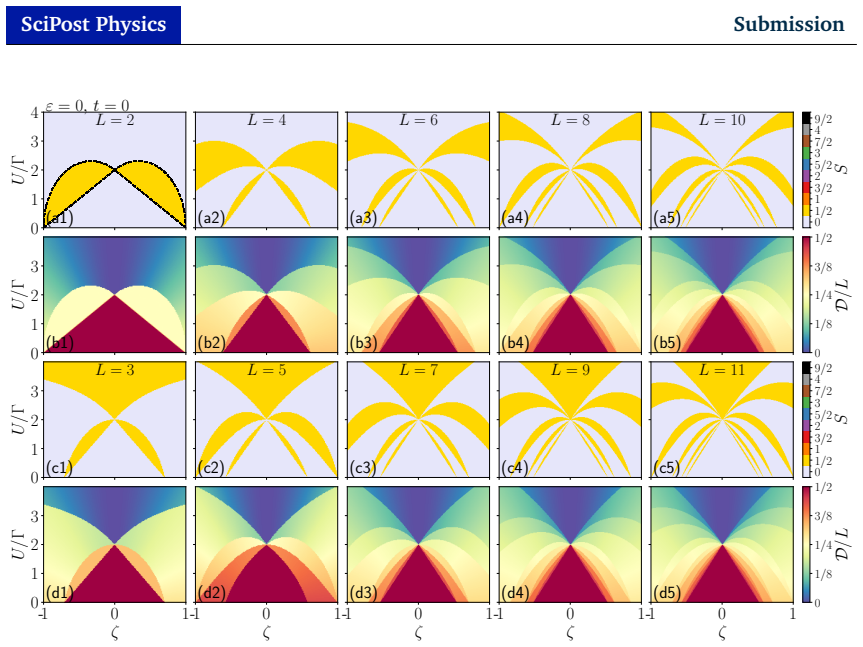
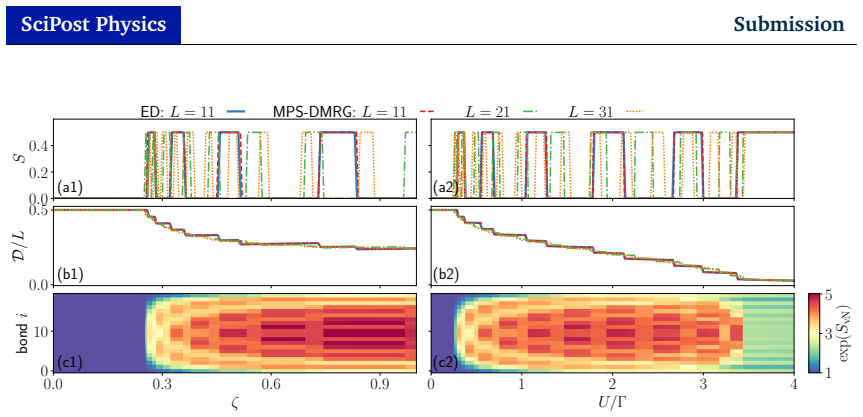
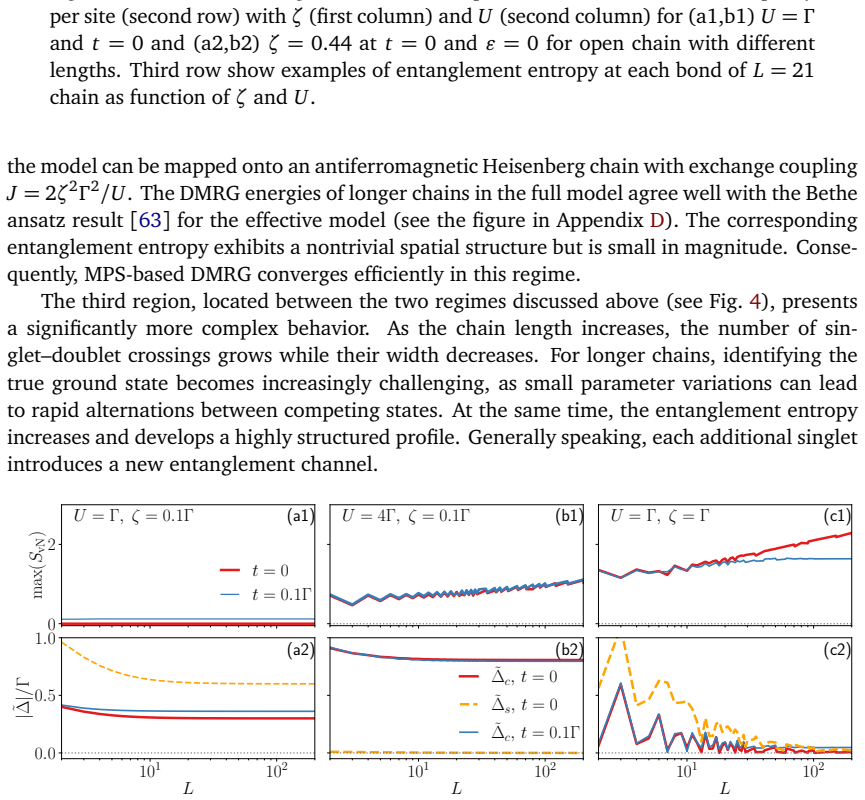
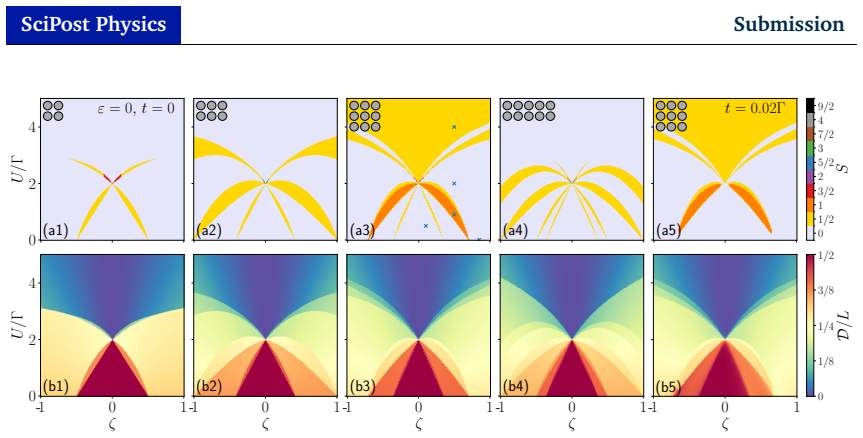
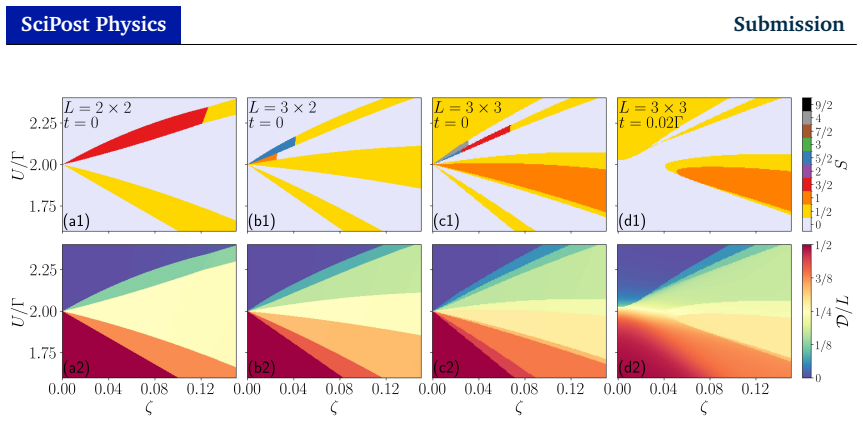
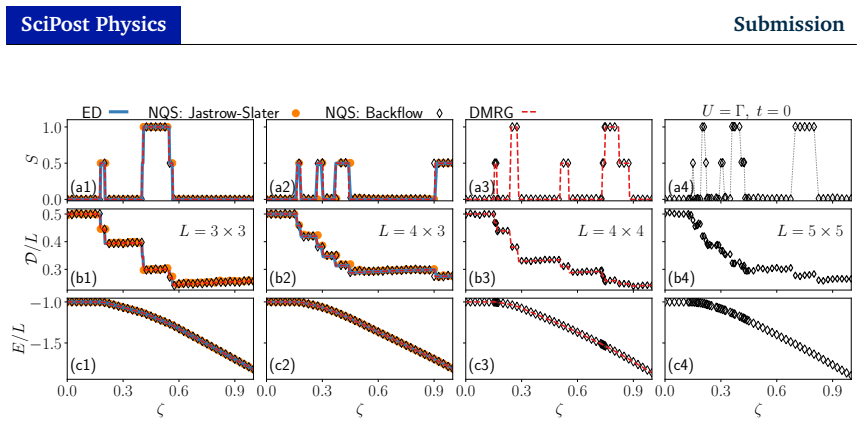
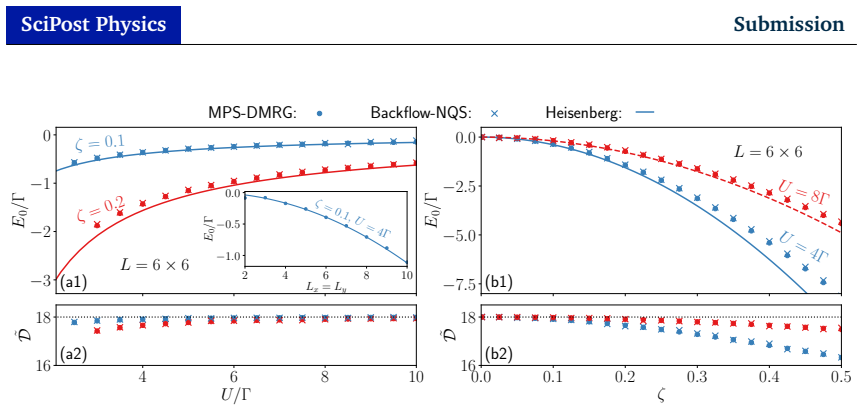
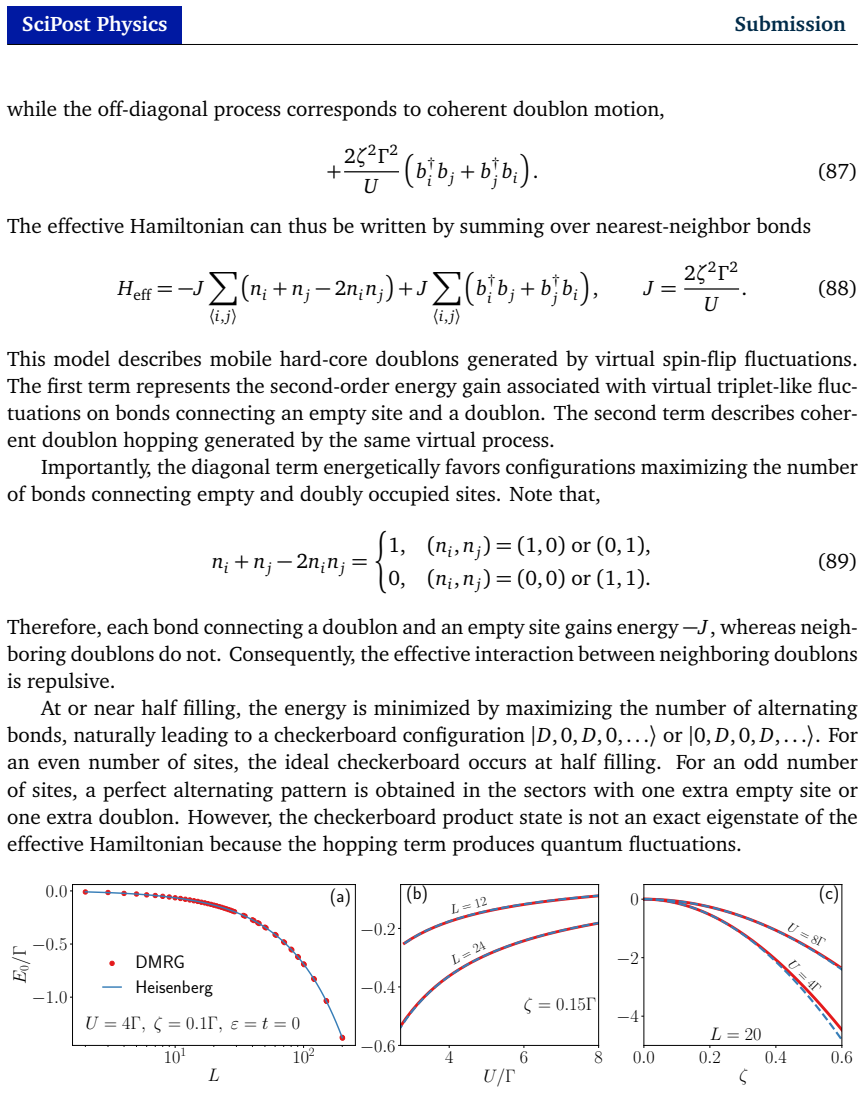
By applying a canonical transformation the system is rewritten in a particle-number-conserving representation that is directly treatable by fermionic neural quantum states. Exact, DMRG, and variational Monte Carlo calculations then identify three regimes: a trivial superconducting singlet phase, a strongly correlated regime connected to an effective Heisenberg model, and a critical intermediate regime. In one dimension the intermediate regime shows singlet-doublet transitions and becomes gapless for large systems even at finite Coulomb interaction; in two dimensions the same regime supports robust triplet ground states.
What carries the argument
The canonical transformation that converts the original model into a particle-number-conserving representation, allowing direct application of standard fermionic neural-network variational Monte Carlo.
If this is right
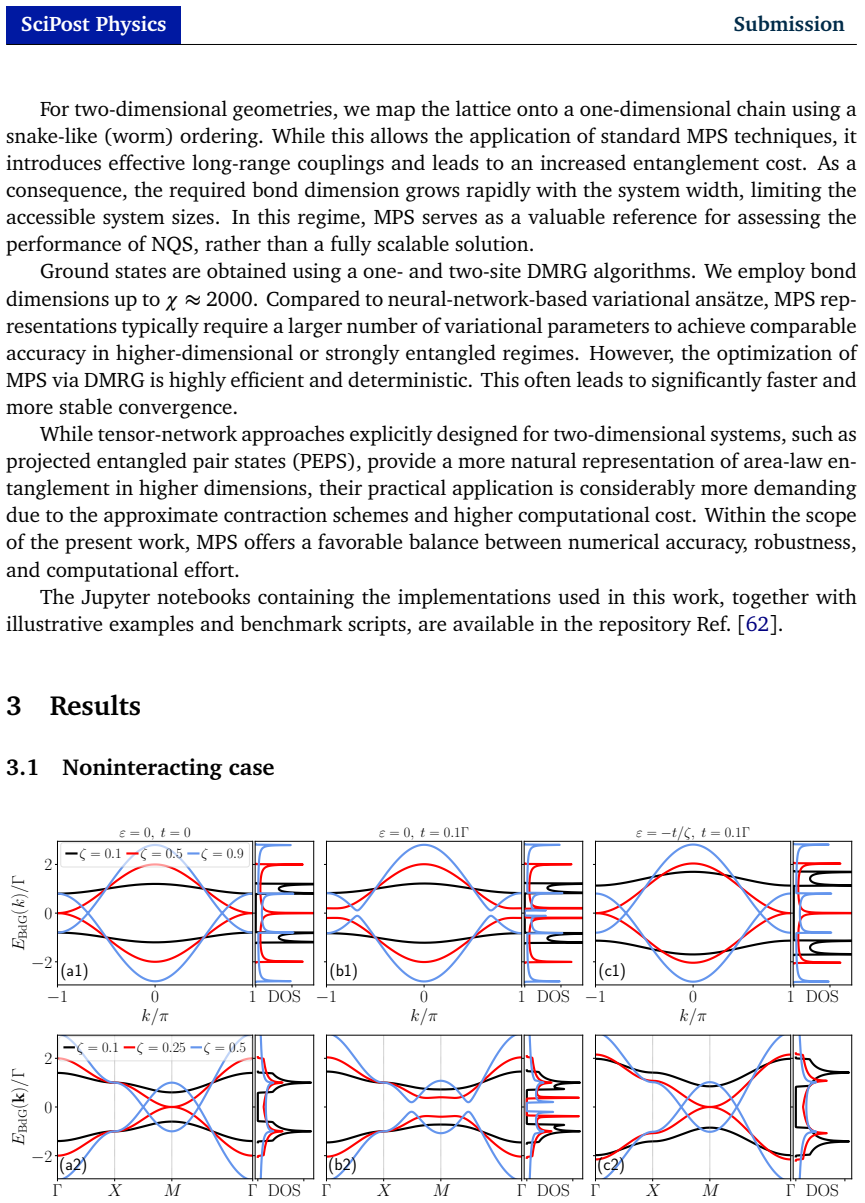
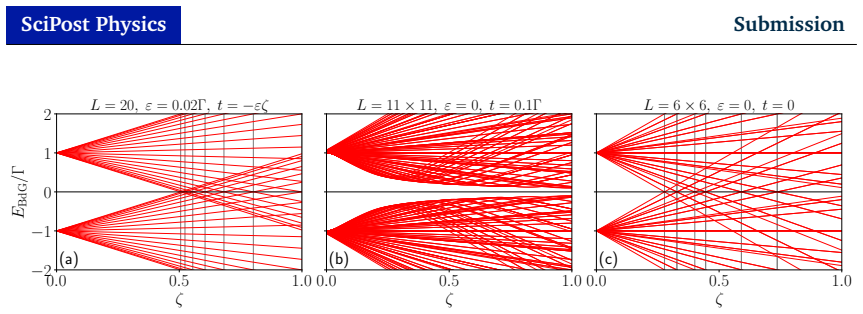
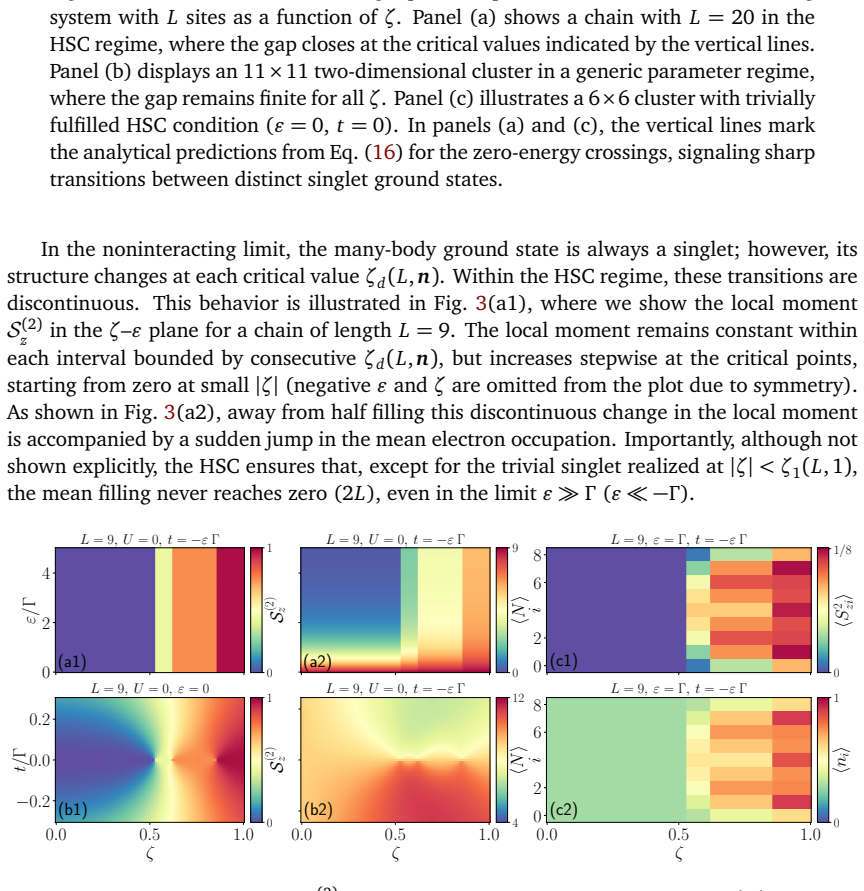
- The superconducting gap closes at a high-symmetry point that marks crossings between singlet ground states of different character in finite non-interacting systems.
- One-dimensional systems in the intermediate regime undergo singlet-doublet transitions and become gapless in the thermodynamic limit even with finite Coulomb interaction.
- Two-dimensional clusters in the intermediate regime support robust triplet ground states.
- Standard fermionic neural quantum states provide an efficient route to correlated superconducting nanostructures.
Where Pith is reading between the lines
- The same mapping and neural-state approach can be applied to larger clusters that remain out of reach for exact methods.
- Geometry dependence between one and two dimensions implies that device layout can be used to select between gapless and gapped correlated phases.
- The reduction to an effective Heisenberg model in the strongly correlated regime opens the use of established spin-model techniques for predicting properties of these hybrid systems.
Load-bearing premise
The canonical transformation that produces the particle-number-conserving representation remains valid and faithful once finite Coulomb interactions are present.
What would settle it
Numerical or experimental detection of whether the superconducting gap closes exactly at the high-symmetry point and whether one-dimensional chains exhibit the predicted sequence of singlet-doublet transitions that close the gap in the thermodynamic limit.
Figures
read the original abstract
We study an effective model of regular quantum dot clusters coupled to a common superconductor. By applying a canonical transformation, we map the system onto a particle-number-conserving representation, making it directly accessible to standard fermionic neural-network quantum-state variational Monte Carlo methods. We show that the superconducting gap closes at a particular high-symmetry point, which, in finite non-interacting systems, corresponds to crossings between singlet ground states of different character. Combining exact methods, density matrix renormalization group, and neural quantum-state variational Monte Carlo calculations, we identify three distinct interacting regimes: a trivial superconducting singlet phase, a strongly correlated regime connected to an effective Heisenberg model, and a critical intermediate regime with qualitatively different behavior in one and two dimensions. In one-dimensional systems, the intermediate regime exhibits a sequence of singlet-doublet transitions and becomes gapless in the thermodynamic limit even for finite Coulomb interaction. In two-dimensional clusters, we find robust triplet ground states. Furthermore, our results demonstrate that relatively standard fermionic neural quantum states provide an efficient approach for correlated superconducting nanostructures.
Editorial analysis
A structured set of objections, weighed in public.
Referee Report
Summary. The manuscript studies an effective model of regular quantum dot clusters coupled to a common superconductor. A canonical transformation is used to map the system to a particle-number-conserving representation, enabling application of exact methods, DMRG, and fermionic neural quantum-state variational Monte Carlo. The superconducting gap is shown to close at a high-symmetry point. Three interacting regimes are identified: a trivial superconducting singlet phase, a strongly correlated regime connected to an effective Heisenberg model, and a critical intermediate regime. In 1D the intermediate regime exhibits singlet-doublet transitions and becomes gapless in the thermodynamic limit even at finite U; in 2D, robust triplet ground states appear. The work also demonstrates the efficiency of standard fermionic NQS for correlated superconducting nanostructures.
Significance. If the mapping is exact, the paper provides a concrete route to apply NQS-VMC to superconducting nanostructures and reports dimension-dependent critical behavior of potential interest to the cond-mat.str-el community. The multi-method approach (exact + DMRG + NQS) is a positive feature when convergence details are supplied.
major comments (2)
- [Section describing the canonical transformation (likely §II or §III)] The canonical transformation that produces the particle-number-conserving Hamiltonian is load-bearing for every subsequent claim. The manuscript must explicitly demonstrate (or derive the conditions under which) the generator of the transformation commutes with the finite-U Coulomb terms; otherwise additional interaction-induced terms appear and the spectrum of the mapped model is not guaranteed to match the original. This issue is not resolved by the abstract statement that the mapping is applied to the effective model.
- [Numerical results and figures (e.g., §IV and associated figures showing gap vs. parameters)] Claims of three distinct regimes and the thermodynamic-limit statements in 1D rest on numerical identification of gap closings, singlet-doublet crossings, and ground-state character. The manuscript does not supply sufficient information on DMRG bond-dimension convergence, NQS optimization stability, or finite-size scaling to rule out that the reported distinctions are artifacts of accessible system sizes.
minor comments (2)
- [Model definition section] Notation for the transformed operators and the effective Heisenberg coupling should be introduced with an explicit equation reference to avoid ambiguity when comparing to the original model.
- [Figure captions] Figure captions would benefit from explicit statements of the system sizes and method parameters used for each data set.
Simulated Author's Rebuttal
We thank the referee for the careful reading of the manuscript and the constructive comments. We address each major point below and will revise the manuscript accordingly to strengthen the presentation.
read point-by-point responses
-
Referee: [Section describing the canonical transformation (likely §II or §III)] The canonical transformation that produces the particle-number-conserving Hamiltonian is load-bearing for every subsequent claim. The manuscript must explicitly demonstrate (or derive the conditions under which) the generator of the transformation commutes with the finite-U Coulomb terms; otherwise additional interaction-induced terms appear and the spectrum of the mapped model is not guaranteed to match the original. This issue is not resolved by the abstract statement that the mapping is applied to the effective model.
Authors: We agree that an explicit demonstration is required. The transformation is performed on the effective model prior to including the finite-U terms, and the generator commutes with the Coulomb interaction by construction in this setup. In the revised manuscript we will add a dedicated appendix deriving the commutation relations explicitly, confirming that no additional interaction-induced terms are generated and that the spectrum of the mapped model matches the original. revision: yes
-
Referee: [Numerical results and figures (e.g., §IV and associated figures showing gap vs. parameters)] Claims of three distinct regimes and the thermodynamic-limit statements in 1D rest on numerical identification of gap closings, singlet-doublet crossings, and ground-state character. The manuscript does not supply sufficient information on DMRG bond-dimension convergence, NQS optimization stability, or finite-size scaling to rule out that the reported distinctions are artifacts of accessible system sizes.
Authors: We acknowledge that additional convergence and scaling details are needed to support the regime identifications and thermodynamic-limit claims. In the revised version we will expand the numerical sections and supplementary material with explicit DMRG bond-dimension convergence data, NQS optimization stability checks (including multiple random seeds and learning-rate schedules), and finite-size scaling analysis for the gap closings and singlet-doublet transitions. revision: yes
Circularity Check
No significant circularity detected
full rationale
The derivation applies a standard canonical transformation to reach a number-conserving form, followed by independent numerical methods (exact diagonalization, DMRG, NQS-VMC) whose outputs are not forced by the transformation itself or by any fitted parameters. No self-citations are load-bearing for the central claims, no predictions reduce to inputs by construction, and the three-regime identification follows from direct computation on the mapped Hamiltonian without definitional equivalence or ansatz smuggling. The paper is self-contained against external benchmarks.
Axiom & Free-Parameter Ledger
Reference graph
Works this paper leans on
-
[1]
S. De Franceschi, L. Kouwenhoven, C. Sch \"o nenberger and W. Wernsdorfer, Hybrid superconductor-quantum dot devices, Nat. Nanotechnol. 5, 703 (2010), doi:10.1038/nnano.2010.173
-
[2]
B. W. Heinrich, J. I. Pascual and K. J. Franke, Single magnetic adsorbates on s-wave superconductors, Prog. Surf. Sci. 93, 1 (2018), doi:10.1016/j.progsurf.2018.01.001
-
[3]
A. V. Balatsky, I. Vekhter and J.-X. Zhu, Impurity-induced states in conventional and unconventional superconductors, Rev. Mod. Phys. 78, 373 (2006), doi:10.1103/RevModPhys.78.373
-
[4]
P. Krantz, M. Kjaergaard, F. Yan, T. P. Orlando, S. Gustavsson and W. D. Oliver, A quantum engineer's guide to superconducting qubits, Appl. Phys. Rev. 6, 021318 (2019), doi:10.1063/1.5089550
-
[5]
C. M. Natarajan, M. G. Tanner and R. H. Hadfield, Superconducting nanowire single-photon detectors: physics and applications, Supercond. Sci. Technol. 25, 063001 (2012), doi:10.1088/0953-2048/25/6/063001
-
[6]
Studying Quantum Materials with Scanning SQUID Microscopy,
E. Persky, I. Sochnikov and B. Kalisky, Studying quantum materials with scanning SQUID microscopy , Annu. Rev. Condens. Matter Phys. 13, 385 (2022), doi:10.1146/annurev-conmatphys-031620-104226
-
[7]
C. Li, V. Pokorn\'y, M. Z onda, J.-C. Liu, P. Zhou, O. Chahib, T. Glatzel, R. H \"a ner, S. Decurtins, S.-X. Liu, R. Pawlak and E. Meyer, Individual assembly of radical molecules on superconductors: Demonstrating quantum spin behavior and bistable charge rearrangement, ACS Nano 19, 3403 (2025), doi:10.1021/acsnano.4c12387
-
[8]
C. Li, V. Pokorn \'y , P. Hapala, M. Z onda, P. Zhou, S. Decurtins, S.-X. Liu, F. Song, R. Pawlak and E. Meyer, Negative differential conductance in triangular molecular assemblies, https://arxiv.org/abs/2508.05575
-
[9]
R. Seoane Souto and R. Aguado, Subgap States in Semiconductor-Superconductor Devices for Quantum Technologies: Andreev Qubits and Minimal Majorana Chains , pp. 133--223, Springer Nature Switzerland , Cham, ISBN 978-3-031-55657-9, doi:10.1007/978-3-031-55657-9_3 (2024)
-
[10]
T. Antonelli, M. Coraiola, D. C. Ohnmacht, A. E. Svetogorov, D. Sabonis, S. C. ten Kate, E. Cheah, F. Krizek, R. Schott, J. C. Cuevas, W. Belzig, W. Wegscheider et al., Exploring the energy spectrum of a four-terminal Josephson junction: Toward topological Andreev band structures , Phys. Rev. X 15, 031066 (2025), doi:10.1103/qd3y-f912
-
[11]
A. Martín-Rodero and A. Levy Yeyati, The Andreev states of a superconducting quantum dot: mean field versus exact numerical results , J. Phys.: Condens. Matter 24, 385303 (2012), doi:10.1088/0953-8984/24/38/385303
-
[12]
M. Z onda, V. Pokorn\'y, V. Jani s and T. Novotn\'y, Perturbation theory of a superconducting 0- impurity quantum phase transition, Sci. Rep. 5, 8821 (2015), doi:10.1038/srep08821
-
[13]
J.-D. Pillet, P. Joyez, R. Z itko and M. F. Goffman, Tunneling spectroscopy of a single quantum dot coupled to a superconductor: From Kondo ridge to Andreev bound states , Phys. Rev. B 88, 045101 (2013), doi:10.1103/PhysRevB.88.045101
-
[14]
C. Karrasch, A. Oguri and V. Meden, Josephson current through a single Anderson impurity coupled to BCS leads , Phys. Rev. B 77, 024517 (2008), doi:10.1103/PhysRevB.77.024517
-
[15]
D. J. Luitz and F. F. Assaad, Weak-coupling continuous-time quantum Monte Carlo study of the single impurity and periodic Anderson models with s -wave superconducting baths , Phys. Rev. B 81, 024509 (2010), doi:10.1103/PhysRevB.81.024509
-
[16]
D. J. Luitz, F. F. Assaad, T. Novotn \'y , C. Karrasch and V. Meden, Understanding the Josephson current through a Kondo -correlated quantum dot , Phys. Rev. Lett. 108, 227001 (2012), doi:10.1103/PhysRevLett.108.227001
-
[17]
V. Pokorn\'y and M. Z onda, Correlation effects in superconducting quantum dot systems, Physica B: Condens. Matter 536, 488 (2018), doi:10.1016/j.physb.2017.08.059
-
[18]
E. Vecino, A. Mart\' n-Rodero and A. L. Yeyati, Josephson current through a correlated quantum level: Andreev states and junction behavior , Phys. Rev. B 68, 035105 (2003), doi:10.1103/PhysRevB.68.035105
-
[19]
T. Meng, S. Florens and P. Simon, Self-consistent description of Andreev bound states in Josephson quantum dot devices , Phys. Rev. B 79, 224521 (2009), doi:10.1103/PhysRevB.79.224521
-
[20]
V. Pokorn\'y and M. Z onda, Effective low-energy models for superconducting impurity systems, Phys. Rev. B 107, 155111 (2023), doi:10.1103/PhysRevB.107.155111
-
[21]
D. Bobok, L. Frk, V. Pokorn\'y and M. Z onda, Scalable effective models for superconducting nanostructures: Applications to double, triple, and quadruple quantum dots, Phys. Rev. B 112, 205418 (2025), doi:10.1103/mxsl-fc96
-
[22]
Meden, The Anderson Josephson quantum dot a theory perspective , J
V. Meden, The Anderson Josephson quantum dot a theory perspective , J. Phys. Condens. Matter 31, 163001 (2019), doi:10.1088/1361-648x/aafd6a
-
[23]
S. R. White, Density matrix formulation for quantum renormalization groups, Phys. Rev. Lett. 69, 2863 (1992), doi:10.1103/PhysRevLett.69.2863
-
[24]
S. R. White, Density-matrix algorithms for quantum renormalization groups, Phys. Rev. B 48, 10345 (1993), doi:10.1103/PhysRevB.48.10345
-
[25]
G. Catarina and B. Murta, Density-matrix renormalization group: a pedagogical introduction, Eur. Phys. J. B 96, 111 (2023), doi:10.1140/epjb/s10051-023-00575-2
-
[26]
J. Gubernatis, N. Kawashima and P. Werner, Quantum Monte Carlo methods , Cambridge University Press, Cambridge, England, doi:10.1017/CBO9780511902581 (2016)
-
[27]
\'A . B \'a csi, L. Pave s i \'c and R. Z itko, Exchange interaction between two quantum dots coupled through a superconducting island, Phys. Rev. B 108, 115160 (2023), doi:10.1103/PhysRevB.108.115160
-
[28]
J. I. Cirac, D. P\'erez-Garc\' a, N. Schuch and F. Verstraete, Matrix product states and projected entangled pair states: Concepts, symmetries, theorems, Rev. Mod. Phys. 93, 045003 (2021), doi:10.1103/RevModPhys.93.045003
-
[29]
M. C. Banuls, Tensor network algorithms: A route map, Annu. Rev. Condens. Matter Phys. 14, 173 (2023), doi:10.1146/annurev-conmatphys-040721-022705
-
[30]
F. Verstraete and J. I. Cirac, Renormalization algorithms for quantum-many body systems in two and higher dimensions, https://arxiv.org/abs/cond-mat/0407066
-
[31]
R. Or\'us, A practical introduction to tensor networks: Matrix product states and projected entangled pair states, Ann. Phys. 349, 117 (2014), doi:10.1016/j.aop.2014.06.013
-
[32]
G. Carleo and M. Troyer, Solving the quantum many-body problem with artificial neural networks, Science 355, 602 (2017), doi:10.1126/science.aag2302
-
[33]
G. Carleo, Y. Nomura and M. Imada, Constructing exact representations of quantum many-body systems with deep neural networks, Nat. Commun. 9, 5322 (2018), doi:10.1038/s41467-018-07520-3
-
[34]
M. Medvidovi \' c and J. R. Moreno, Neural-network quantum states for many-body physics, Eur. Phys. J. Plus 139, 631 (2024), doi:10.1140/epjp/s13360-024-05311-y
-
[35]
K. Choo, G. Carleo, N. Regnault and T. Neupert, Symmetries and Many-Body Excitations with Neural-Network Quantum States , Phys. Rev. Lett. 121, 167204 (2018), doi:10.1103/PhysRevLett.121.167204
-
[36]
A. Dawid, J. Arnold, B. Requena, A. Gresch, M. P odzien, K. Donatella, K. Nicoli, P. Stornati, R. Koch, M. B \"u ttner, R. Oku a, G. Mu \ n oz et al., Modern applications of machine learning in quantum sciences p. 268, doi:10.48550/arXiv.2204.04198
-
[37]
E. Ibarra-Garc\' a-Padilla, H. Lange, R. G. Melko, R. T. Scalettar, J. Carrasquilla, A. Bohrdt and E. Khatami, Autoregressive neural quantum states of Fermi Hubbard models , Phys. Rev. Res. 7, 013122 (2025), doi:10.1103/PhysRevResearch.7.013122
-
[38]
M. Mezera, J. Men s \'ikov\'a, P. Bal\'a z and M. Z onda, Neural network quantum states analysis of the Shastry-Sutherland model , SciPost Phys. Core 6, 088 (2023), doi:10.21468/SciPostPhysCore.6.4.088
-
[39]
J. Carrasquilla and G. Torlai, Neural networks in quantum many-body physics: A hands-on tutorial, http://arxiv.org/abs/2101.11099
-
[40]
J. Kim, G. Pescia, B. Fore, J. Nys, G. Carleo, S. Gandolfi, M. Hjorth-Jensen and A. Lovato, Neural-network quantum states for ultra-cold Fermi gases , Commun. Phys. 7, 148 (2024), doi:10.1038/s42005-024-01613-w
-
[41]
About the Pauli exclusion princip le
P. Jordan and E. Wigner, \"U ber das Paulische \"a quivalenzverbot , Z. Physik 47, 631 (1928), doi:10.1007/BF01331938
-
[42]
T. D. Barrett, A. Malyshev and A. I. Lvovsky, Autoregressive neural-network wavefunctions for ab initio quantum chemistry, Nat. Mach. Intell. 4, 351 (2022), doi:10.1038/s42256-022-00461-z
-
[43]
M. Bajdich, L. Mitas, G. Drobn\'y, L. K. Wagner and K. E. Schmidt, Pfaffian pairing wave functions in electronic-structure quantum monte carlo simulations, Phys. Rev. Lett. 96, 130201 (2006), doi:10.1103/PhysRevLett.96.130201
- [44]
- [45]
-
[46]
A. Chen and M. Heyl, Empowering deep neural quantum states through efficient optimization, Nat. Phys. 20, 1476 (2024), doi:10.1038/s41567-024-02566-1
-
[47]
A. Chen, Z.-Q. Wan, A. Sengupta, A. Georges and C. Roth, Neural network-augmented Pfaffian wave-functions for scalable simulations of interacting fermions , http://arxiv.org/abs/2507.10705
-
[48]
R. G. Xu, T. Okubo, S. Todo and M. Imada, Optimized implementation for calculation and fast-update of Pfaffians installed to the open-source fermionic variational solver mVMC , Comput. Phys. Commun. 277, 108375 (2022), doi:10.1016/j.cpc.2022.108375
-
[49]
G. Carleo, K. Choo, D. Hofmann, J. E. Smith, T. Westerhout, F. Alet, E. J. Davis, S. Efthymiou, I. Glasser, S.-H. Lin, M. Mauri, G. Mazzola et al., NetKet : A machine learning toolkit for many-body quantum systems , SoftwareX p. 100311 (2019), doi:10.1016/j.softx.2019.100311
-
[50]
F. Vicentini, D. Hofmann, A. Szab \'o , D. Wu, C. Roth, C. Giuliani, G. Pescia, J. Nys, V. Vargas-Calder\' o n, N. Astrakhantsev and G. Carleo, NetKet 3 : Machine learning toolbox for many-body quantum systems , SciPost Phys. Codebases p. 7 (2022), doi:10.21468/SciPostPhysCodeb.7
-
[51]
Y. Nomura, A. S. Darmawan, Y. Yamaji and M. Imada, Restricted Boltzmann machine learning for solving strongly correlated quantum systems , Phys. Rev. B 96, 205152 (2017), doi:10.1103/PhysRevB.96.205152
-
[52]
J. Stokes, J. R. Moreno, E. A. Pnevmatikakis and G. Carleo, Phases of two-dimensional spinless lattice fermions with first-quantized deep neural-network quantum states, Phys. Rev. B 102, 205122 (2020), doi:10.1103/PhysRevB.102.205122
-
[53]
D. Luo and B. K. Clark, Backflow transformations via neural networks for quantum many-body wave functions, Phys. Rev. Lett. 122, 226401 (2019), doi:10.1103/PhysRevLett.122.226401
-
[54]
Z. Liu and B. K. Clark, Unifying view of fermionic neural network quantum states: From neural network backflow to hidden fermion determinant states, Phys. Rev. B 110, 115124 (2024), doi:10.1103/PhysRevB.110.115124
-
[55]
M. R. Ebert, D. C. Ohnmacht, W. Belzig and J. C. Cuevas, Sextets in four-terminal Josephson junctions , Phys. Rev. B 112, 195430 (2025), doi:10.1103/phvj-vfnx
-
[56]
J. Hauschild, J. Unfried, S. Anand, B. Andrews, M. Bintz, U. Borla, S. Divic, M. Drescher, J. Geiger, M. Hefel, K. H\'emery, W. Kadow et al., Tensor network Python (TeNPy) version 1 , SciPost Phys. Codebases p. 41 (2024), doi:10.21468/SciPostPhysCodeb.41
-
[57]
V. Pokorn\'y and T. Novotn\'y, Footprints of impurity quantum phase transitions in quantum Monte Carlo statistics , Phys. Rev. Research 3, 023013 (2021), doi:10.1103/PhysRevResearch.3.023013
-
[58]
5, 359–366,https: //doi.org/10.1016/0893-6080(89)90020-8
K. Hornik, M. Stinchcombe and H. White, Multilayer feedforward networks are universal approximators, Neural Netw. 2, 359 (1989), doi:10.1016/0893-6080(89)90020-8
-
[59]
R. DeVore, B. Hanin and G. Petrova, Neural network approximation, Acta Numer. 30, 327 (2021), doi:10.1017/S0962492921000052
-
[60]
Carleo, Neural-Network Quantum States
G. Carleo, Neural-Network Quantum States . A lecture for the machine learning and many-body physics workshop , ://www.csrc.ac.cn/upload/file/20170703/1499072201537152.pdf (2017)
arXiv 2017
-
[61]
H. Lange, A. Van de Walle, A. Abedinnia and A. Bohrdt, From architectures to applications: a review of neural quantum states, Quantum Sci. Technol. 9, 040501 (2024), doi:10.1088/2058-9565/ad7168
-
[62]
M. Z onda, Correlated states in quantum dot clusters coupled to a common superconductor, https://gitlab.mff.cuni.cz/zondam/sc_qd_clusters, GitLab repository, accessed 2026-06-02 (2026)
2026
-
[63]
Bethe, Zur theorie der metalle: I
H. Bethe, Zur theorie der metalle: I. eigenwerte und eigenfunktionen der linearen atomkette, Z. Physik 71, 205 (1931), doi:10.1007/BF01341708
-
[64]
A. W. Sandvik, Finite-size scaling of the ground-state parameters of the two-dimensional Heisenberg model , Phys. Rev. B 56, 11678 (1997), doi:10.1103/PhysRevB.56.11678
-
[65]
M. Z onda, P. Zalom, T. Novotn\'y, G. Loukeris, J. B\"atge and V. Pokorn\'y, Generalized atomic limit of a double quantum dot coupled to superconducting leads, Phys. Rev. B 107, 115407 (2023), doi:10.1103/PhysRevB.107.115407
-
[66]
P. Zalom, K. Wrze\' s niewski, T. Novotn\'y and I. Weymann, Double quantum dot Andreev molecules: Phase diagrams and critical evaluation of effective models , Phys. Rev. B 110, 134506 (2024), doi:10.1103/PhysRevB.110.134506
-
[67]
E. Lieb, T. Schultz and D. Mattis, Two soluble models of an antiferromagnetic chain, Ann. Phys. 16, 407 (1961), doi:10.1016/0003-4916(61)90115-4
-
[68]
M. Karbach, K. Hu and G. Muller, Introduction to the Bethe ansatz II , https://arxiv.org/abs/cond-mat/9809163
discussion (0)
Sign in with ORCID, Apple, or X to comment. Anyone can read and Pith papers without signing in.