Deep Active Re-Labeling: Toward Noise-Resilient Annotation Efficiency
Pith reviewed 2026-06-27 18:24 UTC · model grok-4.3
The pith
Allocating annotation budget to re-label noisy data makes deep active learning more efficient and noise-resilient.
A machine-rendered reading of the paper's core claim, the machinery that carries it, and where it could break.
Core claim
By implementing active noise sampling to select instances for re-annotation, the framework removes noise from the active training set and achieves higher data efficiency under fixed annotation budgets.
What carries the argument
Active noise sampling strategies that detect potentially noisy labels for re-annotation.
If this is right
- Active learning regains its performance advantage over passive learning despite annotation noise.
- The final training set contains fewer errors.
- Models reach higher accuracy without increasing the overall labeling cost.
Where Pith is reading between the lines
- The re-labeling idea could extend to semi-supervised settings where pseudo-labels might be noisy.
- Combining this with robust loss functions might further improve results.
- Applying it to image, text, or other modalities would test its generality.
Load-bearing premise
The model has enough ability to identify which data points have noisy labels.
What would settle it
A test showing that re-annotating the selected noisy samples does not reduce the error rate or improve final model accuracy compared to not re-labeling.
Figures


read the original abstract
While Deep Active Learning (DAL) effectively reduces human annotation costs, its efficacy is constrained by human annotation errors. This is because the data sampled for active learning is assumed to be highly informative for training. When human annotators introduce errors into this informative data at a certain rate, the active learning performance drops significantly and, in some cases, even exhibits worse outcomes than passive learning. In this paper, we first analyze the impact of human annotation errors in the DAL setting. Then we propose a framework to address the human annotation noise problem for DAL. Informed by human learning patterns, the core idea of our proposed solution involves allocating a portion of the human annotation budget to re-annotate data that has already been labeled. Previous theoretical work suggests that when the model possesses a certain level of ability to identify potentially noisy data, even re-labeling a small fraction of the data can effectively remove noise from the active training set. To achieve this, we implement two active noise sampling strategies to detect noise under different circumstances and allocate a part of the annotation budget to re-annotate these instances. Our approach imbues active learning with a revisiting and introspective behavior. Our experiments demonstrate that, under the same annotation budget, our method is more data-efficient and yields a relatively noise-free annotation dataset in the end.
Editorial analysis
A structured set of objections, weighed in public.
Referee Report
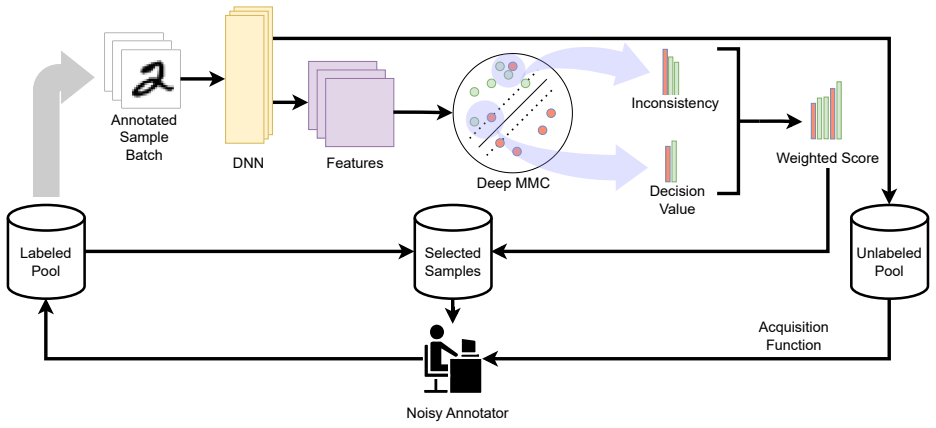
Summary. The paper analyzes the negative impact of human annotation noise on deep active learning (DAL) performance and proposes Deep Active Re-Labeling, a framework that reserves part of a fixed annotation budget for re-annotating instances flagged as noisy by two active noise sampling strategies. Drawing on prior theory, it posits that re-labeling a small fraction suffices once the model reaches a sufficient (unspecified) noise-identification accuracy, yielding a more data-efficient and relatively noise-free training set.
Significance. If the empirical gains hold and the noise-identification precondition is met, the work would offer a practical, budget-neutral way to improve DAL robustness to label noise. The introspective re-labeling idea is a clear conceptual contribution, but its significance is currently limited by the absence of diagnostics confirming the theoretical precondition.
major comments (2)
- [Experiments] The central claim that the method 'yields a relatively noise-free annotation dataset' depends on the two active noise sampling strategies achieving the noise-identification accuracy threshold implied by the cited theoretical work. No ablation, precision/recall diagnostic, or explicit check against that threshold is reported, which is load-bearing for the noise-resilience and data-efficiency results.
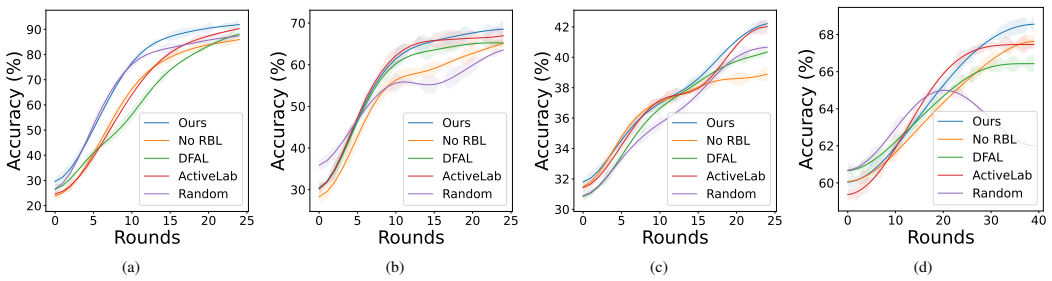
- [Abstract] The abstract asserts experimental superiority under the same annotation budget but supplies no datasets, noise rates, baselines, or quantitative metrics, preventing evaluation of whether the claimed gains actually materialize or depend on the unverified precondition.
minor comments (1)
- [Abstract] The phrase 'a certain level of ability' in the abstract and introduction is too vague to connect the implementation to the theoretical precondition; a concrete accuracy target or reference to the cited work's requirement would clarify the link.
Simulated Author's Rebuttal
We thank the referee for the constructive feedback. We address the major comments point by point below, acknowledging where the manuscript requires strengthening and outlining planned revisions.
read point-by-point responses
-
Referee: [Experiments] The central claim that the method 'yields a relatively noise-free annotation dataset' depends on the two active noise sampling strategies achieving the noise-identification accuracy threshold implied by the cited theoretical work. No ablation, precision/recall diagnostic, or explicit check against that threshold is reported, which is load-bearing for the noise-resilience and data-efficiency results.
Authors: We agree that the noise-identification accuracy precondition from the cited theory is central to the claims and that explicit verification is needed. The manuscript reports overall performance gains but does not include precision/recall diagnostics or direct checks against the threshold. In revision we will add these analyses, including ablations on the two sampling strategies and empirical confirmation that the precondition holds in the evaluated settings. revision: yes
-
Referee: [Abstract] The abstract asserts experimental superiority under the same annotation budget but supplies no datasets, noise rates, baselines, or quantitative metrics, preventing evaluation of whether the claimed gains actually materialize or depend on the unverified precondition.
Authors: The abstract was kept concise to provide a high-level overview. We acknowledge that including concrete details would improve evaluability. In the revised manuscript we will update the abstract to specify the datasets, noise rates, baselines, and key quantitative metrics. revision: yes
Circularity Check
No circularity; empirical method and results are independent of internal definitions or self-referential fits.
full rationale
The paper contains no derivations, equations, or fitted parameters that reduce claims to inputs by construction. It motivates the re-labeling approach by citing external prior theoretical work on noise identification thresholds, without defining any internal quantity in terms of the target result or renaming a fitted statistic as a prediction. The central claims are end-to-end experimental comparisons under fixed annotation budgets; these rest on observable performance metrics rather than any self-definitional or self-citation chain. No load-bearing step collapses to a tautology.
Axiom & Free-Parameter Ledger
Reference graph
Works this paper leans on
-
[1]
DistilBERT, a distilled version of BERT: smaller, faster, cheaper and lighter
V . Sanh, L. Debut, J. Chaumond, and T. Wolf, “Distilbert, a distilled version of bert: smaller, faster, cheaper and lighter,”arXiv preprint arXiv:1910.01108, 2019
work page internal anchor Pith review Pith/arXiv arXiv 1910
-
[2]
Deep residual learning for image recognition,
K. He, X. Zhang, S. Ren, and J. Sun, “Deep residual learning for image recognition,” inProceedings of the IEEE conference on computer vision and pattern recognition, 2016, pp. 770–778
2016
-
[3]
Active learning literature survey,
B. Settles, “Active learning literature survey,” 2009. [Online]. Available: https://burrsettles.com/pub/settles.activelearning.pdf
2009
-
[4]
A survey of deep active learning,
P. Ren, Y . Xiao, X. Chang, P.-Y . Huang, Z. Li, B. B. Gupta, X. Chen, and X. Wang, “A survey of deep active learning,”ACM computing surveys (CSUR), vol. 54, no. 9, pp. 1–40, 2021
2021
-
[5]
Learning with labeling induced abstentions,
K. Amin, G. DeSalvo, and A. Rostamizadeh, “Learning with labeling induced abstentions,” inAdvances in Neural Information Processing Systems, M. Ranzato, A. Beygelzimer, Y . Dauphin, P. Liang, and J. W. Vaughan, Eds., vol. 34. Curran Associates, Inc., 2021, pp. 12 576– 12 586
2021
-
[6]
Active learning with oracle epiphany,
T.-K. Huang, L. Li, A. Vartanian, S. Amershi, and J. Zhu, “Active learning with oracle epiphany,” inAdvances in Neural Information Processing Systems, D. Lee, M. Sugiyama, U. Luxburg, I. Guyon, and R. Garnett, Eds., vol. 29. Curran Associates, Inc., 2016
2016
-
[7]
Active learning for noisy data streams using weak and strong labelers,
T. Younesian, D. Epema, and L. Y . Chen, “Active learning for noisy data streams using weak and strong labelers,”arXiv preprint arXiv:2010.14149, 2020
-
[8]
Noisy batch active learning with deterministic annealing,
G. Gupta, A. K. Sahu, and W.-Y . Lin, “Noisy batch active learning with deterministic annealing,”arXiv preprint arXiv:1909.12473, 2019
-
[9]
Retrieval-based learning: A per- spective for enhancing meaningful learning,
J. D. Karpicke and P. J. Grimaldi, “Retrieval-based learning: A per- spective for enhancing meaningful learning,”Educational Psychology Review, vol. 24, no. 3, pp. 401–418, 2012
2012
-
[10]
Whatever next? predictive brains, situated agents, and the future of cognitive science,
A. Clark, “Whatever next? predictive brains, situated agents, and the future of cognitive science,”Behavioral and brain sciences, vol. 36, no. 3, pp. 181–204, 2013
2013
-
[11]
Multi-class active learning for image classification,
A. J. Joshi, F. Porikli, and N. Papanikolopoulos, “Multi-class active learning for image classification,” in2009 IEEE Conference on Com- puter Vision and Pattern Recognition, 2009, pp. 2372–2379
2009
-
[12]
Active learning: theory and applications,
S. Tong, “Active learning: theory and applications,” 2001. [Online]. Available: https://api.semanticscholar.org/CorpusID:62018951
2001
-
[13]
Deep bayesian active learning with image data,
Y . Gal, R. Islam, and Z. Ghahramani, “Deep bayesian active learning with image data,” inInternational conference on machine learning. PMLR, 2017, pp. 1183–1192
2017
-
[14]
Mentornet: Learning data-driven curriculum for very deep neural networks on corrupted labels,
L. Jiang, Z. Zhou, T. Leung, L.-J. Li, and L. Fei-Fei, “Mentornet: Learning data-driven curriculum for very deep neural networks on corrupted labels,” inInternational conference on machine learning. PMLR, 2018, pp. 2304–2313
2018
-
[15]
Co-teaching: Robust training of deep neural networks with extremely noisy labels,
B. Han, Q. Yao, X. Yu, G. Niu, M. Xu, W. Hu, I. Tsang, and M. Sugiyama, “Co-teaching: Robust training of deep neural networks with extremely noisy labels,”Advances in neural information processing systems, vol. 31, 2018
2018
-
[16]
Learning to reweight examples for robust deep learning,
M. Ren, W. Zeng, B. Yang, and R. Urtasun, “Learning to reweight examples for robust deep learning,” inInternational conference on machine learning. PMLR, 2018, pp. 4334–4343
2018
-
[17]
Meta-weight-net: Learning an explicit mapping for sample weighting,
J. Shu, Q. Xie, L. Yi, Q. Zhao, S. Zhou, Z. Xu, and D. Meng, “Meta-weight-net: Learning an explicit mapping for sample weighting,” Advances in neural information processing systems, vol. 32, 2019
2019
-
[18]
Meta label correction for noisy label learning,
G. Zheng, A. H. Awadallah, and S. Dumais, “Meta label correction for noisy label learning,” inProceedings of the AAAI Conference on Artificial Intelligence, vol. 35, no. 12, 2021, pp. 11 053–11 061
2021
-
[19]
Stars: Spatial-temporal active re-sampling for label-efficient learning from noisy annotations,
D. Yu, W. Shi, and Q. Yu, “Stars: Spatial-temporal active re-sampling for label-efficient learning from noisy annotations,” Proceedings of the AAAI Conference on Artificial Intelligence, vol. 37, no. 9, pp. 10 980–10 988, Jun. 2023. [Online]. Available: https://ojs.aaai.org/index.php/AAAI/article/view/26301
2023
-
[20]
Adversarial Active Learning for Deep Networks: a Margin Based Approach
M. Ducoffe and F. Precioso, “Adversarial active learning for deep networks: a margin based approach,”arXiv preprint arXiv:1802.09841, 2018
work page internal anchor Pith review Pith/arXiv arXiv 2018
-
[21]
A closer look at memorization in deep networks,
D. Arpit, S. Jastrz˛ ebski, N. Ballas, D. Krueger, E. Bengio, M. S. Kanwal, T. Maharaj, A. Fischer, A. Courville, Y . Bengioet al., “A closer look at memorization in deep networks,” inInternational conference on machine learning. PMLR, 2017, pp. 233–242
2017
-
[22]
Qactor: Active learning on noisy labels,
T. Younesian, Z. Zhao, A. Ghiassi, R. Birke, and L. Y . Chen, “Qactor: Active learning on noisy labels,” inAsian Conference on Machine Learning, 2021. [Online]. Available: https://api.semanticscholar.org/CorpusID:245355788
2021
-
[23]
Activelab: Active learning with re-labeling by multiple annotators,
H. W. Goh and J. Mueller, “Activelab: Active learning with re-labeling by multiple annotators,”arXiv preprint arXiv:2301.11856, 2023
-
[24]
A review of possible effects of cognitive biases on interpretation of rule-based machine learning models,
T. Kliegr, Št ˇepán Bahník, and J. Fürnkranz, “A review of possible effects of cognitive biases on interpretation of rule-based machine learning models,”Artificial Intelli- gence, vol. 295, p. 103458, 2021. [Online]. Available: https://www.sciencedirect.com/science/article/pii/S0004370221000096
2021
-
[25]
Support vector machines under adversarial label noise,
B. Biggio, B. Nelson, and P. Laskov, “Support vector machines under adversarial label noise,” inAsian conference on machine learning. PMLR, 2011, pp. 97–112
2011
-
[26]
Label-noise reduction with support vector machines,
S. Fefilatyev, M. Shreve, K. Kramer, L. Hall, D. Goldgof, R. Kasturi, K. Daly, A. Remsen, and H. Bunke, “Label-noise reduction with support vector machines,” inProceedings of the 21st International Conference on Pattern Recognition (ICPR2012), 2012, pp. 3504–3508
2012
-
[27]
Bayesian learning for neural networks,
R. M. Neal, “Bayesian learning for neural networks,” 1995. [Online]. Available: https://api.semanticscholar.org/CorpusID:60809283
1995
-
[28]
Priors for infinite networks,
——, “Priors for infinite networks,” inBayesian Learning for Neural Networks. New York, NY: Springer New York, 1996, pp. 29–53
1996
-
[29]
Computing with infinite networks,
C. K. I. Williams, “Computing with infinite networks,” inProceedings of the 9th International Conference on Neural Information Processing Systems, ser. NIPS’96. Cambridge, MA, USA: MIT Press, 1996, p. 295–301
1996
-
[30]
Deep neural networks as gaussian processes,
J. Lee, Y . Bahri, R. Novak, S. S. Schoenholz, J. Pennington, and J. Sohl- Dickstein, “Deep neural networks as gaussian processes,” 2018
2018
-
[31]
Approximate inference turns deep networks into gaussian processes,
M. E. Khan, A. Immer, E. Abedi, and M. Korzepa, “Approximate inference turns deep networks into gaussian processes,” 2020
2020
-
[32]
C. M. Bishop and N. M. Nasrabadi,Pattern recognition and machine learning. Springer, 2006, vol. 4, no. 4
2006
-
[33]
Mnist handwritten digit database,
Y . LeCun, C. Cortes, and C. Burges, “Mnist handwritten digit database,” ATT Labs [Online]. Available: http://yann.lecun.com/exdb/mnist, vol. 2, 2010
2010
-
[34]
Fashion-MNIST: a Novel Image Dataset for Benchmarking Machine Learning Algorithms
H. Xiao, K. Rasul, and R. V ollgraf, “Fashion-mnist: a novel image dataset for benchmarking machine learning algorithms,”CoRR, vol. abs/1708.07747, 2017. [Online]. Available: http://arxiv.org/abs/1708.07747
work page internal anchor Pith review Pith/arXiv arXiv 2017
-
[35]
Learning multiple layers of features from tiny images,
A. Krizhevsky, “Learning multiple layers of features from tiny images,” Tech. Rep., 2009
2009
-
[36]
Medmnist classification decathlon: A lightweight automl benchmark for medical image analysis,
J. Yang, R. Shi, and B. Ni, “Medmnist classification decathlon: A lightweight automl benchmark for medical image analysis,” inIEEE 18th International Symposium on Biomedical Imaging (ISBI), 2021, pp. 191–195
2021
discussion (0)
Sign in with ORCID, Apple, or X to comment. Anyone can read and Pith papers without signing in.