Probing outflow physics through CH₃CN and CH₃OH chemistry
Pith reviewed 2026-06-26 03:56 UTC · model grok-4.3
The pith
The CH3OH/CH3CN abundance ratio in protostellar outflows requires cosmic-ray ionization rates up to 10^{-14} s^{-1}.
A machine-rendered reading of the paper's core claim, the machinery that carries it, and where it could break.
Core claim
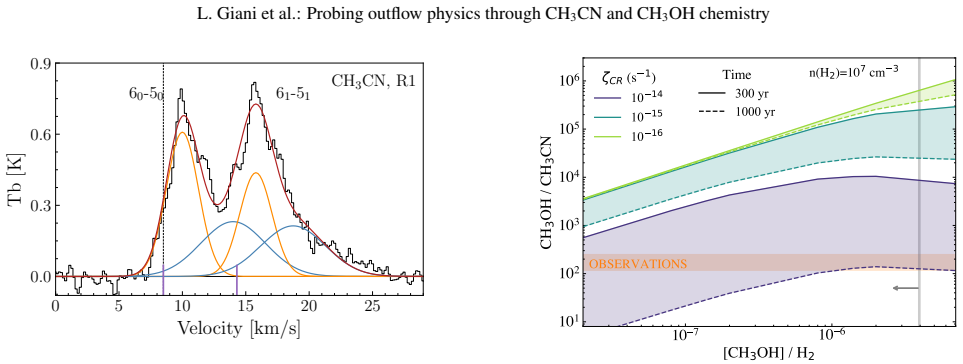
Using ALMA Band 3 and Band 6 observations of the outflow driven by the Class 0 protostar S68N, excitation temperatures of 50-60 K and column densities are derived for CH3CN and CH3OH. The CH3OH/CH3CN abundance ratio is nearly constant at ~100-200. Gas-phase astrochemical models match these ratios only by assuming enhanced cosmic-ray ionization rates ζ_CR up to ~10^{-14} s^{-1}. This indicates the ratio can probe irradiation conditions in protostellar outflows.
What carries the argument
The CH3OH/CH3CN abundance ratio as a diagnostic of cosmic-ray ionization rates in outflow gas, validated through comparison with gas-phase astrochemical models.
If this is right
- The abundance ratio remains constant along the outflow.
- Enhanced cosmic-ray ionization rates of up to 10^{-14} s^{-1} are needed to explain the observations via gas-phase chemistry.
- The ratio can be used as a probe of irradiation conditions in protostellar outflows.
- Similar ratios appear in other protostellar environments.
Where Pith is reading between the lines
- Significant grain-surface formation of CH3CN could reduce the required cosmic-ray rate.
- Extending the analysis to more sources could reveal variations in outflow irradiation.
- The approach may help connect molecular ratios to the overall energy input from cosmic rays in star formation regions.
Load-bearing premise
Gas-phase formation routes alone control the CH3CN abundance without major input from grain-surface chemistry.
What would settle it
A model or observation demonstrating that grain-surface reactions can produce the observed CH3CN abundances at standard cosmic-ray ionization rates around 10^{-17} s^{-1}.
Figures

read the original abstract
Chemical correlations between molecules provide powerful diagnostics to probe the physical conditions of protostellar outflows. In particular, the relationship between methanol (CH$_3$OH) and methyl cyanide (CH$_3$CN) offers a promising tool to investigate the chemistry and irradiation environment of shocked gas. In this Letter, we use the CH$_3$OH/CH$_3$CN abundance ratio to constrain the physical properties of the outflow driven by the Class 0 protostar S68N using ALMA Band 3 and Band 6 observations. Assuming local thermodynamic equilibrium (LTE), we derive excitation temperatures of 50-60 K and column densities of 2-3$\times$10$^{13}$ cm$^{-2}$ for CH$_3$CN and 3-5$\times$10$^{15}$ cm$^{-2}$ for CH$_3$OH. The resulting CH$_3$OH/CH$_3$CN abundance ratio is nearly constant along the outflow, with values of $\sim$100-200, similar to those found in other protostellar environments. Using an up-to-date astrochemical model, we test whether gas-phase formation of CH$_3$CN can account for the observed ratios. We find that they are reproduced only by assuming enhanced cosmic-ray ionization rates $\zeta_{\rm CR}$ up to $\sim$10$^{-14}$ s$^{-1}$. These results suggest that the CH$_3$OH-CH$_3$CN correlation can be used as a probe of the irradiation conditions in protostellar outflows. Further studies are required to explore the possible contribution of grain-surface formation of CH$_3$CN which could lead to a lower $\zeta_{\rm CR}$ and to extend the analysis to a larger sample of sources.
Editorial analysis
A structured set of objections, weighed in public.
Referee Report
Summary. The manuscript reports ALMA Band 3/6 observations toward the outflow of the Class 0 protostar S68N. Under the LTE assumption, excitation temperatures of 50-60 K and column densities of 2-3×10^{13} cm^{-2} (CH₃CN) and 3-5×10^{15} cm^{-2} (CH₃OH) are derived, yielding a nearly constant CH₃OH/CH₃CN abundance ratio of ~100-200. An up-to-date astrochemical model is used to test gas-phase formation routes; the observed ratio is reproduced only when the cosmic-ray ionization rate is raised to ζ_CR ~10^{-14} s^{-1}. The authors propose the ratio as a diagnostic of irradiation conditions in outflows while noting that grain-surface CH₃CN formation (omitted from the model) could allow lower ζ_CR.
Significance. If the gas-phase-only assumption is valid, the constant observed ratio and its reproduction only at elevated ζ_CR would constitute a useful new probe of cosmic-ray ionization in shocked outflow gas, extending standard LTE column-density methods. The work credits the reproducibility of the ratio across sources and the use of an up-to-date network, but the significance remains conditional on the untested neglect of surface chemistry.
major comments (2)
- [Abstract] Abstract: The headline claim that the observed ratio 'requires' ζ_CR up to ∼10^{-14} s^{-1} rests on the astrochemical model excluding grain-surface formation of CH₃CN. The abstract itself states that including such routes 'could lead to a lower ζ_CR', yet no quantitative test or alternative model run is presented to show the magnitude of this effect. This assumption is load-bearing for the central conclusion that the ratio diagnoses enhanced ionization.
- [Model comparison] Model section (inferred from abstract description): No exhaustive exploration of other free parameters (density, temperature, shock velocity) is reported to demonstrate that the ratio cannot be matched at the canonical ζ_CR ~10^{-17} s^{-1} when surface routes are omitted; the result is therefore presented as a unique requirement for enhanced ionization rather than a conditional outcome of the chosen network.
Simulated Author's Rebuttal
We thank the referee for their thoughtful and constructive comments, which have helped us identify areas where the presentation of our results can be clarified. We address each major comment below and indicate the revisions we will make to the manuscript.
read point-by-point responses
-
Referee: [Abstract] Abstract: The headline claim that the observed ratio 'requires' ζ_CR up to ∼10^{-14} s^{-1} rests on the astrochemical model excluding grain-surface formation of CH₃CN. The abstract itself states that including such routes 'could lead to a lower ζ_CR', yet no quantitative test or alternative model run is presented to show the magnitude of this effect. This assumption is load-bearing for the central conclusion that the ratio diagnoses enhanced ionization.
Authors: We agree that the abstract wording could be read as implying a firm requirement for elevated ζ_CR without sufficient qualification. The manuscript already notes the possible role of grain-surface routes, but we will revise the abstract to state explicitly that the elevated ζ_CR is required only under the gas-phase formation assumption used in the model. We will also add a short sentence in the discussion section referencing literature estimates of surface CH₃CN formation efficiencies to indicate the plausible range of impact, while noting that a full quantitative re-run lies outside the scope of this Letter. revision: yes
-
Referee: [Model comparison] Model section (inferred from abstract description): No exhaustive exploration of other free parameters (density, temperature, shock velocity) is reported to demonstrate that the ratio cannot be matched at the canonical ζ_CR ~10^{-17} s^{-1} when surface routes are omitted; the result is therefore presented as a unique requirement for enhanced ionization rather than a conditional outcome of the chosen network.
Authors: In the modeling we adopted densities and temperatures directly constrained by the LTE fits to the observed lines and explored a limited range of shock velocities consistent with the outflow kinematics. Within this observationally motivated parameter space the CH₃OH/CH₃CN ratio remained insensitive to modest variations and required ζ_CR ≳ 10^{-15} s^{-1} to match the data. We will expand the model section to describe these tests explicitly and to state that the result is conditional on the adopted physical conditions and gas-phase network, thereby clarifying that it is not presented as universally unique. revision: yes
Circularity Check
No significant circularity; model-based constraint on ζ_CR is independent
full rationale
The paper runs an external astrochemical model with varied ζ_CR to determine which values reproduce the observed CH₃OH/CH₃CN ratio under the stated gas-phase assumption. This is a standard forward-modeling exercise, not a derivation that reduces to its own inputs by construction. No self-citations, self-definitional equations, or fitted parameters renamed as predictions appear in the provided text. The abstract explicitly flags the grain-surface omission as requiring further study, confirming the result is conditional rather than tautological.
Axiom & Free-Parameter Ledger
free parameters (1)
- ζ_CR =
~10^{-14} s^{-1}
axioms (1)
- domain assumption Local thermodynamic equilibrium (LTE) holds for the excitation of CH₃CN and CH₃OH in the outflow gas.
Reference graph
Works this paper leans on
-
[1]
The Astropy Project: Building an inclusive, open-science project and status of the v2.0 core package
The Astropy Project: Building an Open-science Project and Status of the v2.0 Core Package. , keywords =. doi:10.3847/1538-3881/aabc4f , archivePrefix =. 1801.02634 , primaryClass =
work page internal anchor Pith review Pith/arXiv arXiv doi:10.3847/1538-3881/aabc4f
-
[2]
Astropy: A Community Python Package for Astronomy
Astropy: A community Python package for astronomy. , keywords =. doi:10.1051/0004-6361/201322068 , archivePrefix =. 1307.6212 , primaryClass =
work page internal anchor Pith review Pith/arXiv arXiv doi:10.1051/0004-6361/201322068
-
[3]
Chemistry of Dark Clouds: Databases, Networks, and Models
Chemistry of Dark Clouds: Databases, Networks, and Models. Chemical Reviews , keywords =. doi:10.1021/cr4001176 , archivePrefix =. 1310.3651 , primaryClass =
work page internal anchor Pith review Pith/arXiv arXiv doi:10.1021/cr4001176
-
[4]
Detection of ethanol, acetone, and propanal in TMC-1 New O-bearing complex organics in cold sources. , keywords =. doi:10.1051/0004-6361/202346076 , archivePrefix =. 2303.16121 , primaryClass =
-
[5]
Submillimeter Continuum Observations of rho Ophiuchi A: The Candidate Protostar VLA 1623 and Prestellar Clumps. , keywords =. doi:10.1086/172425 , adsurl =
-
[6]
Protostellar Evolution in Serpens Main: Possible Origin of Disk-size Diversity. , keywords =. doi:10.3847/1538-4357/ab5284 , archivePrefix =. 1910.13665 , primaryClass =
-
[7]
, year = 1996, month = jan, volume =
Bipolar Molecular Outflows from Young Stars and Protostars. , year = 1996, month = jan, volume =. doi:10.1146/annurev.astro.34.1.111 , adsurl =
-
[8]
MNRAS , volume=
Formation of complex organic molecules in cold objects: the role of gas-phase reactions , author=. MNRAS , volume=. 2015 , publisher=
2015
-
[9]
Questioning the spatial origin of complex organic molecules in young protostars with the CALYPSO survey. , keywords =. doi:10.1051/0004-6361/201937352 , archivePrefix =. 2002.00592 , primaryClass =
-
[10]
The clumpy structure of the chemically active L1157 outflow. , keywords =. doi:10.1111/j.1365-2966.2007.12300.x , archivePrefix =. 0708.0133 , primaryClass =
-
[11]
Collisional excitation of methyl (iso)cyanide by He atoms: rate coefficients and isomerism effects. , keywords =. doi:10.1093/mnras/stad1508 , archivePrefix =. 2309.12045 , primaryClass =
-
[12]
A Survey for Dense Cores in Dark Clouds. , keywords =. doi:10.1086/191365 , adsurl =
-
[13]
A Simple Model of Nonlinear Diffusive Shock Acceleration. , keywords =. doi:10.1086/307993 , adsurl =
-
[14]
Cold Dark Clouds: The Initial Conditions for Star Formation. , keywords =. doi:10.1146/annurev.astro.45.071206.100404 , archivePrefix =. 0705.3765 , primaryClass =
-
[15]
Complex Organic Molecules Towards Embedded Low-Mass Protostars
Complex Organic Molecules toward Embedded Low-mass Protostars. , keywords =. doi:10.3847/1538-4357/aa72f6 , archivePrefix =. 1705.05338 , primaryClass =
work page internal anchor Pith review Pith/arXiv arXiv doi:10.3847/1538-4357/aa72f6
-
[16]
The hot corino at the heart of the prototypical Class I protostar L1551 IRS5
FAUST I. The hot corino at the heart of the prototypical Class I protostar L1551 IRS5. , keywords =. doi:10.1093/mnrasl/slaa130 , archivePrefix =. 2007.10275 , primaryClass =
-
[17]
Cyanopolyyne Chemistry in the L1544 Prestellar Core: New Insights from GBT Observations. , keywords =. doi:10.3847/1538-4357/acb5e8 , archivePrefix =. 2301.10106 , primaryClass =
-
[18]
Deuterated methanol in the pre-stellar core L1544
Deuterated methanol in the pre-stellar core L1544. , keywords =. doi:10.1051/0004-6361/201423858 , archivePrefix =. 1408.2491 , primaryClass =
work page internal anchor Pith review Pith/arXiv arXiv doi:10.1051/0004-6361/201423858
-
[19]
Molecular Abundances and Low-Mass Star Formation. I. Si- and S-bearing Species toward IRAS 16293-2422. , keywords =. doi:10.1086/174278 , adsurl =
-
[20]
PCCP , volume=
Gas-phase kinetics of CH 3 CHO with OH radicals between 11.7 and 177.5 K , author=. PCCP , volume=. 2020 , publisher=
2020
-
[21]
Bistability in Interstellar Gas-Phase Chemistry
Bistability in Interstellar Gas-Phase Chemistry. , keywords =. doi:10.1086/502624 , archivePrefix =. astro-ph/0601323 , primaryClass =
work page internal anchor Pith review Pith/arXiv arXiv doi:10.1086/502624
-
[22]
Near-arcsecond resolution observations of the hot corino of the solar type protostar IRAS 16293-2422
Near-Arcsecond Resolution Observations of the Hot Corino of the Solar-Type Protostar IRAS 16293-2422. , keywords =. doi:10.1086/426964 , archivePrefix =. astro-ph/0410601 , primaryClass =
work page internal anchor Pith review Pith/arXiv arXiv doi:10.1086/426964
-
[23]
Hunting for hot corinos and WCCC sources in the OMC-2/3 filament. , keywords =. doi:10.1051/0004-6361/201937164 , archivePrefix =. 2003.06198 , primaryClass =
-
[24]
The Chemical Nature of Orion Protostars: Are ORANGES Different from PEACHES? ORANGES II. , keywords =. doi:10.3847/1538-4357/ac5904 , archivePrefix =. 2202.13835 , primaryClass =
-
[25]
Discovery of an intriguing chemically rich outflow in the OMC-2/3 filament. , keywords =. doi:10.1093/mnras/staf631 , archivePrefix =. 2504.10133 , primaryClass =
-
[26]
, year = 2014, month = dec, volume =
H _ 2 D ^ + observations give an age of at least one million years for a cloud core forming Sun-like stars. , year = 2014, month = dec, volume =. doi:10.1038/nature13924 , adsurl =
-
[27]
Detection of the Carbon Chain Negative Ion C _ 8 H ^ - in TMC-1. , keywords =. doi:10.1086/520703 , adsurl =
-
[28]
Discovery of the Pure Polycyclic Aromatic Hydrocarbon Indene (c-C9H8) with GOTHAM Observations of TMC-1. , keywords =. doi:10.3847/2041-8213/abfd3a , archivePrefix =. 2104.15117 , primaryClass =
-
[29]
Ubiquitous aromatic carbon chemistry at the earliest stages of star formation. Nature Astronomy , keywords =. doi:10.1038/s41550-020-01253-4 , archivePrefix =. 2009.13548 , primaryClass =
-
[30]
Discovery of the cyclic C _ 5 H radical in TMC-1. , keywords =. doi:10.1051/0004-6361/202244063 , archivePrefix =. 2206.00955 , primaryClass =
-
[31]
The ALMA-PILS survey: Complex nitriles towards IRAS 16293--2422
The ALMA-PILS survey: complex nitriles towards IRAS 16293-2422. , keywords =. doi:10.1051/0004-6361/201732289 , archivePrefix =. 1804.09210 , primaryClass =
work page internal anchor Pith review Pith/arXiv arXiv doi:10.1051/0004-6361/201732289
-
[32]
CO Depletion in the Starless Cloud Core L1544. , keywords =. doi:10.1086/312280 , adsurl =
-
[33]
, archivePrefix = "arXiv", eprint =
Our astrochemical heritage. , archivePrefix = "arXiv", eprint =. doi:10.1007/s00159-012-0056-x , adsurl =
-
[34]
The Central 1000 au of a Prestellar Core Revealed with ALMA. II. Almost Complete Freeze-out. , keywords =. doi:10.3847/1538-4357/ac5913 , archivePrefix =. 2202.13374 , primaryClass =
-
[35]
Multiple shocks around the low-luminosity protostar IRAS 16293-2422. , keywords =. doi:10.1051/0004-6361:20010662 , adsurl =
-
[36]
TIMASSS: the IRAS 16293-2422 millimeter and submillimeter spectral survey. I. Observations, calibration, and analysis of the line kinematics. , archivePrefix = "arXiv", eprint =. doi:10.1051/0004-6361/201015399 , adsurl =
-
[37]
The Hot Core around the Low-mass Protostar IRAS 16293-2422: Scoundrels Rule!. , keywords =. doi:10.1086/378038 , adsurl =
-
[38]
The Lamb-dip spectrum of methylcyanide: Precise rotational transition frequencies and improved ground-state rotational parameters , author=. J. Mol. Spectrosc. , volume=. 2006 , publisher=
2006
-
[39]
The spatial distribution of an aromatic molecule, C _ 6 H _ 5 CN, in the cold dark cloud TMC-1. , keywords =. doi:10.1051/0004-6361/202346722 , archivePrefix =. 2305.15315 , primaryClass =
-
[40]
, year = 2000, month = may, volume =
The hot core of the solar-type protostar IRAS 16293-2422: H\_2CO emission. , year = 2000, month = may, volume =
2000
-
[41]
ISO ammonia line absorption reveals a layer of hot gas veiling Sgr B2. , keywords =. doi:10.1051/0004-6361:20011765 , adsurl =
-
[42]
Theoretical HDO emission from low-mass protostellar envelopes
Theoretical H _ 2 CO emission from protostellar envelopes. , keywords =. doi:10.1051/0004-6361:20031243 , archivePrefix =. astro-ph/0506144 , primaryClass =
work page internal anchor Pith review Pith/arXiv arXiv doi:10.1051/0004-6361:20031243
-
[43]
Star Formation in the Interstellar Medium: In Honor of David Hollenbach , year = 2004, volume =
The Hot Corinos of Solar Type Protostars. Star Formation in the Interstellar Medium: In Honor of David Hollenbach , year = 2004, volume =
2004
-
[44]
Protostars and Planets V , eprint =
Extreme Deuteration and Hot Corinos: The Earliest Chemical Signatures of Low-Mass Star Formation. Protostars and Planets V , eprint =
-
[45]
Overview of the 555-636 GHz range
Herschel spectral surveys of star-forming regions. Overview of the 555-636 GHz range. , keywords =. doi:10.1051/0004-6361/201015081 , adsurl =
-
[46]
Supernova enhanced cosmic ray ionization and induced chemistry in a molecular cloud of W51C
Supernova-enhanced Cosmic-Ray Ionization and Induced Chemistry in a Molecular Cloud of W51C. , keywords =. doi:10.1088/2041-8205/740/1/L4 , archivePrefix =. 1108.3600 , primaryClass =
work page internal anchor Pith review Pith/arXiv arXiv doi:10.1088/2041-8205/740/1/l4 2041
-
[47]
Herschel Finds Evidence for Stellar Wind Particles in a Protostellar Envelope: Is This What Happened to the Young Sun?. , keywords =. doi:10.1088/2041-8205/790/1/L1 , adsurl =
-
[48]
Protostars and Planets VI , archivePrefix = "arXiv", eprint =
Deuterium Fractionation: The Ariadne's Thread from the Precollapse Phase to Meteorites and Comets Today. Protostars and Planets VI , archivePrefix = "arXiv", eprint =. doi:10.2458/azu_uapress_9780816531240-ch037 , adsurl =
-
[49]
, archivePrefix = "arXiv", eprint =
Seeds Of Life In Space (SOLIS): The Organic Composition Diversity at 300-1000 au Scale in Solar-type Star-forming Regions. , archivePrefix = "arXiv", eprint =. doi:10.3847/1538-4357/aa961d , adsurl =
-
[50]
Astronomical Society of the Pacific Conference Series , year = 2023, volume =
Organic Chemistry in the First Phases of Solar-Type Protostars. Astronomical Society of the Pacific Conference Series , year = 2023, volume =
2023
-
[51]
Discovery of benzyne, o-C _ 6 H _ 4 , in TMC-1 with the QUIJOTE line survey. , keywords =. doi:10.1051/0004-6361/202141660 , archivePrefix =. 2108.02308 , primaryClass =
-
[52]
OMC-2 FIR 4 under the microscope: Shocks, filaments, and a highly collimated jet at 100 au scales. , keywords =. doi:10.1051/0004-6361/202243799 , archivePrefix =. 2209.03696 , primaryClass =
-
[53]
IRAS 16293-2422: Proper Motions, Jet Precession, the Hot Core, and the Unambiguous Detection of Infall. , keywords =. doi:10.1086/432828 , archivePrefix =. astro-ph/0506435 , primaryClass =
work page internal anchor Pith review Pith/arXiv arXiv doi:10.1086/432828
-
[54]
Methyl cyanide as tracer of bow shocks in L1157-B1. , keywords =. doi:10.1051/0004-6361/200913340 , adsurl =
-
[55]
Formamide in protostellar shocks: Evidence for gas-phase formation , author=
Seeds of Life in Space (SOLIS)-II. Formamide in protostellar shocks: Evidence for gas-phase formation , author=. , volume=. 2017 , publisher=
2017
-
[56]
Methanol and acetaldehyde in the protostellar jet-driven shocks L1157-B0 and B1 , author=
Seeds of Life in Space (SOLIS)-V. Methanol and acetaldehyde in the protostellar jet-driven shocks L1157-B0 and B1 , author=. Astronomy & Astrophysics , volume=. 2020 , publisher=
2020
-
[57]
Frontiers in Astronomy and Space Sciences , keywords =
Enlightening the chemistry of infalling envelopes and accretion disks around Sun-like protostars: the ALMA FAUST project. Frontiers in Astronomy and Space Sciences , keywords =. doi:10.3389/fspas.2021.782006 , archivePrefix =. 2111.14121 , primaryClass =
-
[58]
Organic Chemistry of Low-mass Star-forming Cores. I. 7 mm Spectroscopy of Chamaeleon MMS1. , keywords =. doi:10.1088/0004-637X/744/2/131 , archivePrefix =. 1109.4081 , primaryClass =
work page internal anchor Pith review Pith/arXiv arXiv doi:10.1088/0004-637x/744/2/131
-
[59]
, archivePrefix = "arXiv", eprint =
A study of deuterated water in the low-mass protostar IRAS 16293-2422. , archivePrefix = "arXiv", eprint =. doi:10.1051/0004-6361/201117627 , adsurl =
-
[60]
Probing the evolutionary status of starless cores through N2H+ and N2D+ observations
Probing the Evolutionary Status of Starless Cores through N _ 2 H ^ + and N _ 2 D ^ + Observations. , keywords =. doi:10.1086/426472 , archivePrefix =. astro-ph/0409529 , primaryClass =
work page internal anchor Pith review Pith/arXiv arXiv doi:10.1086/426472
-
[61]
Observing the gas temperature drop in the high-density nucleus of L 1544
Observing the gas temperature drop in the high-density nucleus of L 1544. , keywords =. doi:10.1051/0004-6361:20077613 , archivePrefix =. 0705.0471 , primaryClass =
work page internal anchor Pith review Pith/arXiv arXiv doi:10.1051/0004-6361:20077613
-
[62]
The solar type protostar IRAS16293-2422: new constraints on the physical structure
The solar type protostar IRAS16293-2422: new constraints on the physical structure. , keywords =. doi:10.1051/0004-6361/200913112 , archivePrefix =. 1003.5774 , primaryClass =
work page internal anchor Pith review Pith/arXiv arXiv doi:10.1051/0004-6361/200913112
-
[63]
Seeds of Life in Space (SOLIS). X. Interstellar complex organic molecules in the NGC 1333 IRAS 4A outflows. , keywords =. doi:10.1051/0004-6361/201937004 , archivePrefix =. 2006.09925 , primaryClass =
-
[64]
Molecular Abundances and Low-Mass Star Formation. II. Organic and Deuterated Species toward IRAS 16293-2422. , keywords =. doi:10.1086/175915 , adsurl =
-
[65]
BASECOL2023 scientific content. , keywords =. doi:10.1051/0004-6361/202348233 , adsurl =
-
[66]
The ALMA-PILS survey: the sulphur connection between protostars and comets: IRAS 16293-2422 B and 67P/Churyumov-Gerasimenko. , keywords =. doi:10.1093/mnras/sty462 , archivePrefix =. 1802.02977 , primaryClass =
work page internal anchor Pith review Pith/arXiv arXiv doi:10.1093/mnras/sty462
-
[67]
Reports on Progress in Physics , keywords =
REVIEW ARTICLE: An introduction to the theory of diffusive shock acceleration of energetic particles in tenuous plasmas. Reports on Progress in Physics , keywords =. doi:10.1088/0034-4885/46/8/002 , adsurl =
-
[68]
Young Stellar Objects in the Gould Belt
Young Stellar Objects in the Gould Belt. , keywords =. doi:10.1088/0067-0049/220/1/11 , archivePrefix =. 1508.03199 , primaryClass =
work page internal anchor Pith review Pith/arXiv arXiv doi:10.1088/0067-0049/220/1/11
-
[69]
Distances and Kinematics of Gould Belt Star-Forming Regions with Gaia DR2 results
Distances and Kinematics of Gould Belt Star-forming Regions with Gaia DR2 Results. , keywords =. doi:10.3847/1538-4357/aae687 , archivePrefix =. 1810.01917 , primaryClass =
work page internal anchor Pith review Pith/arXiv arXiv doi:10.3847/1538-4357/aae687
-
[70]
The Cologne Database for Molecular Spectroscopy, CDMS, in the Virtual Atomic and Molecular Data Centre, VAMDC. J. Mol. Spectrosc. , keywords =. doi:10.1016/j.jms.2016.03.005 , adsurl =
-
[71]
Disk and Envelope Structure in Class 0 Protostars. I. The Resolved Massive Disk in Serpens Firs 1. , keywords =. doi:10.1088/0004-637X/707/1/103 , archivePrefix =. 0910.2715 , primaryClass =
work page internal anchor Pith review Pith/arXiv arXiv doi:10.1088/0004-637x/707/1/103
-
[72]
Interstellar chemistry of CN radicals on ices: The formation of CH _ 3 CN and CH _ 3 NC and potential connection to acetamide. , keywords =. doi:10.1051/0004-6361/202555360 , archivePrefix =. 2506.08792 , primaryClass =
-
[73]
SOLIS IV. Hydrocarbons in the OMC-2 FIR4 Region, a Probe of Energetic Particle Irradiation of the Region. , keywords =. doi:10.3847/1538-4357/aabfd4 , archivePrefix =. 1804.07825 , primaryClass =
work page internal anchor Pith review Pith/arXiv arXiv doi:10.3847/1538-4357/aabfd4
-
[74]
, archivePrefix = "arXiv", eprint =
First Detection of the Simplest Organic Acid in a Protoplanetary Disk. , archivePrefix = "arXiv", eprint =. doi:10.3847/2041-8213/aad046 , adsurl =
-
[75]
Modeling the Chemistry of Dense Interstellar Clouds. I. Observational Constraints for the Chemistry. , keywords =. doi:10.1086/168711 , adsurl =
-
[76]
Production of linear alkanes via the solid-state hydrogenation of interstellar polyynes. , keywords =. doi:10.1051/0004-6361/202452210 , archivePrefix =. 2501.03031 , primaryClass =
-
[77]
Methanol line formation in outflow sources. , year = 2010, month = nov, volume =. doi:10.1111/j.1365-2966.2010.17501.x , adsurl =
-
[78]
Seeds of Life in Space (SOLIS). I. Carbon-chain growth in the Solar-type protocluster OMC2-FIR4. , archivePrefix = "arXiv", eprint =. doi:10.1051/0004-6361/201730527 , adsurl =
-
[79]
Abundant cyanopolyynes as a probe of infall in the Serpens South cluster-forming region
Abundant cyanopolyynes as a probe of infall in the Serpens South cluster-forming region. , keywords =. doi:10.1093/mnras/stt1671 , archivePrefix =. 1309.1763 , primaryClass =
work page internal anchor Pith review Pith/arXiv arXiv doi:10.1093/mnras/stt1671
-
[80]
Discovery of CH _ 3 CHCO in TMC-1 with the QUIJOTE line survey. , keywords =. doi:10.1051/0004-6361/202245732 , archivePrefix =. 2302.08825 , primaryClass =
discussion (0)
Sign in with ORCID, Apple, or X to comment. Anyone can read and Pith papers without signing in.