Dynamical Stability and Habitability in the HD 20794 System
Pith reviewed 2026-06-29 20:16 UTC · model grok-4.3
The pith
The HD 20794 system remains dynamically stable over 10 million years across all tested inclinations, with its eccentric planet d crossing the habitable zone and acting as the dominant habitability influence.
A machine-rendered reading of the paper's core claim, the machinery that carries it, and where it could break.
Core claim
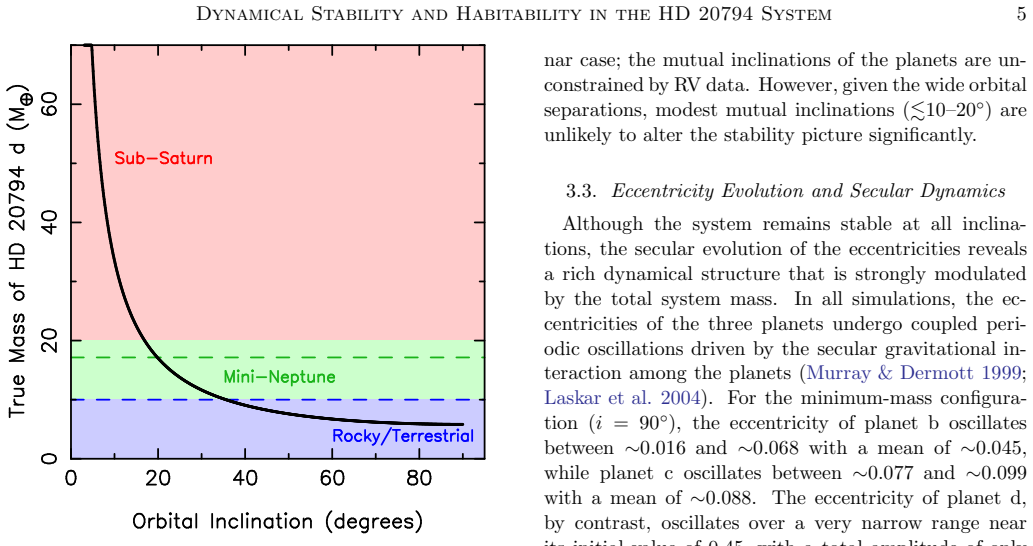
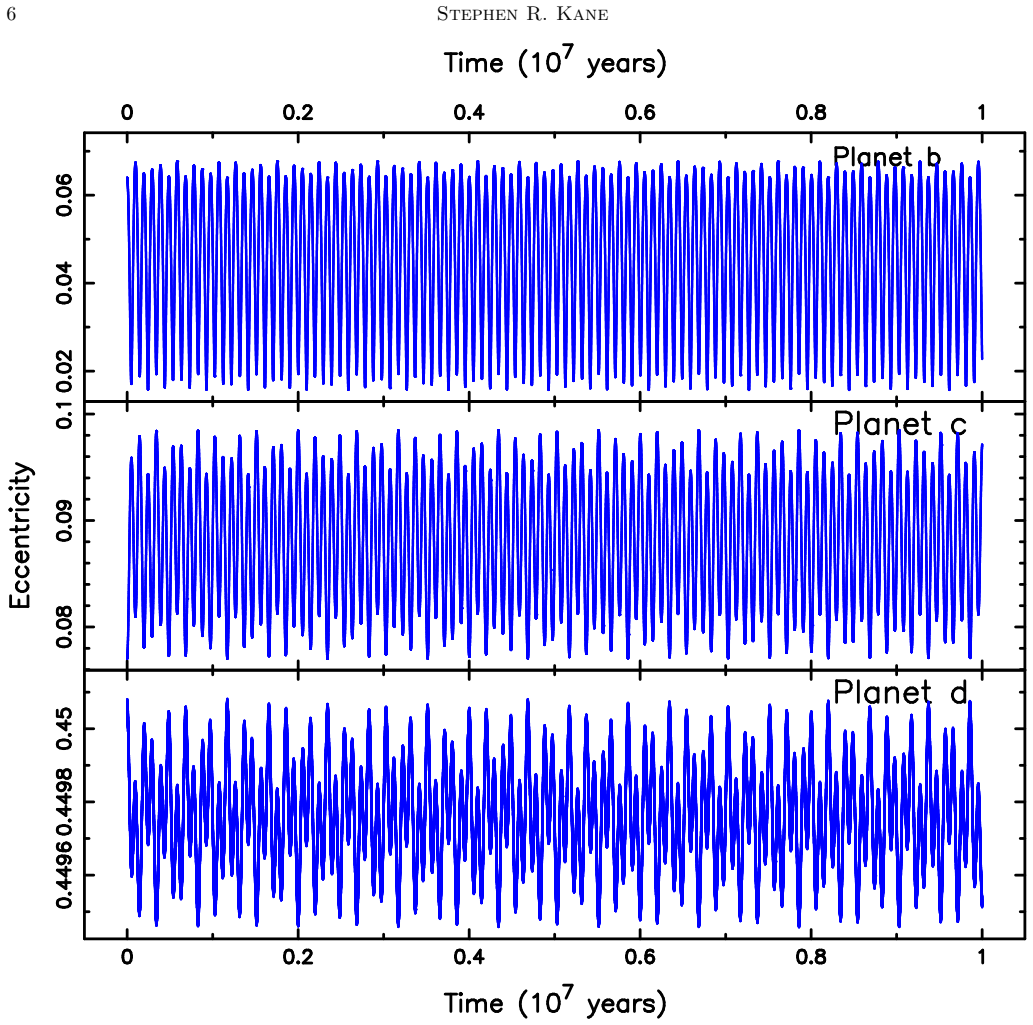
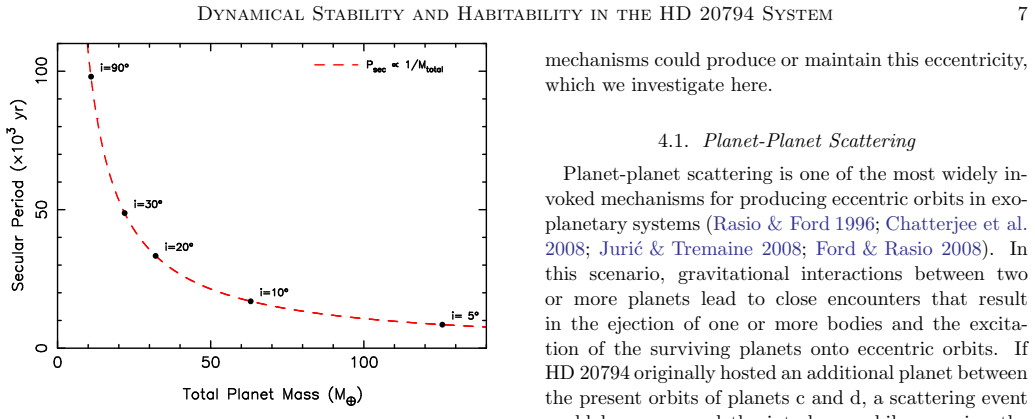
The HD 20794 system remains dynamically stable over the full 10^7 year integration for all tested inclinations, including i = 5° (M_d ≈ 67 M_⊕). The secular eccentricity oscillations share a common eigenperiod that scales inversely with the total system mass, consistent with Laplace-Lagrange secular theory. HD 20794 d is the lowest-mass confirmed planet with e > 0.4 whose orbit crosses the HZ of its host star, and its periastron passage deep within the HZ makes it a likely dynamical disruptor for additional terrestrial planets.
What carries the argument
N-body simulations run across inclinations from 5° to 90° that track long-term orbital stability and secular eccentricity oscillations in the three-planet configuration.
If this is right
- Planet d spends a measurable fraction of each orbit inside both the conservative and optimistic habitable zone boundaries.
- The secular interactions produce eccentricity oscillations with a single shared eigenperiod across the planets.
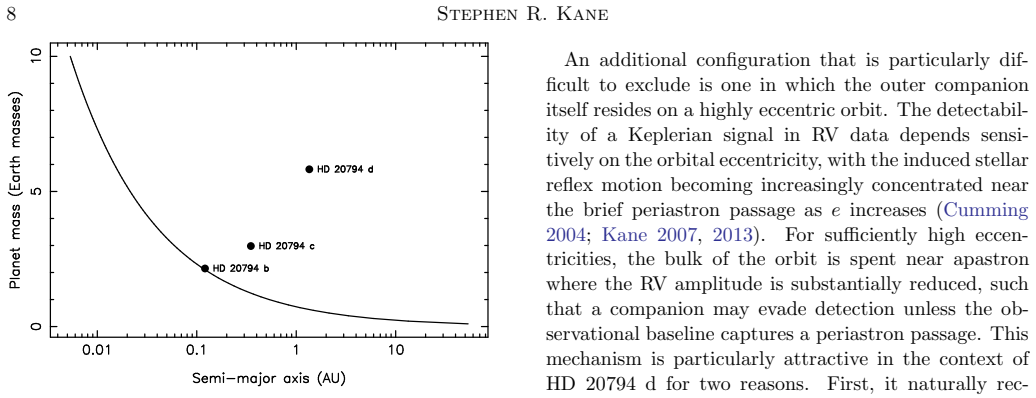
- The eccentricity of planet d could arise from planet-planet scattering or secular forcing by an unseen outer companion.
- Planet d is expected to clear or disrupt the orbits of any additional terrestrial planets that might otherwise form in the system.
Where Pith is reading between the lines
- Similar nearby systems with eccentric habitable-zone planets may need comparable inclination-dependent stability tests before habitability assessments proceed.
- Radial-velocity monitoring to exclude additional companions would directly strengthen the no-unseen-planet premise used here.
- The quantified time planet d spends in the habitable zone could be combined with climate models to estimate surface temperature swings on any hypothetical moons or co-orbiting worlds.
- Extending the integration length or including general-relativistic effects might reveal slower secular drifts not visible at 10 million years.
Load-bearing premise
The observed minimum masses and orbital elements of the three planets are sufficient to model the system's dynamics without additional unseen planets or significant uncertainties in the parameters affecting the stability conclusions.
What would settle it
An N-body integration to 10^8 years that produces orbital instability or close encounters, or the detection of a fourth planet that induces chaos in the existing configuration, would falsify the reported stability.
Figures

read the original abstract
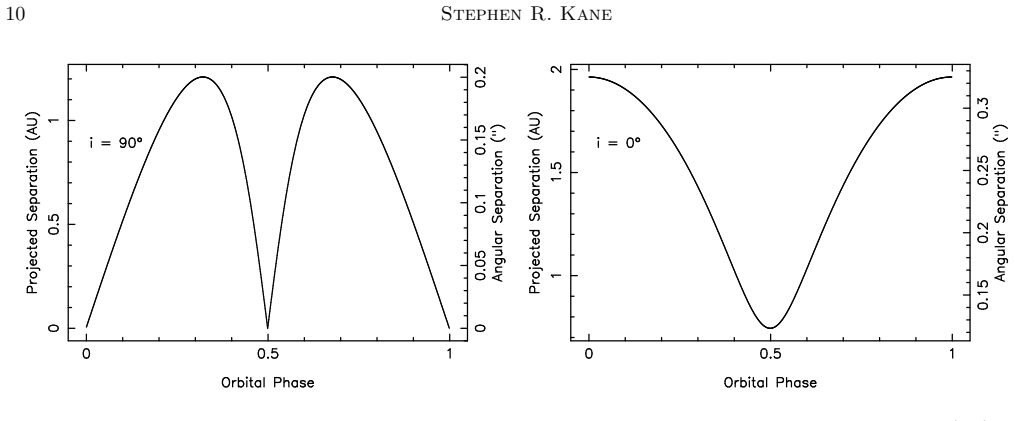
The Keplerian orbit of a terrestrial planet can be a significant driver in the evolution of surface conditions, as well as influencing the overall dynamics of the system. The HD 20794 system harbors three confirmed planets orbiting a nearby G-type star, including HD 20794 d, a $\sim$5.82 $M_\oplus$ (minimum mass) planet on a highly eccentric ($e = 0.45$) orbit that passes through the Habitable Zone (HZ). Here, we present a dynamical analysis of the HD 20794 system. We calculate the HZ boundaries and quantify the fraction of the orbital period that planet d spends within the conservative and optimistic HZ limits. Using N-body simulations, we explore the long-term orbital stability across inclinations spanning $\sim$5--90\degr. The system remains dynamically stable over the full $10^7$ year integration for all tested inclinations, including $i = 5\degr$ ($M_d \approx 67$ $M_\oplus$). The secular eccentricity oscillations share a common eigenperiod that scales inversely with the total system mass, consistent with Laplace-Lagrange secular theory. We examine the origin of the eccentricity of planet d, including planet-planet scattering and secular excitation from an unseen eccentric outer companion. HD 20794 d is the lowest-mass confirmed planet with $e > 0.4$ whose orbit crosses the HZ of its host star, and its periastron passage deep within the HZ makes it a likely dynamical disruptor for additional terrestrial planets, reinforcing its status as the dominant habitability prospect in the system. The proximity of HD 20794 and its inclusion on the Habitable Worlds Observatory precursor target list make this a high-priority system for understanding the interplay between orbital dynamics and planetary habitability.
Editorial analysis
A structured set of objections, weighed in public.
Referee Report
Summary. The paper claims that the HD 20794 three-planet system remains dynamically stable over 10^7 yr N-body integrations for all tested inclinations (5°–90°), including the high-mass i=5° case (M_d≈67 M_⊕), with secular eccentricity oscillations matching Laplace-Lagrange theory; planet d (e=0.45) is identified as the lowest-mass confirmed planet with e>0.4 whose orbit crosses the HZ, acting as a dynamical disruptor and making the system a high-priority target for habitability studies.
Significance. If the stability result is robust, the work supplies a concrete nearby-system example of the interplay between high-eccentricity orbits, HZ crossing, and long-term dynamical stability, with explicit credit due for the direct comparison of N-body secular periods to analytic Laplace-Lagrange predictions. The identification of HD 20794 d as the lowest-mass e>0.4 HZ-crossing planet is a falsifiable claim that strengthens the paper’s relevance to Habitable Worlds Observatory target selection.
major comments (2)
- [N-body stability analysis] N-body stability section: stability at all inclinations, including i=5° (M_d≈67 M_⊕), is shown only for single integrations that adopt the fixed best-fit Keplerian elements; no Monte Carlo draws from the observational posterior or tests with injected unseen companions are reported. At elevated masses the secular forcing and close-encounter timescales shorten, so a modest shift in a or e within the reported 1σ errors can move the system across a stability boundary that the nominal runs do not probe.
- [HZ and habitability discussion] HZ-crossing and habitability section: the claim that planet d is “the lowest-mass confirmed planet with e>0.4 whose orbit crosses the HZ” rests on the nominal minimum mass and eccentricity; without posterior sampling it is unclear whether the conclusion survives the full uncertainty range of the orbital fit.
minor comments (1)
- [Abstract] The abstract states that the fraction of the orbital period spent in the conservative and optimistic HZ is quantified, but the corresponding numerical values and integration details are not referenced to a table or figure in the provided text.
Simulated Author's Rebuttal
We thank the referee for their constructive comments, which highlight important aspects of robustness in the dynamical analysis. We agree that Monte Carlo sampling from the observational posterior would strengthen the stability and habitability claims, and we will incorporate such tests in the revised manuscript. We address each major comment below.
read point-by-point responses
-
Referee: [N-body stability analysis] N-body stability section: stability at all inclinations, including i=5° (M_d≈67 M_⊕), is shown only for single integrations that adopt the fixed best-fit Keplerian elements; no Monte Carlo draws from the observational posterior or tests with injected unseen companions are reported. At elevated masses the secular forcing and close-encounter timescales shorten, so a modest shift in a or e within the reported 1σ errors can move the system across a stability boundary that the nominal runs do not probe.
Authors: We acknowledge that the presented N-body results rely on single integrations using the nominal best-fit elements. The agreement between the simulated secular periods and Laplace-Lagrange analytic predictions offers supporting evidence independent of the specific numerical realizations. To address the concern directly, the revised manuscript will include Monte Carlo draws from the observational posterior, with multiple integrations sampling a and e within 1σ uncertainties, focused on the high-mass i=5° case. Tests with injected unseen companions are not performed because no evidence for additional planets exists in the current data; we will note this as a limitation rather than a required extension of the three-planet analysis. revision: yes
-
Referee: [HZ and habitability discussion] HZ-crossing and habitability section: the claim that planet d is “the lowest-mass confirmed planet with e>0.4 whose orbit crosses the HZ” rests on the nominal minimum mass and eccentricity; without posterior sampling it is unclear whether the conclusion survives the full uncertainty range of the orbital fit.
Authors: The identification uses the published minimum mass (~5.82 M_⊕) and e=0.45. While posterior sampling would provide a more complete assessment, the nominal values lie well inside the reported 1σ uncertainties, and no other confirmed planet satisfies the low-mass, high-eccentricity, HZ-crossing criteria. In revision we will add a short check confirming that the conclusion remains unchanged when parameters are varied within their 1σ ranges. revision: partial
Circularity Check
No significant circularity; standard N-body application to fixed inputs
full rationale
The paper's central stability result follows from direct N-body integrations over 10^7 years using the reported best-fit Keplerian elements and masses at each tested inclination. No step reduces by construction to a fitted parameter renamed as a prediction, nor does any load-bearing claim rest on a self-citation chain or imported uniqueness theorem; the secular eigenperiod comparison is to standard Laplace-Lagrange theory. The derivation is therefore self-contained against external dynamical benchmarks and receives the default non-finding.
Axiom & Free-Parameter Ledger
free parameters (1)
- planetary masses and eccentricities
axioms (2)
- standard math The planets interact only through Newtonian gravity in a multi-body system
- domain assumption The system has no additional undetected planets significantly affecting the dynamics
Reference graph
Works this paper leans on
-
[1]
Alei, E., Quanz, S. P., Konrad, B. S., et al. 2024, A&A, 689, A245, doi: 10.1051/0004-6361/202450320
-
[2]
Anderson, K. R., & Lai, D. 2017, MNRAS, 472, 3692, doi: 10.1093/mnras/stx2250
-
[3]
2014, MNRAS, 437, 3473, doi: 10.1093/mnras/stt2146
Pollacco, D. 2014, MNRAS, 437, 3473, doi: 10.1093/mnras/stt2146
-
[4]
Barnes, R., & Raymond, S. N. 2004, ApJ, 617, 569, doi: 10.1086/423419
-
[5]
2024, MNRAS, 530, 4300, doi: 10.1093/mnras/stae1124
Biasiotti, L., Simonetti, P., Vladilo, G., et al. 2024, MNRAS, 530, 4300, doi: 10.1093/mnras/stae1124
-
[6]
Blunt, S., Endl, M., Weiss, L. M., et al. 2019, AJ, 158, 181, doi: 10.3847/1538-3881/ab3e63
-
[7]
2018, ApJL, 867, L3, doi: 10.3847/2041-8213/aae710
Foreman-Mackey, D. 2018, ApJL, 867, L3, doi: 10.3847/2041-8213/aae710
-
[8]
Buchhave, L. A., Bizzarro, M., Latham, D. W., et al. 2014, Nature, 509, 593, doi: 10.1038/nature13254
-
[9]
Carrera, D., Raymond, S. N., & Davies, M. B. 2019, A&A, 629, L7, doi: 10.1051/0004-6361/201935744
-
[10]
C., Krissansen-Totton, J., Kiang, N
Catling, D. C., Krissansen-Totton, J., Kiang, N. Y., et al. 2018, Astrobiology, 18, 709, doi: 10.1089/ast.2017.1737
-
[11]
Chambers, J. E. 1999, MNRAS, 304, 793, doi: 10.1046/j.1365-8711.1999.02379.x
-
[12]
Chambers, J. E., Wetherill, G. W., & Boss, A. P. 1996, Icarus, 119, 261, doi: 10.1006/icar.1996.0019
-
[13]
Chatterjee, S., Ford, E. B., Matsumura, S., & Rasio, F. A. 2008, ApJ, 686, 580, doi: 10.1086/590227
-
[14]
Chen, J., & Kipping, D. 2017, ApJ, 834, 17, doi: 10.3847/1538-4357/834/1/17
-
[15]
2023, A&A, 678, A2, doi: 10.1051/0004-6361/202347232 12 Stephen R
Cretignier, M., Dumusque, X., Aigrain, S., & Pepe, F. 2023, A&A, 678, A2, doi: 10.1051/0004-6361/202347232 12 Stephen R. Kane
-
[16]
Cumming, A. 2004, MNRAS, 354, 1165, doi: 10.1111/j.1365-2966.2004.08275.x
-
[17]
Damasso, M., Perger, M., Almenara, J. M., et al. 2022, A&A, 666, A187, doi: 10.1051/0004-6361/202243522
-
[18]
2007, A&A, 473, 983, doi: 10.1051/0004-6361:20078144
Mayor, M. 2007, A&A, 473, 983, doi: 10.1051/0004-6361:20078144
-
[19]
Raymond, S. N. 2010, ApJ, 721, 1295, doi: 10.1088/0004-637X/721/2/1295
-
[20]
Feng, F., Tuomi, M., & Jones, H. R. A. 2017, A&A, 605, A103, doi: 10.1051/0004-6361/201730406
-
[21]
Ford, E. B. 2008, AJ, 135, 1008, doi: 10.1088/0004-6256/135/3/1008 —. 2014, Proceedings of the National Academy of Science, 111, 12616, doi: 10.1073/pnas.1304219111
-
[22]
Ford, E. B., & Rasio, F. A. 2008, ApJ, 686, 621, doi: 10.1086/590926
-
[23]
2018, Astrobiology, 18, 739, doi: 10.1089/ast.2017.1733
Fujii, Y., Angerhausen, D., Deitrick, R., et al. 2018, Astrobiology, 18, 739, doi: 10.1089/ast.2017.1733
-
[24]
1993, Icarus, 106, 247, doi: 10.1006/icar.1993.1169
Gladman, B. 1993, Icarus, 106, 247, doi: 10.1006/icar.1993.1169
-
[25]
Harada, C. K., Dressing, C. D., Kane, S. R., & Ardestani, B. A. 2024, ApJS, 272, 30, doi: 10.3847/1538-4365/ad3e81
-
[26]
Hill, M. L., Bott, K., Dalba, P. A., et al. 2023, AJ, 165, 34, doi: 10.3847/1538-3881/aca1c0
-
[27]
Hill, M. L., Kane, S. R., Seperuelo Duarte, E., et al. 2018, ApJ, 860, 67, doi: 10.3847/1538-4357/aac384
-
[28]
2023, A&A, 674, A10, doi: 10.1051/0004-6361/202244161
Holl, B., Sozzetti, A., Sahlmann, J., et al. 2023, A&A, 674, A10, doi: 10.1051/0004-6361/202244161
-
[29]
Horner, J., Kane, S. R., Marshall, J. P., et al. 2020, PASP, 132, 102001, doi: 10.1088/1538-3873/ab8eb9 Juri´ c, M., & Tremaine, S. 2008, ApJ, 686, 603, doi: 10.1086/590047
-
[30]
Kane, S. R. 2007, MNRAS, 380, 1488, doi: 10.1111/j.1365-2966.2007.12144.x —. 2013, ApJ, 766, 10, doi: 10.1088/0004-637X/766/1/10 —. 2015, ApJL, 814, L9, doi: 10.1088/2041-8205/814/1/L9 —. 2023, AJ, 166, 187, doi: 10.3847/1538-3881/acfb01 —. 2025, AJ, 170, 329, doi: 10.3847/1538-3881/ae17c9
-
[31]
Kane, S. R., & Blunt, S. 2019, AJ, 158, 209, doi: 10.3847/1538-3881/ab4c3e
-
[32]
Kane, S. R., & Burt, J. A. 2024, AJ, 168, 279, doi: 10.3847/1538-3881/ad8a68
-
[33]
Observations, data reduction and spectroscopic sample of 582 low-redshift Type Ia supernovae
Kane, S. R., Ciardi, D. R., Gelino, D. M., & von Braun, K. 2012, MNRAS, 425, 757, doi: 10.1111/j.1365-2966.2012.21627.x
-
[34]
Kane, S. R., & Fetherolf, T. 2023, AJ, 166, 205, doi: 10.3847/1538-3881/acff5a
-
[35]
Kane, S. R., & Gelino, D. M. 2012, Astrobiology, 12, 940, doi: 10.1089/ast.2011.0798
-
[36]
Harada, C. K. 2024, AJ, 168, 195, doi: 10.3847/1538-3881/ad6a50
-
[37]
Kane, S. R., Li, Z., Wolf, E. T., Ostberg, C., & Hill, M. L. 2021a, AJ, 161, 31, doi: 10.3847/1538-3881/abcbfd
-
[38]
Kane, S. R., & Raymond, S. N. 2014, ApJ, 784, 104, doi: 10.1088/0004-637X/784/2/104
-
[39]
Kane, S. R., & Torres, S. M. 2017, AJ, 154, 204, doi: 10.3847/1538-3881/aa8fce
-
[40]
Kane, S. R., Dalba, P. A., Li, Z., et al. 2019, AJ, 157, 252, doi: 10.3847/1538-3881/ab1ddf
-
[41]
Kane, S. R., Arney, G. N., Byrne, P. K., et al. 2021b, Journal of Geophysical Research (Planets), 126, e06643, doi: 10.1002/jgre.v126.2
-
[42]
Kane, S. R., Foley, B. J., Hill, M. L., et al. 2022, AJ, 163, 20, doi: 10.3847/1538-3881/ac366b
-
[43]
Kane, S. R., Hill, M. L., Dalba, P. A., et al. 2023, AJ, 165, 252, doi: 10.3847/1538-3881/acd17a
-
[44]
M., Matr` a, L., Marmier, M., et al
Kennedy, G. M., Matr` a, L., Marmier, M., et al. 2015, MNRAS, 449, 3121, doi: 10.1093/mnras/stv511
-
[45]
Kopparapu, R. K., & Barnes, R. 2010, ApJ, 716, 1336, doi: 10.1088/0004-637X/716/2/1336
-
[46]
Kopparapu, R. K., Ramirez, R. M., SchottelKotte, J., et al. 2014, ApJ, 787, L29, doi: 10.1088/2041-8205/787/2/L29
-
[47]
Kopparapu, R. K., Ramirez, R., Kasting, J. F., et al. 2013, ApJ, 765, 131, doi: 10.1088/0004-637X/765/2/131
-
[48]
K., H´ ebrard, E., Belikov, R., et al
Kopparapu, R. K., H´ ebrard, E., Belikov, R., et al. 2018, ApJ, 856, 122, doi: 10.3847/1538-4357/aab205
-
[49]
Laliotis, K., Burt, J. A., Mamajek, E. E., et al. 2023, AJ, 165, 176, doi: 10.3847/1538-3881/acc067
-
[50]
Laskar, J. 1997, A&A, 317, L75 —. 2008, Icarus, 196, 1, doi: 10.1016/j.icarus.2008.02.017
-
[51]
Laskar, J., & Petit, A. C. 2017, A&A, 605, A72, doi: 10.1051/0004-6361/201630022
-
[52]
2004, A&A, 428, 261, doi: 10.1051/0004-6361:20041335
Laskar, J., Robutel, P., Joutel, F., et al. 2004, A&A, 428, 261, doi: 10.1051/0004-6361:20041335
-
[53]
2013, Nature, 504, 268, doi: 10.1038/nature12827
Pottier, A. 2013, Nature, 504, 268, doi: 10.1038/nature12827
-
[54]
Lunine, J. I. 2017, Acta Astronautica, 131, 123, doi: 10.1016/j.actaastro.2016.11.017
-
[55]
Luque, R., & Pall´ e, E. 2022, Science, 377, 1211, doi: 10.1126/science.abl7164
-
[56]
2024, arXiv e-prints, arXiv:2402.12414, doi: 10.48550/arXiv.2402.12414
Mamajek, E., & Stapelfeldt, K. 2024, arXiv e-prints, arXiv:2402.12414, doi: 10.48550/arXiv.2402.12414
-
[57]
Mishra, L., Alibert, Y., Udry, S., & Mordasini, C. 2023a, A&A, 670, A68, doi: 10.1051/0004-6361/202243751 Dynamical Stability and Habitability in the HD 20794 System 13 —. 2023b, A&A, 670, A69, doi: 10.1051/0004-6361/202244705 M¨ uller, S., Baron, J., Helled, R., Bouchy, F., & Parc, L. 2024, A&A, 686, A296, doi: 10.1051/0004-6361/202348690
-
[58]
Murray, C. D., & Dermott, S. F. 1999, Solar System Dynamics (Cambridge University Press), doi: 10.1017/CBO9781139174817
-
[59]
2008, ApJ, 678, 498, doi: 10.1086/529369
Nagasawa, M., Ida, S., & Bessho, T. 2008, ApJ, 678, 498, doi: 10.1086/529369
-
[60]
2013, MNRAS, 431, 2155, doi: 10.1093/mnras/stt302
Teyssandier, J. 2013, MNRAS, 431, 2155, doi: 10.1093/mnras/stt302
-
[61]
Nari, N., Dumusque, X., Hara, N. C., et al. 2025, A&A, 693, A297, doi: 10.1051/0004-6361/202451769
-
[62]
Otegi, J. F., Bouchy, F., & Helled, R. 2020, A&A, 634, A43, doi: 10.1051/0004-6361/201936482
-
[63]
2011, A&A, 534, A58, doi: 10.1051/0004-6361/201117055
Pepe, F., Lovis, C., S´ egransan, D., et al. 2011, A&A, 534, A58, doi: 10.1051/0004-6361/201117055
-
[64]
Perryman, M., Hartman, J., Bakos, G. ´A., & Lindegren, L. 2014, ApJ, 797, 14, doi: 10.1088/0004-637X/797/1/14
-
[65]
Petit, A. C., Laskar, J., & Bou´ e, G. 2017, A&A, 607, A35, doi: 10.1051/0004-6361/201731196
-
[66]
2015, ApJ, 805, 75, doi: 10.1088/0004-637X/805/1/75
Petrovich, C. 2015, ApJ, 805, 75, doi: 10.1088/0004-637X/805/1/75
-
[67]
, archivePrefix = "arXiv", eprint =
Petrovich, C., Malhotra, R., & Tremaine, S. 2013, ApJ, 770, 24, doi: 10.1088/0004-637X/770/1/24
-
[68]
Quanz, S. P., Ottiger, M., Fontanet, E., et al. 2022a, A&A, 664, A21, doi: 10.1051/0004-6361/202140366
-
[69]
P., Absil, O., Benz, W., et al
Quanz, S. P., Absil, O., Benz, W., et al. 2022b, Experimental Astronomy, 54, 1197, doi: 10.1007/s10686-021-09791-z
-
[70]
Rasio, F. A., & Ford, E. B. 1996, Science, 274, 954, doi: 10.1126/science.274.5289.954
-
[71]
Raymond, S. N., Armitage, P. J., & Gorelick, N. 2009a, ApJL, 699, L88, doi: 10.1088/0004-637X/699/2/L88
-
[72]
Raymond, S. N., O’Brien, D. P., Morbidelli, A., & Kaib, N. A. 2009b, Icarus, 203, 644, doi: 10.1016/j.icarus.2009.05.016
-
[73]
2014, Science, 345, 440, doi: 10.1126/science.1253253
Robertson, P., Mahadevan, S., Endl, M., & Roy, A. 2014, Science, 345, 440, doi: 10.1126/science.1253253
-
[74]
Rogers, L. A. 2015, ApJ, 801, 41, doi: 10.1088/0004-637X/801/1/41
-
[75]
Schwieterman, E. W., Kiang, N. Y., Parenteau, M. N., et al. 2018, Astrobiology, 18, 663, doi: 10.1089/ast.2017.1729
-
[76]
Shen, Y., & Turner, E. L. 2008, ApJ, 685, 553, doi: 10.1086/590548
-
[77]
L., Barnes, R., Agol, E., et al
Shields, A. L., Barnes, R., Agol, E., et al. 2016, Astrobiology, 16, 443, doi: 10.1089/ast.2015.1353 Stef´ ansson, G., Mahadevan, S., Winn, J. N., et al. 2025, AJ, 169, 107, doi: 10.3847/1538-3881/ada9e1
-
[78]
Tuchow, N. W., Stark, C. C., & Mamajek, E. 2024, AJ, 167, 139, doi: 10.3847/1538-3881/ad25ec Van Eylen, V., & Albrecht, S. 2015, ApJ, 808, 126, doi: 10.1088/0004-637X/808/2/126
-
[79]
Way, M. J., & Georgakarakos, N. 2017, ApJ, 835, L1, doi: 10.3847/2041-8213/835/1/L1
-
[80]
Way, M. J., Ostberg, C., Foley, B. J., et al. 2023, SSRv, 219, 13, doi: 10.1007/s11214-023-00953-3
discussion (0)
Sign in with ORCID, Apple, or X to comment. Anyone can read and Pith papers without signing in.