Soliton-antisoliton pairs in the supersymmetric gapped phase of an interacting Majorana chain
Pith reviewed 2026-06-28 03:59 UTC · model grok-4.3
The pith
In the gapped supersymmetric phase of an interacting Majorana chain, the lowest excitations are soliton-antisoliton pairs that bind Majorana modes into nonlocal Dirac fermions distinguishing even and odd parity states.
A machine-rendered reading of the paper's core claim, the machinery that carries it, and where it could break.
Core claim
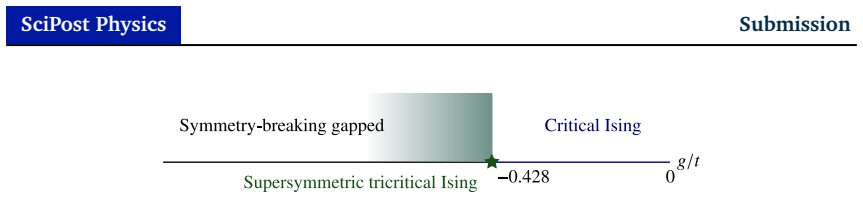
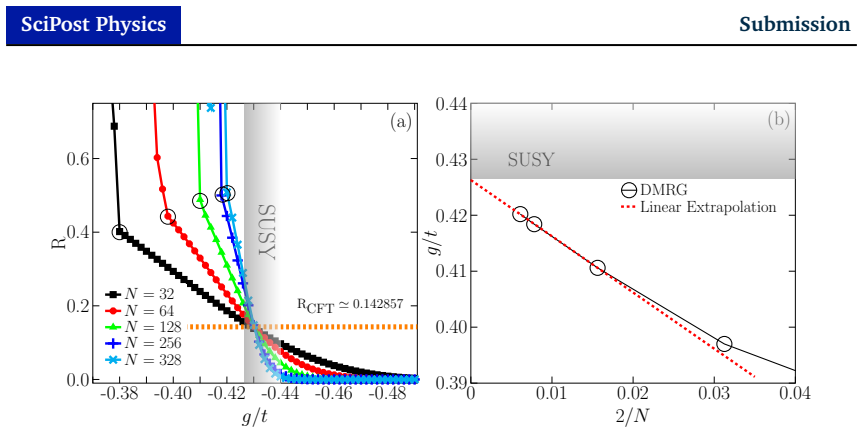
In the thermodynamic limit within the supersymmetric gapped regime, the excitations consist of soliton-antisoliton pairs separating distinct ordered regions. Each soliton binds an emergent localized Majorana mode, and together the pair forms a nonlocal Dirac fermion. The occupation of this Dirac mode distinguishes eigenstates with even and odd fermion parity. The conventional SUSY diagnostic remains finite at the tricritical point, diverges immediately on the Ising side, and decays continuously to zero deeper in the gapped phase.
What carries the argument
soliton-antisoliton pairs that bind emergent localized Majorana modes into a single nonlocal Dirac fermion
Load-bearing premise
The conventional SUSY diagnostic remains a valid probe of supersymmetry persistence even after entering the gapped phase.
What would settle it
Numerical computation of the low-energy spectrum on long chains that either shows or fails to show soliton-antisoliton pairs whose Majorana modes produce a parity-dependent nonlocal Dirac fermion.
Figures


read the original abstract
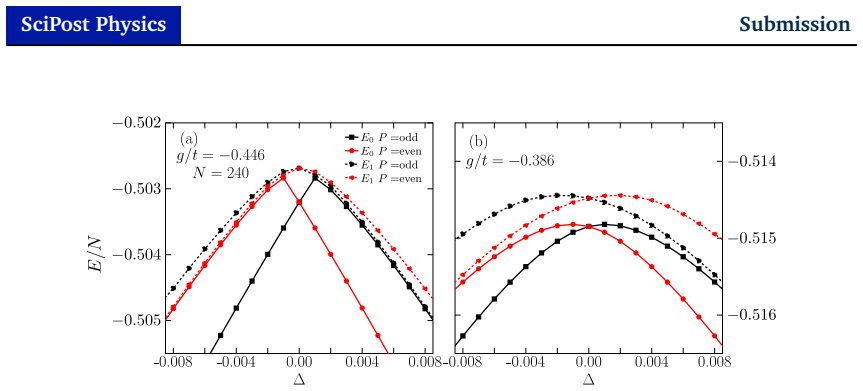
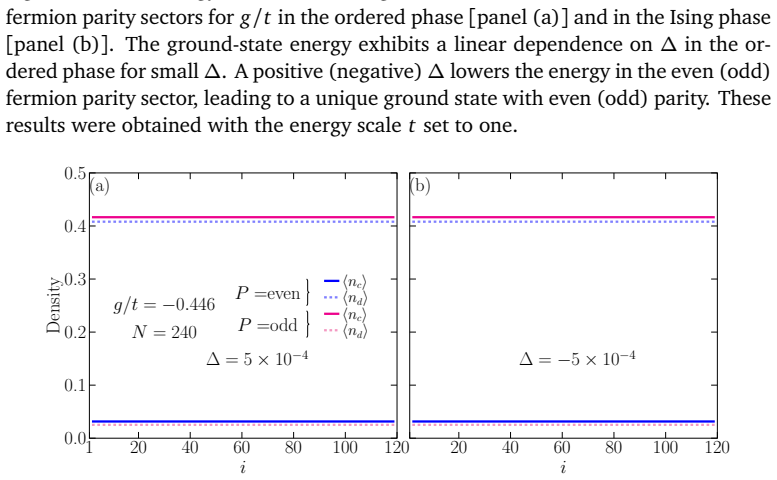
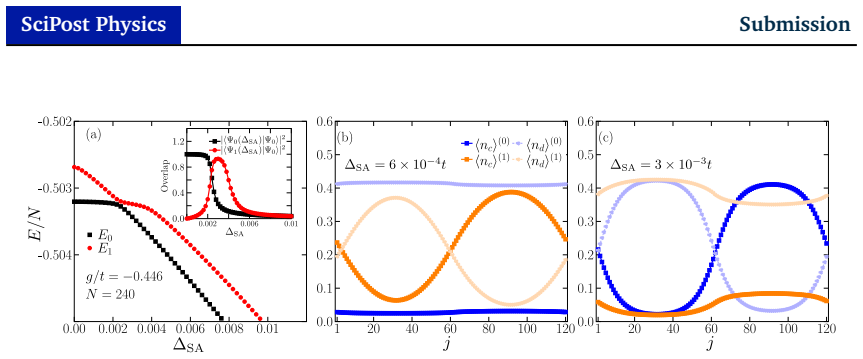
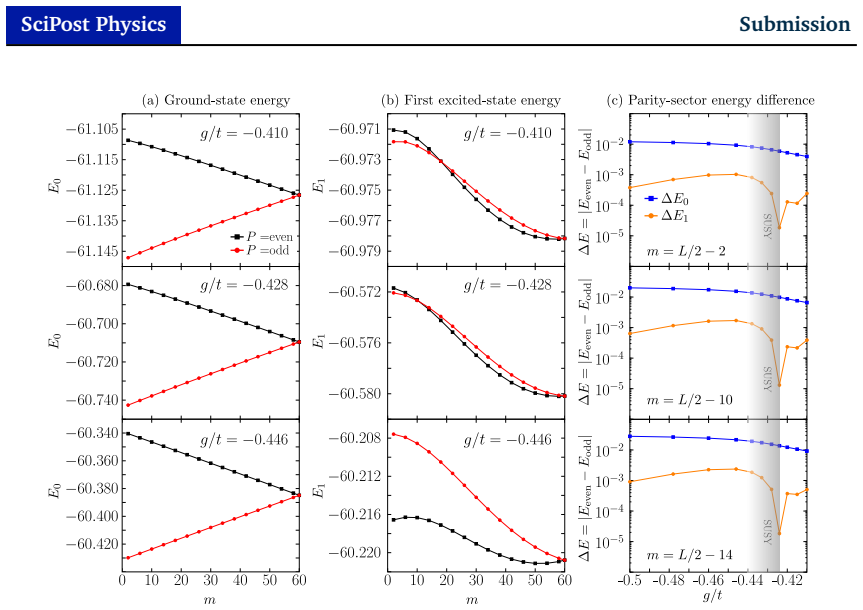
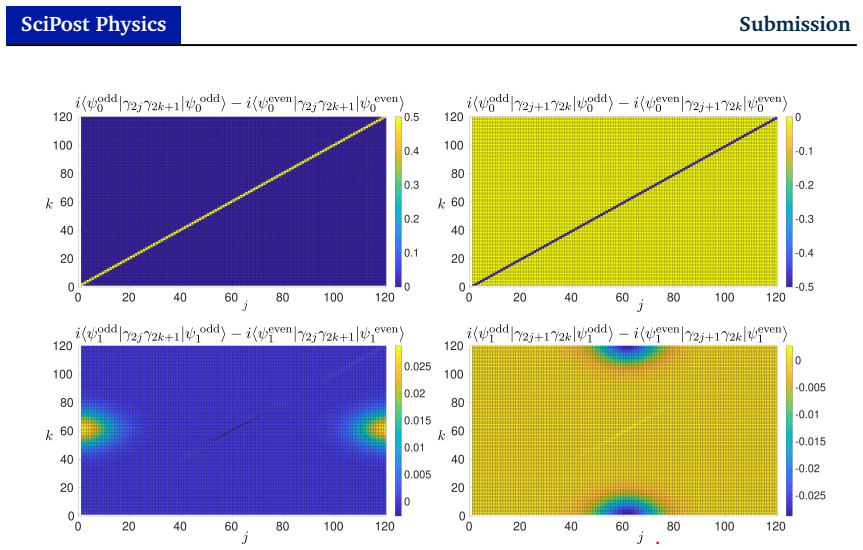
A strongly interacting chain of Majorana fermions realizes the supersymmetric tricritical Ising phase, with supersymmetry (SUSY) extending into a symmetry-broken ordered phase adjacent to the tricritical point. Although the signatures of SUSY at the tricritical point are well understood, their behavior in the gapped phase remains less clear. Here, we address two key questions: how SUSY manifests in the gapped phase and what is the nature of the excitations in this phase. We show that, in the thermodynamic limit, a conventional SUSY diagnostic that remains finite at the tricritical point diverges immediately on the Ising side, yet decays continuously to zero deeper in the gapped phase, signaling the persistence of SUSY. Focusing on the lowest excited states in the supersymmetric gapped regime, we find that the excitations consist of soliton-antisoliton pairs separating distinct ordered regions. Each soliton binds an emergent localized Majorana mode, and together the pair forms a nonlocal Dirac fermion. The occupation of this Dirac mode distinguishes eigenstates with even and odd fermion parity.
Editorial analysis
A structured set of objections, weighed in public.
Referee Report
Summary. The manuscript studies the supersymmetric gapped phase of an interacting Majorana chain adjacent to the tricritical Ising point. It reports that a conventional SUSY diagnostic, finite at the tricritical point, diverges immediately on the Ising side yet decays continuously to zero deeper inside the gapped phase, taken as evidence that SUSY persists. The lowest excitations in this regime are identified as soliton-antisoliton pairs that separate distinct ordered regions; each soliton binds an emergent localized Majorana mode, the pair forms a nonlocal Dirac fermion, and the occupation of this mode distinguishes even- and odd-fermion-parity eigenstates.
Significance. If the central claims hold, the work supplies a concrete microscopic picture of how supersymmetry can survive in a translationally broken gapped phase and links it to a specific excitation structure (soliton pairs carrying bound Majorana modes). This would be of interest to the condensed-matter community working on interacting Majorana systems and supersymmetric lattice models.
major comments (2)
- [Abstract] Abstract: The central claim that the continuous decay of the SUSY diagnostic to zero signals persistence of supersymmetry inside the gapped phase rests on the assumption that the diagnostic retains its meaning once the gap opens and translational symmetry is broken by ordered regions. The manuscript must demonstrate, via an independent cross-check (e.g., correlation with the soliton-pair spectrum or a SUSY-protected quantity), that the diagnostic is not instead tracking domain-wall density or parity mixing; without this, the decay-to-zero no longer implies unbroken SUSY.
- [Abstract] Abstract: The identification of the lowest excited states as soliton-antisoliton pairs is presented without reference to the concrete diagnostic (energy spectrum, wave-function overlap, or parity-sector analysis) used to establish this assignment. The link between this construction and the reported behavior of the SUSY diagnostic is therefore not independently verified and remains load-bearing for the persistence claim.
Simulated Author's Rebuttal
We thank the referee for the careful reading and constructive comments. We address each major comment below, agreeing that additional explicit cross-checks and references will strengthen the manuscript.
read point-by-point responses
-
Referee: [Abstract] Abstract: The central claim that the continuous decay of the SUSY diagnostic to zero signals persistence of supersymmetry inside the gapped phase rests on the assumption that the diagnostic retains its meaning once the gap opens and translational symmetry is broken by ordered regions. The manuscript must demonstrate, via an independent cross-check (e.g., correlation with the soliton-pair spectrum or a SUSY-protected quantity), that the diagnostic is not instead tracking domain-wall density or parity mixing; without this, the decay-to-zero no longer implies unbroken SUSY.
Authors: We agree that an independent cross-check is needed to confirm the diagnostic tracks supersymmetry rather than domain-wall density or parity mixing. In the revised manuscript we will add a new analysis correlating the diagnostic's decay with the soliton-antisoliton excitation gap (a SUSY-protected quantity) across the gapped phase, explicitly ruling out alternative interpretations. revision: yes
-
Referee: [Abstract] Abstract: The identification of the lowest excited states as soliton-antisoliton pairs is presented without reference to the concrete diagnostic (energy spectrum, wave-function overlap, or parity-sector analysis) used to establish this assignment. The link between this construction and the reported behavior of the SUSY diagnostic is therefore not independently verified and remains load-bearing for the persistence claim.
Authors: The identification is based on the low-energy spectrum in even/odd parity sectors together with wave-function overlaps to trial soliton-pair states. We will revise the manuscript to explicitly reference these diagnostics (including the parity-sector analysis that distinguishes the nonlocal Dirac fermion) and to state how they connect to the SUSY diagnostic's behavior. revision: yes
Circularity Check
No significant circularity detected
full rationale
The abstract and provided context present the SUSY diagnostic behavior and soliton-antisoliton construction as outcomes of thermodynamic-limit analysis and examination of lowest excited states, without any quoted equations, self-citations, or fitting procedures that reduce a claimed prediction or result to an input by construction. No self-definitional loops, fitted inputs renamed as predictions, or load-bearing self-citation chains are exhibited. The derivation therefore remains self-contained against external benchmarks and does not match any of the enumerated circularity patterns.
Axiom & Free-Parameter Ledger
Reference graph
Works this paper leans on
-
[1]
H. A. Bethe, Zur Theorie der Metalle. i. Eigenwerte und Eigenfunktionen der linearen Atomkette , Zeit. f \"u r Phys. 71 , 205 (1931), 10.1007\
1931
-
[2]
Ginsparg, It was twenty years ago today
P. Ginsparg, It was twenty years ago today... , http://arxiv.org/abs/1108.2700
-
[3]
P. Fendley, K. Schoutens and J. de Boer, Lattice models with n=2 supersymmetry, Phys. Rev. Lett. 90, 120402 (2003), doi:10.1103/PhysRevLett.90.120402
-
[4]
Lee, Emergence of supersymmetry at a critical point of a lattice model, Phys
S.-S. Lee, Emergence of supersymmetry at a critical point of a lattice model, Phys. Rev. B 76, 075103 (2007), doi:10.1103/PhysRevB.76.075103
-
[5]
Exact ground states of a staggered supersymmetric model for lattice fermions
L. Huijse, N. Moran, J. Vala and K. Schoutens, Exact ground states of a staggered supersymmetric model for lattice fermions, Phys. Rev. B 84, 115124 (2011), doi:10.1103/PhysRevB.84.115124, 1103.1368
work page internal anchor Pith review Pith/arXiv arXiv doi:10.1103/physrevb.84.115124 2011
-
[6]
S.-K. Jian, Y.-F. Jiang and H. Yao, Emergent spacetime supersymmetry in 3d weyl semimetals and 2d dirac semimetals, Phys. Rev. Lett. 114, 237001 (2015), doi:10.1103/PhysRevLett.114.237001
-
[7]
T. Grover, D. N. Sheng and A. Vishwanath, Emergent space-time supersymmetry at the boundary of a topological phase, Science 344, 280 (2014), doi:10.1126/science.1248253
-
[8]
P. Ponte and S.-S. Lee, Emergence of supersymmetry on the surface of three-dimensional topological insulators, New Journal of Physics 16(1), 013044 (2014), doi:10.1088/1367-2630/16/1/013044
-
[9]
L. Fu and C. L. Kane, Superconducting proximity effect and majorana fermions at the surface of a topological insulator, Phys. Rev. Lett. 100, 096407 (2008), doi:10.1103/PhysRevLett.100.096407
-
[10]
R. R. Biswas, Majorana fermions in vortex lattices, Phys. Rev. Lett. 111, 136401 (2013), doi:10.1103/PhysRevLett.111.136401
-
[11]
R. V. Mishmash, A. Yazdani and M. P. Zaletel, Majorana lattices from the quantized hall limit of a proximitized spin-orbit coupled electron gas, Phys. Rev. B 99, 115427 (2019), doi:10.1103/PhysRevB.99.115427
-
[12]
C.-K. Chiu, D. I. Pikulin and M. Franz, Strongly interacting majorana fermions, Phys. Rev. B 91, 165402 (2015), doi:10.1103/PhysRevB.91.165402
-
[13]
I. Affleck, A. Rahmani and D. Pikulin, Majorana-hubbard model on the square lattice, Phys. Rev. B 96, 125121 (2017), doi:10.1103/PhysRevB.96.125121
-
[14]
A. Rahmani, D. Pikulin and I. Affleck, Phase diagrams of majorana-hubbard ladders, Phys. Rev. B 99, 085110 (2019), doi:10.1103/PhysRevB.99.085110
-
[15]
A. Rahmani and M. Franz , Interacting Majorana fermions , Reports on Progress in Physics 82(8), 084501 (2019), doi:10.1088/1361-6633/ab28ef, 1811.02593
-
[16]
C. Li and M. Franz, Majorana-hubbard model on the honeycomb lattice, Phys. Rev. B 98, 115123 (2018), doi:10.1103/PhysRevB.98.115123
-
[17]
T. Tummuru, A. Nocera and I. Affleck, Triangular lattice majorana-hubbard model: Mean-field theory and dmrg on a width-4 torus, Phys. Rev. B 103, 115128 (2021), doi:10.1103/PhysRevB.103.115128
-
[18]
A. Rahmani, X. Zhu, M. Franz and I. Affleck, Emergent supersymmetry from strongly interacting majorana zero modes, Phys. Rev. Lett. 115, 166401 (2015), doi:10.1103/PhysRevLett.115.166401
-
[19]
E. O'Brien and P. Fendley, Lattice supersymmetry and order-disorder coexistence in the tricritical ising model, Phys. Rev. Lett. 120, 206403 (2018), doi:10.1103/PhysRevLett.120.206403
-
[20]
A. Rahmani, X. Zhu, M. Franz and I. Affleck, Phase diagram of the interacting majorana chain model, Phys. Rev. B 92, 235123 (2015), doi:10.1103/PhysRevB.92.235123
-
[21]
D. Friedan, Z. Qiu and S. Shenker, Superconformal invariance in two dimensions and the tricritical ising model, Physics Letters B 151(1), 37 (1985), doi:https://doi.org/10.1016/0370-2693(85)90819-6
-
[22]
A. B. Zamolodchikov, Conformal symmetry and multicritical points in two-dimensional quantum field theory, Sov. J. Nucl. Phys. 44, 529 (1986)
1986
-
[23]
D. Aasen, R. S. K. Mong, B. M. Hunt, D. Mandrus and J. Alicea, Electrical probes of the non-abelian spin liquid in kitaev materials, Phys. Rev. X 10, 031014 (2020), doi:10.1103/PhysRevX.10.031014
-
[24]
S. Samanta, J.-X. Zhu and A. Rahmani, Realizing supersymmetry in a digitized quantum device (2025), 2504.18703
arXiv 2025
-
[25]
A. Cappelli, Modular invariant partition functions of superconformal theories, Physics Letters B 185(1), 82 (1987), doi:https://doi.org/10.1016/0370-2693(87)91532-2
-
[26]
Y. Zou and G. Vidal, Emergence of conformal symmetry in quantum spin chains: Antiperiodic boundary conditions and supersymmetry, Phys. Rev. B 101, 045132 (2020), doi:10.1103/PhysRevB.101.045132
-
[27]
T. H. Hsieh, G. B. Hal\'asz and T. Grover, All majorana models with translation symmetry are supersymmetric, Phys. Rev. Lett. 117, 166802 (2016), doi:10.1103/PhysRevLett.117.166802
-
[28]
R. Jackiw and C. Rebbi, Solitons with fermion number 1/2, Phys. Rev. D 13, 3398 (1976), doi:10.1103/PhysRevD.13.3398
-
[29]
W. P. Su, J. R. Schrieffer and A. J. Heeger, Solitons in polyacetylene, Phys. Rev. Lett. 42, 1698 (1979), doi:10.1103/PhysRevLett.42.1698
discussion (0)
Sign in with ORCID, Apple, or X to comment. Anyone can read and Pith papers without signing in.