Towards Process Mining Use Case Map Models with PM4Py-UCM
Pith reviewed 2026-06-30 10:48 UTC · model grok-4.3
The pith
Process mining can output Use Case Map models directly from event logs for use in requirements engineering.
A machine-rendered reading of the paper's core claim, the machinery that carries it, and where it could break.
Core claim
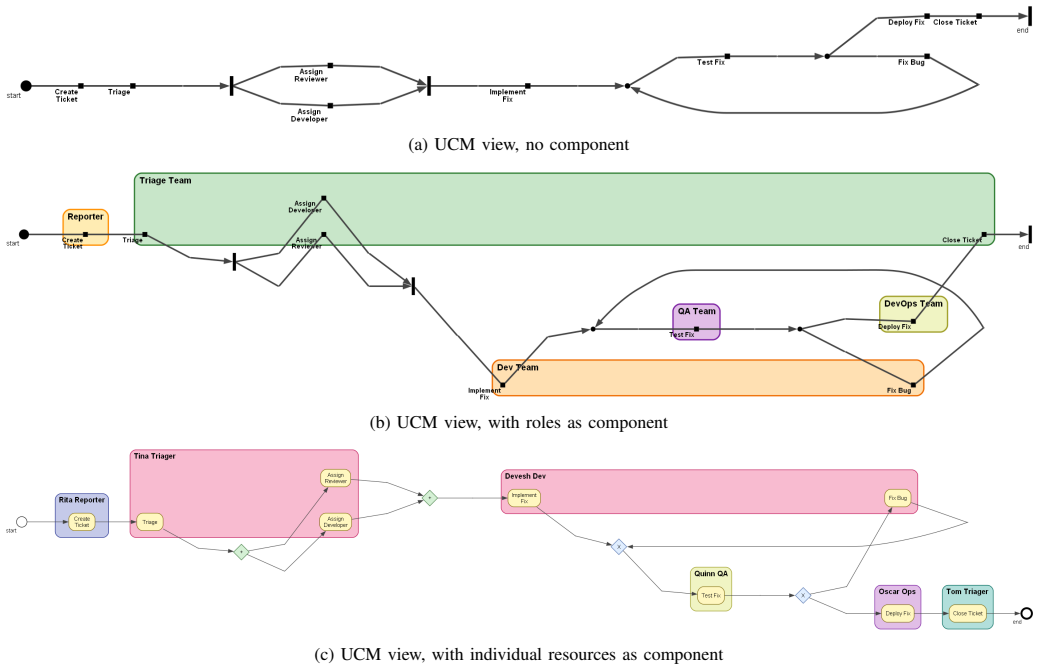
PM4Py-UCM supplies a UCM discovery pipeline, hierarchical decomposition strategies that produce nested UCM models, configurable performer mappings for UCM and BPMN views, and an exporter to jUCMNav that maintains the mined model under round-trip. Illustrations with public and synthetic event logs show the same underlying behavior rendered under varying performer abstractions and decomposition choices, positioning process mining as a practical instrument for model-driven requirements engineering.
What carries the argument
The UCM discovery pipeline that converts event logs into Use Case Map models while supporting hierarchical decomposition and round-trip export to jUCMNav.
If this is right
- Mined process behavior becomes usable inside URN-based modeling, analysis, and management activities.
- The same event-log behavior can be shown through different performer abstractions and nested decomposition strategies.
- Process mining gains a direct role as an instrument for model-driven requirements engineering.
- Round-trip export allows mined models to move into existing URN tools without loss of structure.
Where Pith is reading between the lines
- Teams already working with URN standards could incorporate live process data into requirements models with less manual translation.
- Hierarchical UCMs mined from logs might help requirements engineers manage complexity in large processes by revealing natural nesting levels.
- Further experiments on real organizational logs could reveal whether the current decomposition strategies scale without manual tuning.
Load-bearing premise
The discovered UCM models faithfully represent the behavior in the event logs and prove practically useful for URN-based requirements engineering work.
What would settle it
A side-by-side check on the same logs where the exported UCM models omit or distort frequent sequences that appear in the original event data or cannot be analyzed correctly inside jUCMNav.
Figures


read the original abstract
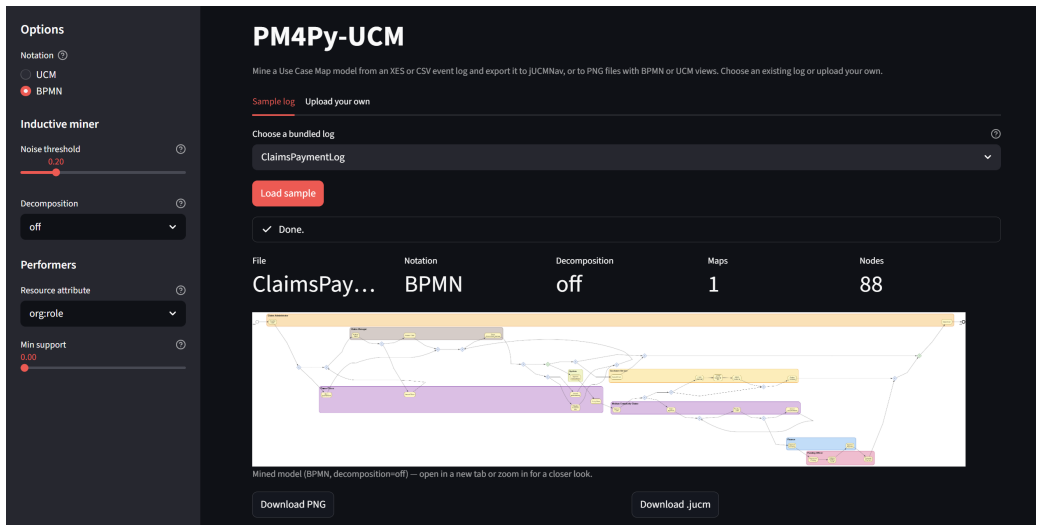
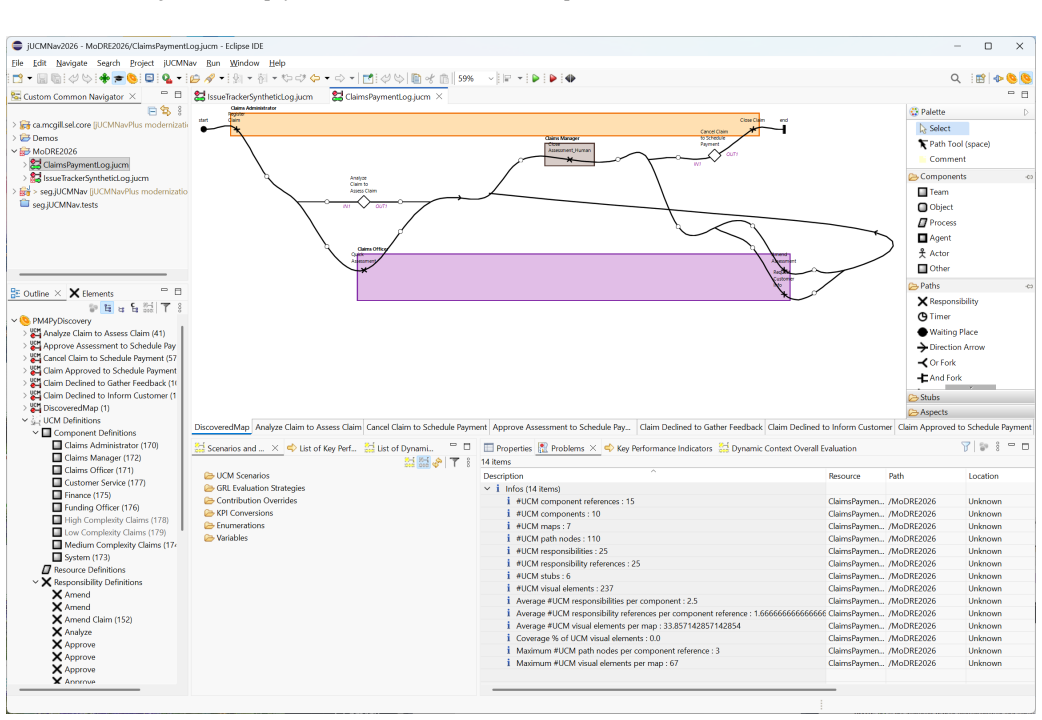
Given the increasing amount of data available in organizational systems, there is an opportunity for early requirements engineering (RE) activities to be better based on evidence than ever before. Process mining (PM) has been used for over two decades to discover and analyze as-is process models from event logs extracted from such data, with outputs often in the form of Petri Nets, directly-follows graphs, or BPMN models. This paper aims to make Use Case Map (UCM) models, from ITU-T's User Requirements Notation (URN), a first-class output of process discovery, so that mined behavior can be used in URN-based modeling, analysis, and management activities. This paper contributes and illustrates PM4Py-UCM, an open-source extension to the existing PM4Py Python library. This new tool contributes 1) a UCM discovery pipeline, 2) hierarchical decomposition strategies producing nested UCM models, 3) configurable performer mappings for UCM and BPMN visualizations, and 4) an exporter to a URN tool (jUCMNav) that preserves the mined model under round-trip. Using public and synthetic event logs, the paper showcases how the same behavior is rendered under different performer abstractions and decomposition strategies, and discusses how PM can become a practical instrument for model-driven RE.
Editorial analysis
A structured set of objections, weighed in public.
Referee Report
Summary. The paper claims to extend the PM4Py library with PM4Py-UCM to enable discovery of Use Case Map (UCM) models from event logs, including hierarchical decomposition strategies, configurable performer mappings, and an exporter to jUCMNav that preserves the model for round-trip use. This is positioned to make UCMs a first-class output of process discovery for integration with URN-based requirements engineering, demonstrated through qualitative showcases on public and synthetic event logs.
Significance. If the UCM discovery pipeline produces models that accurately capture log behavior and support requirements engineering tasks, this could significantly bridge process mining and model-driven RE by providing an alternative to Petri nets or BPMN that is directly usable in URN tools. The open-source nature of the extension is a strength, allowing community adoption and further development.
major comments (2)
- [Abstract] Abstract: The manuscript states the tool features (UCM discovery pipeline, hierarchical decompositions, performer mappings, jUCMNav exporter) but supplies no implementation details, error handling, testing results, or quantitative evaluation against baselines, leaving the central claim that UCMs become a first-class, practically usable output without demonstrated support.
- [Results/showcases] Showcase description (implied evaluation): The qualitative showcases on public/synthetic logs under different abstractions report no conformance metrics (fitness, precision, generalization), no comparison to BPMN/Petri net baselines, and no assessment of whether decompositions preserve behavior or aid RE tasks, which is load-bearing for the claim of faithful representation and practical utility.
minor comments (2)
- [Figures] Ensure all figures include clear captions explaining the specific abstraction or decomposition strategy applied.
- [Abstract] The contribution list in the abstract could be cross-referenced to specific sections for easier navigation.
Simulated Author's Rebuttal
We thank the referee for the constructive feedback on our tool paper introducing PM4Py-UCM. We address each major comment below, clarifying the scope of the work as a contribution focused on enabling UCM discovery and integration rather than a full empirical benchmark.
read point-by-point responses
-
Referee: [Abstract] Abstract: The manuscript states the tool features (UCM discovery pipeline, hierarchical decompositions, performer mappings, jUCMNav exporter) but supplies no implementation details, error handling, testing results, or quantitative evaluation against baselines, leaving the central claim that UCMs become a first-class, practically usable output without demonstrated support.
Authors: The abstract is written to be concise and highlight the core contributions. Implementation details for the discovery pipeline, hierarchical decomposition strategies, performer mappings, and jUCMNav exporter are provided in Sections 3, 4, and 5 of the manuscript, with the open-source code (including error handling and testing on the reported logs) available for inspection. As the paper positions itself as a tool extension rather than a comparative evaluation study, quantitative baselines were not included; we can revise the abstract to explicitly reference the relevant sections for these details. revision: partial
-
Referee: [Results/showcases] Showcase description (implied evaluation): The qualitative showcases on public/synthetic logs under different abstractions report no conformance metrics (fitness, precision, generalization), no comparison to BPMN/Petri net baselines, and no assessment of whether decompositions preserve behavior or aid RE tasks, which is load-bearing for the claim of faithful representation and practical utility.
Authors: We agree that further discussion would strengthen the presentation. Standard conformance metrics are defined for formalisms such as Petri nets and are not directly applicable to UCMs without additional mapping; the discovery algorithm constructs hierarchical decompositions to preserve observed behavior by design. The round-trip export to jUCMNav directly supports integration with URN-based RE tasks. In revision we will add explicit discussion of behavior preservation and how the models can be used for downstream analysis in the showcases section. revision: yes
Circularity Check
No circularity; tool extension paper with no derivations or fitted predictions
full rationale
The paper describes a software extension (PM4Py-UCM) for producing UCM models from event logs, including a discovery pipeline, decomposition strategies, mappings, and exporter. It provides qualitative showcases on public/synthetic logs but contains no equations, predictions, fitted parameters, or load-bearing self-citations that reduce to inputs by construction. The contribution is a described implementation and illustration, with no internal derivation chain to inspect for circularity. This matches the default expectation of a non-circular paper.
Axiom & Free-Parameter Ledger
Reference graph
Works this paper leans on
-
[1]
van der Aalst,Data Science in Action
W. van der Aalst,Data Science in Action. Springer, 2016, pp. 3–23, doi: 10.1007/978-3-662-49851-4_1
-
[2]
ISO/IEC 15909-1:2019 – Systems and software engineering – High-level Petri nets – Part 1: Concepts, definitions and graphical notation,
ISO, “ISO/IEC 15909-1:2019 – Systems and software engineering – High-level Petri nets – Part 1: Concepts, definitions and graphical notation,” 2019. [Online]. Available: https://www.iso.org/obp/ui/#iso: std:iso-iec:15909:-1:en
2019
-
[3]
Business Process Model and Notation (BPMN), version 2.0.2,
OMG, “Business Process Model and Notation (BPMN), version 2.0.2,”
-
[4]
Available: https://www.omg.org/spec/BPMN/2.0.2
[Online]. Available: https://www.omg.org/spec/BPMN/2.0.2
-
[5]
PM2: a process mining project methodology,
M. L. van Eck, X. Lu, S. J. J. Leemans, and W. M. P. van der Aalst, “PM2: a process mining project methodology,” inAdvanced Information Systems Engineering, CAiSE 2015. Springer, 2015, pp. 297–313, doi: 10.1007/978-3-319-19069-3_19
-
[6]
A systematic literature review of studies comparing process mining tools,
C. A. Kesici, N. Ozkan, S. Ta¸ skesenlioglu, and T. G. Erdogan, “A systematic literature review of studies comparing process mining tools,” International Journal of Information Technology and Computer Science, vol. 14, no. 5, pp. 1–14, 2022, doi: 10.5815/ijitcs.2022.05.01
-
[7]
PM4Py: A process min- ing library for Python,
A. Berti, S. van Zelst, and D. Schuster, “PM4Py: A process min- ing library for Python,”Software Impacts, vol. 17, 2023, doi: 10.1016/j.simpa.2023.100556
-
[8]
Data-driven requirements elicitation: A systematic literature review,
S. Lim, A. Henriksson, and J. Zdravkovic, “Data-driven requirements elicitation: A systematic literature review,”SN Computer Science, vol. 2, 2021, doi: 10.1007/s42979-020-00416-4
-
[9]
Discovering requirements through goal-driven pro- cess mining,
J. D ˛ abrowski, F. M. Kifetew, D. Muñante, E. Letier, A. Siena, and A. Susi, “Discovering requirements through goal-driven pro- cess mining,” in2017 IEEE 25th International Requirements En- gineering Conference Workshops (REW), 2017, pp. 199–203, doi: 10.1109/REW.2017.61
-
[10]
What requirements engineering can learn from process mining,
M. Ghasemi, “What requirements engineering can learn from process mining,” in2018 1st International Workshop on Learning from other Disciplines for Requirements Engineering (D4RE), 2018, pp. 8–11, doi: 10.1109/D4RE.2018.00008
-
[11]
Goal-oriented process mining: A scalability experiment,
M. Ghasemi, D. Amyot, and W. Van Woensel, “Goal-oriented process mining: A scalability experiment,” in2025 IEEE 33rd International Requirements Engineering Conference Workshops (REW), 2025, pp. 304–313, doi: 10.1109/REW66121.2025.00046
-
[12]
A requirement-driven method for process mining based on model-driven engineering,
S. I. Bouhidel, M. M. Bouhamed, G. Diaz, and N. Belala, “A requirement-driven method for process mining based on model-driven engineering,”Computer Standards & Interfaces, vol. 97, p. 104108, 2026, doi: 10.1016/j.csi.2025.104108
-
[13]
Recommendation Z.151 (10/2018): User requirements notation (URN) — language definition,
ITU-T, “Recommendation Z.151 (10/2018): User requirements notation (URN) — language definition,” International Telecommunication Union, Tech. Rep., 2018. [Online]. Available: https://www.itu.int/rec/T-REC-Z. 151-201810-I/en
2018
-
[14]
Use case maps as architectural entities for complex systems,
R. J. A. Buhr, “Use case maps as architectural entities for complex systems,”IEEE Transactions on Software Engineering, vol. 24, no. 12, pp. 1131–1155, 1998, doi: 10.1109/32.738343
-
[15]
D. Amyot, O. Akhigbe, M. Baslyman, S. Ghanavati, M. Ghasemi, J. Hassine, L. Lessard, G. Mussbacher, K. Shen, and E. Yu, “Combining goal modelling with business process modelling: Two decades of expe- rience with the user requirements notation standard,”Enterprise Mod- elling and Information Systems Architectures (EMISAJ)-International Journal of Conceptua...
-
[16]
Towards integrated tool support for the User Requirements Notation,
J.-F. Roy, J. Kealey, and D. Amyot, “Towards integrated tool support for the User Requirements Notation,” inSystem Analysis and Modeling: Language Profiles. SAM 2006, ser. LNCS 4320. Springer, 2006, pp. 198–215, doi: 10.1007/119511
-
[17]
The IEEE XES standard for process mining: Experiences, adoption, and revision [society briefs],
M. T. Wynn, W. van der Aalst, E. Verbeek, and B. D. Stefano, “The IEEE XES standard for process mining: Experiences, adoption, and revision [society briefs],”IEEE Computational Intelligence Magazine, vol. 19, no. 1, pp. 20–23, 2024, doi: 10.1109/MCI.2023.3333141
-
[18]
Discovering block-structured process models from event logs – A constructive approach,
S. J. J. Leemans, D. Fahland, and W. M. P. van der Aalst, “Discovering block-structured process models from event logs – A constructive approach,” inApplication and Theory of Petri Nets and Concurrency, ser. LNCS, vol. 7927. Springer, 2013, pp. 311–329, doi: 10.1007/978- 3-642-38697-8_17
-
[19]
Discovering block-structured process models from event logs containing infrequent behaviour,
——, “Discovering block-structured process models from event logs containing infrequent behaviour,” inBusiness Process Management Workshops, ser. LNBIP, vol. 171. Springer, 2014, pp. 66–78, doi: 10.1007/978-3-319-06257-0_6
-
[20]
M. Khorasani, M. Abdou, and J. Fernández Hernández,Streamlit for Web Development: Build and Scale Secure Python-Powered Apps with Streamlit. Apress Berkeley, 2025. doi: 10.1007/979-8-8688-1826-4
-
[21]
Consistency analysis for User Requirements Notation models,
O. Akhigbe, D. Amyot, A. A. Anda, L. Lessard, and D. Xiao, “Consistency analysis for User Requirements Notation models,” in iStar 2016, Ninth International i* Workshop, vol. CEUR-WS V ol-1674, 2016, pp. 43–48. [Online]. Available: https://ceur-ws.org/V ol-1674/ iStar16_pp43-48.pdf
2016
-
[22]
From use case maps to executable test procedures: a scenario-based approach,
N. Kesserwan, R. Dssouli, J. Bentahar, B. Stepien, and P. Labrèche, “From use case maps to executable test procedures: a scenario-based approach,”Software and Systems Modeling, vol. 18, no. 2, pp. 1543– 1570, 2019, doi: 10.1007/s10270-017-0620-y
-
[23]
From event logs to goals: a systematic literature review of goal-oriented process mining,
M. Ghasemi and D. Amyot, “From event logs to goals: a systematic literature review of goal-oriented process mining,”Requirements En- gineering, vol. 25, no. 1, pp. 67–93, 2020, doi: 10.1007/s00766-018- 00308-3
-
[24]
B. Aysolmaz, H. Leopold, H. A. Reijers, and O. Demirörs, “A semi- automated approach for generating natural language requirements doc- uments based on business process models,”Information and Software Technology, vol. 93, pp. 14–29, 2018, doi: 10.1016/j.infsof.2017.08.009
-
[25]
Trace clustering in process mining,
M. Song, C. W. Günther, and W. M. P. van der Aalst, “Trace clustering in process mining,” inBusiness Process Management Workshops, ser. LNBIP, vol. 17. Springer, 2009, pp. 109–120, doi: 10.1007/978-3-642- 00328-8_11
-
[26]
Towards explainable clustering in process mining and sequential pattern mining: A formal framework,
M. Trabelsi, S. E. Boukhetta, D. Mondouet al., “Towards explainable clustering in process mining and sequential pattern mining: A formal framework,” inConceptual Knowledge Structures. Springer, 2025, pp. 143–160, doi: 10.1007/978-3-032-03364-2_9
-
[27]
Process discovery using inductive miner and decomposition,
R. Ghawi, “Process discovery using inductive miner and decomposition,”
-
[28]
Process Discovery using Inductive Miner and Decomposition
[Online]. Available: https://arxiv.org/abs/1610.07989
work page internal anchor Pith review Pith/arXiv arXiv
-
[29]
Towards comprehensive support for organizational mining,
M. Song and W. M. P. van der Aalst, “Towards comprehensive support for organizational mining,”Decision Support Systems, vol. 46, no. 1, pp. 300–317, 2008, doi: 10.1016/j.dss.2008.07.002
-
[30]
Discovering social networks from event logs,
W. M. P. van der Aalst, H. A. Reijers, and M. Song, “Discovering social networks from event logs,”Computer Supported Cooperative Work (CSCW), vol. 14, no. 6, pp. 549–593, 2005, doi: 10.1007/s10606- 005-9005-9
-
[31]
Business process management with the user require- ments notation,
A. Pourshahid, D. Amyot, L. Peyton, S. Ghanavati, P. Chen, M. Weiss, and A. J. Forster, “Business process management with the user require- ments notation,”Electronic Commerce Research, vol. 9, no. 4, pp. 269– 316, 2009, doi: 10.1007/s10660-009-9039-z
-
[32]
Split miner: automated discovery of accurate and simple business process models from event logs,
A. Augusto, R. Conforti, M. Dumas, M. La Rosa, and A. Polyvyanyy, “Split miner: automated discovery of accurate and simple business process models from event logs,”Knowledge and Information Systems, vol. 59, no. 2, pp. 251–284, May 2019, doi: 10.1007/s10115-018-1214- x
-
[33]
Criteria and heuristics for business process model decomposition: review and comparative evaluation,
F. Milani, M. Dumas, R. Matulevi ˇcius, N. Ahmed, and S. Kasela, “Criteria and heuristics for business process model decomposition: review and comparative evaluation,”Business & Information Systems Engineering, vol. 58, no. 1, pp. 7–17, 2016, doi: 10.1007/s12599-015- 0413-1
-
[34]
Discovering the why of process models – a systematic literature review on decision mining,
E. Elhami, W. Van Woensel, and D. Amyot, “Discovering the why of process models – a systematic literature review on decision mining,” SSRN, p. 6749580, 2026, doi: 10.2139/ssrn.6749580
-
[35]
A. Rozinat and W. M. P. van der Aalst, “Decision mining in ProM,” inBusiness Process Management. Springer, 2006, pp. 420–425, doi: 10.1007/11841760_33
discussion (0)
Sign in with ORCID, Apple, or X to comment. Anyone can read and Pith papers without signing in.