First Constraints on the Ellipticities of Self-Interacting Fermionic Dark Matter Admixed Neutron Stars from Continuous Gravitational-Wave Searches
Pith reviewed 2026-06-28 05:01 UTC · model grok-4.3
The pith
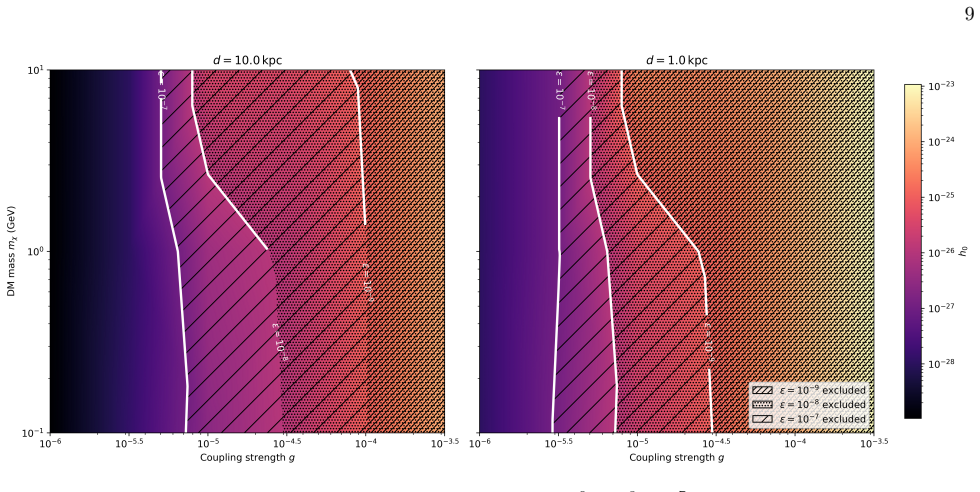
LIGO continuous-wave searches exclude self-interacting fermionic dark matter couplings g ≳ 10^{-5.5} for neutron stars with ellipticities of 10^{-7} at 1 kpc.
A machine-rendered reading of the paper's core claim, the machinery that carries it, and where it could break.
Core claim
The central claim is that the developed formalism maps dark-matter accumulation and anisotropic distribution inside a rapidly rotating neutron star to an increased ellipticity and gravitational-wave amplitude; when this amplitude is compared with the sensitivity of existing LIGO all-sky continuous-wave searches, large regions of the dark-matter mass versus self-interaction coupling parameter space are excluded, with the strongest limits ruling out couplings g ≳ 10^{-5.5} for ellipticities ε = 10^{-7} at 1 kpc and m_χ between 0.1 and 10 GeV.
What carries the argument
The formalism that converts dark-matter accumulation and anisotropic distribution into dark mountains, an increased moment of inertia, and a calculable continuous gravitational-wave amplitude.
If this is right
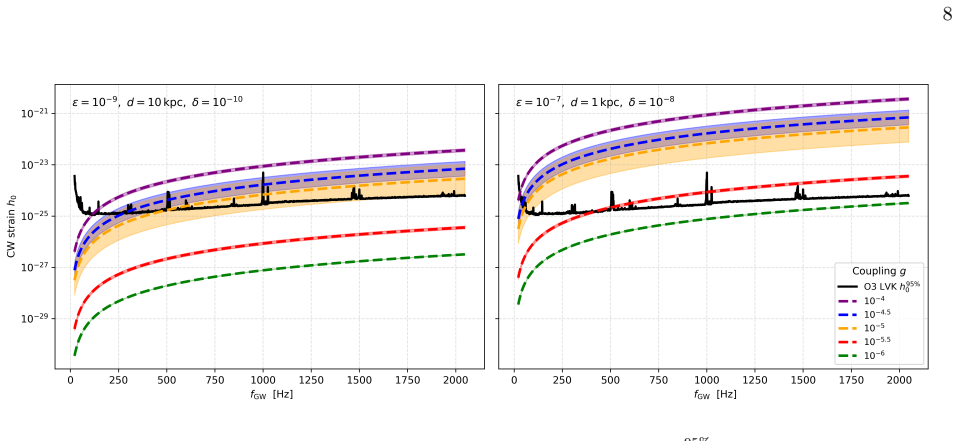
- Couplings g ≳ 10^{-4} are excluded even for the weaker ellipticity of 10^{-9} at 10 kpc.
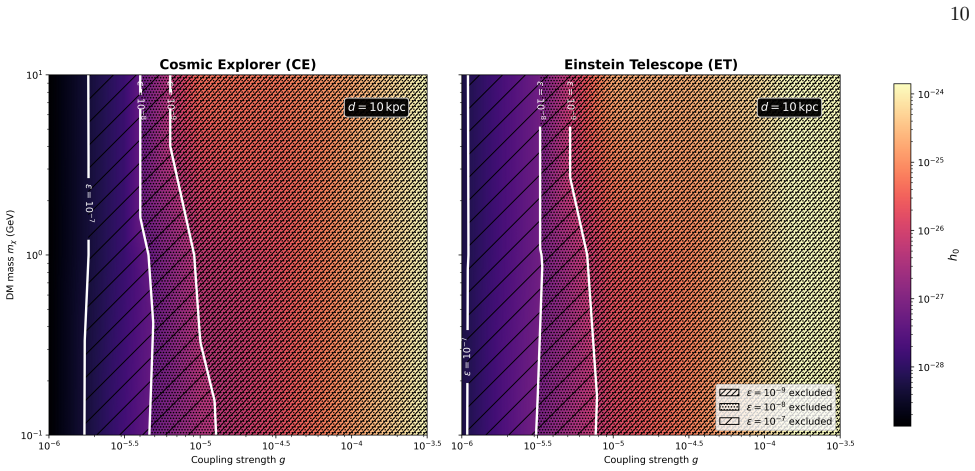
- Einstein Telescope and Cosmic Explorer will reach exclusions as strong as g ≳ 10^{-6} for the same ellipticity at 10 kpc.
- The same data set already rules out detectable signals across the full frequency range analyzed by LIGO for the considered dark-matter masses.
- Continuous-wave searches thereby become a direct probe of dark mountains sustained by dark-matter-admixed neutron stars.
Where Pith is reading between the lines
- The same modeling approach could be applied to other dark-matter candidates that produce anisotropic distributions inside neutron stars.
- Joint analysis with radio or X-ray observations of neutron-star rotation rates might further tighten the ellipticity bounds used here.
- If the dark-matter density profile inside the star deviates strongly from the assumed form, the derived coupling limits would shift by an amount comparable to the difference between the best and worst cases already quoted.
Load-bearing premise
The mapping from dark-matter parameters to the resulting gravitational-wave amplitude is accurate enough that non-detections in LIGO data can be read directly as exclusions on coupling strength without large extra uncertainties from the internal dark-matter density profile.
What would settle it
A confirmed continuous gravitational-wave detection from an isolated neutron star at 1 kpc with frequency in the LIGO band and ellipticity near 10^{-7} that is inconsistent with the excluded coupling values would falsify the reported exclusions.
Figures

read the original abstract
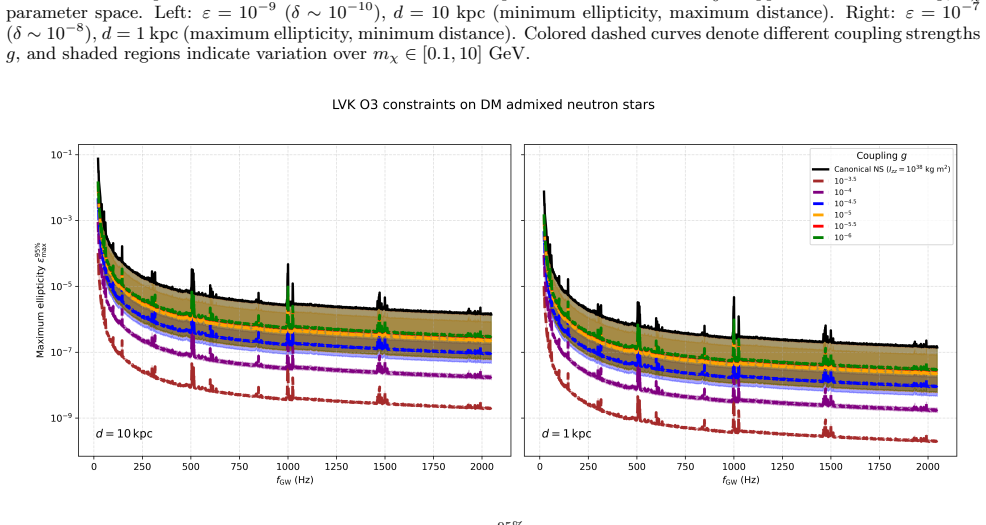
We investigate continuous gravitational-wave (CW) emission from rapidly rotating, non-axisymmetric, isolated neutron stars admixed with self-interacting fermionic dark matter (DM) and hosting DM-induced equatorial deformations (``dark mountains''). In particular, we develop a formalism that describes how DM accumulation inside the star changes its structure, how dark mountains arise from an anisotropic distribution of DM inside it, and how the star's moment of inertia and thus the amplitude of its GW emission is increased compared to that of an ordinary neutron star. Moreover, using results from all-sky searches for CWs from non-axisymmetric neutron stars performed with LIGO O3 data, we place the first constraints on the DM-induced ellipticities $\varepsilon$ of DM-admixed neutron stars across the full GW frequency range analyzed by LIGO and for a range of self-interaction strengths. With the same data, we also exclude portions of the DM-mass/self-interaction coupling strength parameter space that would have produced detectable GW signals in LIGO O3 data. We rule out at best (at worst) couplings $g\gtrsim10^{-5.5}$ ($g\gtrsim 10^{-4}$) for DM-admixed neutron stars with ellipticities $\varepsilon=10^{-7}$ ($\varepsilon=10^{-9}$) at distances $d=1$ ($d=10$) kpc away for DM masses of $m_\chi\in[0.1,10]$ GeV. Furthermore, we show that even larger regions of this parameter space will become accessible to next-generation detectors, such as Einstein Telescope and Cosmic Explorer, with exclusions as strong as $g\gtrsim10^{-6}$ for neutron stars located $d=10$ kpc away for $\varepsilon=10^{-7}$. Our results demonstrate that searches for CWs naturally provide a direct probe of dark mountains sustained by DM-admixed neutron stars.
Editorial analysis
A structured set of objections, weighed in public.
Referee Report
Summary. The paper develops a formalism describing how self-interacting fermionic dark matter accumulates in rapidly rotating neutron stars, produces anisotropic distributions leading to equatorial deformations ('dark mountains'), and increases the stellar moment of inertia, thereby enhancing continuous gravitational-wave (CW) emission. Using published upper limits from LIGO O3 all-sky CW searches for non-axisymmetric neutron stars, the authors derive the first constraints on the DM-induced ellipticity ε across the analyzed frequency range and exclude regions of the DM particle mass m_χ and self-interaction coupling g parameter space for assumed values of ε and source distance d, with exclusions as strong as g ≳ 10^{-5.5} for ε=10^{-7} at d=1 kpc; prospects for Einstein Telescope and Cosmic Explorer are also discussed.
Significance. If the mapping from (m_χ, g) to ε and GW strain is robust, the work establishes CW searches as a new probe of DM-admixed neutron stars and demonstrates that existing LIGO limits already constrain portions of the fermionic DM parameter space. The efficient reuse of published all-sky search results without requiring new data analysis is a methodological strength.
major comments (2)
- [formalism and constraints sections] The central exclusion bounds on g (abstract and § on constraints) rest on a specific mapping from DM self-interaction parameters to ellipticity ε via an assumed anisotropic DM density profile inside the star. The manuscript does not quantify how changes to this profile (e.g., different anisotropy parameters or self-consistent solutions of the fermionic EOS versus an imposed distribution) propagate into the predicted GW amplitude h_0 and the resulting excluded regions in the (m_χ, g) plane.
- [GW amplitude derivation] It is unclear whether the increased moment of inertia due to DM is inserted directly into the standard CW strain formula without additional model-dependent factors arising from modifications to the stellar rotation law or selection effects in the LIGO all-sky searches; this directly affects whether the quoted exclusions (e.g., g ≳ 10^{-5.5} for ε=10^{-7}) can be compared one-to-one with the published upper limits.
minor comments (2)
- [formalism] Notation for the DM density profile and anisotropy parameter should be defined explicitly at first use to improve readability.
- [parameter space] The range of m_χ ∈ [0.1,10] GeV is stated but the motivation for the lower and upper bounds could be clarified with a brief reference to existing DM constraints.
Simulated Author's Rebuttal
We thank the referee for their careful reading of the manuscript, positive assessment of its significance, and constructive comments. We address each major comment below and will incorporate clarifications and additional discussion in a revised version.
read point-by-point responses
-
Referee: [formalism and constraints sections] The central exclusion bounds on g (abstract and § on constraints) rest on a specific mapping from DM self-interaction parameters to ellipticity ε via an assumed anisotropic DM density profile inside the star. The manuscript does not quantify how changes to this profile (e.g., different anisotropy parameters or self-consistent solutions of the fermionic EOS versus an imposed distribution) propagate into the predicted GW amplitude h_0 and the resulting excluded regions in the (m_χ, g) plane.
Authors: We acknowledge that the exclusion bounds rely on the specific anisotropic DM density profile developed in the formalism section. The manuscript does not include a quantitative sensitivity study to variations in this profile. In the revised manuscript we will add a dedicated paragraph in the constraints section that states the adopted profile explicitly, discusses qualitatively how reasonable changes to the anisotropy parameter or EOS solution could shift the ellipticity and thus the excluded regions in the (m_χ, g) plane, and notes that a full parameter exploration lies beyond the scope of the present work. This will make the model assumptions and their implications transparent without altering the central results obtained under the chosen profile. revision: partial
-
Referee: [GW amplitude derivation] It is unclear whether the increased moment of inertia due to DM is inserted directly into the standard CW strain formula without additional model-dependent factors arising from modifications to the stellar rotation law or selection effects in the LIGO all-sky searches; this directly affects whether the quoted exclusions (e.g., g ≳ 10^{-5.5} for ε=10^{-7}) can be compared one-to-one with the published upper limits.
Authors: The GW strain is computed from the standard expression h_0 = (4π²G/c⁴)(I_DM ε f²/d), where I_DM is the moment of inertia of the DM-admixed star. The LIGO O3 all-sky CW searches supply upper limits on the emitted strain amplitude h_0 that are independent of the internal stellar model; they do not incorporate assumptions about the rotation law or moment of inertia. Consequently the comparison between our predicted h_0 and the published limits is direct. In the revised manuscript we will insert an explicit statement of the strain formula together with this justification in the constraints section, confirming that no additional model-dependent selection effects are applied. revision: yes
Circularity Check
No circularity: external LIGO limits applied to independent model
full rationale
The paper develops a formalism mapping DM parameters (g, m_χ) to ellipticity ε and GW strain h0 via DM accumulation and anisotropic density effects, then applies published LIGO O3 all-sky CW upper limits as external bounds to exclude regions of parameter space. No equation reduces a claimed prediction to a quantity fitted from the same LIGO data, no self-citation chain is load-bearing for the central mapping, and the derivation remains self-contained against the external search results.
Axiom & Free-Parameter Ledger
free parameters (4)
- DM self-interaction coupling g
- DM particle mass m_χ
- ellipticity ε
- distance d
axioms (2)
- domain assumption DM accumulation inside the neutron star changes its structure and produces an anisotropic distribution that creates equatorial deformations.
- domain assumption The DM-induced deformations increase the star's moment of inertia and thereby the amplitude of its continuous gravitational-wave emission.
invented entities (1)
-
dark mountains
no independent evidence
Reference graph
Works this paper leans on
-
[1]
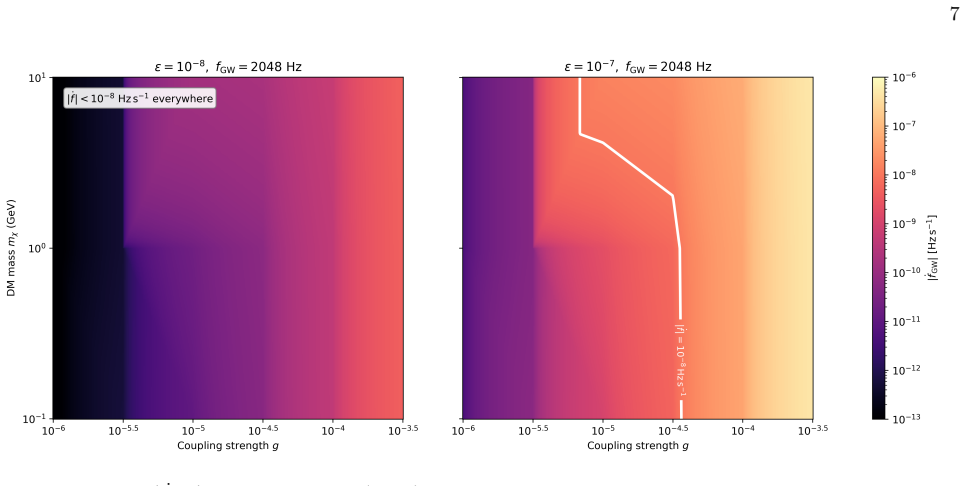
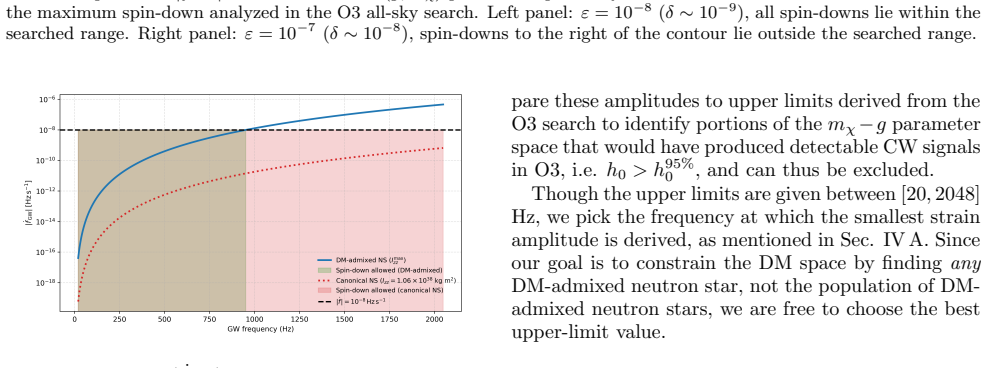
Verify whether the predicted spin-down from DM-admixed neutron stars lies within the spin- down range given in Eq. (4.1)
-
[2]
Cast theFrequency-Hough95% upper limits h95% 0 into the maximum detectable ellipticities on DM-admixed neutron stars for differentg, mχ
-
[3]
Identify regions of the parameter space (g, m χ) that would have produced a strain greater than the upper limits, which excludes the existence of DM-admixed neutron stars with those DM masses and self-interaction couplings. B. DM-admixed neutron-star spin-downs within the searched parameter space The spin-down rate of the neutron star depends onε andI zz ...
Pith/arXiv arXiv 2048
-
[4]
Recent searches for continuous gravitational waves,
K. Riles, “Recent searches for continuous gravitational waves,”Mod. Phys. Lett. A32no. 39, (2017) 1730035,arXiv:1712.05897 [gr-qc]
Pith/arXiv arXiv 2017
-
[5]
Status and Perspectives of Continuous Gravitational Wave Searches,
O. J. Piccinni, “Status and Perspectives of Continuous Gravitational Wave Searches,”Galaxies 10no. 3, (2022) 72,arXiv:2202.01088 [gr-qc]
arXiv 2022
-
[6]
Searches for continuous-wave gravitational radiation,
K. Riles, “Searches for continuous-wave gravitational radiation,”Living Rev. Rel.26no. 1, (2023) 3,arXiv:2206.06447 [astro-ph.HE]
arXiv 2023
-
[7]
Gravitational waves from freely precessing neutron stars,
D. I. Jones and N. Andersson, “Gravitational waves from freely precessing neutron stars,”Mon. Not. Roy. Astron. Soc.331(2002) 203, arXiv:gr-qc/0106094
Pith/arXiv arXiv 2002
-
[8]
Evidence for a Minimum Ellipticity in Millisecond Pulsars,
G. Woan, M. D. Pitkin, B. Haskell, D. I. Jones, and P. D. Lasky, “Evidence for a Minimum Ellipticity in Millisecond Pulsars,”Astrophys. J. Lett.863no. 2, (2018) L40,arXiv:1806.02822 [astro-ph.HE]
Pith/arXiv arXiv 2018
-
[9]
Superradiance: New Frontiers in Black Hole Physics,
R. Brito, V. Cardoso, and P. Pani, “Superradiance: New Frontiers in Black Hole Physics,”Lect. Notes Phys.906(2015) pp.1–237,arXiv:1501.06570 [gr-qc]
Pith/arXiv arXiv 2015
-
[10]
Gravitational wave searches for ultralight bosons with LIGO and LISA,
R. Brito, S. Ghosh, E. Barausse, E. Berti, V. Cardoso, I. Dvorkin, A. Klein, and P. Pani, “Gravitational wave searches for ultralight bosons with LIGO and LISA,”Phys. Rev. D96no. 6, (2017) 064050,arXiv:1706.06311 [gr-qc]
Pith/arXiv arXiv 2017
-
[11]
Searching for Dark Photon Dark Matter with Gravitational Wave Detectors,
A. Pierce, K. Riles, and Y. Zhao, “Searching for Dark Photon Dark Matter with Gravitational Wave Detectors,”Phys. Rev. Lett.121no. 6, (2018) 061102,arXiv:1801.10161 [hep-ph]
Pith/arXiv arXiv 2018
-
[12]
Novel signatures of dark matter in laser-interferometric gravitational-wave detectors,
H. Grote and Y. V. Stadnik, “Novel signatures of dark matter in laser-interferometric gravitational-wave detectors,”Phys. Rev. Res.1 no. 3, (2019) 033187,arXiv:1906.06193 [astro-ph.IM]
arXiv 2019
-
[13]
Ultralight vector dark matter search with auxiliary length channels of gravitational wave detectors,
Y. Michimura, T. Fujita, S. Morisaki, H. Nakatsuka, and I. Obata, “Ultralight vector dark matter search with auxiliary length channels of gravitational wave detectors,”Phys. Rev. D102no. 10, (2020) 102001, arXiv:2008.02482 [hep-ph]
arXiv 2020
-
[14]
Searching for spin-2 ULDM with gravitational waves interferometers,
J. M. Armaleo, D. L. Nacir, and F. R. Urban, “Searching for spin-2 ULDM with gravitational waves interferometers,”JCAP04(2021) 053, arXiv:2012.13997 [astro-ph.CO]
arXiv 2021
-
[15]
Advanced LIGO, LISA, and Cosmic Explorer as dark matter transducers,
E. Hall and N. Aggarwal, “Advanced LIGO, LISA, and Cosmic Explorer as dark matter transducers,” arXiv:2210.17487 [hep-ex]
-
[16]
Probing planetary-mass primordial black holes with continuous gravitational waves,
A. L. Miller, S. Clesse, F. De Lillo, G. Bruno, A. Depasse, and A. Tanasijczuk, “Probing planetary-mass primordial black holes with continuous gravitational waves,”Phys. Dark Univ. 32(2021) 100836,arXiv:2012.12983 [astro-ph.HE]
arXiv 2021
-
[17]
Gravitational waves from sub-solar mass primordial black holes,
A. L. Miller, “Gravitational waves from sub-solar mass primordial black holes,”arXiv:2404.11601 [gr-qc]. [18]KAGRA, LIGO Scientific, VIRGO Collaboration, R. Abbottet al., “All-sky search for continuous gravitational waves from isolated neutron stars using Advanced LIGO and Advanced Virgo O3 data,”Phys. Rev. D106no. 10, (2022) 102008,arXiv:2201.00697 [gr-qc]
arXiv 2022
-
[18]
Deep Einstein@Home All-sky Search for Continuous Gravitational Waves in LIGO O3 Public Data,
B. Steltner, M. A. Papa, H. B. Eggenstein, R. Prix, M. Bensch, B. Allen, and B. Machenschalk, “Deep Einstein@Home All-sky Search for Continuous Gravitational Waves in LIGO O3 Public Data,” Astrophys. J.952no. 1, (2023) 55, arXiv:2303.04109 [gr-qc]
arXiv 2023
-
[19]
P. B. Covas, M. A. Papa, and R. Prix, “Search for Continuous Gravitational Waves from Unknown Neutron Stars in Binary Systems with Long Orbital Periods in O3 Data,”Astrophys. J.985no. 2, (2025) 192,arXiv:2409.16196 [gr-qc]. [21]LIGO Scientific, VIRGO, KAGRA Collaboration, A. G. Abacet al., “Search for Continuous Gravitational Waves from Known Pulsars in t...
arXiv 2025
-
[20]
High-frequency Continuous Gravitational Wave Search in LIGO O3 Public Data with Einstein@Home,
B. McGloughlin, B. Steltner, J. Martins, M. A. Papa, H.-B. Eggenstein, J. Ming, B. Machenschalk, R. Prix, and M. Bensch, “High-frequency Continuous Gravitational Wave Search in LIGO O3 Public Data with Einstein@Home,”Astrophys. J. 998no. 2, (2026) 205,arXiv:2508.20073 [gr-qc]
arXiv 2026
-
[21]
B. McGloughlin, J. Martins, B. Steltner, M. A. Papa, H.-B. Eggenstein, B. Machenschalk, R. Prix, and M. Bensch, “Einstein@Home All-sky “Bucket” Search for Continuous Gravitational Waves in LIGO O3a Public Data,”Astrophys. J.997no. 2, (2026) 149,arXiv:2508.16423 [gr-qc]
arXiv 2026
-
[22]
J. Ming, M. A. Papa, H.-B. Eggenstein, B. Machenschalk, J. Martins, B. Steltner, B. McGloughlin, V. Dergachev, R. Prix, and M. Bensch, “Observational constraints on the spin/anisotropy of the CCOs of Cassiopeia A, Vela Jr. and G347.3-0.5 and a single surviving continuous gravitational wave candidate,”arXiv:2512.15672 [gr-qc]
-
[23]
Einstein@Home Searches for Gamma-Ray Pulsars in the Inner Galaxy,
C. J. Clarket al., “Einstein@Home Searches for Gamma-Ray Pulsars in the Inner Galaxy,” Astrophys. J.994no. 2, (2025) 149, arXiv:2509.21307 [astro-ph.HE]
arXiv 2025
-
[24]
Early release of low-frequency atlas of continuous gravitational waves,
V. Dergachev and M. A. Papa, “Early release of low-frequency atlas of continuous gravitational waves,”Phys. Rev. D113no. 4, (2026) 042001, arXiv:2507.12161 [gr-qc]
arXiv 2026
-
[25]
P. B. Covas, M. A. Papa, and R. Prix, “Wide parameter-space O3 search for continuous gravitational waves from unknown neutron stars in binary systems,”arXiv:2605.14728 [gr-qc]
-
[26]
Searching for Dark Photon Dark Matter in LIGO O1 Data,
H.-K. Guo, K. Riles, F.-W. Yang, and Y. Zhao, “Searching for Dark Photon Dark Matter in LIGO O1 Data,”Commun. Phys.2(2019) 155, arXiv:1905.04316 [hep-ph]
arXiv 2019
-
[27]
Axion Dark Matter Search with Interferometric Gravitational Wave Detectors,
K. Nagano, T. Fujita, Y. Michimura, and I. Obata, “Axion Dark Matter Search with Interferometric Gravitational Wave Detectors,”Phys. Rev. Lett. 123no. 11, (2019) 111301,arXiv:1903.02017 [hep-ph]
arXiv 2019
-
[28]
A. L. Milleret al., “Probing new light gauge bosons with gravitational-wave interferometers using an adapted semicoherent method,”Phys. Rev. D103 no. 10, (2021) 103002,arXiv:2010.01925 [astro-ph.IM]
arXiv 2021
-
[29]
Direct limits for scalar field dark matter from a gravitational-wave detector,
S. M. Vermeulenet al., “Direct limits for scalar field dark matter from a gravitational-wave detector,” Nature600no. 7889, (2021) 424–428. [33]LIGO Scientific, Virgo, KAGRACollaboration, A. L. Miller, F. Badaracco, and C. Palomba, “Distinguishing between dark-matter interactions with gravitational-wave detectors,”Phys. Rev. D 105no. 10, (2022) 103035,arXi...
arXiv 2021
-
[30]
Exploring the spin of ultralight dark matter with gravitational wave detectors,
Y. Manita, H. Takeda, K. Aoki, T. Fujita, and S. Mukohyama, “Exploring the spin of ultralight dark matter with gravitational wave detectors,” Phys. Rev. D109no. 9, (10, 2024) 095012, arXiv:2310.10646 [hep-ph]
arXiv 2024
-
[31]
Searching for Scalar Field Dark Matter with LIGO,
A. S. G¨ ottel, A. Ejlli, K. Karan, S. M. Vermeulen, L. Aiello, V. Raymond, and H. Grote, “Searching for Scalar Field Dark Matter with LIGO,”Phys. Rev. Lett.133no. 10, (2024) 101001, arXiv:2401.18076 [astro-ph.CO]. [36]KAGRA, LIGO Scientific, VIRGO Collaboration, A. G. Abacet al., “Ultralight vector dark matter search using data from the KAGRA O3GK run,”P...
arXiv 2024
-
[32]
S. D’Antonioet al., “Semicoherent analysis method to search for continuous gravitational waves emitted by ultralight boson clouds around spinning black holes,”Phys. Rev. D98no. 10, (2018) 103017, arXiv:1809.07202 [gr-qc]. [39]LIGO Scientific, Virgo, KAGRACollaboration, R. Abbottet al., “All-sky search for gravitational wave emission from scalar boson clou...
Pith/arXiv arXiv 2018
-
[33]
A. L. Miller, N. Aggarwal, S. Clesse, and F. De Lillo, “Constraints on planetary and asteroid-mass primordial black holes from continuous gravitational-wave searches,”Phys. Rev. D105 no. 6, (2022) 062008,arXiv:2110.06188 [gr-qc]
arXiv 2022
-
[34]
Gravitational Wave Constraints on Planetary-Mass Primordial Black Holes Using LIGO O3a Data,
A. L. Miller, N. Aggarwal, S. Clesse, F. De Lillo, S. Sachdev, P. Astone, C. Palomba, O. J. Piccinni, and L. Pierini, “Gravitational Wave Constraints on Planetary-Mass Primordial Black Holes Using LIGO O3a Data,”Phys. Rev. Lett.133no. 11, (2024) 111401,arXiv:2402.19468 [gr-qc]. [43]LIGO Scientific, VIRGO, KAGRA Collaboration, A. G. Abacet al., “Search for...
arXiv 2024
-
[35]
Deformations of accreting neutron star crusts and gravitational wave emission,
G. Ushomirsky, C. Cutler, and L. Bildsten, “Deformations of accreting neutron star crusts and gravitational wave emission,”Mon. Not. Roy. Astron. Soc.319(2000) 902, arXiv:astro-ph/0001136
Pith/arXiv arXiv 2000
-
[36]
Gravitational waves from neutron stars with large toroidal B fields,
C. Cutler, “Gravitational waves from neutron stars with large toroidal B fields,”Phys. Rev. D66 (2002) 084025,arXiv:gr-qc/0206051
Pith/arXiv arXiv 2002
-
[37]
Detectability of Continuous Gravitational Waves from Magnetically Deformed Neutron Stars,
J. Soldateschi and N. Bucciantini, “Detectability of Continuous Gravitational Waves from Magnetically Deformed Neutron Stars,”Galaxies9no. 4, (2021) 101,arXiv:2110.06039 [astro-ph.HE]
arXiv 2021
-
[38]
A. Biryukov, P. Abolmasov, and A. Levinson, “Rotational Evolution of Deformed Magnetized Neutron Stars: Implications for Obliquity Distribution and Braking Indices Statistics,” Astrophys. J.995no. 2, (2025) 167, arXiv:2508.01721 [astro-ph.HE]
arXiv 2025
-
[39]
Y. Gao, L. Shao, R. Xu, L. Sun, C. Liu, and R.-X. Xu, “Triaxially-deformed Freely-precessing Neutron Stars: Continuous electromagnetic and gravitational radiation,”Mon. Not. Roy. Astron. Soc.498no. 2, (2020) 1826–1838,arXiv:2007.02528 [astro-ph.HE]
arXiv 2020
-
[40]
Gravitational radiation and rotation of accreting neutron stars,
L. Bildsten, “Gravitational radiation and rotation of accreting neutron stars,”Astrophys. J. Lett.501 (1998) L89,arXiv:astro-ph/9804325
Pith/arXiv arXiv 1998
-
[41]
Gravitational waves from accreting neutron stars,
A. Melatos, “Gravitational waves from accreting neutron stars,”Adv. Space Res.40(2007) 1472–1479. 13
2007
-
[42]
A New class of unstable modes of rotating relativistic stars,
N. Andersson, “A New class of unstable modes of rotating relativistic stars,”Astrophys. J.502(1998) 708–713,arXiv:gr-qc/9706075
Pith/arXiv arXiv 1998
-
[43]
Gravitational waves from r-mode oscillations of stochastically accreting neutron stars,
W. Dong and A. Melatos, “Gravitational waves from r-mode oscillations of stochastically accreting neutron stars,”Mon. Not. Roy. Astron. Soc.537 no. 2, (2025) 650–660,arXiv:2501.04968 [astro-ph.HE]
arXiv 2025
-
[44]
Continuous gravitational waves: A new window to look for heavy nonannihilating dark matter,
S. Bhattacharya, A. L. Miller, and A. Ray, “Continuous gravitational waves: A new window to look for heavy nonannihilating dark matter,”Phys. Rev. D110(2024) 043006,arXiv:2403.13886 [hep-ph]
arXiv 2024
-
[45]
Searching for continuous gravitational waves from highly deformed compact objects with DECIGO,
A. L. Miller and F. De Lillo, “Searching for continuous gravitational waves from highly deformed compact objects with DECIGO,”Phys. Rev. D112 no. 4, (2025) 042001,arXiv:2503.03748 [gr-qc]
arXiv 2025
-
[46]
G. Pagliaro, M. A. Papa, J. Ming, and M. Muratore, “Searching for continuous gravitational waves from slowly spinning neutron stars with DECIGO, Big Bang Observer, Einstein Telescope, and Cosmic Explorer,”Mon. Not. Roy. Astron. Soc.540no. 1, (2025) 1006–1016, arXiv:2503.17087 [astro-ph.HE]
arXiv 2025
-
[47]
G. Prabhu, A. K. Sharma, R. Prasad, and S. J. Kapadia, “Constraining the Abundance of Spinning Deformed Galactic Compact Objects with Continuous Gravitational Waves,”Astrophys. J. 971no. 2, (2024) 135,arXiv:2403.00502 [gr-qc]
arXiv 2024
-
[48]
On the capture of dark matter by neutron stars,
T. G¨ uver, A. E. Erkoca, M. Hall Reno, and I. Sarcevic, “On the capture of dark matter by neutron stars,”JCAP05(2014) 013, arXiv:1201.2400 [hep-ph]
Pith/arXiv arXiv 2014
-
[49]
Effects of fermionic dark matter on properties of neutron stars,
Q.-F. Xiang, W.-Z. Jiang, D.-R. Zhang, and R.-Y. Yang, “Effects of fermionic dark matter on properties of neutron stars,”Phys. Rev. C89no. 2, (2014) 025803,arXiv:1305.7354 [astro-ph.SR]
Pith/arXiv arXiv 2014
-
[50]
Neutron Stars and Dark Matter,
A. Del Popolo, M. Le Delliou, and M. Deliyergiyev, “Neutron Stars and Dark Matter,”Universe6 no. 12, (2020) 222,arXiv:2410.06078 [astro-ph.CO]
arXiv 2020
-
[51]
Compact Stars as Dark Matter Probes,
G. Bertone and M. Fairbairn, “Compact Stars as Dark Matter Probes,”Phys. Rev. D77(2008) 043515,arXiv:0709.1485 [astro-ph]
Pith/arXiv arXiv 2008
-
[52]
Constraining dark matter properties with the first generation of stars,
C. Ilie, C. Levy, J. Pilawa, and S. Zhang, “Constraining dark matter properties with the first generation of stars,”Phys. Rev. D104no. 12, (2021) 123031,arXiv:2009.11474 [astro-ph.CO]
arXiv 2021
-
[53]
Impact of dark matter on tidal signatures in neutron star mergers with the Einstein Telescope,
H. Koehn, E. Giangrandi, N. Kunert, R. Somasundaram, V. Sagun, and T. Dietrich, “Impact of dark matter on tidal signatures in neutron star mergers with the Einstein Telescope,” Phys. Rev. D110no. 10, (2024) 103033, arXiv:2408.14711 [astro-ph.HE]
arXiv 2024
-
[54]
Dark-matter admixed neutron stars,
S. C. Leung, M. C. Chu, and L. M. Lin, “Dark-matter admixed neutron stars,”Phys. Rev. D 84(2011) 107301,arXiv:1111.1787 [astro-ph.CO]
Pith/arXiv arXiv 2011
-
[55]
Review of asymmetric dark matter,
K. Petraki and R. R. Volkas, “Review of asymmetric dark matter,”Int. J. Mod. Phys. A28 (2013) 1330028,arXiv:1305.4939 [hep-ph]
Pith/arXiv arXiv 2013
-
[56]
Asymmetric dark matter stars,
C. Kouvaris and N. G. Nielsen, “Asymmetric dark matter stars,”Physical Review D92no. 6, (Sept.,
-
[57]
http://dx.doi.org/10.1103/PhysRevD.92.063526
-
[58]
S. Mukhopadhyay, D. Atta, K. Imam, D. N. Basu, and C. Samanta, “Compact bifluid hybrid stars: Hadronic Matter mixed with self-interacting fermionic Asymmetric Dark Matter,”Eur. Phys. J. C77no. 7, (2017) 440,arXiv:1612.07093 [nucl-th]. [Erratum: Eur.Phys.J.C 77, 553 (2017)]
Pith/arXiv arXiv 2017
-
[59]
Dark Matter Effects On Neutron Star Properties,
J. Ellis, G. H¨ utsi, K. Kannike, L. Marzola, M. Raidal, and V. Vaskonen, “Dark Matter Effects On Neutron Star Properties,”Phys. Rev. D97 no. 12, (2018) 123007,arXiv:1804.01418 [astro-ph.CO]
Pith/arXiv arXiv 2018
-
[60]
Constraints on the fermionic dark matter from observations of neutron stars,
V. Sagun, E. Giangrandi, O. Ivanytskyi, I. Lopes, and K. A. Bugaev, “Constraints on the fermionic dark matter from observations of neutron stars,” PoSPANIC2021(2022) 313,arXiv:2111.13289 [astro-ph.HE]
arXiv 2022
-
[61]
P. Bhattacharjee and A. Dutta Banik, “Confronting the dark matter capture rate with a continuous gravitational wave probe of local neutron stars,” Phys. Rev. D111no. 4, (2025) 043009, arXiv:2404.15038 [astro-ph.HE]
arXiv 2025
-
[62]
Cooling of Dark-Matter Admixed Neutron Stars with density-dependent Equation of State,
S. A. Bhat and A. Paul, “Cooling of Dark-Matter Admixed Neutron Stars with density-dependent Equation of State,”Eur. Phys. J. C80no. 6, (2020) 544,arXiv:1905.12483 [hep-ph]
arXiv 2020
-
[63]
A. Das, T. Malik, and A. C. Nayak, “Dark matter admixed neutron star properties in light of gravitational wave observations: A two fluid approach,”Phys. Rev. D105no. 12, (2022) 123034, arXiv:2011.01318 [nucl-th]
arXiv 2022
-
[64]
Continuous Gravitational Wave Emissions from Neutron Stars with Pinned Superfluids in the Core,
B. Haskell, M. Antonelli, and P. Pizzochero, “Continuous Gravitational Wave Emissions from Neutron Stars with Pinned Superfluids in the Core,” Universe8no. 12, (2022) 619,arXiv:2211.15507 [astro-ph.HE]
arXiv 2022
-
[65]
Inferring neutron star properties with continuous gravitational waves,
N. Lu, K. Wette, S. M. Scott, and A. Melatos, “Inferring neutron star properties with continuous gravitational waves,”Mon. Not. Roy. Astron. Soc. 521no. 2, (2023) 2103–2113,arXiv:2209.10981 [gr-qc]
arXiv 2023
-
[66]
F. Grippa, G. Lambiase, and T. K. Poddar, “Searching for New Physics in an Ultradense Environment: A Review on Dark Matter Admixed Neutron Stars,”Universe11no. 3, (2025) 74, arXiv:2412.09381 [astro-ph.HE]
arXiv 2025
-
[67]
R-modes as a new probe of dark matter in neutron stars,
S. Shirke, S. Ghosh, D. Chatterjee, L. Sagunski, and J. Schaffner-Bielich, “R-modes as a new probe of dark matter in neutron stars,”JCAP12(2023) 008, arXiv:2305.05664 [astro-ph.HE]
arXiv 2023
-
[68]
Type Ia supernovae from dark matter core collapse,
R. Janish, V. Narayan, and P. Riggins, “Type Ia supernovae from dark matter core collapse,”Phys. Rev. D100no. 3, (2019) 035008,arXiv:1905.00395 [hep-ph]
arXiv 2019
-
[69]
Implications of Fermionic Dark Matter Interactions on Anisotropic Neutron Stars,
P. Mahapatra, C. Singha, A. Hazarika, and P. K. Das, “Implications of Fermionic Dark Matter Interactions on Anisotropic Neutron Stars,” Astrophys. J.985no. 1, (2025) 74, arXiv:2408.14020 [astro-ph.CO]
arXiv 2025
-
[70]
X.-Z. Liu, P. Mahapatra, C. Huang, A. Hazarika, C. Singha, and P. K. Das, “Revealing dark matter’s role in neutron stars anisotropy: A Bayesian approach using multimessenger observations,”Phys. Rev. D112no. 8, (2025) 083032,arXiv:2506.08376 [astro-ph.HE]
arXiv 2025
-
[71]
S. W. Randall, M. Markevitch, D. Clowe, A. H. Gonzalez, and M. Bradaˇ c, “Constraints on the self-interaction cross section of dark matter from numerical simulations of the merging galaxy cluster 1e 0657−56,”The Astrophysical Journal679no. 2, (June, 2008) 1173–1180. http://dx.doi.org/10.1086/587859
-
[72]
Dark Matter Self-interactions and Small Scale Structure,
S. Tulin and H.-B. Yu, “Dark Matter Self-interactions and Small Scale Structure,”Phys. Rept.730(2018) 1–57,arXiv:1705.02358 [hep-ph]. 14 [81]XENONCollaboration, E. Aprileet al., “Dark Matter Search Results from a One Ton-Year Exposure of XENON1T,”Phys. Rev. Lett.121 no. 11, (2018) 111302,arXiv:1805.12562 [astro-ph.CO]. [82]DarkSideCollaboration, P. Agnese...
Pith/arXiv arXiv 2018
-
[73]
M. Markevitch, A. H. Gonzalez, D. Clowe, A. Vikhlinin, L. David, W. Forman, C. Jones, S. Murray, and W. Tucker, “Direct constraints on the dark matter self-interaction cross-section from the merging galaxy cluster 1E0657-56,”Astrophys. J.606(2004) 819–824,arXiv:astro-ph/0309303. https://iopscience.iop.org/article/10.1086/ 383178/pdf
Pith/arXiv arXiv 2004
-
[74]
M. Kaplinghat, S. Tulin, and H.-B. Yu, “Dark Matter Halos as Particle Colliders: Unified Solution to Small-Scale Structure Puzzles from Dwarfs to Clusters,”Phys. Rev. Lett.116no. 4, (2016) 041302,arXiv:1508.03339 [astro-ph.CO]
Pith/arXiv arXiv 2016
-
[75]
Bounds on self-interacting fermion dark matter from observations of old neutron stars,
J. Bramante, K. Fukushima, J. Kumar, and E. Stopnitzky, “Bounds on self-interacting fermion dark matter from observations of old neutron stars,” Phys. Rev. D89no. 1, (2014) 015010, arXiv:1310.3509 [hep-ph]
Pith/arXiv arXiv 2014
-
[76]
A. Guha and D. Sen, “Constraining the mass of fermionic dark matter from its feeble interaction with hadronic matter via dark mediators in neutron stars,”Phys. Rev. D109no. 4, (2024) 043038, arXiv:2401.14419 [astro-ph.HE]
arXiv 2024
-
[77]
M. Mariani, C. Albertus, M. del Rosario Alessandroni, M. G. Orsaria, M. A. Perez-Garcia, and I. F. Ranea-Sandoval, “Constraining self-interacting fermionic dark matter in admixed neutron stars using multimessenger astronomy,”Mon. Not. Roy. Astron. Soc.527no. 3, (2024) 6795–6806,arXiv:2311.14004 [astro-ph.HE]. [88]ETCollaboration, M. Maggioreet al., “Scien...
arXiv 2024
-
[78]
Science with the Einstein Telescope: a comparison of different designs,
M. Branchesiet al., “Science with the Einstein Telescope: a comparison of different designs,”JCAP 07(2023) 068,arXiv:2303.15923 [gr-qc]. [90]ETCollaboration, A. Abacet al., “The Science of the Einstein Telescope,”arXiv:2503.12263 [gr-qc]
Pith/arXiv arXiv 2023
-
[79]
Cosmic Explorer: The U.S. Contribution to Gravitational-Wave Astronomy beyond LIGO,
D. Reitzeet al., “Cosmic Explorer: The U.S. Contribution to Gravitational-Wave Astronomy beyond LIGO,”Bull. Am. Astron. Soc.51no. 7, (2019) 035,arXiv:1907.04833 [astro-ph.IM]
Pith/arXiv arXiv 2019
-
[80]
Cosmic Explorer: A Submission to the NSF MPSAC ngGW Subcommittee,
M. Evanset al., “Cosmic Explorer: A Submission to the NSF MPSAC ngGW Subcommittee,” arXiv:2306.13745 [astro-ph.IM]
discussion (0)
Sign in with ORCID, Apple, or X to comment. Anyone can read and Pith papers without signing in.