Automated Mediator for Human Negotiation: Pre-Mediation via a Structured LLM Pipeline
Pith reviewed 2026-06-27 12:58 UTC · model grok-4.3
The pith
A structured LLM pipeline prepares negotiators with outcomes comparable to human mediators while making fewer preference-inference errors.
A machine-rendered reading of the paper's core claim, the machinery that carries it, and where it could break.
Core claim
The automated mediator, built as a structured pipeline of LLM modules for dialogue, preference prediction, response-level critique, and structured summarization, achieves preparation outcomes broadly comparable to professional human mediators on short-term self-reported measures such as trust in the mediator and confidence in reaching mutually beneficial agreements, while attaining substantially lower error on the preference-inference task under the tested scenario and prompts.
What carries the argument
A fixed forward-sequence pipeline of LLM modules that separates dialogue handling, preference prediction, response-level critique, and structured summarization.
If this is right
- Scalable pre-mediation support becomes feasible without requiring trained human mediators for every session.
- The single-party design allows the same pipeline to run in parallel for every party in a dispute.
- Targeted prompt refinements can reduce excessive affirmation patterns from 36.6 percent to 16.8 percent, matching human mediator levels.
- Preparation can be delivered at low cost and effort while still producing measurable gains in confidence and preference understanding.
Where Pith is reading between the lines
- The same modular separation of inference, generation, and evaluation steps could be tested in other multi-party decision settings such as resource allocation or policy bargaining.
- Connecting the pre-mediation output directly to a live negotiation interface might reduce the gap between preparation and actual talks.
- Repeated use across multiple sessions could reveal whether short-term trust gains persist and affect final agreement quality.
Load-bearing premise
Short-term self-reported measures from one controlled multi-issue scenario accurately reflect real-world pre-mediation effectiveness and the pipeline will generalize across domains and user populations.
What would settle it
A follow-up experiment in a different negotiation domain or with long-term outcome tracking that finds lower trust scores or higher preference-inference error for the automated mediator than for human mediators would falsify the comparability claim.
Figures



read the original abstract
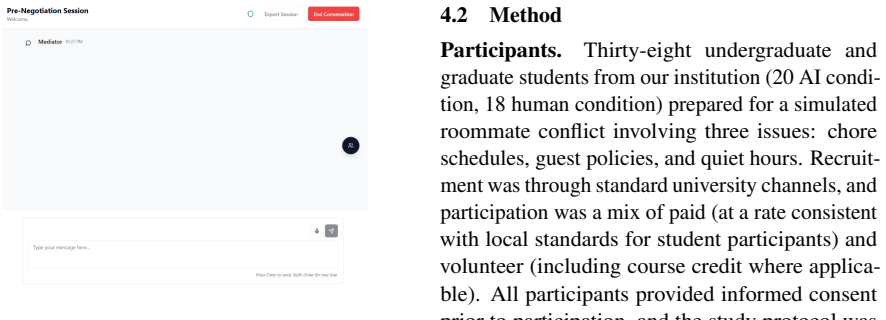
Pre-mediation, the preparatory phase preceding direct human negotiation, plays a critical role in achieving mutually beneficial agreements, yet is often omitted due to cost, time, and limited access to trained mediators. We introduce an automated mediator for human negotiation, implemented as a structured pipeline of LLM modules, that supports pre-mediation in integrative negotiation settings. The pipeline decomposes preparation into specialized modules for dialogue, preference prediction, response-level critique, and structured summarization, separating inference, generation, and evaluation to address limitations of monolithic single-prompt approaches. We use the term "agent" for each module following common LLM-systems terminology, but the components are not autonomous and do not interact peer-to-peer; outputs are passed forward in a fixed sequence. We evaluate the system in two controlled human-subject experiments comparing AI-based pre-mediation with professional human mediators in a multi-issue negotiation scenario. On short-term self-reported measures, the automated mediator achieves preparation outcomes broadly comparable to human mediators, including trust in the mediator and confidence in reaching mutually beneficial agreements, while achieving substantially lower error on the preference-inference task under our scenario and prompts (36% lower RMSE). A second study shows that targeted prompt refinements reduce excessive affirmation patterns from 36.6% to 16.8%, matching human mediator baselines. Our findings suggest that structured LLM pipelines can provide scalable, low-effort pre-mediation support broadly comparable to human mediators on short-term self-reported preparation outcomes. The pipeline's single-party design mirrors how human mediators run pre-mediation today and enables parallel deployment across all parties to a dispute, supporting scalability.
Editorial analysis
A structured set of objections, weighed in public.
Referee Report
Summary. The paper introduces a structured pipeline of LLM modules for automated pre-mediation in integrative human negotiations, decomposing the task into sequential modules for dialogue, preference prediction, response-level critique, and structured summarization. It evaluates the system via two controlled human-subject experiments against professional human mediators in a multi-issue scenario, claiming broadly comparable outcomes on short-term self-reported trust in the mediator and confidence in reaching mutually beneficial agreements, a 36% lower RMSE on preference inference, and (after prompt refinements) a reduction in excessive affirmation from 36.6% to 16.8% matching human baselines. The work concludes that such pipelines can provide scalable pre-mediation support on these short-term self-reported preparation outcomes.
Significance. If the results hold, the work offers a practical demonstration of how separating inference, generation, and evaluation in LLM pipelines can support a high-value social task that is often skipped due to cost and access barriers. The direct head-to-head comparison with professional human mediators in human-subject experiments, combined with concrete quantitative metrics on preference inference and affirmation patterns, provides a grounded basis for assessing the approach. The explicit scoping of claims to short-term self-reported measures and a single scenario is a strength that avoids overgeneralization.
major comments (1)
- [Evaluation] Evaluation (experiments): The central claim of 'broadly comparable' preparation outcomes rests on self-reported trust/confidence and RMSE metrics, yet the manuscript does not report sample sizes, statistical tests for equivalence (or non-inferiority), effect sizes, or confidence intervals for the human-AI comparisons. This makes it difficult to assess whether the observed similarities are statistically supported or merely consistent with the data.
minor comments (2)
- [Introduction] The abstract and introduction would benefit from a brief table or bullet list summarizing the pipeline modules and their inputs/outputs to improve readability of the structured approach.
- [Pipeline description] The paper correctly clarifies that the modules are not autonomous peer-to-peer agents but a fixed sequential pipeline; a simple flowchart would further aid readers in following the data flow.
Simulated Author's Rebuttal
We thank the referee for their constructive feedback and recommendation for major revision. We address the single major comment below and will revise the manuscript accordingly to strengthen the statistical reporting.
read point-by-point responses
-
Referee: [Evaluation] Evaluation (experiments): The central claim of 'broadly comparable' preparation outcomes rests on self-reported trust/confidence and RMSE metrics, yet the manuscript does not report sample sizes, statistical tests for equivalence (or non-inferiority), effect sizes, or confidence intervals for the human-AI comparisons. This makes it difficult to assess whether the observed similarities are statistically supported or merely consistent with the data.
Authors: We agree that the manuscript should report sample sizes, statistical tests (including equivalence or non-inferiority tests where appropriate), effect sizes, and confidence intervals to rigorously support the comparability claims. In the revised manuscript we will add the exact sample sizes from both experiments, report the results of statistical tests for the key self-reported outcomes and RMSE metric (e.g., equivalence testing via TOST or standard t-tests with effect sizes such as Cohen's d), and include 95% confidence intervals for all human-AI differences. These additions will allow readers to evaluate whether the observed similarities are statistically supported. revision: yes
Circularity Check
No circularity; claims rest on direct human-subject experiments vs. human mediators
full rationale
The paper evaluates its LLM pipeline via two controlled human-subject experiments that directly compare short-term self-reported outcomes and RMSE on preference inference against professional human mediators. No equations, fitted parameters renamed as predictions, self-definitional constructs, or load-bearing self-citations appear in the derivation of the main claims. The evaluation metrics are externally measured against human baselines rather than derived from the system's own outputs or prior author work.
Axiom & Free-Parameter Ledger
Reference graph
Works this paper leans on
-
[1]
Yihong Dong, Xue Jiang, Zhi Jin, and Ge Li
What do people value when they negoti- ate?Journal of Personality and Social Psychology, 91(3):493–512. Yihong Dong, Xue Jiang, Zhi Jin, and Ge Li. 2023. Self-collaboration code generation via chatgpt.arXiv preprint arXiv:2304.07590. 9 Roger Fisher, William L. Ury, and Bruce Patton. 1991. Getting to Yes: Negotiating Agreement Without Giv- ing In, 2 editio...
arXiv 2023
-
[2]
Ryo Kamoi, Yusen Zhang, Nan Zhang, Jiawei Han, and Rui Zhang
Assistive large language model agents for socially-aware negotiation dialogues.arXiv preprint arXiv:2402.01737. Ryo Kamoi, Yusen Zhang, Nan Zhang, Jiawei Han, and Rui Zhang. 2024. When can LLMs actu- ally correct their own mistakes? A critical sur- vey of self-correction of LLMs.arXiv preprint arXiv:2406.01297. John Lande. 2022. The critical importance of...
arXiv 2024
-
[3]
Decision Support Systems, 60:1–9
Training with automated agents improves peo- ple’s behavior in negotiation and coordination tasks. Decision Support Systems, 60:1–9. Aman Madaan and 1 others. 2023. Self-refine: Itera- tive refinement with self-feedback. InAdvances in Neural Information Processing Systems, volume 36. N. McAleese and 1 others. 2024. Llm critics help catch llm bugs.arXiv pr...
Pith/arXiv arXiv 2023
-
[4]
A dynamic strategy coach for effective negoti- ation.arXiv preprint arXiv:1909.13426. He Zhu, Wenjia Zhang, Nuoxian Huang, Boyang Li, Luyao Niu, Zipei Fan, Tianle Lun, Yicheng Tao, Junyou Su, Zhaoya Gong, and 1 others. 2024. Plangpt: Enhancing urban planning with tailored lan- guage model and efficient retrieval.arXiv preprint arXiv:2402.19273. A Prompt T...
arXiv 1909
-
[5]
chore_schedule_importance
-
[6]
guests_frequency_importance
-
[7]
quiet_hours_importance
-
[8]
frustration_expression
-
[9]
balanced_outcome_preparedness
-
[10]
negotiation_confidence
-
[11]
principles_preparedness
-
[12]
perspective_understanding
-
[13]
Return the analysis in JSON format with a' rationale'object
relationship_importance For each evaluation, provide a brief rationale explaining your reasoning. Return the analysis in JSON format with a' rationale'object. A.4 Summary Generation Agent Synthesizes the full transcript and prediction out- put into a one-page report intended for the human mediator. SYSTEM PROMPT: You are an expert mediator who creates con...
-
[14]
PARTICIPANT PROFILE A brief summary of the individual's key characteristics and negotiation style
-
[15]
PRIORITIZED PREFERENCES - Rank their preferences regarding chore schedules, guest frequency, and quiet hours based on importance - Highlight their non-negotiable points versus areas where they are flexible
-
[16]
COMMUNICATION STYLE - How they express frustration or disagreement - Their level of trust in the mediation process
-
[17]
Keep it concise - it should not exceed one page when printed
MEDIATION APPROACH RECOMMENDATIONS - Suggested conversation starters tailored to this individual - Topics that might require special handling due to sensitivity - Potential compromise areas the mediator should explore Format the report in plain text with clear headings. Keep it concise - it should not exceed one page when printed. Model and decoding param...
discussion (0)
Sign in with ORCID, Apple, or X to comment. Anyone can read and Pith papers without signing in.