Faithfulness as Information Flow: Evaluating and Training Faithful Chain-of-Thought Reasoning
Pith reviewed 2026-06-30 15:25 UTC · model grok-4.3
The pith
Training interventions that control information flow produce more faithful chain-of-thought reasoning in language models.
A machine-rendered reading of the paper's core claim, the machinery that carries it, and where it could break.
Core claim
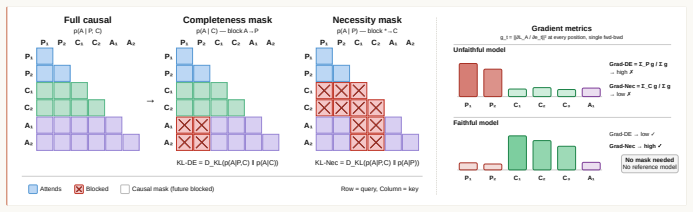
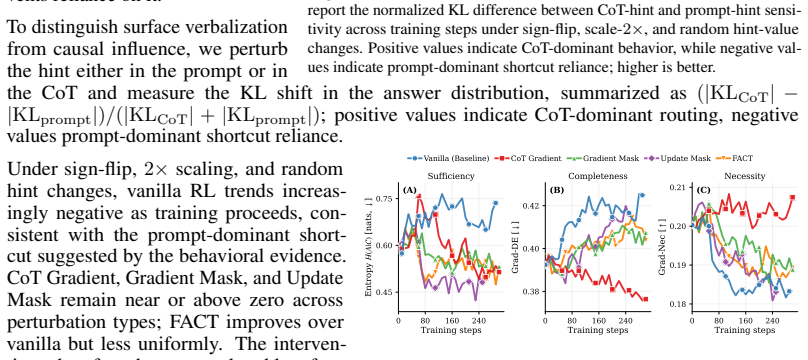
Faithful CoT reasoning routes answer-relevant information through the mediated prompt-to-CoT-to-answer path instead of direct prompt-to-answer shortcuts. This view is captured by a task-agnostic framework of sufficiency, completeness, and necessity properties measured via entropy-based, masked-KL, and gradient-based diagnostics. Update-time interventions including attention masking, backward-only gradient masking, CoT gradients, and adversarial prompt perturbations shift models toward stronger CoT mediation, making shortcut behavior more visible in the trace while improving the structural metrics.
What carries the argument
The structural information-flow perspective instantiated as the three properties of sufficiency, completeness, and necessity that diagnose whether answer-relevant information must pass through the chain-of-thought.
If this is right
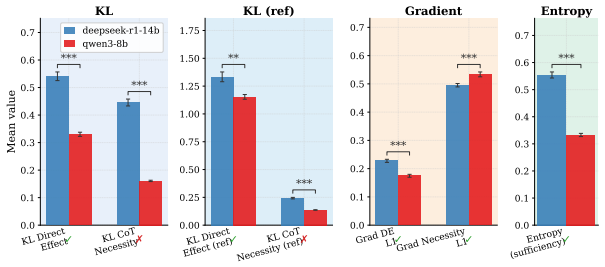
- The entropy, masked-KL, and gradient diagnostics recover externally judged faithfulness differences on hinted reasoning tasks.
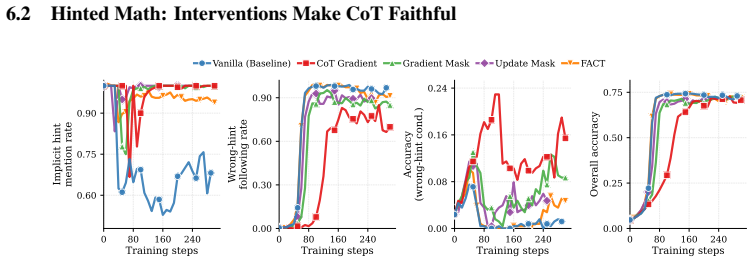
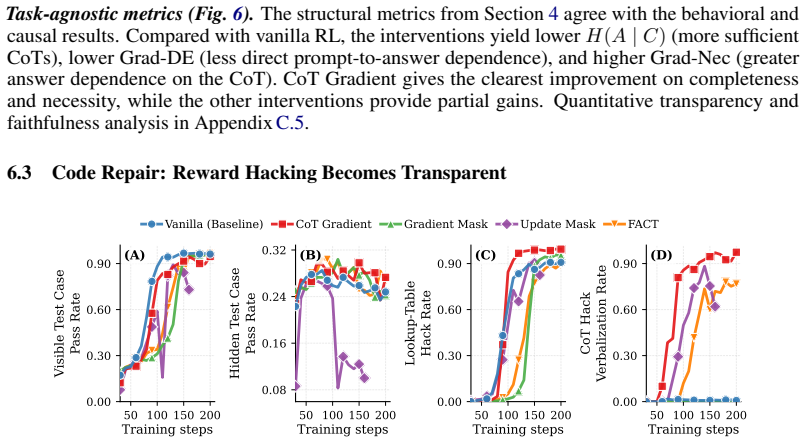
- The interventions increase behavioral and structural indicators of CoT mediation across hinted arithmetic, reward-hackable code repair, and DAPO-Math models.
- Shortcut and reward-hacking behavior becomes more transparent inside the generated chain-of-thought.
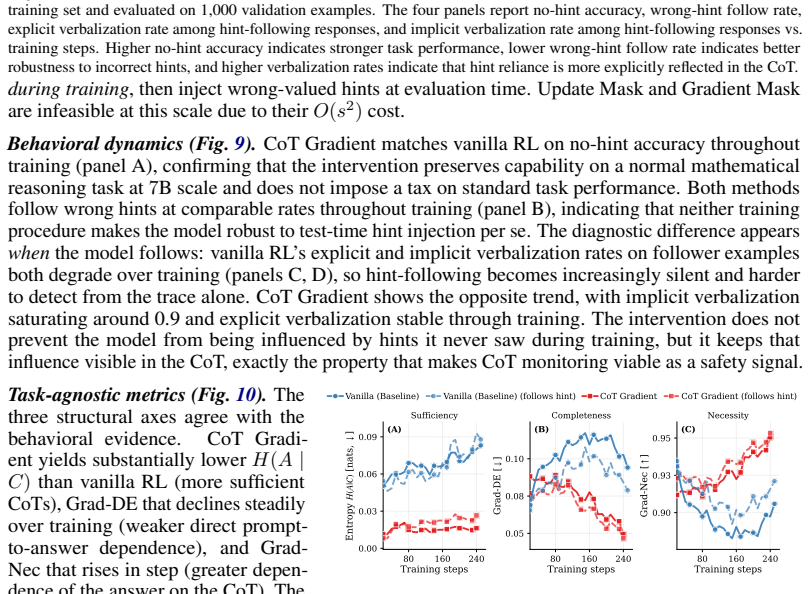
- Task-agnostic faithfulness metrics improve and wrong-hint susceptibility decreases in some evaluated settings.
Where Pith is reading between the lines
- The same information-flow controls could be tested on models trained entirely without hints to check whether monitorability improves on open-ended tasks.
- Gradient-based diagnostics may remain usable even when entropy-based or KL-based measures become unstable due to low-entropy outputs.
- Combining these training interventions with process-level supervision might further reduce hidden reliance on prompt shortcuts.
Load-bearing premise
The three information-flow properties accurately capture what counts as faithful reasoning when judged externally, an assumption checked only on hinted-reasoning tasks.
What would settle it
Apply the training interventions to a new model, then measure whether the resulting chain-of-thought traces receive higher human faithfulness ratings than the baseline on tasks that include incorrect hints or no hints at all.
Figures



read the original abstract
Chain-of-thought (CoT) reasoning is useful for monitoring language models only when the reasoning trace faithfully reflects the computation that produces the final answer. However, models can rely on prompt-to-answer shortcuts that bypass the CoT, making the visible reasoning trace misleading even when it appears plausible. We study CoT faithfulness through a structural information-flow perspective: faithful reasoning should route answer-relevant information through the mediated path from prompt to CoT to answer, rather than through a direct prompt-to-answer shortcut. This perspective yields a task-agnostic framework based on three complementary properties, sufficiency, completeness, and necessity, which we instantiate with entropy-based, masked-KL, and gradient-based diagnostics. We show that these metrics recover externally judged faithfulness differences in hinted reasoning, and identify a low-entropy failure mode of KL-based diagnostics where gradient-based measures remain more stable. Building on this analysis, we introduce update-time interventions for verifier-based on-policy RL, including attention masking, backward-only gradient masking, CoT gradients, and adversarial perturbations of prompt representations. Across hinted arithmetic, reward-hackable code repair, and DAPO-Math models trained without hints but evaluated under wrong-hint injection, our interventions shift behavioral and structural indicators toward stronger CoT mediation. In particular, they make shortcut and reward-hacking behavior more transparent in the CoT and improve task-agnostic faithfulness metrics, while in some settings also reducing wrong-hint susceptibility. Our results suggest that controlling information flow during training is a practical route toward more faithful and monitorable CoT reasoning. Code is available at https://github.com/safety-research/faithful-cot.
Editorial analysis
A structured set of objections, weighed in public.
Referee Report
Summary. The paper claims that CoT faithfulness can be understood and improved via an information-flow lens requiring answer-relevant information to route through the prompt-to-CoT-to-answer path. It defines three properties (sufficiency, completeness, necessity) instantiated as entropy-based, masked-KL, and gradient diagnostics; shows these recover human faithfulness judgments on hinted-reasoning tasks; and introduces on-policy RL interventions (attention masking, backward-only gradient masking, CoT gradients, adversarial prompt perturbations) that shift behavioral and structural indicators toward greater CoT mediation on hinted arithmetic, reward-hackable code repair, and DAPO-Math under wrong-hint injection.
Significance. If the results hold, the work supplies a task-agnostic, information-theoretic framework plus concrete training interventions for producing more monitorable CoT, with open code at the cited GitHub repository strengthening reproducibility. The low-entropy failure mode identified for KL diagnostics and the gradient-based alternative are useful technical contributions.
major comments (2)
- [Abstract] Abstract and experiments on hinted reasoning: the three diagnostics are shown to recover externally judged faithfulness differences only on hinted-reasoning tasks, yet the central claim that the RL interventions produce more faithful CoT on code repair and DAPO-Math rests on metric shifts in those settings without reported human faithfulness judgments, so it is unclear whether the observed changes track faithfulness or merely the mechanics of the interventions (e.g., attention masking directly affecting the masked-KL term).
- [Abstract] Abstract: the reported shifts in behavioral and structural indicators after interventions are presented without error bars, dataset sizes, or statistical tests, so the strength of evidence that the interventions reliably improve CoT mediation cannot be assessed from the given information.
Simulated Author's Rebuttal
We thank the referee for the constructive feedback. We address each major comment below.
read point-by-point responses
-
Referee: [Abstract] Abstract and experiments on hinted reasoning: the three diagnostics are shown to recover externally judged faithfulness differences only on hinted-reasoning tasks, yet the central claim that the RL interventions produce more faithful CoT on code repair and DAPO-Math rests on metric shifts in those settings without reported human faithfulness judgments, so it is unclear whether the observed changes track faithfulness or merely the mechanics of the interventions (e.g., attention masking directly affecting the masked-KL term).
Authors: Human judgments are reported only on hinted-reasoning tasks, where controlled external labels are feasible. The three diagnostics are task-agnostic by design (sufficiency/completeness/necessity via information flow) and were validated to recover human distinctions in that setting. On code repair and DAPO-Math, the interventions target information-flow mechanisms (attention masking blocks direct shortcuts; gradient masking and CoT gradients enforce mediation) and produce consistent shifts across multiple diagnostics, including gradient-based ones that are orthogonal to attention masking. This multi-metric pattern indicates the changes reflect the intended structural property rather than artifacts of any single diagnostic. We will add an explicit discussion of the validation scope and metric rationale in the revised manuscript. revision: partial
-
Referee: [Abstract] Abstract: the reported shifts in behavioral and structural indicators after interventions are presented without error bars, dataset sizes, or statistical tests, so the strength of evidence that the interventions reliably improve CoT mediation cannot be assessed from the given information.
Authors: We agree that the abstract omits these details. Dataset sizes appear in the experimental sections of the full manuscript. In revision we will add error bars and statistical tests to all reported shifts in figures/tables and update the abstract to reference the strengthened statistical presentation. revision: yes
Circularity Check
No significant circularity; metrics defined independently and validated externally
full rationale
The paper defines faithfulness via three information-flow properties (sufficiency, completeness, necessity) instantiated with entropy, masked-KL, and gradient diagnostics drawn from standard information theory. These are validated against external human judgments on hinted-reasoning tasks, and interventions are assessed via on-policy RL with reported behavioral and metric shifts. No load-bearing step reduces by the paper's equations or self-citation to a fitted input or self-defined quantity; the derivation remains self-contained against external benchmarks.
Axiom & Free-Parameter Ledger
axioms (1)
- domain assumption Entropy, masked KL divergence and gradient attributions can be used to quantify information flow through specific paths in transformer models
Reference graph
Works this paper leans on
-
[1]
Show your work: Scratchpads for intermediate computation with language models
Maxwell Nye, Anders Johan Andreassen, Guy Gur-Ari, Henryk Michalewski, Jacob Austin, David Bieber, David Dohan, Aitor Lewkowycz, Maarten Bosma, David Luan, et al. Show your work: Scratchpads for intermediate computation with language models. 2021
2021
-
[2]
Chain-of-thought prompting elicits reasoning in large language models
Jason Wei, Xuezhi Wang, Dale Schuurmans, Maarten Bosma, Fei Xia, Ed Chi, Quoc V Le, Denny Zhou, et al. Chain-of-thought prompting elicits reasoning in large language models. Advances in neural information processing systems, 35:24824–24837, 2022
2022
-
[3]
Large language models are zero-shot reasoners.Advances in neural information processing systems, 35:22199–22213, 2022
Takeshi Kojima, Shixiang Shane Gu, Machel Reid, Yutaka Matsuo, and Yusuke Iwasawa. Large language models are zero-shot reasoners.Advances in neural information processing systems, 35:22199–22213, 2022
2022
-
[4]
Language models don’t always say what they think: Unfaithful explanations in chain-of-thought prompting.Advances in Neural Information Processing Systems, 36:74952–74965, 2023
Miles Turpin, Julian Michael, Ethan Perez, and Samuel Bowman. Language models don’t always say what they think: Unfaithful explanations in chain-of-thought prompting.Advances in Neural Information Processing Systems, 36:74952–74965, 2023
2023
-
[5]
Measuring Faithfulness in Chain-of-Thought Reasoning
Tamera Lanham, Anna Chen, Ansh Radhakrishnan, Benoit Steiner, Carson Denison, Danny Hernandez, Dustin Li, Esin Durmus, Evan Hubinger, Jackson Kernion, et al. Measuring faithfulness in chain-of-thought reasoning.arXiv preprint arXiv:2307.13702, 2023
work page internal anchor Pith review Pith/arXiv arXiv 2023
-
[6]
Making reasoning matter: Measuring and improving faithfulness of chain-of-thought reasoning
Debjit Paul, Robert West, Antoine Bosselut, and Boi Faltings. Making reasoning matter: Measuring and improving faithfulness of chain-of-thought reasoning. InFindings of the Association for Computational Linguistics: EMNLP 2024, 2024
2024
-
[7]
Are deepseek r1 and other reasoning models more faithful? arXiv preprint arXiv:2501.08156, 2025
James Chua and Owain Evans. Are deepseek r1 and other reasoning models more faithful? arXiv preprint arXiv:2501.08156, 2025
-
[8]
Chain-of-Thought Reasoning In The Wild Is Not Always Faithful
Iván Arcuschin, Jett Janiak, Robert Krzyzanowski, Senthooran Rajamanoharan, Neel Nanda, and Arthur Conmy. Chain-of-thought reasoning in the wild is not always faithful.arXiv preprint arXiv:2503.08679, 2025
work page internal anchor Pith review Pith/arXiv arXiv 2025
-
[9]
Measuring chain of thought faithfulness by unlearning reasoning steps
Martin Tutek, Fateme Hashemi Chaleshtori, Ana Marasovic, and Yonatan Belinkov. Measuring chain of thought faithfulness by unlearning reasoning steps. In Christos Christodoulopoulos, Tanmoy Chakraborty, Carolyn Rose, and Violet Peng, editors,Proceedings of the 2025 Confer- ence on Empirical Methods in Natural Language Processing, pages 9935–9960, Suzhou, C...
-
[10]
Mechanistic Evidence for Faithfulness Decay in Chain-of-Thought Reasoning
Donald Ye, Max Loffgren, Om Kotadia, and Linus Wong. Mechanistic evidence for faithfulness decay in chain-of-thought reasoning.arXiv preprint arXiv:2602.11201, 2026
work page internal anchor Pith review Pith/arXiv arXiv 2026
-
[11]
Counterfactual simulation training for chain-of-thought faithfulness, 2026
Peter Hase and Christopher Potts. Counterfactual simulation training for chain-of-thought faithfulness, 2026. URLhttps://arxiv.org/abs/2602.20710
-
[12]
Usman Anwar, Tim Bakker, Dana Kianfar, Cristina Pinneri, and Christos Louizos. Analyzing and improving chain-of-thought monitorability through information theory.arXiv preprint arXiv:2602.18297, 2026
-
[13]
Han Wang, Yifan Sun, Brian Ko, Mann Talati, Jiawen Gong, Zimeng Li, Naicheng Yu, Xucheng Yu, Wei Shen, Vedant Jolly, et al. Monitorbench: A comprehensive benchmark for chain-of- thought monitorability in large language models.arXiv preprint arXiv:2603.28590, 2026
-
[14]
DeepSeekMath: Pushing the Limits of Mathematical Reasoning in Open Language Models
Zhihong Shao, Peiyi Wang, Qihao Zhu, Runxin Xu, Junxiao Song, Xiao Bi, Haowei Zhang, Mingchuan Zhang, YK Li, Yang Wu, et al. Deepseekmath: Pushing the limits of mathematical reasoning in open language models.arXiv preprint arXiv:2402.03300, 2024
work page internal anchor Pith review Pith/arXiv arXiv 2024
-
[15]
DeepSeek-R1: Incentivizing Reasoning Capability in LLMs via Reinforcement Learning
Daya Guo, Dejian Yang, Haowei Zhang, Junxiao Song, Peiyi Wang, Qihao Zhu, Runxin Xu, Ruoyu Zhang, Shirong Ma, Xiao Bi, et al. Deepseek-r1: Incentivizing reasoning capability in llms via reinforcement learning.arXiv preprint arXiv:2501.12948, 2025. 10
work page internal anchor Pith review Pith/arXiv arXiv 2025
-
[16]
DAPO: An Open-Source LLM Reinforcement Learning System at Scale
Qiying Yu, Zheng Zhang, Ruofei Zhu, Yufeng Yuan, Xiaochen Zuo, Yu Yue, Weinan Dai, Tiantian Fan, Gaohong Liu, Lingjun Liu, et al. Dapo: An open-source llm reinforcement learning system at scale.arXiv preprint arXiv:2503.14476, 2025
work page internal anchor Pith review Pith/arXiv arXiv 2025
-
[17]
Faithcot-bench: Benchmarking instance-level faithfulness of chain-of-thought reasoning
Xu Shen, Song Wang, Zhen Tan, Laura Yao, Xinyu Zhao, Kaidi Xu, Xin Wang, and Tianlong Chen. Faithcot-bench: Benchmarking instance-level faithfulness of chain-of-thought reasoning. arXiv preprint arXiv:2510.04040, 2025
-
[18]
Avni Mittal and Rauno Arike. C2-faith: Benchmarking llm judges for causal and coverage faithfulness in chain-of-thought reasoning.arXiv preprint arXiv:2603.05167, 2026
-
[19]
Zidi Xiong, Shan Chen, and Himabindu Lakkaraju. Monitorability as a free gift: How rlvr spontaneously aligns reasoning.arXiv preprint arXiv:2602.03978, 2026
-
[20]
Reasoning models struggle to control their chains of thought.arXiv preprint arXiv:2603.05706, 2026
Chen Yueh-Han, Robert McCarthy, Bruce W Lee, He He, Ian Kivlichan, Bowen Baker, Micah Carroll, and Tomek Korbak. Reasoning models struggle to control their chains of thought.arXiv preprint arXiv:2603.05706, 2026
-
[21]
Max Kaufmann, David Lindner, Roland S Zimmermann, et al. Aligned, orthogonal or in- conflict: When can we safely optimize chain-of-thought?arXiv preprint arXiv:2603.30036, 2026
-
[22]
Miles Turpin, Andy Arditi, Marvin Li, Joe Benton, and Julian Michael. Teaching models to verbalize reward hacking in chain-of-thought reasoning.arXiv preprint arXiv:2506.22777, 2025
-
[23]
Concrete Problems in AI Safety
Dario Amodei, Chris Olah, Jacob Steinhardt, Paul Christiano, John Schulman, and Dan Mané. Concrete problems in ai safety.arXiv preprint arXiv:1606.06565, 2016
work page internal anchor Pith review Pith/arXiv arXiv 2016
-
[24]
Deep reinforcement learning from human preferences.Advances in neural information processing systems, 30, 2017
Paul F Christiano, Jan Leike, Tom Brown, Miljan Martic, Shane Legg, and Dario Amodei. Deep reinforcement learning from human preferences.Advances in neural information processing systems, 30, 2017
2017
-
[25]
Training language models to follow instructions with human feedback.Advances in neural information processing systems, 35:27730–27744, 2022
Long Ouyang, Jeffrey Wu, Xu Jiang, Diogo Almeida, Carroll Wainwright, Pamela Mishkin, Chong Zhang, Sandhini Agarwal, Katarina Slama, Alex Ray, et al. Training language models to follow instructions with human feedback.Advances in neural information processing systems, 35:27730–27744, 2022
2022
-
[26]
Defining and characterizing reward gaming.Advances in Neural Information Processing Systems, 35:9460– 9471, 2022
Joar Skalse, Nikolaus Howe, Dmitrii Krasheninnikov, and David Krueger. Defining and characterizing reward gaming.Advances in Neural Information Processing Systems, 35:9460– 9471, 2022
2022
-
[27]
Scaling laws for reward model overoptimization
Leo Gao, John Schulman, and Jacob Hilton. Scaling laws for reward model overoptimization. InInternational Conference on Machine Learning, pages 10835–10866. PMLR, 2023
2023
-
[28]
Ai control: Improving safety despite intentional subversion.arXiv preprint arXiv:2312.06942, 2023
Ryan Greenblatt, Buck Shlegeris, Kshitij Sachan, and Fabien Roger. Ai control: Improving safety despite intentional subversion.arXiv preprint arXiv:2312.06942, 2023
-
[29]
Monitoring Reasoning Models for Misbehavior and the Risks of Promoting Obfuscation
Bowen Baker, Joost Huizinga, Leo Gao, Zehao Dou, Melody Y Guan, Aleksander Madry, Wojciech Zaremba, Jakub Pachocki, and David Farhi. Monitoring reasoning models for misbehavior and the risks of promoting obfuscation.arXiv preprint arXiv:2503.11926, 2025
work page internal anchor Pith review Pith/arXiv arXiv 2025
-
[30]
Melody Y Guan, Miles Wang, Micah Carroll, Zehao Dou, Annie Y Wei, Marcus Williams, Benjamin Arnav, Joost Huizinga, Ian Kivlichan, Mia Glaese, et al. Monitoring monitorability. arXiv preprint arXiv:2512.18311, 2025
-
[31]
Analysing Mathematical Reasoning Abilities of Neural Models
David Saxton, Edward Grefenstette, Felix Hill, and Pushmeet Kohli. Analysing mathematical reasoning abilities of neural models.arXiv preprint arXiv:1904.01557, 2019
work page internal anchor Pith review Pith/arXiv arXiv 1904
-
[32]
URLhttps://www.science.org/doi/full/10.1126/science
Yujia Li, David Choi, Junyoung Chung, Nate Kushman, Julian Schrittwieser, Rémi Leblond, Tom Eccles, James Keeling, Felix Gimeno, Agustin Dal Lago, Thomas Hubert, Peter Choy, Cyprien de Masson d’Autume, Igor Babuschkin, Xinyun Chen, Po-Sen Huang, Johannes Welbl, Sven Gowal, Alexey Cherepanov, James Molloy, Daniel J. Mankowitz, Esme Sutherland Robson, Pushm...
-
[33]
Gemma Team Aishwarya Kamath, Johan Ferret, Shreya Pathak, Nino Vieillard, Ramona Merhej, Sarah Perrin, Tatiana Matejovicova, Alexandre Ram’e, Morgane Rivière, Louis Rouillard, Thomas Mesnard, Geoffrey Cideron, Jean-Bastien Grill, Sabela Ramos, Edouard Yvinec, Michelle Casbon, Etienne Pot, Ivo Penchev, Gael Liu, Francesco Visin, Kathleen Kenealy, Lucas Bey...
work page internal anchor Pith review Pith/arXiv arXiv 2025
-
[34]
Qwen2.5: A party of foundation models, September 2024
Qwen Team. Qwen2.5: A party of foundation models, September 2024. URL https:// qwenlm.github.io/blog/qwen2.5/
2024
-
[35]
Judging llm-as-a-judge with mt-bench and chatbot arena.Advances in neural information processing systems, 36:46595–46623, 2023
Lianmin Zheng, Wei-Lin Chiang, Ying Sheng, Siyuan Zhuang, Zhanghao Wu, Yonghao Zhuang, Zi Lin, Zhuohan Li, Dacheng Li, Eric Xing, et al. Judging llm-as-a-judge with mt-bench and chatbot arena.Advances in neural information processing systems, 36:46595–46623, 2023
2023
-
[36]
Hybridflow: A flexible and efficient rlhf framework
Guangming Sheng, Chi Zhang, Zilingfeng Ye, Xibin Wu, Wang Zhang, Ru Zhang, Yanghua Peng, Haibin Lin, and Chuan Wu. Hybridflow: A flexible and efficient rlhf framework. In Proceedings of the Twentieth European Conference on Computer Systems, pages 1279–1297, 2025
2025
-
[37]
Decoupled Weight Decay Regularization
Ilya Loshchilov and Frank Hutter. Decoupled weight decay regularization.arXiv preprint arXiv:1711.05101, 2017. 12 Appendix A Information flow based intervention methods Pipeline Pipeline details.Figure A1 expands the intervention locations within the GRPO training loop. The top row shows the shared pipeline: the policy first generates K completions for ea...
work page internal anchor Pith review Pith/arXiv arXiv 2017
discussion (0)
Sign in with ORCID, Apple, or X to comment. Anyone can read and Pith papers without signing in.