Fine-scale downflows above flare ribbons captured by Solar Orbiter/EUI
Pith reviewed 2026-06-26 19:15 UTC · model grok-4.3
The pith
EUV observations from Solar Orbiter capture fine-scale downflows above flare ribbons matching chromospheric riblets at 10^6 K
A machine-rendered reading of the paper's core claim, the machinery that carries it, and where it could break.
Core claim
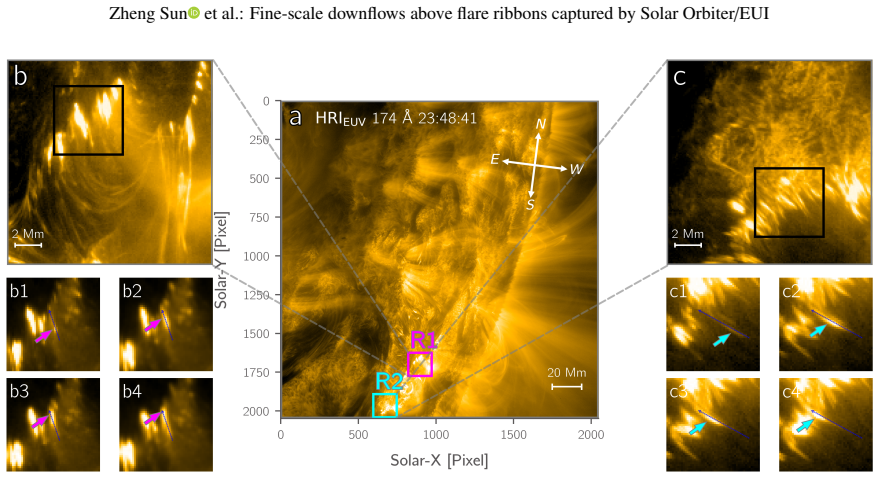
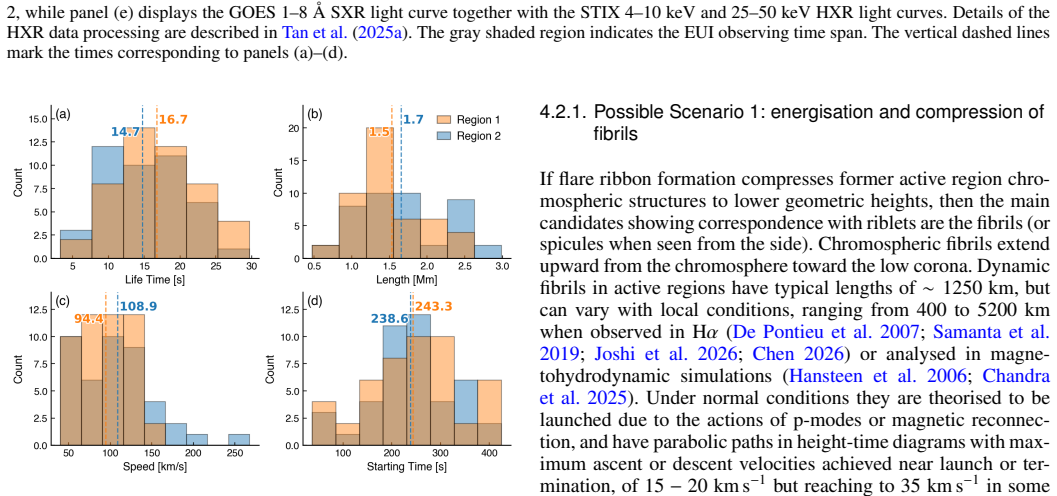
High-resolution EUV observations reveal downward-propagating bright thread-like structures above flare ribbons with velocities of approximately 100 km s^{-1}, lifetimes of approximately 15 s, and lengths of approximately 1.6 Mm. Based on their morphological and dynamical properties, these are interpreted as the EUV counterparts of chromospheric riblets, representing downflows at temperatures around 10^6 K that result from energisation and compression of pre-existing chromospheric fibrils due to particle beams or from adiabatic or shock-driven compression induced by downward-propagating plasma from the corona.
What carries the argument
Morphological and dynamical property matching (velocity, lifetime, length, and location above ribbons) used to identify the EUV thread-like downflows as riblet counterparts
If this is right
- The downflows arise from particle beam energisation and compression of fibrils or from adiabatic or shock-driven compression by downward plasma.
- EUV riblets provide a diagnostic tool for the dynamics of magnetic reconnection during solar flares.
- These features enable study of energy transport and deposition in flares at temperatures around 10^6 K.
Where Pith is reading between the lines
- Coordinated multi-wavelength campaigns could test whether the temperature and density profiles align across the proposed riblet layers.
- Flare reconnection models could be examined for whether they naturally produce fine-scale downflows with these speeds and sizes at both chromospheric and transition-region heights.
- If the structures are general, similar riblet signatures might appear in other wavelength bands or even in stellar flare observations with sufficient resolution.
Load-bearing premise
Similarities in velocity, lifetime, length, and location above ribbons suffice to identify the EUV structures as the same physical objects as the chromospheric riblets, without spectroscopic or multi-temperature confirmation.
What would settle it
Simultaneous chromospheric and EUV observations of the same flare ribbon showing mismatched velocities, lifetimes, or spatial scales between the two sets of downflows would undermine the counterpart identification.
Figures


read the original abstract
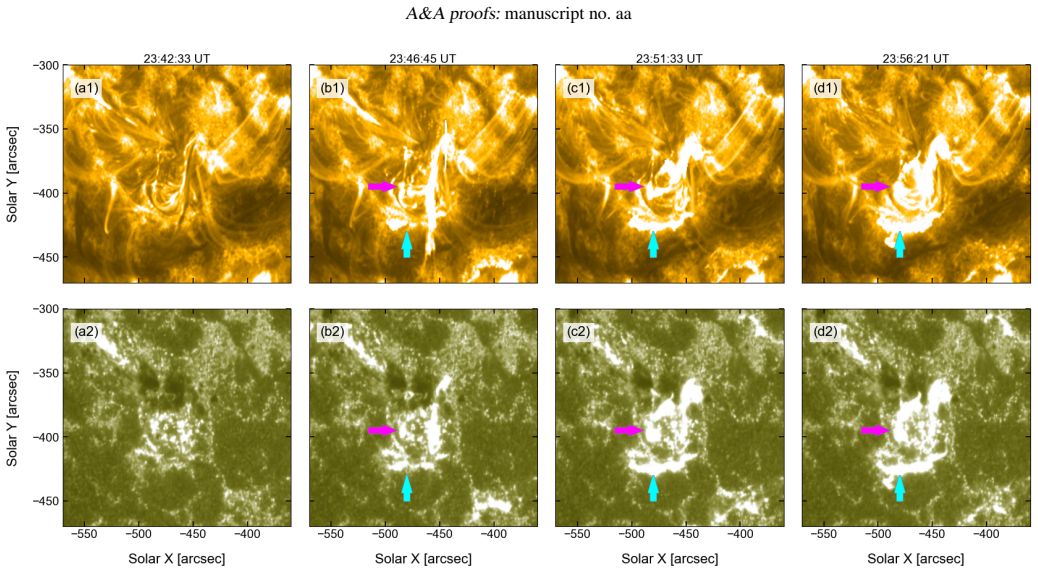
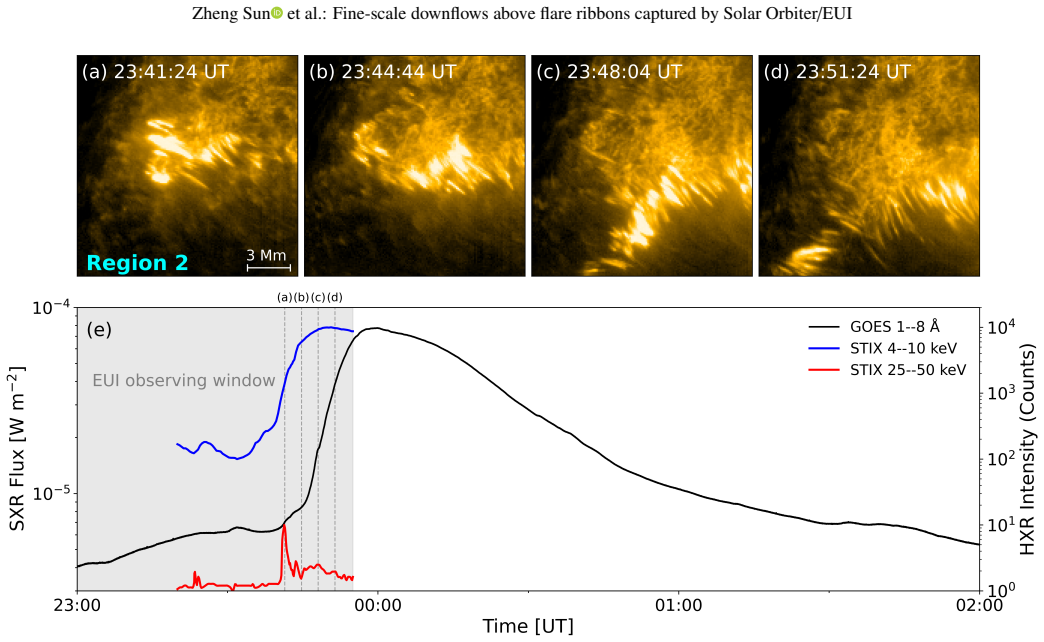
In solar flares, flare ribbons map chromospheric footpoints where flare energy deposition occurs. These locations are associated with field aligned energy transport from the corona that results from energy liberated during magnetic reconnection. Recent chromospheric observations in the H$\alpha$ and H$\beta$ bands have revealed fine-scale downflow structures above flare ribbons, referred to as riblets. In this study, we identify similar downflow structures in the extreme-ultraviolet (EUV) wavelength using high-resolution observations from Solar Orbiter/EUI. These fine-scale downflows appear as downward-propagating, bright, and thread-like structures. They exhibit typical velocities of $\sim100~\mathrm{km\ s^{-1}}$, lifetimes of $\sim15$~s, and lengths of $\sim1.6$~Mm. Based on their morphological and dynamical properties, we interpret these observed downflows as the EUV counterparts of the riblets that have previously been reported from chromospheric observations. This study presents EUV imaging of $\sim 10^6$~K downflows above flare ribbons. We interpret these downflows as a result of (1) the energisation and subsequent compression of pre-existing chromospheric fibrils due to particle beams or (2) adiabatic or shock-driven compression induced by the downward-propagating plasma from the corona. These fine-scale EUV riblets provide a new diagnostic tool for probing the dynamics of magnetic reconnection as well as energy transport and deposition during solar flares.
Editorial analysis
A structured set of objections, weighed in public.
Referee Report
Summary. The manuscript reports high-resolution EUV observations from Solar Orbiter/EUI of fine-scale, downward-propagating, thread-like bright structures above flare ribbons. These downflows exhibit typical velocities of ~100 km s^{-1}, lifetimes of ~15 s, and lengths of ~1.6 Mm. The authors interpret the features as the EUV (~10^6 K) counterparts of chromospheric riblets previously seen in Hα/Hβ, and propose formation via beam-driven fibril compression or coronal downflow compression. The work claims these EUV riblets provide a new diagnostic for flare reconnection and energy transport.
Significance. If the identification is substantiated, the result supplies the first reported EUV imaging of ~10^6 K downflows above flare ribbons and extends the riblet phenomenon to coronal temperatures. This would add an observational constraint on the multi-temperature structure of flare energy deposition and reconnection outflows, with potential utility for future multi-instrument campaigns.
major comments (2)
- [Abstract] Abstract: The central identification of the EUV downflows as riblet counterparts rests on stated similarities in velocity (~100 km s^{-1}), lifetime (~15 s), length (~1.6 Mm), and location, yet the text supplies no quantitative measurements, error bars, histograms, or explicit data-selection criteria. Without these, the morphological/dynamical match remains unverified and the interpretation is not data-driven.
- [Abstract] Abstract: The EUV features are formed at ~10^6 K while riblets are reported from chromospheric lines; no spectroscopic line profiles, emission-measure analysis, or simultaneous multi-temperature imaging is invoked to demonstrate that the same plasma volume or magnetic structure is observed. This leaves the two proposed formation mechanisms observationally indistinguishable.
minor comments (1)
- [Abstract] Abstract: The phrase 'fine-scale downflows' is used before the term 'riblets' is introduced; a brief parenthetical definition on first use would improve readability.
Simulated Author's Rebuttal
We thank the referee for their constructive comments on our manuscript. We address each major comment point by point below, indicating where revisions will be made to strengthen the paper.
read point-by-point responses
-
Referee: [Abstract] Abstract: The central identification of the EUV downflows as riblet counterparts rests on stated similarities in velocity (~100 km s^{-1}), lifetime (~15 s), length (~1.6 Mm), and location, yet the text supplies no quantitative measurements, error bars, histograms, or explicit data-selection criteria. Without these, the morphological/dynamical match remains unverified and the interpretation is not data-driven.
Authors: We agree that additional quantitative detail is needed to support the identification. The revised manuscript will include histograms of the measured velocities, lifetimes, and lengths with associated uncertainties, along with a clear description of the feature selection criteria and measurement methods. These additions will make the comparison with chromospheric riblets more rigorous and data-driven. revision: yes
-
Referee: [Abstract] Abstract: The EUV features are formed at ~10^6 K while riblets are reported from chromospheric lines; no spectroscopic line profiles, emission-measure analysis, or simultaneous multi-temperature imaging is invoked to demonstrate that the same plasma volume or magnetic structure is observed. This leaves the two proposed formation mechanisms observationally indistinguishable.
Authors: The EUI observations are obtained in an EUV passband with formation temperature around 10^6 K, which sets the thermal context. As an imaging instrument, EUI does not provide spectroscopic line profiles or emission-measure diagnostics, and the dataset lacks simultaneous multi-temperature coverage. We will revise the discussion to explicitly note that the two formation mechanisms cannot be distinguished observationally with the available data and to frame this as a limitation. The core result remains the first reported EUV imaging of these downflows and their morphological/dynamical similarity to chromospheric riblets. revision: partial
Circularity Check
No circularity: purely observational report with no derivations or self-referential reductions
full rationale
The paper is an observational study that reports EUV downflows with measured properties (velocities ~100 km s^{-1}, lifetimes ~15 s, lengths ~1.6 Mm) and interprets them as counterparts to chromospheric riblets based on morphological and dynamical matches. No equations, parameter fits, predictions, or derivations are present. The central claim does not reduce to any self-citation chain or input by construction; it is a direct comparison of observed features. This is self-contained observational work with no load-bearing circular steps.
Axiom & Free-Parameter Ledger
axioms (1)
- domain assumption Standard model of field-aligned energy transport from coronal reconnection to chromospheric footpoints.
Reference graph
Works this paper leans on
-
[1]
C., Alaoui, M., Kowalski, A
Allred, J. C., Alaoui, M., Kowalski, A. F., & Kerr, G. S. 2020, ApJ, 902, 16
2020
-
[2]
Ashfield, W. H. & Longcope, D. W. 2021, ApJ, 912, 25
2021
-
[3]
2012, A&A, 543, A110
Aulanier, G., Janvier, M., & Schmieder, B. 2012, A&A, 543, A110
2012
-
[4]
2002, A&A, 384, 273
Aurass, H., Vršnak, B., & Mann, G. 2002, A&A, 384, 273
2002
-
[5]
2015, ApJ, 813, 113
Battaglia, M., Kleint, L., Krucker, S., & Graham, D. 2015, ApJ, 813, 113
2015
-
[6]
Benz, A. O. 2017, Living Reviews in Solar Physics, 14, 2
2017
-
[7]
M., et al
Berghmans, D., Auchère, F., Long, D. M., et al. 2021, A&A, 656, L4
2021
-
[8]
Brosius, J. W. 2012, ApJ, 754, 54
2012
-
[9]
Brown, J. C. 1973, Sol. Phys., 28, 151
1973
-
[10]
K., Patel, R., et al
Bura, A., Shrivastav, A. K., Patel, R., et al. 2025, ApJ, 988, L65
2025
-
[11]
C., et al
Cai, Q., Shen, C., Raymond, J. C., et al. 2019, MNRAS, 489, 3183
2019
-
[12]
Canfield, R. C. & Gayley, K. G. 1987, ApJ, 322, 999
1987
-
[13]
1964, in NASA Special Publication, ed
Carmichael, H. 1964, in NASA Special Publication, ed. W. N. Hess, V ol. 50, 451
1964
-
[14]
2025, A&A, 701, A294
Chandra, S., Cameron, R., Przybylski, D., et al. 2025, A&A, 701, A294
2025
-
[15]
2026, Earth and Planetary Physics, 10, 438
Chen, C. 2026, Earth and Planetary Physics, 10, 438
2026
-
[16]
2022, A&A, 659, A107
Chen, H., Tian, H., Li, L., et al. 2022, A&A, 659, A107
2022
-
[17]
2021, A&A, 656, L7
Chen, Y ., Przybylski, D., Peter, H., et al. 2021, A&A, 656, L7
2021
-
[18]
P., Pontin, D
Chitta, L. P., Pontin, D. I., Priest, E. R., et al. 2026, A&A, 705, A113 ¸ Sahin, S. & Antolin, P. 2024, ApJ, 970, 106
2026
-
[19]
T., Antiochos, S
Dahlin, J. T., Antiochos, S. K., Wyper, P. F., Qiu, J., & DeV ore, C. R. 2025, ApJ, 993, 31 De Pontieu, B., De Moortel, I., Martinez-Sykora, J., & McIntosh, S. W. 2017, ApJ, 845, L18 De Pontieu, B., Hansteen, V . H., Rouppe van der V oort, L., van Noort, M., &
2025
-
[20]
2007, ApJ, 655, 624 De Pontieu, B., Title, A
Carlsson, M. 2007, ApJ, 655, 624 De Pontieu, B., Title, A. M., Lemen, J. R., et al. 2014, Sol. Phys., 289, 2733 De Wilde, M., Pietrow, A. G. M., Druett, M. K., et al. 2025, A&A, 700, A275
2007
-
[21]
C., Priest, E
Demoulin, P., Henoux, J. C., Priest, E. R., & Mandrini, C. H. 1996, A&A, 308, 643
1996
-
[22]
2024, A&A, 684, A171
Druett, M., Ruan, W., & Keppens, R. 2024, A&A, 684, A171
2024
-
[23]
2017, Nature Communications, 8, 15905
Druett, M., Scullion, E., Zharkova, V ., et al. 2017, Nature Communications, 8, 15905
2017
-
[24]
K., Ruan, W., & Keppens, R
Druett, M. K., Ruan, W., & Keppens, R. 2023, Sol. Phys., 298, 134
2023
-
[25]
Emslie, A. G. 1978, ApJ, 224, 241
1978
-
[26]
H., Canfield, R
Fisher, G. H., Canfield, R. C., & McClymont, A. N. 1985, ApJ, 289, 414
1985
-
[27]
R., Hudson, H
Fletcher, L., Dennis, B. R., Hudson, H. S., et al. 2011, Space Sci. Rev., 159, 19
2011
-
[28]
& Hudson, H
Fletcher, L. & Hudson, H. S. 2002, Sol. Phys., 210, 307
2002
-
[29]
& Hudson, H
Fletcher, L. & Hudson, H. S. 2008, ApJ, 675, 1645
2008
-
[30]
Forbes, T. G. & Priest, E. R. 1983, Sol. Phys., 84, 169
1983
-
[31]
J., Kazachenko, M
French, R. J., Kazachenko, M. D., Berghmans, D., et al. 2025, ApJ, 995, L54
2025
-
[32]
2025, ApJ, 985, L12
Gao, Y ., Tian, H., Berghmans, D., et al. 2025, ApJ, 985, L12
2025
-
[33]
2006, ApJ, 647, L73
Carlsson, M. 2006, ApJ, 647, L73
2006
-
[34]
1974, Sol
Hirayama, T. 1974, Sol. Phys., 34, 323
1974
-
[35]
Hollweg, J. V . 1981, Sol. Phys., 70, 25
1981
-
[36]
D., Aschwanden, M
Holman, G. D., Aschwanden, M. J., Aurass, H., et al. 2011, Space Sci. Rev., 159, 107
2011
-
[37]
1981, ApJ, 244, L153
Hoyng, P., Duijveman, A., Boelee, A., et al. 1981, ApJ, 244, L153
1981
-
[38]
Isenberg, P. A. & Forbes, T. G. 2007, ApJ, 670, 1453
2007
-
[39]
2017, Journal of Plasma Physics, 83, 535830101
Janvier, M. 2017, Journal of Plasma Physics, 83, 535830101
2017
-
[40]
2026, A&A, 706, A369
Joshi, R., Rouppe van der V oort, L., Aulanier, G., et al. 2026, A&A, 706, A369
2026
-
[41]
Kerr, G. S. 2022, Frontiers in Astronomy and Space Sciences, 9, 1060856
2022
-
[42]
S., Krucker, S., Allred, J
Kerr, G. S., Krucker, S., Allred, J. C., et al. 2026, Nature Astronomy
2026
-
[43]
Kopp, R. A. & Pneuman, G. W. 1976, Sol. Phys., 50, 85
1976
-
[44]
S., Jeffrey, N
Krucker, S., Hudson, H. S., Jeffrey, N. L. S., et al. 2011, ApJ, 739, 96
2011
-
[45]
J., Grimm, O., et al
Krucker, S., Hurford, G. J., Grimm, O., et al. 2020, A&A, 642, A15 Article number, page 7 of 9 A&A proofs:manuscript no. aa
2020
-
[46]
S., et al
Krucker, S., Saint-Hilaire, P., Hudson, H. S., et al. 2015, ApJ, 802, 19
2015
-
[47]
2020, ApJ, 896, 120
Kuridze, D., Mathioudakis, M., Heinzel, P., et al. 2020, ApJ, 896, 120
2020
-
[48]
R., Title, A
Lemen, J. R., Title, A. M., Akin, D. J., et al. 2012, Sol. Phys., 275, 17
2012
-
[49]
2022, ApJ, 926, 23
Li, D., Hong, Z., & Ning, Z. 2022, ApJ, 926, 23
2022
-
[50]
2024, Science in China E: Technological Sciences, 67, 1592
Li, D., Hou, Z., Bai, X., et al. 2024, Science in China E: Technological Sciences, 67, 1592
2024
-
[51]
2023, ApJ, 954, 7
Li, D., Li, C., Qiu, Y ., et al. 2023, ApJ, 954, 7
2023
-
[52]
& Zhang, J
Li, T. & Zhang, J. 2014, ApJ, 791, L13
2014
-
[53]
& Zhang, J
Li, T. & Zhang, J. 2015, ApJ, 804, L8
2015
-
[54]
2025, Earth and Planetary Physics, 9, 171
Li, Y ., Huang, S., Xu, S., et al. 2025, Earth and Planetary Physics, 9, 171
2025
-
[55]
W., Ding, M
Li, Y ., Qiu, J., Longcope, D. W., Ding, M. D., & Yang, K. 2016, ApJ, 823, L13 Lörinˇcík, J., Polito, V ., De Pontieu, B., Yu, S., & Freij, N. 2022, Frontiers in Astronomy and Space Sciences, 9, 334
2016
-
[56]
L., Frederiks, D
Lysenko, A. L., Frederiks, D. D., Fleishman, G. D., et al. 2020, Physics-Uspekhi, 63, 818
2020
-
[57]
2009, A&A, 494, 669 Martínez Oliveros, J.-C., Hudson, H
Mann, G., Warmuth, A., & Aurass, H. 2009, A&A, 494, 669 Martínez Oliveros, J.-C., Hudson, H. S., Hurford, G. J., et al. 2012, ApJ, 753, L26 Martínez Oliveros, J.-C., Krucker, S., Hudson, H. S., et al. 2014, ApJ, 780, L28
2009
-
[58]
Masson, S., Pariat, E., Aulanier, G., & Schrijver, C. J. 2009, ApJ, 700, 559
2009
-
[59]
Milligan, R. O. & Dennis, B. R. 2009, ApJ, 699, 968
2009
-
[60]
D., Thompson, B
Pesnell, W. D., Thompson, B. J., & Chamberlin, P. C. 2012, Sol. Phys., 275, 3
2012
-
[61]
S., Xu, Y ., Sadykov, V
Polito, V ., Kerr, G. S., Xu, Y ., Sadykov, V . M., & Lorincik, J. 2023, ApJ, 944, 104
2023
-
[62]
& Forbes, T
Priest, E. & Forbes, T. 2000, Magnetic Reconnection: MHD Theory and Appli- cations
2000
-
[63]
2024, ApJ, 973, 57
Qiao, F., Li, L., Tian, H., et al. 2024, ApJ, 973, 57
2024
-
[64]
Reep, J. W. & Russell, A. J. B. 2016, ApJ, 818, L20
2016
-
[65]
Ricchiazzi, P. J. & Canfield, R. C. 1983, ApJ, 272, 739
1983
-
[66]
2020, A&A, 642, A8
Rochus, P., Auchère, F., Berghmans, D., et al. 2020, A&A, 642, A8
2020
-
[67]
2020, ApJ, 896, 97
Ruan, W., Xia, C., & Keppens, R. 2020, ApJ, 896, 97
2020
-
[68]
2023, ApJ, 947, 67
Ruan, W., Yan, L., & Keppens, R. 2023, ApJ, 947, 67
2023
-
[69]
2021, ApJ, 920, L15
Ruan, W., Zhou, Y ., & Keppens, R. 2021, ApJ, 920, L15
2021
-
[70]
Russell, A. J. B. & Fletcher, L. 2013, ApJ, 765, 81
2013
-
[71]
2019, Science, 366, 890
Samanta, T., Tian, H., Yurchyshyn, V ., et al. 2019, Science, 366, 890
2019
-
[72]
B., Bjelksjo, K., Korhonen, T
Scharmer, G. B., Bjelksjo, K., Korhonen, T. K., Lindberg, B., & Petterson, B. 2003, in Proc. SPIE, V ol. 4853, Innovative Telescopes and Instrumentation for Solar Astrophysics, ed. S. L. Keil & S. V . Avakyan, 341–350
2003
-
[73]
2016, ApJ, 833, 184
Scullion, E., Rouppe van der V oort, L., Antolin, P., et al. 2016, ApJ, 833, 184
2016
-
[74]
Sharykin, I. N. & Kosovichev, A. G. 2014, ApJ, 788, L18
2014
-
[75]
& Tanuma, S
Shibata, K. & Tanuma, S. 2001, Earth, Planets and Space, 53, 473
2001
-
[76]
Singh, V ., Scullion, E., Botha, G. J. J., et al. 2025, arXiv e-prints, arXiv:2507.01169
arXiv 2025
-
[77]
V ., Syrovatskii, S
Somov, B. V ., Syrovatskii, S. I., & Spektor, A. R. 1981, Sol. Phys., 73, 145
1981
-
[78]
Sturrock, P. A. 1966, Nature, 211, 695
1966
-
[79]
2025, ApJ, 990, 45
Sun, Z., Li, T., Bian, X., et al. 2025, ApJ, 990, 45
2025
-
[80]
2023, ApJ, 953, 148
Sun, Z., Li, T., Tian, H., et al. 2023, ApJ, 953, 148
2023
discussion (0)
Sign in with ORCID, Apple, or X to comment. Anyone can read and Pith papers without signing in.