Mass and radius measurements of the neutron star 47~Tuc X7 -- A new bias-free method
Pith reviewed 2026-06-29 10:48 UTC · model grok-4.3
The pith
Spectral modeling that includes rotation and surface variations yields a 12.9 km neutron-star radius at 1.4 solar masses from 47 Tuc X7.
A machine-rendered reading of the paper's core claim, the machinery that carries it, and where it could break.
Core claim
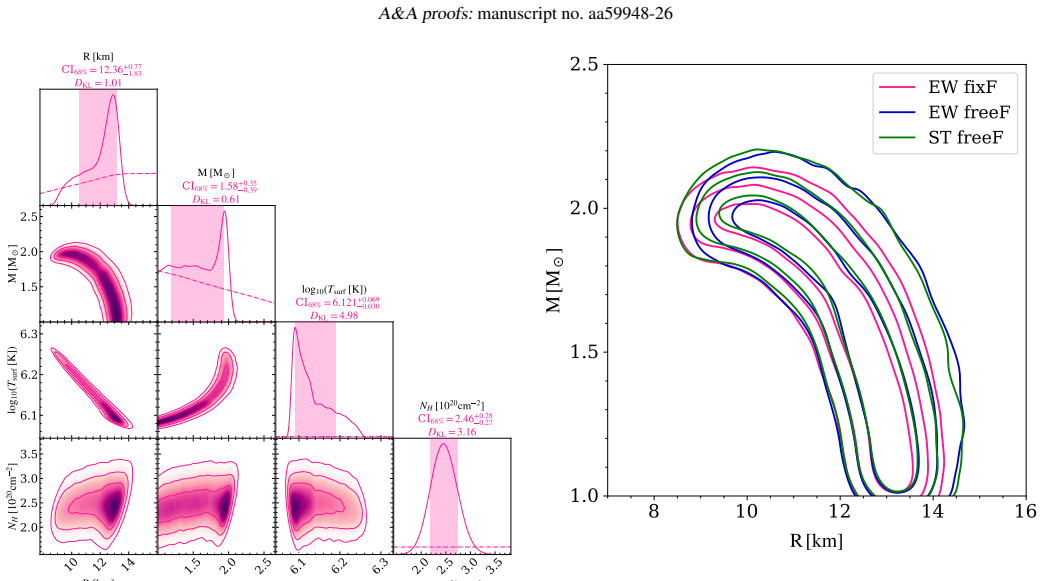
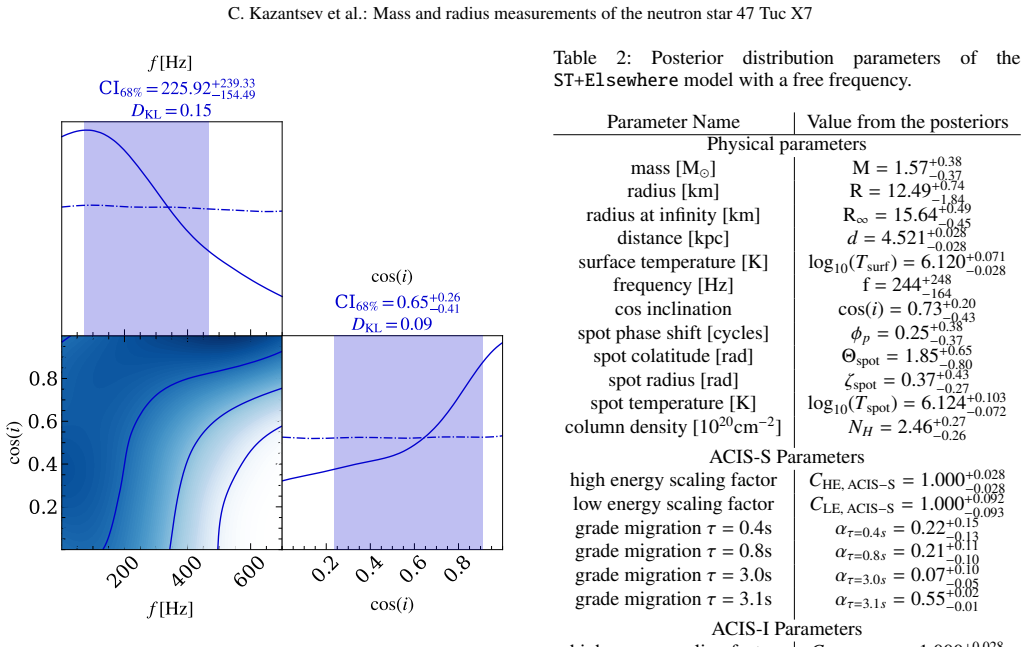
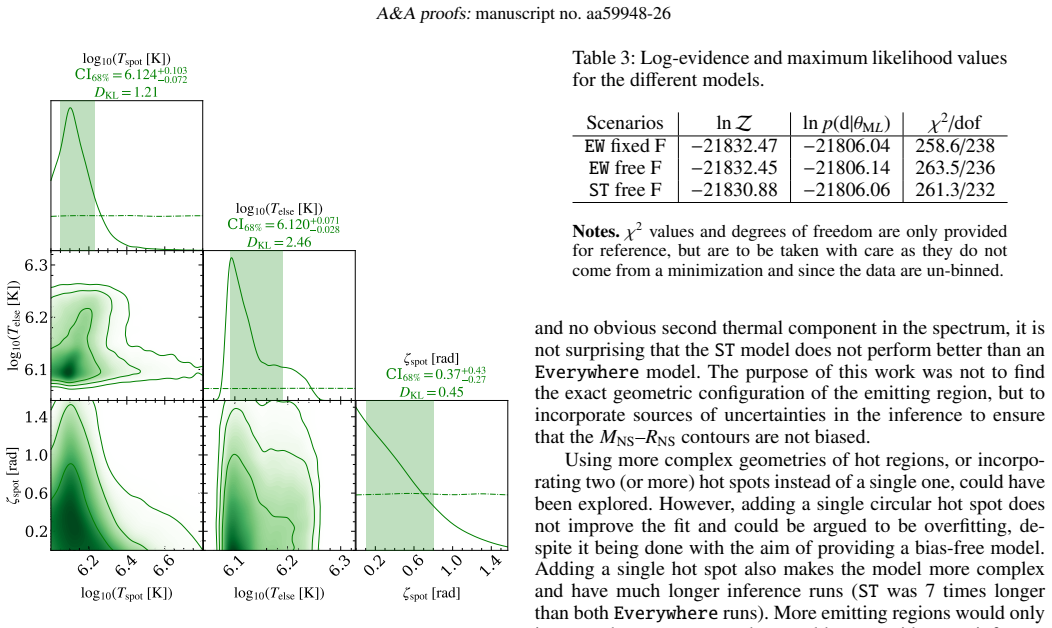
By using X-PSI to model the spectra of 47 Tuc X7 while accounting for unknown rotation and surface temperature anisotropies, the analysis produces R at 1.4 solar masses equal to 12.9 plus or minus 0.4 km at 68 percent credibility; the same data yield an upper limit of 6.0 percent on the pulsed fraction at 99.97 percent credibility. Neglecting rotation and anisotropy changes the radius by less than one percent and does not broaden the posterior, showing that robust constraints are obtained even for this source.
What carries the argument
X-PSI spectral modeling that folds neutron-star rotation and surface temperature anisotropies into the predicted X-ray emission from a hydrogen atmosphere.
If this is right
- The measured mass-radius point can be combined with other neutron-star observations to tighten constraints on the dense-matter equation of state.
- Quiescent low-mass X-ray binaries become usable inputs for equation-of-state inference when analyzed with rotation and anisotropy included.
- For sources with exposures comparable to 47 Tuc X7, the additional modeling parameters do not degrade the radius precision.
- An X-ray pulsed fraction upper limit of 6 percent at high credibility is now available for this neutron star.
Where Pith is reading between the lines
- The same modeling pipeline could be applied to other quiescent sources whose atmospheres are independently known or assumed to be hydrogen-rich.
- Cross-checks between this radius value and independent measurements from accreting or radio pulsars would test consistency across different classes of neutron-star observations.
- If the method is applied to shallower data sets, the finding that rotation and anisotropy do not broaden posteriors may no longer hold, pointing to a possible exposure requirement.
Load-bearing premise
The atmosphere of 47 Tuc X7 is hydrogen-rich and the modeling code correctly translates rotation and any surface temperature differences into the observed spectrum.
What would settle it
An observed pulsed fraction above 6 percent at the stated credibility level, or a radius posterior that widens by more than a few percent once rotation is included, would contradict the claim that these effects are negligible for this source.
Figures


read the original abstract
Neutron star (NS) radius measurements provide precious information to constrain the dense matter equation of state (EOS). Quiescent low-mass X-ray binaries (qLMXBs) have been used for this purpose, but a number of sources of systematic biases were uncovered, making other sources more favored for EOS studies. We aim to reintroduce qLMXBs as reliable sources of NS mass and radius measurements with a new method, free of systematic biases. We test our implementation on the qLMXB X7 in the globular cluster 47 Tucanae. We used X-PSI to perform the spectral analysis of the 47Tuc X7 observations. X-PSI accurately models the effects of the unknown NS rotation and possible surface anisotropies (two sources of biases in qLMXBs) on the NS spectra. The most significant source of bias on the radius is usually the chemical composition of the NS atmosphere, which, in the case of 47Tuc X7, is known to be hydrogen-rich. A broad range of masses and radii was explored. We obtain a NS radius at 1.4 $M_\odot$ of $R_{1.4} = 12.9\pm0.4$ km (68% credible interval). A shift of the radius by less than a % is measured compared to the model where these sources of systematic uncertainties are neglected. More importantly, including rotation and surface anisotropies in the modeling does not significantly broaden the radius posteriors. We also place strong constraints on the X-ray pulsed fraction (upper limit of 6.0% at a 99.97% credible level) caused by the possible presence of a hot spot. This suggests that, for 47Tuc X7, robust radius constraints can be obtained even without considering systematics, likely because of the deep exposures. We use the resulting M-R constraints from this NS to quantify the improvement on an EOS inference when combined with other measurements. We show that, using recently developed tools, qLMXBs can be exploited to infer reliable NS masses and radii, which can in turn constrain the EOS.
Editorial analysis
A structured set of objections, weighed in public.
Referee Report
Summary. The paper introduces a new method for obtaining bias-free neutron star mass and radius measurements from quiescent low-mass X-ray binaries (qLMXBs) by using the X-PSI spectral modeling code to account for unknown rotation and possible surface anisotropies. Applied to the deep-exposure source 47 Tuc X7 (assumed hydrogen-rich atmosphere), the analysis yields R_{1.4} = 12.9 ± 0.4 km (68% credible interval), with a radius shift of less than 1% and no significant posterior broadening when these effects are included versus neglected. An upper limit of 6.0% on the X-ray pulsed fraction (99.97% credible level) is also reported, and the resulting M-R constraints are used to illustrate improved EOS inference when combined with other measurements.
Significance. If the central claim holds, the work is significant because it addresses known systematic biases in qLMXBs and reintroduces them as viable sources for dense-matter EOS constraints. The concrete posterior R_{1.4} = 12.9 ± 0.4 km, the quantified <1% shift, and the demonstration that rotation/anisotropy modeling does not broaden posteriors for this source provide a falsifiable data point and a practical test of the method's robustness for deep exposures.
major comments (2)
- [Abstract / spectral analysis] Abstract and spectral analysis section: The central claim that the method is bias-free and that systematics are controlled rests on X-PSI correctly computing relativistic effects, Doppler boosting, and beaming for unknown spin and possible hot spots. No cross-validation against independent ray-tracing codes or synthetic-data recovery tests are referenced to support this modeling accuracy, which is load-bearing for the <1% shift and non-broadening conclusions.
- [Abstract] Abstract: The hydrogen-rich atmosphere composition is treated as known and the dominant bias source, yet the manuscript provides no explicit sensitivity analysis or alternative composition tests to quantify how violations of this assumption would propagate into the reported R_{1.4} posterior.
minor comments (2)
- [Abstract] Notation for the radius at 1.4 M_⊙ is introduced as R_{1.4} without an explicit definition equation in the abstract; a short clarifying sentence would improve readability.
- [Abstract] The pulsed-fraction upper limit is reported at 99.97% credible level; a brief statement on how this credible level was chosen (e.g., equivalent to 3σ) would aid interpretation.
Simulated Author's Rebuttal
We thank the referee for their constructive feedback on our manuscript. We address each major comment below with point-by-point responses, indicating where revisions will be made to strengthen the presentation of our results on bias-free radius measurements for 47 Tuc X7.
read point-by-point responses
-
Referee: [Abstract / spectral analysis] Abstract and spectral analysis section: The central claim that the method is bias-free and that systematics are controlled rests on X-PSI correctly computing relativistic effects, Doppler boosting, and beaming for unknown spin and possible hot spots. No cross-validation against independent ray-tracing codes or synthetic-data recovery tests are referenced to support this modeling accuracy, which is load-bearing for the <1% shift and non-broadening conclusions.
Authors: We agree that explicit references to validation are warranted for transparency. X-PSI's treatment of relativistic effects, Doppler boosting, and beaming has been cross-validated against independent ray-tracing codes and tested via synthetic data recovery in the foundational X-PSI methodology papers. We will add these citations in the spectral analysis section of the revised manuscript to directly support the modeling accuracy underlying our <1% shift and non-broadening results. revision: yes
-
Referee: [Abstract] Abstract: The hydrogen-rich atmosphere composition is treated as known and the dominant bias source, yet the manuscript provides no explicit sensitivity analysis or alternative composition tests to quantify how violations of this assumption would propagate into the reported R_{1.4} posterior.
Authors: The hydrogen-rich composition for 47 Tuc X7 is established by prior independent spectroscopic analyses rather than assumed here; our focus is the control of rotation and anisotropy biases. We will add a concise discussion paragraph noting the literature consensus on composition and the expected direction of radius shifts for alternative compositions, while clarifying that a full propagation study lies outside the scope of this work on previously unaccounted systematics. revision: partial
Circularity Check
No significant circularity; radius posterior is a direct fit outcome
full rationale
The paper's central result (R_{1.4} = 12.9 ± 0.4 km) is obtained by performing a spectral fit of the 47 Tuc X7 observations inside the X-PSI framework. The text states that X-PSI 'accurately models the effects of the unknown NS rotation and possible surface anisotropies' and that the atmosphere is 'known to be hydrogen-rich,' but these are modeling assumptions external to the derivation chain rather than self-definitions or fitted inputs renamed as predictions. No equation reduces the reported radius to a quantity already fixed by the input parameters, no self-citation chain is load-bearing for the M-R posterior, and the comparison to the 'model where these sources of systematic uncertainties are neglected' is an explicit model-variation test, not a tautology. The derivation is therefore self-contained against the spectral data.
Axiom & Free-Parameter Ledger
free parameters (1)
- neutron star mass and radius parameters
axioms (2)
- domain assumption Atmosphere is hydrogen-rich
- domain assumption X-PSI correctly captures the spectral effects of rotation and surface temperature anisotropy
Reference graph
Works this paper leans on
-
[1]
P., Abbott, R., Abbott, T
Abbott, B. P., Abbott, R., Abbott, T. D., et al. 2020, ApJ, 892, L3
2020
-
[2]
P., Abbott, R., Abbott, T
Abbott, B. P., Abbott, R., Abbott, T. D., et al. 2019, Physical Review X, 9, 011001
2019
-
[3]
& Morsink, S
AlGendy, M. & Morsink, S. M. 2014, ApJ, 791, 78
2014
-
[4]
Arnaud, K. A. 1996, in Astronomical Data Analysis Software and Systems V , V ol. 101, 17
1996
-
[5]
O., Degenaar, N., et al
Bahramian, A., Heinke, C. O., Degenaar, N., et al. 2015, MNRAS, 452, 3475 Baillot d’Etivaux, N., Guillot, S., Margueron, J., et al. 2019, ApJ, 887, 48 Bauböck, M., Özel, F., Psaltis, D., & Morsink, S. M. 2015, ApJ, 799, 22
2015
-
[6]
& Vasiliev, E
Baumgardt, H. & Vasiliev, E. 2021, MNRAS, 505, 5957
2021
-
[7]
E., & Wasserman, I
Bildsten, L., Salpeter, E. E., & Wasserman, I. 1992, ApJ, 384, 143
1992
-
[8]
S., et al
Bogdanov, S., Guillot, S., Ray, P. S., et al. 2019, ApJ, 887, L25
2019
-
[9]
O., Özel, F., & Güver, T
Bogdanov, S., Heinke, C. O., Özel, F., & Güver, T. 2016, ApJ, 831, 184
2016
-
[10]
K., Mahmoodifar, S., et al
Bogdanov, S., Lamb, F. K., Mahmoodifar, S., et al. 2019, ApJ, 887, L26
2019
-
[11]
F., Bildsten, L., & Rutledge, R
Brown, E. F., Bildsten, L., & Rutledge, R. E. 1998, ApJ, 504, L95
1998
-
[12]
2014, A&A, 564, A125
Buchner, J., Georgakakis, A., Nandra, K., et al. 2014, A&A, 564, A125
2014
-
[13]
O., Sivakoff, G
Catuneanu, A., Heinke, C. O., Sivakoff, G. R., Ho, W. C. G., & Servillat, M. 2013, ApJ, 764, 145
2013
-
[14]
T., Gandolfi, S., et al
Chatziioannou, K., Cromartie, H. T., Gandolfi, S., et al. 2025, Reviews of Mod- ern Physics, 97, 045007
2025
-
[15]
2024, ApJ, 971, L20
Choudhury, D., Salmi, T., Vinciguerra, S., et al. 2024, ApJ, 971, L20
2024
-
[16]
Davis, J. E. 2001, ApJ, 562, 575
2001
-
[17]
2024, The Open Journal of Astrophysics, 7, 79 Echiburú, C., Guillot, S., Zhao, Y ., et al
Dittmann, A. 2024, The Open Journal of Astrophysics, 7, 79 Echiburú, C., Guillot, S., Zhao, Y ., et al. 2020, MNRAS, 495, 4508
2024
-
[18]
G., Heinke, C
Elshamouty, K. G., Heinke, C. O., Morsink, S. M., Bogdanov, S., & Stevens, A. L. 2016, ApJ, 826, 162
2016
-
[19]
P., & Bridges, M
Feroz, F., Hobson, M. P., & Bridges, M. 2009, MNRAS, 398, 1601
2009
-
[20]
T., Pennucci, T
Fonseca, E., Cromartie, H. T., Pennucci, T. T., et al. 2021, ApJ, 915, L12
2021
-
[21]
C., Allen, G
Fruscione, A., McDowell, J. C., Allen, G. E., et al. 2006, in Observatory Opera- tions: Strategies, Processes, and Systems, V ol. 6270, 62701V
2006
-
[22]
Galloway, D. K. & Keek, L. 2021, in Ap&SS Library, V ol. 461, Timing Neutron Stars: Pulsations, Oscillations and Explosions, ed. T. M. Belloni, M. Méndez, & C. Zhang, 209–262
2021
-
[23]
C., Arzoumanian, Z., Adkins, P
Gendreau, K. C., Arzoumanian, Z., Adkins, P. W., et al. 2016, in Society of Photo-Optical Instrumentation Engineers (SPIE) Conference Series, V ol. 9905, Space Telescopes and Instrumentation 2016: Ultraviolet to Gamma Ray, ed. J.-W. A. den Herder, T. Takahashi, & M. Bautz, 99051H
2016
-
[24]
A., & Rutledge, R
Guillot, S., Servillat, M., Webb, N. A., & Rutledge, R. E. 2013, ApJ, 772, 7
2013
-
[25]
& Zdunik, J
Haensel, P. & Zdunik, J. L. 2008, A&A, 480, 459
2008
-
[26]
M., Pethick, C
Hebeler, K., Lattimer, J. M., Pethick, C. J., & Schwenk, A. 2013, ApJ, 773, 11
2013
-
[27]
O., Cohn, H
Heinke, C. O., Cohn, H. N., Lugger, P. M., et al. 2014, MNRAS, 444, 443
2014
-
[28]
O., Rybicki, G
Heinke, C. O., Rybicki, G. B., Narayan, R., & Grindlay, J. E. 2006, ApJ, 644, 1090
2006
-
[29]
O., Zheng, J., Maccarone, T
Heinke, C. O., Zheng, J., Maccarone, T. J., et al. 2025, ApJS, 279, 57
2025
-
[30]
Ho, W. C. G. & Heinke, C. O. 2009, Nature, 462, 71
2009
-
[31]
Houck, J. C. & Denicola, L. A. 2000, in Astronomical Data Analysis Software and Systems IX, V ol. 216, 591
2000
-
[32]
Kass, R. E. & Raftery, A. E. 1995, Journal of the American Statistical Associa- tion, 90, 773
1995
-
[33]
2023, Phys
Keller, J., Hebeler, K., & Schwenk, A. 2023, Phys. Rev. Lett., 130, 072701
2023
-
[34]
Kini, Y ., Mauviard, L., Salmi, T., et al. 2026, submitted to ApJ, arXiv:2602.23743
-
[35]
2001, New A Rev., 45, 449
Lasota, J.-P. 2001, New A Rev., 45, 449
2001
-
[36]
Lattimer, J. M. 2010, New A Rev., 54, 101
2010
-
[37]
Lattimer, J. M. & Steiner, A. W. 2014, ApJ, 784, 123 Le Stum, S., Cangemi, F., Coleiro, A., et al. 2026, ApJ, 997, L25
2014
-
[38]
Lorimer, D. R. & Kramer, M. 2004, Handbook of Pulsar Astronomy, V ol. 4
2004
-
[39]
G., Stovall, K., Freire, P
Martinez, J. G., Stovall, K., Freire, P. C. C., et al. 2015, ApJ, 812, 143
2015
-
[40]
2025, ApJ, 995, 60
Mauviard, L., Guillot, S., Salmi, T., et al. 2025, ApJ, 995, 60
2025
-
[41]
The Radius of PSR J0437-4715 from NICER Data
Miller, M. C., Dittmann, A. J., Holt, I. M., et al. 2025, submited to ApJ, arXiv:2512.08790
work page internal anchor Pith review Pith/arXiv arXiv 2025
-
[42]
2015, MNRAS, 452, 3994
Mukherjee, D., Bult, P., van der Klis, M., & Bhattacharya, D. 2015, MNRAS, 452, 3994
2015
-
[43]
& Watts, A
Patruno, A. & Watts, A. L. 2021, in Ap&SS Library, V ol. 461, Timing Neutron Stars: Pulsations, Oscillations and Explosions, ed. T. M. Belloni, M. Méndez, & C. Zhang, 143–208
2021
-
[44]
Potekhin, A. Y . 2014, Physics Uspekhi, 57, 735
2014
-
[45]
2025, Journal of Open Source Software, 10, 6003
Raaijmakers, G., Rutherford, N., Timmerman, P., et al. 2025, Journal of Open Source Software, 10, 6003
2025
-
[46]
E., Choudhury, D., Salmi, T., et al
Riley, T. E., Choudhury, D., Salmi, T., et al. 2023, Journal of Open Source Soft- ware, 8, 4977
2023
-
[47]
E., Watts, A
Riley, T. E., Watts, A. L., Bogdanov, S., et al. 2019, ApJ, 887, L21
2019
-
[48]
Romani, R. W. 1990, Nature, 347, 741
1990
-
[49]
2024, ApJ, 971, L19
Rutherford, N., Mendes, M., Svensson, I., et al. 2024, ApJ, 971, L19
2024
-
[50]
2023, ApJ, 956, 138
Salmi, T., Vinciguerra, S., Choudhury, D., et al. 2023, ApJ, 956, 138
2023
-
[51]
O., Ho, W
Servillat, M., Heinke, C. O., Ho, W. C. G., et al. 2012, MNRAS, 423, 1556
2012
-
[52]
W., Heinke, C
Shaw, A. W., Heinke, C. O., Steiner, A. W., et al. 2018, MNRAS, 476, 4713
2018
-
[53]
2019, A&A, 622, A61 van den Berg, M., Rivera Sandoval, L
Staubert, R., Trümper, J., Kendziorra, E., et al. 2019, A&A, 622, A61 van den Berg, M., Rivera Sandoval, L. E., Heinke, C. O., et al. 2024, MNRAS, 531, 1653
2019
-
[54]
L., et al
Vinciguerra, S., Salmi, T., Watts, A. L., et al. 2023, ApJ, 959, 55
2023
-
[55]
L., et al
Vinciguerra, S., Salmi, T., Watts, A. L., et al. 2024, ApJ, 961, 62
2024
-
[56]
E., Pavlov, G
Zavlin, V . E., Pavlov, G. G., & Shibanov, Y . A. 1996, A&A, 315, 141
1996
-
[57]
Zdunik, J. L. & Haensel, P. 2013, A&A, 551, A61 Article number, page 13 A&A proofs:manuscript no. aa59948-26 Appendix A: Full posteriors 10 12 14 R [km] 0.2 0.6 1.0 1.4 spot [rad] spot [rad] - R [km] 1 2spot [rad] spot [rad] - R [km] 0.0 0.2 0.4 0.6 p [cycles] p [cycles] - R [km] 0.2 0.4 0.6 0.8 cos(i) cos(i) - R [km] 200 400 600 f [Hz] f [Hz] - R [km] 0....
2013
discussion (0)
Sign in with ORCID, Apple, or X to comment. Anyone can read and Pith papers without signing in.