REVIEW 4 major objections 5 minor 54 references
Reasoning-free reinforcement learning aligns document QA models directly to grounded outputs and outperforms reasoning-enabled training at the 4-billion-parameter scale.
Reviewed by Pith at T0; open to challenge. T0 means a machine referee read the full paper against a public rubric. the ladder, T0–T4 →
T0 review · deepseek-v4-flash
2026-08-02 01:21 UTC pith:ZX7ZCWZX
load-bearing objection A useful applied result with an overstated reasoning conclusion; worth a look if you work on document grounding or RL for perception tasks. the 4 major comments →
Stop Thinking, Start Looking: Efficient Post-Training for Multimodal Document Question Answering via Reasoning-Free Alignment
The pith
A machine-rendered reading of the paper's core claim, the machinery that carries it, and where it could break.
Core claim
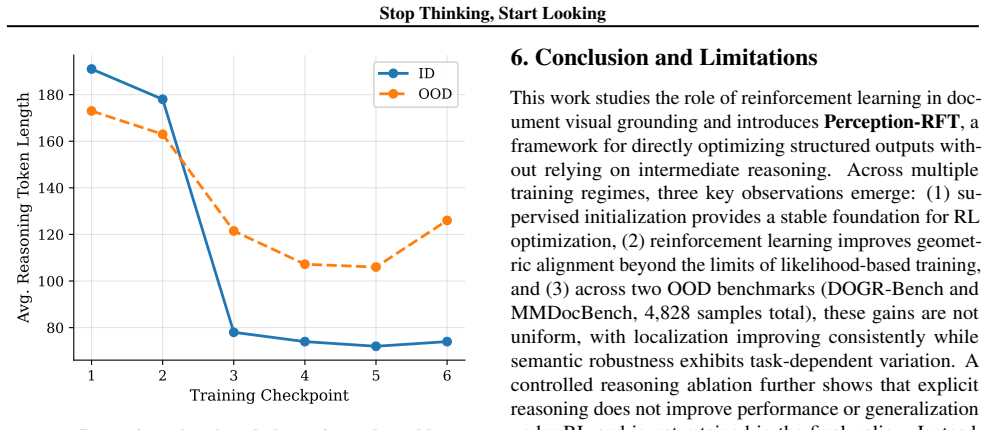
Perception-RFT applies Group Relative Policy Optimization to document visual grounding under a 'Direct Perception' constraint that forbids reasoning tokens, with a three-part gated reward: binary JSON format, quadratically scaled ANLS for semantics, and a thresholded IoU reward that shapes toward tight boxes. Under identical rewards, the reasoning-enabled variant collapses its reasoning traces during training: average reasoning length falls from about 191 to 72 tokens (62% reduction) while performance stays level or drops below the perception-only variant. The paper's central discovery is that explicit reasoning is neither retained nor beneficial for this grounding task; the optimal policy i
What carries the argument
The central object is Perception-RFT, a training framework built on GRPO (group-relative policy optimization) with a Gated Dense Reward. The Direct Perception system prompt suppresses <think> tokens and forces immediate JSON output {answer, bbox 2d}; the gated reward splits the optimization surface into a shaping state (λ·IoU below threshold 0.6) and a success state (1.0 above), preventing degenerate oversized boxes. A reasoning variant with identical rewards is used as a controlled comparison.
Load-bearing premise
The reasoning-enabled variant is tested only in cold-start RL with a reward that never rewards producing or retaining reasoning traces, so it may not capture what a warm-started, reasoning-supervised pipeline would do; if such a model kept its traces and improved grounding, the central 'reasoning is unnecessary' claim would collapse.
What would settle it
Train a reasoning-enabled model with supervised fine-tuning on reasoning-annotated grounding data, then apply RL with a reward that explicitly encourages retaining reasoning; if it outperforms perception-only training and keeps its traces, the paper's conclusion is overturned. Alternatively, run the same GRPO setup with a small reward bonus for reasoning tokens and observe whether performance exceeds the perception-only baseline.
If this is right
- RL post-training lifts joint semantic-geometric accuracy beyond the supervised fine-tuning plateau on in-distribution documents (F1 all from 0.668 to 0.718 for SFT→RL).
- SFT initialization is required for stable geometric learning under RL; cold-start RL is substantially worse, confirming that text-domain cold-start instability carries over to multimodal grounding.
- Reasoning-enabled RL converges to a policy with minimal reasoning tokens, cutting per-query inference tokens by more than 60% while underperforming perception-only training.
- An early SFT→RL transition (300 of 1,113 SFT steps) matches or exceeds full SFT localization with about 65% less training data.
- Under distribution shift, localization improves consistently while semantic extraction often regresses (Grounding Divergence), so joint grounding still improves but the trade-off is asymmetric.
Where Pith is reading between the lines
- If this finding holds at larger scales, reasoning-centric RL pipelines for perception-heavy document tasks may be paying an inference cost without a grounding benefit; testing at 7B+ would clarify.
- The reasoning ablation is cold-start only; a warm-started reasoning policy trained on reasoning-annotated supervision might retain traces and improve grounding, which the paper itself flags as an open question.
- The gated reward design (shaping below threshold, cliff-edge success) could transfer to other structured-output tasks where degenerate solutions are common, such as table extraction or layout parsing.
- Grounding Divergence could be reduced by decoupling semantic and geometric rewards, e.g., weighting ANLS more heavily on OOD splits.
Editorial analysis
A structured set of objections, weighed in public.
Referee Report
Summary. The paper proposes Perception-RFT, a GRPO-based post-training method for document visual grounding (DVG) that directly optimizes structured JSON outputs (answer text and bounding box) without intermediate reasoning tokens. Using Qwen3-VL-4B trained on a 23,696-sample financial document corpus, it compares SFT, cold-start RL (RFTb), and SFT-then-RL (RFTs) on in-distribution and two OOD benchmarks (DOGR-Bench and MMDocBench, 4,828 samples). The central empirical claims are: (i) SFT saturates while RL continues to improve geometric precision; (ii) SFT initialization is needed for stable RL; (iii) an early SFT-to-RL transition achieves comparable precision with ~65% less training data; (iv) a reasoning-enabled cold-start RL variant (Reasoning-RFTb) underperforms the perception-only variant, suppresses its reasoning traces during training, and reduces inference token length by ~62% on ID data; and (v) a new 'Grounding Divergence' phenomenon describes selective trade-offs between semantic robustness and geometric precision under distribution shift. The paper introduces a Gated Dense Reward mechanism with a success threshold and a shaping scale.
Significance. If the central finding holds, the paper makes a practically relevant contribution: it shows at the 4B scale that reasoning traces are not necessary for DVG under cold-start RL, yielding faster and cheaper inference, and that RL can improve geometric grounding beyond SFT. The controlled comparison under identical reward settings is a genuine strength, as is the use of a strict joint success metric (F1 all) and the analysis of optimization dynamics. The paper is also transparent about several limitations. However, the headline claim that 'reasoning-enabled RL does not improve performance' rests on a single cold-start RL ablation in which the reward (Eq. 3–5) never scores reasoning tokens, so the observed trace suppression is partly a reward-design artifact. The authors acknowledge this limitation but the abstract and conclusions still overgeneralize. The paper is a promising empirical study that needs additional evidence or a more carefully scoped claim before its main conclusion is fully accepted.
major comments (4)
- [§3.4, §5.4, Eqs. (3)–(5)] The reasoning ablation is not a fair test of the value of reasoning. The reward is computed exclusively from the final JSON: format validity, ANLS of the answer string, and gated IoU (Eq. 3–5). Reasoning tokens inside <think> tags are never scored, so GRPO has no incentive to retain them; the observed compression in Figure 5 is a direct consequence of this reward design. The paper acknowledges in §6 that reasoning-annotated SFT data are unavailable, but this is load-bearing: the central claim that 'optimal grounding policies rely on direct perception rather than explicit reasoning' is supported only for cold-start RL with no reward signal for reasoning. To support the stronger claim, the authors would need a warm-started SFT→RL reasoning pipeline (e.g., with DocThinker-style reasoning-annotated data) or a reward that explicitly rewards reasoning quality. Absent that, the conclusion must
- [Table 1, Figures 2–5] No error bars, confidence intervals, or significance tests are reported even though the text repeatedly says 'averaged over 3 independent runs.' Several key comparisons are small in magnitude: on DOGR-Bench, SFT semantic F1 drops from the base 0.743 to 0.722, and on MMDocBench SFT (0.616) and RFTs (0.620) are within 0.02 of the base (0.636). Without variance estimates, the reader cannot distinguish genuine effects from run-to-run noise. This is particularly important for the claim that 'all trained variants fall below the zero-shot base' on DOGR and for the 'Grounding Divergence' phenomenon. Please report standard deviations or at least error bars.
- [§5.2, Table 1] The 'Grounding Divergence' is presented as a consistent pattern, but the results are actually inconsistent across the two OOD benchmarks. On DOGR-Bench, all trained variants drop below zero-shot on semantic F1, matching the stated divergence. On MMDocBench, by contrast, RFTb improves semantic F1 from 0.636 to 0.702, while SFT and RFTs drop slightly. This is not a consistent selective trade-off but a task-dependent result. The paper acknowledges in §5.2 that 'the severity of the Grounding Divergence varies with visual domain distance,' but the abstract and §5.1 describe it as a general phenomenon. The claim needs to be substantially nuanced or supported by a mechanism that explains the differential behavior.
- [§5.4, Table 2, Fig. 4] The reasoning ablation is only run in a cold-start RL setting, which limits the generality of the conclusion stated in the introduction and abstract: 'reasoning-enabled RL does not improve performance and can underperform direct perception-based training.' Because the reward never incentivizes retaining reasoning traces, a warm-started reasoning model might behave differently. The authors explicitly note this limitation in §6, but the title and abstract still imply a general conclusion about reasoning's non-necessity. The recommendation should be either to add the warm-start experiment when data become available, or to clearly state in the abstract that the finding is specific to cold-start RL without reasoning supervision.
minor comments (5)
- [§1, §5.1] Typo in the introduction: 'We confirm that, the two dynamics' should read 'We confirm that the two dynamics.' Also the phrase 'the, the two dynamics' in §5.1 is garbled.
- [§3.4 vs Appendix A.1] The reasoning variant is described as 'the model may generate intermediate <think> traces' in §3.4, but the reasoning system prompt in Appendix A.1 says 'You MUST first formulate your extraction plan internally' and requires <think> tags. This inconsistency should be resolved; the implementation appears to mandate reasoning, which strengthens the ablation but should be stated precisely.
- [Figure 5 and §5.4] The text claims a '>60% inference-token reduction' based on ID data (from ~191 to ~72 tokens), but Figure 5 shows that on OOD data the reasoning length slightly increases at later checkpoints. The claim should be scoped to the ID setting or averaged over both settings with the reported variance.
- [Table 1 and §4.3] The table note 'DOGR SFT is evaluated on DOGR-Bench only' is confusing, since the SFT row reports ID, DOGR, and MMDocBench numbers. Clarify what this note means. Also, Gemini 3.0 Flash is described as 'evaluated zero-shot' but no details are given about API version, sampling, or whether the same system prompts are used.
- [§3.3, Eq. (5)] The success threshold τ=0.6 and shaping scale λ=0.3 are set 'empirically' with no sensitivity analysis. The paper should at least report the stability of results to reasonable variations of these hyperparameters, since the 'cliff-edge' design is a core methodological contribution.
Circularity Check
No significant circularity: the paper's claims are empirical comparisons on held-out benchmarks, and the reasoning-ablation limitation is acknowledged rather than built into the derivation.
full rationale
The paper's central claims are empirical results, not derivations: Perception-RFT is compared against SFT, cold-start RL, and a reasoning-enabled variant on held-out ID and OOD benchmarks (DOGR-Bench, MMDocBench). The reasoning ablation is run under the same reward function, and the observed compression of <think> tokens is reported as a measured training trajectory (Figure 5), not as a consequence of the reward equations by construction. Although the reward (Eq. 3-5) does not score reasoning tokens, the paper explicitly scopes the conclusion to cold-start RL under identical reward settings, and the Limitations section acknowledges that a warm-started SFT-to-RL reasoning pipeline remains untested. The SFT saturation, cold-start instability, and Grounding Divergence findings are supported by external benchmarks and are not fitted parameters renamed as predictions; hyperparameters τ and λ are presented as empirical tuning choices, not as outputs of the method. There is no load-bearing self-citation chain. The paper is self-contained against external evaluation, so no circular step is exhibited.
Axiom & Free-Parameter Ledger
free parameters (2)
- IoU success threshold τ =
0.6
- Shaping scale λ =
0.3
axioms (5)
- domain assumption GRPO with group-relative advantage (Eq. 2) is a valid and stable optimizer for a 4B multimodal policy.
- domain assumption Output-token length is a valid proxy for the amount of reasoning the model performs.
- domain assumption DocILE/FormNLU KIE key-value annotations can be faithfully converted into document visual QA grounding targets with valid bounding boxes.
- domain assumption DOGR-Bench and MMDocBench labels and coordinate formats are compatible with the model's normalized output range [0,1000].
- domain assumption Three SFT epochs represent the saturation limit of supervised fine-tuning.
invented entities (1)
-
Grounding Divergence
no independent evidence
read the original abstract
Efficient multimodal document question answering with explicit visual grounding, locating the precise document region that supports each answer remains an open challenge. Current approaches bifurcate into Supervised Fine-Tuning (SFT), which requires large annotated datasets and reaches optimization plateaus, and reasoning-centric Reinforcement Learning (RL), which depends on verbose intermediate traces that inflate inference token cost without clear benefit. We introduce Perception-RFT, a training framework that applies Group Relative Policy Optimization (GRPO) to multimodal document QA, bypassing intermediate reasoning tokens to directly align visual features with structured grounding outputs. To rigorously evaluate the necessity of reasoning, we construct a reasoning variant under identical reward settings. We find that reasoning-enabled models suppress their reasoning traces during training, converging to direct perception-based policies at the 4B parameter scale, reducing per-query inference token length by more than 60%, while reasoning-enabled RL underperforms perception-only training. Through a fine-grained analysis of Qwen3-VL-4B optimization dynamics, we confirm that SFT saturation and cold-start RL instability established in text-domain post-training extend to multimodal, and identify a previously uncharacterized Grounding Divergence: a selective trade-off between semantic robustness and geometric precision on two out of distribution (OOD) benchmarks (4,828 samples) under joint RL optimization. We further show that an early SFT$\rightarrow$RL transition achieves comparable precision with 65% less training data.
Figures



Reference graph
Works this paper leans on
-
[1]
Qwen3-vl technical report, 2025
Bai, S., Cai, Y., Chen, R., Chen, K., Chen, X., Cheng, Z., Deng, L., Ding, W., Gao, C., Ge, C., Ge, W., Guo, Z., Huang, Q., Huang, J., Huang, F., Hui, B., Jiang, S., Li, Z., Li, M., Li, M., Li, K., Lin, Z., Lin, J., Liu, X., Liu, J., Liu, C., Liu, Y., Liu, D., Liu, S., Lu, D., Luo, R., Lv, C., Men, R., Meng, L., Ren, X., Ren, X., Song, S., Sun, Y., Tang, ...
Pith/arXiv arXiv 2025
-
[2]
F., Tito, R., Mafla, A., Gomez, L., Rusinol, M., Valveny, E., Jawahar, C., and Karatzas, D
Biten, A. F., Tito, R., Mafla, A., Gomez, L., Rusinol, M., Valveny, E., Jawahar, C., and Karatzas, D. Scene text visual question answering. In Proceedings of the IEEE/CVF international conference on computer vision, pp.\ 4291--4301, 2019
2019
-
[6]
Ding, Y., Long, S., Huang, J., Ren, K., Luo, X., Chung, H., and Han, S. C. Form-nlu: dataset for the form natural language understanding. In Proceedings of the 46th International ACM SIGIR Conference on Research and Development in Information Retrieval, pp.\ 2807--2816, 2023
2023
-
[8]
Boundingdocs: a unified dataset for document question answering with spatial annotations: S
Giovannini, S., Coppini, F., Gemelli, A., and Marinai, S. Boundingdocs: a unified dataset for document question answering with spatial annotations: S. giovannini et al. International Journal on Document Analysis and Recognition (IJDAR), pp.\ 1--16, 2025
2025
-
[10]
J., Shen, Y., Wallis, P., Allen-Zhu, Z., Li, Y., Wang, S., Wang, L., and Chen, W
Hu, E. J., Shen, Y., Wallis, P., Allen-Zhu, Z., Li, Y., Wang, S., Wang, L., and Chen, W. Lora: Low-rank adaptation of large language models, 2021. URL https://arxiv.org/abs/2106.09685
Pith/arXiv arXiv 2021
-
[12]
Layoutlmv3: Pre-training for document ai with unified text and image masking
Huang, Y., Lv, T., Cui, L., Lu, Y., and Wei, F. Layoutlmv3: Pre-training for document ai with unified text and image masking. In Proceedings of the 30th ACM international conference on multimedia, pp.\ 4083--4091, 2022
2022
-
[15]
B., and Zhang, K
Li, M., Zhong, J., Zhao, S., Lai, Y., Zhang, H., Zhu, W. B., and Zhang, K. To think or not to think: A study of thinking in rule-based visual reinforcement fine-tuning. In The Thirty-ninth Annual Conference on Neural Information Processing Systems, 2025 b
2025
-
[19]
4v (ision) system card https://cdn
OpenAI, G. 4v (ision) system card https://cdn. openai. com/papers. GPTV\_System\_Card. pdf, 2023
2023
-
[23]
Docile benchmark for document information localization and extraction
S imsa, S ., S ulc, M., U r i c \'a r , M., Patel, Y., Hamdi, A., Koci \'a n, M., Skalick \`y , M., Matas, J., Doucet, A., Coustaty, M., et al. Docile benchmark for document information localization and extraction. In International Conference on Document Analysis and Recognition, pp.\ 147--166. Springer, 2023
2023
-
[27]
Unsloth: Fast fine-tuning and training of llms
Team, U. Unsloth: Fast fine-tuning and training of llms. https://github.com/unslothai/unsloth, 2024
2024
-
[28]
A., Jung, K., J \"a lk \"o , J., D’Andecy, V
Tito, R., Nguyen, K., Tobaben, M., Kerkouche, R., Souibgui, M. A., Jung, K., J \"a lk \"o , J., D’Andecy, V. P., Joseph, A., Kang, L., et al. Privacy-aware document visual question answering. In International Conference on Document Analysis and Recognition, pp.\ 199--218. Springer, 2024
2024
-
[29]
Drishtikon: Multi-granular visual grounding for text-rich document images
Vishal Kasuba, B., Chaudhuri, P., and Ramakrishnan, G. Drishtikon: Multi-granular visual grounding for text-rich document images. arXiv e-prints, pp.\ arXiv--2506, 2025
2025
-
[30]
Towards visual grounding: A survey
Xiao, L., Yang, X., Lan, X., Wang, Y., and Xu, C. Towards visual grounding: A survey. IEEE Transactions on Pattern Analysis and Machine Intelligence, pp.\ 1--20, 2025. doi:10.1109/TPAMI.2025.3630635
arXiv 2025
-
[33]
Docthinker: Explainable multimodal large language models with rule-based reinforcement learning for document understanding
Yu, W., Yang, Z., Liu, Y., and Bai, X. Docthinker: Explainable multimodal large language models with rule-based reinforcement learning for document understanding. In Proceedings of the IEEE/CVF International Conference on Computer Vision, pp.\ 837--847, 2025 b
2025
-
[34]
Dogr: Towards versatile visual document grounding and referring
Zhou, Y., Chen, Y., Lin, H., Wu, Y., Yang, S., Qi, Z., Ma, C., and Zhu, L. Dogr: Towards versatile visual document grounding and referring. In Proceedings of the IEEE/CVF International Conference on Computer Vision, pp.\ 3596--3606, 2025
2025
-
[35]
X., Wu, H., Wang, W., Feng, F., Wang, C., Luan, H., and Chua, T.-S
Zhu, F., Liu, Z., Yao, N. X., Wu, H., Wang, W., Feng, F., Wang, C., Luan, H., and Chua, T.-S. Mmdocbench: Benchmarking large vision-language models for fine-grained visual document understanding and grounding. In Loko c , J., Pe s ka, L., Zah \'a lka, J., Rudinac, S., Kastner, M., Chen, J., Hu, M.-C., Wu, J., and Sharma, U. (eds.), MultiMedia Modeling, pp...
2026
-
[36]
arXiv preprint arXiv:2412.14056 , year=
A review of multimodal explainable artificial intelligence: Past, present and future , author=. arXiv preprint arXiv:2412.14056 , year=
-
[37]
arXiv preprint arXiv:2501.00321 , year=
Ocrbench v2: An improved benchmark for evaluating large multimodal models on visual text localization and reasoning , author=. arXiv preprint arXiv:2501.00321 , year=
-
[38]
arXiv preprint arXiv:2504.04974 , year=
Towards visual text grounding of multimodal large language model , author=. arXiv preprint arXiv:2504.04974 , year=
-
[39]
Proceedings of the IEEE/CVF International Conference on Computer Vision , pages=
Dogr: Towards versatile visual document grounding and referring , author=. Proceedings of the IEEE/CVF International Conference on Computer Vision , pages=
-
[40]
Proceedings of the IEEE/CVF International Conference on Computer Vision , pages=
Docthinker: Explainable multimodal large language models with rule-based reinforcement learning for document understanding , author=. Proceedings of the IEEE/CVF International Conference on Computer Vision , pages=
-
[41]
arXiv preprint arXiv:2501.12948 , year=
Deepseek-r1: Incentivizing reasoning capability in llms via reinforcement learning , author=. arXiv preprint arXiv:2501.12948 , year=
-
[42]
arXiv preprint arXiv:2501.17161 , year=
Sft memorizes, rl generalizes: A comparative study of foundation model post-training , author=. arXiv preprint arXiv:2501.17161 , year=
-
[43]
arXiv preprint arXiv:2509.12235 , year=
Rl fine-tuning heals ood forgetting in sft , author=. arXiv preprint arXiv:2509.12235 , year=
-
[44]
5-vl technical report , author=
Qwen2. 5-vl technical report , author=. arXiv preprint arXiv:2502.13923 , year=
-
[45]
arXiv preprint arXiv:2402.03300 , year=
Deepseekmath: Pushing the limits of mathematical reasoning in open language models , author=. arXiv preprint arXiv:2402.03300 , year=
-
[46]
Proceedings of the 30th ACM international conference on multimedia , pages=
Layoutlmv3: Pre-training for document ai with unified text and image masking , author=. Proceedings of the 30th ACM international conference on multimedia , pages=
-
[47]
arXiv preprint arXiv:2507.05595 , year=
Paddleocr 3.0 technical report , author=. arXiv preprint arXiv:2507.05595 , year=
-
[48]
arXiv preprint arXiv:2403.05530 , year=
Gemini 1.5: Unlocking multimodal understanding across millions of tokens of context , author=. arXiv preprint arXiv:2403.05530 , year=
-
[49]
4V (ision) System Card https://cdn. openai. com/papers , author=. GPTV\_System\_Card. pdf , year=
-
[50]
arXiv preprint arXiv:2412.00151 , year=
DLaVA: Document Language and Vision Assistant for Answer Localization with Enhanced Interpretability and Trustworthiness , author=. arXiv preprint arXiv:2412.00151 , year=
-
[51]
arXiv preprint arXiv:2306.15195 , year=
Shikra: Unleashing multimodal llm's referential dialogue magic , author=. arXiv preprint arXiv:2306.15195 , year=
-
[52]
arXiv preprint arXiv:2310.07704 , year=
Ferret: Refer and ground anything anywhere at any granularity , author=. arXiv preprint arXiv:2310.07704 , year=
-
[53]
arXiv preprint arXiv:2309.11419 , year=
Kosmos-2.5: A multimodal literate model , author=. arXiv preprint arXiv:2309.11419 , year=
-
[54]
Farrar, Straus and Giroux , year=
Thinking, fast and slow , author=. Farrar, Straus and Giroux , year=
-
[55]
arXiv preprint arXiv:2504.07954 , year=
Perception-r1: Pioneering perception policy with reinforcement learning , author=. arXiv preprint arXiv:2504.07954 , year=
-
[56]
The Thirty-ninth Annual Conference on Neural Information Processing Systems , year=
To think or not to think: A study of thinking in rule-based visual reinforcement fine-tuning , author=. The Thirty-ninth Annual Conference on Neural Information Processing Systems , year=
-
[57]
arXiv preprint arXiv:2503.20752 , year=
Reason-rft: Reinforcement fine-tuning for visual reasoning , author=. arXiv preprint arXiv:2503.20752 , year=
-
[58]
2021 , eprint=
Key Information Extraction From Documents: Evaluation And Generator , author=. 2021 , eprint=
2021
-
[59]
International Conference on Document Analysis and Recognition , pages=
Privacy-aware document visual question answering , author=. International Conference on Document Analysis and Recognition , pages=. 2024 , organization=
2024
-
[60]
International Conference on Document Analysis and Recognition , pages=
Docile benchmark for document information localization and extraction , author=. International Conference on Document Analysis and Recognition , pages=. 2023 , organization=
2023
-
[61]
Proceedings of the 46th International ACM SIGIR Conference on Research and Development in Information Retrieval , pages=
Form-NLU: dataset for the form natural language understanding , author=. Proceedings of the 46th International ACM SIGIR Conference on Research and Development in Information Retrieval , pages=
-
[62]
Giovannini et al
BoundingDocs: a Unified Dataset for Document Question Answering with Spatial Annotations: S. Giovannini et al. , author=. International Journal on Document Analysis and Recognition (IJDAR) , pages=. 2025 , publisher=
2025
-
[63]
arXiv e-prints , pages=
DrishtiKon: Multi-Granular Visual Grounding for Text-Rich Document Images , author=. arXiv e-prints , pages=
-
[64]
arXiv preprint arXiv:2503.01785 , year=
Visual-rft: Visual reinforcement fine-tuning , author=. arXiv preprint arXiv:2503.01785 , year=
-
[65]
arXiv preprint arXiv:2503.06749 , year=
Vision-r1: Incentivizing reasoning capability in multimodal large language models , author=. arXiv preprint arXiv:2503.06749 , year=
-
[66]
arXiv preprint arXiv:2504.07615 , year=
Vlm-r1: A stable and generalizable r1-style large vision-language model , author=. arXiv preprint arXiv:2504.07615 , year=
-
[67]
2021 , eprint=
LoRA: Low-Rank Adaptation of Large Language Models , author=. 2021 , eprint=
2021
-
[68]
GitHub repository , howpublished =
Unsloth Team , title =. GitHub repository , howpublished =. 2024 , publisher =
2024
-
[69]
Proceedings of the IEEE/CVF international conference on computer vision , pages=
Scene text visual question answering , author=. Proceedings of the IEEE/CVF international conference on computer vision , pages=
-
[70]
Towards Visual Grounding: A Survey , year=
Xiao, Linhui and Yang, Xiaoshan and Lan, Xiangyuan and Wang, Yaowei and Xu, Changsheng , journal=. Towards Visual Grounding: A Survey , year=
-
[71]
arXiv preprint arXiv:2509.10345 , year=
Towards understanding visual grounding in visual language models , author=. arXiv preprint arXiv:2509.10345 , year=
-
[72]
MMDocBench: Benchmarking Large Vision-Language Models for Fine-Grained Visual Document Understanding and Grounding
Zhu, Fengbin and Liu, Ziyang and Yao, NG Xiang and Wu, Haohui and Wang, Wenjie and Feng, Fuli and Wang, Chao and Luan, Huanbo and Chua, Tat-Seng. MMDocBench: Benchmarking Large Vision-Language Models for Fine-Grained Visual Document Understanding and Grounding. MultiMedia Modeling. 2026
2026
-
[73]
2025 , eprint=
Qwen3-VL Technical Report , author=. 2025 , eprint=
2025
discussion (0)
Sign in with ORCID, Apple, or X to comment. Anyone can read and Pith papers without signing in.