Conserved Kinematic Representations enable Zero-Shot Decoding in Handwriting BCIs
Pith reviewed 2026-05-20 07:42 UTC · model grok-4.3
The pith
Neural representations of handwriting strokes stay conserved across characters, allowing decoders to recognize unseen letters without training examples.
A machine-rendered reading of the paper's core claim, the machinery that carries it, and where it could break.
Core claim
By aligning neural activity to imagined kinematics across large intracortical datasets, a machine-learning decoder can be trained that retrieves unseen characters at 64 percent hits@3 accuracy. This performance indicates that kinematic stroke representations in motor cortex are robustly conserved across varying character contexts and therefore support a compositional account of complex motor behavior.
What carries the argument
The computational alignment procedure that maps recorded neural activity onto imagined kinematic trajectories, thereby isolating stroke primitives that remain stable enough for zero-shot generalization.
If this is right
- iBCI systems can scale to logographic scripts containing thousands of characters without requiring the user to produce every class during calibration.
- Communication vocabularies can become effectively open-ended with only minimal recalibration sessions.
- Large-scale intracortical recordings can be mined for conserved dynamical motifs that underlie other skilled movements.
- Evidence accumulates for a compositional organization of motor cortex that assembles complex actions from a smaller set of kinematic building blocks.
Where Pith is reading between the lines
- The same alignment technique could shorten calibration periods even for Latin-alphabet users who already train on full alphabets.
- If the conserved primitives prove stable across days or sessions, daily recalibration might become unnecessary for some users.
- Testing whether similar stroke-level conservation appears in real-time movement rather than imagined movement would clarify how much the finding depends on the imagined condition.
- The approach may transfer to other high-dimensional motor tasks such as speech or gesture, where exhaustive training on every possible output is equally impractical.
Load-bearing premise
The alignment step between neural activity and imagined kinematics isolates primitives that truly generalize without depending on the surrounding character context.
What would settle it
Retraining the decoder on the same aligned data but testing it on a fresh set of characters never used in any alignment, then finding retrieval accuracy at or below chance level.
Figures




read the original abstract
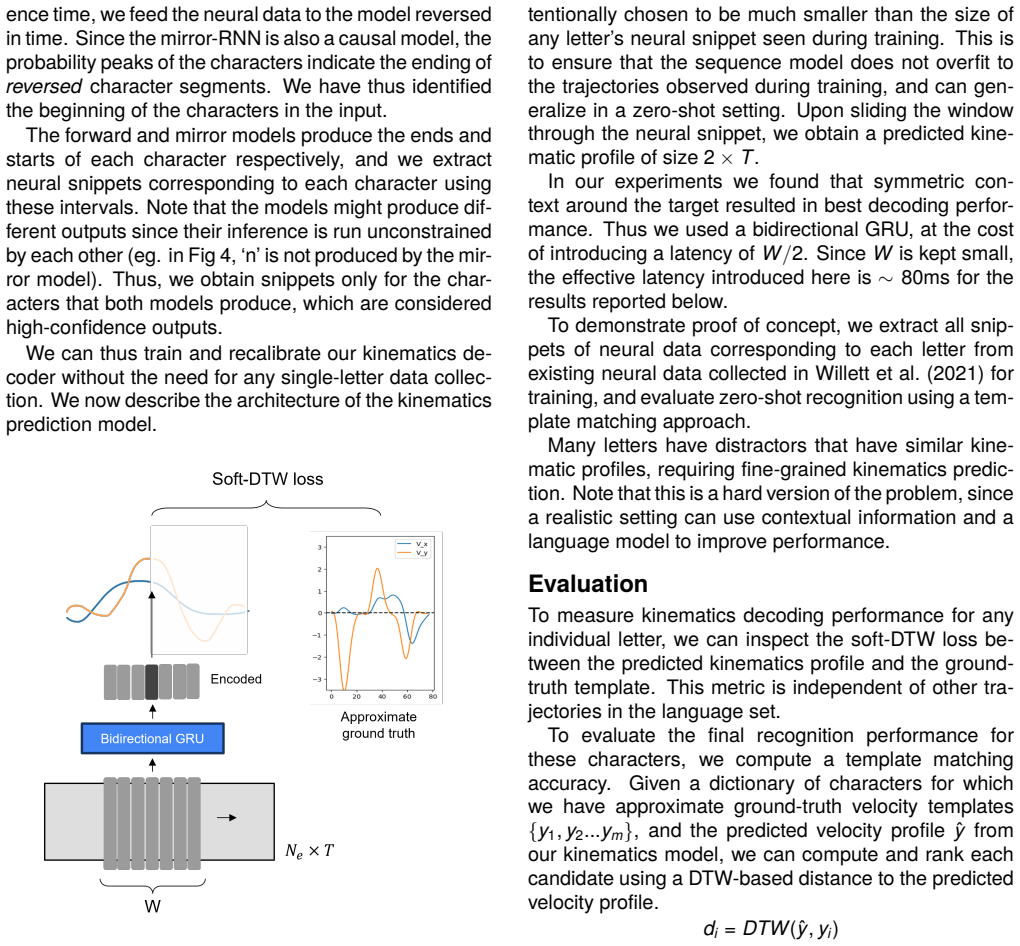
While intracortical Brain-Computer Interfaces (iBCIs) that decode imagined handwriting have achieved high communication rates for Latin scripts, they rely on observing every character in the alphabet during training. This poses a challenge in scaling to logographic languages (e.g., Chinese, Japanese), where the character set exceeds thousands of classes. The limitation highlights a fundamental question in motor neuroscience: does the motor cortex represent handwriting through the composition of shared kinematic primitives, that can be exploited by decoders? We introduce a computational framework for aligning neural activity to imagined kinematics in large datasets, enabling the training of a zero-shot capable machine learning algorithm for decoding unseen characters. Our model achieves 64% hits@3 retrieval on unseen letters, suggesting that neural representations of kinematic strokes are robustly conserved across different character contexts. This study provides a framework for dissecting conserved neural dynamics in large-scale intracortical datasets and offers strong evidence for a compositional basis of complex motor control. It also establishes a new paradigm for open-vocabulary iBCI communication with minimal recalibration burden on the user, crucial to increasing adoption of neuroprosthetics in logographic languages.
Editorial analysis
A structured set of objections, weighed in public.
Referee Report
Summary. The manuscript introduces a computational framework for aligning intracortical neural activity during imagined handwriting to kinematic stroke primitives. This alignment enables training of a machine learning decoder that achieves zero-shot retrieval of unseen characters, with a reported 64% hits@3 accuracy on held-out letters. The authors interpret this performance as evidence that motor cortex represents complex handwriting via conserved, context-independent kinematic primitives, with implications for scaling iBCIs to logographic scripts without exhaustive per-character training.
Significance. If the alignment isolates truly conserved primitives and the zero-shot result survives appropriate controls for leakage and statistical power, the work would advance motor neuroscience by providing empirical support for compositional representations in motor cortex and offer a practical route to open-vocabulary BCI communication. The framework for dissecting large-scale neural datasets could also be reusable beyond handwriting.
major comments (2)
- [Methods (Alignment)] Methods, Alignment subsection: the description of kinematic template construction or generative-model fitting does not state whether templates are derived exclusively from training-session data or from the pooled dataset that includes neural trajectories from the held-out 'unseen' characters. If the latter, residual character-conditioned correlations could be exploited by the decoder, so the 64% hits@3 would not demonstrate context-independent conservation.
- [Results (Zero-shot Decoding)] Results, Zero-shot evaluation: the 64% hits@3 figure is given without the number of unseen characters, total trials per character, or comparison to a chance baseline and permutation controls. These quantities are required to determine whether the retrieval performance is consistent with robust generalization rather than partial leakage or dataset-specific structure.
minor comments (2)
- [Abstract] Abstract: performance numbers should be accompanied by at least a brief statement of dataset size, number of held-out classes, and alignment details so readers can immediately gauge the strength of the conservation claim.
- [Methods] Notation: the distinction between 'imagined kinematics' (the alignment target) and the neural activity used for decoding should be made explicit in the first methods paragraph to avoid ambiguity about what is being aligned.
Simulated Author's Rebuttal
We thank the referee for their constructive and detailed comments, which have helped us improve the clarity and rigor of the manuscript. We address each major comment below and indicate the corresponding revisions.
read point-by-point responses
-
Referee: Methods, Alignment subsection: the description of kinematic template construction or generative-model fitting does not state whether templates are derived exclusively from training-session data or from the pooled dataset that includes neural trajectories from the held-out 'unseen' characters. If the latter, residual character-conditioned correlations could be exploited by the decoder, so the 64% hits@3 would not demonstrate context-independent conservation.
Authors: We thank the referee for identifying this ambiguity. The kinematic templates were in fact constructed exclusively from training-session data, with no neural trajectories from held-out unseen characters included in template construction or model fitting. This was done to ensure that any zero-shot performance arises from conserved, context-independent representations. We have revised the Alignment subsection to state this explicitly and to describe the data partitioning used for template derivation. revision: yes
-
Referee: Results, Zero-shot evaluation: the 64% hits@3 figure is given without the number of unseen characters, total trials per character, or comparison to a chance baseline and permutation controls. These quantities are required to determine whether the retrieval performance is consistent with robust generalization rather than partial leakage or dataset-specific structure.
Authors: We agree that these details are necessary for proper evaluation of the result. We have revised the zero-shot evaluation subsection to report the number of unseen characters, the number of trials per character, the corresponding chance baseline for hits@3, and the results of permutation controls (label shuffling). These additions show that the observed performance is statistically above chance and inconsistent with leakage or dataset-specific artifacts. revision: yes
Circularity Check
Derivation self-contained; no reduction to fitted inputs or self-citation chains
full rationale
The abstract and available description outline a framework for aligning neural activity to imagined kinematics to enable zero-shot decoding of unseen characters. No equations, fitting procedures, or self-citations are presented that would make the reported 64% hits@3 retrieval equivalent to its own inputs by construction. The central claim of conserved kinematic primitives rests on empirical alignment and retrieval performance rather than definitional equivalence or load-bearing self-reference. This is consistent with an honest non-finding of circularity.
Axiom & Free-Parameter Ledger
Lean theorems connected to this paper
-
IndisputableMonolith/Cost/FunctionalEquation.leanwashburn_uniqueness_aczel unclear?
unclearRelation between the paper passage and the cited Recognition theorem.
Our model achieves 64% hits@3 retrieval on unseen letters, suggesting that neural representations of kinematic strokes are robustly conserved across different character contexts.
-
IndisputableMonolith/Foundation/RealityFromDistinction.leanreality_from_one_distinction unclear?
unclearRelation between the paper passage and the cited Recognition theorem.
We introduce a computational framework for aligning neural activity to imagined kinematics in large datasets
What do these tags mean?
- matches
- The paper's claim is directly supported by a theorem in the formal canon.
- supports
- The theorem supports part of the paper's argument, but the paper may add assumptions or extra steps.
- extends
- The paper goes beyond the formal theorem; the theorem is a base layer rather than the whole result.
- uses
- The paper appears to rely on the theorem as machinery.
- contradicts
- The paper's claim conflicts with a theorem or certificate in the canon.
- unclear
- Pith found a possible connection, but the passage is too broad, indirect, or ambiguous to say the theorem truly supports the claim.
Reference graph
Works this paper leans on
-
[1]
Surrogate deep neural networks reveal hierarchical handwriting encoding in the human motor cortex , author=. Cell Reports , volume=. 2026 , publisher=
work page 2026
-
[2]
Nature communications , volume=
Hierarchical motor control in mammals and machines , author=. Nature communications , volume=. 2019 , publisher=
work page 2019
-
[3]
On the Properties of Neural Machine Translation: Encoder-Decoder Approaches
On the properties of neural machine translation: Encoder-decoder approaches , author=. arXiv preprint arXiv:1409.1259 , year=
work page internal anchor Pith review Pith/arXiv arXiv
-
[4]
Journal of machine learning research , volume=
Visualizing data using t-SNE , author=. Journal of machine learning research , volume=
-
[5]
arXiv preprint arXiv:2105.14849 , year=
Why does CTC result in peaky behavior? , author=. arXiv preprint arXiv:2105.14849 , year=
-
[6]
Advances in neural information processing systems , volume=
Plug-and-play stability for intracortical brain-computer interfaces: a one-year demonstration of seamless brain-to-text communication , author=. Advances in neural information processing systems , volume=
-
[7]
International conference on machine learning , pages=
Soft-dtw: a differentiable loss function for time-series , author=. International conference on machine learning , pages=. 2017 , organization=
work page 2017
-
[8]
Decoding imaginary handwriting trajectories with shape and time distortion loss for brain-to-text communication , author=. medRxiv , pages=. 2024 , publisher=
work page 2024
-
[9]
Advances in Neural Information Processing Systems , volume=
Few-shot algorithms for consistent neural decoding (falcon) benchmark , author=. Advances in Neural Information Processing Systems , volume=
-
[10]
High-performance brain-to-text communication via handwriting , author=. Nature , volume=. 2021 , publisher=
work page 2021
-
[11]
Nature Human Behaviour , pages=
Human motor cortex encodes complex handwriting through a sequence of stable neural states , author=. Nature Human Behaviour , pages=. 2025 , publisher=
work page 2025
-
[12]
IEEE Transactions on Neural Systems and Rehabilitation Engineering , year=
Reconstructing Multi-Stroke Characters from Brain Signals toward Generalizable Handwriting Brain-Computer Interfaces , author=. IEEE Transactions on Neural Systems and Rehabilitation Engineering , year=
discussion (0)
Sign in with ORCID, Apple, or X to comment. Anyone can read and Pith papers without signing in.