RefleX: X-ray absorption and reflection in active galactic nuclei for arbitrary geometries
Pith reviewed 2026-05-25 18:56 UTC · model grok-4.3
The pith
RefleX simulation platform computes X-ray absorption and reflection for quasi-arbitrary geometries around supermassive black holes.
A machine-rendered reading of the paper's core claim, the machinery that carries it, and where it could break.
Core claim
RefleX reproduces absorption and reflection by quasi-arbitrary geometries. Its reliability is shown by matching results from pexrav, MYTorus and BNTorus. The code treats both Compton scattering on free electrons and Rayleigh scattering plus Compton scattering on bound electrons. RXTorus, the released torus model, allows a variable minor-to-major axis ratio and is supplied in three components—absorbed primary emission, scattered radiation and fluorescent lines—for different abundances and in both atomic and free-electron configurations. Fitting NGC 424 shows that the bound versus free electron assumption has significant consequences on the fit parameters.
What carries the argument
RefleX Monte Carlo simulation platform that implements Compton scattering on free electrons together with Rayleigh scattering and Compton scattering on bound electrons for arbitrary geometries.
If this is right
- Spectra can be generated for tori whose minor-to-major axis ratio takes any value.
- The output separates into absorbed primary emission, scattered radiation, and fluorescent lines.
- Models are supplied for different elemental abundances and with or without bound-electron physics.
- The released executable allows users to define custom geometries beyond the torus case.
Where Pith is reading between the lines
- The platform could be applied to clumpy or warped structures that current fixed-geometry codes cannot treat.
- Bound-electron corrections may systematically shift inferred column densities or iron abundances when the same data are refit with free-electron models.
- Direct comparison of RefleX predictions against spectra of sources with known non-axisymmetric geometries would provide an independent test.
Load-bearing premise
Agreement with existing fixed-geometry models is taken as sufficient evidence that the code works correctly for the quasi-arbitrary geometries those models cannot represent.
What would settle it
An observed X-ray spectrum from an AGN whose surrounding material has an independently mapped irregular geometry that RefleX fails to reproduce while still matching pexrav, MYTorus and BNTorus on standard cases.
Figures






read the original abstract
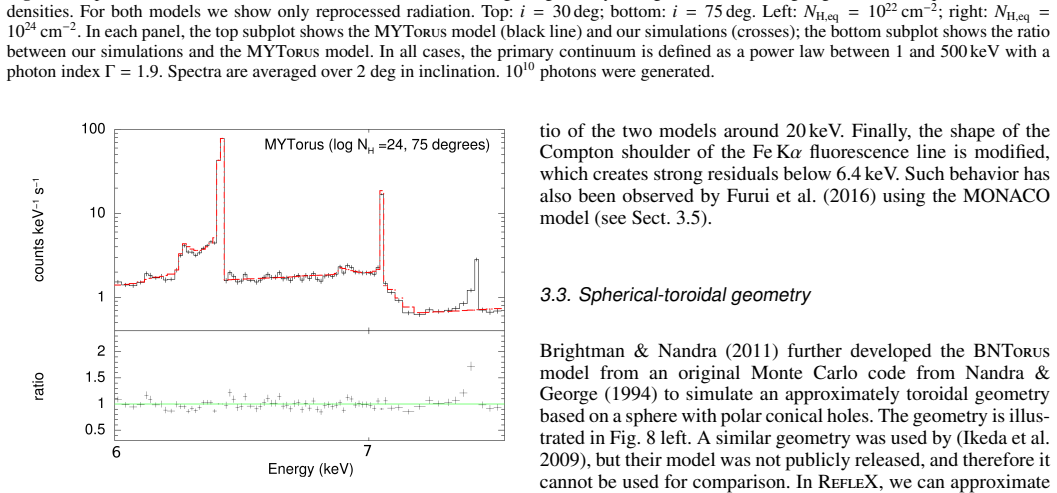
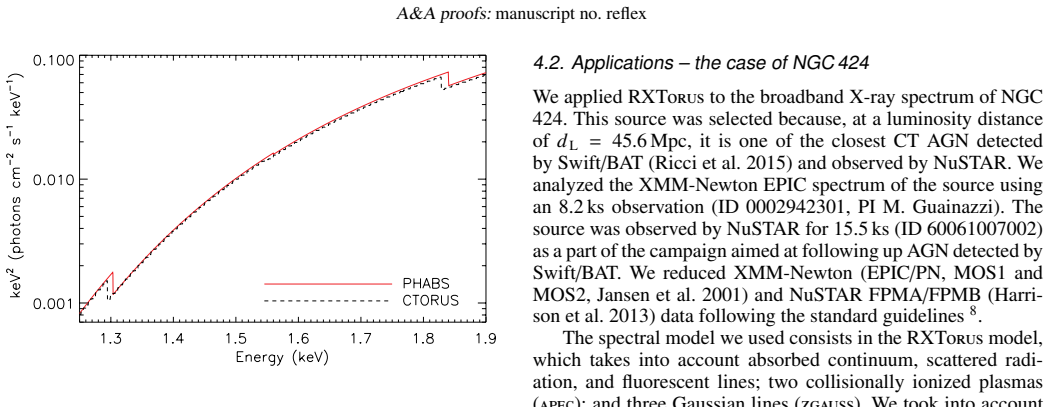
Reprocessed X-ray radiation carries important information about the structure and physical characteristics of the material surrounding the supermassive black hole (SMBH) in active galactic nuclei (AGN). We report here on a newly developed simulation platform, RefleX, which allows to reproduce absorption and reflection by quasi-arbitrary geometries. We show here the reliability of our approach by comparing the results of our simulations with existing spectral models such as pexrav, MYTorus and BNTorus. RefleX implements both Compton scattering on free electrons and Rayleigh scattering and Compton scattering on bound electrons. We show the effect of bound-electron corrections on a torus geometry simulated like in MYTorus. We release with this paper the RefleX executable, as well as RXTorus, a model that assumes absorption and reflection from a torus with a varying ratio of the minor to major axis of the torus. To allow major flexibility RXTorus is also distributed in three components: absorbed primary emission, scattered radiation and fluorescent lines. RXTorus is provided for different values of the abundance, and with (atomic configuration) or without (free-electron configuration) taking into account Rayleigh scattering and bound electrons. We apply the RXTorus model in both configurations on the XMM-Newton and NuSTAR spectrum of the Compton-thick AGN NGC 424 and find that the models are able to reproduce very well the observations, but that the assumption on the bound or free state of the electrons has significant consequences on the fit parameters.
Editorial analysis
A structured set of objections, weighed in public.
Referee Report
Summary. The manuscript introduces RefleX, a Monte Carlo simulation platform for modeling X-ray absorption and reflection from quasi-arbitrary geometries around AGN. It validates the code via spectral comparisons to pexrav (slab), MYTorus and BNTorus (torus), examines the impact of bound-electron Rayleigh and Compton scattering versus free-electron approximations on torus spectra, releases the RXTorus model (with varying minor-to-major axis ratio and abundance options, in absorbed/scattered/line components and bound/free configurations), and applies both configurations to the XMM-Newton + NuSTAR spectrum of the Compton-thick AGN NGC 424.
Significance. A correctly implemented code for arbitrary geometries would enable modeling of complex, non-standard reprocessing structures (e.g., warped disks, offset clouds, or clumpy media) that fixed-geometry codes cannot represent, improving physical interpretation of high-signal X-ray data. The public release of the executable and modular RXTorus components is a clear strength for reproducibility. The demonstration that bound- versus free-electron assumptions produce significant differences in fitted parameters underscores the need for detailed atomic physics in such models.
major comments (2)
- [Abstract] Abstract: the central claim that RefleX reproduces absorption and reflection for 'quasi-arbitrary geometries' rests on comparisons only to pexrav, MYTorus and BNTorus; these test only the standard slab and toroidal geometries already implemented in those codes. No test case is shown for a user-specified non-standard geometry (e.g., offset sphere, warped disk, or multi-component distribution) whose output cannot be cross-checked against existing models, so the extrapolation to arbitrary geometries remains unverified.
- [Application to NGC 424] Application section (NGC 424 fit): the statement that both RXTorus configurations 'reproduce very well the observations' is presented without quantitative fit statistics (reduced χ², degrees of freedom, null-hypothesis probability) or residual plots, preventing assessment of whether the bound-electron corrections meaningfully improve or alter the fit quality relative to the free-electron case.
minor comments (1)
- The description of RXTorus components (absorbed primary, scattered radiation, fluorescent lines) would benefit from an explicit equation or table listing the free parameters (torus axis ratio, abundance) and how they enter each component.
Simulated Author's Rebuttal
We thank the referee for the constructive comments on our manuscript. We address each major comment below.
read point-by-point responses
-
Referee: [Abstract] Abstract: the central claim that RefleX reproduces absorption and reflection for 'quasi-arbitrary geometries' rests on comparisons only to pexrav, MYTorus and BNTorus; these test only the standard slab and toroidal geometries already implemented in those codes. No test case is shown for a user-specified non-standard geometry (e.g., offset sphere, warped disk, or multi-component distribution) whose output cannot be cross-checked against existing models, so the extrapolation to arbitrary geometries remains unverified.
Authors: We agree that the presented validation is limited to standard geometries for which cross-checks with existing models are possible. Although the Monte Carlo framework is constructed to support quasi-arbitrary user-defined geometries, an explicit demonstration with a non-standard configuration would strengthen the claim. We will add such a test case (e.g., an offset cloud distribution) to the revised manuscript. revision: yes
-
Referee: [Application to NGC 424] Application section (NGC 424 fit): the statement that both RXTorus configurations 'reproduce very well the observations' is presented without quantitative fit statistics (reduced χ², degrees of freedom, null-hypothesis probability) or residual plots, preventing assessment of whether the bound-electron corrections meaningfully improve or alter the fit quality relative to the free-electron case.
Authors: We agree that quantitative fit statistics and residual plots are required for a rigorous evaluation. In the revised manuscript we will report the reduced χ², degrees of freedom, and include residual plots for both the bound-electron and free-electron RXTorus configurations applied to the NGC 424 data. revision: yes
Circularity Check
No circularity; simulation validated against independent external codes
full rationale
The paper presents RefleX as a Monte Carlo simulation implementing standard Compton/Rayleigh scattering physics on free or bound electrons for user-specified geometries. Reliability is demonstrated solely by direct numerical comparison of output spectra to the independent codes pexrav (slab), MYTorus and BNTorus (torus). No equations, parameters or results are defined in terms of the paper's own outputs; no fitted quantities are relabeled as predictions; no load-bearing self-citations or uniqueness theorems appear. The derivation chain is therefore self-contained against external benchmarks.
Axiom & Free-Parameter Ledger
free parameters (2)
- torus minor-to-major axis ratio
- elemental abundance
axioms (2)
- standard math Compton scattering on free electrons follows standard Klein-Nishina cross-section
- domain assumption Rayleigh scattering and Compton scattering on bound electrons are included
Forward citations
Cited by 1 Pith paper
-
Population synthesis of active galactic nuclei based on the radiation-regulated unification model
Using ray-tracing simulations and simulation-based inference, the authors construct an AGN population that reproduces the cosmic X-ray background, number counts, and absorption properties, deriving an intrinsic Compto...
Reference graph
Works this paper leans on
-
[1]
Agostinelli, S., Allison, J., Amako, K., et al. 2003, Nucl. Instruments Methods Phys. Res. Sect. A Accel. Spectrometers, Detect. Assoc. Equip., 506, 250
work page 2003
-
[2]
Allison, J., Amako, K., Apostolakis, J., et al. 2006, IEEE Trans. Nucl. Sci., 53, 270
work page 2006
- [3]
- [4]
-
[5]
Arnaud, K. A. 1996, Astron. Data Anal. Softw. Syst. V, 101
work page 1996
- [6]
- [7]
- [8]
-
[9]
Barret, D., Lam Trong , T., den Herder, J.-W., et al. 2016, in Sp. Telesc. Instrum. 2016 Ultrav. to Gamma Ray, ed. J.-W. A. den Herder, T. Takahashi, & M. Bautz (International Society for Optics and Photonics), 99052F
work page 2016
- [10]
-
[11]
Bearden, J. A. 1967, Rev. Mod. Phys., 39, 78
work page 1967
-
[12]
Brightman, M., Balokovic, M., Stern, D., et al. 2015, ApJ, 805, 41
work page 2015
- [13]
-
[14]
1990, The 1989 Livermore Evaluated Photon Data Library (EPDL), Technical Report No
Cullen, D., Perkins, S., & Rathkopf, J. 1990, The 1989 Livermore Evaluated Photon Data Library (EPDL), Technical Report No. UCRL-ID-103424 (University of California Radiation Laboratory)
work page 1990
-
[15]
Fabian, A. C., Zoghbi, A., Ross, R. R., et al. 2009, Nature, 459, 540
work page 2009
- [16]
- [17]
-
[18]
George, I. M. & Fabian, A. C. 1991, MNRAS, 249, 352
work page 1991
-
[19]
Goulding, A. D., Alexander, D. M., Bauer, F. E., et al. 2012, ApJ, 755, 5
work page 2012
- [20]
- [21]
-
[22]
Harrison, F. A., Craig, W. W., Christensen, F. E., et al. 2013, ApJ, 770, 103
work page 2013
-
[23]
Hitomi Collaboration , H., Aharonian, F., Akamatsu, H., et al. 2016, Nature, 535, 117
work page 2016
-
[24]
Hubbell, J. H., Veigele, W. J., Briggs, E. a., et al. 1975, J. Phys. Chem. Ref. Data, 4, 471
work page 1975
- [25]
- [26]
-
[27]
Kalberla, P. M. W., Burton, W. B., Hartmann, D., et al. 2005, , 440, 775
work page 2005
- [28]
-
[29]
Liu, Y. & Li, X. 2014, ApJ, 787, 52
work page 2014
-
[30]
Liu, Y. & Li, X. 2015, MNRAS, 57, 53
work page 2015
- [31]
- [32]
- [33]
-
[34]
Matt, G., Feroci, M., Rapisarda, M., & Costa, E. 1996, Radiat. Phys. Chem., 48, 403
work page 1996
-
[35]
Mitsuda, K., Kelley, R. L., Akamatsu, H., et al. 2014, in Proc. SPIE, ed. T. Takahashi, J.-W. A. den Herder, & M. Bautz, Vol. 9144, 91442A
work page 2014
-
[36]
Murphy, K. D. & Yaqoob, T. 2009, MNRAS, 397, 1549
work page 2009
-
[37]
Mushotzky, R. F., Serlemitsos, P., Boldt, E. A., Holt, S. S., & Becker, R. H. 1978, ApJ, 220, 790
work page 1978
-
[38]
Nandra, K., Barret, D., Barcons, X., et al. 2013, ArXiv e-prints, 1306.2307
work page internal anchor Pith review Pith/arXiv arXiv 2013
- [39]
-
[40]
Nandra, K., O'Neill, P., George, I., & Reeves, J. 2007, MNRAS, 382, 194
work page 2007
-
[41]
Nandra, K., Pounds, K. A., Stewart, G. C., Fabian, A. C., & Rees, M. J. 1989, MNRAS, 236, 39P
work page 1989
- [42]
-
[43]
Odaka, H., Aharonian, F., Watanabe, S., et al. 2011, ApJ, 740, 103
work page 2011
-
[44]
Pounds, K., Nandra, K., Stewart, G., George, I., & Fabian, A. 1990, , 344, 132
work page 1990
-
[45]
Pounds, K. A., Nandra, K., Stewart, G. C., & Leighly, K. 1989, MNRAS, 240, 769
work page 1989
-
[46]
Ricci, C., Bauer, F. E., Treister, E., et al. 2016, ApJ, 819, 4
work page 2016
- [47]
- [48]
-
[49]
Takahashi, T., Mitsuda, K., Kelley, R., et al. 2014, in Proc. SPIE, ed. T. Takahashi, J.-W. A. den Herder, & M. Bautz, Vol. 9144, 914425
work page 2014
-
[50]
2009, X-ray Data Booklet, LBNL-PUB49 (Lawrence Berkeley National Laboratory)
Thompson, A., Attwood, D., Gullikson, E., et al. 2009, X-ray Data Booklet, LBNL-PUB49 (Lawrence Berkeley National Laboratory)
work page 2009
-
[51]
Turner, T. J., George, I. M., Nandra, K., & Mushotzky, R. F. 1997, , 113, 23
work page 1997
-
[52]
Verner, D. A., Ferland, G. J., Korista, K. T., & Yakovlev, D. G. 1996, ApJ, 465, 487
work page 1996
-
[53]
Verner, D. A. & Yakovlev, D. G. 1995, , 109, 125
work page 1995
- [54]
- [55]
- [56]
discussion (0)
Sign in with ORCID, Apple, or X to comment. Anyone can read and Pith papers without signing in.