Stable and unstable capillary-gravity waves
Pith reviewed 2026-05-24 06:17 UTC · model grok-4.3
The pith
Rigorous analysis shows small non-resonant capillary-gravity waves are spectrally stable while resonant Wilton ripples can be unstable in bubble-shaped spectra.
A machine-rendered reading of the paper's core claim, the machinery that carries it, and where it could break.
Core claim
We make rigorous spectral stability analysis for non-resonant capillary-gravity waves as well as resonant Wilton ripples of sufficiently small amplitude. Our analysis is based on a periodic Evans function approach, developed recently by the authors for Stokes waves. On top of our previous work, we add to the approach new framework ingredients, including a two-stage Weierstrass preparation manipulation for the Periodic Evans function associated to the wave and the definition of a stability function as an analytic function of the wave amplitude parameter. These new ingredients are keys for proving stability near non-resonant frequencies and defining index functions ruling both stability and 0.
What carries the argument
The periodic Evans function after a two-stage Weierstrass preparation manipulation, together with an analytic stability function of the wave amplitude parameter.
If this is right
- Non-resonant waves remain stable near the origin in the complex plane.
- Near non-zero resonant frequencies, index functions determine whether the wave is stable or unstable.
- Unstable spectra near resonances form either an ellipse or a circle at leading order in amplitude.
- The formal multi-scale expansion for the Floquet exponent is justified at leading order.
- The results reduce exactly to the known gravity-wave case when surface tension vanishes.
Where Pith is reading between the lines
- The same Weierstrass-based index functions could be tested numerically on moderate-amplitude waves to see how far the small-amplitude regime extends.
- The ellipse-versus-circle distinction for unstable bubbles offers a concrete signature that could be checked in laboratory wave-tank experiments.
- The analytic stability function may allow asymptotic tracking of stability thresholds as surface tension varies continuously.
- The method supplies a template for proving stability or instability in other resonant wave problems governed by similar Hamiltonian PDEs.
Load-bearing premise
The wave amplitude must be sufficiently small so that the periodic Evans function framework extends directly once Weierstrass preparation and analyticity in the amplitude are added.
What would settle it
A direct numerical computation of the Floquet spectrum for a concrete small-amplitude non-resonant capillary-gravity wave that finds any eigenvalue with positive real part would falsify the claimed stability.
Figures






read the original abstract
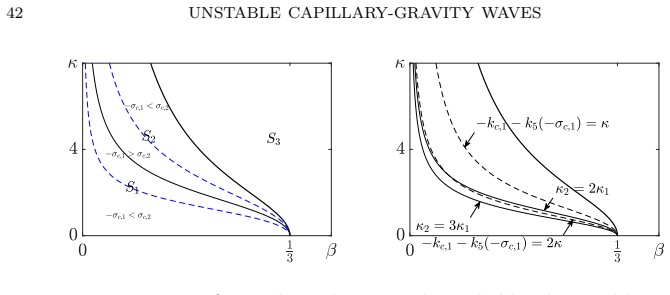
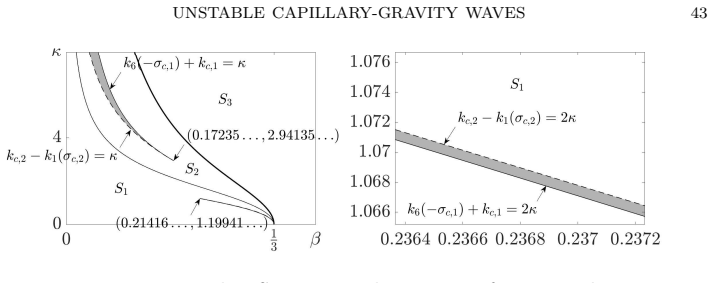
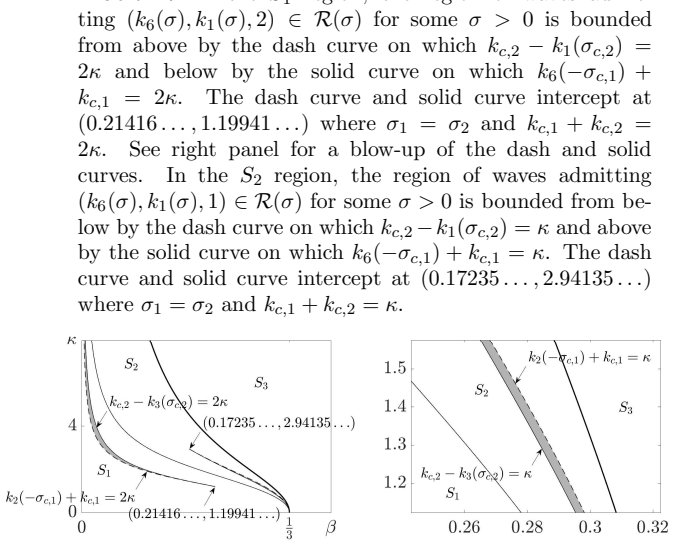
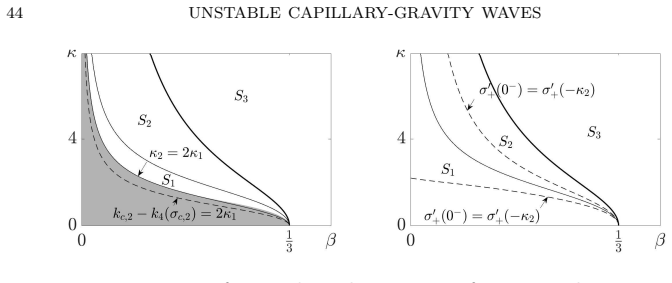
We make rigorous spectral stability analysis for non-resonant capillary-gravity waves as well as resonant Wilton ripples of sufficiently small amplitude. Our analysis is based on a periodic Evans function approach, developed recently by the authors for Stokes waves. On top of our previous work, we add to the approach new framework ingredients, including a two-stage Weierstrass preparation manipulation for the Periodic Evans function associated to the wave and the definition of a stability function as an analytic function of the wave amplitude parameter. These new ingredients are keys for proving stability near non-resonant frequencies and defining index functions ruling both stability and instability near non-zero resonant frequencies. We also prove that unstable bubble spectra near non-zero resonant frequencies form, at the leading order, either an ellipse or a circle and provide a justification for Creedon, Deconinck, and Trichtchenko's formal asymptotic expansion for the Floquet exponent. For non-resonant capillary-gravity waves for the stability near the origin of the complex plane, our stability results agree with the prediction from formal multi-scale expansion. New are our stability results near non-zero resonant frequencies. As the effects of surface tension vanish, our result recovers that for gravity waves. Also new are our stability results for Wilton ripples of small amplitude near the origin as well as near non-zero resonant frequencies.
Editorial analysis
A structured set of objections, weighed in public.
Referee Report
Summary. The manuscript claims to establish rigorous spectral stability results for small-amplitude capillary-gravity waves, both non-resonant and resonant (Wilton ripples), by extending the periodic Evans function method with a two-stage Weierstrass preparation and an analytic stability function in the amplitude parameter. It recovers known formal predictions for non-resonant cases, provides new index functions for resonant cases, describes the leading-order geometry of unstable spectra as ellipses or circles, and justifies a formal asymptotic expansion for the Floquet exponent. Results agree with multi-scale expansions near the origin and recover the gravity-wave case as surface tension vanishes.
Significance. If the central claims hold, the work supplies the first rigorous justification of formal stability predictions for capillary-gravity waves and introduces new analytic tools for the resonant Wilton-ripple case. The explicit bubble-spectrum geometry and the amplitude-analytic stability function strengthen the periodic Evans-function framework and may serve as a template for related water-wave problems. The recovery of the pure-gravity limit is a useful consistency check.
major comments (2)
- [§4] §4 (construction of the stability function): the proof that the two-stage Weierstrass preparation yields an analytic function of the amplitude whose zeros determine stability must be checked to ensure that higher-order remainder terms do not shift the leading-order zero count in the resonant case; this step is load-bearing for the new index functions.
- [§5.3] §5.3 (bubble-spectrum geometry): the claim that unstable spectra form an ellipse or circle at leading order relies on the expansion of the Floquet exponent; an explicit verification that the Weierstrass factors produce precisely this quadratic form (rather than higher-order perturbations) is needed to support the geometric statement.
minor comments (2)
- The notation distinguishing the non-resonant and resonant index functions would benefit from a short comparative table or explicit statement of their domains of definition.
- [Introduction] A sentence in the introduction clarifying which ingredients are carried over verbatim from the authors' prior Stokes-wave paper versus which are new would improve readability.
Simulated Author's Rebuttal
We thank the referee for the careful reading of the manuscript and the positive overall assessment. The two major comments concern the level of detail in the proofs of the stability function in §4 and the bubble-spectrum geometry in §5.3. We address each point below and indicate where clarifications will be added.
read point-by-point responses
-
Referee: [§4] §4 (construction of the stability function): the proof that the two-stage Weierstrass preparation yields an analytic function of the amplitude whose zeros determine stability must be checked to ensure that higher-order remainder terms do not shift the leading-order zero count in the resonant case; this step is load-bearing for the new index functions.
Authors: The two-stage Weierstrass preparation in §4 is performed on the periodic Evans function, which depends analytically on the amplitude ε. The first stage isolates the resonant zeros at ε=0; the second stage produces the stability function F(λ,ε) whose zeros govern the spectrum for small ε>0. Because the preparation theorem yields a Weierstrass polynomial whose coefficients are analytic in ε, the remainder after division is O(ε^k) with k larger than the degree of the polynomial. For sufficiently small |ε|, Rouche’s theorem applied to small circles centered at the leading-order roots shows that the number and multiplicity of zeros inside each circle are unchanged. This argument is already implicit in the construction, but we will insert an explicit paragraph after the statement of the preparation theorem to record the application of Rouche and thereby make the zero-count preservation fully transparent. revision: partial
-
Referee: [§5.3] §5.3 (bubble-spectrum geometry): the claim that unstable spectra form an ellipse or circle at leading order relies on the expansion of the Floquet exponent; an explicit verification that the Weierstrass factors produce precisely this quadratic form (rather than higher-order perturbations) is needed to support the geometric statement.
Authors: The leading-order geometry follows directly from the quadratic Weierstrass polynomial obtained in §4. Substituting the factored form into the characteristic equation and retaining terms through O(ε²) produces a quadratic equation in the scaled Floquet variable whose discriminant and coefficients determine the ellipse (or circle when the discriminant vanishes). Higher-order terms in the expansion of the stability function are O(ε³) and therefore do not affect the O(ε) scaling of the bubble radius; they only perturb the location of the bubble by o(ε). We will add a short calculation in §5.3 that writes out the quadratic coefficients explicitly in terms of the Weierstrass data, confirming that the geometry is indeed that of an ellipse or circle at leading order. revision: yes
Circularity Check
No significant circularity; derivation extends prior framework with new analytic ingredients
full rationale
The paper's central claims consist of rigorous small-amplitude spectral stability results obtained by extending the authors' earlier periodic Evans function construction (for Stokes waves) via explicitly introduced new tools: a two-stage Weierstrass preparation for the Periodic Evans function and the definition of a stability function analytic in the amplitude parameter. These additions enable proofs for both non-resonant and resonant (Wilton ripple) cases, with new index functions and bubble-spectrum geometry. The small-amplitude regime is the explicit setting for all expansions; no equation or step reduces by construction to a fitted input, self-definition, or load-bearing self-citation chain. The prior work supplies the base framework while the present manuscript supplies the independent analytic extensions and verifications. This is a standard, non-circular extension of a mathematical method to a new physical setting.
Axiom & Free-Parameter Ledger
axioms (1)
- domain assumption The periodic Evans function is analytic in the wave amplitude parameter
Forward citations
Cited by 2 Pith papers
-
Spectral structure of the Benjamin-Feir instability in deep-water gravity-capillary Stokes waves
Rigorous Bloch-Floquet analysis of the Euler equations confirms the Benjamin-Feir instability via figure-eight eigenvalue splitting and yields exact stability regions for gravity-capillary Stokes waves.
-
On the stability of large-amplitude gravity-capillary surface waves
Surface tension stabilizes the modulational instability of large-amplitude gravity-capillary waves at smaller values than weakly nonlinear theory predicts, with nonmonotonic dependence on tension.
Reference graph
Works this paper leans on
-
[1]
Richard Barakat and Agnes Houston, Nonlinear periodic capillary-gravity waves on a fluid of finite depth , Journal of Geophysical Research (1896-1977) 73 (1968), no. 20, 6545–6554
work page 1977
-
[2]
Brooke Benjamin, Instability of periodic wavetrains in nonlinear dispersiv e systems, Proc
T. Brooke Benjamin, Instability of periodic wavetrains in nonlinear dispersiv e systems, Proc. R. Soc. Lond. A 299 (1967), no. 1456, 59–76
work page 1967
-
[3]
Massimiliano Berti, Alberto Maspero, and Paolo Ventura, Full description of Benjamin-Feir instability of Stokes waves in deep water , Invent. Math. 230 (2022), no. 2, 651–711. MR 4493325
work page 2022
-
[4]
, Benjamin–feir instability of stokes waves in finite depth , Archive for Rational Mechanics and Analysis 247 (2023), no. 5, 91
work page 2023
-
[5]
Bridges and Alexander Mielke, A proof of the Benjamin-Feir instability , Arch
Thomas J. Bridges and Alexander Mielke, A proof of the Benjamin-Feir instability , Arch. Rational Mech. Anal. 133 (1995), no. 2, 145–198. MR 1367360
work page 1995
-
[6]
B. Buffoni and M. D. Groves, A multiplicity result for solitary gravity-capillary wave s in deep water via critical-point theory , Arch. Ration. Mech. Anal. 146 (1999), no. 3, 183–220. MR 1720395
work page 1999
- [7]
-
[8]
Gong Chen and Qingtang Su, Nonlinear modulational instabililty of the Stokes waves in 2D full water waves , Comm. Math. Phys. 402 (2023), no. 2, 1345–1452. MR 4627323
work page 2023
-
[9]
Ryan P. Creedon, Bernard Deconinck, and Olga Trichtchenk o, High-frequency insta- bilities of stokes waves , Journal of Fluid Mechanics 937 (2022), A24
work page 2022
-
[10]
Bernard Deconinck and Katie Oliveras, The instability of periodic surface gravity waves, J. Fluid Mech. 675 (2011), 141–167. MR 2801039
work page 2011
-
[11]
V. D. Djordjevic and L. G. Redekopp, On two-dimensional packets of capillary-gravity waves, Journal of Fluid Mechanics 79 (1977), no. 4, 703–714
work page 1977
-
[12]
Marc Francius and Christian Kharif, Three-dimensional instabilities of periodic gravity waves in shallow water , J. Fluid Mech. 561 (2006), 417–437. MR 2266187 UNSTABLE CAPILLARY-GRA VITY W A VES 107
work page 2006
-
[13]
R. A. Gardner, On the structure of the spectra of periodic travelling waves , J. Math. Pures Appl. (9) 72 (1993), no. 5, 415–439. MR 1239098
work page 1993
-
[14]
Gardner, Spectral analysis of long wavelength periodic waves and app lica- tions, J
Robert A. Gardner, Spectral analysis of long wavelength periodic waves and app lica- tions, J. Reine Angew. Math. 491 (1997), 149–181. MR 1476091
work page 1997
-
[15]
M. D. Groves and A. Mielke, A spatial dynamics approach to three-dimensional gravity- capillary steady water waves , Proceedings of the Royal Society of Edinburgh Section A: Mathematics 131 (2001), no. 1, 83–136
work page 2001
-
[16]
Mariana Haragus and Arnd Scheel, Finite-wavelength stability of capillary-gravity soli- tary waves , Comm. Math. Phys. 225 (2002), no. 3, 487–521. MR 1888871
work page 2002
-
[17]
Vera Mikyoung Hur and Zhao Yang, Unstable stokes waves , Archive for Rational Mechanics and Analysis 247 (2023), no. 4, 62
work page 2023
-
[18]
G´ erard Iooss and Klaus Kirchg¨ assner, Water waves for small surface tension: an approach via normal form , Proceedings of the Royal Society of Edinburgh Section A: Mathematics 122 (1992), no. 3-4, 267–299
work page 1992
-
[19]
M. C. W. Jones, Small amplitude capillary-gravity waves in a channel of fini te depth , Glasgow Mathematical Journal 31 (1989), no. 2, 142–160
work page 1989
- [20]
-
[21]
superharmonics , Proceedings of the Royal Society of London
Michael Selwyn Longuet-Higgins, The instabilities of gravity waves of finite amplitude in deep water i. superharmonics , Proceedings of the Royal Society of London. A. Mathematical and Physical Sciences 360 (1978), no. 1703, 471–488
work page 1978
-
[22]
subhar- monics, Proceedings of the Royal Society of London
, The instabilities of gravity waves of finite amplitude in dee p water ii. subhar- monics, Proceedings of the Royal Society of London. A. Mathematica l and Physical Sciences 360 (1978), no. 1703, 489–505
work page 1978
-
[23]
R. S. MacKay and P. G. Saffman, Stability of water waves , Proc. Roy. Soc. London Ser. A 406 (1986), no. 1830, 115–125. MR 853684
work page 1986
-
[24]
John W. McLean, Instabilities of finite-amplitude gravity waves on water of finite depth, Journal of Fluid Mechanics 114 (1982), 331–341
work page 1982
-
[25]
, Instabilities of finite-amplitude water waves , Journal of Fluid Mechanics 114 (1982), 315–330
work page 1982
-
[26]
Alexander Mielke, Reduction of quasilinear elliptic equations in cylindrica l domains with applications , Math. Methods Appl. Sci. 10 (1988), no. 1, 51–66. MR 929221
work page 1988
-
[27]
Huy Q. Nguyen and Walter A. Strauss, Proof of modulational instability of stokes waves in deep water , Communications on Pure and Applied Mathematics 76 (2023), no. 5, 1035–1084
work page 2023
-
[28]
Nicholls and Fernando Reitich, On analyticity of travelling water waves , Proc
David P. Nicholls and Fernando Reitich, On analyticity of travelling water waves , Proc. R. Soc. Lond. Ser. A Math. Phys. Eng. Sci. 461 (2005), no. 2057, 1283–1309. MR 2147749
work page 2005
-
[29]
Pascal Noble, Luis Miguel Rodrigues, and Changzhen Sun, Spectral instability of small-amplitude periodic waves of the electronic euler–po isson system , Nonlinearity 36 (2023), no. 9, 4615
work page 2023
-
[30]
Differential Equations 248 (2010), no
Myunghyun Oh and Bj¨ orn Sandstede, Evans functions for periodic waves on infinite cylindrical domains, J. Differential Equations 248 (2010), no. 3, 544–555. MR 2557905
work page 2010
-
[31]
John Reeder and Marvin Shinbrot, On wilton ripples, ii: Rigorous results , Archive for Rational Mechanics and Analysis 77 (1981), no. 4, 321–347
work page 1981
-
[32]
S.M. Rump, INTLAB - INTerval LABoratory , Developments in Reliable Com- puting (Tibor Csendes, ed.), Kluwer Academic Publishers, D ordrecht, 1999, http://www.tuhh.de/ti3/rump/, pp. 77–104
work page 1999
-
[33]
George Gabriel Stokes, On the theory of oscillatory waves , Trans. Camb. Philos. Soc. 8 (1847), 441–455
-
[34]
, Mathematical and physical papers. Volume 1 , Cambridge Library Collec- tion, Cambridge University Press, Cambridge, 2009, Reprin t of the 1880 original. MR 2858161 108 UNSTABLE CAPILLARY-GRA VITY W A VES
work page 2009
-
[35]
J. F. Toland and M. C. W. Jones, The bifurcation and secondary bifurcation of capillary-gravity waves , Proceedings of the Royal Society of London. Series A, Math- ematical and Physical Sciences 399 (1985), no. 1817, 391–417
work page 1985
-
[36]
Olga Trichtchenko, Bernard Deconinck, and Jon Wilkenin g, The instability of wilton ripples, Wave Motion 66 (2016), 147–155
work page 2016
-
[37]
Jean-Marc Vanden-Broeck, Gravity–capillary free-surface flows , Cambridge Mono- graphs on Mechanics, Cambridge University Press, 2010
work page 2010
-
[38]
G. B. Whitham, Non-linear dispersion of water waves , J. Fluid Mech. 27 (1967), 399–412. MR 208903
work page 1967
-
[39]
J. R. Wilton, Lxxii. on ripples , The London, Edinburgh, and Dublin Philosophical Magazine and Journal of Science 29 (1915), no. 173, 688–700
work page 1915
-
[40]
V. E. Zakharov and L. A. Ostrovsky, Modulation instability: the beginning , Phys. D 238 (2009), no. 5, 540–548. MR 2591296
work page 2009
discussion (0)
Sign in with ORCID, Apple, or X to comment. Anyone can read and Pith papers without signing in.