Communication protocol for a satellite-swarm interferometer
Pith reviewed 2026-05-24 04:46 UTC · model grok-4.3
The pith
A k-nearest-neighbour protocol keeps a satellite swarm connected enough to compute most cross-correlations within each satellite's energy budget.
A machine-rendered reading of the paper's core claim, the machinery that carries it, and where it could break.
Core claim
The authors show that limiting each satellite to communicate only with its k nearest neighbors produces a connected graph for at least 95% of the swarm once k is chosen appropriately, and that the resulting set of exchanged signals permits computation of a useful proportion of the cross-correlations needed for interferometry, all while respecting an energy budget per satellite.
What carries the argument
The k-nearest-neighbour communication protocol, which restricts data exchange to the k closest satellites and thereby trades connectivity and baseline coverage against energy use.
If this is right
- The swarm can achieve 95% connectivity with a modest neighbourhood size k.
- A calculable fraction of cross-correlations becomes available under the energy constraint.
- Specific energy requirements per satellite can be derived for adequate baseline coverage.
- The method provides insight into the design requirements for such satellite swarms.
Where Pith is reading between the lines
- This approach might generalize to other distributed sensing tasks where energy is limited.
- Future simulations could test how random satellite positions affect the required k.
- The protocol could be made adaptive by varying k based on remaining energy.
Load-bearing premise
The satellites are positioned such that limiting communication to k nearest neighbors produces a graph with the required high connectivity and sufficient baseline coverage for interferometry.
What would settle it
A simulation or measurement showing that for the chosen k the fraction of connected satellites falls below 95% or that too few unique baselines are covered to reconstruct the sky image.
Figures



read the original abstract
Orbiting low frequency antennas for radio astronomy (OLFAR) that capture cosmic signals in the frequency range below 30MHz could provide valuable insights on our Universe. These wireless swarms of satellites form a connectivity graph that allows data exchange between most pairs of satellites. Since this swarm acts as an interferometer, the aim is to compute the cross-correlations between most pairs of satellites. We propose a k-nearest-neighbour communication protocol, and investigate the minimum neighbourhood size of each satellite that ensures connectivity of at least 95% of the swarm. We describe the proportion of cross-correlations that can be computed in our method given an energy budget per satellite. Despite the method's apparent simplicity, it allows us to gain insight into the requirements for such satellite swarms. In particular, we give specific advice on the energy requirements to have sufficient coverage of the relevant baselines.
Editorial analysis
A structured set of objections, weighed in public.
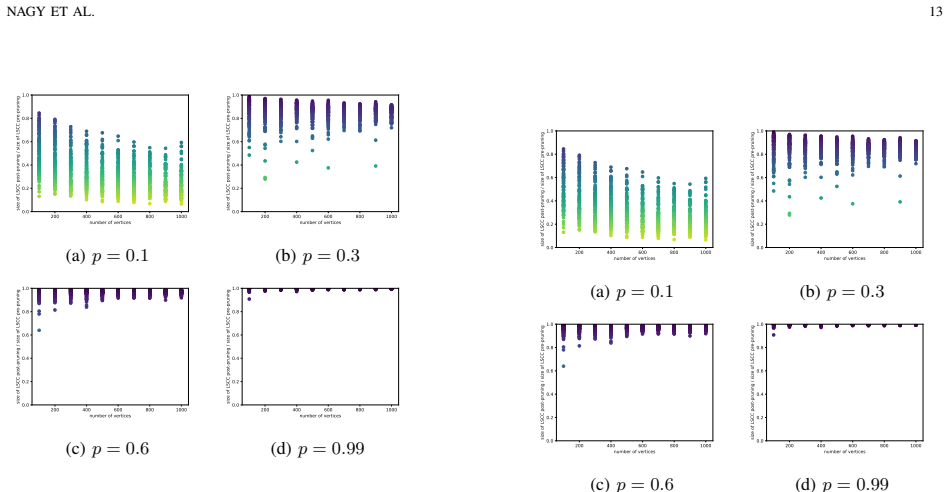
Referee Report
Summary. The manuscript proposes a k-nearest-neighbour communication protocol for OLFAR satellite swarms operating below 30 MHz. It claims that there exists a minimum neighbourhood size k ensuring at least 95% swarm connectivity and that the protocol permits computation of a quantifiable fraction of cross-correlations under a per-satellite energy budget, yielding concrete advice on energy requirements needed for adequate baseline coverage in the interferometer.
Significance. If validated, the work supplies a simple, implementable rule of thumb for trading communication range against connectivity and interferometric coverage in distributed satellite arrays. The absence of machine-checked proofs or parameter-free derivations is offset by the potential practical utility for mission design, provided the quantitative results survive realistic orbital constraints.
major comments (2)
- [Abstract] Abstract: the central claim that a finite k suffices for ≥95% connectivity and sufficient baseline coverage rests on an unspecified satellite positioning model. The stress-test correctly notes that Keplerian motion and formation flying induce spatial correlations; nearest-neighbour edges therefore cluster locally, which can raise the required k and leave long baselines uncovered. The manuscript must state the distribution model (random, formation-flying, or otherwise) and report sensitivity of the 95% threshold and cross-correlation fraction to that model.
- [Abstract] Abstract: no derivation, simulation protocol, or quantitative table is supplied for either the connectivity threshold or the energy-to-cross-correlation mapping. Without these, the stated “specific advice on the energy requirements” cannot be reproduced or falsified.
Simulated Author's Rebuttal
We thank the referee for the constructive feedback. We address each major comment below and will revise the manuscript accordingly to improve clarity and reproducibility.
read point-by-point responses
-
Referee: [Abstract] Abstract: the central claim that a finite k suffices for ≥95% connectivity and sufficient baseline coverage rests on an unspecified satellite positioning model. The stress-test correctly notes that Keplerian motion and formation flying induce spatial correlations; nearest-neighbour edges therefore cluster locally, which can raise the required k and leave long baselines uncovered. The manuscript must state the distribution model (random, formation-flying, or otherwise) and report sensitivity of the 95% threshold and cross-correlation fraction to that model.
Authors: We agree that the positioning model requires explicit statement. The analysis assumes satellites distributed uniformly at random in a 3D spherical volume. We will revise the abstract, introduction, and methods to state this model clearly. We acknowledge that formation-flying and Keplerian orbits introduce spatial correlations that could increase the required k and reduce long-baseline coverage; our current results are for the random case, and we will add a discussion noting this limitation and its implications for mission design without claiming sensitivity results we have not computed. revision: yes
-
Referee: [Abstract] Abstract: no derivation, simulation protocol, or quantitative table is supplied for either the connectivity threshold or the energy-to-cross-correlation mapping. Without these, the stated “specific advice on the energy requirements” cannot be reproduced or falsified.
Authors: The full manuscript describes the Monte Carlo simulation protocol for k-NN graph connectivity and the energy-budget mapping in Sections II and III, with figures presenting the 95% connectivity threshold and cross-correlation fractions. However, these details are not summarized in the abstract. We will revise the abstract to include a concise description of the simulation approach and key quantitative outcomes (e.g., minimum k and example energy values), and we will add or highlight a summary table of results to ensure the advice is reproducible. revision: yes
Circularity Check
No circularity: claims rest on direct graph analysis of k-NN protocol
full rationale
The paper proposes a k-nearest-neighbour protocol, then investigates the minimum k ensuring >=95% swarm connectivity and the resulting proportion of computable cross-correlations under a per-satellite energy budget. These quantities are obtained by applying standard random-graph connectivity results to the described swarm model; no equations fit a parameter on one data subset and rename the output as a prediction of a related quantity, no self-citation supplies a load-bearing uniqueness theorem, and no ansatz is smuggled via prior work. The derivation chain is therefore self-contained and does not reduce to its inputs by construction.
Axiom & Free-Parameter Ledger
free parameters (1)
- neighbourhood size k
axioms (1)
- domain assumption The satellite swarm forms a connectivity graph allowing data exchange between most pairs
Lean theorems connected to this paper
-
IndisputableMonolith/Foundation/AlexanderDuality.leanalexander_duality_circle_linking echoes?
echoesECHOES: this paper passage has the same mathematical shape or conceptual pattern as the Recognition theorem, but is not a direct formal dependency.
We adopt the assumption that the initial distribution of satellites is uniformly random within a unit cube... each satellite’s position is independently and uniformly chosen within the interval [0,1] for each of its three Cartesian coordinates.
-
IndisputableMonolith/Cost/FunctionalEquation.leanwashburn_uniqueness_aczel unclear?
unclearRelation between the paper passage and the cited Recognition theorem.
the transmission costs are distributed as a generalized gamma distribution... fP0,t(k)(c) = ...
What do these tags mean?
- matches
- The paper's claim is directly supported by a theorem in the formal canon.
- supports
- The theorem supports part of the paper's argument, but the paper may add assumptions or extra steps.
- extends
- The paper goes beyond the formal theorem; the theorem is a base layer rather than the whole result.
- uses
- The paper appears to rely on the theorem as machinery.
- contradicts
- The paper's claim conflicts with a theorem or certificate in the canon.
- unclear
- Pith found a possible connection, but the passage is too broad, indirect, or ambiguous to say the theorem truly supports the claim.
Reference graph
Works this paper leans on
-
[1]
M. Van Haarlem et al. LOFAR: The low-frequency array Astronomy and Astrophysics, vol. 556, 2013
work page 2013
-
[2]
S. Jester and H. Falcke Science with a lunar low-frequency array: From the dark ages of the universe to nearby exoplanets New Astronomy Reviews, vol. 53, no. 1-2, pp. 1 – 26, 2009
work page 2009
-
[3]
M. Bentum et al. A roadmap towards a space-based radio telescope for ultra-low frequency radio astronomy Advances in Space Research , vol. 65, no. 2, pp. 856 – 867, 2020
work page 2020
-
[4]
B. Cecconi et al. NOIRE study report: Towards a low frequency radio interferometer in space In 2018 IEEE Aerospace Conference Proceedings , 2018, pp. 1–19
work page 2018
-
[5]
D. M. Blough, M. Leoncini, G. Resta, and P. Santi The k-neigh protocol for symmetric topology control in ad hoc networks In Proceedings of the 4th ACM International Symposium on Mobile Ad Hoc Networking & Computing , ser. MobiHoc ’03. New York, NY , USA: Association for Computing Machinery, 2003, pp. 141–152
work page 2003
-
[6]
D. M. Blough, M. Leoncini, G. Resta, and P. Santi On the Symmetric Range Assignment Problem in Wireless Ad Hoc Networks . Boston, MA: Springer US, 2002, pp. 71–82
work page 2002
-
[7]
M. K. Marina and S. R. Das Routing performance in the presence of unidirectional links in multihop wireless networks In Proceedings of the 3rd ACM International Symposium on Mobile Ad Hoc Networking & Computing , ser. MobiHoc ’02. New York, NY , USA: Association for Computing Machinery, 2002, pp. 12–23
work page 2002
- [8]
-
[9]
A. Jadbabaie, J. Lin, and A. Morse Coordination of groups of mobile autonomous agents using nearest neighbor rules IEEE Transactions on Automatic Control , vol. 48, no. 6, pp. 988–1001, 2003
work page 2003
- [10]
-
[11]
Y . Xie, Y . Wang, A. Nallanathan, and L. Wang An Improved K-Nearest-Neighbor Indoor Localization Method Based on Spearman Distance IEEE Signal Processing Letters , vol. 23, no. 3, pp. 351–355, 2016
work page 2016
- [12]
-
[13]
J.-B. Wang et al. A machine learning framework for resource allocation assisted by cloud computing IEEE Network, vol. 32, no. 2, pp. 144–151, 2018
work page 2018
- [14]
-
[15]
M. Lee, G. Yu, and G. Y . Li Graph embedding-based wireless link scheduling with few training samples IEEE Transactions on Wireless Communications , vol. 20, no. 4, pp. 2282–2294, 2021
work page 2021
-
[16]
M. Alamgir and U. V on Luxburg NAGY ET AL. 16 Shortest path distance in random k-nearest neighbor graphs In Proceedings of the 29th International Conference on Machine Learning, ICML 2012 , vol. 2, 2012, Conference paper, pp. 1031 – 1038
work page 2012
-
[17]
P. Balister, B. Bollob ´as, A. Sarkar, and M. Walters Connectivity of random k-nearest-neighbour graphs Advances in Applied Probability , vol. 37, no. 1, pp. 1–24, 2005
work page 2005
-
[18]
P. Balister, B. Bollob ´as, A. Sarkar, and M. Walters A critical constant for the k nearest-neighbour model Advances in Applied Probability , vol. 41, no. 1, pp. 1–12, 2009
work page 2009
-
[19]
P. Balister and B. Bollob ´as Percolation in the k-nearest neighbor graph Recent results in designs and graphs: A tribute to Lucia Gionfriddo, Quaderni di Matematica , vol. 28, pp. 83–100, 2013
work page 2013
-
[20]
D. Eppstein, M. S. Paterson, and F. F. Yao On nearest-neighbor graphs Discrete & Computational Geometry , vol. 17, pp. 263–282, 1997
work page 1997
-
[21]
L. Kleinrock and J. Silvester Optimum transmission radii for packet radio networks or why six is a magic number In Proceedings of the IEEE national telecommunications conference , vol. 4, 1978, pp. 1–4
work page 1978
- [22]
-
[23]
Communication protocol for a satellite-swarm interferometer
F. Xue and P. R. Kumar The number of neighbors needed for connectivity of wireless networks Wireless networks, vol. 10, no. 2, pp. 169–181, 2004. Oliver Nagy was born in Bratislava, Slovakia, in 1994. He received his bachelor’s degree in physics in February 2017 from Charles University, Prague, Czech Republic. In February 2020, he received a master’s degr...
work page internal anchor Pith review Pith/arXiv arXiv 2004
-
[24]
Initially, all the n satellites are assigned an energy budget Emax =qGG(p), where qGG(p) is the quantile function associated with the distribution function identified in Section II.C with finite-size correction described in Section II.D and p is a parameter of the simulation
-
[25]
We establish a pruned k-NN communication network, which is created from k-NN graph between the satellites, with edges removed when their existence causes the satellite’s power consumption to exceed the energy budget Emax. We iteratively remove the most energetically expensive edge, until the edges no longer deplete the power budget
-
[26]
1 and assign computation jobs as described in Section III.A
We set the energy per one cross-correlation computation as in Eq. 1 and assign computation jobs as described in Section III.A. For a more detailed discussion of the setting and motivation of our study, we refer the reader to the main paper. The choice of Emax and βstrongly influences the outcome of the simulation. Since we aim to explore disconnected netw...
-
[27]
LSCC reduction factor ρL = |LSCC post-pruning| |LSCC pre-pruning| ,
-
[28]
LSCC coverage factor αL = |jobs assigned within LSCC | |jobs available within LSCC |,
-
[29]
Coverage factor α= |jobs assigned within LSCC | |jobs available within swarm |. In this document, we present a more detailed account of our results and discuss the influence of various parameters on the aforementioned quantities. B. LSCC reduction factor Firstly, note that the LSCC reduction factor ρL is independent of the parameter β, since the energy co...
discussion (0)
Sign in with ORCID, Apple, or X to comment. Anyone can read and Pith papers without signing in.