Data Augmentation of Contrastive Learning is Estimating Positive-incentive Noise
Pith reviewed 2026-05-23 21:32 UTC · model grok-4.3
The pith
Predefined data augmentations in contrastive learning are point estimations of positive-incentive noise.
A machine-rendered reading of the paper's core claim, the machinery that carries it, and where it could break.
Core claim
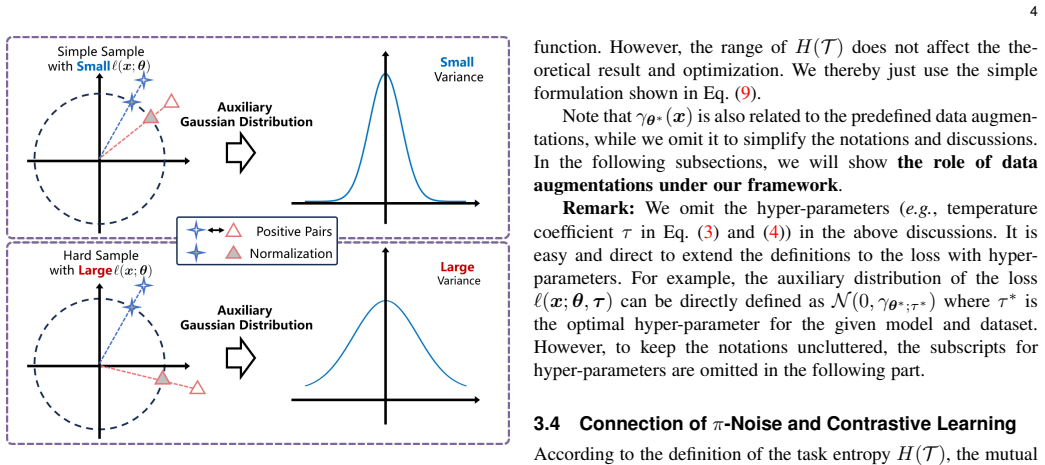
By converting the contrastive loss to an auxiliary Gaussian distribution to measure task difficulty, task entropy is defined for contrastive learning; the predefined data augmentation is thereby proved to be a point estimation of π-noise.
What carries the argument
Conversion of contrastive loss to an auxiliary Gaussian distribution that defines task entropy and supports the point-estimation proof for data augmentation as π-noise.
If this is right
- A trainable π-noise generator can replace fixed augmentations while remaining compatible with existing contrastive models.
- The same generator applies across image, text, and other data modalities.
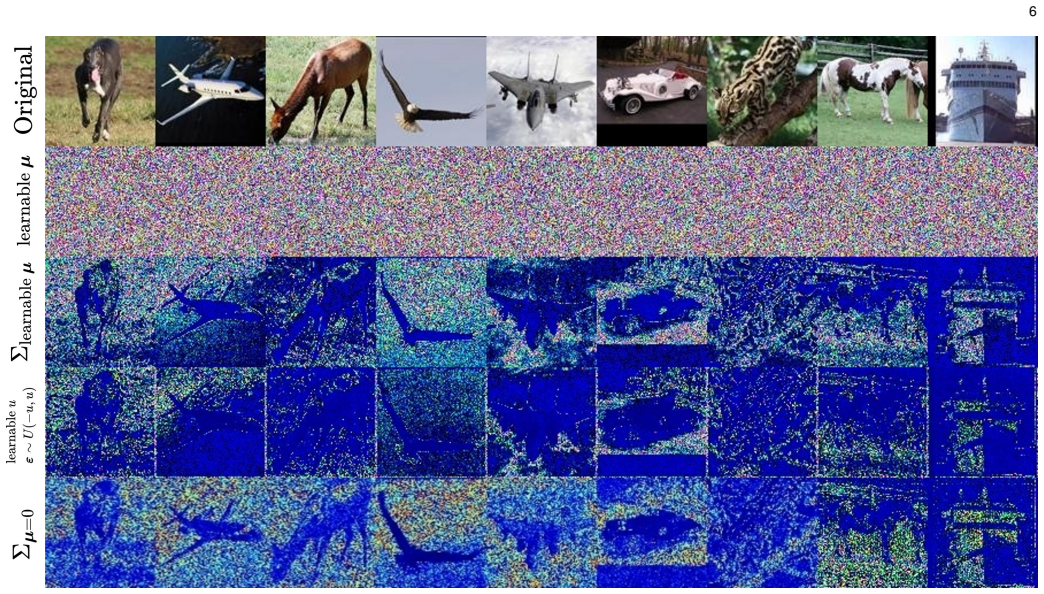
- Visualization of the learned noise reveals augmentations that the model itself judges beneficial.
- The point-estimation view supplies a quantitative route to replace heuristic augmentation choices.
Where Pith is reading between the lines
- If the point-estimation result holds, augmentation design reduces to an optimization problem over noise distributions rather than manual selection.
- The entropy definition may extend to other self-supervised objectives that rely on augmentation, allowing similar noise-learning replacements.
- Downstream task performance could be used as an external test of whether the learned noise actually lowers task entropy.
Load-bearing premise
Converting the contrastive loss to an auxiliary Gaussian distribution correctly measures task difficulty and permits a valid definition of task entropy under the information theory framework.
What would settle it
An experiment in which the learned π-noise generator produces no gain in downstream contrastive performance compared with standard fixed augmentations, or in which the derived task entropy fails to track measured model difficulty.
Figures



read the original abstract
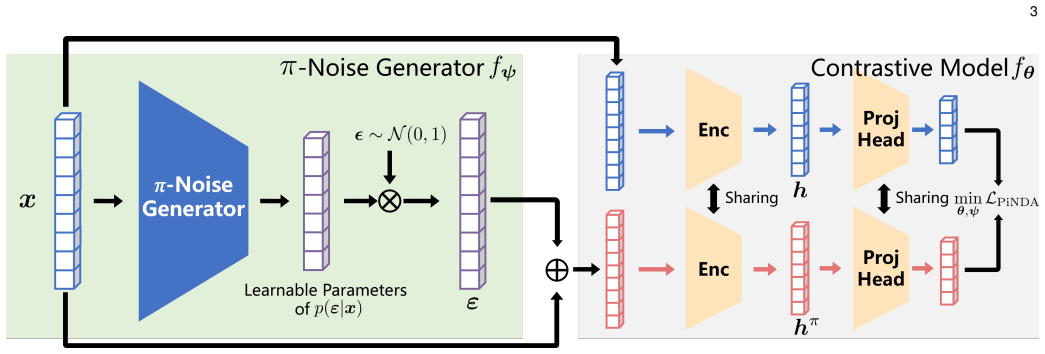
Inspired by the idea of Positive-incentive Noise (Pi-Noise or $\pi$-Noise) that aims at learning the reliable noise beneficial to tasks, we scientifically investigate the connection between contrastive learning and $\pi$-noise in this paper. By converting the contrastive loss to an auxiliary Gaussian distribution to quantitatively measure the difficulty of the specific contrastive model under the information theory framework, we properly define the task entropy, the core concept of $\pi$-noise, of contrastive learning. It is further proved that the predefined data augmentation in the standard contrastive learning paradigm can be regarded as a kind of point estimation of $\pi$-noise. Inspired by the theoretical study, a framework that develops a $\pi$-noise generator to learn the beneficial noise (instead of estimation) as data augmentations for contrast is proposed. The designed framework can be applied to diverse types of data and is also completely compatible with the existing contrastive models. From the visualization, we surprisingly find that the proposed method successfully learns effective augmentations. Our code is available at https://github.com/hyzhang98/PiNDA.
Editorial analysis
A structured set of objections, weighed in public.
Referee Report
Summary. The paper claims that data augmentation in standard contrastive learning can be interpreted as point estimation of positive-incentive noise (π-noise). It converts the contrastive loss into an auxiliary Gaussian distribution to define task entropy under an information-theoretic framework, proves that predefined augmentations estimate this π-noise, and proposes a compatible π-noise generator framework that learns beneficial noise as augmentations for diverse data types.
Significance. If the auxiliary Gaussian mapping and resulting point-estimation equivalence hold without circularity, the work would supply a novel theoretical grounding for why contrastive augmentations succeed and enable learned augmentations that improve upon hand-designed ones. Code release supports reproducibility.
major comments (2)
- [Abstract] Abstract: the central claim that 'the predefined data augmentation ... can be regarded as a kind of point estimation of π-noise' rests on converting the contrastive loss to an auxiliary Gaussian whose entropy defines task entropy; no derivation steps, explicit assumptions, or verification that this entropy matches the mutual-information properties of InfoNCE (or similar) are supplied, leaving the mapping unverified and potentially chosen rather than entailed.
- [Abstract] Abstract: task entropy is obtained directly from the contrastive loss via the auxiliary Gaussian, so the subsequent claim that augmentations estimate this quantity risks reducing to a restatement of the loss itself rather than an independent grounding; this circularity must be addressed before the point-estimation result can be accepted.
minor comments (2)
- The abstract states the framework 'can be applied to diverse types of data' but provides no concrete examples or ablation results in the visible text; a table or section detailing performance across modalities would strengthen the claim.
- Notation for π-noise generator and its relation to the original contrastive objective should be introduced with an equation or diagram early in the manuscript to avoid ambiguity.
Simulated Author's Rebuttal
We thank the referee for the constructive comments. We address the two major points regarding the abstract's presentation of the theoretical claims. The full manuscript contains the requested derivations and distinctions, but we agree the abstract can be improved for clarity.
read point-by-point responses
-
Referee: [Abstract] Abstract: the central claim that 'the predefined data augmentation ... can be regarded as a kind of point estimation of π-noise' rests on converting the contrastive loss to an auxiliary Gaussian whose entropy defines task entropy; no derivation steps, explicit assumptions, or verification that this entropy matches the mutual-information properties of InfoNCE (or similar) are supplied, leaving the mapping unverified and potentially chosen rather than entailed.
Authors: The full paper (Section 3) derives the auxiliary Gaussian by equating the InfoNCE loss to the negative log-likelihood of an isotropic Gaussian model over positive-pair embeddings, with explicit assumptions of unit-norm embeddings and Gaussian approximation of the view distribution. The resulting task entropy is shown to match InfoNCE's mutual-information lower bound by direct algebraic equivalence to the original MI analysis in the contrastive learning literature. The mapping is therefore entailed by the loss rather than chosen. We will revise the abstract to include a concise outline of these steps. revision: yes
-
Referee: [Abstract] Abstract: task entropy is obtained directly from the contrastive loss via the auxiliary Gaussian, so the subsequent claim that augmentations estimate this quantity risks reducing to a restatement of the loss itself rather than an independent grounding; this circularity must be addressed before the point-estimation result can be accepted.
Authors: Task entropy is introduced as an information-theoretic measure of task difficulty via the auxiliary distribution; the π-noise concept originates independently from the positive-incentive noise framework. Section 4 then proves that standard augmentations are the point estimate (mode) of the π-noise distribution minimizing this entropy. This supplies an external interpretation rather than a restatement. We will add an explicit paragraph in the introduction distinguishing the loss-derived entropy from the separate π-noise estimation result. revision: partial
Circularity Check
Point-estimation claim reduces to auxiliary Gaussian modeling choice for task entropy
specific steps
-
self definitional
[Abstract]
"By converting the contrastive loss to an auxiliary Gaussian distribution to quantitatively measure the difficulty of the specific contrastive model under the information theory framework, we properly define the task entropy, the core concept of π-noise, of contrastive learning. It is further proved that the predefined data augmentation in the standard contrastive learning paradigm can be regarded as a kind of point estimation of π-noise."
Task entropy is defined via the loss-to-Gaussian conversion; the point-estimation result for data augmentation is then proved from this definition. The equivalence is therefore entailed by the modeling choice itself rather than derived independently.
full rationale
The paper defines task entropy (core of π-noise) by converting the contrastive loss to an auxiliary Gaussian, then proves that predefined augmentations are point estimates of π-noise. This step is self-definitional: the claimed equivalence follows directly from the introduced conversion rather than from an independent derivation or external grounding. The provided abstract text exhibits the reduction without requiring external assumptions. No self-citation load-bearing or other patterns are quotable from the given material.
Axiom & Free-Parameter Ledger
axioms (1)
- domain assumption The contrastive loss can be converted to an auxiliary Gaussian distribution that quantifies task difficulty under an information-theory framework
invented entities (1)
-
π-noise generator
no independent evidence
Forward citations
Cited by 1 Pith paper
-
How Noise Benefits AI-generated Image Detection
PiN-CLIP jointly trains a noise generator and detector under a variational positive-incentive principle to inject feature-space noise that suppresses shortcut directions and improves out-of-distribution accuracy by 5....
Reference graph
Works this paper leans on
-
[1]
Representation Learning with Contrastive Predictive Coding
A. van den Oord, Y . Li, and O. Vinyals, “Representation learning with contrastive predictive coding,” CoRR, vol. abs/1807.03748, 2018
work page internal anchor Pith review Pith/arXiv arXiv 2018
-
[2]
Unsupervised feature learning via non-parametric instance discrimination,
Z. Wu, Y . Xiong, S. X. Yu, and D. Lin, “Unsupervised feature learning via non-parametric instance discrimination,” in 2018 IEEE Conference on Computer Vision and Pattern Recognition, CVPR 2018, Salt Lake City, UT, USA, June 18-22, 2018, 2018, pp. 3733–3742
work page 2018
-
[3]
Momentum contrast for unsupervised visual representation learning,
K. He, H. Fan, Y . Wu, S. Xie, and R. B. Girshick, “Momentum contrast for unsupervised visual representation learning,” in 2020 IEEE/CVF Conference on Computer Vision and Pattern Recognition, CVPR 2020, Seattle, WA, USA, June 13-19, 2020, 2020, pp. 9726–9735
work page 2020
-
[4]
A simple frame- work for contrastive learning of visual representations,
T. Chen, S. Kornblith, M. Norouzi, and G. E. Hinton, “A simple frame- work for contrastive learning of visual representations,” in Proceedings of the 37th International Conference on Machine Learning, ICML 2020, 13-18 July 2020, Virtual Event , ser. Proceedings of Machine Learning Research, vol. 119, 2020, pp. 1597–1607
work page 2020
-
[5]
Learning transferable visual models from natural language supervision,
A. Radford, J. W. Kim, C. Hallacy, A. Ramesh, G. Goh, S. Agarwal, G. Sastry, A. Askell, P. Mishkin, J. Clark, G. Krueger, and I. Sutskever, “Learning transferable visual models from natural language supervision,” in Proceedings of the 38th International Conference on Machine Learn- ing, ICML 2021, 18-24 July 2021, Virtual Event , ser. Proceedings of Machi...
work page 2021
-
[6]
Bootstrap your own latent - A new approach to self-supervised learning,
J. Grill, F. Strub, F. Altch ´e, C. Tallec, P. H. Richemond, E. Buchatskaya, C. Doersch, B. ´A. Pires, Z. Guo, M. G. Azar, B. Piot, K. Kavukcuoglu, R. Munos, and M. Valko, “Bootstrap your own latent - A new approach to self-supervised learning,” in Advances in Neural Information Process- ing Systems 33: Annual Conference on Neural Information Processing S...
work page 2020
-
[7]
Contrastive multi-view represen- tation learning on graphs,
K. Hassani and A. H. Khasahmadi, “Contrastive multi-view represen- tation learning on graphs,” in International Conference on Machine Learning. PMLR, 2020, pp. 4116–4126
work page 2020
-
[8]
Multi-view contrastive graph clustering,
E. Pan and Z. Kang, “Multi-view contrastive graph clustering,” in Ad- vances in Neural Information Processing Systems 34: Annual Conference on Neural Information Processing Systems 2021, NeurIPS 2021, Decem- ber 6-14, 2021, virtual , M. Ranzato, A. Beygelzimer, Y . N. Dauphin, P. Liang, and J. W. Vaughan, Eds., 2021, pp. 2148–2159
work page 2021
-
[9]
Graph contrastive learning with adaptive augmentation,
Y . Zhu, Y . Xu, F. Yu, Q. Liu, S. Wu, and L. Wang, “Graph contrastive learning with adaptive augmentation,” inWWW ’21: The Web Conference 2021, Virtual Event / Ljubljana, Slovenia, April 19-23, 2021 , 2021, pp. 2069–2080
work page 2021
-
[10]
Lightgcl: Simple yet effective graph contrastive learning for recommendation,
X. Cai, C. Huang, L. Xia, and X. Ren, “Lightgcl: Simple yet effective graph contrastive learning for recommendation,” in The Eleventh Inter- national Conference on Learning Representations, ICLR 2023, Kigali, Rwanda, May 1-5, 2023, 2023
work page 2023
-
[11]
MODALS: modality-agnostic automated data augmentation in the latent space,
T. Cheung and D. Yeung, “MODALS: modality-agnostic automated data augmentation in the latent space,” in 9th International Conference on Learning Representations, ICLR 2021, Virtual Event, Austria, May 3-7,
work page 2021
-
[12]
OpenReview.net, 2021
work page 2021
-
[13]
Towards domain-agnostic contrastive learning,
V . Verma, T. Luong, K. Kawaguchi, H. Pham, and Q. V . Le, “Towards domain-agnostic contrastive learning,” in Proceedings of the 38th Inter- national Conference on Machine Learning, ICML 2021, 18-24 July 2021, Virtual Event, ser. Proceedings of Machine Learning Research, M. Meila and T. Zhang, Eds., vol. 139. PMLR, 2021, pp. 10 530–10 541
work page 2021
-
[14]
Simcl: Simple contrastive learning for image classification,
H. Yang, X. Ding, J. Wang, and J. Li, “Simcl: Simple contrastive learning for image classification,” in 5th International Conference on Big Data Technologies, ICBDT 2022, Qingdao, China, September 23-25, 2022 . ACM, 2022, pp. 273–278
work page 2022
-
[15]
Contrastive learning with adversarial exam- ples,
C. Ho and N. Vasconcelos, “Contrastive learning with adversarial exam- ples,” in Advances in Neural Information Processing Systems 33: Annual Conference on Neural Information Processing Systems 2020, NeurIPS 2020, December 6-12, 2020, virtual, 2020
work page 2020
-
[16]
X. Li, “Positive-incentive noise,” IEEE Transactions on Neural Networks and Learning Systems, pp. 1–7, 2022
work page 2022
-
[17]
Variational positive-incentive noise: How noise benefits models,
H. Zhang, S. Huang, and X. Li, “Variational positive-incentive noise: How noise benefits models,” CoRR, vol. abs/2306.07651, 2023
-
[18]
Noise-contrastive estimation: A new estimation principle for unnormalized statistical models,
M. Gutmann and A. Hyv ¨arinen, “Noise-contrastive estimation: A new estimation principle for unnormalized statistical models,” in Proceedings of the Thirteenth International Conference on Artificial Intelligence and Statistics, AISTATS 2010, Chia Laguna Resort, Sardinia, Italy, May 13- 15, 2010, ser. JMLR Proceedings, vol. 9. JMLR.org, 2010, pp. 297–304
work page 2010
-
[19]
Contrastive learning with hard negative samples,
J. D. Robinson, C. Chuang, S. Sra, and S. Jegelka, “Contrastive learning with hard negative samples,” in9th International Conference on Learning Representations, ICLR 2021, Virtual Event, Austria, May 3-7, 2021 . OpenReview.net, 2021
work page 2021
-
[20]
An empirical study on disentanglement of negative-free contrastive learning,
J. Cao, R. Nai, Q. Yang, J. Huang, and Y . Gao, “An empirical study on disentanglement of negative-free contrastive learning,” inNeurIPS, 2022
work page 2022
-
[21]
Supervised contrastive learn- ing,
P. Khosla, P. Teterwak, C. Wang, A. Sarna, Y . Tian, P. Isola, A. Maschinot, C. Liu, and D. Krishnan, “Supervised contrastive learn- ing,” in Advances in Neural Information Processing Systems 33: Annual Conference on Neural Information Processing Systems 2020, NeurIPS 2020, December 6-12, 2020, virtual, 2020
work page 2020
-
[22]
Y . Li, P. Hu, J. Z. Liu, D. Peng, J. T. Zhou, and X. Peng, “Contrastive clustering,” in Thirty-Fifth AAAI Conference on Artificial Intelligence, AAAI 2021, Thirty-Third Conference on Innovative Applications of Arti- ficial Intelligence, IAAI 2021, The Eleventh Symposium on Educational Advances in Artificial Intelligence, EAAI 2021, Virtual Event, Februar...
work page 2021
-
[23]
Augmentations in hypergraph contrastive learning: Fabricated and generative,
T. Wei, Y . You, T. Chen, Y . Shen, J. He, and Z. Wang, “Augmentations in hypergraph contrastive learning: Fabricated and generative,” in NeurIPS, 2022
work page 2022
-
[24]
C. M. Bishop, Pattern recognition and machine learning, 5th Edition , ser. Information science and statistics. Springer, 2007
work page 2007
-
[25]
Auto-encoding variational bayes,
D. P. Kingma and M. Welling, “Auto-encoding variational bayes,” in 2nd International Conference on Learning Representations, ICLR 2014, Banff, AB, Canada, April 14-16, 2014, Conference Track Proceedings , 2014
work page 2014
-
[26]
[Shiet al., 2026 ] Yuchen Shi, Qijun Hou, Pingyi Fan, and Khaled B
J. Reyes-Ortiz, D. Anguita, A. Ghio, L. Oneto, and X. Parra, “Hu- man Activity Recognition Using Smartphones,” UCI Machine Learning Repository, 2012, DOI: https://doi.org/10.24432/C54S4K
-
[27]
RCV1: A new benchmark collection for text categorization research,
D. D. Lewis, Y . Yang, T. G. Rose, and F. Li, “RCV1: A new benchmark collection for text categorization research,” J. Mach. Learn. Res., vol. 5, pp. 361–397, 2004
work page 2004
-
[28]
Generalized clustering and multi-manifold learning with geometric structure preservation,
L. Wu, Z. Liu, J. Xia, Z. Zang, S. Li, and S. Z. Li, “Generalized clustering and multi-manifold learning with geometric structure preservation,” in IEEE/CVF Winter Conference on Applications of Computer Vision, WACV 2022, Waikoloa, HI, USA, January 3-8, 2022 , 2022, pp. 1668– 1676
work page 2022
-
[29]
Fashion-MNIST: a Novel Image Dataset for Benchmarking Machine Learning Algorithms
H. Xiao, K. Rasul, and R. V ollgraf, “Fashion-mnist: a novel image dataset for benchmarking machine learning algorithms,” CoRR, vol. abs/1708.07747, 2017
work page internal anchor Pith review Pith/arXiv arXiv 2017
-
[30]
80 million tiny images: A large data set for nonparametric object and scene recognition,
A. Torralba, R. Fergus, and W. T. Freeman, “80 million tiny images: A large data set for nonparametric object and scene recognition,” IEEE Trans. Pattern Anal. Mach. Intell., vol. 30, no. 11, pp. 1958–1970, 2008
work page 1958
-
[31]
An analysis of single-layer networks in unsupervised feature learning,
A. Coates, A. Y . Ng, and H. Lee, “An analysis of single-layer networks in unsupervised feature learning,” in Proceedings of the Fourteenth In- ternational Conference on Artificial Intelligence and Statistics, AISTATS 2011, Fort Lauderdale, USA, April 11-13, 2011, ser. JMLR Proceedings, G. J. Gordon, D. B. Dunson, and M. Dud ´ık, Eds., vol. 15. JMLR.org, ...
work page 2011
-
[32]
Exploring simple siamese representation learning,
X. Chen and K. He, “Exploring simple siamese representation learning,” in Proceedings of the IEEE/CVF conference on computer vision and pattern recognition, 2021, pp. 15 750–15 758
work page 2021
-
[33]
Deep residual learning for image recognition,
K. He, X. Zhang, S. Ren, and J. Sun, “Deep residual learning for image recognition,” inProceedings of the IEEE Conference on Computer Vision and Pattern Recognition, 2016, pp. 770–778
work page 2016
-
[34]
Adam: A method for stochastic optimization,
D. P. Kingma and J. Ba, “Adam: A method for stochastic optimization,” in 3rd International Conference on Learning Representations, ICLR 2015, San Diego, CA, USA, May 7-9, 2015, Conference Track Proceedings , 2015
work page 2015
discussion (0)
Sign in with ORCID, Apple, or X to comment. Anyone can read and Pith papers without signing in.