The quantum Kibble-Zurek mechanism: the role of boundary conditions, endpoints and kink types
Pith reviewed 2026-05-23 07:07 UTC · model grok-4.3
The pith
Advanced kink definitions yield robust critical scaling in the quantum Kibble-Zurek mechanism for one-dimensional Ising and Potts models.
A machine-rendered reading of the paper's core claim, the machinery that carries it, and where it could break.
Core claim
In the transverse-field Ising and quantum three-state Potts models the critical scaling of advanced kink types remains robust to endpoint choice, fixed boundary conditions improve the accuracy of Kibble-Zurek scaling when kinks are tracked over the entire chain, and the density of kinks extracted from the central part of long chains obeys the predicted universal scaling for every type of boundary condition; the same kink definition also proves more robust against endpoint choice when applied to the period-2 phase of the Rydberg model.
What carries the argument
Kink operators of intuitive versus advanced types that count defects after a linear quench through the critical point, examined under open, fixed-symmetric, and fixed-antisymmetric boundary conditions.
If this is right
- Advanced kink types exhibit remarkably robust universal scaling independent of endpoint selection.
- Fixed boundary conditions improve the accuracy of Kibble-Zurek scaling when kinks are counted over the entire chain.
- The scaling remains equally accurate for symmetric and antisymmetric fixed boundaries.
- Central-region kink density obeys the predicted universal scaling for all boundary conditions.
- The tested kink definition is more robust to endpoint choice than the standard definition when applied to the Rydberg period-2 phase.
Where Pith is reading between the lines
- Rydberg-atom experiments could extract more reliable critical exponents by using advanced kink definitions and restricting counts to the chain center.
- The same central-density approach may reduce sensitivity to boundary imperfections in other one-dimensional symmetry-breaking transitions.
- Extending the analysis to two-dimensional models would test whether advanced defect operators retain their robustness beyond one dimension.
Load-bearing premise
Numerical simulations performed on finite chains of the Ising and Potts models capture the universal scaling behavior that would be seen in the thermodynamic limit and in corresponding Rydberg-atom experiments.
What would settle it
A measurement on significantly larger chains or with a different quench rate that produces scaling exponents for advanced kinks differing from the predicted universal values would falsify the robustness claim.
Figures




read the original abstract
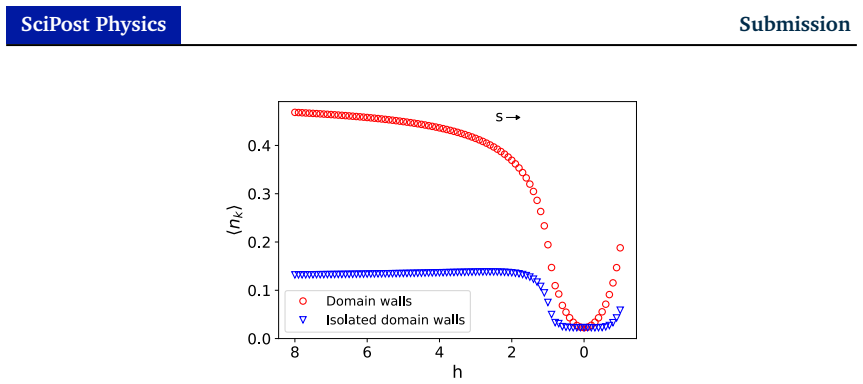
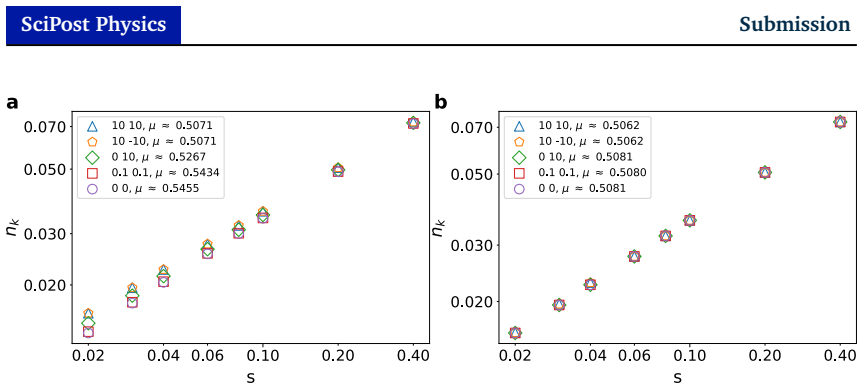
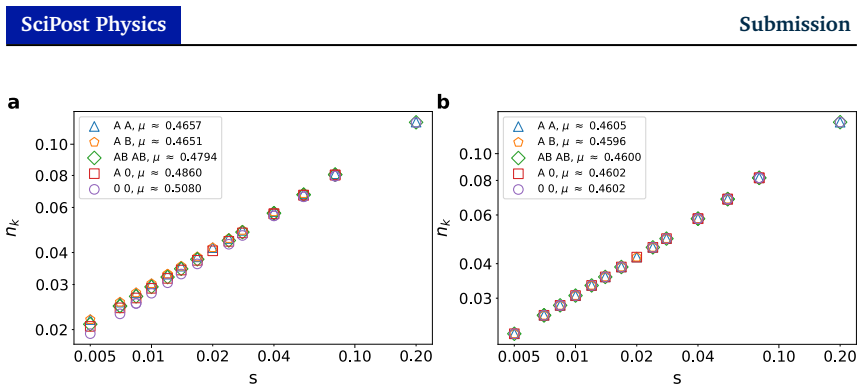
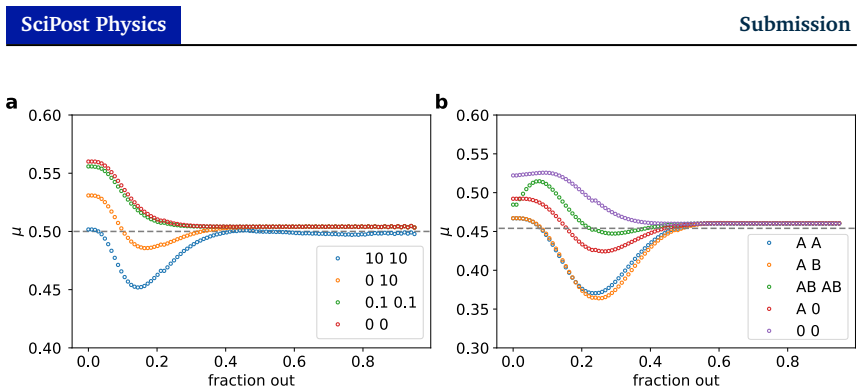
Quantum phase transitions are characterised by the universal scaling laws in the critical region surrounding the transitions. This universality is also manifested in the critical real-time dynamics through the quantum Kibble-Zurek mechanism. In recent experiments on a Rydberg atom quantum simulator, the Kibble-Zurek mechanism has been used to probe the nature of quantum phase transitions. In this paper we analyze the caveats associated with this method and develop strategies to improve its accuracy. Focusing on two minimal models -- transverse-field Ising and quantum three-state Potts, both in one dimension -- we study the effect of boundary conditions, the location of the endpoints and some subtleties in the definition of the kink operators. In particular, we show that the critical scaling of the most intuitive types of kinks is extremely sensitive to the correct choice of endpoint, while more advanced types of kinks exhibit remarkably robust universal scaling. Furthermore, we show that when kinks are tracked over the entire chain, fixed boundary conditions improve the accuracy of the scaling. Surprisingly, the Kibble-Zurek critical scaling appears to be equally accurate whether the fixed boundary conditions are chosen to be symmetric or anti-symmetric. We also show that the density of kinks extracted in the central part of long chains obeys the predicted universal scaling for all types of boundary conditions. Finally, we test our kink definition for the Ising transition on the period-2 phase of the Rydberg model and show that it is more robust against the end point than the standard definition.
Editorial analysis
A structured set of objections, weighed in public.
Referee Report
Summary. The manuscript analyzes the quantum Kibble-Zurek mechanism in one-dimensional transverse-field Ising and quantum three-state Potts models. It examines effects of boundary conditions, endpoint locations, and kink operator definitions on defect scaling. Claims include: intuitive kink types are highly sensitive to endpoint choice while advanced kink types show robust universal scaling; fixed boundary conditions (symmetric or anti-symmetric) improve accuracy for whole-chain kink tracking; central-region kink density obeys predicted scaling for all boundary conditions; and the proposed kink definition is more robust than standard when tested on the period-2 phase of the Rydberg model.
Significance. If the numerical results hold, the work supplies concrete, practical guidance for reducing systematic errors in Kibble-Zurek experiments on Rydberg simulators, particularly by clarifying boundary-condition and endpoint choices that affect extracted critical exponents from defect densities.
major comments (1)
- [Rydberg model test] Rydberg model test (final paragraph of abstract and corresponding section): the test applies the kink operator only to the period-2 phase and does not repeat the full KZ scaling analysis under Hamiltonians with long-range van der Waals interactions or for system sizes beyond those of the minimal nearest-neighbor chains. This limits support for the claim that the reported robustness directly improves experimental accuracy in Rydberg arrays, where the dynamical exponent z can differ.
minor comments (1)
- The distinction between 'intuitive' and 'advanced' kink types is introduced without an early, compact definition; adding a short parenthetical or footnote in the introduction would improve readability.
Simulated Author's Rebuttal
We thank the referee for their careful reading and constructive feedback. We address the single major comment below.
read point-by-point responses
-
Referee: [Rydberg model test] Rydberg model test (final paragraph of abstract and corresponding section): the test applies the kink operator only to the period-2 phase and does not repeat the full KZ scaling analysis under Hamiltonians with long-range van der Waals interactions or for system sizes beyond those of the minimal nearest-neighbor chains. This limits support for the claim that the reported robustness directly improves experimental accuracy in Rydberg arrays, where the dynamical exponent z can differ.
Authors: We agree that the Rydberg-model test is limited in scope: it applies the kink operator to the period-2 phase without performing a full Kibble-Zurek scaling analysis under long-range van der Waals interactions or for system sizes larger than the minimal nearest-neighbor chains. The purpose of the test was to demonstrate that the proposed kink definition remains more robust to endpoint choice than the standard definition in a Rydberg-relevant setting. Because the kink operator is strictly local, its improved robustness is expected to be independent of the value of the dynamical exponent z. Nevertheless, we acknowledge that a complete scaling study with long-range interactions would provide stronger evidence for experimental applicability. Such an analysis lies beyond the computational scope of the present work, which centers on minimal models. In the revised manuscript we have added a clarifying sentence that explicitly states the limited scope of the Rydberg test and moderates the associated claim. revision: partial
Circularity Check
Numerical simulations of minimal models yield self-contained results with no circularity
full rationale
The paper reports direct numerical results on the transverse-field Ising and quantum three-state Potts chains, examining boundary-condition effects and kink-operator definitions via explicit simulations. No derivation reduces to a self-definition, a fitted parameter renamed as a prediction, or a load-bearing self-citation chain; all scaling claims follow from the computed data on these standard short-range models. The final test on the Rydberg period-2 phase is likewise an independent numerical check rather than a tautology.
Axiom & Free-Parameter Ledger
Lean theorems connected to this paper
-
IndisputableMonolith/Foundation/DimensionForcing.lean (and Cost/FunctionalEquation.lean)reality_from_one_distinction; washburn_uniqueness_aczel unclear?
unclearRelation between the paper passage and the cited Recognition theorem.
We analyze the caveats associated with this method and develop strategies to improve its accuracy. Focusing on two minimal models—transverse-field Ising and three-state Potts—we study the effect of boundary conditions, the location of the endpoints and some subtleties in the definition of the kink operators.
-
IndisputableMonolith/Foundation/ArithmeticFromLogic.leanLogicNat recovery; embed_strictMono_of_one_lt unclear?
unclearRelation between the paper passage and the cited Recognition theorem.
the density of kinks extracted in the central part of long chains obeys the predicted universal scaling for all types of boundary conditions
What do these tags mean?
- matches
- The paper's claim is directly supported by a theorem in the formal canon.
- supports
- The theorem supports part of the paper's argument, but the paper may add assumptions or extra steps.
- extends
- The paper goes beyond the formal theorem; the theorem is a base layer rather than the whole result.
- uses
- The paper appears to rely on the theorem as machinery.
- contradicts
- The paper's claim conflicts with a theorem or certificate in the canon.
- unclear
- Pith found a possible connection, but the passage is too broad, indirect, or ambiguous to say the theorem truly supports the claim.
Forward citations
Cited by 1 Pith paper
-
Infinite randomness criticality and localization of the floating phase in arrays of Rydberg atoms trapped with non-perfect tweezers
Numerical analysis shows quenched disorder from tweezer imperfections drives crossover to infinite-randomness fixed point in Kibble-Zurek dynamics and localizes the floating phase while preserving short-range incommen...
Reference graph
Works this paper leans on
-
[1]
Sachdev, Quantum phase transitions, Physics world 12(4), 33 (1999)
S. Sachdev, Quantum phase transitions, Physics world 12(4), 33 (1999)
work page 1999
-
[2]
Cardy ,Scaling and renormalization in statistical physics, vol
J. Cardy ,Scaling and renormalization in statistical physics, vol. 5, Cambridge university press (1996)
work page 1996
-
[3]
W . H. Zurek, U. Dorner and P . Zoller,Dynamics of a quantum phase transition , Physical review letters 95(10), 105701 (2005)
work page 2005
-
[4]
Polkovnikov, Universal adiabatic dynamics in the vicinity of a quantum critical point , Phys
A. Polkovnikov, Universal adiabatic dynamics in the vicinity of a quantum critical point , Phys. Rev. B72, 161201 (2005), doi:10.1103 /PhysRevB.72.161201
work page 2005
-
[5]
J. Dziarmaga, Dynamics of a quantum phase transition and relaxation to a steady state , Advances in Physics 59(6), 1063 (2010)
work page 2010
-
[6]
A. Keesling, A. Omran, H. Levine, H. Bernien, H. Pichler, S. Choi, R. Samajdar, S. Schwartz, P . Silvi, S. Sachdev et al., Quantum kibble–zurek mechanism and critical dynamics on a programmable rydberg simulator, Nature 568(7751), 207 (2019)
work page 2019
-
[7]
T . W . Kibble,Topology of cosmic domains and strings, Journal of Physics A: Mathematical and General 9(8), 1387 (1976)
work page 1976
-
[8]
T . W . Kibble,Some implications of a cosmological phase transition, Physics Reports 67(1), 183 (1980)
work page 1980
-
[9]
W . H. Zurek, Cosmological experiments in superfluid helium? , Nature 317(6037), 505 (1985)
work page 1985
-
[10]
J. Dziarmaga, Dynamics of a quantum phase transition: Exact solution of the quantum ising model, Physical review letters 95(24), 245701 (2005)
work page 2005
-
[11]
M. Kolodrubetz, B. K. Clark and D. A. Huse, Nonequilibrium dynamic critical scaling of the quantum ising chain, Physical review letters 109(1), 015701 (2012)
work page 2012
-
[12]
A. Chandran, A. Erez, S. S. Gubser and S. L. Sondhi, Kibble-zurek problem: Universality and the scaling limit, Physical Review B—Condensed Matter and Materials Physics 86(6), 064304 (2012)
work page 2012
-
[13]
A. Francuz, J. Dziarmaga, B. Gardas and W . H. Zurek,Space and time renormalization in phase transition dynamics, Physical Review B 93(7), 075134 (2016)
work page 2016
-
[14]
D. Sadhukhan, A. Sinha, A. Francuz, J. Stefaniak, M. M. Rams, J. Dziarmaga and W . H. Zurek, Sonic horizons and causality in phase transition dynamics , Physical Review B 101(14), 144429 (2020)
work page 2020
-
[15]
H. Bernien, S. Schwartz, A. Keesling, H. Levine, A. Omran, H. Pichler, S. Choi, A. S. Zibrov, M. Endres, M. Greineret al., Probing many-body dynamics on a 51-atom quantum simulator, Nature 551(7682), 579 (2017)
work page 2017
-
[16]
P . Laguna and W . H. Zurek,Density of kinks after a quench: When symmetry breaks, how big are the pieces?, Physical Review Letters 78(13), 2519 (1997)
work page 1997
- [17]
-
[18]
G. De Chiara, A. Del Campo, G. Morigi, M. B. Plenio and A. Retzker, Spontaneous nucle- ation of structural defects in inhomogeneous ion chains , New Journal of Physics 12(11), 115003 (2010)
work page 2010
-
[19]
A. Del Campo, G. De Chiara, G. Morigi, M. B. Plenio and A. Retzker, Structural defects in ion chains by quenching the external potential:<? format?> the inhomogeneous kibble- zurek mechanism, Physical review letters 105(7), 075701 (2010)
work page 2010
-
[20]
D. Jaschke, K. Maeda, J. D. Whalen, M. L. Wall and L. D. Carr, Critical phenomena and kibble–zurek scaling in the long-range quantum ising chain, New Journal of Physics19(3), 033032 (2017)
work page 2017
-
[21]
J. Soto Garcia and N. Chepiga, Resolving chiral transitions in one-dimensional rydberg arrays with quantum kibble-zurek mechanism and finite-time scaling , Physical Review B 110(12), 125113 (2024)
work page 2024
-
[22]
C. N. Weiler, T . W . Neely , D. R. Scherer, A. S. Bradley , M. J. Davis and B. P . Anderson, Spontaneous vortices in the formation of bose–einstein condensates , Nature 455(7215), 948 (2008)
work page 2008
-
[23]
S. Griffin, M. Lilienblum, K. Delaney , Y. Kumagai, M. Fiebig and N. Spaldin, From mul- tiferroics to cosmology: Scaling behaviour and beyond in the hexagonal manganites, arXiv preprint arXiv:1204.3785 (2012)
-
[24]
G. Lamporesi, S. Donadello, S. Serafini, F . Dalfovo and G. Ferrari,Spontaneous creation of kibble–zurek solitons in a bose–einstein condensate, Nature Physics 9(10), 656 (2013)
work page 2013
-
[25]
M. Mielenz, J. Brox, S. Kahra, G. Leschhorn, M. Albert, T . Schätz, H. Landa and B. Reznik, Trapping of topological-structural defects in coulomb crystals , Physical review letters 110(13), 133004 (2013)
work page 2013
-
[26]
K. Pyka, J. Keller, H. Partner, R. Nigmatullin, T . Burgermeister, D. Meier, K. Kuhlmann, A. Retzker, M. B. Plenio, W . Zurek et al., Topological defect formation and spontaneous symmetry breaking in ion coulomb crystals, Nature communications 4(1), 2291 (2013)
work page 2013
-
[27]
S. Ulm, J. Roßnagel, G. Jacob, C. Degünther, S. Dawkins, U. Poschinger, R. Nigmatullin, A. Retzker, M. Plenio, F . Schmidt-Kaleret al., Observation of the kibble–zurek scaling law for defect formation in ion crystals, Nature communications 4(1), 2290 (2013)
work page 2013
-
[28]
J. Beugnon and N. Navon, Exploring the kibble–zurek mechanism with homogeneous bose gases, Journal of Physics B: Atomic, Molecular and Optical Physics50(2), 022002 (2017)
work page 2017
-
[29]
B. Ko, J. W . Park and Y.-i. Shin, Kibble–zurek universality in a strongly interacting fermi superfluid, Nature physics 15(12), 1227 (2019)
work page 2019
-
[30]
K. Lee, S. Kim, T . Kim and Y. Shin, Universal kibble–zurek scaling in an atomic fermi superfluid, Nature Physics 20(10), 1570 (2024)
work page 2024
- [31]
-
[32]
R. Samajdar and D. A. Huse, Quantum and classical coarsening and their interplay with the kibble-zurek mechanism, arXiv preprint arXiv:2401.15144 (2024)
-
[33]
P . Di Francesco, P . Mathieu and D. Sénéchal,Conformal Field Theory, Graduate Texts in Contemporary Physics. Springer, New York, ISBN 9780387947853 (1997). 17 SciPost Physics Submission
work page 1997
-
[34]
S. R. White, Density matrix formulation for quantum renormalization groups , Physical review letters 69(19), 2863 (1992)
work page 1992
-
[35]
U. Schollwöck, The density-matrix renormalization group in the age of matrix product states, Annals of physics 326(1), 96 (2011)
work page 2011
-
[36]
G. Vidal, Efficient simulation of one-dimensional quantum many-body systems , Physical review letters 93(4), 040502 (2004)
work page 2004
-
[37]
F . Verstraete, J. J. Garcia-Ripoll and J. I. Cirac,Matrix product density operators: Simula- tion of finite-temperature and dissipative systems, Physical review letters 93(20), 207204 (2004)
work page 2004
-
[38]
S. Paeckel, T . Köhler, A. Swoboda, S. R. Manmana, U. Schollwöck and C. Hubig, Time- evolution methods for matrix-product states, Annals of Physics 411, 167998 (2019)
work page 2019
-
[39]
J. Haegeman, J. I. Cirac, T . J. Osborne, I. Pižorn, H. Verschelde and F . Verstraete,Time- dependent variational principle for quantum lattices , Physical review letters 107(7), 070601 (2011)
work page 2011
-
[40]
J. Haegeman, C. Lubich, I. Oseledets, B. Vandereycken and F . Verstraete, Unifying time evolution and optimization with matrix product states, Physical Review B 94(16), 165116 (2016)
work page 2016
-
[41]
C.-Y. Xia and H.-B. Zeng, Kibble zurek mechanism in rapidly quenched phase transition dynamics, arXiv preprint arXiv:2110.07969 (2021)
-
[42]
H.-B. Zeng, C.-Y. Xia and A. Del Campo, Universal breakdown of kibble-zurek scaling in fast quenches across a phase transition, Physical Review Letters 130(6), 060402 (2023)
work page 2023
- [43]
discussion (0)
Sign in with ORCID, Apple, or X to comment. Anyone can read and Pith papers without signing in.