Microring Perceptron Sensing for Low-Power Radio-Frequency Detection with Quantum-Compatible Photonic Preprocessing
Pith reviewed 2026-05-22 18:43 UTC · model grok-4.3
The pith
A programmable microring resonator preprocesses RF signals optically to preserve information at low power levels before detection.
A machine-rendered reading of the paper's core claim, the machinery that carries it, and where it could break.
Core claim
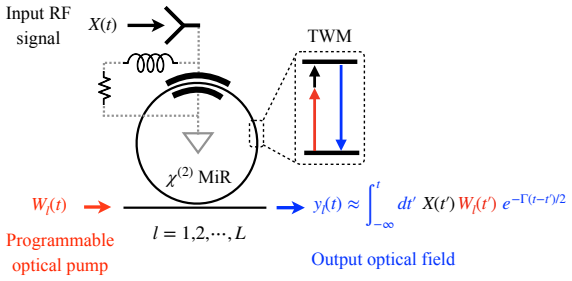
MiRP sensing exploits RF-photonic transduction in a microring resonator, where a programmable optical pump performs three-wave mixing to implement a learned mapping from the incoming RF signal to optical feature signals prior to detection. The transducer front end and digital neural-network back end are jointly optimized within a single end-to-end training pipeline, allowing the sensing system to learn an encoding that preserves task-relevant information through detection. Across benchmark tasks, this yields substantially higher task performance than conventional processing at low input RF power levels where detection noise dominates.
What carries the argument
The microring perceptron that uses a programmable optical pump in a microring resonator to perform three-wave mixing and implement a learned nonlinear mapping from RF inputs to optical feature signals.
If this is right
- MiRP sensing achieves higher task performance than conventional methods at low RF input powers.
- The algorithmic gain composes with hardware efficiency and quantum-enhanced optical sensing advances.
- Pre-detection processing preserves task-relevant information that post-detection analysis cannot recover.
- End-to-end training enables the system to learn optimal encodings for specific sensing tasks.
Where Pith is reading between the lines
- This photonic preprocessing could be adapted to other signal types beyond RF, such as acoustic or biomedical signals.
- The quantum-compatible aspect suggests potential integration with quantum measurement systems for enhanced sensitivity.
- Future work might explore scaling the number of microrings or integrating them into larger photonic circuits for more complex mappings.
Load-bearing premise
The microring resonator with programmable optical pump can accurately and stably implement the learned nonlinear mapping from RF input to optical feature signals via three-wave mixing without prohibitive losses or hardware constraints that would prevent end-to-end optimization.
What would settle it
Experimental comparison showing whether MiRP sensing maintains higher accuracy than conventional digital processing on classification or detection tasks as the input RF power is reduced into the noise-dominated regime.
Figures



read the original abstract
Radio-frequency (RF) sensing underpins applications ranging from radar and wireless communication to biomedical and quantum measurement, where detection sensitivity at low signal-to-noise ratio (SNR) directly limits the achievable range, resolution, and information capacity. Machine learning has been widely applied to enhance sensing performance, but predominantly as post-detection analysis of already-acquired data. At low SNR, however, the information missing from acquired data cannot be recovered downstream, making pre-detection processing essential. Here we introduce microring perceptron (MiRP) sensing, a framework that exploits RF-photonic transduction in a microring resonator, where a programmable optical pump performs three-wave mixing to implement a learned mapping from the incoming RF signal to optical feature signals prior to detection. The transducer front end and digital neural-network back end are jointly optimized within a single end-to-end training pipeline, allowing the sensing system to learn an encoding that preserves task-relevant information through detection. Across benchmark tasks, MiRP sensing achieves substantially higher task performance than conventional processing at low input RF power levels where detection noise dominates. The algorithmic gain reported here offers an orthogonal axis of improvement that composes with, and amplifies the impact of, existing and future advances along complementary dimensions, including hardware efficiency and quantum-enhanced optical sensing.
Editorial analysis
A structured set of objections, weighed in public.
Referee Report
Summary. The paper introduces microring perceptron (MiRP) sensing, a framework that uses RF-photonic transduction in a microring resonator. A programmable optical pump performs three-wave mixing to implement a learned nonlinear mapping from the incoming RF signal to optical feature signals prior to detection. The transducer front-end and digital neural-network back-end are jointly optimized in an end-to-end training pipeline. The central empirical claim is that MiRP achieves substantially higher task performance than conventional processing on benchmark tasks at low input RF power levels where detection noise dominates.
Significance. If the reported performance gains hold under realistic hardware constraints, the work would provide an orthogonal axis of improvement for low-SNR RF sensing by enabling task-specific information-preserving preprocessing at the physical layer. This could compose with advances in hardware efficiency and quantum-enhanced optical sensing, with potential impact on radar, wireless communications, biomedical sensing, and quantum measurements.
major comments (1)
- [Physical model and joint optimization sections] The central performance claim at low RF power depends on the microring three-wave mixing accurately realizing the end-to-end trained nonlinear mapping without unmodeled losses, resonance drift, or instability that would degrade the effective transfer function. The manuscript should provide explicit bounds or simulations quantifying dynamic range, phase stability, and insertion loss across the relevant RF bandwidths and power levels (see the physical model and training pipeline sections).
minor comments (2)
- [Results and experimental setup] Clarify the exact benchmark tasks, number of trials, error bars, and training details (e.g., dataset sizes, optimization hyperparameters) to allow independent verification of the reported gains.
- [Methods] Ensure all equations for the three-wave mixing process and the end-to-end loss function are fully specified with consistent notation.
Simulated Author's Rebuttal
We thank the referee for their constructive feedback and positive evaluation of the potential impact of MiRP sensing. We address the major comment point-by-point below.
read point-by-point responses
-
Referee: [Physical model and joint optimization sections] The central performance claim at low RF power depends on the microring three-wave mixing accurately realizing the end-to-end trained nonlinear mapping without unmodeled losses, resonance drift, or instability that would degrade the effective transfer function. The manuscript should provide explicit bounds or simulations quantifying dynamic range, phase stability, and insertion loss across the relevant RF bandwidths and power levels (see the physical model and training pipeline sections).
Authors: We agree that explicit quantification of hardware non-idealities is essential to substantiate the low-power performance claims. The current manuscript derives the three-wave mixing transfer function in the physical model section and validates the end-to-end training pipeline under nominal conditions. To directly address this point, we will add a dedicated robustness analysis subsection containing: (i) analytic bounds on dynamic range derived from the resonator Q-factor, pump power, and Kerr coefficient; (ii) Monte Carlo simulations incorporating thermal phase noise and resonance drift over the relevant RF bandwidth; and (iii) insertion-loss estimates across the operating power range. These additions will confirm that the learned nonlinear mapping remains effective in the noise-dominated regime without requiring changes to the core algorithmic or empirical results. revision: yes
Circularity Check
No significant circularity in MiRP sensing derivation or performance claims
full rationale
The paper frames MiRP as an end-to-end trainable RF-photonic front-end using microring three-wave mixing to realize learned nonlinear mappings prior to detection, with performance gains reported as empirical outcomes on benchmark tasks at low SNR. No derivation step reduces the claimed advantage to a fitted parameter renamed as prediction, a self-definitional mapping, or a load-bearing self-citation chain. The physical model and joint optimization pipeline are presented as independent of the final task metrics, making the result self-contained against external benchmarks rather than tautological.
Axiom & Free-Parameter Ledger
axioms (1)
- domain assumption The microring resonator supports stable, programmable three-wave mixing that implements a task-relevant nonlinear mapping from RF input to optical output features.
Forward citations
Cited by 1 Pith paper
-
Breaking On/Off-coupling Loss Degeneracies via Bidirectional Nonlinear Optics
Bidirectional nonlinear optical tomography breaks the η1 η2 degeneracy via forward/backward pumping and joint optimization to yield unbiased individual coupling efficiencies and on-chip figures of merit.
Reference graph
Works this paper leans on
-
[1]
[15] postures [16] MiRP sensing 94 ± 0.1% 83 ± 0.7% 96 ± 0.3% Conventional 11 ± 0.4% 28 ± 0.9% 19 ± 0.7% RF sensing Random guess 10% 25% 16.7% (class number) (10) (4) (6) ADC rate/ 1/49 1/64 1/51 Nyquist rate Table I. Test accuracy comparison at 1 pW input RF power be- tween MiRP sensing and conventional sensing schemes. Mod: modulation. II. ARCHITECTURE ...
work page 2048
-
[2]
MNIST The MNIST dataset is sourced from the canonical handwritten digit database [111], comprising 10 digits (0 − 9 with class number C = 10). Each image is orig- inally of size 28 × 28, but it is flattened into a 1D array with M = 784 elements to be processed by our sensor system, functional for one-dimensional input data
-
[3]
RF modulation classification The RF modulation classification dataset is sourced from the Radio Signal Classification collection available in Ref. [15] and includes 18 modulation types, with each input I /Q sample represented as an M-sized complex- valued dataset. To process these complex-valued inputs, we represent the data as a two-channel input with di...
work page 2048
-
[4]
Human posture detection The Human posture detection dataset [16] consists of time-series data collected from sensors during six human postures ( C = 6): walking, walking upstairs, walking downstairs, sitting, standing, and lying down. Each data sample has a size of M = 561 and were gathered using an accelerometer and a gyroscope, capturing total and body ...
-
[5]
Conventional RF sensing Widely adopted in RF sensing, the super-heterodyne receiver chain follows a fixed analog sequence—antenna, transmission line, RF amplifier, mixer, and IF ampli- fier—that sets the reference point for receiver sensitiv- ity and linearity. SR consists of an antenna, a transmis- sion line with loss LT , an RF amplifier with gain GR an...
-
[6]
MiRP sensing In MiRP sensing, the input RF Signal is multi- plicatively combined with the optical Weight inside the micro-ring, producing an optical Product that is detected by balanced HRs. To bound the achievable SNR, we an- alytically solve the field dynamics in MiR, treat the out- put as a coherent state, and propagate it through an HR model driven by...
-
[7]
This ensures both schemes have identical average input pump powers, allowing di- rect comparison
Untrained MiRP In untrained MiRP, the configuration closely parallels that of MiRP sensing, except that the programmable op- tical pump is replaced by a CW pump with the same root-mean-square field, Wrms. This ensures both schemes have identical average input pump powers, allowing di- rect comparison. Given this substitution, the dynamics of field in the ...
-
[8]
C. L. Degen, F. Reinhard, and P. Cappellaro, Reviews of modern physics 89, 035002 (2017)
work page 2017
-
[9]
B. P. Abbott, R. Abbott, T. D. Abbott, M. R. Abernathy, F. Acernese, K. Ackley, C. Adams, T. Adams, P. Ad- 11 desso, R. X. Adhikari, et al., Physical review letters116, 061102 (2016)
work page 2016
-
[10]
M. Aspelmeyer, T. J. Kippenberg, and F. Marquardt, Re- views of Modern Physics 86, 1391 (2014)
work page 2014
- [11]
-
[12]
J. Elzerman, R. Hanson, L. Willems van Beveren, B. Witkamp, L. Vandersypen, and L. P. Kouwenhoven, nature 430, 431 (2004)
work page 2004
- [13]
-
[14]
A. Facon, E.-K. Dietsche, D. Grosso, S. Haroche, J.-M. Raimond, M. Brune, and S. Gleyzes, Nature 535, 262 (2016)
work page 2016
-
[15]
R. Maiwald, D. Leibfried, J. Britton, J. C. Bergquist, G. Leuchs, and D. J. Wineland, Nature Physics 5, 551 (2009)
work page 2009
- [16]
-
[17]
H. Dang, A. C. Maloof, and M. V . Romalis, Applied physics letters 97 (2010)
work page 2010
-
[18]
H. Purwins, B. Li, T. Virtanen, J. Schlüter, S.-Y . Chang, and T. Sainath, IEEE Journal of Selected Topics in Sig- nal Processing 13, 206 (2019)
work page 2019
-
[19]
Y . Xu, J. Du, L.-R. Dai, and C.-H. Lee, IEEE Signal pro- cessing letters 21, 65 (2013)
work page 2013
-
[20]
P. Nagrath, R. Jain, A. Madan, R. Arora, P. Kataria, and J. Hemanth, Sustainable cities and society 66, 102692 (2021)
work page 2021
-
[21]
P. K. Mall, P. K. Singh, S. Srivastav, V . Narayan, M. Pa- przycki, T. Jaworska, and M. Ganzha, Healthcare Ana- lytics 4, 100216 (2023)
work page 2023
-
[22]
Classification of Radio Signals and HF Transmission Modes with Deep Learning
S. Scholl, Classification of radio signals and hf transmission modes with deep learning (2019), arXiv:1906.04459 [eess.SP]
work page internal anchor Pith review Pith/arXiv arXiv 2019
-
[23]
Brownlee, in Machine Learning Mastery (2018)
J. Brownlee, in Machine Learning Mastery (2018)
work page 2018
-
[24]
H. L. Van Trees, Detection, Estimation, and Modulation Theory, Part III: Radar-Sonar Signal Processing and Gaussian Signals in Noise (John Wiley & Sons, 2001)
work page 2001
-
[25]
H. L. Van Trees, Detection, estimation, and modulation theory, part I: detection, estimation, and linear modula- tion theory (John Wiley & Sons, 2004)
work page 2004
-
[26]
M. I. Skolnik et al., Introduction to radar systems, V ol. 3 (McGraw-hill New York, 1980)
work page 1980
-
[27]
Goldsmith, Wireless communications (Cambridge university press, 2005)
A. Goldsmith, Wireless communications (Cambridge university press, 2005)
work page 2005
- [28]
-
[29]
I. H. Woodhouse, Introduction to microwave remote sensing (CRC press, 2017)
work page 2017
-
[30]
D. M. Pozar, Microwave engineering; 3rd ed. (Wiley, Hoboken, NJ, 2005)
work page 2005
-
[31]
Razavi, RF Microelectronics, 2nd ed
B. Razavi, RF Microelectronics, 2nd ed. (Prentice Hall, 2012)
work page 2012
-
[32]
N. Yu, T. Qiu, F. Bi, and A. Wang, IEEE Journal of se- lected topics in signal processing 5, 1074 (2011)
work page 2011
-
[33]
Z. Liu, Z. Lai, W. Ou, K. Zhang, and R. Zheng, Signal Processing 170, 107456 (2020)
work page 2020
- [34]
-
[35]
R. Hamerly, L. Bernstein, A. Sludds, M. Solja ˇci´c, and D. Englund, Phys. Rev. X 9, 021032 (2019)
work page 2019
- [36]
-
[37]
L. Bernstein, A. Sludds, C. Panuski, S. Trajtenberg-Mills, R. Hamerly, and D. En- glund, Science Advances 9, eadg7904 (2023), https://www.science.org/doi/pdf/10.1126/sciadv.adg7904
-
[38]
T. Wang, S.-Y . Ma, L. G. Wright, T. Onodera, B. C. Richard, and P. L. McMahon, Nature Communications 13, 123 (2022)
work page 2022
-
[39]
R. Hamerly, A. Sludds, S. Bandyopadhyay, Z. Chen, Z. Zhong, L. Bernstein, and D. Englund, Netcast: Low- power edge computing with wdm-defined optical neural networks (2022), arXiv:2207.01777 [cs.ET]
-
[40]
X. Xu, M. Tan, B. Corcoran, J. Wu, T. G. Nguyen, A. Boes, S. T. Chu, B. E. Little, R. Morandotti, A. Mitchell, D. G. Hicks, and D. J. Moss, Laser Pho- tonics Reviews 14, 2000070 (2020)
work page 2020
-
[41]
X. Xu, M. Tan, B. Corcoran, J. Wu, A. Boes, T. G. Nguyen, S. T. Chu, B. E. Little, D. G. Hicks, R. Moran- dotti, A. Mitchell, and D. J. Moss, Nature589, 44 (2021)
work page 2021
-
[42]
K. Sulimany, S. K. Vadlamani, R. Hamerly, P. Iyengar, and D. Englund, Quantum-secure multiparty deep learn- ing (2024), arXiv:2408.05629 [quant-ph]
-
[43]
A. Sludds, S. Bandyopadhyay, Z. Chen, Z. Zhong, J. Cochrane, L. Bernstein, D. Bunandar, P. B. Dixon, S. A. Hamilton, M. Streshinsky, A. No- vack, T. Baehr-Jones, M. Hochberg, M. Ghobadi, R. Hamerly, and D. Englund, Science 378, 270 (2022), https://www.science.org/doi/pdf/10.1126/science.abq8271
-
[44]
S. Bandyopadhyay, A. Sludds, S. Krastanov, R. Hamerly, N. Harris, D. Bunandar, M. Streshinsky, M. Hochberg, and D. Englund, Nature Photonics 18, 1335 (2024)
work page 2024
-
[45]
J. Feldmann, N. Youngblood, C. D. Wright, H. Bhaskaran, and W. H. P. Pernice, Nature 569, 208 (2019)
work page 2019
-
[46]
J. Feldmann, N. Youngblood, M. Karpov, H. Gehring, X. Li, M. Stappers, M. Le Gallo, X. Fu, A. Lukashchuk, A. S. Raja, J. Liu, C. D. Wright, A. Sebastian, T. J. Kip- penberg, W. H. P. Pernice, and H. Bhaskaran, Nature 589, 52 (2021)
work page 2021
-
[47]
C. Mesaritakis, V . Papataxiarhis, and D. Syvridis, Jour- nal of the Optical Society of America B30, 3048 (2013)
work page 2013
-
[48]
J. R. Basani, M. Heuck, D. R. Englund, and S. Kras- tanov, Phys. Rev. Appl.22, 014009 (2024)
work page 2024
-
[49]
L. Fan, Z. Zhao, K. Wang, A. Dutt, J. Wang, S. Bud- dhiraju, C. C. Wojcik, and S. Fan, Phys. Rev. Appl. 18, 034088 (2022)
work page 2022
-
[50]
L. Fan, K. Wang, H. Wang, A. Dutt, and S. Fan, Science Advances 9, eadi4956 (2023). 12
work page 2023
-
[51]
S. Xu, B. Liu, S. Yi, J. Wang, and W. Zou, Light: Science & Applications 13, 50 (2024)
work page 2024
- [52]
-
[54]
H.-Y . S. Li, Y . Qiao, and D. Psaltis, Applied Optics 32, 5026 (1993)
work page 1993
-
[55]
P. J. Burt, Proceedings of the IEEE 76, 1006 (1988)
work page 1988
-
[56]
J. Li, D. Mengu, N. T. Yardimci, Y . Luo, X. Li, M. Veli, Y . Rivenson, M. Jarrahi, and A. Ozcan, Science Ad- vances 7, eabd7690 (2021)
work page 2021
-
[57]
V . Boominathan, J. T. Robinson, L. Waller, and A. Veer- araghavan, Optica 9, 1 (2021)
work page 2021
- [58]
-
[59]
Deng, IEEE Signal Processing Magazine 29, 141 (2012)
L. Deng, IEEE Signal Processing Magazine 29, 141 (2012)
work page 2012
-
[60]
N. Willis and H. Gri ffiths, Advances in Bistatic Radar , Electromagnetics and Radar (Institution of Engineering and Technology, 2007)
work page 2007
- [61]
-
[62]
G. Wetzstein, A. Ozcan, S. Gigan, S. Fan, D. Englund, M. Soljaˇci´c, C. Denz, D. A. Miller, and D. Psaltis, Nature 588, 39 (2020)
work page 2020
-
[63]
Y . Shen, N. C. Harris, S. Skirlo, M. Prabhu, T. Baehr- Jones, M. Hochberg, X. Sun, S. Zhao, H. Larochelle, D. Englund, et al., Nature photonics 11, 441 (2017)
work page 2017
-
[64]
X. Lin, Y . Rivenson, N. T. Yardimci, M. Veli, Y . Luo, M. Jarrahi, and A. Ozcan, Science 361, 1004 (2018)
work page 2018
- [65]
- [66]
-
[67]
J. Holzgrafe, N. Sinclair, D. Zhu, A. Shams-Ansari, M. Colangelo, Y . Hu, M. Zhang, K. K. Berggren, and M. Lonˇcar, Optica 7, 1714 (2020)
work page 2020
- [68]
-
[69]
A. W. Bruch, X. Liu, J. B. Surya, C.-L. Zou, and H. X. Tang, Optica 6, 1361 (2019)
work page 2019
-
[70]
J. Lu, M. Li, C.-L. Zou, A. Al Sayem, and H. X. Tang, Optica 7, 1654 (2020)
work page 2020
-
[71]
T. Herr, K. Hartinger, J. Riemensberger, C. Y . Wang, E. Gavartin, R. Holzwarth, M. L. Gorodetsky, and T. J. Kippenberg, Nature photonics 6, 480 (2012)
work page 2012
-
[72]
M. H. Pfei ffer, C. Herkommer, J. Liu, H. Guo, M. Kar- pov, E. Lucas, M. Zervas, and T. J. Kippenberg, Optica 4, 684 (2017)
work page 2017
-
[73]
T. Herr, M. L. Gorodetsky, and T. J. Kippenberg, Non- linear optical cavity dynamics: from microresonators to fiber lasers , 129 (2016)
work page 2016
-
[74]
K. Y . Yang, K. Beha, D. C. Cole, X. Yi, P. Del’Haye, H. Lee, J. Li, D. Y . Oh, S. A. Diddams, S. B. Papp,et al., Nature Photonics 10, 316 (2016)
work page 2016
-
[75]
S. H. Lee, D. Y . Oh, Q.-F. Yang, B. Shen, H. Wang, K. Y . Yang, Y .-H. Lai, X. Yi, X. Li, and K. Vahala, Nature communications 8, 1295 (2017)
work page 2017
-
[76]
M. Kues, C. Reimer, J. M. Lukens, W. J. Munro, A. M. Weiner, D. J. Moss, and R. Morandotti, Nature Photonics 13, 170 (2019)
work page 2019
- [77]
- [78]
- [79]
-
[80]
Q. Xu, S. Manipatruni, B. Schmidt, J. Shakya, and M. Lipson, Optics express 15, 430 (2007)
work page 2007
- [81]
discussion (0)
Sign in with ORCID, Apple, or X to comment. Anyone can read and Pith papers without signing in.