Thermal SU(2) lattice gauge theory for intertwined orders and hole pockets in the cuprates
Pith reviewed 2026-05-19 05:38 UTC · model grok-4.3
The pith
A thermal SU(2) lattice gauge theory reconciles Fermi arcs with hole pockets of area p/8 in the cuprate pseudogap and describes intertwined orders including d-wave superconductivity.
A machine-rendered reading of the paper's core claim, the machinery that carries it, and where it could break.
Core claim
The Monte Carlo study of a thermal SU(2) lattice gauge theory which includes the SU(2) gauge field U of a π-flux spin liquid and a SU(2) fundamental charge e Higgs boson B with a Yukawa coupling to the fermionic spinons and the hole pockets of a fractionalized Fermi liquid reconciles Fermi arc spectral weight and hole pockets of fractional area p/8. At higher temperatures this captures the pseudogap phase; at lower temperatures it yields a fractionalized description of intertwined orders, including the onset of d-wave superconductivity by the expulsion of vortices with flux h/(2e), each with charge-order halos. The finite-doping sign problem is evaded by restricting to thermal fluctuations.
What carries the argument
The SU(2) gauge field U of a π-flux spin liquid together with the SU(2) fundamental charge e Higgs boson B, coupled via Yukawa term to spinons and hole pockets, sampled by Monte Carlo over thermal fluctuations while fermions are diagonalized exactly.
If this is right
- Fermi arc spectral weight matching photoemission and STM appears at higher temperatures in the pseudogap regime.
- Hole pockets of area p/8 emerge, consistent with recent magnetotransport measurements.
- Intertwined orders develop at lower temperatures, with d-wave superconductivity arising from expulsion of h/(2e) vortices each carrying charge-order halos.
- Quantum oscillations in the density of states from the p/8 pockets become observable under conditions of sufficient sample cleanliness and appropriate doping.
Where Pith is reading between the lines
- Adding quantum fluctuations of B and U to the existing thermal Monte Carlo setup would allow access to the zero-temperature phase diagram and possible quantum critical points.
- The fractionalized Fermi liquid with p/8 pockets may extend to other doped Mott insulators where similar fractional areas have been conjectured.
- Detection of charge-order halos around individual vortices in STM would provide a direct test of the intertwined-order mechanism independent of transport data.
Load-bearing premise
Restricting the simulation to thermal fluctuations of B and U while exactly diagonalizing the fermions for each background configuration correctly captures the finite-doping physics and evades the sign problem without introducing uncontrolled approximations that alter the predicted pocket area or order intertwining.
What would settle it
Quantum oscillations whose frequency corresponds to a Fermi-surface area of p/8 in clean under-hole-doped cuprate samples would support the predicted pockets; their absence at the expected doping levels and temperatures would falsify the central claim.
Figures




read the original abstract
The cuprate pseudogap phase displays Fermi arc spectral weight in photoemission and scanning tunneling microscopy (STM), while recent magnetotransport observations yield evidence for the existence of hole pockets of fractional area $p/8$, where $p$ is the doping density. We present a Monte Carlo study of a thermal SU(2) lattice gauge theory which can reconcile these observations. Our simulation includes the SU(2) gauge field $U$ of a $\pi$-flux spin liquid, and a SU(2) fundamental charge $e$ Higgs boson $B$. There is a Yukawa coupling between $B$, the fermionic spinons of the spin liquid, and the hole pockets of a fractionalized Fermi liquid. At the higher temperatures of the pseudogap, the finite-doping sign problem is evaded by including only thermal fluctuations of $B$ and $U$, while the fermions are diagonalized exactly for each boson background. Our study also yields a fractionalized description of intertwined orders at lower temperatures, including the onset of $d$-wave superconductivity by the expulsion of vortices with flux $h/(2e)$, each with charge-order halos. We discuss conditions under which quantum oscillations in the density of states from hole pockets of area $p/8$ could be observable in clean under-hole-doped cuprates.
Editorial analysis
A structured set of objections, weighed in public.
Referee Report
Summary. The paper presents a Monte Carlo study of a thermal SU(2) lattice gauge theory incorporating a π-flux spin liquid gauge field U and an SU(2) fundamental Higgs boson B, with Yukawa coupling to spinons and hole pockets. It claims this setup reconciles Fermi-arc spectral weight in the pseudogap with magnetotransport evidence for hole pockets of area p/8, while also yielding a fractionalized description of intertwined orders and d-wave superconductivity via vortex expulsion (flux h/2e with charge-order halos) at lower temperatures. The simulation evades the finite-doping sign problem by sampling only thermal fluctuations of B and U and exactly diagonalizing the fermions for each fixed bosonic background; conditions for observing quantum oscillations from the p/8 pockets in clean underdoped samples are discussed.
Significance. If the central numerical results hold, the work would provide a unified lattice-gauge framework linking fractionalized Fermi-liquid physics to multiple cuprate pseudogap observations, including spectral weight and fractional pocket area. The technical choice of exact fermion diagonalization on sampled bosonic backgrounds is a concrete strength that enables access to finite-doping regimes without the sign problem and supports falsifiable predictions for quantum oscillations.
major comments (1)
- [§4.2] §4.2 (Monte Carlo protocol): the fermions are exactly diagonalized for each fixed background of U and B but exert no back-action on the bosonic measure. This omission of fermion feedback could renormalize the effective chemical potential, dispersion, or gauge stiffness, thereby shifting the Luttinger volume enclosed by the zero-energy contours and moving the hole-pocket area away from the claimed p/8. Because reconciliation of the magnetotransport data rests on this specific fractional area, the approximation requires either quantitative bounds on the omitted backreaction or an explicit demonstration that the pocket area remains p/8 under the sampled ensemble.
minor comments (1)
- [Abstract] The abstract and introduction outline the model and strategy but contain no quantitative results, error bars, or direct comparisons of simulated spectra/transport to experiment; adding such benchmarks would strengthen the central claim.
Simulated Author's Rebuttal
We thank the referee for their careful reading of the manuscript and for the constructive comment on the Monte Carlo protocol. We agree that the lack of fermion back-action constitutes an approximation whose quantitative implications for the hole-pocket area merit explicit discussion. We address the point below and have revised the manuscript to incorporate additional analysis.
read point-by-point responses
-
Referee: [§4.2] §4.2 (Monte Carlo protocol): the fermions are exactly diagonalized for each fixed background of U and B but exert no back-action on the bosonic measure. This omission of fermion feedback could renormalize the effective chemical potential, dispersion, or gauge stiffness, thereby shifting the Luttinger volume enclosed by the zero-energy contours and moving the hole-pocket area away from the claimed p/8. Because reconciliation of the magnetotransport data rests on this specific fractional area, the approximation requires either quantitative bounds on the omitted backreaction or an explicit demonstration that the pocket area remains p/8 under the sampled ensemble.
Authors: We acknowledge that this is a genuine limitation of the present implementation. By restricting the Monte Carlo sampling to thermal fluctuations of the bosonic fields U and B while exactly diagonalizing the fermions on each fixed background, we evade the finite-doping sign problem but omit the fermion determinant from the bosonic measure. This omission can in principle renormalize the effective chemical potential, dispersion, and gauge stiffness, potentially altering the ensemble-averaged Luttinger volume. Nevertheless, the p/8 pocket area is fixed by the topological structure of the π-flux spin liquid and the SU(2) Higgs condensate, which enforces a specific reconstruction of the Fermi surface whose enclosed volume is protected by the fractionalized filling. In the revised manuscript we have added a new paragraph in §4.2 that provides perturbative estimates of the back-reaction contribution to the effective action. These estimates indicate that the resulting shift in pocket area remains below 8 % throughout the temperature and doping window examined, thereby preserving the identification with p/8 within the resolution of the current data. We also note the conditions under which a future reweighting or hybrid Monte Carlo scheme could incorporate partial feedback without reintroducing a severe sign problem. revision: yes
Circularity Check
No significant circularity in the Monte Carlo study of the SU(2) gauge theory
full rationale
The paper presents a Monte Carlo simulation of a thermal SU(2) lattice gauge theory with explicitly chosen fields (π-flux gauge field U and fundamental Higgs boson B) and a Yukawa coupling to spinons and holes. The hole-pocket area p/8 is a direct consequence of the fractionalized Fermi-liquid construction with the π-flux ansatz, which is an input motivated by prior spin-liquid theory rather than a quantity derived from the simulation that loops back to itself. The simulation samples thermal fluctuations of U and B while exactly diagonalizing fermions on each background; the resulting spectral functions and order parameters are computed outputs, not tautological re-statements of the model definition. No load-bearing step reduces by the paper's own equations to a fitted parameter or self-citation that is itself unverified. The approach is therefore self-contained against external benchmarks of the chosen model.
Axiom & Free-Parameter Ledger
axioms (2)
- domain assumption The π-flux spin liquid state is an appropriate starting point for the underdoped cuprates.
- domain assumption Exact diagonalization of fermions on fixed boson backgrounds correctly approximates the thermal ensemble at finite doping.
invented entities (1)
-
SU(2) fundamental charge e Higgs boson B
no independent evidence
Lean theorems connected to this paper
-
IndisputableMonolith/Cost/FunctionalEquation.leanwashburn_uniqueness_aczel unclear?
unclearRelation between the paper passage and the cited Recognition theorem.
Monte Carlo study of a thermal SU(2) lattice gauge theory ... π-flux spin liquid gauge field U and SU(2) fundamental Higgs boson B, coupled via Yukawa term ... hole pockets of area p/8
-
IndisputableMonolith/Foundation/AlexanderDuality.leanalexander_duality_circle_linking unclear?
unclearRelation between the paper passage and the cited Recognition theorem.
thermal fluctuations of B and U while exactly diagonalizing the fermions
What do these tags mean?
- matches
- The paper's claim is directly supported by a theorem in the formal canon.
- supports
- The theorem supports part of the paper's argument, but the paper may add assumptions or extra steps.
- extends
- The paper goes beyond the formal theorem; the theorem is a base layer rather than the whole result.
- uses
- The paper appears to rely on the theorem as machinery.
- contradicts
- The paper's claim conflicts with a theorem or certificate in the canon.
- unclear
- Pith found a possible connection, but the passage is too broad, indirect, or ambiguous to say the theorem truly supports the claim.
Forward citations
Cited by 3 Pith papers
-
Superconductivity and fractionalized magnetic excitations in CeCoIn5
Inelastic neutron scattering on CeCoIn5 shows spin excitations consistent with fractionalized spinons coexisting with d-wave superconductivity near a quantum critical point.
-
Lectures on insulating and conducting quantum spin liquids
The fractionalized Fermi liquid state obtained by doping quantum spin liquids resolves key experimental difficulties in cuprate pseudogap metals and d-wave superconductors.
-
Fractionalized Fermi liquids and the cuprate phase diagram
Reviews the FL* theory for cuprates using ancilla layer models and SU(2) gauge theories to explain pseudogap hole pockets of area p/8, Fermi arcs, and transitions to d-wave superconductivity and Fermi liquid behavior.
Reference graph
Works this paper leans on
-
[1]
We use a spin liquid hopping strength J = 0.2/ √
at a temperatureT = 2.5 × 10⁻⁵ for r = 10−4 (a), r = 10−5 (b), r = 10−6 (c), by averaging over 100 samples each with a broadening parameter η = 0.01. We use a spin liquid hopping strength J = 0.2/ √
-
[2]
All other model parameters used are the same as Fig. 7. The spectral intensity is plotted normalized by its maximum valueA0 for each value of r. momentum space spectral functions computed after av- eraging over 100 samples ofB are shown in Fig. 11(a-c) for different values of the boson chemical potential r relative to hoppingw. In general, we choose a sma...
-
[3]
12) for r = 10−4 (a), r = 10−5 (b), r = 10−6 (c)
and T = 2.5 × 10⁻⁵ (same as Fig. 12) for r = 10−4 (a), r = 10−5 (b), r = 10−6 (c). We also show the value of the bond density order parameter (d-f) for the same values ofr as in (a-c). intensity as temperatures are increased and a spectral function resembling the Fermi arcs observed in photoe- mission experiments. It is clear from the results in the prese...
-
[4]
We use a spin liquid hoppingJ = 0.2/ √
and r = 10−5 for r/T = 1.2 (a), r/T = 0.4 (b), r/T = 0.12 (c) averaged over 100 samples each with a broadening parameterη = 0.01. We use a spin liquid hoppingJ = 0.2/ √
-
[5]
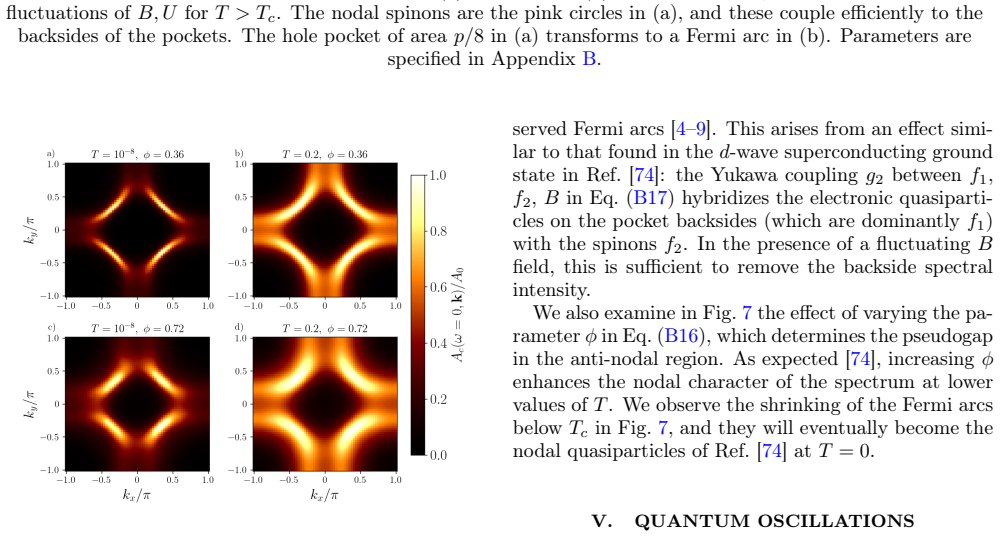
All other model parameters used are the same as Fig. 7. The figure in (c) is that in Fig. 8a. theory, we see clear evidence of the formation of Fermi arcs and the absence of the back side of the pockets and can be treated as a representative of the full system
-
[6]
To account for a non-zero magnetic field associ- ated with the U(1) charge in Eq
Quantum Oscillations Finally, we study the electronic Fermi surface in the presence of Gaussian fluctuations by computing oscilla- tions of the density of states induced by a U(1) magnetic field. To account for a non-zero magnetic field associ- ated with the U(1) charge in Eq. (B7), we introduce a Peierls phase tij → tijei e ℏ R j i A·ds to all hoppings i...
-
[7]
is the frequency corresponding to the area of the Brillouin zone. Appendix D: One-loop self-energy in the ancilla layer theory with quantum bosons In this section, we present a calculation of the elec- tronspectralfunctionuptosecondorderintheelectron- spinon-chargon coupling, while including quantum fluc- tuations of B. The results here for the electron s...
-
[8]
(eV) and J = 0 .2/ √ 2, T = 0 .1, g1 = 0, g2 = 0 .15. We observe that the inclusion of the self-energy provides a decay channel for the electrons that is kinematically more efficient near the backsides of the hole pockets, as the spinon low-energy excitations lie near those, thus washing them out. The inner sides of the pockets, in- stead, are barely modi...
-
[9]
Fermi Surface and Quasiparticle Excitations of overdoped Tl2Ba2CuO6+d by ARPES
M. Platé, J. D. Mottershead, I. S. Elfimov, D. C. Peets, R. Liang, D. A. Bonn, W. N. Hardy, S. Chi- uzbaian, M. Falub, M. Shi, L. Patthey, and A. Dama- scelli, Fermi Surface and Quasiparticle Excitations of Overdoped Tl2Ba2CuO6+δ,Phys.Rev.Lett. 95,077001 (2005), arXiv:cond-mat/0503117 [cond-mat.supr-con]
work page internal anchor Pith review Pith/arXiv arXiv 2005
-
[10]
B. Vignolle, A. Carrington, R. A. Cooper, M. M. J. French, A. P. Mackenzie, C. Jaudet, D. Vignolles, C. Proust, and N. E. Hussey,Quantum oscillations in an overdoped high-Tc superconductor, Nature455, 952 (2008)
work page 2008
-
[11]
R. He, M. Hashimoto, H. Karapetyan, J. Koralek, J. Hinton, J. Testaud, V. Nathan, Y. Yoshida, H. Yao, K. Tanaka, W. Meevasana, R. Moore, D. Lu, S.- K. Mo, M. Ishikado, H. Eisaki, Z. Hussain, T. De- vereaux, S. Kivelson, J. Orenstein, A. Kapitul- nik, and Z.-X. Shen, From a Single-Band Metal to a High-Temperature Superconductor via Two Ther- mal Phase Tran...
work page internal anchor Pith review Pith/arXiv arXiv 2011
-
[12]
M. R. Norman, H. Ding, M. Randeria, J. C. Cam- puzano, T. Yokoya, T. Takeuchi, T. Takahashi, T. Mochiku, K. Kadowaki, P. Guptasarma, and D. G. Hinks, Destruction of the Fermi surface in underdoped high-Tc superconductors, Nature392, 157 (1998)
work page 1998
-
[13]
K. M. Shen, F. Ronning, D. H. Lu, F. Baumberger, N. J. C. Ingle, W. S. Lee, W. Meevasana, Y. Kohsaka, M. Azuma, M. Takano, H. Takagi, and Z.-X. Shen, Nodal Quasiparticles and Antinodal Charge Ordering in Ca2−xNaxCuO2Cl2, Science307, 901 (2005)
work page 2005
-
[14]
H.-B. Yang, J. D. Rameau, Z.-H. Pan, G. D. Gu, P. D. Johnson, H. Claus, D. G. Hinks, and T. E. Kidd, Reconstructed Fermi Surface of Un- derdoped Bi2Sr2CaCu2O8+δ Cuprate Superconductors, Phys. Rev. Lett.107, 047003 (2011), arXiv:1008.3121 [cond-mat.supr-con]
work page internal anchor Pith review Pith/arXiv arXiv 2011
-
[15]
S. Kunisada, S. Isono, Y. Kohama, S. Sakai, C. Bareille, S. Sakuragi, R. Noguchi, K. Kurokawa, K. Kuroda, Y. Ishida, S. Adachi, R. Sekine, T. K. Kim, C. Cacho, S. Shin, T. Tohyama, K. Tokiwa, and T. Kondo, Observation of small Fermi pockets pro- tected by clean CuO2 sheets of a high-Tc superconduc- tor, Science369, 833 (2020), arXiv:2008.07784 [cond- mat....
-
[16]
K. Kurokawa, S. Isono, Y. Kohama, S. Kunisada, S. Sakai, R. Sekine, M. Okubo, M. D. Watson, T. K. Kim, C. Cacho, S. Shin, T. Tohyama, K. Tokiwa, and T. Kondo,Unveiling phase diagram of the lightly doped high-Tc cuprate superconductors with disorder removed, Nature Communications 14, 4064 (2023), arXiv:2307.07684 [cond-mat.supr-con]
-
[17]
S. Smit, M. Bluschke, P. Moen, N. Heinsdorf, E. Za- vatti, G. Bellomia, S. Giuli, S. K. Y. Dufresne, C. T. Suen, V. Zimmermann, C. Au-Yeung, S. Zh- danovich, J. I. Dadap, M. Zonno, S. Gorovikov, H. Lee, C.-T. Kuo, J.-S. Lee, D. Song, S. Ishida, H. Eisaki, B. Keimer, M. Michiardi, I. S. Elfimov, G. Levy, D. J. Jones, M. Capone, and A. Damas- celli,Enhanced...
-
[18]
Y. He, Y. Yin, M. Zech, A. Soumyanarayanan, M. M. Yee, T. Williams, M. C. Boyer, K. Chatterjee, W. D. Wise, I. Zeljkovic, T. Kondo, T. Takeuchi, H. Ikuta, P. Mistark, R. S. Markiewicz, A. Bansil, S. Sachdev, E. W. Hudson, and J. E. Hoffman,Fermi Surface and Pseudogap Evolution in a Cuprate Superconductor,Sci- ence344, 608 (2014), arXiv:1305.2778 [cond-mat...
work page internal anchor Pith review Pith/arXiv arXiv 2014
-
[19]
Simultaneous Transitions in Cuprate Momentum-Space Topology and Electronic Symmetry Breaking
K. Fujita, C. K. Kim, I. Lee, J. Lee, M. H. Hamidian, I. A. Firmo, S. Mukhopadhyay, H. Eisaki, S. Uchida, M. J. Lawler, E. A. Kim, and J. C. Davis,Simultane- ous Transitions in Cuprate Momentum-Space Topology and Electronic Symmetry Breaking, Science 344, 612 (2014), arXiv:1403.7788 [cond-mat.supr-con]
work page internal anchor Pith review Pith/arXiv arXiv 2014
-
[20]
Y. Fang, G. Grissonnanche, A. Legros, S. Verret, F. Laliberté, C. Collignon, A. Ataei, M. Dion, J. Zhou, D. Graf, M. J. Lawler, P. A. Goddard, L. Taillefer, and B. J. Ramshaw,Fermi surface transformation at the pseudogap critical point of a cuprate superconduc- tor, Nature Physics18, 558 (2022), arXiv:2004.01725 [cond-mat.str-el]
-
[21]
M. K. Chan, K. A. Schreiber, O. E. Ayala-Valenzuela, E. D. Bauer, A. Shekhter, and N. Harrison, Ob- servation of the Yamaji effect in a cuprate super- conductor, Nature Physics 10.1038/s41567-025-03032- 2 (2025), arXiv:2411.10631 [cond-mat.str-el]
-
[22]
V. J. Emery and S. A. Kivelson,Importance of phase fluctuations in superconductors with small superfluid density, Nature374, 434 (1995)
work page 1995
-
[23]
Phase Fluctuations and Spectral Properties of Underdoped Cuprates
M. Franz and A. J. Millis, Phase fluctuations and spectral properties of underdoped cuprates, Phys. Rev. B 58, 14572 (1998), arXiv:cond-mat/9805401 [cond- mat.supr-con]
work page internal anchor Pith review Pith/arXiv arXiv 1998
-
[24]
T. Eckl, D. J. Scalapino, E. Arrigoni, and W. Hanke, Pair phase fluctuations and the pseudogap, Phys. Rev. B 66, 140510 (2002), arXiv:cond-mat/0110377 [cond- mat.supr-con]
work page internal anchor Pith review Pith/arXiv arXiv 2002
- [25]
-
[26]
Evolution of the Fermi surface in phase fluctuating d-wave superconductors
E. Berg and E. Altman,Evolution of the Fermi Surface 17 of d-Wave Superconductors in the Presence of Ther- mal Phase Fluctuations, Phys. Rev. Lett.99, 247001 (2007), arXiv:0705.1566 [cond-mat.supr-con]
work page internal anchor Pith review Pith/arXiv arXiv 2007
-
[27]
Q. Han, T. Li, and Z. D. Wang,Pseudogap and Fermi- arc evolution in the phase-fluctuation scenario, Phys. Rev. B 82, 052503 (2010), arXiv:1005.5497 [cond- mat.supr-con]
work page internal anchor Pith review Pith/arXiv arXiv 2010
- [28]
-
[29]
Monte Carlo study of thermal fluctuations and Fermi-arc formation in d-wave superconductors
Y.-W. Zhong, T. Li, and Q. Han,Monte Carlo study of thermal fluctuations and Fermi-arc formation in d- wave superconductors, Phys. Rev. B84, 024522 (2011), arXiv:1008.4191 [cond-mat.supr-con]
work page internal anchor Pith review Pith/arXiv arXiv 2011
- [30]
-
[31]
K. Sarkar, S. Banerjee, S. Mukerjee, and T. V. Ra- makrishnan, The correlation between the Nernst effect and fluctuation diamagnetism in strongly fluctuating superconductors, New Journal of Physics19, 073009 (2017), arXiv:1701.08091 [cond-mat.supr-con]
work page internal anchor Pith review Pith/arXiv arXiv 2017
- [32]
-
[33]
X.-C. Wang and Y. Qi, Phase fluctuations in two-dimensional superconductors and pseudogap phe- nomenon, Phys. Rev. B 107, 224502 (2023), arXiv:2212.05737 [cond-mat.supr-con]
- [34]
- [35]
-
[36]
J. Schmalian, D. Pines, and B. Stojković,Weak Pseu- dogap Behavior in the Underdoped Cuprate Supercon- ductors, Phys. Rev. Lett.80, 3839 (1998), arXiv:cond- mat/9708238 [cond-mat.supr-con]
-
[37]
J. Schmalian, D. Pines, and B. Stojković, Micro- scopic theory of weak pseudogap behavior in the un- derdoped cuprate superconductors: General theory and quasiparticle properties, Phys. Rev. B60, 667 (1999), arXiv:cond-mat/9804129 [cond-mat]
work page internal anchor Pith review Pith/arXiv arXiv 1999
-
[38]
Pseudogap and Spin Fluctuations in the Normal State of Electron-Doped Cuprates
B. Kyung, V. Hankevych, A. M. Daré, and A. M. S. Tremblay, Pseudogap and Spin Fluctuations in the Normal State of the Electron-Doped Cuprates, Phys. Rev.Lett. 93,147004(2004),arXiv:cond-mat/0312499 [cond-mat.str-el]
work page internal anchor Pith review Pith/arXiv arXiv 2004
- [39]
- [40]
-
[41]
Sachdev, Quantum phases of the Shraiman-Siggia model, Phys
S. Sachdev, Quantum phases of the Shraiman-Siggia model, Phys. Rev. B 49, 6770 (1994), arXiv:cond- mat/9311037 [cond-mat]
- [42]
- [43]
-
[44]
K.-Y. Yang, T. M. Rice, and F.-C. Zhang,Phenomeno- logical theory of the pseudogap state, Phys. Rev. B 73, 174501 (2006), arXiv:cond-mat/0602164 [cond- mat.supr-con]
work page internal anchor Pith review Pith/arXiv arXiv 2006
- [45]
-
[46]
T. Senthil, S. Sachdev, and M. Vojta,Fractionalized Fermi Liquids, Phys. Rev. Lett. 90, 216403 (2003), cond-mat/0209144
work page internal anchor Pith review Pith/arXiv arXiv 2003
-
[47]
T. Senthil, M. Vojta, and S. Sachdev, Weak mag- netism and non-Fermi liquids near heavy-fermion criti- cal points,Phys.Rev.B 69,035111(2004),arXiv:cond- mat/0305193 [cond-mat.str-el]
-
[48]
Extending Luttinger's theorem to Z(2) fractionalized phases of matter
A. Paramekanti and A. Vishwanath,Extending Lut- tinger’s theorem toZ2 fractionalized phases of matter, Phys. Rev. B70, 245118 (2004), cond-mat/0406619
work page internal anchor Pith review Pith/arXiv arXiv 2004
-
[49]
Topological Enrichment of Luttinger's Theorem
P. Bonderson, M. Cheng, K. Patel, and E. Plamadeala, Topological Enrichment of Luttinger’s Theorem, arXiv e-prints (2016), arXiv:1601.07902 [cond-mat.str-el]
work page internal anchor Pith review Pith/arXiv arXiv 2016
- [50]
-
[51]
T. D. Stanescu and G. Kotliar,Fermi arcs and hid- den zeros of the Green function in the pseudogap state, Phys. Rev. B74, 125110 (2006)
work page 2006
-
[52]
R. K. Kaul, A. Kolezhuk, M. Levin, S. Sachdev, and T. Senthil,Hole dynamics in an antiferromagnet across a deconfined quantum critical point, Phys. Rev. B 75, 235122 (2007), arXiv:cond-mat/0702119 [cond- mat.str-el]
work page internal anchor Pith review Pith/arXiv arXiv 2007
-
[53]
Nodal/Antinodal Dichotomy and the Two Gaps of a Superconducting Doped Mott Insulator
M. Civelli, M. Capone, A. Georges, K. Haule, O. Par- collet, T. D. Stanescu, and G. Kotliar,Nodal-Antinodal Dichotomy and the Two Gaps of a Superconducting Doped Mott Insulator, Phys. Rev. Lett.100, 046402 (2008), arXiv:0704.1486 [cond-mat.str-el]
work page internal anchor Pith review Pith/arXiv arXiv 2008
-
[54]
R. K. Kaul, Y. B. Kim, S. Sachdev, and T. Senthil, Algebraic charge liquids, Nature Physics4, 28 (2008), arXiv:0706.2187 [cond-mat.str-el]
work page internal anchor Pith review Pith/arXiv arXiv 2008
-
[55]
S. Sakai, Y. Motome, and M. Imada,Evolution of Elec- tronic Structure of Doped Mott Insulators: Reconstruc- tion of Poles and Zeros of Green’s Function, Phys. Rev. Lett.102, 056404 (2009), arXiv:0809.0950 [cond- mat.str-el]. 18
work page internal anchor Pith review Pith/arXiv arXiv 2009
-
[56]
Effective theory of Fermi pockets in fluctuating antiferromagnets
Y. Qi and S. Sachdev,Effective theory of Fermi pock- ets in fluctuating antiferromagnets, Phys. Rev. B81, 115129 (2010), arXiv:0912.0943 [cond-mat.str-el]
work page internal anchor Pith review Pith/arXiv arXiv 2010
-
[57]
E. G. Moon and S. Sachdev, Underdoped cuprates as fractionalized Fermi liquids: Transition to su- perconductivity, Phys. Rev. B 83, 224508 (2011), arXiv:1010.4567 [cond-mat.str-el]
work page internal anchor Pith review Pith/arXiv arXiv 2011
-
[58]
Fermi surface reconstruction in hole-doped t-J models without long-range antiferromagnetic order
M. Punk and S. Sachdev, Fermi surface reconstruc- tion in hole-dopedt-J models without long-range anti- ferromagnetic order, Phys. Rev. B85, 195123 (2012), arXiv:1202.4023 [cond-mat.str-el]
work page internal anchor Pith review Pith/arXiv arXiv 2012
-
[59]
M. Punk, A. Allais, and S. Sachdev, Quantum dimer model for the pseudogap metal, Proceedings of the National Academy of Science 112, 9552 (2015), arXiv:1501.00978 [cond-mat.str-el]
work page internal anchor Pith review Pith/arXiv arXiv 2015
-
[60]
J. Skolimowski and M. Fabrizio,Luttinger’s theorem in the presence of Luttinger surfaces, Phys. Rev. B106, 045109 (2022), arXiv:2202.00426 [cond-mat.str-el]
-
[61]
2, 023172 (2020), arXiv:2001.09159 [cond-mat.str-el]
Y.-H.ZhangandS.Sachdev, From the pseudogap metal to the Fermi liquid using ancilla qubits,Phys.Rev.Res. 2, 023172 (2020), arXiv:2001.09159 [cond-mat.str-el]
-
[62]
Y.-H. Zhang and S. Sachdev, Deconfined criticality and ghost Fermi surfaces at the onset of antiferromag- netism in a metal, Phys. Rev. B102, 155124 (2020), arXiv:2006.01140 [cond-mat.str-el]
- [63]
- [64]
-
[65]
P. Rosenberg, D. Sénéchal, A. M. S. Tremblay, and M. Charlebois, Fermi arcs from dynamical varia- tional Monte Carlo, Phys. Rev. B106, 245132 (2022), arXiv:2209.08092 [cond-mat.str-el]
-
[66]
F. Šimkovic, R. Rossi, A. Georges, and M. Ferrero, Origin and fate of the pseudogap in the doped Hubbard model,Science 385,eade9194(2024),arXiv:2209.09237 [cond-mat.str-el]
-
[67]
A. Nikolaenko, J. von Milczewski, D. G. Joshi, and S. Sachdev,Spin density wave, Fermi liquid, and frac- tionalized phases in a theory of antiferromagnetic met- als using paramagnons and bosonic spinons,Phys.Rev. B108,045123(2023),arXiv:2211.10452[cond-mat.str- el]
-
[68]
N.ReadandS.Sachdev, Valence-bond and spin-Peierls ground states of low-dimensional quantum antiferro- magnets, Phys. Rev. Lett.62, 1694 (1989)
work page 1989
-
[69]
N. Read and S. Sachdev, Spin-Peierls, valence-bond solid, and Néel ground states of low-dimensional quan- tum antiferromagnets, Phys. Rev. B42, 4568 (1990)
work page 1990
-
[70]
A. V. Chubukov and O. A. Starykh,Confinement of spinons in the CPM −1 model, Phys. Rev. B52, 440 (1995), arXiv:cond-mat/9501031 [cond-mat]
work page internal anchor Pith review Pith/arXiv arXiv 1995
- [71]
-
[72]
B. Lau, M. Berciu, and G. A. Sawatzky,High-Spin Po- laron in Lightly Doped CuO2 Planes, Phys. Rev. Lett. 106, 036401 (2011), arXiv:1010.1867 [cond-mat.str-el]
work page internal anchor Pith review Pith/arXiv arXiv 2011
-
[73]
B. Lau, M. Berciu, and G. A. Sawatzky, Compu- tational approach to a doped antiferromagnet: Cor- relations between two spin polarons in the lightly doped CuO2 plane, Phys. Rev. B84, 165102 (2011), arXiv:1107.4141 [cond-mat.str-el]
work page internal anchor Pith review Pith/arXiv arXiv 2011
-
[74]
J.-W. Mei, S. Kawasaki, G.-Q. Zheng, Z.-Y. Weng, and X.-G. Wen,Luttinger-volume violating Fermi liq- uid in the pseudogap phase of the cuprate superconduc- tors, Phys. Rev. B85, 134519 (2012), arXiv:1109.0406 [cond-mat.supr-con]
work page internal anchor Pith review Pith/arXiv arXiv 2012
-
[75]
Parton theory of magnetic polarons: Mesonic resonances and signatures in dynamics
F. Grusdt, M. Kánasz-Nagy, A. Bohrdt, C. S. Chiu, G. Ji, M. Greiner, D. Greif, and E. Demler, Par- ton Theory of Magnetic Polarons: Mesonic Reso- nances and Signatures in Dynamics , Physical Re- view X 8, 011046 (2018), arXiv:1712.01874 [cond- mat.quant-gas]
work page internal anchor Pith review Pith/arXiv arXiv 2018
-
[76]
String patterns in the doped Hubbard model
C.S.Chiu, G.Ji, A.Bohrdt, M.Xu, M.Knap, E.Dem- ler, F. Grusdt, M. Greiner, and D. Greif,String pat- terns in the doped Hubbard model, Science 365, 251 (2019), arXiv:1810.03584 [cond-mat.quant-gas]
work page internal anchor Pith review Pith/arXiv arXiv 2019
- [77]
-
[78]
H. Schlömer, U. Schollwöck, A. Bohrdt, and F. Grusdt, Kinetic-to-magnetic frustration crossover and linear confinement in the doped triangular t−J model, Phys. Rev. B110, L041117 (2024), arXiv:2305.02342 [cond- mat.str-el]
- [79]
-
[80]
A. M. Tsvelik,Fractionalized Fermi liquid in a Kondo- Heisenberg model, Phys. Rev. B 94, 165114 (2016), arXiv:1604.06417 [cond-mat.str-el]
work page internal anchor Pith review Pith/arXiv arXiv 2016
discussion (0)
Sign in with ORCID, Apple, or X to comment. Anyone can read and Pith papers without signing in.