OKG-LLM: Aligning Ocean Knowledge Graph with Observation Data via LLMs for Global Sea Surface Temperature Prediction
Pith reviewed 2026-05-19 02:40 UTC · model grok-4.3
The pith
Aligning an ocean knowledge graph with observation data via LLMs improves global sea surface temperature prediction.
A machine-rendered reading of the paper's core claim, the machinery that carries it, and where it could break.
Core claim
The central claim is that constructing the first Ocean Knowledge Graph tailored to SST prediction, learning its embeddings to encode region-specific traits and inter-region correlations, aligning those embeddings with numerical SST data, and routing the fused input through a pre-trained LLM produces more accurate global sea surface temperature forecasts than prior methods.
What carries the argument
The Ocean Knowledge Graph (OKG) together with its graph embedding network, which encodes semantic and structural ocean knowledge and is then aligned and fused with fine-grained numerical SST data before being processed by a pre-trained LLM for pattern modeling.
If this is right
- OKG-LLM consistently outperforms state-of-the-art methods on real-world SST datasets.
- The framework demonstrates effectiveness and robustness when domain knowledge is integrated with numerical observations.
- It opens a path to advance SST prediction for weather forecasting, fisheries, and storm tracking.
- The construction of a dedicated Ocean Knowledge Graph constitutes the first systematic effort of its kind for this task.
Where Pith is reading between the lines
- The same knowledge-graph alignment approach could be adapted to predict other ocean variables such as salinity or current velocities.
- Incorporating near-real-time satellite streams into the alignment step might enable shorter-horizon operational forecasts.
- Testing the framework on multi-decadal climate-model outputs could reveal whether the embedded ocean knowledge improves long-term trend capture.
Load-bearing premise
The constructed Ocean Knowledge Graph accurately represents relevant domain knowledge for SST prediction and can be effectively aligned and fused with fine-grained numerical SST data.
What would settle it
A head-to-head evaluation on additional real-world SST datasets in which OKG-LLM does not achieve lower prediction error than current state-of-the-art data-driven models would falsify the central performance claim.
Figures


read the original abstract
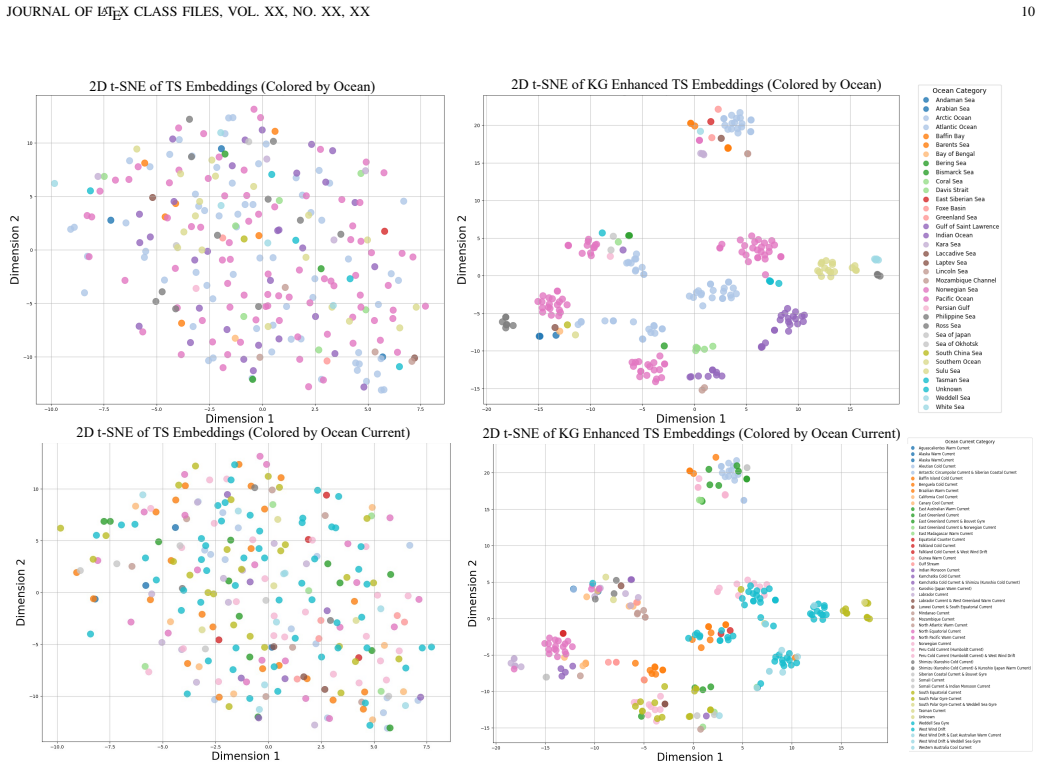
Sea surface temperature (SST) prediction is a critical task in ocean science, supporting various applications, such as weather forecasting, fisheries management, and storm tracking. While existing data-driven methods have demonstrated significant success, they often neglect to leverage the rich domain knowledge accumulated over the past decades, limiting further advancements in prediction accuracy. The recent emergence of large language models (LLMs) has highlighted the potential of integrating domain knowledge for downstream tasks. However, the application of LLMs to SST prediction remains underexplored, primarily due to the challenge of integrating ocean domain knowledge and numerical data. To address this issue, we propose Ocean Knowledge Graph-enhanced LLM (OKG-LLM), a novel framework for global SST prediction. To the best of our knowledge, this work presents the first systematic effort to construct an Ocean Knowledge Graph (OKG) specifically designed to represent diverse ocean knowledge for SST prediction. We then develop a graph embedding network to learn the comprehensive semantic and structural knowledge within the OKG, capturing both the unique characteristics of individual sea regions and the complex correlations between them. Finally, we align and fuse the learned knowledge with fine-grained numerical SST data and leverage a pre-trained LLM to model SST patterns for accurate prediction. Extensive experiments on the real-world dataset demonstrate that OKG-LLM consistently outperforms state-of-the-art methods, showcasing its effectiveness, robustness, and potential to advance SST prediction. The codes are available in the online repository.
Editorial analysis
A structured set of objections, weighed in public.
Referee Report
Summary. The paper proposes OKG-LLM, a framework for global sea surface temperature (SST) prediction that constructs an Ocean Knowledge Graph (OKG) to encode domain knowledge, learns embeddings via a graph network to capture semantic and structural relations among sea regions, aligns and fuses these embeddings with fine-grained numerical SST observation data, and employs a pre-trained LLM to model temporal patterns and generate predictions. The authors position this as the first systematic effort to build such an OKG and report that the resulting model consistently outperforms state-of-the-art methods on real-world datasets.
Significance. If the central claims hold after addressing the points below, the work would be significant for showing how structured oceanographic knowledge can be integrated with LLMs to improve SST forecasting beyond purely data-driven approaches. This has clear relevance to applications in weather prediction, fisheries, and climate monitoring. The public release of code is a concrete strength that supports reproducibility and follow-on work.
major comments (3)
- [Abstract and §4] The abstract and §4 (Experiments) assert consistent outperformance over SOTA baselines on real-world data, yet no quantitative metrics, error bars, or statistical significance tests are referenced in the provided summary of results. This information is load-bearing for the headline claim and must be supplied with specific numbers and baselines.
- [§3.1] §3.1 (OKG Construction): The description of entity/relation extraction does not specify the primary sources (e.g., which oceanographic databases, literature, or expert rules are used to encode relations such as ENSO teleconnections, current systems, or thermocline effects). Without this, it is impossible to verify that the graph supplies non-redundant knowledge beyond spatial adjacency already implicit in gridded SST observations.
- [§3.3] §3.3 (Alignment and Fusion): The fusion mechanism between graph embeddings and numerical SST features is described at a high level but lacks an ablation that isolates its contribution (e.g., OKG-LLM vs. LLM backbone alone or vs. simple concatenation). This ablation is required to establish that performance gains derive from knowledge integration rather than model capacity or preprocessing.
minor comments (2)
- [Figure 1] Figure 1 (framework overview) would benefit from explicit arrows or annotations clarifying the exact tensor shapes and operations at the alignment/fusion stage.
- [Notation and §3.2] Ensure that all acronyms (OKG, LLM, SST) are defined on first use in the main text and that notation for graph embeddings is consistent between §3.2 and the experimental tables.
Simulated Author's Rebuttal
We thank the referee for the detailed and constructive feedback. We have revised the manuscript to strengthen the presentation of results, clarify the construction of the Ocean Knowledge Graph, and add targeted ablations. Point-by-point responses follow.
read point-by-point responses
-
Referee: [Abstract and §4] The abstract and §4 (Experiments) assert consistent outperformance over SOTA baselines on real-world data, yet no quantitative metrics, error bars, or statistical significance tests are referenced in the provided summary of results. This information is load-bearing for the headline claim and must be supplied with specific numbers and baselines.
Authors: We agree that explicit quantitative support is necessary. The full §4 already contains tables reporting RMSE, MAE, and correlation coefficients for OKG-LLM against baselines (LSTM, Transformer, GraphWaveNet, and recent SST-specific models), with error bars computed over five random seeds. We have now added paired t-test p-values (<0.01) confirming statistical significance. The abstract has been updated to cite the key improvements (e.g., 12–18% RMSE reduction). These changes will appear in the revised version. revision: yes
-
Referee: [§3.1] §3.1 (OKG Construction): The description of entity/relation extraction does not specify the primary sources (e.g., which oceanographic databases, literature, or expert rules are used to encode relations such as ENSO teleconnections, current systems, or thermocline effects). Without this, it is impossible to verify that the graph supplies non-redundant knowledge beyond spatial adjacency already implicit in gridded SST observations.
Authors: We accept that source transparency is required. In the revised §3.1 we now explicitly list the sources: entities are drawn from NOAA World Ocean Database and CMIP6 model outputs; relations for ENSO teleconnections reference key papers (e.g., Trenberth 1997 and subsequent works); current systems and thermocline effects are encoded via expert rules derived from standard oceanographic references (e.g., Talley et al., Descriptive Physical Oceanography). We also add a short analysis showing that a non-trivial fraction of edges encode long-range teleconnections absent from local grid adjacency. revision: yes
-
Referee: [§3.3] §3.3 (Alignment and Fusion): The fusion mechanism between graph embeddings and numerical SST features is described at a high level but lacks an ablation that isolates its contribution (e.g., OKG-LLM vs. LLM backbone alone or vs. simple concatenation). This ablation is required to establish that performance gains derive from knowledge integration rather than model capacity or preprocessing.
Authors: This is a fair request. We have conducted the requested ablations and will insert them into §4.3: (i) LLM backbone alone (no OKG), (ii) simple concatenation of graph embeddings and SST tokens without the alignment module, and (iii) OKG-LLM with the proposed cross-attention fusion. Results show that the full alignment-and-fusion design yields an additional 7–9% RMSE reduction over simple concatenation and 15% over the LLM-only variant, with statistical significance. These new experiments directly attribute gains to knowledge integration. revision: yes
Circularity Check
No significant circularity; derivation builds from external domain knowledge and data
full rationale
The paper's chain starts with construction of an Ocean Knowledge Graph from accumulated oceanographic domain knowledge, followed by a graph embedding network to capture semantic and structural relations, alignment/fusion with fine-grained numerical SST observations, and finally LLM-based modeling for prediction. No equations, definitions, or steps in the provided description reduce the final SST predictions to a fitted parameter, self-referential definition, or self-citation that is itself unverified. The OKG is presented as an independent input derived from external sources rather than from the model's outputs or performance metrics, and the empirical outperformance is reported as a downstream result rather than a tautology. This satisfies the default expectation of a non-circular framework.
Axiom & Free-Parameter Ledger
axioms (1)
- domain assumption Ocean domain knowledge accumulated over decades can be represented as a knowledge graph that captures unique sea-region characteristics and inter-region correlations relevant to SST prediction.
Forward citations
Cited by 1 Pith paper
-
AdaMamba: Adaptive Frequency-Gated Mamba for Long-Term Time Series Forecasting
AdaMamba adds input-dependent frequency bases and a unified time-frequency forgetting gate to Mamba, yielding higher forecasting accuracy than prior methods on standard long-term time series benchmarks.
Reference graph
Works this paper leans on
-
[1]
Accurate medium-range global weather forecasting with 3d neural networks,
K. Bi, L. Xie, H. Zhang, X. Chen, X. Gu, and Q. Tian, “Accurate medium-range global weather forecasting with 3d neural networks,” Nature, vol. 619, no. 7970, pp. 533–538, 2023
work page 2023
-
[2]
A survey on time-series pre-trained models,
Q. Ma, Z. Liu, Z. Zheng, Z. Huang, S. Zhu, Z. Yu, and J. T. Kwok, “A survey on time-series pre-trained models,” IEEE Transactions on Knowledge and Data Engineering , 2024
work page 2024
-
[3]
Spatial-Temporal Data Mining for Ocean Science: Data, Methodologies, and Opportunities
H. Yang, W. Li, S. Wang, H. Li, J. Guan, S. Zhou, and J. Cao, “Spatial-temporal data mining for ocean science: Data, methodologies, and opportunities,” arXiv preprint arXiv:2307.10803 , 2023
work page internal anchor Pith review Pith/arXiv arXiv 2023
-
[4]
Ocean currents show global intensification of weak tropical cyclones,
G. Wang, L. Wu, W. Mei, and S.-P. Xie, “Ocean currents show global intensification of weak tropical cyclones,” Nature, vol. 611, no. 7936, pp. 496–500, 2022
work page 2022
-
[5]
El ni˜no–southern oscillation complexity,
A. Timmermann, S.-I. An, J.-S. Kug, F.-F. Jin, W. Cai, A. Capotondi, K. M. Cobb, M. Lengaigne, M. J. McPhaden, M. F. Stuecker et al., “El ni˜no–southern oscillation complexity,” Nature, vol. 559, no. 7715, pp. 535–545, 2018
work page 2018
-
[6]
The circulation of the eastern tropical pacific: A review,
W. S. Kessler, “The circulation of the eastern tropical pacific: A review,” Progress in Oceanography, vol. 69, no. 2-4, pp. 181–217, 2006
work page 2006
-
[7]
Improving language understanding by generative pre-training,
A. Radford, K. Narasimhan, T. Salimans, I. Sutskever et al., “Improving language understanding by generative pre-training,” 2018. JOURNAL OF LATEX CLASS FILES, VOL. XX, NO. XX, XX 11
work page 2018
-
[8]
LLaMA: Open and Efficient Foundation Language Models
H. Touvron, T. Lavril, G. Izacard, X. Martinet, M.-A. Lachaux, T. Lacroix, B. Rozi `ere, N. Goyal, E. Hambro, F. Azhar et al. , “Llama: Open and efficient foundation language models,”arXiv preprint arXiv:2302.13971, 2023
work page internal anchor Pith review Pith/arXiv arXiv 2023
-
[9]
A. Liu, B. Feng, B. Xue, B. Wang, B. Wu, C. Lu, C. Zhao, C. Deng, C. Zhang, C. Ruan et al., “Deepseek-v3 technical report,” arXiv preprint arXiv:2412.19437, 2024
work page internal anchor Pith review Pith/arXiv arXiv 2024
-
[10]
Mixed-order relation-aware recurrent neural networks for spatio-temporal forecast- ing,
Y . Liang, K. Ouyang, Y . Wang, Z. Pan, Y . Yin, H. Chen, J. Zhang, Y . Zheng, D. S. Rosenblum, and R. Zimmermann, “Mixed-order relation-aware recurrent neural networks for spatio-temporal forecast- ing,” IEEE Transactions on Knowledge and Data Engineering , vol. 35, no. 9, pp. 9254–9268, 2022
work page 2022
-
[11]
One fits all: Power general time series analysis by pretrained lm,
T. Zhou, P. Niu, L. Sun, R. Jin et al. , “One fits all: Power general time series analysis by pretrained lm,” Advances in neural information processing systems, vol. 36, pp. 43 322–43 355, 2023
work page 2023
-
[12]
Unitime: A language-empowered unified model for cross-domain time series forecasting,
X. Liu, J. Hu, Y . Li, S. Diao, Y . Liang, B. Hooi, and R. Zimmermann, “Unitime: A language-empowered unified model for cross-domain time series forecasting,” in Proceedings of the ACM Web Conference 2024 , 2024
work page 2024
-
[13]
Time-LLM: Time series forecasting by reprogramming large language models,
M. Jin, S. Wang, L. Ma, Z. Chu, J. Y . Zhang, X. Shi, P.-Y . Chen, Y . Liang, Y .-F. Li, S. Pan, and Q. Wen, “Time-LLM: Time series forecasting by reprogramming large language models,” in International Conference on Learning Representations (ICLR) , 2024
work page 2024
-
[14]
Position paper: What can large language models tell us about time series analysis,
M. Jin, Y . Zhang, W. Chen, K. Zhang, Y . Liang, B. Yang, J. Wang, S. Pan, and Q. Wen, “Position paper: What can large language models tell us about time series analysis,” in International Conference on Machine Learning (ICML 2024) , 2024
work page 2024
-
[15]
Tempo: Prompt-based generative pre-trained transformer for time series forecasting,
D. Cao, F. Jia, S. O. Arik, T. Pfister, Y . Zheng, W. Ye, and Y . Liu, “Tempo: Prompt-based generative pre-trained transformer for time series forecasting,” in The Twelfth International Conference on Learning Representations
-
[16]
Higrn: a hierarchical graph recurrent network for global sea surface temperature prediction,
H. Yang, W. Li, S. Hou, J. Guan, and S. Zhou, “Higrn: a hierarchical graph recurrent network for global sea surface temperature prediction,” ACM Transactions on Intelligent Systems and Technology, vol. 14, no. 4, pp. 1–19, 2023
work page 2023
-
[17]
H. Peng, W. Li, C. Jin, Y . Zhang, J. Guan, H. Yang, and S. Zhou, “Cross- region graph convolutional network with periodicity shift adaptation for wide-area sst prediction,” ACM Transactions on Intelligent Systems and Technology, 2025
work page 2025
-
[18]
Mustc: A multi-stage spatio–temporal clustering method for uncovering the regionality of global sst,
H. Peng, W. Li, C. Jin, H. Yang, and J. Guan, “Mustc: A multi-stage spatio–temporal clustering method for uncovering the regionality of global sst,” Atmosphere, vol. 14, no. 9, p. 1358, 2023
work page 2023
-
[19]
Physical knowledge-enhanced deep neural network for sea surface temperature prediction,
Y . Meng, F. Gao, E. Rigall, R. Dong, J. Dong, and Q. Du, “Physical knowledge-enhanced deep neural network for sea surface temperature prediction,” IEEE Transactions on Geoscience and Remote Sensing , vol. 61, pp. 1–13, 2023
work page 2023
-
[20]
Multi-scale adaptive graph neural network for multivariate time series forecasting,
L. Chen, D. Chen, Z. Shang, B. Wu, C. Zheng, B. Wen, and W. Zhang, “Multi-scale adaptive graph neural network for multivariate time series forecasting,” IEEE Transactions on Knowledge and Data Engineering , vol. 35, no. 10, pp. 10 748–10 761, 2023
work page 2023
-
[21]
Causal- former: An interpretable transformer for temporal causal discovery,
L. Kong, W. Li, H. Yang, Y . Zhang, J. Guan, and S. Zhou, “Causal- former: An interpretable transformer for temporal causal discovery,” IEEE Transactions on Knowledge and Data Engineering , vol. 37, no. 1, pp. 102–115, 2025
work page 2025
-
[22]
On evaluating the predictability of sea surface temperature using entropy,
C. Jin, H. Peng, H. Yang, W. Li, and J. Guan, “On evaluating the predictability of sea surface temperature using entropy,”Remote Sensing, vol. 15, no. 8, p. 1956, 2023
work page 1956
-
[23]
The ecmwf ensemble prediction system: Methodology and validation,
F. Molteni, R. Buizza, T. N. Palmer, and T. Petroliagis, “The ecmwf ensemble prediction system: Methodology and validation,” Quarterly journal of the royal meteorological society , vol. 122, no. 529, pp. 73– 119, 1996
work page 1996
-
[24]
Spatiotemporal attention network for chl-a prediction with sparse multifactor observations,
X. Jiang, Y . Liu, S. Wang, W. Li, and J. Guan, “Spatiotemporal attention network for chl-a prediction with sparse multifactor observations,” IEEE Geoscience and Remote Sensing Letters , vol. 22, pp. 1–5, 2025
work page 2025
-
[25]
Multivariate time series forecasting with dynamic graph neural odes,
M. Jin, Y . Zheng, Y .-F. Li, S. Chen, B. Yang, and S. Pan, “Multivariate time series forecasting with dynamic graph neural odes,” IEEE Trans- actions on Knowledge and Data Engineering , vol. 35, no. 9, pp. 9168– 9180, 2022
work page 2022
-
[26]
Informer: Beyond efficient transformer for long sequence time-series forecasting,
H. Zhou, S. Zhang, J. Peng, S. Zhang, J. Li, H. Xiong, and W. Zhang, “Informer: Beyond efficient transformer for long sequence time-series forecasting,” in Proceedings of the AAAI conference on artificial intel- ligence, vol. 35, no. 12, 2021, pp. 11 106–11 115
work page 2021
-
[27]
Fedformer: Frequency enhanced decomposed transformer for long-term series fore- casting,
T. Zhou, Z. Ma, Q. Wen, X. Wang, L. Sun, and R. Jin, “Fedformer: Frequency enhanced decomposed transformer for long-term series fore- casting,” in International conference on machine learning . PMLR, 2022, pp. 27 268–27 286
work page 2022
-
[28]
Timemixer++: A general time series pattern machine for universal predictive analysis,
S. Wang, J. Li, X. Shi, Z. Ye, B. Mo, W. Lin, S. Ju, Z. Chu, and M. Jin, “Timemixer++: A general time series pattern machine for universal predictive analysis,” ICLR, 2025
work page 2025
-
[29]
Are transformers effective for time series forecasting?
A. Zeng, M. Chen, L. Zhang, and Q. Xu, “Are transformers effective for time series forecasting?” in Proceedings of the AAAI conference on artificial intelligence, vol. 37, no. 9, 2023, pp. 11 121–11 128
work page 2023
-
[30]
Frequency-domain mlps are more effective learners in time series forecasting,
K. Yi, Q. Zhang, W. Fan, S. Wang, P. Wang, H. He, N. An, D. Lian, L. Cao, and Z. Niu, “Frequency-domain mlps are more effective learners in time series forecasting,” Advances in Neural Information Processing Systems, vol. 36, pp. 76 656–76 679, 2023
work page 2023
-
[31]
Llm4hrs: Llm-based spatiotemporal imputation model for highly sparse remote sensing data,
S. Wang, W. Li, H. Yang, J. Guan, X. Liu, Y . Zhang, R. Qin, and S. Zhou, “Llm4hrs: Llm-based spatiotemporal imputation model for highly sparse remote sensing data,” IEEE Transactions on Geoscience and Remote Sensing, vol. 63, pp. 1–17, 2025
work page 2025
-
[32]
Prompt-based time series forecasting: A new task and dataset,
H. Xue and F. D. Salim, “Promptcast: A new prompt-based learning paradigm for time series forecasting,” arXiv preprint arXiv:2210.08964, 2022
-
[33]
Urbangpt: Spatio-temporal large language models,
Z. Li, L. Xia, J. Tang, Y . Xu, L. Shi, L. Xia, D. Yin, and C. Huang, “Urbangpt: Spatio-temporal large language models,” in Proceedings of the 30th ACM SIGKDD Conference on Knowledge Discovery and Data Mining, 2024, pp. 5351–5362
work page 2024
-
[34]
A foundation model of transcription across human cell types,
X. Fu, S. Mo, A. Buendia, A. P. Laurent, A. Shao, M. d. M. Alvarez- Torres, T. Yu, J. Tan, J. Su, R. Sagatelian et al. , “A foundation model of transcription across human cell types,” Nature, pp. 1–9, 2025
work page 2025
-
[35]
Protgpt2 is a deep unsupervised language model for protein design,
N. Ferruz, S. Schmidt, and B. H ¨ocker, “Protgpt2 is a deep unsupervised language model for protein design,” Nature communications , vol. 13, no. 1, p. 4348, 2022
work page 2022
-
[36]
K2: A foundation language model for geoscience knowledge understanding and utilization,
C. Deng, T. Zhang, Z. He, Q. Chen, Y . Shi, Y . Xu, L. Fu, W. Zhang, X. Wang, C. Zhou et al. , “K2: A foundation language model for geoscience knowledge understanding and utilization,” in Proceedings of the 17th ACM International Conference on Web Search and Data Mining, 2024, pp. 161–170
work page 2024
-
[37]
Foundation model for material science,
S. Takeda, A. Kishimoto, L. Hamada, D. Nakano, and J. R. Smith, “Foundation model for material science,” in Proceedings of the AAAI Conference on Artificial Intelligence, vol. 37, no. 13, 2023, pp. 15 376– 15 383
work page 2023
-
[38]
Leveraging network structure for efficient dynamic negative sampling in network embedding,
C. Wang, Z. Zhu, P. Meng, and Y . Qiu, “Leveraging network structure for efficient dynamic negative sampling in network embedding,”Information Sciences, vol. 606, pp. 853–863, 2022
work page 2022
-
[39]
Fathomgpt: A natural language interface for interactively exploring ocean science data,
N. Khanal, C. M. Yu, J.-C. Chiu, A. Chaudhary, Z. Zhang, K. Katija, and A. G. Forbes, “Fathomgpt: A natural language interface for interactively exploring ocean science data,” in Proceedings of the 37th Annual ACM Symposium on User Interface Software and Technology , ser. UIST ’24. New York, NY , USA: Association for Computing Machinery, 2024
work page 2024
-
[40]
Oceangpt: A large language model for ocean science tasks,
Z. Bi, N. Zhang, Y . Xue, Y . Ou, D. Ji, G. Zheng, and H. Chen, “Oceangpt: A large language model for ocean science tasks,” inProceed- ings of the 62nd Annual Meeting of the Association for Computational Linguistics (Volume 1: Long Papers) , 2024, pp. 3357–3372
work page 2024
-
[41]
Knowledge graph quality management: a compre- hensive survey,
B. Xue and L. Zou, “Knowledge graph quality management: a compre- hensive survey,” IEEE Transactions on Knowledge and Data Engineer- ing, vol. 35, no. 5, pp. 4969–4988, 2022
work page 2022
-
[42]
Unifying large language models and knowledge graphs: A roadmap,
S. Pan, L. Luo, Y . Wang, C. Chen, J. Wang, and X. Wu, “Unifying large language models and knowledge graphs: A roadmap,” IEEE Transactions on Knowledge and Data Engineering , vol. 36, no. 7, pp. 3580–3599, 2024
work page 2024
-
[43]
Knowledge- aware parsimony learning: A perspective from relational graphs,
Q. Yao, Y . Zhang, Y . Wang, N. Yin, J. Kwok, and Q. Yang, “Knowledge- aware parsimony learning: A perspective from relational graphs,” arXiv preprint arXiv:2407.00478, 2024
-
[44]
Knowledge graphs: Opportunities and challenges,
C. Peng, F. Xia, M. Naseriparsa, and F. Osborne, “Knowledge graphs: Opportunities and challenges,” Artificial Intelligence Review , vol. 56, no. 11, pp. 13 071–13 102, 2023
work page 2023
-
[45]
Uukg: Unified urban knowledge graph dataset for urban spatiotemporal prediction,
Y . Ning, H. Liu, H. Wang, Z. Zeng, and H. Xiong, “Uukg: Unified urban knowledge graph dataset for urban spatiotemporal prediction,” Advances in Neural Information Processing Systems , vol. 36, pp. 62 442–62 456, 2023
work page 2023
-
[46]
From Local to Global: A Graph RAG Approach to Query-Focused Summarization
D. Edge, H. Trinh, N. Cheng, J. Bradley, A. Chao, A. Mody, S. Truitt, D. Metropolitansky, R. O. Ness, and J. Larson, “From local to global: A graph rag approach to query-focused summarization,” arXiv preprint arXiv:2404.16130, 2024
work page internal anchor Pith review Pith/arXiv arXiv 2024
-
[47]
Knowledge graph-guided retrieval augmented generation,
X. Zhu, Y . Xie, Y . Liu, Y . Li, and W. Hu, “Knowledge graph-guided retrieval augmented generation,”arXiv preprint arXiv:2502.06864, 2025
-
[48]
Reversible instance normalization for accurate time-series forecasting against distri- bution shift,
T. Kim, J. Kim, Y . Tae, C. Park, J.-H. Choi, and J. Choo, “Reversible instance normalization for accurate time-series forecasting against distri- bution shift,” in International Conference on Learning Representations , 2021
work page 2021
-
[49]
Making large language models perform better in knowledge graph completion,
Y . Zhang, Z. Chen, L. Guo, Y . Xu, W. Zhang, and H. Chen, “Making large language models perform better in knowledge graph completion,” JOURNAL OF LATEX CLASS FILES, VOL. XX, NO. XX, XX 12 in Proceedings of the 32nd ACM International Conference on Multime- dia, 2024, pp. 233–242
work page 2024
-
[50]
A decoder-only foundation model for time-series forecasting,
A. Das, W. Kong, R. Sen, and Y . Zhou, “A decoder-only foundation model for time-series forecasting,” in Forty-first International Confer- ence on Machine Learning , 2024
work page 2024
discussion (0)
Sign in with ORCID, Apple, or X to comment. Anyone can read and Pith papers without signing in.