REVIEW 3 major objections 3 minor 1 cited by
Random punctured hyperbolic surfaces & the Brownian sphere
T0 review · 3 major / 3 minor · reviewed 2026-08-05 · deepseek-v4-flash
Pith's one-line read Random Weil-Petersson spheres with many cusps converge to the Brownian sphere after n^{-1/4} rescaling.
desk verdict Major advance: WP punctured spheres join the Brownian sphere universality class via a new Schaeffer-type tree encoding, but the ε→0 step in Theorem 3 and two smaller gaps need attention before I'd call it watertight. read the letter →
The pith
A machine-rendered reading of the paper's core claim, the machinery that carries it, and where it could break.
The reading
What carries the argument
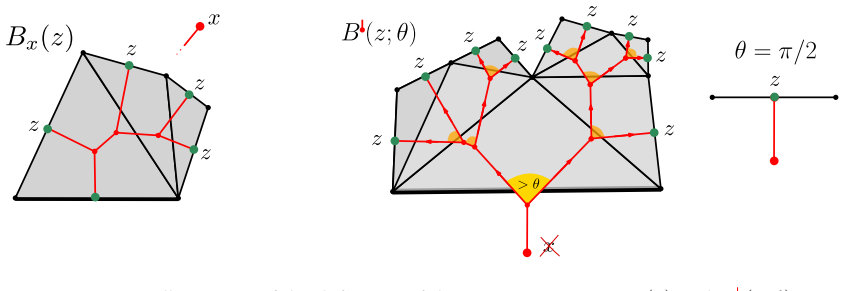
The key object is the allowed-angle binary tree encoding of a punctured sphere. Starting from $\lambda$-length coordinates on decorated ideal triangles, the paper lets every horocycle except the origin's shrink to a point; the cut-locus of the origin becomes a plane binary tree whose leaves are the other punctures, and the Euclidean triangles built from $\lambda$-lengths place angles in $(0,\pi)$ at each corner. The global constraint that opposite angles around each internal edge sum to more than $\pi$ is exactly the Delaunay condition. Theorem 3 shows the Weil-Petersson measure is $2^{n-2}$ times Lebesgue measure on such configurations. The analytic work then decomposes the associated tree of Euclidean tri
What would settle it
Take a small fixed $n$, enumerate the finitely many rooted plane binary trees with $n$ leaves, integrate Lebesgue measure over each allowed-angle polytope, and compare the total with Zograf's exact Weil-Petersson volume through the paper's formula relating the two; a mismatch beyond numerical precision would refute Theorem 3 and with it the whole route. For the scaling limit itself, simulate the $n$-horocycle distance matrix for a large $n$, rescale by $n^{-1/4}$, and compare the empirical diameter distribution with $c_{wp}$ times the known Brownian sphere diameter law; a systematic deviation would refute T
Extended reading notes
Core claim
On the paper's own terms, the central claim is Theorem 2: if $S_n$ is a Weil-Petersson random genus-zero hyperbolic surface with $n+1$ punctures, then with the unit-length horocycle collars removed and distances multiplied by $n^{-1/4}$, $S_n$ converges in the Gromov-Hausdorff-Prokhorov sense to the Brownian sphere carrying its normalized mass measure, with scaling constant $c_{wp} = 2\pi \sqrt{3}/c_0$, where $c_0 \approx 2.4048$ is the first zero of the Bessel function $J_0$. The companion Theorem 1 states that the local geometry around a uniformly chosen point converges, without rescaling, to a random infinite flute surface homeomorphic to $\mathbb{R}^2 \setminus \mathbb{Z}^2$. The load-bearing mechanism is Theorem 3: a generic punctured sphere is en
Load-bearing premise
The load-bearing premise is that, in the limit where all but one cusps' horocycles shrink, the Weil-Petersson measure is carried, up to negligible mass, by surfaces whose cut-locus is a binary tree, and that the angle encoding of those trees pushes the measure forward to Lebesgue measure; if that identification is wrong, the tree model describes the wrong random surfaces and the convergence theorems do not follow.
Editorial extensions
If this is right
- The random labeled trees encoding the surfaces converge, after n^{-1/2} height and n^{-1/4} label rescaling, to the Brownian continuum random tree decorated by the Brownian snake, with explicitly computed constants.
- The diameter and typical distances of the truncated random surfaces scale as n^{1/4} with the universal constant 2π√3/c0, putting continuous random hyperbolic surfaces in the same scaling class as random planar maps.
- After rescaling, hyperbolic area measure converges to the uniform measure on the Brownian sphere, so random points on a large punctured sphere sit at Brownian-sphere mutual distances.
- Without rescaling, finite-radius hyperbolic balls around a typical point converge in total variation to those of a random infinite punctured surface homeomorphic to R^2 \ Z^2.
- The same convergence holds if the cut-off horocycle collars are replaced by any fixed positive length, because the Hausdorff distance between the truncations is uniformly bounded.
Reading between the lines
- The encoding suggests a practical sampling algorithm for Weil-Petersson punctured spheres: sample a uniform plane binary tree with n leaves and allowed angles, then glue ideal triangles; this bypasses fundamental-domain sampling and makes numerical experiments on distances and systoles routine.
- The same n^{-1/4} Brownian-sphere scaling may govern other planar hyperbolic ensembles whose Weil-Petersson weights survive, such as random ideal triangulations with Penner coordinates or matrix-model formulations; a natural test is whether their distance constants match c_wp.
- The paper notes that in higher genus the spine is a one-face genus-g graph rather than a tree. A concrete next step is to find a tractable angle-coordinate description for that graph; if the nonlinear constraints simplify in the many-cusp regime, the same labeled-tree toolbox could attack high-genus many-cusp surfaces.
- The conformal type of the infinite local limit remains open; the tree encoding gives a concrete route to test parabolicity by analyzing the random walk on the infinite labeled tree and the associated geodesic flow, rather than relying only on geometric estimates.
Editorial analysis
A structured set of objections, weighed in public.
Referee Report
Summary. The paper studies random genus-0 Weil–Petersson hyperbolic surfaces S_n with n+1 punctures. It introduces a new encoding of such surfaces by plane binary trees with continuous angle assignments, based on the Bowditch–Epstein–Penner spine construction. Theorem 3 asserts that this encoding pushes the Weil–Petersson measure forward to Lebesgue measure on allowed angle configurations. From this tree model the paper derives a Benjamini–Schramm local limit (Theorem 1) and a scaling limit: after rescaling the hyperbolic metric by n^{-1/4}, the punctured spheres converge in Gromov–Hausdorff/Prokhorov topology to the Brownian sphere with an explicit constant c_wp (Theorem 2). The proofs adapt the Schaeffer/Le Gall machinery for random planar maps, including local limits of conditioned Galton–Watson trees, a Brownian-snake invariance principle, and Le Gall's rerooting trick for the Brownian map.
Significance. If correct, this is a major result: it places continuous random hyperbolic surfaces in the same scaling universality class as random planar maps and provides the first rigorous Brownian-sphere limit for a family of Riemannian surfaces. A notable strength is that the scaling constant c_wp is derived analytically from the model (via Bessel functions and a Markov-chain computation), not fitted. The tree encoding itself, and the local limit to a hyperbolic analogue of the UIPT, are likely to be influential. The paper is extremely detailed and transparent about its debts to existing map techniques. However, the central bridge from surfaces to trees (Theorem 3) contains a limiting argument that is asserted rather than proved, and two further technical points used later have gaps; these issues currently prevent acceptance.
major comments (3)
- [Section 3, proof of Theorem 3] The proof establishes the Jacobian identity for fixed looptree cells and then says: 'Taking ε→0, the probability under WP that Δ(eX) is not dual to a looptree tends to 0, and we deduce...'. This is the load-bearing step of the whole paper. For ε>0, non-looptree cells have positive WP mass and require a separate treatment of the λ→θ change of variables and of boundary terms in the angle polytope; no uniform estimate or dominated-convergence argument is supplied to show their contribution vanishes in the ε→0 limit. Since the tree law P_n used for all later theorems is defined only after this limit, the argument as written leaves the surface-to-tree relation unproved.
- [Section 6.6, Lemma 30] Lemma 30, which computes the integral identity determining ρ̃_0^2, is not proved in the manuscript; the proof is replaced by a reference to a MathOverflow question. This identity feeds directly into λ^2, the constants c_2 and c_wp, and hence the explicit constant in Theorem 2. For a formal publication, the computation must either be carried out in the paper or backed by a rigorous published reference. As it stands, the explicit scaling constant is not verified.
- [Section 8.3, Proposition 39] The union bound in the proof of Proposition 39 is numerically wrong as written. The bound gives P(min_c θ_c ≤ ε) ≤ C n ε / P0(|τ|=n) ≈ C' n^{5/2} ε; with ε=n^{-2} this diverges, so the claim that α_min > n^{-2} with high probability is not established. The same issue affects the bound on contour intervals without leaves: the displayed estimate with k=3 log n gives n(0.43)^{3 log n}/P0(|τ|=n) ~ C n^{-0.032}, which does not tend to 0. These can likely be repaired by taking ε=n^{-3} and k=4 log n, but as written the high-probability bounds underpinning Proposition 41 and the proof of Theorem 2 fail.
minor comments (3)
- [Section 3] The text contains duplicated lecture-slide fragments ('I Distinguish puncture ? with label 0...' repeated several times, and 'Proof: an associated ideal triangulation ...'). These should be removed and replaced by a clean exposition.
- [Notation] The symbol Z is used both for the generating function Z(x) of WP volumes and for the Brownian snake Z in Theorem 24. The footnote acknowledges this, but the double use is still a source of confusion and should be resolved by renaming one of them.
- [Section 5.2.1, proof of Proposition 14] The step 'According to Lemma 7, B0(F(x;π/2)) = F(x;π/2) - xZ'(z/4)' is terse. A short explanation of how the x-derivative term is obtained from B^*(z;θ) would improve readability.
Circularity Check
No significant circularity: the derivation is self-contained and the scaling constants are computed, not fitted.
full rationale
The paper's central derivation does not reduce to its inputs. The key encoding theorem (Theorem 3) computes the push-forward of the Weil-Petersson measure in Penner lambda-length coordinates, changes variables to angles, and identifies the resulting measure as Lebesgue measure on allowed angle configurations; no fitted parameter is involved. The later convergence theorems (Theorems 24 and 2) use standard external machinery: Marckert–Miermont invariance principles, Le Gall's Brownian sphere, and the Gromov–Hausdorff/Prokhorov framework. The scaling constant cwp = 2π√3 c0 is derived analytically from Bessel-function asymptotics and the stationary distribution of a Markov chain (Section 6.6), not adjusted to match the Brownian sphere. The paper's self-citations — e.g. [8], [19], [20], [21] — are contextual, comparative, or point to future work, and none of the load-bearing arguments (Theorem 3, Proposition 16, Theorem 24, Proposition 40) depends on an unverified result from the authors' own prior work. The unproved ε→0 step in the proof of Theorem 3 and the external MathOverflow citation in Lemma 30 are rigor concerns, not circularity: the claimed reductions are not equivalent by construction to the statements being proved.
Assumptions & free parameters
assumptions (6)
- domain assumption Penner's decorated Teichmuller space coordinates and the Weil-Petersson symplectic form in lambda-length coordinates (Eq. (7)).
- domain assumption Bowditch-Epstein spine construction degenerates to a tree as non-origin horocycle lengths tend to 0, preserving the WP measure.
- standard math Integral identity in Lemma 30 (deferred to MathOverflow).
- standard math Marckert-Miermont invariance principle for spatial monotype Galton-Watson trees.
- standard math Le Gall's Brownian sphere: existence, homeomorphism to the 2-sphere, and rerooting invariance.
- standard math Equivalence between Zograf's recursion and the generating function equation for WP volumes.
Cite this review
Pith. "Pith review of Random punctured hyperbolic surfaces & the Brownian sphere." pith.science (2026). https://pith.science/paper/3ASPC7UT
@misc{pith2026250818792,
  author       = {Pith},
  title        = {Pith review of: Random punctured hyperbolic surfaces & the Brownian sphere},
  year         = {2026},
  howpublished = {\url{https://pith.science/paper/3ASPC7UT}},
  note         = {Machine review of arXiv:2508.18792}
}
abstract
We consider random genus-0 hyperbolic surfaces $\mathcal{S}_n$ with $n + 1$ punctures, sampled according to the Weil-Petersson measure. We show that, after rescaling the metric by $n^{-1/4}$, the surface $\mathcal{S}_n$ converges in distribution to the Brownian sphere - a random compact metric space homeomorphic to the 2-sphere, exhibiting fractal geometry and appearing as a universal scaling limit in various models of random planar maps. Without rescaling the metric, we establish a local Benjamini--Schramm convergence of $\mathcal{S}_n$ to a random infinite-volume hyperbolic surface with countably many punctures, homeomorphic to $\mathbb{R}^2 \setminus \mathbb{Z}^2$. Our proofs mirror techniques from the theory of random planar maps. In particular, we develop an encoding of punctured hyperbolic surfaces via a family of plane trees with continuous labels, akin to Schaeffer's bijection. This encoding stems from the Epstein-Penner decomposition and, through a series of transformations, reduces to a model of single-type Galton--Watson trees, enabling the application of known invariance principles.
Figures


Figures from the paper (34 more)




Forward citations
Cited by 1 Pith paper
-
Bass notes of random hyperbolic surfaces of large genus
A survey of recent results proving that random hyperbolic surfaces of large genus have near-optimal spectral gaps, after Hide–Magee, Anantharaman–Monk, and Hide–Macera–Thomas.
Reference graph
Works this paper leans on
-
[1]
5, 2295–2404
Miklós Abért and Ian Biringer, Unimodular measures on the space of all riemannian manifolds , Geometry & Topology 26 (2022), no. 5, 2295–2404
2022
-
[2]
Romain Abraham and Jean-Francois Delmas, Local limits of conditioned Galton-Watson trees: the infinite spine case, Electron. J. Probab. 19 (2014), 19 pp
2014
-
[3]
Romain Abraham, Jean-François Delmas, and Patrick Hoscheit, A note on the Gromov-Hausdorff-Prokhorov distance between (locally) compact metric measure spaces , Electron. J. Probab. 18 (2013)
2013
-
[4]
Louigi Addario-Berry and Marie Albenque, The scaling limit of random simple triangulations and random simple quadrangulations, Ann. Probab. 45 (2017), no. 5, 2767–2825
2017
-
[5]
Louigi Addario-Berry, Serte Donderwinkel, Christina Goldschmidt, and Rivka Mitchell, Discrete snakes with globally centered displacements, arXiv preprint arXiv:2505.21823 (2025)
work page Pith review arXiv 2025
-
[6]
David Aldous, Asymptotic fringe distributions for general families of random trees , Ann. Appl. Probab. 1 (1991), no. 2, 228–266. MR1102319 (92j:60009)
1991
-
[7]
, The continuum random tree. I , Ann. Probab. 19 (1991), no. 1, 1–28. MR1085326 (91i:60024)
1991
-
[8]
Jan Ambjørn and Timothy Budd, Multi-point functions of weighted cubic maps , Ann. Inst. H. Poincaré D 3 (2016), 1–44
2016
Show all 109 references
-
[9]
MR1465433 (98i:82001)
Jan Ambjørn, Bergfinnur Durhuus, and Thordur Jonsson, Quantum geometry: A statistical field approach , Cambridge Monographs on Mathematical Physics, Cambridge University Press, Cambridge, 1997. MR1465433 (98i:82001)
1997
-
[10]
Nalini Anantharaman and Laura Monk, Spectral gap of random hyperbolic surfaces , arXiv preprint arXiv:2403.12576 (2024). 88
2024 arXiv
-
[11]
Angel and O
O. Angel and O. Schramm, Uniform infinite planar triangulation , Comm. Math. Phys. 241 (2003), no. 2-3, 191–213
2003
-
[12]
Simon Barazer, Alessandro Giacchetto, and Mingkun Liu, Length spectrum of large genus random metric maps , Forum of mathematics, sigma, 2025, pp. e70
2025
-
[13]
Itai Benjamini and Oded Schramm, Recurrence of distributional limits of finite planar graphs , Electron. J. Probab. 6 (2001), no. 23, 13 pp. (electronic). MR1873300 (2002m:82025)
2001
-
[14]
Bobenko, Ulrich Pinkall, and Boris A
Alexander I. Bobenko, Ulrich Pinkall, and Boris A. Springborn, Discrete conformal maps and ideal hyperbolic polyhedra, Geom. Topol. 19 (2015), no. 4, 2155–2215. MR3375525
2015
-
[15]
Bouttier, P
J. Bouttier, P. Di Francesco, and E. Guitter, Planar maps as labeled mobiles , Electron. J. Combin. 11 (2004), no. 1, Research Paper 69, 27 pp. (electronic). MR2097335 (2005i:05087)
2004
-
[16]
1, 91–117
Brian H Bowditch and David BA Epstein, Natural triangulations associated to a surface , Topology 27 (1988), no. 1, 91–117
1988
-
[17]
Lewis Bowen, Kasra Rafi, and Hunter Vallejos, Benjamini-schramm limits of high genus translation surfaces: research announcement, arXiv preprint arXiv:2501.03474 (2025)
2025 arXiv
-
[18]
Differential Geom
Robert Brooks and Eran Makover, Random construction of Riemann surfaces , J. Differential Geom. 68 (2004), no. 1, 121–157. MR2152911 (2006i:57034)
2004
-
[19]
Timothy Budd, Thomas Budzinski, Nicolas Curien, and Bram Petri, Peeling Weil–Petersson random surfaces , work in progress (2025+)
2025
-
[20]
Timothy Budd and Tanguy Lions, The tight length spectrum of large-genus random hyperbolic surfaces with many cusps, arXiv preprint arXiv:2506.02611 (2025)
2025
-
[21]
Timothy Budd and Bart Zonneveld, Topological recursion of the Weil-Petersson volumes of hyperbolic surfaces with tight boundaries, J. Math. Phys. 65 (2024), no. 9, Paper No. 092302, 34. MR4796626
2024
-
[22]
Theory Related Fields 171 (2018), no
Thomas Budzinski, The hyperbolic Brownian plane , Probab. Theory Related Fields 171 (2018), no. 1-2, 503–541
2018
-
[23]
Thomas Budzinski, Guillaume Chapuy, and Baptiste Louf, Distances and isoperimetric inequalities in random triangulations of high genus , arXiv preprint arXiv:2311.04005 (2023)
2023 arXiv
-
[24]
Thomas Budzinski, Nicolas Curien, and Bram Petri, The diameter of random Bely ˘ı surfaces, Algebraic & Geometric Topology (to appear), arXiv:1910.11809 (2019)
1910 arXiv
-
[25]
2, 365–377
, On the minimal diameter of closed hyperbolic surfaces , Duke Mathematical Journal 170 (2021), no. 2, 365–377
2021
-
[26]
Thomas Budzinski and Baptiste Louf, Local limits of uniform triangulations in high genus , Inventiones mathematicae 223 (2021), no. 1, 1–47
2021
-
[27]
33, American Mathematical Society Providence, 2001
Dmitri Burago, Yuri Burago, Sergei Ivanov, et al.,A course in metric geometry, Vol. 33, American Mathematical Society Providence, 2001
2001
-
[28]
Reprint of the 1992 edition
Peter Buser, Geometry and spectra of compact Riemann surfaces , Modern Birkhäuser Classics, Birkhäuser Boston, Inc., Boston, MA, 2010. Reprint of the 1992 edition. MR2742784 89
2010
-
[29]
1667–1686
Alessandra Caraceni, The scaling limit of random outerplanar maps , Annales de l’institut henri poincaré, probabilités et statistiques, 2016, pp. 1667–1686
2016
-
[30]
Theory Related Fields 128 (2004), no
Philippe Chassaing and Gilles Schaeffer, Random planar lattices and integrated superBrownian excursion , Probab. Theory Related Fields 128 (2004), no. 2, 161–212. MR2031225 (2004k:60016)
2004
-
[31]
Robert Cori and Bernard Vauquelin, Planar maps are well labeled trees , Canad. J. Math. 33 (1981), no. 5, 1023–1042. MR638363 (83c:05070)
1981
-
[32]
Curien, L
N. Curien, L. Ménard, and G. Miermont, A view from infinity of the uniform infinite planar quadrangulation , ALEA Lat. Am. J. Probab. Math. Stat. 10 (2013), no. 1, 45–88. MR3083919
2013
-
[33]
Nicolas Curien, A glimpse of the conformal structure of random planar maps , Comm. Math. Phys. 333 (2015), no. 3, 1417–1463. MR3302638
2015
-
[34]
Theory Related Fields165 (2016), no
, Planar stochastic hyperbolic triangulations, Probab. Theory Related Fields165 (2016), no. 3-4, 509–540. MR3520011
2016
-
[35]
, A random walk among random graphs , arXiv preprint arXiv:2412.19752 (2024)
2024 arXiv
-
[36]
Nicolas Curien et al., Peeling random planar maps , Saint-Flour lecture notes (2019)
2019
-
[37]
2, 304–327
Nicolas Curien, Bénédicte Haas, and Igor Kortchemski, The CRT is the scaling limit of random dissections , Random Structures Algorithms 47 (2015), no. 2, 304–327. MR3382675
2015
-
[38]
Nicolas Curien and Jean-François Le Gall, The Brownian plane, J. Theoret. Probab. 27 (2014), no. 4, 1249–1291. MR3278940
2014
-
[39]
Scaling limits of discrete cactuses, Ann
Nicolas Curien, Jean-François Le Gall, and Grégory Miermont, The Brownian cactus I. Scaling limits of discrete cactuses, Ann. Inst. Henri Poincaré Probab. Stat. 49 (2013), no. 2, 340–373. MR3088373
2013
-
[40]
Nicolas Curien and Jean-François Le Gall, First-passage percolation and local modifications of distances in random triangulations, Annales scientifiques de l’école normale supérieure, 2019, pp. 631–701
2019
-
[41]
Nicolas Curien and Laurent Ménard, The skeleton of the UIPT, seen from infinity , Annales Henri Lebesgue 1 (2018), no. 87–125
2018
-
[42]
Nicolas Curien, Grégory Miermont, and Armand Riera, Scaling limits of planar maps with large faces , ArXiv e-prints (2025)
2025
-
[43]
Norman Do, Moduli spaces of hyperbolic surfaces and their Weil-Petersson volumes , arXiv preprint arXiv:1103.4674 (2011)
2011 arXiv
-
[44]
Bertrand Duplantier, Jason Miller, and Scott Sheffield, Liouville quantum gravity as a mating of trees , arXiv:1409.7055
-
[45]
Theory Related Fields 131 (2005), no
Thomas Duquesne and Jean-François Le Gall, Probabilistic and fractal aspects of Lévy trees , Probab. Theory Related Fields 131 (2005), no. 4, 553–603. MR2147221 (2006d:60123)
2005
-
[46]
1, 67–80
David BA Epstein and Robert C Penner,Euclidean decompositions of noncompact hyperbolic manifolds , Journal of Differential Geometry 27 (1988), no. 1, 67–80
1988
-
[47]
70, Birkh˝auser/Springer, [Cham],
Bertrand Eynard, Counting surfaces, Progress in Mathematical Physics, vol. 70, Birkh˝auser/Springer, [Cham],
-
[48]
Flajolet and R
P. Flajolet and R. Sedgewick, Analytic combinatorics, Cambridge University Press, 2009
2009
-
[49]
3, 1071–1091
James T Gill and Steffen Rohde, On the Riemann surface type of random planar maps , Revista Matematica Iberoamericana 29 (2013), no. 3, 1071–1091
2013
-
[50]
Samuel Grushevsky, An explicit upper bound for weil-petersson volumes of the moduli spaces of punctured riemann surfaces, Mathematische Annalen 321 (2001), no. 1, 1–13
2001
-
[51]
Maths 177 (2013), no
Ori Gurel-Gurevich and Asaf Nachmias, Recurrence of planar graph limits , Ann. Maths 177 (2013), no. 2, 761–781, available at 1206.0707v1
2013 arXiv
-
[52]
Will Hide and Joe Thomas, Large-n asymptotics for weil-petersson volumes of moduli spaces of bordered hyperbolic surfaces: W. hide, j. thomas , Communications in Mathematical Physics 406 (2025), no. 9, 203
2025
-
[53]
, Short geodesics and small eigenvalues on random hyperbolic punctured spheres , Commentarii Mathe- matici Helvetici (2025)
2025
-
[54]
I. A. Ibragimov and Yu. V. Linnik,Independent and stationary sequences of random variables, Wolters-Noordhoff Publishing, Groningen, 1971. With a supplementary chapter by I. A. Ibragimov and V. V. Petrov, Translation from the Russian edited by J. F. C. Kingman. MR0322926 (48 #1287)
1971
-
[55]
1, 57–101, available at https://onlinelibrary
Svante Janson, Asymptotic normality of fringe subtrees and additive functionals in conditioned Galton–Watson trees, Random Structures & Algorithms 48 (2016), no. 1, 57–101, available at https://onlinelibrary. wiley.com/doi/pdf/10.1002/rsa.20568
2016 doi
-
[56]
, On the Gromov-Prohorov distance, arXiv preprint arXiv:2005.13505 (2020)
2005 arXiv
-
[57]
hyperbolic surfaces in large genus: simple closed curves , The Annals of Probability 51 (2023), no
Svante Janson and Baptiste Louf, Unicellular maps vs. hyperbolic surfaces in large genus: simple closed curves , The Annals of Probability 51 (2023), no. 3, 899–929
2023
-
[58]
R Kaufmann, Yu Manin, and D Zagier, Higher Weil-Petersson volumes of moduli spaces of stablen-pointed curves, Comm. Math. Phys. 181 (1996), no. 3, 763–787
1996
-
[59]
1, 205–211
Harry Kesten, Sums of stationary sequences cannot grow slower than linearly , Proceedings of the American Mathematical Society 49 (1975), no. 1, 205–211
1975
-
[60]
, Subdiffusive behavior of random walk on a random cluster , Ann. Inst. H. Poincaré Probab. Statist. 22 (1986), no. 4, 425–487. MR871905 (88b:60232)
1986
-
[61]
345, Springer, Heidelberg, 2012
Tomasz Komorowski, Claudio Landim, and Stefano Olla, Fluctuations in Markov processes , Grundlehren der mathematischen Wissenschaften [Fundamental Principles of Mathematical Sciences], vol. 345, Springer, Heidelberg, 2012. Time symmetry and martingale approximation. MR2952852
2012
-
[62]
Le Gall and M
J-F. Le Gall and M. Weill, Conditioned Brownian trees , Ann. Inst. H. Poincaré Probab. Statist. 42 (2006), 455–489
2006
-
[63]
MR1714707 (2001g:60211)
Jean-François Le Gall, Spatial branching processes, random snakes and partial differential equations , Lectures in Mathematics ETH Zürich, Birkhäuser Verlag, Basel, 1999. MR1714707 (2001g:60211)
1999
-
[64]
Math.169 (2007), no
, The topological structure of scaling limits of large planar maps, Invent. Math.169 (2007), no. 3, 621–670. MR2336042 (2008i:60022)
2007
-
[65]
, Uniqueness and universality of the Brownian map , Ann. Probab. 41 (2013), 2880–2960. 91
2013
-
[66]
2, 135–174
, Brownian geometry, Japanese Journal of Mathematics 14 (2019), no. 2, 135–174
2019
-
[67]
Jean-François Le Gall and Grégory Miermont, Scaling limits of random trees and planar maps , Lecture notes for the Clay Mathematical Institute Summer School in Buzios (August 7, 2010 July 11 )
2010
-
[68]
Jean-François Le Gall and Frédéric Paulin, Scaling limits of bipartite planar maps are homeomorphic to the 2-sphere, Geom. Funct. Anal. 18 (2008), no. 3, 893–918. MR2438999
2008
-
[69]
2, 545–575
Michael Lipnowski and Alex Wright, Towards optimal spectral gaps in large genus , The Annals of Probability 52 (2024), no. 2, 545–575
2024
-
[70]
Baptiste Louf, Planarity and non-separating cycles in uniform high genus quadrangulations , arXiv preprint arXiv:2012.06512
2012 arXiv
-
[71]
3, 595–661
Michael Magee, Frédéric Naud, and Doron Puder, A random cover of a compact hyperbolic surface has relative spectral gap 3 16- ε, Geometric and Functional Analysis 32 (2022), no. 3, 595–661
2022
-
[72]
Jean-François Marckert and Luca Lionni, Iterated foldings of discrete spaces and their limits: candidates for the role of brownian map in higher dimensions , arXiv preprint arXiv:1908.02259 (2019)
1908 arXiv
-
[73]
Jean-François Marckert and Grégory Miermont, Invariance principles for random bipartite planar maps , Ann. Probab. 35 (2007), no. 5, 1642–1705. MR2349571 (2008k:05191)
2007
-
[74]
Jean-François Marckert and Abdelkader Mokkadem, Limit of normalized quadrangulations: the Brownian map, Ann. Probab. 34 (2006), no. 6, 2144–2202. MR2294979 (2007m:60092)
2006
-
[75]
1, 115–125
Jean-François Marckert and Alois Panholzer, Noncrossing trees are almost conditioned Galton-Watson trees , Random Structures Algorithms 20 (2002), no. 1, 115–125. MR1871954 (2002h:60184)
2002
-
[76]
Thomas G Mertens and Gustavo J Turiaci, Solvable models of quantum black holes: a review on Jackiw– Teitelboim gravity, Living Reviews in Relativity 26 (2023), no. 1, 4
2023
-
[77]
Grégory Miermont, Invariance principles for spatial multitype Galton-Watson trees , Ann. Inst. Henri Poincaré Probab. Stat. 44 (2008), no. 6, 1128–1161. MR2469338 (2010a:60292)
2008
-
[78]
, Tessellations of random maps of arbitrary genus , Ann. Sci. Éc. Norm. Supér. (4) 42 (2009), no. 5, 725–781. MR2571957
2009
-
[79]
210 (2013), no
, The Brownian map is the scaling limit of uniform random plane quadrangulations , Acta Math. 210 (2013), no. 2, 319–401
2013
-
[80]
, The brownian map is the scaling limit of uniform random plane quadrangulations , Acta Math 210 (2013), 319–401
2013
-
[81]
Jason Miller and Scott Sheffield, An axiomatic characterization of the Brownian map , arXiv:1506.03806 (2015)
2015 arXiv
-
[82]
, Liouville quantum gravity and the Brownian map I: The QLE (8/3, 0) metric , Invent. Math. 219 (2020), no. 1, 75–152
2020
-
[83]
Maryam Mirzakhani, Simple geodesics and Weil-Petersson volumes of moduli spaces of bordered Riemann surfaces, Invent. Math. 167 (2007), no. 1, 179–222
2007
-
[84]
, Weil-Petersson volumes and intersection theory on the moduli space of curves , Journal of the American Mathematical Society 20 (2007), no. 1, 1–23. 92
2007
-
[85]
2, 267–300
, Growth of Weil-Petersson volumes and random hyperbolic surface of large genus, Journal of Differential Geometry 94 (2013), no. 2, 267–300
2013
-
[86]
4, 869–889
Maryam Mirzakhani and Bram Petri,Lengths of closed geodesics on random surfaces of large genus, Commentarii Mathematici Helvetici 94 (2019), no. 4, 869–889
2019
-
[87]
Sumner Byron Myers, Connections between differential geometry and topology. I. simply connected surfaces (1935)
1935
-
[88]
1, 322–359
Hossein Namazi, Pekka Pankka, and Juan Souto, Distributional limits of riemannian manifolds and graphs with sublinear genus growth , Geometric and Functional Analysis 24 (2014), no. 1, 322–359
2014
-
[89]
Neveu, Arbres et processus de Galton-Watson, Ann
J. Neveu, Arbres et processus de Galton-Watson, Ann. Inst. H. Poincaré Probab. Statist. 22 (1986), no. 2, 199–207. MR850756 (88a:60150)
1986
-
[90]
3, 368–410
Gabriel Berzunza Ojeda and Svante Janson, The distance profile of rooted and unrooted simply generated trees , Combinatorics, Probability and Computing 31 (2022), no. 3, 368–410
2022
-
[91]
Thesis, 2024
Michael Antony Pandazis, Parabolic and non-parabolic surfaces with small or large end spaces via Fenchel- Nielsen parameters, Ph.D. Thesis, 2024
2024
-
[92]
R. C. Penner, Weil-Petersson volumes, J. Differential Geom. 35 (1992), no. 3, 559–608. MR1163449
1992
-
[93]
2, 299–339
Robert C Penner, The decorated teichmüller space of punctured surfaces , Communications in Mathematical Physics 113 (1987), no. 2, 299–339
1987
-
[94]
1, European Mathematical Society, 2012
, Decorated Teichmüller theory , Vol. 1, European Mathematical Society, 2012
2012
-
[95]
1, 211–267
Bram Petri, Random regular graphs and the systole of a random surface , Journal of Topology 10 (2017), no. 1, 211–267
2017
-
[96]
Thesis, 2024
, Extremal and random hyperbolic geometry , Ph.D. Thesis, 2024
2024
-
[97]
Yvette Portmanteau, Local limits of random graphs , Lecture notes (2025+)
2025
-
[98]
2, 259–269
Ian Richards, On the classification of noncompact surfaces, Transactions of the American Mathematical Society 106 (1963), no. 2, 259–269
1963
-
[99]
Schaeffer, Conjugaison d’arbres et cartes combinatoires aléatoires
G. Schaeffer, Conjugaison d’arbres et cartes combinatoires aléatoires. PhD thesis (1998)
1998
-
[100]
Gilles Schaeffer, Bijective census and random generation of Eulerian planar maps with prescribed vertex degrees , the electronic journal of combinatorics 4 (1997), no. 1, 20
1997
-
[101]
Boris Springborn, Ideal hyperbolic polyhedra and discrete uniformization , Discrete Comput. Geom. 64 (2020), no. 1, 63–108. MR4110530
2020
-
[102]
1, 159–205
Robin Stephenson, Local convergence of large critical multi-type Galton–Watson trees and applications to random maps, Journal of Theoretical Probability 31 (2018), no. 1, 159–205
2018
-
[103]
Benedikt Stufler, Random enriched trees with applications to random graphs , The Electronic Journal of Combinatorics (2018), P3–11
2018
-
[104]
, Local limits of large Galton–Watson trees rerooted at a random vertex , Annales de l’institut Henri Poincaré, probabilités et statistiques, 2019, pp. 155–183. 93
2019
-
[105]
, Rerooting multi-type branching trees: the infinite spine case , arXiv preprint arXiv:1908.04843 (2019)
1908 arXiv
-
[106]
3, The University Press, 1922
George Neville Watson, A treatise on the theory of Bessel functions , Vol. 3, The University Press, 1922
1922
-
[107]
3, 359–408
Alex Wright, A tour through Mirzakhani’s work on moduli spaces of Riemann surfaces, Bulletin of the American Mathematical Society 57 (2020), no. 3, 359–408
2020
-
[108]
Peter Zograf, The Weil-Petersson volume of the moduli space of punctured spheres , Mapping class groups and moduli spaces of Riemann surfaces (Göttingen, 1991/Seattle, WA, 1991), 1993, pp. 367–372. MR1234274 94
1991
-
[2016]
MR3468847 90
CRM Aisenstadt chair lectures. MR3468847 90
Reviewed August 5, 2026 · model on record in the stance chip above.
Discussion (0). Continue with ORCID to comment.