REVIEW 3 major objections 4 minor 1 cited by
A variational autoencoder trained only on single-particle form factors can distinguish fractional Chern insulators from trivial states and generate new topological band geometries—including Chern-zero form factors—that yield many-body phase
Reviewed by Pith at T0; open to challenge. T0 means a machine referee read the full paper against a public rubric. the ladder, T0–T4 →
T0 review · deepseek-v4-flash
2026-08-04 12:38 UTC pith:XHCE57HF
load-bearing objection A promising proof-of-concept whose generative claims outrun the evidence: the VAE interpolation is credible, but generated arrays are never checked for the constraints that make them physical form factors. the 3 major comments →
Modeling Quantum Geometry for Fractional Chern Insulators with unsupervised learning
The pith
A machine-rendered reading of the paper's core claim, the machinery that carries it, and where it could break.
Core claim
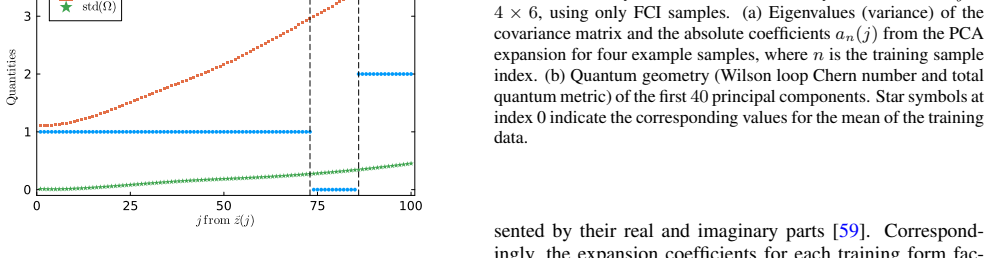
The central discovery is that the distribution of form factors—overlaps of Bloch states at separated momenta—contains enough information for an unsupervised generative model to recover the FCI/non-FCI phase structure and to synthesize new form factors with different topological character. The VAE's latent space organizes ideal geometries at the three magic parameters into connected curves while non-FCI samples scatter; interpolating between ideal points in latent space preserves the quantized quantum metric and yields FCI states in exact diagonalization, and extrapolating beyond the training range produces C=0 form factors that stabilize charge density wave ground states. PCA of the FCI data
What carries the argument
The form factor λ_q(k)=⟨u_k|u_{k+q}⟩ is the central object: it encodes all quantum-geometric information (quantum metric and Berry curvature) and enters directly into the projected many-body Hamiltonian H=∑_q V(q) ρ̂_q ρ̂_{-q}. The paper treats λ_q(k) as a high-dimensional complex array, reshaped into a 2D image, on which a convolutional variational autoencoder learns a three-dimensional latent space; sampling and interpolating in that space generates new arrays that are then used as inputs to exact diagonalization. PCA provides a complementary linear decomposition whose principal components have approximately quantized Chern numbers, revealing the global topological structure hidden in the
Load-bearing premise
The decoder's outputs are treated as legitimate single-particle form factors without verifying that they satisfy the algebraic relations a true overlap matrix must obey (such as λ_{q+G}(k)=λ_q(k+G) and the unitarity constraints inherited from Bloch states), so the generated Chern numbers and many-body phases might be properties of arbitrary matrices rather than of any actual band.
What would settle it
Take a VAE-generated form factor that is labeled C=-1 with high quantum metric and yields an FCI ground state in exact diagonalization. Check whether there exists a smooth set of Bloch states |u_k⟩ whose overlaps reproduce the array for all k and q on the mesh, including the relation λ_{q+G}(k)=λ_q(k+G). If no such states exist, or if the Wilson-loop Chern number computed from a directly constructed bundle disagrees with the value computed from the raw array, then the generated 'quantum geometry' is not a band property and the claimed discovery of new topological states is unsupported.
If this is right
- Interpolation in latent space between ideal quantum geometries preserves the quantized quantum metric and yields FCI ground states, providing a way to tune band geometry without closing the single-particle gap.
- Sampling beyond the training range generates C=0 form factors that produce CDW ground states in exact diagonalization, demonstrating discovery of many-body phases absent from the original model.
- PCA truncation to roughly 20 principal components accurately reconstructs FCI form factors, and projecting a non-FCI form factor onto the FCI-centered PCA basis can turn it into an FCI-like spectrum, suggesting a linear notion of distance from ideal geometry.
- A VAE trained only on C=-1 form factors can generate C=0 form factors, showing that the model generalizes beyond its training topological class.
- The latent-space path connecting FCI and CDW states yields a smooth evolution of the many-body spectrum with gap closing and reopening, enabling controlled modeling of phase boundaries.
Where Pith is reading between the lines
- The paper never checks whether decoder outputs satisfy the algebraic consistency conditions of genuine form factors (e.g., λ_{q+G}(k)=λ_q(k+G) and unitarity/positivity inherited from Bloch states); if they do not, the computed Chern numbers and many-body phases are properties of matrices rather than of any realizable band. This is an editorial concern, not a claim the paper makes.
- The approximately quantized Chern numbers of PCA components suggest a new diagnostic: the distribution of component Chern numbers could serve as a topological fingerprint quantifying how far a band deviates from ideal geometry, independent of any generative model.
- A direct extension would train a VAE on form factors from a different lattice model (e.g., twisted MoTe₂) to test whether the latent-space classification and generative capabilities transfer to experimentally relevant systems; the paper does not attempt this.
- If the form-factor consistency conditions are satisfied, the latent space could be used as a continuous 'phase diagram generator' to systematically search for non-Abelian FCI states by training on models closer to generalized Landau levels, as the paper hints but does not test.
Editorial analysis
A structured set of objections, weighed in public.
Referee Report
Summary. The manuscript introduces an unsupervised machine-learning framework, based on a variational autoencoder (VAE) and principal component analysis (PCA), to model single-particle form factors of topological flat bands relevant to fractional Chern insulators (FCIs). Form factors from a quadratic band crossing point (QBCP) model are encoded into a three-dimensional latent space; the authors show that the latent representation separates FCI from non-FCI many-body states (labeled by exact diagonalization) and supports interpolation between ideal geometries. They further claim that sampling from the latent space generates new form factors with distinct topological character, including Chern number C=0 form factors and a charge density wave (CDW) state. PCA of FCI form factors is reported to yield principal components with approximately quantized Chern numbers, which the authors interpret as a decomposition of quantum-geometry deviations into topological superpositions.
Significance. If the central claim is established, this work would offer a novel generative approach to quantum geometry and many-body phase discovery in flat bands, potentially enabling inverse design of band structures. The use of exact diagonalization to evaluate the many-body consequences of machine-generated form factors is a substantial strength, as is the use of Wilson-loop diagnostics for discrete geometry. The interpolation and classification parts of the paper appear credible and useful. However, the generative claims—especially C=0 form factors and the CDW state—rely on the assumption that every decoder output is a legitimate single-particle form factor. That assumption is not tested, and the paper itself notes the analogous failure for PCA components. Because this assumption is load-bearing for the abstract's main claim, the manuscript requires major revision before the generative results can be accepted.
major comments (3)
- The VAE is trained with a pure L2 reconstruction loss on the raw real/imag arrays of the form factor. No term enforces, and no post-processing check verifies, the algebraic constraints that a genuine form factor λ_q(k)=⟨u_k|u_{k+q}⟩ must satisfy: λ_0(k)=1, |λ_q(k)|≤1, λ_q^*(k)=λ_{-q}(k+q), translation covariance λ_{q+G}(k)=λ_q(k+G), and positive-semidefiniteness of the Gram matrix over arbitrary k-point sets. The Wilson-loop Chern number (Eq. 7) is computed from products of these overlaps; for a generic array this number is not a topological invariant. The paper correctly applies the 'not physical states' caveat to PCA components (Sec. II.C: '⟨u_k|u_{k+G}⟩≠1'), but no such caveat is applied to VAE-generated arrays, including the CDW example in Fig. 3b and the claimed C=0 generation. The authors' statement that ED results 'suggest they are physically meaningful' is not sufficient: Eq. (1)
- The CDW result is presented as the outcome of filtering generated samples for C=−1 and high quantum metric, but no sample count or selection statistics are given. The same paragraph asserts that 'even when training only on C=−1 FCI form factors, the VAE can generate C=0 form factors,' again without showing the frequency, the distribution of Chern numbers over generated samples, or the consistency of the C=0 Wilson-loop calculation with the constraints in the previous comment. Given that these are the manuscript's headline claims, the paper should report the number of generated samples, the filter thresholds, the number of samples passing the filter, and the robustness of the CDW and C=0 results across decoder initializations and latent-space sampling. A single cherry-picked sample would not support the claim of 'distinct topological character, not present in the training set.'
- The claim that PCA components have 'approximately quantized Chern numbers' is weakened by the paper's own acknowledgement that these components are not physical states because ⟨u_k|u_{k+G}⟩≠1. Since the principal components are not valid form factors, the Wilson-loop Chern numbers in Fig. 4b are properties of numerical arrays, not of bands. The interpretation that deviations from ideal geometry are 'superpositions of principal components with different Chern numbers' is therefore not established. Please clarify in what formal sense this decomposition is meaningful—e.g., as a basis of the data manifold rather than of physical form factors—or tone down the topological interpretation.
minor comments (4)
- The FCI labeling criteria (threefold quasi-degeneracy, PES gap, Δ>D) are reasonable but threshold-dependent. The choice of thresholds (e.g., how 'quasi-degenerate' is quantified) is not stated; please specify the exact criteria used in the ED labeling.
- The statement that a latent dimension of 3 gives best results 'consistent with the training data being generated around three magic parameters' is a post-hoc interpretation. Since the latent dimension is a free parameter, this consistency is suggestive but not a test; please avoid presenting it as a validated design principle.
- The phrase 'physically plausible form factors' appears in the discussion of Gaussian mixture models on PCA coefficients, but plausibility is not defined. Please either define it operationally or remove the term.
- Typographical issues: 'moir ´e' and 'Varying the single-particle parameter ˜α' (should presumably be 'Varying the single-particle parameter ˜α in the original model leads to gap closures...'). Also, the reference to 'SI Sec. IV Fig. 4' for the phase-evolution spectra is inconsistent with the main-text figure numbering; please ensure all cross-references are correct.
Circularity Check
No significant circularity: VAE classification and generation are benchmarked against independently computed exact-diagonalization labels, and the PCA caveats are explicit.
full rationale
The paper's central chain—train a VAE on single-particle form factors, then classify or generate form factors and evaluate their many-body phases—does not reduce to its own inputs. The FCI/non-FCI labels used to assess the latent space are obtained from exact diagonalization and are not used to train the VAE: the paper states 'the FCI labels were obtained from ED and not provided during training' (Sec. II.B). The generated form factors are decoded from the learned latent distribution and then fed into the projected many-body Hamiltonian; the resulting FCI or CDW phases are diagnosed from the ED spectra and PES, not imposed by the loss function. The PCA claim about approximately quantized Chern numbers of principal components is also explicitly caveated by the authors: 'principal components themselves are not physical states and are not guaranteed to have quantized Chern numbers, partly because ⟨uk|uk+G⟩ ≠ 1' (Sec. II.C), so it is not presented as a forced prediction. Self-citations to the QBCP model and ED/PES methodology ([27], [46], and related work) are model/method references rather than load-bearing arguments such as imported uniqueness theorems; no central result is derived by invoking an unpublished or unverified prior claim from the same authors. The manuscript does note a limitation—generated form factors may not be realizable by the original single-particle model and their physical interpretation may be unclear—but this is a correctness/validity concern about whether decoded arrays are legitimate form factors, not a circularity in the derivation. The interpolation and extrapolation results are benchmarked against independent ED data, so the main claims have independent content.
Axiom & Free-Parameter Ledger
free parameters (7)
- VAE latent dimension L =
3
- VAE architecture/hyperparameters =
FC 2048 -> conv 32x64, 4 channels, kernel 3 -> FC 4096; lr=1e-3, weight decay=1e-2; best of 100 seeds
- Screened Coulomb interaction V(q) =
V(q)=4π tanh(√3 q/(4π))/(√3 q)
- FCI labeling thresholds =
Δ>D, PES gap at (1,3) admissible counting, 3-fold quasi-degeneracy; numerical thresholds unspecified
- PCA truncation M =
20
- Momentum-transfer truncation NBZ =
127
- CDW sample selection criterion =
C=-1 and high quantum metric filter applied to generated samples; selection fraction unreported
axioms (6)
- domain assumption QBCP single-particle model yields C=-1 topological flat bands with exactly ideal quantum geometry at magic parameters
- domain assumption The projected flatband Hamiltonian H=Σ_q V(q) ρ_q ρ_-q at ν=1/3 captures FCI physics; ED/PES criteria identify FCI phases
- domain assumption Form factors λ_q(k)=⟨u_k|u_{k+q}⟩ on a 4×6 mesh with gauge fixed to k=0 adequately encode quantum geometry
- standard math Wilson-loop discretization gives reliable Chern numbers and total quantum metric on the small mesh
- domain assumption A VAE with a 3-dimensional Gaussian latent space can represent the form-factor distribution faithfully
- ad hoc to paper Generated arrays that are not realized by the original model can still be interpreted as physical form factors
read the original abstract
Fractional Chern insulators (FCIs) in moire materials present a unique platform for exploring strongly correlated topological phases beyond the paradigm of ideal quantum geometry. While analytical approaches to FCIs and fractional quantum Hall states (FQHS) often rely on idealized Bloch wavefunctions, realistic moire models lack direct tunability of quantum metric and Berry curvature, limiting theoretical and numerical exploration. Here, we introduce an unsupervised machine learning framework to model interacting Hamiltonians directly through the distribution of single-particle form factors. Using a variational autoencoder (VAE), we show that unsupervised learning can not only distinguish FCI and non-FCI states, but also generate new form factors with distinct topological character, not present in the training set. This latent space enables the generation and interpolation of form factors for topological flatbands with Chern number $|C|=1$, enabling the discovery of unobserved many-body states such as charge density waves. Principal component analysis (PCA) further reveals that the dominant patterns in the form factors-reflecting correlations across the Brillouin zone-can be decomposed into components with approximately quantized Chern numbers, providing new insights into the global and topological structure of quantum geometry. Our results highlight the ability of machine learning to generalize and model topological quantum systems, paving the way for the inverse design of form factors with tailored quantum geometry and many-body phases in flatband materials.
Figures




Forward citations
Cited by 1 Pith paper
-
Engineering two-body interaction for the Moore-Read State
Gradient-optimized two-body Haldane pseudopotentials yield Moore–Read Pfaffian overlaps above 99% up to 12 electrons and collapse to a nearly universal exponential short-range profile.
Reference graph
Works this paper leans on
-
[1]
Reconstruction loss: Lrecon(xn) = ∑ j (xnj − ˜xj)2, (11) where xn is the nth training sample, xnj its jth compo- nent, and ˜x the reconstructed output
-
[2]
The total loss is Ltot = Lrecon + LKL
Kullback-Leibler (KL) divergence: LKL = DKL(p||q) = ∫ x p(x) ln p(x) q(x) = 1 2 [ µT µ + Tr(Σ) − L − ln |Σ| ] , (12) where L is the dimension of the latent space. The total loss is Ltot = Lrecon + LKL. The architecture used in this work consists of a fully con- nected (FC) layer with 2048 nodes, followed by a convolu- tional layer operating on 32 × 64 res...
2048
-
[3]
E. J. Bergholtz and Z. Liu, Topological flat band models and fractional chern insulators, International Journal of Modern Physics B 27, 1330017 (2013) , https://doi.org/10.1142/S021797921330017X
-
[4]
S. A. Parameswaran, R. Roy, and S. L. Sondhi, Fractional quantum hall physics in topological flat bands, Comptes Ren- dus Physique 14, 816 (2013) , topological insulators / Isolants topologiques
2013
-
[5]
Neupert, L
T. Neupert, L. Santos, C. Chamon, and C. Mudry, Fractional quantum hall states at zero magnetic field, Phys. Rev. Lett. 106, 236804 (2011)
2011
-
[6]
Neupert, C
T. Neupert, C. Chamon, T. Iadecola, L. H. Santos, and C. Mudry, Fractional (chern and topological) insulators, Phys- ica Scripta 2015, 014005 (2015)
2015
-
[7]
Liu and E
Z. Liu and E. J. Bergholtz, Recent developments in fractional chern insulators, Encyclopedia of Condensed Matter Physics , 515 (2024)
2024
-
[8]
Morales-Dur ´an, J
N. Morales-Dur ´an, J. Wang, G. R. Schleder, M. Angeli, Z. Zhu, E. Kaxiras, C. Repellin, and J. Cano, Pressure-enhanced frac- tional chern insulators along a magic line in moir ´e transition metal dichalcogenides, Phys. Rev. Res. 5, L032022 (2023)
2023
-
[9]
Morales-Dur ´an, N
N. Morales-Dur ´an, N. Wei, J. Shi, and A. H. MacDonald, Magic angles and fractional chern insulators in twisted homobilayer transition metal dichalcogenides, Phys. Rev. Lett. 132, 096602 (2024)
2024
-
[10]
Shavit and Y
G. Shavit and Y . Oreg, Quantum geometry and stabilization of fractional chern insulators far from the ideal limit, Phys. Rev. Lett. 133, 156504 (2024)
2024
-
[11]
D. C. Tsui, H. L. Stormer, and A. C. Gossard, Two-dimensional magnetotransport in the extreme quantum limit, Phys. Rev. Lett. 48, 1559 (1982)
1982
-
[12]
R. B. Laughlin, Anomalous quantum hall effect: An incom- pressible quantum fluid with fractionally charged excitations, Phys. Rev. Lett. 50, 1395 (1983)
1983
-
[13]
H. L. Stormer, Nobel lecture: The fractional quantum hall ef- fect, Rev. Mod. Phys. 71, 875 (1999)
1999
-
[14]
W. Pan, H. L. Stormer, D. C. Tsui, L. N. Pfeiffer, K. W. Bald- win, and K. W. West, Fractional quantum hall effect of compos- ite fermions, Phys. Rev. Lett. 90, 016801 (2003)
2003
-
[15]
J. K. Jain, Composite fermions (Cambridge University Press, 2007)
2007
-
[16]
J. Cai, E. Anderson, C. Wang, X. Zhang, X. Liu, W. Holtzmann, Y . Zhang, F. Fan, T. Taniguchi, K. Watanabe, Y . Ran, T. Cao, L. Fu, D. Xiao, W. Y ao, and X. Xu, Signatures of fractional quantum anomalous hall states in twisted MoTe2, Nature 622, 63 (2023)
2023
-
[17]
H. Park, J. Cai, E. Anderson, Y . Zhang, J. Zhu, X. Liu, C. Wang, W. Holtzmann, C. Hu, Z. Liu, et al., Observation of fractionally quantized anomalous hall effect, Nature 622, 74 (2023)
2023
-
[18]
F. Xu, Z. Sun, T. Jia, C. Liu, C. Xu, C. Li, Y . Gu, K. Watan- abe, T. Taniguchi, B. Tong, J. Jia, Z. Shi, S. Jiang, Y . Zhang, X. Liu, and T. Li, Observation of integer and fractional quan- tum anomalous hall effects in twisted bilayer mote2, Phys. Rev. X 13, 031037 (2023)
2023
-
[19]
Y . Zeng, Z. Xia, K. Kang, J. Zhu, P . Kn ¨uppel, C. V aswani, K. Watanabe, T. Taniguchi, K. F. Mak, and J. Shan, Thermo- dynamic evidence of fractional chern insulator in moir ´e mote2, Nature 622, 69 (2023)
2023
-
[20]
K. Kang, B. Shen, Y . Qiu, Y . Zeng, Z. Xia, K. Watanabe, T. Taniguchi, J. Shan, and K. F. Mak, Evidence of the frac- tional quantum spin hall effect in moir ´e mote2, Nature 628, 522 (2024)
2024
-
[21]
Z. Lu, T. Han, Y . Y ao, A. P . Reddy, J. Y ang, J. Seo, K. Watan- abe, T. Taniguchi, L. Fu, and L. Ju, Fractional quantum anoma- lous hall effect in multilayer graphene, Nature 626, 759 (2024)
2024
-
[22]
J. Xie, Z. Huo, X. Lu, Z. Feng, Z. Zhang, W. Wang, Q. Y ang, K. Watanabe, T. Taniguchi, K. Liu, et al. , Even-and odd-denominator fractional quantum anomalous hall effect in graphene moire superlattices, arXiv , arXiv (2024)
2024
-
[23]
Roy, Band geometry of fractional topological insulators, Phys
R. Roy, Band geometry of fractional topological insulators, Phys. Rev. B 90, 165139 (2014)
2014
-
[24]
J. Wang, J. Cano, A. J. Millis, Z. Liu, and B. Y ang, Exact lan- dau level description of geometry and interaction in a flatband, Phys. Rev. Lett. 127, 246403 (2021)
2021
-
[25]
H. L. Stormer, D. C. Tsui, and A. C. Gossard, The fractional quantum hall effect, Rev. Mod. Phys. 71, S298 (1999)
1999
-
[27]
J. Y . Lee, E. Khalaf, S. Liu, X. Liu, Z. Hao, P . Kim, and A. Vish- wanath, Theory of correlated insulating behaviour and spin- triplet superconductivity in twisted double bilayer graphene, Nat. Commun. 10, 5333 (2019)
2019
-
[28]
H. Li, U. Kumar, K. Sun, and S.-Z. Lin, Spontaneous fractional chern insulators in transition metal dichalcogenide moir ´e super- lattices, Phys. Rev. Res. 3, L032070 (2021)
2021
-
[29]
A.-K. Wu, S. Sarkar, X. Wan, K. Sun, and S.-Z. Lin, Quantum- metric-induced quantum hall conductance inversion and reen- trant transition in fractional chern insulators, Phys. Rev. Res. 6, L032063 (2024)
2024
-
[30]
J. Wang, S. Klevtsov, and Z. Liu, Origin of model fractional chern insulators in all topological ideal flatbands: Explicit color-entangled wave function and exact density algebra, Phys. Rev. Res. 5, 023167 (2023)
2023
-
[31]
Z. Liu, B. Mera, M. Fujimoto, T. Ozawa, and J. Wang, Theory of generalized landau levels and its implications for non-abelian states, Phys. Rev. X 15, 031019 (2025)
2025
-
[32]
P . J. Ledwith, G. Tarnopolsky, E. Khalaf, and A. Vishwanath, Fractional chern insulator states in twisted bilayer graphene: An analytical approach, Phys. Rev. Res. 2, 023237 (2020)
2020
-
[33]
Fujimoto, D
M. Fujimoto, D. E. Parker, J. Dong, E. Khalaf, A. Vishwanath, and P . Ledwith, Higher vortexability: Zero-field realization of higher landau levels, Phys. Rev. Lett. 134, 106502 (2025)
2025
-
[34]
Ozawa and B
T. Ozawa and B. Mera, Relations between topology and the quantum metric for chern insulators, Phys. Rev. B 104, 045103 (2021)
2021
-
[35]
Mera and T
B. Mera and T. Ozawa, K ¨ahler geometry and chern insulators: Relations between topology and the quantum metric, Phys. Rev. B 104, 045104 (2021)
2021
-
[36]
Mera and T
B. Mera and T. Ozawa, Engineering geometrically flat chern bands with fubini-study k ¨ahler structure, Phys. Rev. B 104, 115160 (2021)
2021
-
[37]
P . J. Ledwith, A. Vishwanath, and D. E. Parker, V ortexability: A unifying criterion for ideal fractional chern insulators, Phys. Rev. B 108, 205144 (2023)
2023
-
[38]
S. M. Girvin, A. H. MacDonald, and P . M. Platzman, Magneto- roton theory of collective excitations in the fractional quantum hall effect, Phys. Rev. B 33, 2481 (1986)
1986
-
[39]
I: The original single-particle Hamiltonian and training form factors
SI Sec. I: The original single-particle Hamiltonian and training form factors
-
[40]
Jumper, R
J. Jumper, R. Evans, A. Pritzel, T. Green, M. Figurnov, O. Ronneberger, K. Tunyasuvunakool, R. Bates, A. ˇZ´ıdek, A. Potapenko, et al. , Highly accurate protein structure predic- 10 tion with alphafold, nature 596, 583 (2021)
2021
-
[42]
Hastie, R
T. Hastie, R. Tibshirani, J. Friedman, et al. , The elements of statistical learning (2009)
2009
-
[43]
Cortes and V
C. Cortes and V . V apnik, Support-vector networks, Machine learning 20, 273 (1995)
1995
-
[44]
D. P . Kingma and M. Welling, Auto-encoding variational bayes, arXiv:1312.6114 (2013)
Pith/arXiv arXiv 2013
-
[45]
Goodfellow, Y
I. Goodfellow, Y . Bengio, A. Courville, and Y . Bengio, Deep learning, V ol. 1 (MIT press Cambridge, 2016)
2016
-
[46]
Pearson, Liii
K. Pearson, Liii. on lines and planes of closest fit to systems of points in space, The London, Edinburgh, and Dublin philosoph- ical magazine and journal of science 2, 559 (1901)
1901
-
[47]
Hotelling, Analysis of a complex of statistical variables into principal components., Journal of educational psychology 24, 417 (1933)
H. Hotelling, Analysis of a complex of statistical variables into principal components., Journal of educational psychology 24, 417 (1933)
1933
-
[49]
In contrast, interactions with fast-decaying in q, i.e., with tanh(dq), d ≫ 1 tend to destabilize the FCI phase
While a contact interaction V (q) = −q2 produces exact zero- energy FCI ground states for ν = 1 /3 in the ideal case [ 28], it is unbounded from below and leads to instability for non-ideal form factors. In contrast, interactions with fast-decaying in q, i.e., with tanh(dq), d ≫ 1 tend to destabilize the FCI phase
-
[50]
A. M. Samarakoon, K. Barros, Y . W. Li, M. Eisenbach, Q. Zhang, F. Y e, V . Sharma, Z. Dun, H. Zhou, S. A. Grigera, et al., Machine-learning-assisted insight into spin ice dy2ti2o7, Nature communications 11, 892 (2020)
2020
-
[51]
Rocchetto, E
A. Rocchetto, E. Grant, S. Strelchuk, G. Carleo, and S. Sev- erini, Learning hard quantum distributions with variational au- toencoders, npj Quantum Information 4, 28 (2018)
2018
-
[52]
J. Yin, Z. Pei, and M. C. Gao, Neural network-based order parameter for phase transitions and its applications in high- entropy alloys, Nature Computational Science 1, 686 (2021)
2021
-
[53]
Szołdra, P
T. Szołdra, P . Sierant, M. Lewenstein, and J. Zakrzewski, Un- supervised detection of decoupled subspaces: Many-body scars and beyond, Phys. Rev. B 105, 224205 (2022)
2022
-
[54]
S. J. Wetzel, Unsupervised learning of phase transitions: From principal component analysis to variational autoencoders, Phys. Rev. E 96, 022140 (2017)
2017
-
[55]
B. Hou, J. Wu, and D. Y . Qiu, Unsupervised representation learning of kohn–sham states and consequences for down- stream predictions of many-body effects, Nature Communica- tions 15, 9481 (2024)
2024
-
[56]
S. V . Kalinin, A. Ghosh, R. V asudevan, and M. Ziatdinov, From atomically resolved imaging to generative and causal models, Nature Physics 18, 1152 (2022)
2022
-
[57]
Kullback and R
S. Kullback and R. A. Leibler, On information and sufficiency, The annals of mathematical statistics 22, 79 (1951)
1951
-
[58]
Lecun, L
Y . Lecun, L. Bottou, Y . Bengio, and P . Haffner, Gradient-based learning applied to document recognition, Proceedings of the IEEE 86, 2278 (1998)
1998
-
[59]
The spectra of the evolution are shown in SI. Sec. IV Fig. 4
-
[60]
H. Liu, Z. Liu, and E. J. Bergholtz, Non-abelian fractional chern insulators and competing states in flat moir ´e bands, Phys. Rev. Lett. 135, 106604 (2025)
2025
-
[61]
When using phase and amplitude instead (or taking a log of the form factors), the decay is less pronounced due to increased nonlinearity in the data representation
-
[62]
V: PCA expansion and ED results, Fig
SI Sec. V: PCA expansion and ED results, Fig. 6
-
[63]
Moore and N
G. Moore and N. Read, Nonabelions in the fractional quantum hall effect, Nuclear Physics B 360, 362 (1991)
1991
-
[64]
Read and E
N. Read and E. Rezayi, Beyond paired quantum hall states: Parafermions and incompressible states in the first excited lan- dau level, Phys. Rev. B 59, 8084 (1999)
1999
-
[65]
V aswani, N
A. V aswani, N. Shazeer, N. Parmar, J. Uszkoreit, L. Jones, A. N. Gomez, L. u. Kaiser, and I. Polosukhin, Attention is all you need, in Advances in Neural Information Processing Systems , V ol. 30, edited by I. Guyon, U. V . Luxburg, S. Bengio, H. Wal- lach, R. Fergus, S. Vishwanathan, and R. Garnett (Curran As- sociates, Inc., 2017)
2017
-
[66]
IV: V AE other architectures and comparison
SI Sec. IV: V AE other architectures and comparison
-
[67]
important tokens
C. Hellings, P . Gogler, and W. Utschick, Composite real princi- pal component analysis of complex signals, in 2015 23rd Euro- pean Signal Processing Conference (EUSIPCO) (IEEE, 2015) pp. 2216–2220. Supplementary Information: Modeling Quantum Geometry for Fractional Chern Insulators with unsupervised learning Ang-Kun Wu,1 Louis Primeau, 1 Jingtao Zhang, 2...
2015
-
[68]
X. Wan, S. Sarkar, S.-Z. Lin, and K. Sun, Topological exact flat bands in two-dimensional materials under periodic strain, Phys. Rev. Lett. 130, 216401 (2023)
2023
-
[69]
Sarkar, X
S. Sarkar, X. Wan, S.-Z. Lin, and K. Sun, Symmetry-based classification of exact flat bands in single and bilayer moir ´e systems, Phys. Rev. Lett. 135, 016501 (2025)
2025
-
[70]
Regnault and B
N. Regnault and B. A. Bernevig, Fractional chern insulator, Phys. Rev. X 1, 021014 (2011)
2011
-
[71]
A.-K. Wu, S. Sarkar, X. Wan, K. Sun, and S.-Z. Lin, Quantum-metric-induced quantum hall conductance inversion and reentrant transition in fractional chern insulators, Phys. Rev. Res. 6, L032063 (2024)
2024
-
[72]
Provost and G
J. Provost and G. V allee, Riemannian structure on manifolds of quantum states, Comm. Math. Phys. 76, 289 (1980)
1980
-
[73]
C. M. Bishop and N. M. Nasrabadi, Pattern recognition and machine learning, V ol. 4 (Springer, 2006)
2006
-
[74]
Pedregosa, G
F. Pedregosa, G. V aroquaux, A. Gramfort, V . Michel, B. Thirion, O. Grisel, M. Blondel, P . Prettenhofer, R. Weiss, V . Dubourg, J. V ander- plas, A. Passos, D. Cournapeau, M. Brucher, M. Perrot, and E. Duchesnay, Scikit-learn: Machine learning in Python, Journal of Machine Learning Research 12, 2825 (2011)
2011
discussion (0)
Sign in with ORCID, Apple, or X to comment. Anyone can read and Pith papers without signing in.