Recognition: 2 theorem links
· Lean TheoremProbing Observable Features of Lorentz violation in Low-Energy Hov{r}ava Gravity with Accretion Disk Images of Black Hole
Pith reviewed 2026-05-17 04:59 UTC · model grok-4.3
The pith
The Lorentz violation parameter in low-energy Horava gravity alters black hole inner shadows and polarization patterns in accretion disk images.
A machine-rendered reading of the paper's core claim, the machinery that carries it, and where it could break.
Core claim
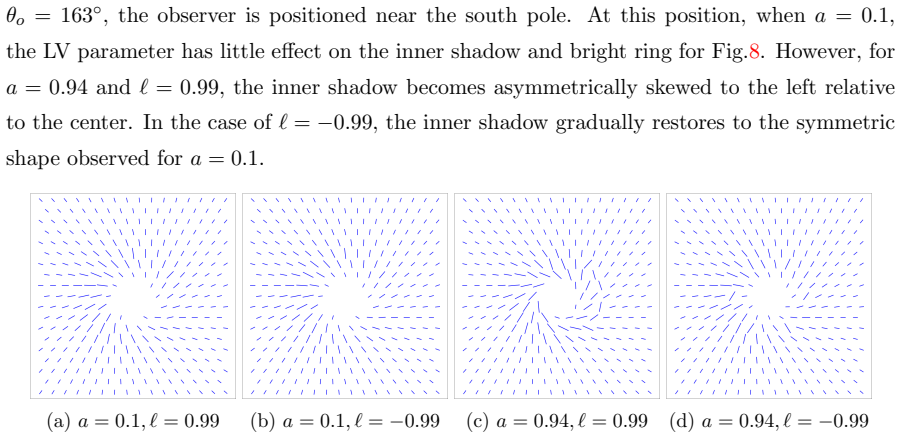
The LV parameter l strongly affects the inner shadow, brightness asymmetry, and polarization properties of the thin disk. Decreasing l leads to a more elliptical and untilted inner shadow, while increasing l produces a pronounced leftward D-shaped structure of the critical curve. The sign of l determines whether the black hole angular velocity is enhanced or suppressed, and variations in l alter the distribution of polarized intensity and polarization direction especially near the critical curve.
What carries the argument
The LV parameter l, which modifies the black hole spacetime in low-energy Horava gravity and thereby changes the geodesics of photons emitted from the thin accretion disk.
If this is right
- The decrease of the LV parameter l produces a more elliptical and untilted inner shadow in the black hole image.
- Increasing l creates a leftward D-shaped structure in the critical curve of the photon ring.
- The sign of l controls the direction of change in the black hole's angular velocity.
- Changes in l modify the polarized intensity distribution and polarization direction near the critical curve.
Where Pith is reading between the lines
- Combining shadow shape with polarization measurements in future telescope images could tighten constraints on the LV parameter beyond what shadow shape alone provides.
- This simulation method could be adapted to probe Lorentz violation in other modified gravity models using similar accretion disk setups.
- Confirmation of these effects would demonstrate that strong-field black hole observations can test quantum gravity candidates at accessible energies.
Load-bearing premise
The thin-disk accretion model and ZAMO framework, along with numerical photon geodesics, capture the dominant observable effects without significant contributions from disk thickness, magnetic fields, or other unmodeled physics.
What would settle it
High-resolution images of a spinning black hole thin disk showing a circular inner shadow instead of the predicted leftward D-shape for positive l would falsify the influence of the Lorentz violation parameter.
Figures





read the original abstract
In this paper, we study the observable signatures of Lorentz violation (LV) in low-energy Horava gravity by simulating the images and polarization features of rotating LV black holes using a backward ray-tracing method. Within a thin-disk accretion model and the ZAMO framework, we numerically solve the geodesics equation of photon and simulate the corresponding thin-disk images and polarization patterns. The results show that the LV parameter l strongly affects the inner shadow, brightness asymmetry, and polarization properties of the thin disk. The decrease of l leads to a more elliptical and untilted inner shadow, while increasing l produces a pronounced leftward D-shaped structure of the critical curve. In addition, the variation of l alters the distribution of polarized intensity and polarization direction, especially near the critical curve. Moreover, it also shows that a positive l enhances the black hole's angular velocity, while a negative one suppresses it, indicating that the sign of l determines the trend direction of the LV effect. These findings suggest that future high-resolution EHT observations combining the thin-disk images and polarization patterns could provide valuable tests of the LV effect.
Editorial analysis
A structured set of objections, weighed in public.
Referee Report
Summary. The paper claims that Lorentz violation in low-energy Hořava gravity, parameterized by l, produces observable effects on black hole images and polarization. Using backward ray-tracing in a thin-disk accretion model with the ZAMO tetrad, the authors numerically integrate photon geodesics and report that decreasing l yields a more elliptical, untilted inner shadow while increasing l produces a leftward D-shaped critical curve; l also alters polarized intensity, polarization direction near the critical curve, and the black hole's angular velocity (positive l enhances it, negative l suppresses it). These signatures are presented as testable with future EHT observations.
Significance. If the numerical results hold under the stated assumptions, the work supplies concrete, falsifiable predictions for how a single LV parameter modifies strong-field observables (shadow shape, brightness asymmetry, and polarization) in a modified-gravity spacetime. The explicit numerical exploration of both positive and negative l, together with the polarization maps, constitutes a strength that could guide targeted EHT analyses. The overall significance remains moderate because the central attribution of changes to l rests on the thin-disk plus ZAMO proxy without quantified systematics.
major comments (2)
- [Methods / thin-disk model description] Thin-disk accretion model (described in the methods and results sections): the paper adopts a standard thin-disk emissivity and orbital structure without providing a quantitative estimate of how the LV-modified metric back-reacts on disk thickness, temperature profile, or magnetic-field structure. Because the reported D-shaped critical curve and polarization shifts are attributed solely to photon geodesics in the fixed metric, this omission is load-bearing for the central claim that l produces dominant, isolated observable changes.
- [Numerical results / geodesic solver] Numerical geodesic integration (results and appendix on ray-tracing): no error analysis, convergence tests, or explicit baseline comparison to the l=0 (Kerr) case is reported for the inner-shadow ellipticity, brightness asymmetry, or polarization degree. Without these, the support for the specific trends with l remains moderate, as stated in the soundness assessment.
minor comments (2)
- [Abstract] The abstract and introduction should include a one-sentence reminder of the explicit form of the low-energy Hořava metric used (including the relation between l and the rotation parameter).
- [Figures] Figures showing critical curves and polarized intensity maps would benefit from direct side-by-side panels for l = 0, positive l, and negative l to make the claimed trends immediately visible.
Simulated Author's Rebuttal
We thank the referee for the careful and constructive review of our manuscript. We address each major comment point by point below. Where appropriate, we have revised the manuscript to incorporate additional discussion and documentation that strengthens the presentation of our results.
read point-by-point responses
-
Referee: [Methods / thin-disk model description] Thin-disk accretion model (described in the methods and results sections): the paper adopts a standard thin-disk emissivity and orbital structure without providing a quantitative estimate of how the LV-modified metric back-reacts on disk thickness, temperature profile, or magnetic-field structure. Because the reported D-shaped critical curve and polarization shifts are attributed solely to photon geodesics in the fixed metric, this omission is load-bearing for the central claim that l produces dominant, isolated observable changes.
Authors: We agree that the thin-disk model is an approximation and that a full quantification of back-reaction on disk thickness, temperature, and magnetic structure would require self-consistent accretion simulations. Our focus is on isolating the effects of the modified spacetime metric on null geodesics and the resulting images under standard thin-disk assumptions used throughout the literature. In the revised manuscript we will add an explicit limitations paragraph in the methods section that discusses these assumptions, notes the absence of quantified back-reaction, and states that such effects are left for future work. revision: partial
-
Referee: [Numerical results / geodesic solver] Numerical geodesic integration (results and appendix on ray-tracing): no error analysis, convergence tests, or explicit baseline comparison to the l=0 (Kerr) case is reported for the inner-shadow ellipticity, brightness asymmetry, or polarization degree. Without these, the support for the specific trends with l remains moderate, as stated in the soundness assessment.
Authors: We performed internal convergence checks and Kerr (l=0) comparisons during the production of the figures, but these were not documented in the original submission. In the revised version we will expand the appendix on ray-tracing to include (i) convergence tests with respect to integration tolerance and image resolution, (ii) quantitative error estimates on the reported shadow ellipticity and polarization degree, and (iii) side-by-side numerical values comparing the l ≠ 0 cases to the l = 0 Kerr baseline for the key observables. revision: yes
Circularity Check
Numerical geodesic integration in LV-modified metric produces independent observable signatures
full rationale
The paper's central results follow from numerically solving the null geodesic equations in a fixed spacetime metric that incorporates the Lorentz-violation parameter l, then ray-tracing through a standard thin-disk emissivity model and ZAMO tetrad. These steps are direct forward computations whose outputs (inner-shadow shape, brightness asymmetry, polarization maps) are not algebraically or statistically forced to equal the input metric or any fitted quantity; the dependence on l is an emergent consequence of the modified geometry rather than a definitional identity or self-referential fit. No load-bearing step reduces to a self-citation, ansatz smuggled via prior work, or renaming of a known result. The derivation chain is therefore self-contained against external benchmarks.
Axiom & Free-Parameter Ledger
free parameters (1)
- l
axioms (2)
- domain assumption The spacetime metric and geodesic equations follow from the low-energy limit of Hořava gravity with Lorentz violation parameter l
- domain assumption The thin accretion disk model and ZAMO observer framework adequately represent the physical system
Lean theorems connected to this paper
-
IndisputableMonolith/Foundation/RealityFromDistinction.leanreality_from_one_distinction contradicts?
contradictsCONTRADICTS: the theorem conflicts with this paper passage, or marks a claim that would need revision before publication.
ds²₂ = ds²_kerr + 4ℓ a M r sin²θ / ρ² ((ℓ+2)a M r / Σ dt² − dt dφ) (Eq. 2.5); ℓ characterizes nontrivial Lorentz-symmetry–violating effect
-
IndisputableMonolith/Foundation/AlexanderDuality.leanalexander_duality_circle_linking unclear?
unclearRelation between the paper passage and the cited Recognition theorem.
numerically solve the geodesics equation of photon... thin-disk images and polarization patterns
What do these tags mean?
- matches
- The paper's claim is directly supported by a theorem in the formal canon.
- supports
- The theorem supports part of the paper's argument, but the paper may add assumptions or extra steps.
- extends
- The paper goes beyond the formal theorem; the theorem is a base layer rather than the whole result.
- uses
- The paper appears to rely on the theorem as machinery.
- contradicts
- The paper's claim conflicts with a theorem or certificate in the canon.
- unclear
- Pith found a possible connection, but the passage is too broad, indirect, or ambiguous to say the theorem truly supports the claim.
Forward citations
Cited by 2 Pith papers
-
Polarized Radiative Transfer of Kerr-Newman Black Hole
A general ODE numerical method for polarized photon transport in Kerr-Newman spacetime shows that increasing black hole charge compresses and distorts EVPA structures on photon-ring scales.
-
Reshaping the inner shadow of a Kerr black hole by a torn accretion disk
Torn accretion disks around Kerr black holes erode the inner shadow and create bifurcated, crescent, and multi-ring shadow features driven by sub-disk discontinuities and outer tilt angle.
Reference graph
Works this paper leans on
-
[1]
Observation of Gravitational Waves from a Binary Black Hole Merger,
B. P. Abbott et al., “Observation of Gravitational Waves from a Binary Black Hole Merger,” Phys. Rev. Lett.116no. 6, (2016) 061102
work page 2016
-
[2]
First M87 Event Horizon Telescope Results. IV. Imaging the Central Supermassive Black Hole,
K. Akiyama et al., “First M87 Event Horizon Telescope Results. IV. Imaging the Central Supermassive Black Hole,” Astrophys. J. Lett.875no. 1, (2019) L4
work page 2019
-
[3]
First M87 Event Horizon Telescope Results. I. The Shadow of the Supermassive Black Hole,
K. Akiyama et al., “First M87 Event Horizon Telescope Results. I. The Shadow of the Supermassive Black Hole,” Astrophys. J. Lett.875(2019) L1
work page 2019
-
[4]
First Sagittarius A* Event Horizon Telescope Results. VI. Testing the Black Hole Metric,
K. Akiyama et al., “First Sagittarius A* Event Horizon Telescope Results. VI. Testing the Black Hole Metric,” Astrophys. J. Lett.930no. 2, (2022) L17
work page 2022
-
[5]
The Escape of Photons from Gravitationally Intense Stars,
J. L. Synge, “The Escape of Photons from Gravitationally Intense Stars,” Mon. Not. Roy. Astron. Soc.131no. 3, (1966) 463–466
work page 1966
-
[6]
Timelike and null geodesics in the kerr metric,
J. M. Bardeen, “Timelike and null geodesics in the kerr metric,” in Black Holes (Les Astres Occlus), pp. 215–240. 1973.https://inspirehep.net/literature/160981
work page 1973
-
[7]
Measurement of the kerr spin parameter by observation of a compact object’s shadow,
K. Hioki and K.-i. Maeda, “Measurement of the kerr spin parameter by observation of a compact object’s shadow,” Phys. Rev. D80no. 2, (2009) 024042
work page 2009
-
[8]
T. Johannsen and D. Psaltis, “Testing the No-Hair Theorem with Observations in the Electromagnetic Spectrum: II. Black-Hole Images,” Astrophys. J.718(2010) 446–454
work page 2010
-
[9]
S. Haroon, M. Jamil, K. Jusufi, K. Lin, and R. B. Mann, “Shadow and Deflection Angle of Rotating Black Holes in Perfect Fluid Dark Matter with a Cosmological Constant,” Phys. Rev. D99no. 4, (2019) 044015
work page 2019
-
[10]
Identification of a Regular Black Hole by Its Shadow,
I. Dymnikova and K. Kraav, “Identification of a Regular Black Hole by Its Shadow,” Universe5no. 7, (2019) 163
work page 2019
-
[11]
Shadow cast and deflection of light by charged rotating regular black holes,
R. Kumar, S. G. Ghosh, and A. Wang, “Shadow cast and deflection of light by charged rotating regular black holes,” Phys. Rev. D100no. 12, (2019) 124024. 22
work page 2019
-
[12]
Rotating black holes in 4DEinstein-Gauss-Bonnet gravity and its shadow,
R. Kumar and S. G. Ghosh, “Rotating black holes in 4DEinstein-Gauss-Bonnet gravity and its shadow,” JCAP07(2020) 053
work page 2020
-
[13]
Determining parameters of Kerr black holes at finite distance by shadow observation,
K. Hioki and U. Miyamoto, “Determining parameters of Kerr black holes at finite distance by shadow observation,” Phys. Rev. D109no. 4, (2024) 044030
work page 2024
-
[14]
Constraints on black-hole charges with the 2017 EHT observations of M87*,
P. Kocherlakota et al., “Constraints on black-hole charges with the 2017 EHT observations of M87*,” Phys. Rev. D103no. 10, (2021) 104047
work page 2017
-
[15]
Testing Horndeski Gravity from EHT Observational Results for Rotating Black Holes,
M. Afrin and S. G. Ghosh, “Testing Horndeski Gravity from EHT Observational Results for Rotating Black Holes,” Astrophys. J.932no. 1, (2022) 51
work page 2022
-
[16]
X.-M. Kuang and A. ¨Ovg¨ un, “Strong gravitational lensing and shadow constraint from M87* of slowly rotating Kerr-like black hole,” Annals Phys.447(2022) 169147
work page 2022
-
[17]
Influence of quantum correction on black hole shadows, photon rings, and lensing rings,
J. Peng, M. Guo, and X.-H. Feng, “Influence of quantum correction on black hole shadows, photon rings, and lensing rings,” Chin. Phys. C45no. 8, (2021) 085103
work page 2021
-
[18]
Photon rings of spherically symmetric black holes and robust tests of non-Kerr metrics,
M. Wielgus, “Photon rings of spherically symmetric black holes and robust tests of non-Kerr metrics,” Phys. Rev. D104no. 12, (2021) 124058
work page 2021
-
[19]
Photon ring and observational appearance of a hairy black hole,
Q. Gan, P. Wang, H. Wu, and H. Yang, “Photon ring and observational appearance of a hairy black hole,” Phys. Rev. D104no. 4, (2021) 044049
work page 2021
-
[20]
Observational signature and additional photon rings of an asymmetric thin-shell wormhole,
J. Peng, M. Guo, and X.-H. Feng, “Observational signature and additional photon rings of an asymmetric thin-shell wormhole,” Phys. Rev. D104no. 12, (2021) 124010
work page 2021
-
[21]
Holographic images of a charged black hole in Lorentz symmetry breaking massive gravity,
X.-X. Zeng, L.-F. Li, P. Li, B. Liang, and P. Xu, “Holographic images of a charged black hole in Lorentz symmetry breaking massive gravity,” Sci. China Phys. Mech. Astron.68 no. 2, (2025) 220412
work page 2025
-
[22]
Photon rings in a holographic toy model,
S. Detournay, S. Kanuri, A. Lupsasca, P. Spindel, Q. Vandermiers, and R. Wutte, “Photon rings in a holographic toy model,” JHEP10(2025) 229
work page 2025
-
[23]
Holography of the photon ring,
S. Hadar, D. Kapec, A. Lupsasca, and A. Strominger, “Holography of the photon ring,” Class. Quant. Grav.39no. 21, (2022) 215001
work page 2022
-
[24]
X.-X. Zeng, H.-Q. Zhang, and H. Zhang, “Shadows and photon spheres with spherical accretions in the four-dimensional Gauss–Bonnet black hole,” Eur. Phys. J. C80no. 9, (2020) 872
work page 2020
-
[25]
Photon spheres and spherical accretion image of a hairy black hole,
Q. Gan, P. Wang, H. Wu, and H. Yang, “Photon spheres and spherical accretion image of a hairy black hole,” Phys. Rev. D104no. 2, (2021) 024003. 23
work page 2021
-
[26]
Images from disk and spherical accretions of hairy Schwarzschild black holes,
Y. Meng, X.-M. Kuang, X.-J. Wang, B. Wang, and J.-P. Wu, “Images from disk and spherical accretions of hairy Schwarzschild black holes,” Phys. Rev. D108no. 6, (2023) 064013
work page 2023
-
[27]
Thin accretion disks in f(R) modified gravity models,
C. S. J. Pun, Z. Kovacs, and T. Harko, “Thin accretion disks in f(R) modified gravity models,” Phys. Rev. D78(2008) 024043
work page 2008
-
[28]
Thin accretion disk onto slowly rotating black holes in Einstein-Æther theory,
C. Liu, S. Yang, Q. Wu, and T. Zhu, “Thin accretion disk onto slowly rotating black holes in Einstein-Æther theory,” JCAP02no. 02, (2022) 034
work page 2022
-
[29]
X.-X. Zeng, G.-P. Li, and K.-J. He, “The shadows and observational appearance of a noncommutative black hole surrounded by various profiles of accretions,” Nucl. Phys. B 974(2022) 115639
work page 2022
-
[30]
A. Uniyal, R. C. Pantig, and A. ¨Ovg¨ un, “Probing a non-linear electrodynamics black hole with thin accretion disk, shadow, and deflection angle with M87* and Sgr A* from EHT,” Phys. Dark Univ.40(2023) 101178
work page 2023
-
[31]
M. Heydari-Fard, S. G. Honarvar, and M. Heydari-Fard, “Thin accretion disc luminosity and its image around rotating black holes in perfect fluid dark matter,” Mon. Not. Roy. Astron. Soc.521no. 1, (2023) 708–716
work page 2023
-
[32]
C.-Y. Yang, M. I. Aslam, X.-X. Zeng, and R. Saleem, “Shadow images of Ghosh-Kumar rotating black hole illuminated by spherical light sources and thin accretion disks,” JHEAp46(2025) 345
work page 2025
-
[33]
Image of the Kerr–Newman Black Hole Surrounded by a Thin Accretion Disk,
S. Guo, Y.-X. Huang, E.-W. Liang, Y. Liang, Q.-Q. Jiang, and K. Lin, “Image of the Kerr–Newman Black Hole Surrounded by a Thin Accretion Disk,” Astrophys. J.975 no. 2, (2024) 237
work page 2024
-
[34]
Images of Kerr-MOG black holes surrounded by geometrically thick magnetized equilibrium tori,
Z. Zhang, S. Chen, and J. Jing, “Images of Kerr-MOG black holes surrounded by geometrically thick magnetized equilibrium tori,” JCAP09(2024) 027
work page 2024
-
[35]
Imaging thick accretion disks and jets surrounding black holes,
Z. Zhang, Y. Hou, M. Guo, and B. Chen, “Imaging thick accretion disks and jets surrounding black holes,” JCAP05(2024) 032
work page 2024
-
[36]
A new analytical model of magnetofluids surrounding rotating black holes,
Y. Hou, Z. Zhang, M. Guo, and B. Chen, “A new analytical model of magnetofluids surrounding rotating black holes,” JCAP02(2024) 030
work page 2024
-
[37]
Black Hole Shadows, Photon Rings, and Lensing Rings,
S. E. Gralla, D. E. Holz, and R. M. Wald, “Black Hole Shadows, Photon Rings, and Lensing Rings,” Phys. Rev. D100no. 2, (2019) 024018. 24
work page 2019
-
[38]
Thin Accretion Disk around a four-dimensional Einstein-Gauss-Bonnet Black Hole,
C. Liu, T. Zhu, and Q. Wu, “Thin Accretion Disk around a four-dimensional Einstein-Gauss-Bonnet Black Hole,” Chin. Phys. C45no. 1, (2021) 015105
work page 2021
-
[39]
Image of the thin accretion disk around compact objects in the Einstein–Gauss–Bonnet gravity,
G. Gyulchev, P. Nedkova, T. Vetsov, and S. Yazadjiev, “Image of the thin accretion disk around compact objects in the Einstein–Gauss–Bonnet gravity,” Eur. Phys. J. C81 no. 10, (2021) 885
work page 2021
-
[40]
Observational appearances of af (r) global monopole black hole illuminated by various accretions,
G.-P. Li and K.-J. He, “Observational appearances of af (r) global monopole black hole illuminated by various accretions,” Eur. Phys. J. C81no. 11, (2021) 1018
work page 2021
-
[41]
Image of a Kerr-Melvin black hole with a thin accretion disk,
Y. Hou, Z. Zhang, H. Yan, M. Guo, and B. Chen, “Image of a Kerr-Melvin black hole with a thin accretion disk,” Phys. Rev. D106no. 6, (2022) 064058
work page 2022
-
[42]
Accretion disk for regular black holes with sub-Planckian curvature,
W. Zeng, Y. Ling, Q.-Q. Jiang, and G.-P. Li, “Accretion disk for regular black holes with sub-Planckian curvature,” Phys. Rev. D108no. 10, (2023) 104072
work page 2023
-
[43]
Thin accretion disk images of rotating hairy Horndeski black holes,
M. Heydari-Fard, M. Heydari-Fard, and N. Riazi, “Thin accretion disk images of rotating hairy Horndeski black holes,” Astrophys. Space Sci.369no. 9, (2024) 96
work page 2024
-
[44]
S.-Q. Liu and J.-H. Huang, “Radiative properties and images of the rotating short-hairy black hole surrounded by a thin accretion disk,” Phys. Rev. D112no. 6, (2025) 064090
work page 2025
-
[45]
Imaging compact boson stars with hot spots and thin accretion disks,
J. L. Rosa, C. F. B. Macedo, and D. Rubiera-Garcia, “Imaging compact boson stars with hot spots and thin accretion disks,” Phys. Rev. D108no. 4, (2023) 044021
work page 2023
-
[46]
Light ring images of double photon spheres in black hole and wormhole spacetimes,
M. Guerrero, G. J. Olmo, D. Rubiera-Garcia, and D. G´ omez S´ aez-Chill´ on, “Light ring images of double photon spheres in black hole and wormhole spacetimes,” Phys. Rev. D 105no. 8, (2022) 084057
work page 2022
-
[47]
Shadows of boson and Proca stars with thin accretion disks,
J. L. Rosa and D. Rubiera-Garcia, “Shadows of boson and Proca stars with thin accretion disks,” Phys. Rev. D106no. 8, (2022) 084004. [48]Event Horizon T elescopeCollaboration, K. Akiyama et al., “First M87 Event Horizon Telescope Results. VII. Polarization of the Ring,” Astrophys. J. Lett.910no. 1, (2021) L12
work page 2022
-
[48]
Polarized image of synchrotron radiations of hotspots in Schwarzschilld-Melvin black hole spacetime,
H. Zhu and M. Guo, “Polarized image of synchrotron radiations of hotspots in Schwarzschilld-Melvin black hole spacetime,”arXiv:2205.04777 [gr-qc]
-
[49]
Polarized images of synchrotron radiations in curved spacetime,
Z. Hu, Y. Hou, H. Yan, M. Guo, and B. Chen, “Polarized images of synchrotron radiations in curved spacetime,” Eur. Phys. J. C82no. 12, (2022) 1166. 25
work page 2022
-
[50]
Black Hole Polarimetry I. A Signature of Electromagnetic Energy Extraction,
A. Chael, A. Lupsasca, G. N. Wong, and E. Quataert, “Black Hole Polarimetry I. A Signature of Electromagnetic Energy Extraction,” Astrophys. J.958no. 1, (2023) 65
work page 2023
-
[51]
Z. Zhang, S. Chen, X. Qin, and J. Jing, “Polarized image of a Schwarzschild black hole with a thin accretion disk as photon couples to Weyl tensor,” Eur. Phys. J. C81no. 11, (2021) 991
work page 2021
-
[52]
Polarized images of charged particles in vortical motions around a magnetized Kerr black hole,
Z. Zhang, Y. Hou, Z. Hu, M. Guo, and B. Chen, “Polarized images of charged particles in vortical motions around a magnetized Kerr black hole,” JCAP03(2024) 013
work page 2024
-
[53]
Polarized image of a rotating black hole surrounded by a cold dark matter halo,
X. Qin, S. Chen, Z. Zhang, and J. Jing, “Polarized image of a rotating black hole surrounded by a cold dark matter halo,” Eur. Phys. J. C83no. 2, (2023) 159
work page 2023
-
[54]
Observational features of massive boson stars with thin disk accretion,
G.-P. Li, M.-Q. Wu, K.-J. He, and Q.-Q. Jiang, “Observational features of massive boson stars with thin disk accretion,”arXiv:2505.14734 [gr-qc]. [56]Event Horizon T elescopeCollaboration, K. Akiyama et al., “The Polarized Image of a Synchrotron-emitting Ring of Gas Orbiting a Black Hole,” Astrophys. J.912no. 1, (2021) 35
-
[55]
Polarized image of equatorial emission in the Kerr geometry,
Z. Gelles, E. Himwich, D. C. M. Palumbo, and M. D. Johnson, “Polarized image of equatorial emission in the Kerr geometry,” Phys. Rev. D104no. 4, (2021) 044060
work page 2021
-
[56]
C.-Y. Yang, K.-J. He, X.-X. Zeng, and L.-F. Li, “Observational signatures and polarized images of rotating charged black holes in Kalb-Ramond Gravity,”arXiv:2508.07393 [gr-qc]
-
[57]
Gravity, Lorentz violation, and the standard model,
V. A. Kostelecky, “Gravity, Lorentz violation, and the standard model,” Phys. Rev. D 69(2004) 105009
work page 2004
-
[58]
Lorentz-violating extension of the standard model,
D. Colladay and V. A. Kosteleck´ y, “Lorentz-violating extension of the standard model,” Phys. Rev. D58(1998) 116002
work page 1998
-
[59]
Exact schwarzschild-like solution in a bumblebee gravity model,
R. Casana, A. Cavalcante, F. P. Poulis, and E. B. Santos, “Exact schwarzschild-like solution in a bumblebee gravity model,” Phys. Rev. D97(2018) 104001
work page 2018
-
[60]
Black holes with a cosmological constant in bumblebee gravity,
R. V. Maluf and J. C. S. Neves, “Black holes with a cosmological constant in bumblebee gravity,” Phys. Rev. D103(2021) 044002
work page 2021
-
[61]
Static and spherically symmetric black holes in gravity with a background kalb-ramond field,
K. Yang, Y.-Z. Chen, Z.-Q. Duan, and J.-Y. Zhao, “Static and spherically symmetric black holes in gravity with a background kalb-ramond field,” Phys. Rev. D108(2023) 124004. 26
work page 2023
-
[62]
Electrically charged black holes in gravity with a background Kalb–Ramond field,
Z.-Q. Duan, J.-Y. Zhao, and K. Yang, “Electrically charged black holes in gravity with a background Kalb–Ramond field,” Eur. Phys. J. C84no. 8, (2024) 798
work page 2024
-
[63]
Static neutral black holes in kalb-ramond gravity,
W. Liu, D. Wu, and J. Wang, “Static neutral black holes in kalb-ramond gravity,” JCAP2024no. 09, (2024) 017
work page 2024
-
[64]
Exploring antisymmetric tensor effects on black hole shadows and quasinormal frequencies,
A. Ara´ ujo Filho, J. Reis, and H. Hassanabadi, “Exploring antisymmetric tensor effects on black hole shadows and quasinormal frequencies,” JCAP2024no. 05, (2024) 029
work page 2024
-
[65]
Exact black hole solutions in gravity with a background Kalb-Ramond field,
J.-Z. Liu, S.-P. Wu, S.-W. Wei, and Y.-X. Liu, “Exact black hole solutions in gravity with a background Kalb-Ramond field,” JCAP11(2025) 056
work page 2025
-
[66]
Gravitational lensing of a Schwarzschild-like black hole in Kalb-Ramond gravity,
E. L. B. Junior, J. T. S. S. Junior, F. S. N. Lobo, M. E. Rodrigues, D. Rubiera-Garcia, L. F. D. da Silva, and H. A. Vieira, “Gravitational lensing of a Schwarzschild-like black hole in Kalb-Ramond gravity,” Phys. Rev. D110no. 2, (2024) 024077
work page 2024
-
[67]
M. Mangut, H. G¨ ursel, S. Kanzi, and ˙I. Sakallı, “Probing the Lorentz Invariance Violation via Gravitational Lensing and Analytical Eigenmodes of Perturbed Slowly Rotating Bumblebee Black Holes,” Universe9no. 5, (2023) 225
work page 2023
-
[68]
Shadow of slowly rotating Kalb-Ramond black holes,
W. Liu, D. Wu, and J. Wang, “Shadow of slowly rotating Kalb-Ramond black holes,” JCAP05(2025) 017
work page 2025
-
[69]
W. Liu, H. Huang, D. Wu, and J. Wang, “Lorentz violation signatures in the low-energy sector of Hoˇ rava gravity from black hole shadow observations,”Phys. Lett. B868 (2025) 139812
work page 2025
-
[70]
A. Baruah et al., “Quasinormal modes, greybody factors, and Hawking radiation sparsity of black holes influenced by a global monopole charge in Kalb-Ramond gravity,” JCAP08(2025) 023
work page 2025
-
[71]
Quasinormal frequencies for a black hole in a bumblebee gravity,
R. Oliveira, D. M. Dantas, and C. A. S. Almeida, “Quasinormal frequencies for a black hole in a bumblebee gravity,” EPL135no. 1, (2021) 10003
work page 2021
-
[72]
Quasinormal modes and bounding greybody factors of GUP-corrected black holes in Kalb–Ramond gravity,
A. Baruah, A. ¨Ovg¨ un, and A. Deshamukhya, “Quasinormal modes and bounding greybody factors of GUP-corrected black holes in Kalb–Ramond gravity,” Annals Phys. 455(2023) 169393
work page 2023
-
[73]
Rotating black holes in a viable Lorentz-violating gravity: finding exact solutions without tears,
D. O. Devecioglu and M.-I. Park, “Rotating black holes in a viable Lorentz-violating gravity: finding exact solutions without tears,” Eur. Phys. J. C84no. 8, (2024) 852. 27
work page 2024
-
[74]
Observing the Inner Shadow of a Black Hole: A Direct View of the Event Horizon,
A. Chael, M. D. Johnson, and A. Lupsasca, “Observing the Inner Shadow of a Black Hole: A Direct View of the Event Horizon,” Astrophys. J.918no. 1, (2021) 6
work page 2021
-
[75]
X.-X. Zeng, C.-Y. Yang, M. I. Aslam, and R. Saleem, “Probing Non-rotating Black Hole in Kalb-Ramond Gravity: Imaging and Polarized Signatures Surrounded by Different Thick Accretion Flows,”arXiv:2511.00586 [gr-qc]
-
[76]
Quantum gravity at a lifshitz point,
P. Hoˇ rava, “Quantum gravity at a lifshitz point,”Phys. Rev. D79(2009) 084008
work page 2009
-
[77]
G.-P. Li, H.-B. Zheng, K.-J. He, and Q.-Q. Jiang, “The shadow and observational images of the non-singular rotating black holes in loop quantum gravity,” Eur. Phys. J. C85no. 3, (2025) 249
work page 2025
-
[78]
Relativistic transport theory,
R. W. Lindquist, “Relativistic transport theory,” Annals Phys.37no. 3, (1966) 487–518. 28
work page 1966
discussion (0)
Sign in with ORCID, Apple, or X to comment. Anyone can read and Pith papers without signing in.