Recognition: 1 theorem link
· Lean TheoremFirst-time assessment of glitch-induced bias and uncertainty in inference of extreme mass ratio inspirals
Pith reviewed 2026-05-16 21:33 UTC · model grok-4.3
The pith
Moderate glitch streams cause only minor biases in LISA extreme mass ratio inspiral parameter estimates.
A machine-rendered reading of the paper's core claim, the machinery that carries it, and where it could break.
Core claim
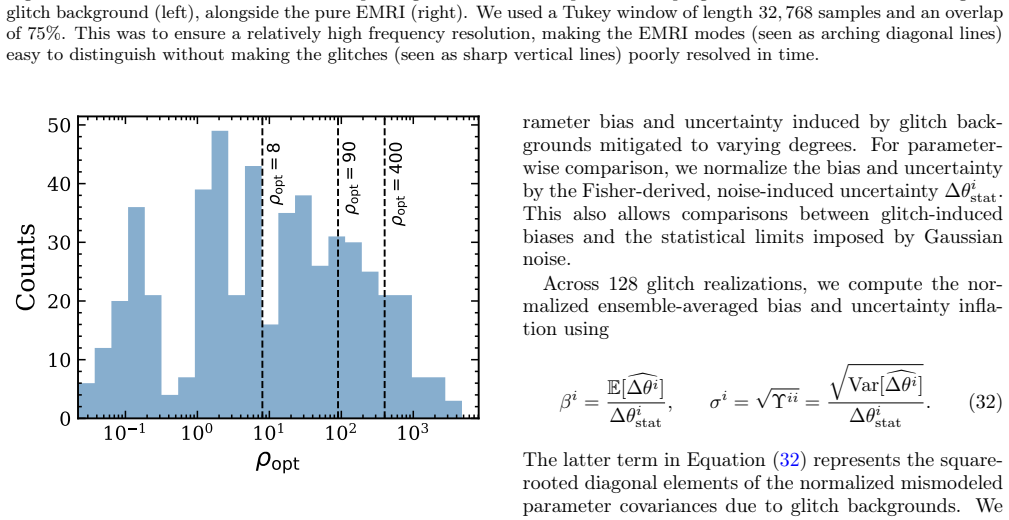
When moderately mitigated glitch streams containing only events up to moderate SNRs are present, the induced biases in recovered EMRI parameters remain negligible to minor (roughly 0.04 to 0.6 sigma), whereas weakly mitigated streams that include higher-SNR glitches can produce biases nearing 1 sigma; overall, EMRI inference proves notably more robust to such artifacts than inference performed on shorter-duration sources.
What carries the argument
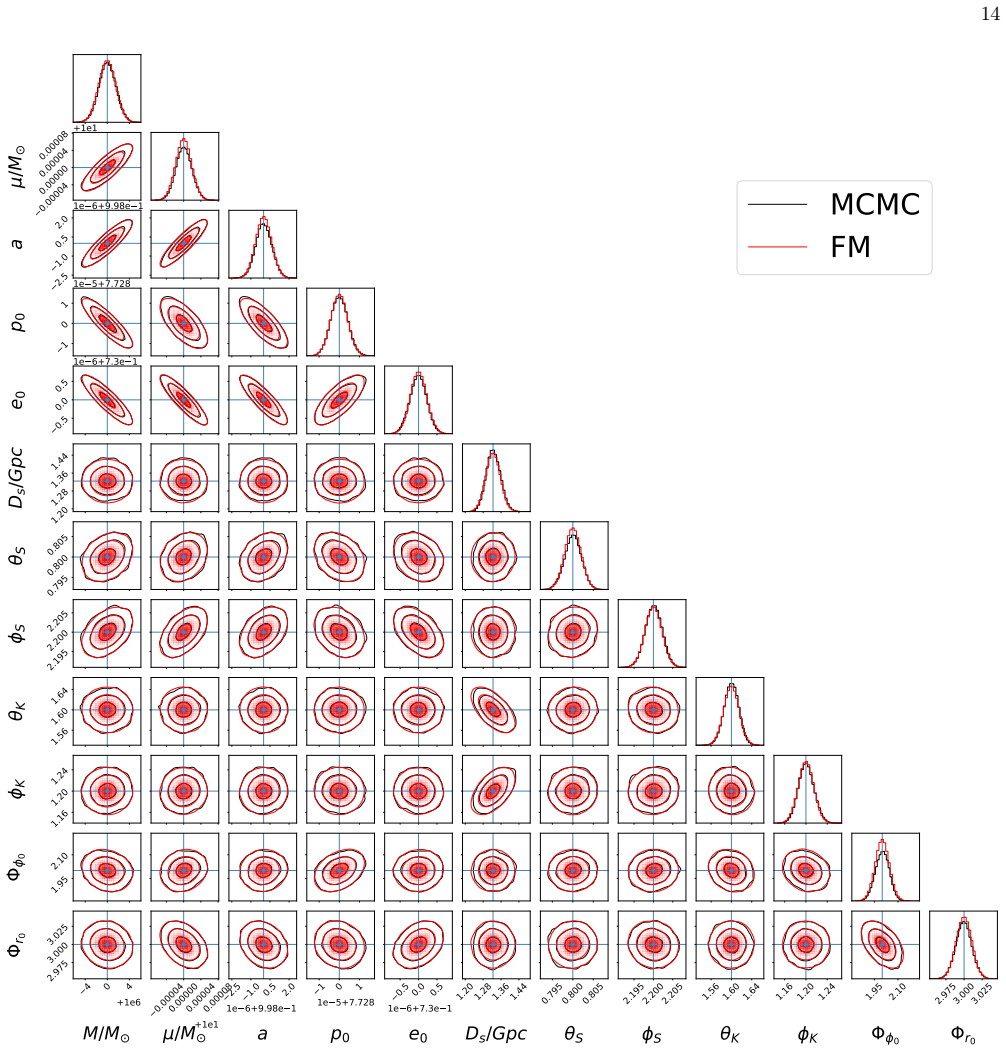
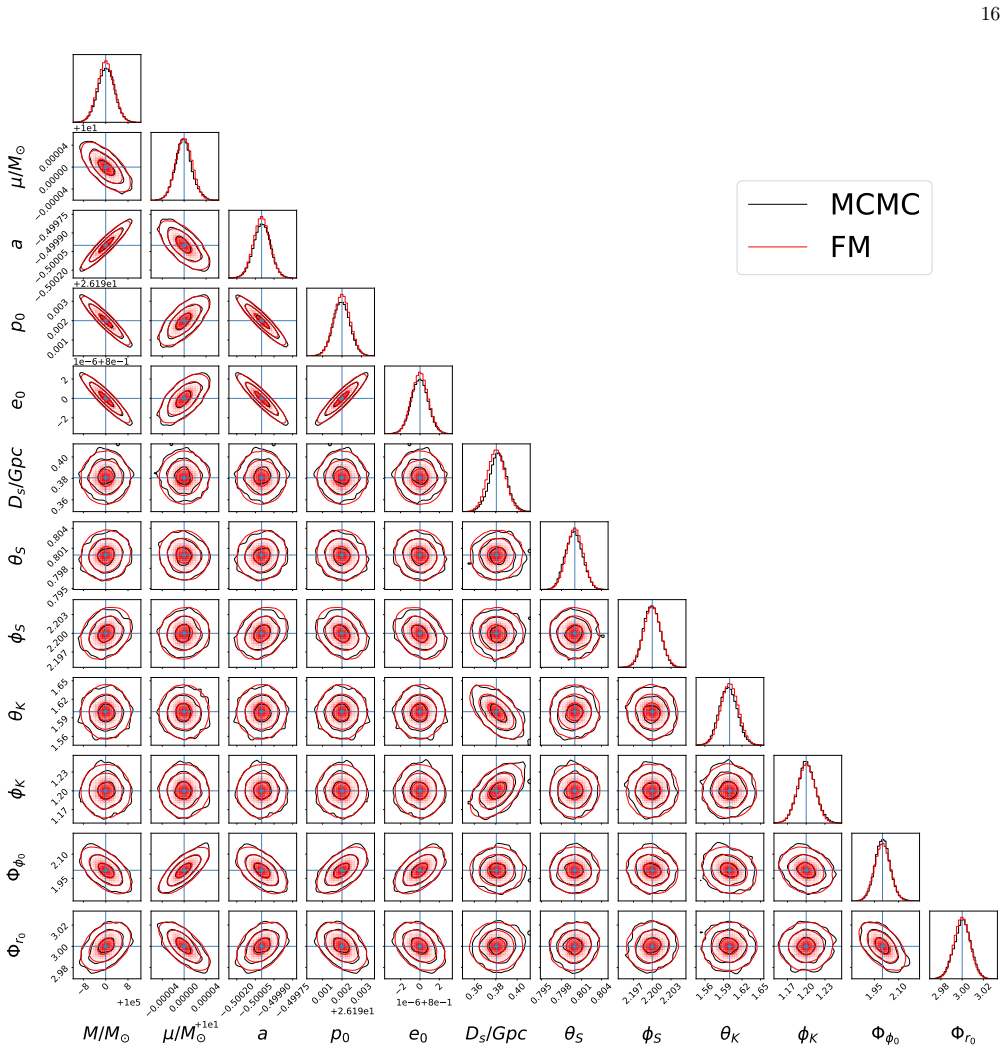
Fisher-matrix-based bias and uncertainty estimation applied to simulated LISA observations of injected EMRIs plus shapelet-modeled glitch streams, with MCMC verification of the Fisher results.
If this is right
- Unmitigated high-SNR glitches can shift EMRI parameter posteriors by up to one standard deviation, requiring at least partial glitch modeling.
- The longer duration of EMRIs relative to massive black hole binaries reduces the fractional impact of individual glitches on the overall signal.
- Fisher-matrix forecasts remain reliable for EMRI-glitch studies once confirmed by MCMC sampling.
- Glitch mitigation strategies that remove events above roughly SNR 90 will keep most EMRI biases below 0.6 sigma.
Where Pith is reading between the lines
- If the same glitch catalog proves representative, existing LISA data-analysis pipelines may need only modest extensions rather than wholesale redesigns for EMRI work.
- The reported robustness may extend to other long-lived sources such as galactic binaries, suggesting a general advantage for signals whose duration greatly exceeds typical glitch timescales.
- Future work could test whether the bias scaling with glitch SNR follows a simple power law that could be used for rapid forecasting.
Load-bearing premise
The shapelet-based glitches drawn from the LISA Pathfinder catalog accurately represent the statistical properties and occurrence rates of glitches that will actually appear in LISA flight data.
What would settle it
Direct comparison of the reported bias magnitudes against parameter shifts recovered from actual LISA flight data once glitch catalogs from the mission become available.
Figures





read the original abstract
This work investigates the impact of streams of transient, non-Gaussian noise artifacts or "glitches" on the parameter estimation of extreme mass ratio inspirals (EMRI) in the Laser Interferometer Space Antenna (LISA). Glitches cause biased and less precise inference for short-duration signals such as massive black hole binaries, but their effect on long-lived sources such as EMRIs has not been quantified. Using simulated LISA observations containing injected EMRIs and streams of shapelet-based glitches drawn from the LISA Pathfinder catalog, we estimate the glitch-induced parameter biases and uncertainties through a Fisher-matrix-based analysis whose accuracy we verify with Markov-Chain Monte Carlo. We find that moderately mitigated glitch streams i.e. ones containing only glitches of up to moderate SNRs ($\rho \lesssim 90$) induce negligible to minor biases $[\sim0.04\sigma ,\sim0.6\sigma]$ in the inferred EMRI parameters. In contrast, weakly mitigated glitch streams containing higher-SNR events ($\rho \lesssim 400$) can produce biases nearing $1\sigma$. These results demonstrate that, when compared to inference of other sources such as massive black hole binaries, EMRI inference is notably more robust to glitches. We stress that at least some amount of glitch modeling and mitigation remains essential for unbiased EMRI analyses in the LISA era.
Editorial analysis
A structured set of objections, weighed in public.
Referee Report
Summary. The manuscript presents the first quantitative assessment of glitch-induced biases and uncertainties in LISA parameter estimation for extreme mass ratio inspirals (EMRIs). Using simulated observations that inject EMRIs together with streams of shapelet-modeled glitches drawn from the LISA Pathfinder catalog, the authors perform a Fisher-matrix analysis whose accuracy is cross-checked via MCMC sampling. They report that moderately mitigated glitch streams (glitches with ρ ≲ 90) produce parameter biases of order 0.04–0.6σ, while weakly mitigated streams containing higher-SNR events (ρ ≲ 400) can reach biases approaching 1σ. The work concludes that EMRI inference is notably more robust to glitches than inference of shorter-duration sources such as massive black hole binaries.
Significance. If the reported bias levels hold, the paper supplies the first controlled, simulation-based quantification of glitch effects on long-lived EMRI signals, a result directly relevant to LISA data-analysis readiness. The explicit MCMC verification of the Fisher-matrix results and the use of an observationally motivated glitch catalog constitute clear methodological strengths that increase confidence in the numerical findings.
major comments (1)
- [Abstract and Conclusions] Abstract and final section: the claim that EMRI inference is 'notably more robust' to glitches than MBHB inference rests on an indirect comparison to earlier literature rather than a controlled side-by-side test performed with identical glitch realizations, mitigation thresholds, data duration, and analysis pipeline. Because differences in glitch occurrence rate, frequency overlap, or pipeline choices could contribute to the observed difference in bias magnitude, the comparative statement requires either a direct re-analysis of an MBHB signal under the same conditions or an explicit caveat.
minor comments (2)
- [Methods] Methods section: the precise criteria used to classify a glitch stream as 'moderately mitigated' versus 'weakly mitigated' (including any SNR cut-offs or removal procedures) should be stated explicitly so that the reader can reproduce the two regimes.
- [Results] Results: the largest biases are reported for particular EMRI parameters; listing the affected parameters (e.g., mass ratio, spin, or sky location) and their physical interpretation would improve clarity.
Simulated Author's Rebuttal
We thank the referee for their constructive review and for recommending minor revision. We appreciate the recognition of the methodological strengths of our work, including the MCMC verification and use of the LISA Pathfinder glitch catalog. We address the single major comment below.
read point-by-point responses
-
Referee: [Abstract and Conclusions] Abstract and final section: the claim that EMRI inference is 'notably more robust' to glitches than MBHB inference rests on an indirect comparison to earlier literature rather than a controlled side-by-side test performed with identical glitch realizations, mitigation thresholds, data duration, and analysis pipeline. Because differences in glitch occurrence rate, frequency overlap, or pipeline choices could contribute to the observed difference in bias magnitude, the comparative statement requires either a direct re-analysis of an MBHB signal under the same conditions or an explicit caveat.
Authors: We agree that the comparison to MBHB inference is indirect, relying on results from prior literature rather than a controlled side-by-side test with identical glitch realizations, mitigation thresholds, data duration, and analysis pipeline. Performing a direct re-analysis of MBHB signals under the same conditions would require substantial additional computational resources and falls outside the scope of the present EMRI-focused study. We will therefore revise both the abstract and the conclusions section to include an explicit caveat clarifying that the robustness statement is based on literature values obtained under differing conditions, and that a dedicated comparative analysis remains a valuable direction for future work. revision: yes
Circularity Check
No significant circularity in the EMRI glitch bias analysis
full rationale
The paper's bias and uncertainty estimates are produced via forward simulations that inject EMRIs into LISA-like data streams containing shapelet glitches drawn from the external LPF catalog, followed by Fisher-matrix calculations whose accuracy is cross-checked with independent MCMC sampling. No parameters are fitted to the reported bias values themselves, and no step reduces by construction to a self-citation or internal normalization. The comparative claim of greater robustness versus MBHB sources is supported by reference to prior external literature rather than any re-derivation internal to this work, leaving the derivation chain self-contained against external benchmarks.
Axiom & Free-Parameter Ledger
axioms (2)
- domain assumption Shapelet-based glitches drawn from the LISA Pathfinder catalog have the same statistical properties and occurrence rates as glitches that will appear in LISA science data.
- domain assumption The Fisher-matrix approximation remains accurate enough to report bias and uncertainty shifts at the 0.04–1σ level for the chosen glitch amplitudes.
Lean theorems connected to this paper
-
IndisputableMonolith/Cost/FunctionalEquation.leanwashburn_uniqueness_aczel unclear?
unclearRelation between the paper passage and the cited Recognition theorem.
We employ a Fisher-matrix-based analysis to estimate the inference bias and uncertainty due to glitch-related model misspecification.
What do these tags mean?
- matches
- The paper's claim is directly supported by a theorem in the formal canon.
- supports
- The theorem supports part of the paper's argument, but the paper may add assumptions or extra steps.
- extends
- The paper goes beyond the formal theorem; the theorem is a base layer rather than the whole result.
- uses
- The paper appears to rely on the theorem as machinery.
- contradicts
- The paper's claim conflicts with a theorem or certificate in the canon.
- unclear
- Pith found a possible connection, but the passage is too broad, indirect, or ambiguous to say the theorem truly supports the claim.
Forward citations
Cited by 1 Pith paper
-
Parameter-estimation bias induced by transient orbital resonances in extreme-mass-ratio inspirals
Neglecting transient orbital resonances in EMRIs causes significant SNR losses and biases in recovered parameters, with the sign and amplitude of resonance-induced changes to integrals of motion being critical.
Reference graph
Works this paper leans on
-
[1]
(29c) For our analysis, we disregard the T channel due to its insensitivity to EMRIs (though not to glitches) and assume identical, uncorrelated noise PSDsSA n = SE n. TDI propagation is implemented with the GPU- accelerated fastlisaresponse [75]. Stationary instru- mental noise follows theSciRDv1 sensitivity curve [76], with the unresolved galactic binar...
-
[2]
Danzmann, Advances in Space Research 25, 1129 (2000), fundamental Physics in Space
K. Danzmann, Advances in Space Research 25, 1129 (2000), fundamental Physics in Space
work page 2000
-
[3]
J. R. Gair, S. Babak, A. Sesana, P. Amaro-Seoane, E. Barausse,et al., Journal of Physics: Conference Se- ries 840, 012021 (2017)
work page 2017
- [5]
-
[6]
Science with the space-based interferometer LISA. V: Extreme mass-ratio inspirals
S. Babak, J. R. Gair, A. Sesana, E. Barausse, C. F. Sop- uerta, C. P. L. Berry, E. Berti, P. Amaro-Seoane, A. Pe- titeau, and A. Klein, Physical Review D 95, 103012 (2017), arXiv:1703.09722
work page internal anchor Pith review Pith/arXiv arXiv 2017
-
[7]
M. Colpi, K. Danzmann, M. Hewitson, K. Holley- Bockelmann, P. Jetzer,et al., Lisa definition study re- port (2024), arXiv:2402.07571 [astro-ph.CO]
work page internal anchor Pith review Pith/arXiv arXiv 2024
- [8]
- [9]
-
[10]
J. R. Gair, M. Vallisneri, S. L. Larson, and J. G. Baker, Living Reviews in Relativity 16, 10.12942/lrr-2013-7 (2013)
-
[11]
Laghi, Gravitational wave cosmology with emris (2021), arXiv:2106.02053 [astro-ph.CO]
D. Laghi, Gravitational wave cosmology with emris (2021), arXiv:2106.02053 [astro-ph.CO]
-
[12]
M. Toscani, O. Burke, C. Liu, N. B. Zamel, N. Tamanini, and F. Pozzoli, Strongly-lensed extreme mass-ratio inspirals (2023), arXiv:2307.06722 [astro- ph.CO]
-
[13]
S. Kumar, Probing deviations to kerr geometry with extreme mass-ratio inspirals (2024), arXiv:2410.08544 [gr-qc]
-
[14]
S. Kumar and T. Zi, Gravitational waves from regu- lar black holes in extreme mass-ratio inspirals (2024), arXiv:2412.11847 [gr-qc]
-
[15]
S. Barsanti, A. Maselli, T. P. Sotiriou, and L. Gualtieri, Physical Review Letters 131, 051401 (2023), arXiv:2212.03888. 12
- [16]
-
[17]
A. Maselli, N. Franchini, L. Gualtieri, T. P. Sotiriou, S. Barsanti, and P. Pani, Nature Astronomy 6, 464 (2022), arXiv:2106.11325
-
[18]
Systematic errors in fast relativistic waveforms for Extreme Mass Ratio Inspirals
H. Khalvati, P. Lynch, O. Burke, L. Speri, M. van de Meent, and Z. Nasipak, Systematic errors in fast rel- ativistic waveforms for extreme mass ratio inspirals (2025), arXiv:2509.08875 [gr-qc]
work page internal anchor Pith review Pith/arXiv arXiv 2025
-
[19]
L.Speri, A.Antonelli, L.Sberna, S.Babak, E.Barausse, J. R. Gair, and M. L. Katz, Physical Review X 13, 10.1103/physrevx.13.021035 (2023)
- [20]
- [21]
-
[22]
A. J. K. Chua, C. J. Moore, and J. R. Gair, Phys. Rev. D 96, 044005 (2017)
work page 2017
-
[23]
J. R. GAIR, inThe Eleventh Marcel Grossmann Meet- ing (World Scientific Publishing Company, 2008) p. 2419–2421
work page 2008
-
[24]
A. J. K. Chua and J. R. Gair, Classical and Quantum Gravity 32, 232002 (2015)
work page 2015
-
[25]
Y. Mino, M. Sasaki, M. Shibata, H. Tagoshi, and T. Tanaka, Progress of Theoretical Physics Supplement 128, 1 (1997), https://academic.oup.com/ptps/article- pdf/doi/10.1143/PTPS.128.1/5438984/128-1.pdf
- [26]
- [27]
- [28]
- [29]
- [30]
- [31]
-
[33]
M. L. Katz, L. Speri, A. J. K. Chua, C. E. A. Chapman-Bird, N. Warburton, et al., BlackHolePer- turbationToolkit/FastEMRIWaveforms: Frequency Do- main Waveform Added! (2023)
work page 2023
-
[34]
A. J. Chua, C. R. Galley, and M. Vallisneri, Phys. Rev. Lett.122, 211101 (2019), arXiv:1811.05491 [astro- ph.IM]
work page internal anchor Pith review Pith/arXiv arXiv 2019
-
[35]
A. J. Chua, C. J. Moore, and J. R. Gair, Phys. Rev. D 96, 044005 (2017), arXiv:1705.04259 [gr-qc]
work page internal anchor Pith review Pith/arXiv arXiv 2017
- [36]
- [37]
-
[38]
H. Khalvati, A. Santini, F. Duque, L. Speri, J. Gair, H. Yang, and R. Brito, arXiv preprint arXiv:2410.17310 (2024), arXiv:2410.17310
- [39]
-
[40]
F. Antonucci, M. Armano, H. Audley, G. Auger, M. Benedetti, et al., Classical and Quantum Gravity 29, 124014 (2012)
work page 2012
- [41]
- [42]
- [43]
- [44]
-
[45]
L. Sala, Residual test mass acceleration in LISA Pathfinder: in-depth statistical analysis and physical sources, Ph.D. thesis, Trento U. (2023)
work page 2023
-
[46]
N. Houba, L. Ferraioli, and D. Giardini, Physical Re- view D 109, 10.1103/physrevd.109.083027 (2024)
- [47]
- [48]
-
[49]
M. Muratore, J. Gair, O. Hartwig, M. L. Katz, and A. Toubiana, A pipeline for searching and fitting in- strumentalglitchesinlisadata(2025),arXiv:2505.19870 [gr-qc]
-
[50]
A. Licciardi, D. Carbone, L. Rondoni, and A. Na- gar, Wavelet scattering transform for gravitational waves analysis. an application to glitch characterization (2025), arXiv:2411.19122 [gr-qc]
- [51]
-
[52]
L. Speri, M. L. Katz, A. J. K. Chua, S. A. Hughes, N. Warburton, J. E. Thompson, C. E. A. Chapman-Bird, and J. R. Gair, Frontiers in Ap- plied Mathematics and Statistics V olume 9 - 2023 , 10.3389/fams.2023.1266739 (2024)
- [53]
- [54]
- [55]
- [56]
-
[57]
Baghi, The lisa data challenges (2022), arXiv:2204.12142 [gr-qc]
Q. Baghi, The lisa data challenges (2022), arXiv:2204.12142 [gr-qc]
-
[59]
E. Castelli, Q. Baghi, J. G. Baker, J. Slutsky, J. Bobin, et al., Extraction of gravitational wave signals in realis- tic lisa data (2024), arXiv:2411.13402 [gr-qc]
-
[60]
P. Whittle,Hypothesis Testing in Time Series Analysis, Statistics / Uppsala universitet (Almqvist & Wiksells boktr., 1951)
work page 1951
-
[61]
L. S. Finn, Physical Review D46, 5236–5249 (1992)
work page 1992
-
[62]
A. J. K. Chua and C. J. Cutler, Phys. Rev. D 106, 124046 (2022)
work page 2022
-
[63]
N. Karnesis, M. L. Katz, N. Korsakova, J. R. Gair, and N. Stergioulas, Monthly Notices of the Royal Astronomical Society 526, 4814 (2023), https://academic.oup.com/mnras/article- pdf/526/4/4814/52313119/stad2939.pdf
work page 2023
-
[64]
G. Ashton, M. Hübner, P. D. Lasky, C. Talbot, K. Ack- ley, S. Biscoveanu, Q. Chu, A. Divakarla, P. J. Easter, B. Goncharov, F. H. Vivanco, J. Harms, M. E. Lower, G. D. Meadors, D. Melchor, E. Payne, M. D. Pitkin, J. Powell, N. Sarin, R. J. E. Smith, and E. Thrane, The Astrophysical Journal Supplement Series241, 27 (2019)
work page 2019
-
[65]
J. S. Speagle, Monthly Notices of the Royal Astronomical Society 493, 3132 (2020), https://academic.oup.com/mnras/article- pdf/493/3/3132/32890730/staa278.pdf
work page 2020
- [66]
-
[67]
S. Kejriwal, C. Chapman-Bird, and O. Burke, per- turber/stableemrifisher. (manuscript under prepara- tion)
-
[68]
N. Karnesis, M. L. Katz, N. Korsakova, J. R. Gair, and N. Stergioulas, Monthly Notices of the Royal Astronom- ical Society 526, 4814–4830 (2023)
work page 2023
-
[69]
E. E. Flanagan and S. A. Hughes, Phys. Rev. D57, 4566 (1998)
work page 1998
- [70]
- [71]
-
[72]
M. Vallisneri, Physical Review D 77, 10.1103/phys- revd.77.042001 (2008)
-
[73]
A. Antonelli, O. Burke, and J. R. Gair, Monthly No- tices of the Royal Astronomical Society507, 5069–5086 (2021)
work page 2021
-
[74]
C. E. A. Chapman-Bird, L. Speri, Z. Nasipak, O. Burke, M. L. Katz,et al., The fast and the frame-dragging: Ef- ficient waveforms for asymmetric-mass eccentric equa- torial inspirals into rapidly-spinning black holes (2025), arXiv:2506.09470 [gr-qc]
work page internal anchor Pith review Pith/arXiv arXiv 2025
- [75]
-
[76]
M. L. Katz, J.-B. Bayle, A. J. Chua, and M. Vallisneri, Physical Review D 106, 10.1103/physrevd.106.103001 (2022)
-
[77]
LISA Science Study Team, Science requirement docu- ment: Esa-l3-est-sci-rs-001 (2018)
work page 2018
-
[78]
M. Katz, CChapmanbird, L. Speri, N. Karnesis, and N. Korsakova, mikekatz04/lisaanalysistools: First main release. (2024)
work page 2024
- [79]
- [80]
-
[81]
L. Consortium, Lisa pathfinder glitches, Available at: https://lisa-simulation.pages.in2p3.fr/glitch/ v1.2/lpf.html, accessed on 30 October 2025
work page 2025
-
[82]
A. Derdzinski and L. Zwick, Multimessenger astronomy with black holes: Extreme mass ratio inspirals (2023), arXiv:2310.16900 [astro-ph.HE]
-
[83]
C. R. Harris, K. J. Millman, S. J. van der Walt, R. Gom- mers, P. Virtanen,et al., Nature 585, 357 (2020)
work page 2020
discussion (0)
Sign in with ORCID, Apple, or X to comment. Anyone can read and Pith papers without signing in.