The Fast and the Frame-Dragging: Efficient waveforms for asymmetric-mass eccentric equatorial inspirals into rapidly-spinning black holes
Pith reviewed 2026-05-19 10:02 UTC · model grok-4.3
The pith
Extending the FastEMRIWaveforms framework produces accurate eccentric inspiral waveforms into black holes with spins up to 0.999 in about 100 milliseconds.
A machine-rendered reading of the paper's core claim, the machinery that carries it, and where it could break.
Core claim
We extend FEW to model eccentric equatorial inspirals into black holes with spin magnitudes |a| ≤ 0.999. Our model supports eccentricities e < 0.9 and semi-latus recta p < 200, enabling the generation of long-duration IMRI waveforms, and produces waveforms in ∼100 ms with hardware acceleration. Characterising systematic errors, we estimate that our model attains mismatches of ∼10^{-5} (for LISA sensitivity) with respect to error-free adiabatic waveforms over most of parameter space.
What carries the argument
Precomputed mode data and interpolation techniques generalized from zero-spin cases to rapidly spinning black holes inside the FastEMRIWaveforms framework.
If this is right
- Long-duration intermediate-mass-ratio inspiral waveforms become feasible to generate efficiently.
- Hardware-accelerated computation reaches roughly 100 milliseconds per waveform.
- Mismatches stay near 10 to the minus 5 for LISA sensitivities over most of the covered parameter space.
- Kludge models produce signal-to-noise ratio errors as large as 60 percent and parameter biases up to one sigma.
- LISA detection horizons reach redshift 3 for extreme-mass-ratio cases and 15 for intermediate-mass-ratio cases at signal-to-noise ratio 20, with spin measurable to 10 to the minus 7.
Where Pith is reading between the lines
- These waveforms could support real-time matched filtering in LISA data analysis pipelines.
- Similar interpolation strategies might extend to inclined or non-equatorial orbits with modest additional precomputation.
- High-precision spin and eccentricity recovery could tighten constraints on formation channels for stellar-mass black holes near galactic centers.
- Direct comparison against self-force calculations at selected high-spin points would test the adiabatic approximation used here.
Load-bearing premise
Interpolation methods and mode data developed for non-spinning black holes can be applied to high-spin cases while keeping mismatches at the reported level without new unquantified errors.
What would settle it
An independent computation of adiabatic waveforms for spin 0.99, eccentricity 0.8, and semi-latus rectum 50 that yields a mismatch above 10 to the minus 5 with the model output would falsify the accuracy claim.
Figures

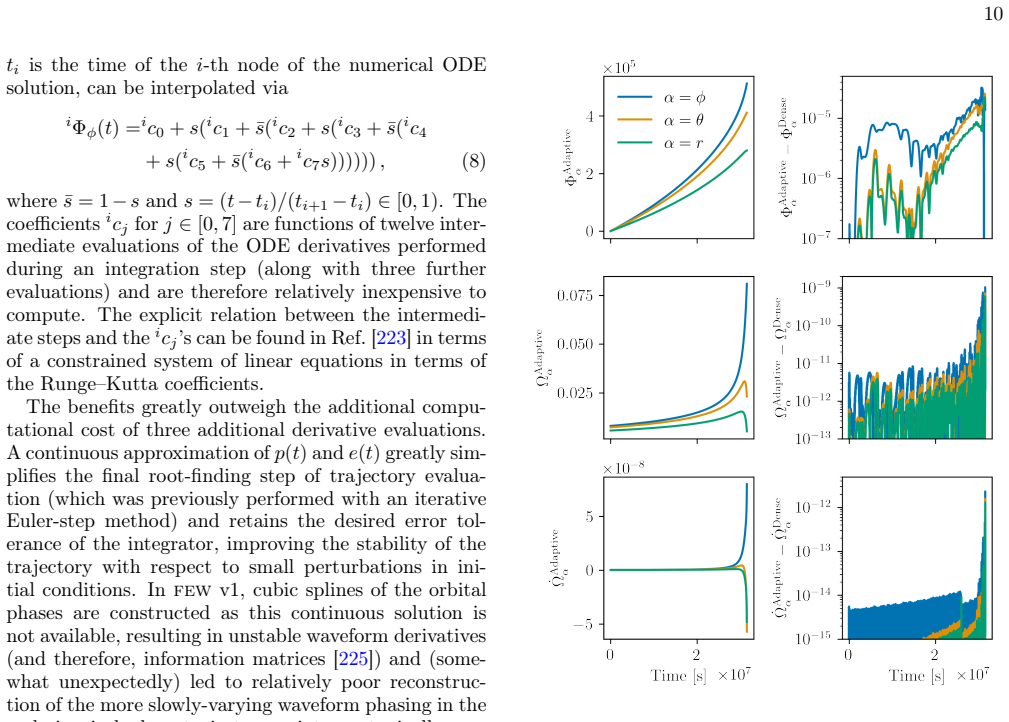


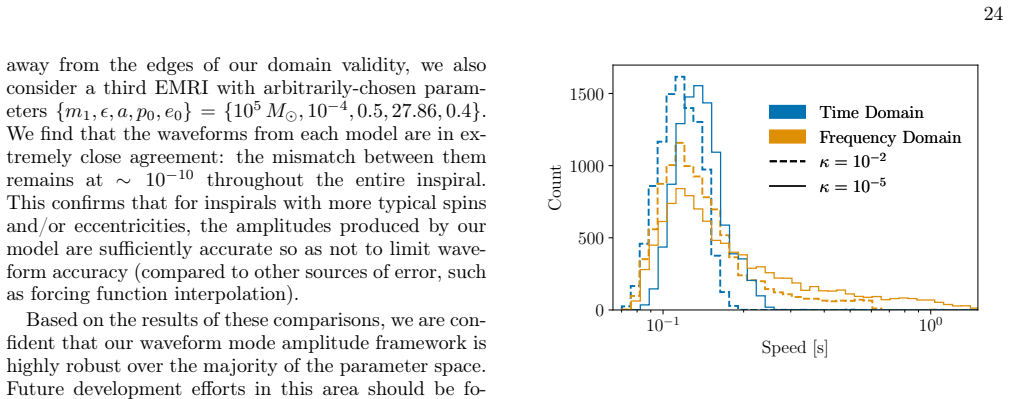


read the original abstract
Observations of gravitational-wave signals emitted by compact binary inspirals provide unique insights into their properties, but their analysis requires accurate and efficient waveform models. Intermediate- and extreme-mass-ratio inspirals (I/EMRIs), with mass ratios $q \gtrsim 10^2$, are promising sources for future detectors such as the Laser Interferometer Space Antenna (LISA). Modelling waveforms for these asymmetric-mass binaries is challenging, entailing the tracking of many harmonic modes over thousands to millions of cycles. The FastEMRIWaveforms (FEW) modelling framework addresses this need, leveraging precomputation of mode data and interpolation to rapidly compute adiabatic waveforms for eccentric inspirals into zero-spin black holes. In this work, we extend FEW to model eccentric equatorial inspirals into black holes with spin magnitudes $|a| \leq 0.999$. Our model supports eccentricities $e < 0.9$ and semi-latus recta $p < 200$, enabling the generation of long-duration IMRI waveforms, and produces waveforms in $\sim 100$ ms with hardware acceleration. Characterising systematic errors, we estimate that our model attains mismatches of $\sim 10^{-5}$ (for LISA sensitivity) with respect to error-free adiabatic waveforms over most of parameter space. We find that kludge models introduce errors in signal-to-noise ratios (SNRs) as great as $^{+60\%}_{-40\%}$ and induce marginal biases of up to $\sim 1\sigma$ in parameter estimation. We show LISA's horizon redshift for I/EMRI signals varies significantly with $a$, reaching a redshift of $3$ ($15$) for EMRIs (IMRIs) with only minor $(\sim10\%)$ dependence on $e$ for an SNR threshold of 20. For signals with SNR $\sim 50$, spin and eccentricity-at-plunge are measured with uncertainties of $\delta a \sim 10^{-7}$ and $\delta e_f \sim 10^{-5}$. This work advances the state-of-the-art in waveform generation for asymmetric-mass binaries.
Editorial analysis
A structured set of objections, weighed in public.
Referee Report
Summary. The manuscript extends the FastEMRIWaveforms (FEW) framework from zero-spin to Kerr black holes with |a| ≤ 0.999, enabling efficient generation of adiabatic waveforms for eccentric equatorial inspirals with e < 0.9 and p < 200. Waveforms are produced in ~100 ms using hardware acceleration. The central claims are that the model attains mismatches of ~10^{-5} (LISA sensitivity) relative to error-free adiabatic waveforms over most of parameter space, that kludge models induce SNR errors up to +60%/-40% and ~1σ parameter biases, and that LISA horizon redshifts and measurement precisions (e.g., δa ~ 10^{-7}) vary with spin and eccentricity.
Significance. If the mismatch and performance claims hold, the work is significant for LISA data analysis of I/EMRIs, as it supplies a practical, fast waveform generator for long-duration signals into spinning primaries and quantifies systematic errors from kludge approximations. The extension of precomputed-mode interpolation to high spins, together with concrete horizon and precision estimates, would be a useful contribution to the EMRI modeling literature.
major comments (2)
- The mismatch characterization (abstract and the section on systematic errors) states ~10^{-5} levels with respect to error-free adiabatic waveforms but supplies no quantitative details on the validation data sets, error-bar propagation, or handling of post-adiabatic corrections. This is load-bearing for the central performance claim, because the generalization of zero-spin precomputed mode amplitudes, phases, and frequencies to |a| ≈ 0.999 must be shown to preserve accuracy when radial potentials and frame-dragging frequencies change sharply near the ISCO.
- Model construction (section describing the extension of precomputed data and interpolation): the manuscript should clarify whether the reported mismatches were obtained by comparison against an independent high-fidelity adiabatic integrator for the spinning case or whether they are internal comparisons between two versions of the same interpolated model. Without the former, phase-error accumulation over thousands of LISA-band cycles remains unquantified.
minor comments (2)
- Figure captions and axis labels should explicitly state the range of spin values sampled and the interpolation method used for each panel.
- A short table summarizing the grid spacing in (a, e, p) for the precomputed modes would improve reproducibility.
Simulated Author's Rebuttal
We thank the referee for their careful reading of the manuscript and for the constructive comments, which help us improve the clarity of our validation procedures. We respond to each major comment below and will revise the manuscript accordingly.
read point-by-point responses
-
Referee: The mismatch characterization (abstract and the section on systematic errors) states ~10^{-5} levels with respect to error-free adiabatic waveforms but supplies no quantitative details on the validation data sets, error-bar propagation, or handling of post-adiabatic corrections. This is load-bearing for the central performance claim, because the generalization of zero-spin precomputed mode amplitudes, phases, and frequencies to |a| ≈ 0.999 must be shown to preserve accuracy when radial potentials and frame-dragging frequencies change sharply near the ISCO.
Authors: We agree that the current presentation would benefit from additional quantitative detail. In the revised manuscript we will expand the relevant section to include a table describing the validation data sets (a dense grid covering |a| up to 0.999, e < 0.9 and p < 200), the precise method of error-bar propagation from the underlying Teukolsky solutions through the interpolation, and explicit statements that the model is strictly adiabatic. We will add a short discussion noting that post-adiabatic corrections lie outside the present scope and a supplementary figure showing mode amplitudes and frequencies near the ISCO at high spin to confirm that the precomputed data remain well-behaved in this regime. revision: yes
-
Referee: Model construction (section describing the extension of precomputed data and interpolation): the manuscript should clarify whether the reported mismatches were obtained by comparison against an independent high-fidelity adiabatic integrator for the spinning case or whether they are internal comparisons between two versions of the same interpolated model. Without the former, phase-error accumulation over thousands of LISA-band cycles remains unquantified.
Authors: We will revise the model-construction section to state explicitly that the reference 'error-free' waveforms are generated by a direct numerical Teukolsky integrator that solves the radial and angular equations for each mode without recourse to the precomputed interpolation tables used in the FEW model. This constitutes an independent high-fidelity computation. We will also report the number of LISA-band cycles (typically 10^4–10^5) over which phase differences were accumulated and the resulting maximum phase error, thereby quantifying the accumulation explicitly. revision: yes
Circularity Check
Minor self-citation in FEW framework extension; central mismatch claims rest on external kludge comparisons rather than self-referential fits
full rationale
The paper extends the existing FEW precomputation and interpolation machinery (developed for a=0) to |a|≤0.999 by reusing grids and schemes, then reports mismatches against 'error-free adiabatic waveforms'. No equation or section reduces a claimed prediction to a fitted parameter by construction, nor does any load-bearing uniqueness theorem trace exclusively to overlapping-author citations. Comparisons to independent kludge models are cited for SNR and bias checks, supplying external benchmarks. This keeps the derivation self-contained against the reported external validations, warranting only a minor self-citation flag.
Axiom & Free-Parameter Ledger
axioms (1)
- domain assumption Adiabatic approximation remains valid for the eccentric equatorial inspirals considered
Lean theorems connected to this paper
-
IndisputableMonolith/Foundation/AlexanderDuality.leanalexander_duality_circle_linking unclear?
unclearRelation between the paper passage and the cited Recognition theorem.
We extend FEW to model eccentric equatorial inspirals into black holes with spin magnitudes |a| ≤ 0.999... leveraging precomputation of mode data and interpolation to rapidly compute adiabatic waveforms
-
IndisputableMonolith/Cost/FunctionalEquation.leanwashburn_uniqueness_aczel unclear?
unclearRelation between the paper passage and the cited Recognition theorem.
At adiabatic order, the evolution of the orbital elements is driven solely by the orbit-averaged back-reaction due to GW emission... flux-balance formulae
What do these tags mean?
- matches
- The paper's claim is directly supported by a theorem in the formal canon.
- supports
- The theorem supports part of the paper's argument, but the paper may add assumptions or extra steps.
- extends
- The paper goes beyond the formal theorem; the theorem is a base layer rather than the whole result.
- uses
- The paper appears to rely on the theorem as machinery.
- contradicts
- The paper's claim conflicts with a theorem or certificate in the canon.
- unclear
- Pith found a possible connection, but the passage is too broad, indirect, or ambiguous to say the theorem truly supports the claim.
Forward citations
Cited by 14 Pith papers
-
First-time assessment of glitch-induced bias and uncertainty in inference of extreme mass ratio inspirals
Moderately mitigated glitch streams induce negligible to minor biases (0.04–0.6σ) in EMRI parameters while weakly mitigated streams with higher-SNR events can reach ~1σ biases, making EMRI inference more robust than f...
-
Black hole mergers beyond general relativity: a self-force approach
Self-force theory is extended to compute merger and ringdown waveforms in beyond-GR black hole binaries under the extreme mass-ratio approximation, with first calculations of self-force corrections to the merger waveform.
-
Efficient and Stable Computation of Gravitational-Wave Fluxes from Generic Kerr Orbits via a Unified HeunC Framework
A unified confluent HeunC framework computes gravitational-wave fluxes from generic Kerr orbits with 10^{-11} relative errors and speedups of 3-60x over existing packages for low- and high-order modes.
-
Efficient and Stable Computation of Gravitational-Wave Fluxes from Generic Kerr Orbits via a Unified HeunC Framework
A unified confluent HeunC framework with hybrid connection-coefficient computation and adaptive bi-power quadrature yields relative errors of order 10^{-11} and 2-10x speedups over existing packages for total radiativ...
-
Relativistic signatures of scalar dark matter in extreme-mass-ratio inspirals
Relativistic metric backreaction from scalar dark matter clouds in EMRIs produces dominant polar gravitational wave corrections for Mμ ≲ 0.12, exceeding axial and scalar radiation channels at small separations.
-
Post-adiabatic self-force waveforms: slowly spinning primary and precessing secondary
Extended 1PA self-force waveforms for slowly spinning primary and precessing secondary, with re-summed 1PAT1R variant showing improved accuracy against NR for q ≳ 5 and |χ1| ≲ 0.1.
-
Probing Kerr Symmetry Breaking with LISA Extreme-Mass-Ratio Inspirals
LISA EMRIs can constrain deviations from Kerr equatorial symmetry to 10^{-2} and axial symmetry to 10^{-3} using Analytic Kludge waveforms and Fisher analysis.
-
Gravitational radiation from hyperbolic orbits: comparison between self-force, post-Minkowskian, post-Newtonian, and numerical relativity results
Self-force calculations of radiated gravitational wave energy from hyperbolic orbits around Schwarzschild black holes agree with post-Minkowskian results for large impact parameters and velocities up to 0.7c, with fur...
-
Systematic errors in fast relativistic waveforms for Extreme Mass Ratio Inspirals
For high-spin Kerr circular orbits, l_max >=30 and Chebyshev interpolation with global relative flux error matching the mass ratio yield mismatches below 10^{-3} and negligible parameter biases in 4-year EMRI signals ...
-
Constraints on the extreme mass-ratio inspiral population from LISA data
A neural-network-accelerated hierarchical Bayesian pipeline is developed and validated on a phenomenological model to constrain EMRI population parameters from LISA data.
-
A multi-parameter expansion for the evolution of asymmetric binaries in astrophysical environments
A multi-parameter formalism is developed to describe asymmetric binaries in general matter distributions by perturbing around Schwarzschild and reducing metric and fluid perturbations to wave equations similar to the ...
-
Constraining Lorentz symmetry breaking in bumblebee gravity with extreme mass-ratio inspirals
Extreme mass-ratio inspirals can constrain the Lorentz symmetry breaking parameter ℓ in bumblebee gravity to O(10^{-4}) uncertainty with LISA.
-
Constraining Lorentz symmetry breaking in bumblebee gravity with extreme mass-ratio inspirals
EMRI waveforms in bumblebee gravity allow LISA to constrain the Lorentz symmetry breaking parameter ell at the level of O(10^{-4}).
-
The Early Career Workshop of GR-Amaldi 2025
The paper reports on the aims, activities, and conclusions of an early-career workshop focused on scientific overviews, transferable skills, and networking in gravitational physics.
Reference graph
Works this paper leans on
-
[1]
Weak-field behaviour against PN-GSF approaches The combined PN-GSF approach of black hole per- turbation theory yields closed-form analytic solutions to the (frequency-domain) Teukolsky equation and thus the inspiral forcing functions in Eq. (2) and the GW strain amplitudes in Eq. (5) in turn; we refer a reader to Refs. [138, 139] for reviews. In the cont...
-
[2]
Validating the interpolations of the forcing func- tions ˆf(0) p,e in the trajectory module against their PN5 equivalents (Fig. 25)
-
[3]
(6) and projected onto spherical harmonics as described in Eq
Validating the interpolations of the mode ampli- tudes Aℓmn against their PN5 equivalents for sam- ple harmonic modes; the PN5 spherical harmonic waveform mode amplitudes were obtained from thePN5Teukolskyspheroidalharmonicmodeam- plitudes via Eq. (6) and projected onto spherical harmonics as described in Eq. (11) (Fig. 26)
-
[4]
Assessing the orbital dephasing (over four years) between the (fully-relativistic) trajectory model in few v2 and the PN5 inspiral model scales(Fig. 27). To do this, we have since implemented two minor im- provements to the PN5 trajectory module. Firstly, we 11 There are a number of other PN-GSF calculations that explic- itly consider the eccentric equato...
-
[5]
R. Abbottet al., “GWTC-3: Compact Binary Coales- cences Observed by LIGO and Virgo during the Sec- ond Part of the Third Observing Run,”Phys. Rev. X, vol. 13, no. 4, p. 041039, 2023
work page 2023
-
[6]
J. Aasiet al., “Advanced LIGO,”Class. Quant. Grav., vol. 32, p. 074001, 2015
work page 2015
-
[7]
Advanced Virgo: a second- generation interferometric gravitational wave detec- tor,
F. Acernese et al., “Advanced Virgo: a second- generation interferometric gravitational wave detec- tor,”Class. Quant. Grav., vol. 32, no. 2, p. 024001, 2015
work page 2015
-
[8]
KAGRA: 2.5 Generation Interfero- metric Gravitational Wave Detector,
T. Akutsuet al., “KAGRA: 2.5 Generation Interfero- metric Gravitational Wave Detector,”Nature Astron., vol. 3, no. 1, pp. 35–40, 2019
work page 2019
-
[9]
Population of Merging Compact Binaries Inferred Using Gravitational Waves through GWTC-3,
R. Abbott et al., “Population of Merging Compact Binaries Inferred Using Gravitational Waves through GWTC-3,”Phys. Rev. X, vol. 13, no. 1, p. 011048, 2023
work page 2023
-
[10]
Surrogatemodelsforprecessingbinaryblackholesim- ulations with unequal masses,
V. Varma, S. E. Field, M. A. Scheel, J. Blackman, D. Gerosa, L. C. Stein, L. E. Kidder, and H. P. Pfeiffer, “Surrogatemodelsforprecessingbinaryblackholesim- ulations with unequal masses,”Phys. Rev. Research., vol. 1, p. 033015, 2019
work page 2019
-
[11]
A. Ramos-Buades, A. Buonanno, H. Estellés, M. Khalil, D. P. Mihaylov, S. Ossokine, L. Pompili, and M. Shiferaw, “Next generation of accurate and efficient multipolar precessing-spin effective-one-body waveforms for binary black holes,”Phys. Rev. D, vol. 108, no. 12, p. 124037, 2023
work page 2023
-
[12]
G. Pratten et al., “Computationally efficient models for the dominant and subdominant harmonic modes of precessing binary black holes,”Phys. Rev. D, vol. 103, no. 10, p. 104056, 2021
work page 2021
-
[13]
Waveform Modelling for the Laser Interferometer Space Antenna,
N. Afshordiet al., “Waveform Modelling for the Laser Interferometer Space Antenna,”ArXiv e-prints, 11 2023
work page 2023
-
[14]
R. Abbott et al., “GW190814: Gravitational Waves from the Coalescence of a 23 Solar Mass Black Hole with a 2.6 Solar Mass Compact Object,”Astrophys. J. Lett., vol. 896, no. 2, p. L44, 2020
work page 2020
-
[15]
A. G. Abacet al., “Observation of Gravitational Waves from the Coalescence of a 2.5–4.5 M⊙ Compact Ob- ject and a Neutron Star,”Astrophys. J. Lett., vol. 970, no. 2, p. L34, 2024
work page 2024
-
[16]
GW190412: Observation of a Binary-Black-Hole Coalescence with Asymmetric Masses,
R. Abbott et al. , “GW190412: Observation of a Binary-Black-Hole Coalescence with Asymmetric Masses,”Phys. Rev. D, vol. 102, no. 4, p. 043015, 2020
work page 2020
-
[17]
The Einstein Telescope: A third- generation gravitational wave observatory,
M. Punturoet al., “The Einstein Telescope: A third- generation gravitational wave observatory,” Class. Quant. Grav., vol. 27, p. 194002, 2010
work page 2010
-
[18]
Cosmic Explorer: The U.S. Contribu- tion to Gravitational-Wave Astronomy beyond LIGO,
D. Reitzeet al., “Cosmic Explorer: The U.S. Contribu- tion to Gravitational-Wave Astronomy beyond LIGO,” Bull. Am. Astron. Soc., vol. 51, no. 7, p. 035, 2019
work page 2019
-
[19]
The missing link in gravitational- wave astronomy: discoveries waiting in the decihertz range,
M. A. Seddaet al., “The missing link in gravitational- wave astronomy: discoveries waiting in the decihertz range,”Class. Quant. Grav., vol. 37, no. 21, p. 215011, 2020
work page 2020
-
[20]
N. Seto, S. Kawamura, and T. Nakamura, “Possibility of direct measurement of the acceleration of the uni- verse using 0.1-Hz band laser interferometer gravita- tionalwaveantenna inspace,”Phys. Rev. Lett., vol. 87, p. 221103, 2001
work page 2001
-
[21]
T. Nakamuraet al., “Pre-DECIGO can get the smok- ing gun to decide the astrophysical or cosmological ori- gin of GW150914-like binary black holes,”PTEP, vol. 2016, no. 9, p. 093E01, 2016
work page 2016
-
[22]
Current status of space grav- itational wave antenna DECIGO and B-DECIGO,
S. Kawamura et al., “Current status of space grav- itational wave antenna DECIGO and B-DECIGO,” PTEP, vol. 2021, no. 5, p. 05A105, 2021
work page 2021
-
[23]
Lunar Gravitational-Wave Detec- tion,
M. Branchesiet al., “Lunar Gravitational-Wave Detec- tion,”Space Sci. Rev., vol. 219, no. 8, p. 67, 2023
work page 2023
-
[24]
Astrophysics, detection and science applications of intermediate- and extreme mass-ratio inspirals,
P. Amaro-Seoane, J. R. Gair, M. Freitag, M. Cole- man Miller, I. Mandel, C. J. Cutler, and S. Babak, “Astrophysics, detection and science applications of intermediate- and extreme mass-ratio inspirals,”Class. Quant. Grav., vol. 24, pp. R113–R169, 2007
work page 2007
-
[25]
M.Colpi et al., “LISADefinitionStudyReport,”ArXiv e-prints, 2 2024
work page 2024
-
[26]
The TianQin project: current progress on science and technology,
J. Meiet al., “The TianQin project: current progress on science and technology,”PTEP, vol. 2021, no. 5, p. 05A107, 2021
work page 2021
-
[27]
The Taiji program: A concise overview,
Z. Luo, Y. Wang, Y. Wu, W. Hu, and G. Jin, “The Taiji program: A concise overview,”PTEP, vol. 2021, no. 5, p. 05A108, May 2021
work page 2021
-
[28]
Conceptsandstatusof Chinese space gravitational wave detection projects,
Y.Gong, J.Luo, andB.Wang, “Conceptsandstatusof Chinese space gravitational wave detection projects,” Nature Astron., vol. 5, no. 9, pp. 881–889, 2021
work page 2021
-
[29]
Relativistic dynamics and extreme mass ratio inspirals,
P. Amaro-Seoane, “Relativistic dynamics and extreme mass ratio inspirals,”Living Rev. Rel., vol. 21, no. 1, p. 4, 2018
work page 2018
-
[30]
Extremely large mass-ratio inspirals,
——, “Extremely large mass-ratio inspirals,”Phys. Rev. D, vol. 99, no. 12, p. 123025, 2019
work page 2019
-
[31]
E. Gourgoulhon, A. Le Tiec, F. H. Vincent, and N. Warburton, “Gravitational waves from bodies or- biting the Galactic Center black hole and their de- tectability by LISA,”Astron. Astrophys., vol. 627, p. A92, 2019
work page 2019
-
[32]
Science with the space- based interferometer LISA. V: Extreme mass-ratio in- spirals,
S. Babak, J. Gair, A. Sesana, E. Barausse, C. F. Sop- uerta, C. P. L. Berry, E. Berti, P. Amaro-Seoane, A. Petiteau, and A. Klein, “Science with the space- based interferometer LISA. V: Extreme mass-ratio in- spirals,”Phys. Rev. D, vol. 95, no. 10, p. 103012, 2017
work page 2017
-
[33]
The unique potential of extreme mass-ratio inspirals for gravitational-wave astronomy,
C. P. L. Berry, S. A. Hughes, C. F. Sopuerta, A. J. K. Chua, A. Heffernan, K. Holley-Bockelmann, D. P. Mihaylov, M. C. Miller, and A. Sesana, “The unique potential of extreme mass-ratio inspirals for gravitational-wave astronomy,”Bull. Am. Astron. Soc., vol. 51, p. 42, 2019
work page 2019
-
[35]
Testing General Relativity with Low-Frequency, Space-Based Gravitational-Wave Detectors,
J. R. Gair, M. Vallisneri, S. L. Larson, and J. G. Baker, “Testing General Relativity with Low-Frequency, Space-Based Gravitational-Wave Detectors,” Living Rev. Rel., vol. 16, p. 7, 2013
work page 2013
-
[36]
Detecting scalar fields with Extreme Mass Ratio Inspirals,
A. Maselli, N. Franchini, L. Gualtieri, and T. P. 54 Sotiriou, “Detecting scalar fields with Extreme Mass Ratio Inspirals,”Phys. Rev. Lett., vol. 125, no. 14, p. 141101, 2020
work page 2020
-
[37]
A. Maselli, N. Franchini, L. Gualtieri, T. P. Sotiriou, S. Barsanti, and P. Pani, “Detecting fundamental fields with LISA observations of gravitational waves from extreme mass-ratio inspirals,”Nature Astron., vol. 6, no. 4, pp. 464–470, 2022
work page 2022
-
[38]
S. Barsanti, N. Franchini, L. Gualtieri, A. Maselli, and T. P. Sotiriou, “Extreme mass-ratio inspirals as probes ofscalarfields: EccentricequatorialorbitsaroundKerr black holes,”Phys. Rev. D, vol. 106, no. 4, p. 044029, 2022
work page 2022
-
[39]
L. Speri, S. Barsanti, A. Maselli, T. P. Sotiriou, N. Warburton, M. van de Meent, A. J. K. Chua, O. Burke, and J. Gair, “Probing fundamental physics with Extreme Mass Ratio Inspirals: a full Bayesian inference for scalar charge,”ArXiv e-prints, 6 2024
work page 2024
-
[40]
Tidalresonance in extreme mass-ratio inspirals,
B.Bonga, H.Yang, andS.A.Hughes, “Tidalresonance in extreme mass-ratio inspirals,”Phys. Rev. Lett., vol. 123, no. 10, p. 101103, 2019
work page 2019
-
[41]
Relativis- tic Mean Motion Resonance,
H. Yang, B. Bonga, Z. Peng, and G. Li, “Relativis- tic Mean Motion Resonance,”Phys. Rev. D, vol. 100, no. 12, p. 124056, 2019
work page 2019
-
[42]
Y. Yin, J. Mathews, A. J. K. Chua, and X. Chen, “Rel- ativistic model of binary extreme-mass-ratio inspiral systems and their gravitational radiation,”Phys. Rev. D, vol. 111, no. 10, p. 103007, 2025
work page 2025
-
[43]
C. Dyson, T. F. M. Spieksma, R. Brito, M. van de Meent, and S. Dolan, “Environmental Effects in Extreme-Mass-Ratio Inspirals: Perturbations to the Environment in Kerr Spacetimes,”Phys. Rev. Lett., vol. 134, no. 21, p. 211403, 2025
work page 2025
-
[44]
Probing Accre- tion Physics with Gravitational Waves,
L. Speri, A. Antonelli, L. Sberna, S. Babak, E. Ba- rausse, J. R. Gair, and M. L. Katz, “Probing Accre- tion Physics with Gravitational Waves,”Phys. Rev. X, vol. 13, no. 2, p. 021035, 2023
work page 2023
-
[45]
LISA extreme- mass-ratio inspiral events as probes of the black hole mass function,
J. R. Gair, C. Tang, and M. Volonteri, “LISA extreme- mass-ratio inspiral events as probes of the black hole mass function,”Phys. Rev. D, vol. 81, p. 104014, 2010
work page 2010
-
[46]
Rapid determination of LISA sensitivity to extreme mass ratio inspirals with machine learning,
C. E. A. Chapman-Bird, C. P. L. Berry, and G. Woan, “Rapid determination of LISA sensitivity to extreme mass ratio inspirals with machine learning,”Mon. Not. Roy. Astron. Soc., vol. 522, no. 4, pp. 6043–6054, 2023
work page 2023
-
[47]
Gravitational waves from Extreme Mass Ratio In- spirals in non-pure Kerr spacetimes,
E. Barausse, L. Rezzolla, D. Petroff, and M. Ansorg, “Gravitational waves from Extreme Mass Ratio In- spirals in non-pure Kerr spacetimes,”Phys. Rev. D, vol. 75, p. 064026, 2007
work page 2007
-
[48]
The Influence of the hy- drodynamic drag from an accretion torus on extreme mass-ratio inspirals,
E. Barausse and L. Rezzolla, “The Influence of the hy- drodynamic drag from an accretion torus on extreme mass-ratio inspirals,”Phys. Rev. D, vol. 77, p. 104027, 2008
work page 2008
-
[49]
N. Yunes, B.Kocsis, A. Loeb, and Z.Haiman, “Imprint of Accretion Disk-Induced Migration on Gravitational Waves from Extreme Mass Ratio Inspirals,”Phys. Rev. Lett., vol. 107, p. 171103, 2011
work page 2011
-
[50]
Can environ- mental effects spoil precision gravitational-wave astro- physics?
E. Barausse, V. Cardoso, and P. Pani, “Can environ- mental effects spoil precision gravitational-wave astro- physics?”Phys. Rev. D, vol. 89, no. 10, p. 104059, 2014
work page 2014
-
[51]
Environmental Effects for Gravitational-wave Astrophysics,
——, “Environmental Effects for Gravitational-wave Astrophysics,”J. Phys. Conf. Ser., vol. 610, no. 1, p. 012044, 2015
work page 2015
-
[52]
Impact of relativistic wave- forms in LISA’s science objectives with extreme-mass- ratio inspirals,
H. Khalvati, A. Santini, F. Duque, L. Speri, J. Gair, H. Yang, and R. Brito, “Impact of relativistic wave- forms in LISA’s science objectives with extreme-mass- ratio inspirals,”Phys. Rev. D, vol. 111, no. 8, p. 082010, 2025
work page 2025
-
[53]
F. Duque, S. Kejriwal, L. Sberna, L. Speri, and J. Gair, “Constraining accretion physics with gravita- tional waves from eccentric extreme-mass-ratio inspi- rals,”Phys. Rev. D, vol. 111, no. 8, p. 084006, 2025
work page 2025
-
[54]
Implications of stochastic gas torques for asymmetric binaries in the LISA band,
L. Copparoni, E. Barausse, L. Speri, L. Sberna, and A. Derdzinski, “Implications of stochastic gas torques for asymmetric binaries in the LISA band,”Phys. Rev. D, vol. 111, no. 10, p. 104079, 2025
work page 2025
-
[55]
Wet extreme mass ratio inspirals may be more common for spaceborne gravi- tational wave detection,
Z. Pan, Z. Lyu, and H. Yang, “Wet extreme mass ratio inspirals may be more common for spaceborne gravi- tational wave detection,”Phys. Rev. D, vol. 104, no. 6, p. 063007, 2021
work page 2021
-
[56]
FormationRateofExtremeMass Ratio Inspirals in Active Galactic Nuclei,
Z.PanandH.Yang, “FormationRateofExtremeMass Ratio Inspirals in Active Galactic Nuclei,”Phys. Rev. D, vol. 103, no. 10, p. 103018, 2021
work page 2021
-
[57]
Astrophysics with the Laser In- terferometer Space Antenna,
P. A. Seoaneet al., “Astrophysics with the Laser In- terferometer Space Antenna,”Living Rev. Rel., vol. 26, no. 1, p. 2, 2023
work page 2023
-
[58]
S. Naoz, S. C. Rose, E. Michaely, D. Melchor, E. Ramirez-Ruiz, B. Mockler, and J. D. Schnittman, “The Combined Effects of Two-body Relaxation Pro- cesses and the Eccentric Kozai–Lidov Mechanism on the Extreme-mass-ratio Inspirals Rate,”Astrophys. J. Lett., vol. 927, no. 1, p. L18, 2022
work page 2022
-
[59]
C. L. MacLeod and C. J. Hogan, “Precision of Hubble constant derived using black hole binary absolute dis- tances and statistical redshift information,”Phys. Rev. D, vol. 77, p. 043512, 2008
work page 2008
-
[60]
Gravitational-wave cosmology with extreme mass- ratio inspirals,
D. Laghi, N. Tamanini, W. Del Pozzo, A. Sesana, J. Gair, S. Babak, and D. Izquierdo-Villalba, “Gravitational-wave cosmology with extreme mass- ratio inspirals,”Monthly Notices of the Royal Astro- nomical Society, vol. 508, no. 3, pp. 4512–4531, Dec. 2021
work page 2021
-
[61]
Probing modified gravitational-wave propagation with extreme mass- ratio inspirals,
C. Liu, D. Laghi, and N. Tamanini, “Probing modified gravitational-wave propagation with extreme mass- ratio inspirals,”Phys. Rev. D, vol. 109, no. 6, p. 063521, 2024
work page 2024
-
[62]
Cosmology with the Laser Interfer- ometerSpaceAntenna,
P. Auclairet al., “Cosmology with the Laser Interfer- ometerSpaceAntenna,”Living Rev. Rel., vol.26, no.1, p. 5, 2023
work page 2023
-
[63]
Strongly lensed ex- treme mass-ratio inspirals,
M. Toscani, O. Burke, C. Liu, N. B. Zamel, N. Tamanini, and F. Pozzoli, “Strongly lensed ex- treme mass-ratio inspirals,”Physical Review D, vol. 109, no. 6, p. 063505, 2024
work page 2024
-
[64]
Assessing the impact of instrumental calibration uncertainty on LISA science,
E. Savalle, J. Gair, L. Speri, and S. Babak, “Assessing the impact of instrumental calibration uncertainty on LISA science,”Phys. Rev. D, vol. 106, no. 2, p. 022003, 2022
work page 2022
-
[65]
Black hole perturbation theory and gravitational self-force,
A. Pound and B. Wardell, “Black hole perturbation theory and gravitational self-force,”Handbook of Grav- itational Wave Astronomy, pp. 1–119, 2022
work page 2022
-
[66]
Self-force and radiation re- action in general relativity,
L. Barack and A. Pound, “Self-force and radiation re- action in general relativity,”Rept. Prog. Phys., vol. 82, 55 no. 1, p. 016904, 2019
work page 2019
-
[67]
Gravitational self force in extreme mass- ratioinspirals,
L. Barack, “Gravitational self force in extreme mass- ratioinspirals,”Class. Quant. Grav., vol.26, p.213001, 2009
work page 2009
-
[68]
EMRIs and the relativistic loss-cone: Thecuriouscaseofthefortunatecoincidence,
T. Alexander, “EMRIs and the relativistic loss-cone: Thecuriouscaseofthefortunatecoincidence,” J. Phys. Conf. Ser., vol. 840, no. 1, p. 012019, 2017
work page 2017
-
[69]
Celestial mechanics in Kerr space-time,
W. Schmidt, “Celestial mechanics in Kerr space-time,” Class. Quant. Grav., vol. 19, p. 2743, 2002
work page 2002
-
[70]
S. A. Hughes, N. Warburton, G. Khanna, A. J. K. Chua, and M. L. Katz, “Adiabatic waveforms for ex- treme mass-ratio inspirals via multivoice decomposi- tion in time and frequency,”Phys. Rev. D, vol. 103, no. 10, p. 104014, 2021, [Erratum: Phys.Rev.D 107, 089901 (2023)]
work page 2021
-
[71]
Gravitational wave snap- shots of generic extreme mass ratio inspirals,
S. Drasco and S. A. Hughes, “Gravitational wave snap- shots of generic extreme mass ratio inspirals,”Phys. Rev. D, vol. 73, no. 2, p. 024027, 2006, [Erratum: Phys.Rev.D 88, 109905 (2013), Erratum: Phys.Rev.D 90, 109905 (2014)]
work page 2006
-
[72]
Exploring the Small Mass Ratio Binary Black Hole Merger via Zeno’s Di- chotomy Approach,
C. O. Lousto and J. Healy, “Exploring the Small Mass Ratio Binary Black Hole Merger via Zeno’s Di- chotomy Approach,”Phys. Rev. Lett., vol. 125, no. 19, p. 191102, 2020
work page 2020
-
[73]
Adapted gauge tosmallmassratiobinaryblackholeevolutions,
N. Rosato, J. Healy, and C. O. Lousto, “Adapted gauge tosmallmassratiobinaryblackholeevolutions,” Phys. Rev. D, vol. 103, no. 10, p. 104068, 2021
work page 2021
-
[74]
C. O. Lousto and J. Healy, “Study of the intermedi- ate mass ratio black hole binary merger up to 1000:1 withnumericalrelativity,”Class. Quant. Grav., vol.40, no. 9, p. 09LT01, 2023
work page 2023
-
[75]
N. A. Wittek, A. Pound, H. P. Pfeiffer, and L. Barack, “Worldtube excision method for intermediate-mass- ratio inspirals: Self-consistent evolution in a scalar- charge model,”Phys. Rev. D, vol. 110, no. 8, p. 084023, 2024
work page 2024
-
[76]
Relieving scale disparity in binary black hole simulations,
N. A. Wittek, L. Barack, H. P. Pfeiffer, A. Pound, N. Deppe, L. E. Kidder, A. Macedo, K. C. Nelli, W. Throwe, and N. L. Vu, “Relieving scale disparity in binary black hole simulations,”ArXiv e-prints, 10 2024
work page 2024
-
[77]
Efficient GPU-accelerated multisource global fit pipeline for LISA data analysis,
M. L. Katz, N. Karnesis, N. Korsakova, J. R. Gair, and N. Stergioulas, “Efficient GPU-accelerated multisource global fit pipeline for LISA data analysis,”Phys. Rev. D, vol. 111, no. 2, p. 024060, 2025
work page 2025
-
[78]
Modular global-fit pipelinefor LISA data analysis,
S. Deng, S. Babak, M. Le Jeune, S. Marsat, E. Plagnol, and A. Sartirana, “Modular global-fit pipelinefor LISA data analysis,”Phys. Rev. D, vol. 111, no. 10, p. 103014, 2025
work page 2025
-
[79]
Prototype global analysis of LISA data with multiple source types,
T. B. Littenberg and N. J. Cornish, “Prototype global analysis of LISA data with multiple source types,” Phys. Rev. D, vol. 107, no. 6, p. 063004, 2023
work page 2023
-
[80]
Gravitational radiation reaction to a particle motion,
Y. Mino, M. Sasaki, and T. Tanaka, “Gravitational radiation reaction to a particle motion,”Phys. Rev. D, vol. 55, pp. 3457–3476, 1997
work page 1997
-
[81]
T. C. Quinn and R. M. Wald, “An Axiomatic approach to electromagnetic and gravitational radiation reac- tion of particles in curved space-time,”Phys. Rev. D, vol. 56, pp. 3381–3394, 1997
work page 1997
discussion (0)
Sign in with ORCID, Apple, or X to comment. Anyone can read and Pith papers without signing in.