Recognition: 2 theorem links
· Lean TheoremDirect temperature readout in nonequilibrium quantum thermometry
Pith reviewed 2026-05-16 15:39 UTC · model grok-4.3
The pith
A corrected dynamical temperature provides a direct postprocessed readout from a nonequilibrium quantum thermometer without prior knowledge of the true temperature.
A machine-rendered reading of the paper's core claim, the machinery that carries it, and where it could break.
Core claim
By applying the maximum entropy principle with the thermometer's mean energy as constraint, we assign a reference temperature to the nonequilibrium thermometer. We demonstrate that this reference temperature outperforms a commonly used effective temperature defined through equilibrium analogy. We obtain positive semi-definite error functions that lower-bound the deviation of the reference temperature from the true temperature in analogy to the quantum Cramer-Rao bound for the mean squared error and vanish upon thermalization with the sample. Combining the reference temperature with these error functions, we introduce a notion of corrected dynamical temperature which furnishes a postprocessed
What carries the argument
The corrected dynamical temperature, formed by combining a maximum-entropy reference temperature (constrained only by mean energy) with positive semi-definite error functions that bound its deviation from the true temperature and vanish at equilibrium.
If this is right
- The reference temperature defined via maximum entropy with mean-energy constraint is strictly closer to the true temperature than the equilibrium-analogy effective temperature under nonequilibrium conditions.
- The error functions supply a quantum-Cramer-Rao-like lower bound on the mean-squared deviation that holds for any nonequilibrium initial state.
- The corrected dynamical temperature recovers the true sample temperature adaptively from energy measurements without requiring knowledge of the actual temperature or waiting for equilibrium.
- Precision of the readout increases when the qubit thermometer carries more quantum coherence.
Where Pith is reading between the lines
- The same inference structure could be applied to readout of other thermodynamic parameters such as chemical potential or pressure in nonequilibrium quantum sensors.
- Real-time monitoring protocols could use the adaptive correction to track temperature changes during ongoing quantum processes without pausing for thermalization.
- The coherence-enhanced precision suggests that engineered quantum states in the thermometer could be deliberately prepared to tighten the error bounds in practical devices.
Load-bearing premise
The maximum entropy principle applied to the thermometer's mean energy yields a reference temperature whose deviation from the true temperature is lower-bounded by positive semi-definite error functions that disappear only upon full thermalization.
What would settle it
Prepare a qubit thermometer in a controlled nonequilibrium state coupled to a sample whose temperature is measured independently by another method; compute the corrected dynamical temperature from the qubit's energy statistics alone and check whether the deviation from the independent temperature stays inside the predicted error bounds for all evolution times.
Figures
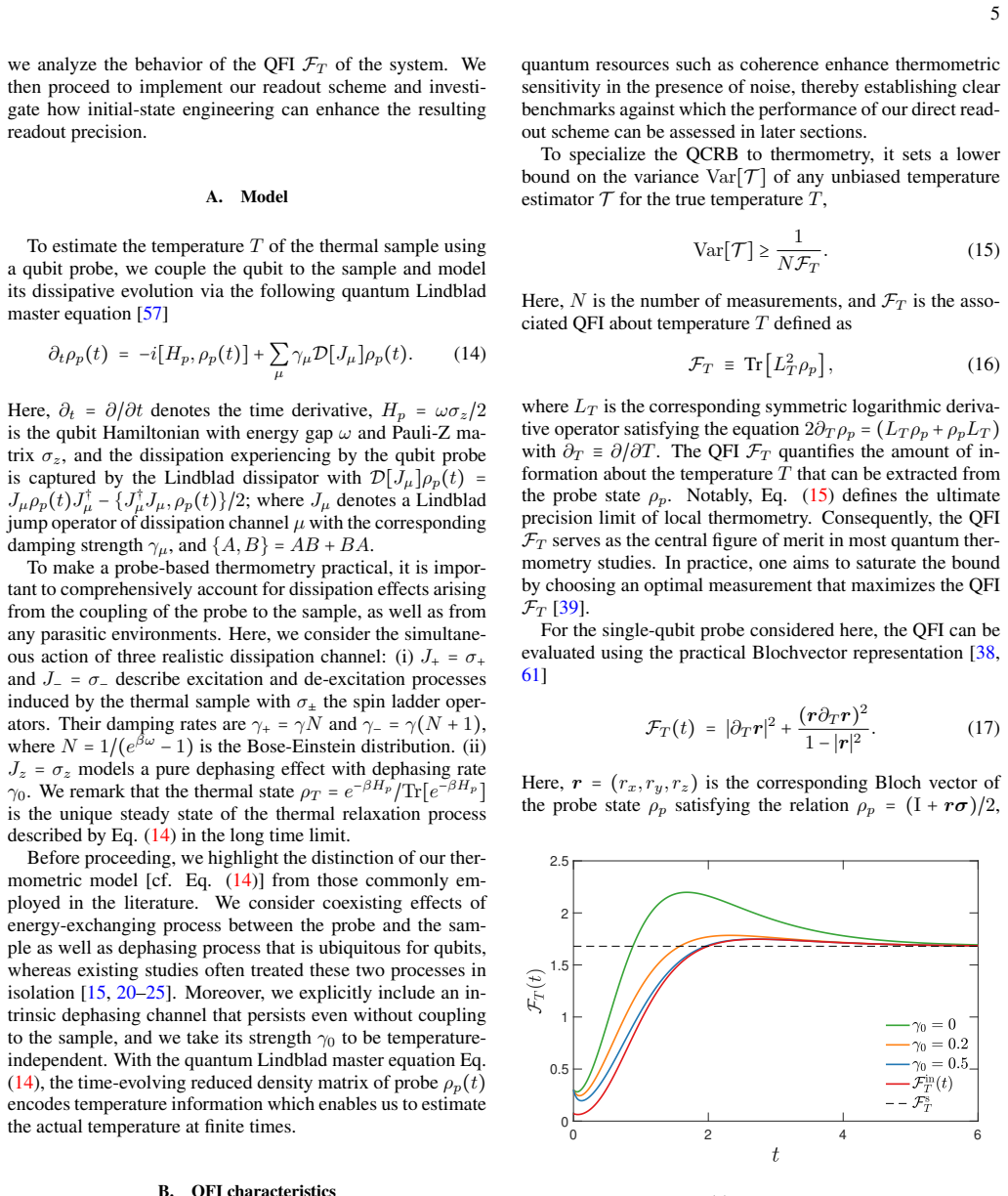

read the original abstract
Quantum thermometry aims to measure temperature in nanoscale quantum systems, paralleling classical thermometry. However, temperature is not a quantum observable, and most theoretical studies have therefore concentrated on analyzing fundamental precision limits set by the quantum Fisher information through the quantum Cramer-Rao bound. In contrast, whether a direct temperature readout can be achieved in quantum thermometry remains largely unexplored, particularly under the nonequilibrium conditions prevalent in real-world applications. To address this, we develop a direct temperature readout scheme based on a thermodynamic inference strategy. The scheme integrates two conceptual developments: (i) By applying the maximum entropy principle with the thermometer's mean energy as a constraint, we assign a reference temperature to the nonequilibrium thermometer. We demonstrate that this reference temperature outperforms a commonly used effective temperature defined through equilibrium analogy. (ii) We obtain positive semi-definite error functions that lower-bound the deviation of the reference temperature from the true temperature-in analogy to the quantum Cramer-Rao bound for the mean squared error-and vanish upon thermalization with the sample. Combining the reference temperature with these error functions, we introduce a notion of corrected dynamical temperature which furnishes a postprocessed temperature readout under nonequilibrium conditions. This corrected dynamical temperature can be evaluated adaptively without prior knowledge of the actual temperature. We validate the corrected dynamical temperature in a qubit-based thermometer under a range of nonequilibrium initial states, confirming its capability to estimate the true temperature. Importantly, we find that increasing quantum coherence can enhance the precision of this readout.
Editorial analysis
A structured set of objections, weighed in public.
Referee Report
Summary. The paper claims to introduce a direct temperature readout for nonequilibrium quantum thermometry by (i) assigning a reference temperature to the thermometer via the maximum-entropy principle constrained only by its mean energy, (ii) deriving positive semi-definite error functions that lower-bound the deviation between this reference temperature and the true temperature (vanishing at thermalization, analogous to a quantum Cramér-Rao bound), and (iii) combining them into a corrected dynamical temperature that can be evaluated adaptively from thermometer observables alone, without prior knowledge of the true temperature. Numerical validation on a qubit thermometer under various nonequilibrium initial states is reported to confirm the scheme and to show that quantum coherence can improve readout precision.
Significance. If the error functions are explicitly computable from measurable quantities and independent of the unknown true temperature, the construction supplies a practical post-processing recipe that converts a nonequilibrium thermometer into a direct temperature meter, moving the field beyond precision-limit analyses toward implementable readouts. The qubit validation and coherence-enhancement observation would then constitute concrete evidence that the method works under realistic conditions.
major comments (3)
- [Section introducing the error functions (following the reference-temperature definition)] The manuscript does not supply the explicit functional form of the positive semi-definite error functions (the objects that are supposed to furnish the correction). Without these expressions it is impossible to verify the central claim that the corrected dynamical temperature can be evaluated adaptively without prior knowledge of the true temperature; if the functions depend on T_true, the system Hamiltonian, or the unknown coupling strength, the procedure becomes circular.
- [Numerical-results section (qubit validation)] The numerical validation on the qubit thermometer is described only qualitatively in the abstract and main text; no explicit error metrics (e.g., mean-squared deviation before and after correction, tables of residuals versus evolution time, or comparison against the effective-temperature baseline) are reported. This absence prevents assessment of whether the claimed improvement is statistically meaningful or merely visual.
- [Definition of corrected dynamical temperature] The construction of the corrected dynamical temperature from the reference temperature plus the error functions is stated but not written as an explicit formula. It is therefore unclear whether the final readout remains independent of unknown parameters or reduces to a fitted quantity, directly affecting the “parameter-free adaptive evaluation” assertion.
minor comments (2)
- [Abstract and introduction] The analogy between the error functions and the quantum Cramér-Rao bound is invoked but never made mathematically precise (e.g., no statement of the precise inequality relating the error functions to the quantum Fisher information of the thermometer state).
- [Throughout the manuscript] Notation for the reference temperature, true temperature, and corrected temperature should be introduced once and used consistently; occasional switches between symbols obscure the logical flow.
Simulated Author's Rebuttal
We are grateful to the referee for their thorough review and insightful comments on our manuscript. We have carefully considered each point and made revisions to improve the clarity and completeness of the presentation. Our point-by-point responses are as follows.
read point-by-point responses
-
Referee: [Section introducing the error functions (following the reference-temperature definition)] The manuscript does not supply the explicit functional form of the positive semi-definite error functions (the objects that are supposed to furnish the correction). Without these expressions it is impossible to verify the central claim that the corrected dynamical temperature can be evaluated adaptively without prior knowledge of the true temperature; if the functions depend on T_true, the system Hamiltonian, or the unknown coupling strength, the procedure becomes circular.
Authors: We thank the referee for highlighting this important point. The error functions are obtained from the energy fluctuations of the thermometer under the maximum-entropy reference state (i.e., the thermal state consistent with the observed mean energy) and are therefore computable from measurable observables alone. They do not depend on the unknown true temperature or coupling strength. We acknowledge that the original manuscript described their properties without writing the explicit expressions; the revised version now includes these closed-form expressions in the section following the reference-temperature definition, confirming that the entire procedure remains parameter-free and adaptive. revision: yes
-
Referee: [Numerical-results section (qubit validation)] The numerical validation on the qubit thermometer is described only qualitatively in the abstract and main text; no explicit error metrics (e.g., mean-squared deviation before and after correction, tables of residuals versus evolution time, or comparison against the effective-temperature baseline) are reported. This absence prevents assessment of whether the claimed improvement is statistically meaningful or merely visual.
Authors: We agree that quantitative metrics are necessary for a rigorous assessment. The revised manuscript now contains explicit error metrics, including mean-squared deviation of the corrected temperature from the true temperature versus evolution time, tables of residuals for each initial state, and side-by-side comparisons with the effective-temperature baseline. These additions demonstrate that the improvement is statistically significant and not merely visual. revision: yes
-
Referee: [Definition of corrected dynamical temperature] The construction of the corrected dynamical temperature from the reference temperature plus the error functions is stated but not written as an explicit formula. It is therefore unclear whether the final readout remains independent of unknown parameters or reduces to a fitted quantity, directly affecting the “parameter-free adaptive evaluation” assertion.
Authors: We apologize for the lack of an explicit formula in the original text. The corrected dynamical temperature is obtained by adding a correction term built from the error functions to the reference temperature; the resulting expression depends only on the thermometer’s instantaneous mean energy and its variance. The revised manuscript now states this formula explicitly and includes a short derivation showing that no unknown parameters (true temperature, Hamiltonian details, or coupling) enter the final readout. revision: yes
Circularity Check
No significant circularity in the corrected dynamical temperature construction
full rationale
The paper defines the reference temperature directly from the thermometer's mean energy via the maximum entropy principle, a standard inference step that does not presuppose the true temperature. It then derives positive semi-definite error functions bounding the deviation from the true temperature (vanishing at thermalization) and combines them with the reference to form the corrected dynamical temperature. The abstract states this corrected quantity is evaluable adaptively from thermometer observables alone without prior knowledge of the actual temperature, with numerical validation on a qubit thermometer under nonequilibrium states. No equation or step reduces by construction to the target temperature or relies on load-bearing self-citation; the chain remains independent and externally falsifiable via the provided examples.
Axiom & Free-Parameter Ledger
axioms (1)
- domain assumption The maximum entropy principle with the thermometer's mean energy as constraint assigns a reference temperature to the nonequilibrium thermometer.
invented entities (1)
-
corrected dynamical temperature
no independent evidence
Lean theorems connected to this paper
-
IndisputableMonolith/Cost/FunctionalEquation.leanwashburn_uniqueness_aczel unclear?
unclearRelation between the paper passage and the cited Recognition theorem.
By applying the maximum entropy principle with the thermometer’s mean energy as a constraint, we assign a reference temperature... positive semi-definite error functions that lower-bound the deviation... corrected dynamical temperature
-
IndisputableMonolith/Foundation/AlphaCoordinateFixation.leanJ_uniquely_calibrated_via_higher_derivative unclear?
unclearRelation between the paper passage and the cited Recognition theorem.
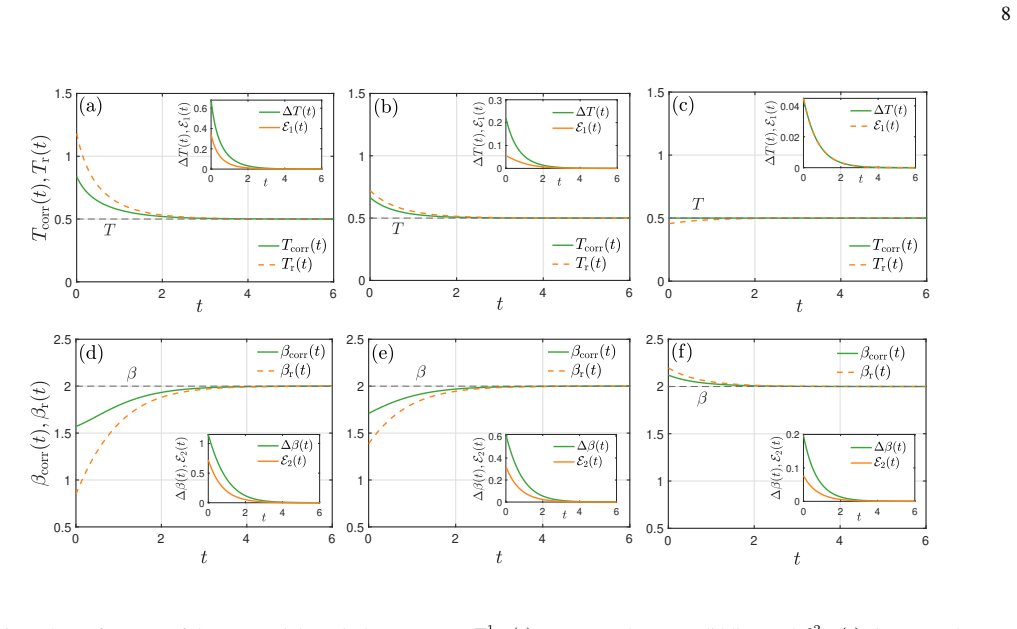
E1 ≡ |Tr D(ρp∥ρr)/Sr − |Tr S/Sr − T||, E2 ≡ |ET − Ep| / ||Hp||∞²
What do these tags mean?
- matches
- The paper's claim is directly supported by a theorem in the formal canon.
- supports
- The theorem supports part of the paper's argument, but the paper may add assumptions or extra steps.
- extends
- The paper goes beyond the formal theorem; the theorem is a base layer rather than the whole result.
- uses
- The paper appears to rely on the theorem as machinery.
- contradicts
- The paper's claim conflicts with a theorem or certificate in the canon.
- unclear
- Pith found a possible connection, but the passage is too broad, indirect, or ambiguous to say the theorem truly supports the claim.
Forward citations
Cited by 1 Pith paper
-
Surpassing thermal-state limit in thermometry via non-completely positive quantum encoding
General probe-environment correlations enable non-completely positive encodings that surpass the thermal-state bound in quantum thermometry precision.
Reference graph
Works this paper leans on
-
[1]
A set of representative results is shown in Fig
V arying initial populations We first analyze the effect of varying the diagonal elements (populations) while keeping the offdiagonal elements (coher- ences) fixed. A set of representative results is shown in Fig. 3. Panels (a)-(c) show the dynamics of the corrected dynamical temperatureT corr(t)[cf. Eq. (8)] for three initial states with increasing groun...
-
[2]
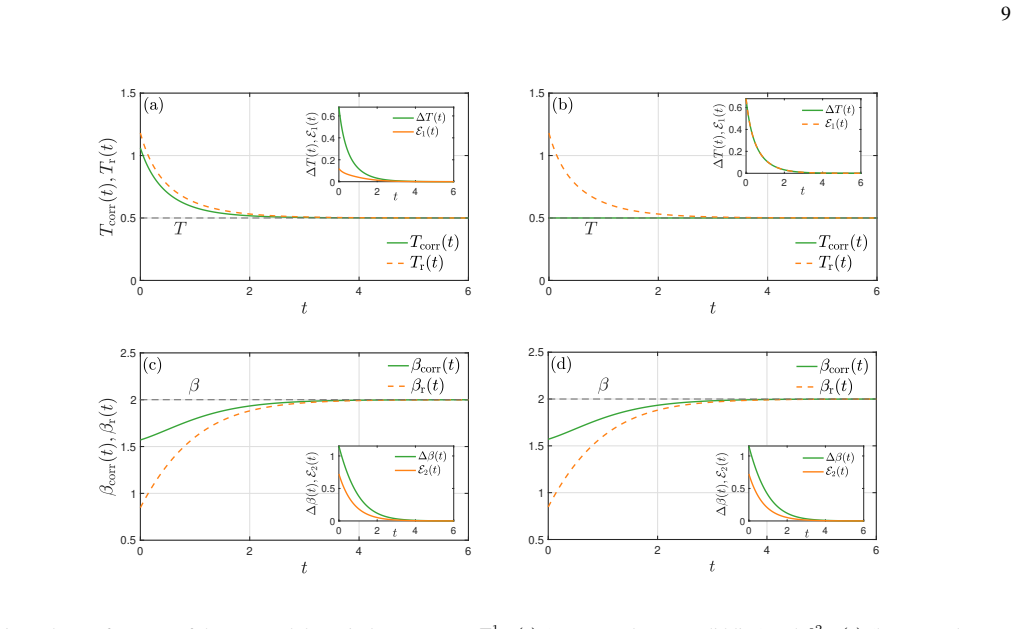
V arying initial coherence Following our analysis of diagonal-element variations, we now examine the specific role of initial quantum coherence in the performance of the direct temperature readout scheme. To isolate this effect, we fix the populations of the initial den- sity matrix and systematically vary the magnitude of its off- diagonal elements (cohe...
-
[3]
Thermometry in the quantum regime: recent theoretical progress,
M. Mehboudi, A. Sanpera, and L. Correa, “Thermometry in the quantum regime: recent theoretical progress,” J. Phys. A: Math. Theor.52, 303001 (2019)
work page 2019
-
[4]
Existence of tempera- ture on the nanoscale,
M. Hartmann, G. Mahler, and O. Hess, “Existence of tempera- ture on the nanoscale,” Phys. Rev. Lett.93, 080402 (2004)
work page 2004
-
[5]
Colloquium: The physics of maxwell’s demon and information,
K. Maruyama, F. Nori, and V . Vedral, “Colloquium: The physics of maxwell’s demon and information,” Rev. Mod. Phys. 81, 1 (2009)
work page 2009
-
[6]
Thermodynamics of information,
J. Parrondo, J. Horowitz, and T. Sagawa, “Thermodynamics of information,” Nat. Phys.11, 131 (2015)
work page 2015
-
[7]
The role of quantum information in thermodynamicsa topical review,
J. Goold, M. Huber, A. Riera, L. del Rio, and P. Skrzypczyk, “The role of quantum information in thermodynamicsa topical review,” J. Phys. A49, 143001 (2016)
work page 2016
-
[8]
I. Georgescu, S. Ashhab, and F. Nori, “Quantum simulation,” Rev. Mod. Phys.86, 153 (2014)
work page 2014
-
[9]
Many-body physics with ultracold gases,
I. Bloch, J. Dalibard, and W. Zwerger, “Many-body physics with ultracold gases,” Rev. Mod. Phys.80, 885 (2008)
work page 2008
-
[10]
Quantum information processing with supercon- ducting circuits: a review,
G. Wendin, “Quantum information processing with supercon- ducting circuits: a review,” Rep. Prog. Phys.80, 106001 (2017)
work page 2017
-
[11]
Thermometry and cooling of a bose gas to 0.02 times the con- densation temperature,
R. Olf, F. Fang, G. Marti, A. MacRae, and D. Stamper-Kurn, “Thermometry and cooling of a bose gas to 0.02 times the con- densation temperature,” Nat. Phys.11, 720 (2015)
work page 2015
-
[12]
Single-atom thermometer for ultracold gases,
M. Hohmann, F. Kindermann, T. Lausch, D. Mayer, F. Schmidt, and A. Widera, “Single-atom thermometer for ultracold gases,” Phys. Rev. A93, 043607 (2016)
work page 2016
-
[13]
Ther- mometry of a deeply degenerate fermi gas with a bose-einstein condensate,
R. Lous, I. Fritsche, M. Jag, B. Huang, and R. Grimm, “Ther- mometry of a deeply degenerate fermi gas with a bose-einstein condensate,” Phys. Rev. A95, 053627 (2017)
work page 2017
-
[14]
Nanoscale temperature mapping in operating microelectronic devices,
M. Mecklenburg, W. Hubbard, E. White, R. Dhall, S. Cronin, S Aloni, and B. Regan, “Nanoscale temperature mapping in operating microelectronic devices,” Science347, 629 (2015). 13
work page 2015
-
[15]
Qubit thermometry for micromechanical resonators,
M. Brunelli, S. Olivares, and M. Paris, “Qubit thermometry for micromechanical resonators,” Phys. Rev. A84, 032105 (2011)
work page 2011
-
[16]
Qubit- assisted thermometry of a quantum harmonic oscillator,
M. Brunelli, S. Olivares, M. Paternostro, and M. Paris, “Qubit- assisted thermometry of a quantum harmonic oscillator,” Phys. Rev. A86, 012125 (2012)
work page 2012
-
[17]
In situ thermometry of a cold fermi gas via de- phasing impurities,
M. Mitchison, T. Fogarty, G. Guarnieri, S. Campbell, T. Busch, and J. Goold, “In situ thermometry of a cold fermi gas via de- phasing impurities,” Phys. Rev. Lett.125, 080402 (2020)
work page 2020
-
[18]
Using polarons for sub-nk quantum nondemolition thermometry in a bose-einstein condensate,
M. Mehboudi, A. Lampo, C. Charalambous, L. Correa, M. Garc ´ıa-March, and M. Lewenstein, “Using polarons for sub-nk quantum nondemolition thermometry in a bose-einstein condensate,” Phys. Rev. Lett.122, 030403 (2019)
work page 2019
-
[19]
J. Rubio, J. Anders, and L. Correa, “Global quantum thermom- etry,” Phys. Rev. Lett.127, 190402 (2021)
work page 2021
-
[20]
S. Jevtic, D. Newman, T. Rudolph, and T. Stace, “Single-qubit thermometry,” Phys. Rev. A91, 012331 (2015)
work page 2015
-
[21]
Individ- ual quantum probes for optimal thermometry,
L. Correa, M Mehboudi, G. Adesso, and A. Sanpera, “Individ- ual quantum probes for optimal thermometry,” Phys. Rev. Lett. 114, 220405 (2015)
work page 2015
-
[22]
Single-qubit probes for temperature estimation in the presence of collective baths,
A. Ullah, M. Cattaneo, and ¨O. M ¨ustecaplıo˘glu, “Single-qubit probes for temperature estimation in the presence of collective baths,” Phys. Rev. A111, 062201 (2025)
work page 2025
-
[23]
Harnessing coher- ence generation for precision single- and two-qubit quantum thermometry,
Y . Aiache, A. El Allati, and K. El Anouz, “Harnessing coher- ence generation for precision single- and two-qubit quantum thermometry,” Phys. Rev. A110, 032605 (2024)
work page 2024
-
[24]
Invasive- ness of nonequilibrium pure-dephasing quantum thermometry,
F. Albarelli, M. Paris, B. Vacchini, and A. Smirne, “Invasive- ness of nonequilibrium pure-dephasing quantum thermometry,” Phys. Rev. A108, 062421 (2023)
work page 2023
-
[25]
Approaching heisenberg-scalable thermometry with built-in robustness against noise,
D.-J. Zhang and D. Tong, “Approaching heisenberg-scalable thermometry with built-in robustness against noise,” npj Quan- tum Inf.8, 81 (2022)
work page 2022
-
[26]
Quantum thermometry by single-qubit dephasing,
S. Razavian, C. Benedetti, M. Bina, Y . Akbari-Kourbolagh, and M. Paris, “Quantum thermometry by single-qubit dephasing,” Eur. Phys. J. Plus134, 284 (2019)
work page 2019
-
[27]
Discrimination of ohmic thermal baths by quantum dephasing probes,
A. Candeloro and M. Paris, “Discrimination of ohmic thermal baths by quantum dephasing probes,” Phys. Rev. A103, 012217 (2021)
work page 2021
-
[28]
Low- temperature quantum thermometry boosted by coherence gen- eration,
A. Ullah, M. Naseem, and ¨O. M ¨ustecaplıo˘glu, “Low- temperature quantum thermometry boosted by coherence gen- eration,” Phys. Rev. Res.5, 043184 (2023)
work page 2023
-
[29]
Coherence-enhanced single-qubit thermometry out of equilibrium,
G. Frazo, M. Pezzutto, Y . Omar, E. Zambrini Cruzeiro, and S. Gherardini, “Coherence-enhanced single-qubit thermometry out of equilibrium,” Entropy26, 568 (2024)
work page 2024
-
[30]
Optimal quantum ther- mometry with coarse-grained measurements,
K. Hovhannisyan, M. Jørgensen, G. Landi, ´A. Alhambra, J. Brask, and M. Perarnau-Llobet, “Optimal quantum ther- mometry with coarse-grained measurements,” PRX Quantum 2, 020322 (2021)
work page 2021
-
[31]
Bypass- ing thermalization timescales in temperature estimation using prethermal probes,
N. Anto-Sztrikacs, H. Miller, A. Nazir, and D. Segal, “Bypass- ing thermalization timescales in temperature estimation using prethermal probes,” Phys. Rev. A109, L060201 (2024)
work page 2024
-
[32]
Collisional quantum thermometry,
S. Seah, S. Nimmrichter, D. Grimmer, J. Santos, V . Scarani, and G. Landi, “Collisional quantum thermometry,” Phys. Rev. Lett.123, 180602 (2019)
work page 2019
-
[33]
Tight bound on finite-resolution quantum thermometry at low temperatures,
M. Jørgensen, P. Potts, M. Paris, and J. Brask, “Tight bound on finite-resolution quantum thermometry at low temperatures,” Phys. Rev. Res.2, 033394 (2020)
work page 2020
-
[34]
Nonequilib- rium quantum thermometry with noncommutative system-bath couplings,
Y . Aiache, A. Allati, ˙I. Demir, and K. Anouz, “Nonequilib- rium quantum thermometry with noncommutative system-bath couplings,” Phys. Rev. A112, 062229 (2025)
work page 2025
-
[35]
Measuring the temperature of cold many-body quantum systems,
K. Hovhannisyan and L. Correa, “Measuring the temperature of cold many-body quantum systems,” Phys. Rev. B98, 045101 (2018)
work page 2018
-
[36]
Dynamical approach to ancilla-assisted quantum thermometry,
A. Kiilerich, A. De Pasquale, and V . Giovannetti, “Dynamical approach to ancilla-assisted quantum thermometry,” Phys. Rev. A98, 042124 (2018)
work page 2018
-
[37]
Bridging thermodynamics and metrology in nonequilibrium quantum thermometry,
V . Cavina, L. Mancino, A. De Pasquale, I. Gianani, M. Sbros- cia, R. Booth, E. Roccia, R. Raimondi, V . Giovannetti, and M. Barbieri, “Bridging thermodynamics and metrology in nonequilibrium quantum thermometry,” Phys. Rev. A98, 050101 (2018)
work page 2018
-
[38]
Optimal nonequilibrium thermometry in Markovian environments,
P. Sekatski and M. Perarnau-Llobet, “Optimal nonequilibrium thermometry in Markovian environments,” Quantum6, 869 (2022)
work page 2022
-
[39]
Multispin probes for thermometry in the strong-coupling regime,
M. Brenes and D. Segal, “Multispin probes for thermometry in the strong-coupling regime,” Phys. Rev. A108, 032220 (2023)
work page 2023
-
[40]
Quantum fisher infor- mation matrix and multiparameter estimation,
J. Liu, H. Yuan, X. Lu, and X. Wang, “Quantum fisher infor- mation matrix and multiparameter estimation,” J. Phys. A53, 023001 (2019)
work page 2019
-
[41]
Statistical distance and the geom- etry of quantum states,
S. Braunstein and C. Caves, “Statistical distance and the geom- etry of quantum states,” Phys. Rev. Lett.72, 3439 (1994)
work page 1994
-
[42]
C. Brites, P. Lima, N. Silva, A. Mill ´an, V . Amaral, F. Palacio, and L. Carlos, “Thermometry at the nanoscale,” Nanoscale4, 4799–4829 (2012)
work page 2012
-
[43]
Thermodynamic meaning of local temperature of nonequilibrium open quantum systems,
L. Ye, X. Zheng, Y . Yan, and M. Di Ventra, “Thermodynamic meaning of local temperature of nonequilibrium open quantum systems,” Phys. Rev. B94, 245105 (2016)
work page 2016
-
[44]
Local temperatures out of equilibrium,
D. Zhang, X. Zheng, and M. Di Ventra, “Local temperatures out of equilibrium,” Phys. Rep.830, 1 (2019)
work page 2019
-
[45]
Information theory and statistical mechanics,
E. T. Jaynes, “Information theory and statistical mechanics,” Phys. Rev.106, 620–630 (1957)
work page 1957
-
[46]
Temper- ature in nonequilibrium quantum systems,
S. Alipour, F. Benatti, M. Afsary, F. Bakhshinezhad, M. Ramezani, T. Ala-Nissila, and A. T. Rezakhani, “Temper- ature in nonequilibrium quantum systems,” arXiv:2105.11915
-
[47]
Oper- ational definition of the temperature of a quantum state,
P. Lipka-Bartosik, M. Perarnau-Llobet, and N. Brunner, “Oper- ational definition of the temperature of a quantum state,” Phys. Rev. Lett.130, 040401 (2023)
work page 2023
-
[48]
Quantum mpemba effect in a quantum dot with reservoirs,
A. Chatterjee, S. Takada, and H. Hayakawa, “Quantum mpemba effect in a quantum dot with reservoirs,” Phys. Rev. Lett.131, 080402 (2023)
work page 2023
-
[49]
Entropy and temperature in finite iso- lated quantum systems,
P. Burke and M. Haque, “Entropy and temperature in finite iso- lated quantum systems,” Phys. Rev. E107, 034125 (2023)
work page 2023
-
[50]
Second law of thermodynamics without einstein relation,
B. Sorkin, H. Diamant, G. Ariel, and T. Markovich, “Second law of thermodynamics without einstein relation,” Phys. Rev. Lett.133, 267101 (2024)
work page 2024
-
[51]
Necessity for quan- tum coherence of nondegeneracy in energy flow,
T. Ma, M. Zhao, S. Fei, and M.-H. Yung, “Necessity for quan- tum coherence of nondegeneracy in energy flow,” Phys. Rev. A 99, 062303 (2019)
work page 2019
-
[52]
P. Strasberg and A. Winter, “First and second law of quantum thermodynamics: A consistent derivation based on a micro- scopic definition of entropy,” PRX Quantum2, 030202 (2021)
work page 2021
-
[53]
Inferring general links between energetics and information with unknown envi- ronment,
J. Liu, J. Lu, C. Wang, and J.-H. Jiang, “Inferring general links between energetics and information with unknown envi- ronment,” Phys. Rev. Res.6, 033202 (2024)
work page 2024
-
[54]
Experimentally probing landauer’s principle in the quantum many-body regime,
S. Aimet, M. Tajik, G. Tournaire, P. Sch ¨uttelkopf, J. Sabino, S. Sotiriadis, G. Guarnieri, J. Schmiedmayer, and J. Eisert, “Experimentally probing landauer’s principle in the quantum many-body regime,” Nat. Phys. (2025), 10.1038/s41567-025- 02930-9
-
[55]
Y . Xiao, J.-H. Jiang, and J. Liu, “Going beyond Landauer: Information-cost relations from inference based on the maxi- mum entropy principle,” arXiv:2509.17060
-
[56]
Universal landauer-like inequality from the first law of thermodynamics,
J. Liu and H. Nie, “Universal landauer-like inequality from the first law of thermodynamics,” Phys. Rev. A108, L040203 (2023)
work page 2023
-
[57]
H.-P. Breuer and F. Petruccione,The Theory of Open Quantum Systems(Oxford University Press, New York, 2002). 14
work page 2002
-
[58]
M. Kuffer, A. Zwick, and G. ´Alvarez, “Sensing out-of- equilibrium and quantum non-gaussian environments via in- duced time-reversal symmetry breaking on the quantum-probe dynamics,” PRX Quantum6, 020320 (2025)
work page 2025
-
[59]
H.-P. Breuer and F. Petruccione,The Theory of Open Quantum Systems(Oxford University Press, New York, 2007)
work page 2007
-
[60]
Quantum estimation for quantum technology,
M. Paris, “Quantum estimation for quantum technology,” Int. J. Quantum Inf.7, 125 (2009)
work page 2009
-
[61]
C. W. Helstrom,Quantum Detection and Estimation Theory (Academic, New York, 1976)
work page 1976
-
[62]
A. S. Holevo,Probabilistic and Statistical Aspects of Quantum Theory(Ed. della Normale, Pisa, 2011)
work page 2011
-
[63]
Fisher infor- mation under decoherence in bloch representation,
W. Zhong, Z. Sun, J. Ma, X. Wang, and F. Nori, “Fisher infor- mation under decoherence in bloch representation,” Phys. Rev. A87, 022337 (2013)
work page 2013
discussion (0)
Sign in with ORCID, Apple, or X to comment. Anyone can read and Pith papers without signing in.