Recognition: unknown
Surpassing thermal-state limit in thermometry via non-completely positive quantum encoding
Pith reviewed 2026-05-10 05:18 UTC · model grok-4.3
The pith
Non-completely positive encodings from initial probe-environment correlations allow quantum thermometers to surpass the thermal-state limit
A machine-rendered reading of the paper's core claim, the machinery that carries it, and where it could break.
Core claim
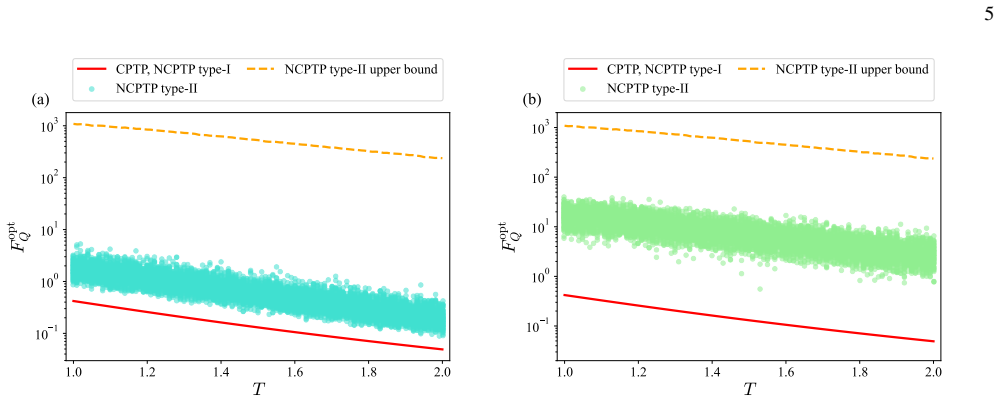
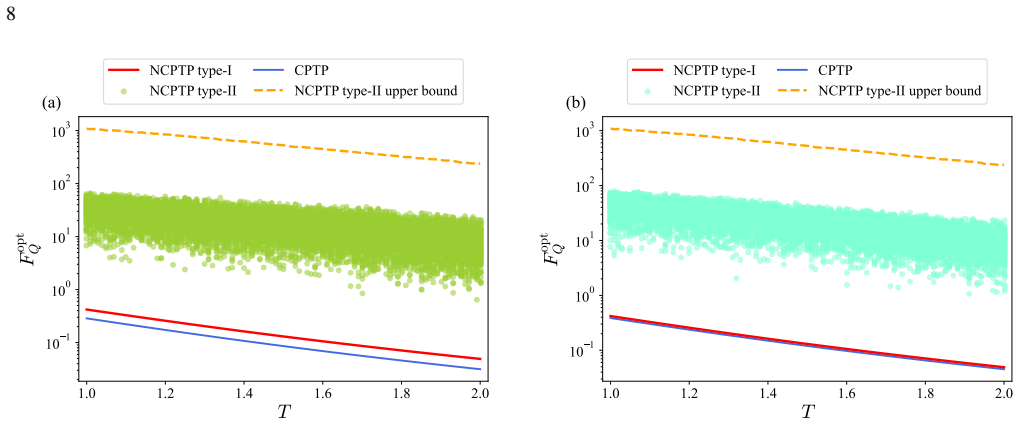
By relaxing the assumption of pure probe-environment states and allowing general correlated initial states that generate Type-II non-completely positive encodings, the maximum achievable precision in estimating the temperature of the environment surpasses the thermal-state limit that holds for completely positive encodings and for pure entangled states.
What carries the argument
Type-II non-completely positive encoding maps generated by general correlated probe-environment initial states
If this is right
- For pure entangled probe-environment states of equal but arbitrary dimension, the maximum precision matches the thermal-state bound.
- For general correlated initial states, the estimation precision can exceed the thermal-state limit.
- The improvement appears in concrete qubit-qubit systems coupled by XY interactions.
- NCP encodings therefore provide a route to better thermometric performance when initial correlations are present.
Where Pith is reading between the lines
- Engineering specific initial correlations may serve as an additional resource for precision in other quantum metrology tasks beyond thermometry.
- In laboratory settings, the presence of unavoidable correlations could convert from a limitation into an advantage for sensing.
- The same mechanism might extend to different interaction types or higher dimensions, yielding further gains in estimation accuracy.
Load-bearing premise
That the non-completely positive encodings arising from general initial probe-environment correlations are physically realizable and that the temperature estimation protocol remains valid under the model's interaction and measurement assumptions.
What would settle it
An explicit calculation of the quantum Fisher information for temperature in a qubit probe correlated with a qubit environment under XY interaction that fails to exceed the thermal-state value would falsify the surpassing claim, while a value exceeding it would support it.
Figures
read the original abstract
Conventional quantum thermometry assumes completely positive (CP) encoding maps, where the probe is initially uncorrelated with the environment. We consider realistic scenarios with initial probe-environment correlations leading to physically realizable non-completely positive (NCP) encoding, and show how such encodings can significantly impact temperature estimation of the environment. We first consider pure entangled probe-environment initial states (Type-I NCP encoding) and analytically show that for probes and environments of equal but arbitrary dimension, the maximum achievable precision matches the thermal-state bound, as in the CP case. However, upon relaxing the constraint of pure probe-environment states and considering general correlated initial states (Type-II NCP encoding), we demonstrate that the estimation precision can surpass the thermal-state limit. This establishes a clear advantage of NCP encoding in enhancing thermometric performance. We illustrate the results using qubit probes interacting with qubit environments via XY interactions.
Editorial analysis
A structured set of objections, weighed in public.
Referee Report
Summary. The paper claims that non-completely positive (NCP) encodings from initial probe-environment correlations can enhance quantum thermometry. Analytically, for pure entangled initial states (Type-I NCP) with equal-dimensional probes and environments, the maximum precision matches the thermal-state bound obtained under completely positive (CP) encodings. For general mixed correlated initial states (Type-II NCP), the estimation precision is shown to surpass the thermal-state limit, with a numerical illustration for qubit probes and environments interacting via XY couplings.
Significance. If the central claims hold, the work demonstrates a concrete advantage of realistic initial correlations in surpassing standard thermometric bounds, which is relevant for metrology in open quantum systems. The analytical equality result for Type-I provides a useful benchmark, and the Type-II surpassing claim, if physically realizable, would be a notable extension beyond CP and pure-state limits.
major comments (2)
- [Abstract and Type-II NCP encoding section] The Type-II NCP construction (abstract and main text on general correlated states) requires an initial joint probe-environment density operator whose environment marginal is exactly the thermal Gibbs state at the unknown temperature T. No T-independent preparation protocol is provided that preserves positivity, the desired correlations, and the exact thermal marginal for arbitrary unknown T; this raises a realizability issue for the thermometry protocol itself.
- [Numerical illustration for qubits] The numerical qubit-qubit illustration (final section) demonstrates mathematical surpassing but lacks a full derivation of the quantum Fisher information, error bars on the reported precision values, or an explicit check that the initial state preparation does not implicitly require knowledge of T.
minor comments (1)
- [Methods or encoding map definition] Clarify the precise definition of the encoding map for Type-II states, including how the partial trace and subsequent XY evolution are computed, to aid reproducibility.
Simulated Author's Rebuttal
We thank the referee for the careful reading of our manuscript and the constructive comments. We address each major comment below, indicating where we agree and will revise the manuscript accordingly.
read point-by-point responses
-
Referee: [Abstract and Type-II NCP encoding section] The Type-II NCP construction (abstract and main text on general correlated states) requires an initial joint probe-environment density operator whose environment marginal is exactly the thermal Gibbs state at the unknown temperature T. No T-independent preparation protocol is provided that preserves positivity, the desired correlations, and the exact thermal marginal for arbitrary unknown T; this raises a realizability issue for the thermometry protocol itself.
Authors: We acknowledge the validity of this point. The manuscript focuses on the theoretical advantage that NCP encodings from general correlated initial states can provide in surpassing the thermal-state bound, assuming such an initial joint state can be prepared with the environment marginal fixed to the Gibbs state at the true (unknown) T. We do not claim or provide a T-independent preparation protocol that works for arbitrary unknown T while preserving positivity and the required correlations. In the revised manuscript, we will explicitly clarify this assumption in the abstract and the Type-II section, and add a discussion noting that practical realization for unknown T would require either adaptive preparation or prior calibration, which is a limitation of the current analysis. revision: partial
-
Referee: [Numerical illustration for qubits] The numerical qubit-qubit illustration (final section) demonstrates mathematical surpassing but lacks a full derivation of the quantum Fisher information, error bars on the reported precision values, or an explicit check that the initial state preparation does not implicitly require knowledge of T.
Authors: We agree that additional details are needed for clarity and rigor. In the revised version, we will provide the full analytical derivation of the quantum Fisher information for the qubit-qubit XY interaction case, including the explicit form of the evolved probe state and the QFI formula used. We will also include a statement confirming that the initial correlated state is constructed using the thermal marginal at the true temperature T (as per the Type-II definition), and discuss that this assumes knowledge of T for preparation in the numerical example, consistent with the theoretical setup. Since the reported values are exact numerical evaluations for chosen parameters rather than statistical estimates, error bars are not applicable, but we will note the numerical precision of the computations. revision: yes
Circularity Check
No circularity; derivation of NCP encoding bounds is self-contained
full rationale
The paper defines Type-I (pure entangled) and Type-II (general correlated) initial states, constructs the induced encoding maps under the given XY interaction, and computes the resulting quantum Fisher information analytically. The claim that Type-II encodings can exceed the thermal-state limit follows from explicit evaluation of these maps and the QFI expression for the qubit case, without any parameter fitting, self-definition, or reduction to prior self-citations. The initial-state marginals are part of the model assumptions rather than outputs of the derivation, and no load-bearing step collapses to an input by construction.
Axiom & Free-Parameter Ledger
axioms (1)
- domain assumption Initial probe-environment correlations produce physically realizable non-completely positive encoding maps for temperature estimation.
Reference graph
Works this paper leans on
-
[1]
Type-I NCPTP encoding: the initial probe-environment joint stateρ SE is a pure entangled state
-
[2]
The probe-environment initial states in both types of NCPTP encodings are chosen such that the reduced state of the en- vironment is the thermal stateτ E
Type-II NCPTP encoding: the initial probe- environment joint stateρ SE is an arbitrary correlated state. The probe-environment initial states in both types of NCPTP encodings are chosen such that the reduced state of the en- vironment is the thermal stateτ E. The encoded probe state ρS(T)is then obtained via the action of the quantum map in Eq. (4) for th...
-
[3]
T. M. Stace, Quantum limits of thermometry, Phys. Rev. A82, 011611 (2010)
2010
-
[4]
Brunelli, S
M. Brunelli, S. Olivares, and M. G. A. Paris, Qubit thermom- etry for micromechanical resonators, Phys. Rev. A84, 032105 (2011)
2011
-
[5]
Jevtic, D
S. Jevtic, D. Newman, T. Rudolph, and T. M. Stace, Single- qubit thermometry, Phys. Rev. A91, 012331 (2015)
2015
-
[6]
L. A. Correa, M. Mehboudi, G. Adesso, and A. Sanpera, In- dividual quantum probes for optimal thermometry, Phys. Rev. Lett.114, 220405 (2015)
2015
-
[7]
Jarzyna and M
M. Jarzyna and M. Zwierz, Quantum interferometric measure- ments of temperature, Phys. Rev. A92, 032112 (2015)
2015
-
[8]
M. G. A. Paris, Achieving the landau bound to precision of quantum thermometry in systems with vanishing gap, J. Phys. A: Math. Theor.49, 03LT02 (2015)
2015
-
[9]
D. Xie, C. Xu, and A. M. Wang, Optimal quantum thermome- try by dephasing, Quantum Inf. Process.16, 155 (2017)
2017
-
[10]
Campbell, M
S. Campbell, M. Mehboudi, G. D. Chiara, and M. Paternostro, Global and local thermometry schemes in coupled quantum systems, New J. Phys.19, 103003 (2017). 9
2017
-
[11]
L. A. Correa, M. Perarnau-Llobet, K. V . Hovhannisyan, S. Hern ´andez-Santana, M. Mehboudi, and A. Sanpera, En- hancement of low-temperature thermometry by strong cou- pling, Phys. Rev. A96, 062103 (2017)
2017
-
[12]
De Pasquale and T
A. De Pasquale and T. M. Stace, Quantum thermometry, in Thermodynamics in the Quantum Regime: Fundamental As- pects and New Directions, edited by F. Binder, L. A. Correa, C. Gogolin, J. Anders, and G. Adesso (Springer International Publishing, Cham, 2018) pp. 503–527
2018
-
[13]
Seveso and M
L. Seveso and M. G. A. Paris, Trade-off between informa- tion and disturbance in qubit thermometry, Phys. Rev. A97, 032129 (2018)
2018
-
[14]
A. H. Kiilerich, A. De Pasquale, and V . Giovannetti, Dynam- ical approach to ancilla-assisted quantum thermometry, Phys. Rev. A98, 042124 (2018)
2018
-
[15]
Cavina, L
V . Cavina, L. Mancino, A. De Pasquale, I. Gianani, M. Sbros- cia, R. I. Booth, E. Roccia, R. Raimondi, V . Giovannetti, and M. Barbieri, Bridging thermodynamics and metrology in nonequilibrium quantum thermometry, Phys. Rev. A98, 050101 (2018)
2018
-
[16]
Razavian, C
S. Razavian, C. Benedetti, M. Bina, Y . Akbari-Kourbolagh, and M. G. A. Paris, Quantum thermometry by single-qubit de- phasing, Eur. Phys. J. Plus134, 284 (2019)
2019
-
[17]
Mehboudi, A
M. Mehboudi, A. Sanpera, and L. A. Correa, Thermometry in the quantum regime: recent theoretical progress, J. Phys. A: Math. Theor.52, 303001 (2019)
2019
-
[18]
P. P. Potts, J. B. Brask, and N. Brunner, Fundamental limits on low-temperature quantum thermometry with finite resolution, Quantum3, 161 (2019)
2019
-
[19]
S. Seah, S. Nimmrichter, D. Grimmer, J. P. Santos, V . Scarani, and G. T. Landi, Collisional quantum thermometry, Phys. Rev. Lett.123, 180602 (2019)
2019
-
[20]
Gebbia, C
F. Gebbia, C. Benedetti, F. Benatti, R. Floreanini, M. Bina, and M. G. A. Paris, Two-qubit quantum probes for the temperature of an ohmic environment, Phys. Rev. A101, 032112 (2020)
2020
-
[21]
A. K. Pati, C. Mukhopadhyay, S. Chakraborty, and S. Ghosh, Quantum precision thermometry with weak measurements, Phys. Rev. A102, 012204 (2020)
2020
-
[22]
M. R. Jørgensen, P. P. Potts, M. G. A. Paris, and J. B. Brask, Tight bound on finite-resolution quantum thermometry at low temperatures, Phys. Rev. Res.2, 033394 (2020)
2020
-
[23]
A. Shu, S. Seah, and V . Scarani, Surpassing the thermal cram´er-rao bound with collisional thermometry, Phys. Rev. A 102, 042417 (2020)
2020
-
[24]
W.-K. Mok, K. Bharti, L.-C. Kwek, and A. Bayat, Optimal probes for global quantum thermometry, Commun. Phys.4, 62 (2021)
2021
-
[25]
K. V . Hovhannisyan, M. R. Jørgensen, G. T. Landi, A. M. Al- hambra, J. B. Brask, and M. Perarnau-Llobet, Optimal quan- tum thermometry with coarse-grained measurements, PRX Quantum2, 020322 (2021)
2021
-
[26]
Zhang and W
Z.-Z. Zhang and W. Wu, Non-markovian temperature sensing, Phys. Rev. Res.3, 043039 (2021)
2021
-
[27]
Rubio, J
J. Rubio, J. Anders, and L. A. Correa, Global quantum ther- mometry, Phys. Rev. Lett.127, 190402 (2021)
2021
-
[28]
Planella, M
G. Planella, M. F. B. Cenni, A. Ac´ın, and M. Mehboudi, Bath- induced correlations enhance thermometry precision at low temperatures, Phys. Rev. Lett.128, 040502 (2022)
2022
-
[29]
M. F. Cenni, L. Lami, A. Ac ´ın, and M. Mehboudi, Thermom- etry of Gaussian quantum systems using Gaussian measure- ments, Quantum6, 743 (2022)
2022
-
[30]
Aybar, A
E. Aybar, A. Niezgoda, S. S. Mirkhalaf, M. W. Mitchell, D. Benedicto Orenes, and E. Witkowska, Critical quantum thermometry and its feasibility in spin systems, Quantum6, 808 (2022)
2022
-
[31]
Glatthard, J
J. Glatthard, J. Rubio, R. Sawant, T. Hewitt, G. Barontini, and L. A. Correa, Optimal cold atom thermometry using adaptive bayesian strategies, PRX Quantum3, 040330 (2022)
2022
-
[32]
Mihailescu, S
G. Mihailescu, S. Campbell, and A. K. Mitchell, Thermom- etry of strongly correlated fermionic quantum systems using impurity probes, Phys. Rev. A107, 042614 (2023)
2023
-
[33]
Brenes and D
M. Brenes and D. Segal, Multispin probes for thermometry in the strong-coupling regime, Phys. Rev. A108, 032220 (2023)
2023
-
[34]
Ullah, M
A. Ullah, M. T. Naseem, and O. E. M ¨ustecaplıo˘glu, Low- temperature quantum thermometry boosted by coherence gen- eration, Phys. Rev. Res.5, 043184 (2023)
2023
-
[35]
N. Zhang and C. Chen, Achieving heisenberg scaling in low-temperature quantum thermometry, arXiv:2407.05762 (2024)
-
[36]
A. Sone, D. O. Soares-Pinto, and S. Deffner, Conditional quantum thermometry—enhancing precision by measuring less, QST9, 045018 (2024)
2024
-
[37]
Aiache, A
Y . Aiache, A. El Allati, and K. El Anouz, Harnessing coher- ence generation for precision single- and two-qubit quantum thermometry, Phys. Rev. A110, 032605 (2024)
2024
-
[38]
A. K. Srivastava, U. Bhattacharya, M. Lewenstein, and M. Płodzie´n, Topological quantum thermometry, Phys. Rev. A111, 052216 (2025)
2025
-
[39]
Q.-S. Tan, Y . Liu, X. Liu, H. Chen, X. Xiao, and W. Wu, Lim- itations of strong coupling in non-markovian quantum ther- mometry, Phys. Rev. A112, 042612 (2025)
2025
-
[40]
Chattopadhyay, Non-gaussian dissipative quantum ther- mometry beyond gaussian bounds, Phys
P. Chattopadhyay, Non-gaussian dissipative quantum ther- mometry beyond gaussian bounds, Phys. Rev. A112, 062606 (2025)
2025
-
[41]
Ullah, M
A. Ullah, M. T. Naseem, and O. E. M ¨ustecaplio˘glu, Optimal strategies for transient and equilibrium quantum thermometry using gaussian and non-gaussian probes, Phys. Rev. A112, 062601 (2025)
2025
-
[42]
Aiache, A
Y . Aiache, A. E. Allati, i. d. I. Demir, and K. E. Anouz, Nonequilibrium quantum thermometry with noncommutative system-bath couplings, Phys. Rev. A112, 062229 (2025)
2025
-
[43]
Direct temperature readout in nonequilibrium quantum thermometry
Y . Xie and J. Liu, Direct temperature readout in nonequilib- rium quantum thermometry, arXiv:2601.07198 (2026)
work page internal anchor Pith review Pith/arXiv arXiv 2026
-
[44]
Precision Enhancement in Transient Quantum Thermometry:Cold-Probe Bias and Its Removal
D. Saha and U. Sen, Precision enhancement in transient quantum thermometry:cold-probe bias and its removal, arXiv: 2601.15237 (2026)
work page internal anchor Pith review Pith/arXiv arXiv 2026
-
[45]
Maruyama, F
K. Maruyama, F. Nori, and V . Vedral, Colloquium: The physics of maxwell’s demon and information, Rev. Mod. Phys. 81, 1 (2009)
2009
-
[46]
Bloch, J
I. Bloch, J. Dalibard, and W. Zwerger, Many-body physics with ultracold gases, Rev. Mod. Phys.80, 885 (2008)
2008
-
[47]
I. M. Georgescu, S. Ashhab, and F. Nori, Quantum simulation, Rev. Mod. Phys.86, 153 (2014)
2014
-
[48]
D. M. Toyli, C. F. de las Casas, D. J. Christle, V . V . Do- brovitski, and D. D. Awschalom, Fluorescence thermometry enhanced by the quantum coherence of single spins in dia- mond, Proc. Natl. Acad. Sci. U. S. A.110, 8417 (2013)
2013
-
[49]
Neumann, I
P. Neumann, I. Jakobi, F. Dolde, C. Burk, R. Reuter, G. Waldherr, J. Honert, T. Wolf, A. Brunner, J. H. Shim, D. Suter, H. Sumiya, J. Isoya, and J. Wrachtrup, High- precision nanoscale temperature sensing using single defects in diamond, Nano Lett.13, 2738 (2013)
2013
-
[50]
Mavalankar, S
A. Mavalankar, S. J. Chorley, J. Griffiths, G. A. C. Jones, I. Farrer, D. A. Ritchie, and C. G. Smith, A non-invasive elec- tron thermometer based on charge sensing of a quantum dot, Appl. Phys. Lett.103, 133116 (2013)
2013
-
[51]
Zhang, Y
S.-C. Zhang, Y . Dong, B. Du, H.-B. Lin, S. Li, W. Zhu, G.-Z. Wang, X.-D. Chen, G.-C. Guo, and F.-W. Sun, A robust fiber- 10 based quantum thermometer coupled with nitrogen-vacancy centers, Rev. Sci. Instrum.92, 044904 (2021)
2021
-
[52]
D. S. Lvov, S. A. Lemziakov, E. Ankerhold, J. T. Peltonen, and J. P. Pekola, Thermometry based on a superconducting qubit, Phys. Rev. Appl.23, 054079 (2025)
2025
-
[53]
C. W. Helstrom, Quantum detection and estimation theory, J. Stat. Phys.1, 231 (1969)
1969
-
[54]
A. S. Holevo, Statistical decision theory for quantum systems, JMV A3, 337 (1973)
1973
-
[55]
S. L. Braunstein and C. M. Caves, Statistical distance and the geometry of quantum states, Phys. Rev. Lett.72, 3439 (1994)
1994
-
[56]
S. L. Braunstein, C. M. Caves, and G. Milburn, Generalized uncertainty relations: Theory, examples, and lorentz invari- ance, Ann. Phys. (N. Y .)247, 135 (1996)
1996
-
[57]
Giovannetti, S
V . Giovannetti, S. Lloyd, and L. Maccone, Quantum-enhanced measurements: Beating the standard quantum limit, Science 306, 1330 (2004)
2004
-
[58]
Cappellaro, J
P. Cappellaro, J. Emerson, N. Boulant, C. Ramanathan, S. Lloyd, and D. G. Cory, Entanglement assisted metrology, Phys. Rev. Lett.94, 020502 (2005)
2005
-
[59]
Giovannetti, S
V . Giovannetti, S. Lloyd, and L. Maccone, Quantum metrol- ogy, Phys. Rev. Lett.96, 010401 (2006)
2006
-
[60]
M. G. A. Paris, Quantum estimation for quantum technology, Int. J. Quant. Inf.07, 125 (2009)
2009
-
[61]
Giovannetti, S
V . Giovannetti, S. Lloyd, and L. Maccone, Advances in quan- tum metrology, Nat. Photon.5, 222 (2011)
2011
-
[62]
A. S. Holevo,Probabilistic and statistical aspects of quantum theory, V ol. 1(Springer Science & Business Media, 2011)
2011
-
[63]
C. L. Degen, F. Reinhard, and P. Cappellaro, Quantum sens- ing, Rev. Mod. Phys.89, 035002 (2017)
2017
-
[64]
Pezz `e, A
L. Pezz `e, A. Smerzi, M. K. Oberthaler, R. Schmied, and P. Treutlein, Quantum metrology with nonclassical states of atomic ensembles, Rev. Mod. Phys.90, 035005 (2018)
2018
-
[65]
Braun, G
D. Braun, G. Adesso, F. Benatti, R. Floreanini, U. Marzolino, M. W. Mitchell, and S. Pirandola, Quantum-enhanced mea- surements without entanglement, Rev. Mod. Phys.90, 035006 (2018)
2018
-
[66]
Mukhopadhyay, V
C. Mukhopadhyay, V . Montenegro, and A. Bayat, Current trends in global quantum metrology, J. Phys. A: Math. Theor. 58, 063001 (2025)
2025
-
[67]
K. D. Agarwal, S. Mondal, A. Sahoo, D. Rakshit, A. Sen(De), and U. Sen, Quantum sensing with ultracold simulators in lat- tice and ensemble systems: A review, Int. J. Mod. Phys. C.0, 2543006 (0)
-
[68]
P. P. Hofer, J. B. Brask, M. Perarnau-Llobet, and N. Brunner, Quantum thermal machine as a thermometer, Phys. Rev. Lett. 119, 090603 (2017)
2017
-
[69]
Zhang and J
Y . Zhang and J. Chen, Thermometry based on coulomb- coupled quantum dots, Physica E114, 113635 (2019)
2019
-
[70]
Huangfu, S
Y . Huangfu, S. fan Qi, and J. Jing, A multifunctional quantum thermal device: With and without inner coupling, Phys. Lett. A393, 127172 (2021)
2021
-
[71]
C. W. Helstrom, Quantum detection and estimation theory, Journal of statistical physics1, 231 (1969)
1969
-
[72]
W. K. Wootters, Statistical distance and hilbert space, Phys. Rev. D23, 357 (1981)
1981
-
[73]
Kraus,States, Effects and Operations: Fundamental No- tions of Quantum Theory(Springer, Berlin, 1983)
K. Kraus,States, Effects and Operations: Fundamental No- tions of Quantum Theory(Springer, Berlin, 1983)
1983
-
[74]
Alicki and K
R. Alicki and K. Lendi,Quantum DynamicaL Semigroups and Applications(Springer, Berlin, 1987)
1987
-
[75]
Preskill,Lecture Notes for Physics 229: Quantum Infor- mation and Computation(California Institute of Technology, Pasadena, CA, 1998)
J. Preskill,Lecture Notes for Physics 229: Quantum Infor- mation and Computation(California Institute of Technology, Pasadena, CA, 1998)
1998
-
[76]
Pechukas, Reduced dynamics need not be completely posi- tive, Phys
P. Pechukas, Reduced dynamics need not be completely posi- tive, Phys. Rev. Lett.73, 1060 (1994)
1994
-
[77]
ˇStelmachoviˇc and V
P. ˇStelmachoviˇc and V . Buˇzek, Dynamics of open quantum systems initially entangled with environment: Beyond the kraus representation, Phys. Rev. A64, 062106 (2001)
2001
-
[78]
T. F. Jordan, A. Shaji, and E. C. G. Sudarshan, Dynamics of initially entangled open quantum systems, Phys. Rev. A70, 052110 (2004)
2004
-
[79]
Ziman, Quantum process tomography: the role of initial correlations, arXiv:quant-ph/0603166 (2006)
M. Ziman, Quantum process tomography: the role of initial correlations, arXiv:quant-ph/0603166 (2006)
-
[80]
H. A. Carteret, D. R. Terno, and K. ˙Zyczkowski, Dynamics beyond completely positive maps: Some properties and appli- cations, Phys. Rev. A77, 042113 (2008)
2008
discussion (0)
Sign in with ORCID, Apple, or X to comment. Anyone can read and Pith papers without signing in.