Recognition: 2 theorem links
· Lean TheoremGeneral gravitational properties of neutron stars: curvature invariants, binding energy, and trace anomaly
Pith reviewed 2026-05-16 14:42 UTC · model grok-4.3
The pith
Roughly half of allowed equations of state produce neutron stars with negative Ricci curvature inside them.
A machine-rendered reading of the paper's core claim, the machinery that carries it, and where it could break.
Core claim
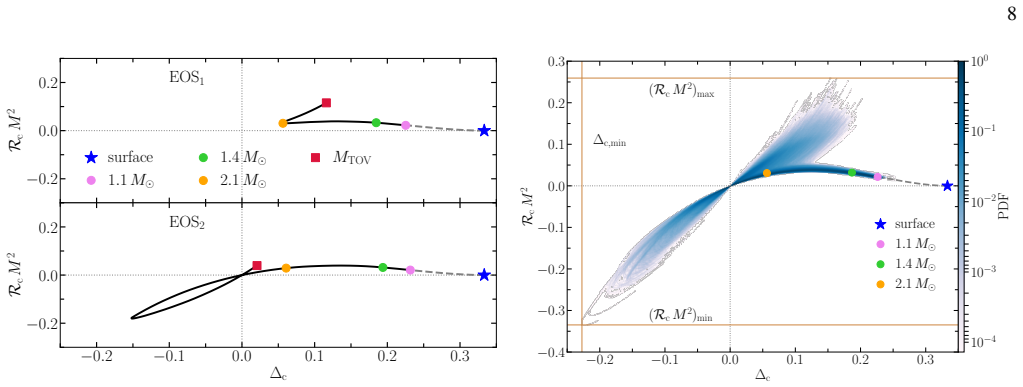
Neutron stars constructed from an ensemble of equations of state consistent with nuclear constraints, perturbative QCD, and observations commonly contain regions of negative Ricci scalar, with approximately 50 percent of the equations of state yielding at least one such star. The negative curvature occurs predominantly at the highest densities and pressures, especially for stiff equations of state and the most compact and massive stars. An improved quasi-universal relation expresses the gravitational mass M in terms of the baryonic mass Mb analytically with a maximum variance of only about 3 percent, and the connection between the Ricci scalar and the trace anomaly Delta identifies the local
What carries the argument
The constrained ensemble of equations of state together with the quasi-universal gravitational-to-baryonic mass relation and the direct link between the Ricci scalar and the trace anomaly.
If this is right
- Negative Ricci curvature occurs inside many neutron stars, especially the most massive and compact ones.
- Gravitational mass can be converted to baryonic mass with an analytic formula accurate to within three percent.
- The trace anomaly vanishes or becomes negative only in regions where the Ricci scalar satisfies specific sign and magnitude conditions.
- Stiff equations of state at high density are the most likely to produce negative interior curvature.
Where Pith is reading between the lines
- The refined mass relation could be inserted directly into merger simulations to track baryonic content without full hydrodynamic integration.
- Future radius measurements from NICER or gravitational-wave events could test whether the fraction of negative-curvature models remains near 50 percent.
- Regions of negative curvature might alter the local stability criteria or the response to external tidal fields in ways not yet calculated.
- The same curvature-trace link might be applied to hybrid stars or strange-quark-matter configurations to predict where the trace anomaly changes sign.
Load-bearing premise
The collection of equations of state examined is representative of all physically allowed matter behavior at the densities inside neutron stars.
What would settle it
A single well-measured neutron-star mass-radius pair whose required equation of state produces strictly positive Ricci curvature at every interior density would contradict the reported prevalence of negative-curvature stars.
Figures




read the original abstract
We investigate the behavior of curvature invariants for a large ensemble of neutron stars built with equations of state (EOSs) that satisfy constraints from nuclear theory and perturbative QCD, as well as measurements of neutron-star masses, radii, and gravitational waves from binary neutron-star mergers. Surprisingly, our analysis reveals that stars with negative Ricci scalar $\mathcal{R}$ are rather common and about $\sim 50\%$ of our EOSs produce one or more stars with Ricci curvature that is negative somewhere inside the star. The negative curvature is found mostly but not exclusively at the highest densities and pressures, and predominantly for stiff EOSs and for the most compact and most massive stars. Furthermore, we improve the quasi-universal relation between the stellar gravitational mass $M$ and the baryonic mass $M_\mathrm{b}$, which allows us to express analytically one in terms of the other with a maximum variance of only $\sim 3\%$. Finally, using the relation between the Ricci scalar and the trace anomaly $\Delta$, we determine the conditions under which $\Delta$ vanishes or becomes negative in neutron stars.
Editorial analysis
A structured set of objections, weighed in public.
Referee Report
Summary. The manuscript examines curvature invariants, particularly the Ricci scalar, in a large ensemble of neutron star models constructed from equations of state constrained by nuclear theory, perturbative QCD, and astrophysical observations. It reports that approximately 50% of the EOSs yield at least one star with negative Ricci scalar in some region, predominantly in stiff EOSs at high central densities. Additionally, an improved analytic quasi-universal relation between gravitational mass M and baryonic mass Mb is presented with a maximum variance of about 3%, and the conditions for the trace anomaly to vanish or become negative are analyzed using the relation to the Ricci scalar.
Significance. If the numerical findings hold under a representative ensemble, the result that negative Ricci curvature occurs in a substantial fraction of neutron stars has implications for the behavior of matter at supranuclear densities and the trace anomaly in QCD. The improved M-Mb relation provides a practical analytic tool for relating observable gravitational mass to baryonic mass in astrophysical modeling. Strengths include the use of a multi-constraint ensemble and the focus on general, EOS-independent properties; the numerical scale of the study is also a positive feature.
major comments (2)
- [Abstract and main results section] Abstract and main results section: the headline claim that ∼50% of EOSs produce one or more stars with negative Ricci scalar somewhere inside lacks any reported total number of EOSs, distribution of central densities sampled, error bars, or convergence/validation tests on the post-processing of curvature invariants, leaving the quantitative fraction only moderately supported.
- [Section presenting the M-Mb relation] Section presenting the M-Mb relation: the improved analytic expression is obtained by fitting to the same ensemble of models to which it is later applied, so the quoted maximum variance of ∼3% is a measure of goodness-of-fit rather than an independent prediction or test of quasi-universality.
minor comments (1)
- [Introduction or methods] The precise definition of the trace anomaly Δ in terms of energy density ε and pressure p should be stated explicitly at first use to avoid ambiguity with standard QCD conventions.
Simulated Author's Rebuttal
We thank the referee for their careful reading of the manuscript and for the constructive comments. We have revised the paper to improve the presentation and support of our main results, addressing each point below.
read point-by-point responses
-
Referee: [Abstract and main results section] Abstract and main results section: the headline claim that ∼50% of EOSs produce one or more stars with negative Ricci scalar somewhere inside lacks any reported total number of EOSs, distribution of central densities sampled, error bars, or convergence/validation tests on the post-processing of curvature invariants, leaving the quantitative fraction only moderately supported.
Authors: We agree that these supporting details should be stated explicitly. In the revised manuscript we now report the total number of EOSs in the ensemble, describe the distribution and range of central densities sampled for each EOS, include error estimates on the reported fraction, and add a dedicated paragraph on the numerical validation and convergence tests performed for the curvature-invariant post-processing. These additions directly strengthen the quantitative claim. revision: yes
-
Referee: [Section presenting the M-Mb relation] Section presenting the M-Mb relation: the improved analytic expression is obtained by fitting to the same ensemble of models to which it is later applied, so the quoted maximum variance of ∼3% is a measure of goodness-of-fit rather than an independent prediction or test of quasi-universality.
Authors: The referee is correct that the quoted variance is obtained from a fit to the full ensemble. We have revised the relevant section to clarify that the ∼3% maximum variance quantifies the degree of universality across the diverse, multi-constraint ensemble rather than constituting an out-of-sample prediction. To further address the concern we have added a cross-validation exercise (fitting on a random 70% subset and testing on the held-out 30%) that yields a comparable variance, confirming the robustness of the relation. revision: partial
Circularity Check
Improved M-Mb quasi-universal relation is a fit to the analyzed EOS ensemble
specific steps
-
fitted input called prediction
[Abstract and section on quasi-universal relations]
"we improve the quasi-universal relation between the stellar gravitational mass $M$ and the baryonic mass $M_mathrm{b}$, which allows us to express analytically one in terms of the other with a maximum variance of only $sim 3%$."
The analytic fit is constructed from the identical ensemble of EOS models whose properties are being analyzed; the quoted maximum variance therefore quantifies residual scatter around the fitted function rather than an independent prediction or first-principles derivation.
full rationale
The paper's central results on curvature invariants (including the ~50% fraction of EOSs yielding negative Ricci scalar) are obtained by direct numerical solution of the TOV equations over an input ensemble of EOSs constrained by nuclear theory, pQCD, and observations; this computation does not reduce to the outputs by construction. The only load-bearing step that qualifies as circularity is the reported improvement of the M-Mb analytic relation, whose ~3% variance is measured on the same ensemble to which the fit is performed. No self-citation load-bearing chains, self-definitional steps, or ansatz smuggling are present in the derivation chain. The score of 4 reflects one instance of fitted-input-called-prediction without affecting the independence of the curvature findings.
Axiom & Free-Parameter Ledger
free parameters (1)
- coefficients in the analytic M-Mb fit
axioms (1)
- domain assumption General relativity governs the spacetime geometry inside and outside the star
Lean theorems connected to this paper
-
IndisputableMonolith/Foundation/RealityFromDistinction.leanreality_from_one_distinction unclear?
unclearRelation between the paper passage and the cited Recognition theorem.
We investigate the behavior of curvature invariants for a large ensemble of neutron stars built with equations of state (EOSs) that satisfy constraints from nuclear theory and perturbative QCD... R = 24π ε Δ
-
IndisputableMonolith/Cost/FunctionalEquation.leanwashburn_uniqueness_aczel echoes?
echoesECHOES: this paper passage has the same mathematical shape or conceptual pattern as the Recognition theorem, but is not a direct formal dependency.
the improved quasi-universal relation between the stellar gravitational mass M and the baryonic mass Mb... maximum variance of only ~3%
What do these tags mean?
- matches
- The paper's claim is directly supported by a theorem in the formal canon.
- supports
- The theorem supports part of the paper's argument, but the paper may add assumptions or extra steps.
- extends
- The paper goes beyond the formal theorem; the theorem is a base layer rather than the whole result.
- uses
- The paper appears to rely on the theorem as machinery.
- contradicts
- The paper's claim conflicts with a theorem or certificate in the canon.
- unclear
- Pith found a possible connection, but the passage is too broad, indirect, or ambiguous to say the theorem truly supports the claim.
Forward citations
Cited by 1 Pith paper
-
Dynamical response of twin stars to perturbations
Twin-star configurations on the hadronic branch are dynamically favored over hybrid twins because they tolerate stronger perturbations before migrating, with binding energies serving as a proxy for this preference.
Reference graph
Works this paper leans on
-
[1]
E. S. Fraga, A. Kurkela, and A. Vuorinen, Astrophys. J. Lett. 781, L25 (2014), arXiv:1311.5154 [nucl-th]
work page internal anchor Pith review Pith/arXiv arXiv 2014
-
[2]
E. R. Most, L. R. Weih, L. Rezzolla, and J. Schaffner-Bielich, Phys.Rev.Lett.120,261103(2018),arXiv:1803.00549[gr-qc]
work page internal anchor Pith review Pith/arXiv arXiv 2018
- [3]
-
[4]
M. Ferreira, R. C. Pereira, and C. Providência, Phys. Rev. D 103, 123020 (2021)
work page 2021
-
[5]
O. Komoltsev and A. Kurkela, Phys. Rev. Lett.128, 202701 (2022), arXiv:2111.05350 [nucl-th]
- [6]
-
[7]
R. Somasundaram, I. Tews, and J. Margueron, arXiv e-prints , arXiv:2204.14039 (2022), arXiv:2204.14039 [nucl-th]
- [8]
-
[9]
Y. Fujimoto, K. Fukushima, K. Hotokezaka, and K. Kyutoku, Phys. Rev. Lett.130, 091404 (2023)
work page 2023
- [10]
-
[11]
Fukushima, Journal of Subatomic Particles and Cosmology , 100066 (2025)
K. Fukushima, Journal of Subatomic Particles and Cosmology , 100066 (2025)
work page 2025
-
[12]
Towards rapid transient identification and characterization of kilonovae
M. Coughlin, T. Dietrich, K. Kawaguchi, S. Smartt, C. Stubbs, andM.Ujevic,Astrophys.J.849,12(2017),arXiv:1708.07714 [astro-ph.HE]
work page internal anchor Pith review Pith/arXiv arXiv 2017
-
[13]
C. C. Moustakidis, T. Gaitanos, C. Margaritis, and G. A. Lalazissis, Physical Review C95, 045801 (2017), arXiv:1608.00344 [nucl-th]
work page internal anchor Pith review Pith/arXiv arXiv 2017
-
[14]
I. Tews, J. Carlson, S. Gandolfi, and S. Reddy, Astrophys. J. 860, 149 (2018), arXiv:1801.01923 [nucl-th]
work page internal anchor Pith review Pith/arXiv arXiv 2018
-
[15]
C. Margaritis, P. S. Koliogiannis, and C. C. Moustakidis, Phys. Rev. D101, 043023 (2020), arXiv:1910.05767 [nucl-th]
-
[16]
A. Kanakis-Pegios, P. S. Koliogiannis, and C. C. Moustakidis, Symmetry13, 183 (2021), arXiv:2012.09580 [astro-ph.HE]
-
[17]
M. Hippert, E. S. Fraga, and J. Noronha, Phys. Rev. D104, 034011 (2021), arXiv:2105.04535 [nucl-th]
-
[18]
S. Altiparmak, C. Ecker, and L. Rezzolla, Astrophys. J. Lett. 939, L34 (2022), arXiv:2203.14974 [astro-ph.HE]
-
[19]
Y. Fujimoto, K. Fukushima, L. D. McLerran, and M. Prasza- lowicz,Phys.Rev.Lett.129,252702(2022),arXiv:2207.06753 [nucl-th]
-
[20]
M. Marczenko, L. McLerran, K. Redlich, and C. Sasaki, Phys. Rev. C107, 025802 (2023), arXiv:2207.13059 [nucl-th]
-
[21]
C. Ecker and L. Rezzolla, Mon. Not. R. Astron. Soc.519, 2615 (2023), arXiv:2209.08101 [astro-ph.HE]
-
[22]
E. Annala, T. Gorda, J. Hirvonen, O. Komoltsev, A. Kurkela, J.Nättilä, andA.Vuorinen,NatureCommunications14(2023), 10.1038/s41467-023-44051-y
-
[23]
M. Marczenko, J. Subatomic Part. Cosmol.3, 100043 (2025), arXiv:2502.10847 [nucl-th]
- [24]
-
[25]
K. Y. Ekşi, C. Güngör, and M. M. Türkoğlu, Physical Review D89(2014), 10.1103/physrevd.89.063003
-
[26]
X.-T.He,F.J.Fattoyev,B.-A.Li, andW.G.Newton,Phys.Rev. C91, 015810 (2015)
work page 2015
- [27]
- [28]
- [29]
-
[30]
A. C. Khunt, K. Y. Eks,i, and P. C. Vinodkumar, arXiv e-prints , arXiv:2512.24194 (2025), arXiv:2512.24194 [gr-qc]
work page internal anchor Pith review Pith/arXiv arXiv 2025
-
[31]
L.RezzollaandO.Zanotti,Relativistic Hydrodynamics(Oxford University Press, 2013)
work page 2013
-
[32]
G. Baym, C. Pethick, and P. Sutherland, Astrophys. J.170, 299 (1971)
work page 1971
-
[33]
Equation of state and neutron star properties constrained by nuclear physics and observation
K. Hebeler, J. M. Lattimer, C. J. Pethick, and A. Schwenk, Astrophys. J.773, 11 (2013), arXiv:1303.4662 [astro-ph.SR]
work page internal anchor Pith review Pith/arXiv arXiv 2013
-
[34]
A Massive Pulsar in a Compact Relativistic Binary
J. Antoniadis, P. C. C. Freire, N. Wex, T. M. Tauris, R. S. Lynch, and et al., Science340, 448 (2013), arXiv:1304.6875 [astro-ph.HE]
work page internal anchor Pith review Pith/arXiv arXiv 2013
-
[35]
H. T. Cromartie, E. Fonseca, S. M. Ransom, P. B. Demor- est, Z. Arzoumanian, H. Blumer, P. R. Brook, M. E. DeCesar, T. Dolch, J. A. Ellis, R. D. Ferdman, E. C. Ferrara, N. Garver- Daniels, P. A. Gentile, M. L. Jones, M. T. Lam, D. R. Lorimer, R. S. Lynch, M. A. McLaughlin, C. Ng, D. J. Nice, T. T. Pen- nucci, R. Spiewak, I. H. Stairs, K. Stovall, J. K. Sw...
-
[36]
E. Fonseca, H. T. Cromartie, T. T. Pennucci, P. S. Ray, A. Y. Kirichenko, S. M. Ransom, P. B. Demorest, I. H. Stairs, Z. Ar- zoumanian, L. Guillemot, A. Parthasarathy, M. Kerr, I. Cog- nard,P.T.Baker,H.Blumer,P.R.Brook,M.DeCesar,T.Dolch, F. A. Dong, E. C. Ferrara, W. Fiore, N. Garver-Daniels, D. C. Good, R. Jennings, M. L. Jones, V. M. Kaspi, M. T. Lam, D...
-
[37]
M. C. Miller, F. K. Lamb, A. J. Dittmann, S. Bogdanov, Z. Ar- zoumanian,K.C.Gendreau,S.Guillot,W.C.G.Ho,J.M.Lat- timer, M. Loewenstein, S. M. Morsink, P. S. Ray, M. T. Wolff, C. L. Baker, T. Cazeau, S. Manthripragada, C. B. Markwardt, T. Okajima, S. Pollard, I. Cognard, H. T. Cromartie, E. Fon- seca, L. Guillemot, M. Kerr, A. Parthasarathy, T. T. Pennucci...
-
[38]
T. E. Riley, A. L. Watts, P. S. Ray, S. Bogdanov, S. Guillot, S. M. Morsink, A. V. Bilous, Z. Arzoumanian, D. Choudhury, J. S. Deneva, K. C. Gendreau, A. K. Harding, W. C. G. Ho, J. M. Lattimer, M. Loewenstein, R. M. Ludlam, C. B. Mark- wardt,T.Okajima,C.Prescod-Weinstein,R.A.Remillard,M.T. Wolff, E. Fonseca, H. T. Cromartie, M. Kerr, T. T. Pennucci, A.Pa...
-
[39]
T. E. Riley, A. L. Watts, S. Bogdanov, P. S. Ray, R. M. Lud- lam, S. Guillot, Z. Arzoumanian, C. L. Baker, A. V. Bilous, D. Chakrabarty, K. C. Gendreau, A. K. Harding, W. C. G. Ho, J.M.Lattimer,S.M.Morsink, andT.E.Strohmayer,Astrophys. J. Lett.887, L21 (2019), arXiv:1912.05702 [astro-ph.HE]
-
[40]
M. C. Miller, F. K. Lamb, A. J. Dittmann, S. Bogdanov, Z. Ar- zoumanian,K.C.Gendreau,S.Guillot,A.K.Harding,W.C.G. Ho, J. M. Lattimer, R. M. Ludlam, S. Mahmoodifar, S. M. Morsink, P. S. Ray, T. E. Strohmayer, K. S. Wood, T. Enoto, R. Foster, T. Okajima, G. Prigozhin, and Y. Soong, Astrophys. J. Lett.887, L24 (2019), arXiv:1912.05705 [astro-ph.HE]
-
[41]
The LIGO Scientific Collaboration, the Virgo Collaboration, B. P. Abbott, R. Abbott, T. D. Abbott, F. Acernese, K. Ackley, C. Adams, T. Adams, P. Addesso, R. X. Adhikari, V. B. Adya, and et al. (LIGO Scientific Collaboration and Virgo Collabora- tion), Physical Review X9, 011001 (2019), arXiv:1805.11579 [gr-qc]
work page internal anchor Pith review Pith/arXiv arXiv 2019
-
[42]
J. Goodman and J. Weare, Communications in applied mathe- matics and computational science5, 65 (2010)
work page 2010
-
[43]
J.GéhéniauandR.Debever,Bulletinsdel’AcadémieRoyalede Belgique42, 114 (1956)
work page 1956
- [44]
-
[45]
T. Demircik, C. Ecker, and M. Järvinen, Phys. Rev. X12, 041012 (2022), arXiv:2112.12157 [hep-ph]
-
[46]
Second Order Scalar Invariants of the Riemann Tensor: Applications to Black Hole Spacetimes
C. Cherubini, D. Bini, S. Capozziello, and R. Ruffini, Int. J. Mod. Phys. D11, 827 (2002), arXiv:gr-qc/0302095
work page internal anchor Pith review Pith/arXiv arXiv 2002
-
[47]
J. Plebanski and J. Stachel, Journal of Mathematical Physics9, 269 (1968)
work page 1968
-
[48]
Y. B. Zel’dovich, Zh. Eksp. Teor. Fiz.41, 1609 (1961)
work page 1961
-
[49]
S. Blomqvist, C. Ecker, T. Gorda, and A. Vuorinen, arXiv e-prints , arXiv:2512.19477 (2025), arXiv:2512.19477 [astro- ph.HE]. 12
-
[50]
L. Rezzolla and C. Ecker, arXiv e-prints , arXiv:2510.12870 (2025), arXiv:2510.12870 [gr-qc]
-
[51]
D. M. Podkowka, R. F. P. Mendes, and E. Poisson, Phys. Rev. D98, 064057 (2018), arXiv:1807.01565 [gr-qc]
work page internal anchor Pith review Pith/arXiv arXiv 2018
-
[52]
L.BaiottiandL.Rezzolla,Rept.Prog.Phys.80,096901(2017), arXiv:1607.03540 [gr-qc]
work page internal anchor Pith review Pith/arXiv arXiv 2017
-
[53]
General relativistic simulations of compact binary mergers as engines of short gamma-ray bursts
V. Paschalidis, Classical and Quantum Gravity34, 084002 (2017), arXiv:1611.01519 [astro-ph.HE]
work page internal anchor Pith review Pith/arXiv arXiv 2017
- [54]
-
[55]
F. X. Timmes, S. E. Woosley, and T. A. Weaver, Astrophys. J. 457, 834 (1996), astro-ph/9510136
work page internal anchor Pith review Pith/arXiv arXiv 1996
-
[56]
H. Gao, S.-K. Ai, Z.-J. Cao, B. Zhang, Z.-Y. Zhu, A. Li, N.-B. Zhang, andA.Bauswein,FrontiersofPhysics15,24603(2020), arXiv:1905.03784 [astro-ph.HE]
work page internal anchor Pith review Pith/arXiv arXiv 2020
-
[57]
J. M. Lattimer and M. Prakash, Astrophys. J.550, 426 (2001), arXiv:astro-ph/0002232 [astro-ph]
work page internal anchor Pith review Pith/arXiv arXiv 2001
-
[58]
Maximum mass, moment of inertia and compactness of relativistic stars
C. Breu and L. Rezzolla, Mon. Not. R. Astron. Soc.459, 646 (2016), arXiv:1601.06083 [gr-qc]
work page internal anchor Pith review Pith/arXiv arXiv 2016
-
[59]
Tests of general relativity from timing the double pulsar
M. Kramer, I. H. Stairs, R. N. Manchester, M. A. McLaugh- lin, A. G. Lyne, R. D. Ferdman, M. Burgay, D. R. Lorimer, A. Possenti, N. D’Amico, J. M. Sarkissian, G. B. Hobbs, J. E. Reynolds, P. C. C. Freire, and F. Camilo, Science314, 97 (2006), astro-ph/0609417
work page internal anchor Pith review Pith/arXiv arXiv 2006
-
[60]
P.Podsiadlowski,J.D.M.Dewi,P.Lesaffre,J.C.Miller,W.G. Newton, and J. R. Stone, Monthly Notices of the Royal Astro- nomical Society361, 1243–1249 (2005)
work page 2005
-
[61]
Explosions of O-Ne-Mg Cores, the Crab Supernova, and Subluminous Type II-P Supernovae
F.S.Kitaura,H.Janka, andW.Hillebrandt,Astron.Astrophys. 450, 345 (2006), arXiv:astro-ph/0512065
work page internal anchor Pith review Pith/arXiv arXiv 2006
-
[62]
D. L. Whittenbury, J. D. Carroll, A. W. Thomas, K. Tsushima, and J. R. Stone, Physical Review C89(2014), 10.1103/phys- revc.89.065801
discussion (0)
Sign in with ORCID, Apple, or X to comment. Anyone can read and Pith papers without signing in.