Recognition: 2 theorem links
· Lean TheoremPrecision Enhancement in Transient Quantum Thermometry:Cold-Probe Bias and Its Removal
Pith reviewed 2026-05-16 11:48 UTC · model grok-4.3
The pith
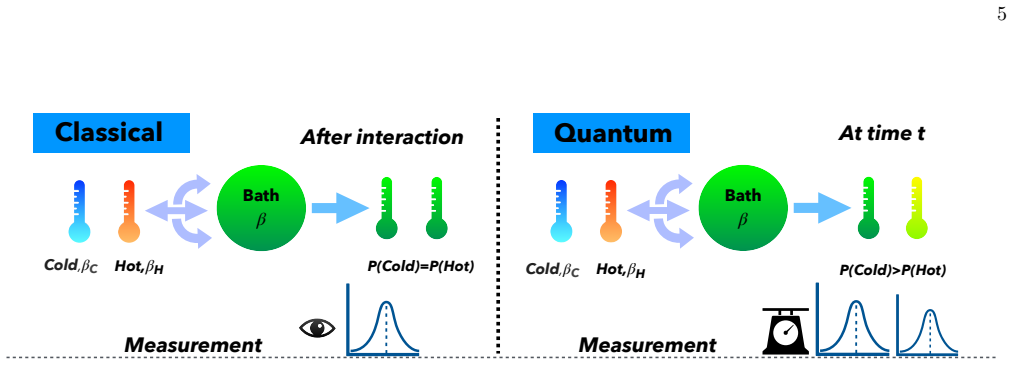
Transient quantum thermometry exceeds steady-state precision only when the probe starts colder than the bath.
A machine-rendered reading of the paper's core claim, the machinery that carries it, and where it could break.
Core claim
Transient precision beyond the steady-state benchmark can be achieved if and only if the probe is initially colder than the bath temperature to be estimated. Cold probes are therefore both necessary and sufficient for enhanced transient precision in the Markovian regime. The requirement persists under auxiliary-mediated non-Markovian coupling but is absent in perfect-swap collisional models regardless of initial temperature.
What carries the argument
The cold-probe bias: the if-and-only-if condition that initial probe temperature must lie below bath temperature to obtain transient precision exceeding the steady-state value under Markovian evolution.
If this is right
- Only initially cold probes exceed steady-state precision in the Markovian regime.
- The cold-probe requirement carries over to auxiliary-mediated non-Markovian dynamics.
- Perfect-swap collisional models eliminate any transient enhancement for every initial temperature.
- Strong non-Markovianity can remove the distinction between hot and cold probes.
Where Pith is reading between the lines
- Strong memory effects realized by swap interactions could allow hot probes to match cold-probe performance.
- Device design might select interaction type to either enforce or bypass the need for probe precooling.
- Other non-Markovian regimes could be checked to see whether hot probes regain transient advantage.
Load-bearing premise
The system obeys either standard Markovian thermalization or the chosen auxiliary-mediated and perfect-swap collisional models for non-Markovian cases.
What would settle it
An experiment or calculation that records transient precision above the steady-state benchmark using an initially hot probe in a Markovian qubit-bath setting would disprove the central claim.
Figures

read the original abstract
We unveil a fundamental temperature bias in transient quantum thermometry under Markovian dynamics. For qubit probes evolving in a thermal Markovian environment, we prove that transient precision beyond the steady-state benchmark can be achieved if and only if the probe is initially colder than the bath temperature to be estimated. Cold probes are therefore both necessary and sufficient for enhanced transient precision in the Markovian regime. We then investigate the fate of this bias in the presence of environmental memory. In particular, in a non-Markovian scenario generated by an auxiliary-mediated system-bath coupling, we find that the cold-probe requirement for enhanced transient precision persists, indicating that the temperature bias survives certain forms of memory effects. In contrast, for a non-Markovian collisional model with perfect swap interactions between bath ancillas, transient enhancement is entirely absent regardless of the probe's initial temperature. This indicates that strong non-Markovianity can lead to the complete disappearance of the enhancement effect, placing hot and cold probes on equal footing, with neither capable of achieving enhanced precision in this regime.
Editorial analysis
A structured set of objections, weighed in public.
Referee Report
Summary. The manuscript proves that, for a qubit probe undergoing Markovian thermalization with a bath via the standard Lindblad master equation, the time-dependent quantum Fisher information (QFI) for temperature estimation exceeds its steady-state value if and only if the probe is initialized colder than the bath temperature. This establishes a necessary and sufficient 'cold-probe bias' for transient precision enhancement. The paper then examines two concrete non-Markovian constructions: an auxiliary-mediated coupling, where the cold-probe requirement persists, and a perfect-swap collisional model, where transient enhancement vanishes for any initial probe temperature.
Significance. If the central Markovian result holds, the work identifies a fundamental initial-condition requirement for outperforming steady-state thermometry, with direct implications for the design of quantum temperature sensors. The explicit analytical solution of the Bloch-vector dynamics under the thermal Lindblad equation (Sec. III) supplies a parameter-free derivation that strengthens the if-and-only-if claim. The comparison with specific non-Markovian models usefully illustrates how memory effects can either preserve or eliminate the enhancement, providing falsifiable predictions for experimental tests.
major comments (1)
- [Sec. III] Sec. III: the derivation of the time-dependent QFI from the Bloch-vector solution is stated to follow directly from the initial-temperature deviation, but the manuscript should explicitly display the intermediate expression linking the deviation sign to the transient peak (e.g., the condition under which dF/dt > 0 at early times).
minor comments (3)
- The abstract asserts a 'proof' without referencing the key dynamical equation or the explicit QFI formula; adding a parenthetical pointer to Eq. (X) in Sec. III would improve accessibility.
- [non-Markovian sections] The non-Markovian sections present two specific models rather than a general theorem; the text should clarify that these are illustrative examples and not exhaustive of all memory effects.
- Figure captions for the QFI time traces should include the exact parameter values (e.g., bath temperature, coupling strength) used to generate the plots.
Simulated Author's Rebuttal
We thank the referee for their positive assessment of our work and for the constructive comment on Sec. III. We address the point below and will incorporate the requested clarification in the revised manuscript.
read point-by-point responses
-
Referee: Sec. III: the derivation of the time-dependent QFI from the Bloch-vector solution is stated to follow directly from the initial-temperature deviation, but the manuscript should explicitly display the intermediate expression linking the deviation sign to the transient peak (e.g., the condition under which dF/dt > 0 at early times).
Authors: We agree that an explicit intermediate step would improve readability. In the revised version we will insert the early-time expansion of the QFI, obtained by differentiating the Bloch-vector expression for F(t) and evaluating the sign of dF/dt at t=0^+. This yields dF/dt|_{t=0^+} > 0 if and only if the initial probe temperature lies below the bath temperature, directly confirming the necessary-and-sufficient character of the cold-probe bias without altering any results. revision: yes
Circularity Check
No significant circularity; direct analytical proof from master equation
full rationale
The central if-and-only-if claim follows from an explicit analytical solution of the qubit Bloch-vector dynamics under the standard thermal Lindblad master equation (Sec. III), with the sign of the initial-temperature deviation directly controlling whether a transient QFI peak exceeds the steady-state value. No parameters are fitted to data, no self-citations are invoked as load-bearing uniqueness theorems, and the non-Markovian constructions are presented only as concrete examples rather than general derivations. The derivation chain is therefore self-contained against the stated dynamical assumptions.
Axiom & Free-Parameter Ledger
axioms (1)
- domain assumption The qubit evolves under Markovian dynamics in a thermal bath
Lean theorems connected to this paper
-
IndisputableMonolith/Cost/FunctionalEquation.leanwashburn_uniqueness_aczel unclear?
unclearRelation between the paper passage and the cited Recognition theorem.
enhanced precision beyond the steady-state benchmark can be achieved if and only if the probe is initially colder than the bath temperature
What do these tags mean?
- matches
- The paper's claim is directly supported by a theorem in the formal canon.
- supports
- The theorem supports part of the paper's argument, but the paper may add assumptions or extra steps.
- extends
- The paper goes beyond the formal theorem; the theorem is a base layer rather than the whole result.
- uses
- The paper appears to rely on the theorem as machinery.
- contradicts
- The paper's claim conflicts with a theorem or certificate in the canon.
- unclear
- Pith found a possible connection, but the passage is too broad, indirect, or ambiguous to say the theorem truly supports the claim.
Forward citations
Cited by 1 Pith paper
-
Surpassing thermal-state limit in thermometry via non-completely positive quantum encoding
General probe-environment correlations enable non-completely positive encodings that surpass the thermal-state bound in quantum thermometry precision.
Reference graph
Works this paper leans on
-
[1]
Quantum limits of thermometry,
T. M. Stace, “Quantum limits of thermometry,” Phys. Rev. A82, 011611 (2010)
work page 2010
-
[2]
Individual quantum probes for optimal thermometry,
L. A. Correa, M. Mehboudi, G. Adesso, and A. Sanpera, “Individual quantum probes for optimal thermometry,” Phys. Rev. Lett.114, 220405 (2015)
work page 2015
-
[3]
Local quantum thermal susceptibility,
A. De Pasquale, D. Rossini, R. Fazio, and V. Giovan- netti, “Local quantum thermal susceptibility,” Nat. Com- mun.7, 12782 (2016)
work page 2016
-
[4]
Enhanced precision bound of low- temperature quantum thermometry via dynamical con- trol,
V. Mukherjee, A. Zwick, A. Ghosh, X. Chen, and G. Kurizki, “Enhanced precision bound of low- temperature quantum thermometry via dynamical con- trol,” Commun. Phys.2, 162 (2019)
work page 2019
-
[5]
Thermom- etry in the quantum regime: recent theoretical progress,
M. Mehboudi, A. Sanpera, and L. A. Correa, “Thermom- etry in the quantum regime: recent theoretical progress,” J. Phys. A Math. Theor.52, 303001 (2019)
work page 2019
-
[6]
Tight bound on finite-resolution quantum thermometry at low temperatures,
M. R. Jørgensen, P. P. Potts, M. G. A. Paris, and Jonatan B. Brask, “Tight bound on finite-resolution quantum thermometry at low temperatures,” Phys. Rev. Res.2, 033394 (2020)
work page 2020
-
[7]
Op- timal probes for global quantum thermometry,
W.-K. Mok, K. Bharti, L.-C. Kwek, and A. Bayat, “Op- timal probes for global quantum thermometry,” Comm. phys.4, 62 (2021)
work page 2021
-
[8]
Low-temperature quantum thermometry boosted by co- 10 herence generation,
A. Ullah, M. T. Naseem, and ¨O.E. M¨ ustecaplıo˘ glu, “Low-temperature quantum thermometry boosted by co- 10 herence generation,” Phys. Rev. Res.5, 043184 (2023)
work page 2023
-
[9]
J. Rubio, J. Anders, and L. A. Correa, “Global quantum thermometry,” Phys. Rev. Lett.127, 190402 (2021)
work page 2021
-
[10]
Global quantum thermometry based on the optimal bi- ased bound,
S. Chang, Y. Yan, L. Wang, W. Ye, X. Rao, H. Zhang, L. Huang, M. Luo, Y. Chen, Q. Ma, and S. Gao, “Global quantum thermometry based on the optimal bi- ased bound,” Phys. Rev. Res.6, 043171 (2024)
work page 2024
-
[11]
Quantum thermometric sensing: Local vs. remote ap- proaches,
S. M. Hosseiny, A. P. Khabisi, J. Seyed-Yazdi, M. Norouzi, S. Ghorbani, A. Ali, and S. Al-Kuwari, “Quantum thermometric sensing: Local vs. remote ap- proaches,” arXiv preprint arXiv:2510.16628 (2025)
-
[12]
Enhancing low- temperature quantum thermometry via sequential mea- surements,
N. Zhang, C. Chen, and P. Wang, “Enhancing low- temperature quantum thermometry via sequential mea- surements,” Phys. Rev. Appl.24, 044008 (2025)
work page 2025
-
[13]
Anomaly to resource: The mpemba effect in quantum thermome- try,
P. Chattopadhyay, J. F. Santos, and A. Misra, “Anomaly to resource: The mpemba effect in quantum thermome- try,” arXiv preprint arXiv:2601.05046 (2026)
-
[14]
Optimal nonequi- librium thermometry in markovian environments,
P. Sekatski and M. Perarnau-Llobet, “Optimal nonequi- librium thermometry in markovian environments,” Quantum6, 869 (2022)
work page 2022
-
[15]
Invasiveness of nonequilibrium pure- dephasing quantum thermometry,
F. Albarelli, Matteo G. A. Paris, B. Vacchini, and A. Smirne, “Invasiveness of nonequilibrium pure- dephasing quantum thermometry,” Physical Review A 108, 062421 (2023)
work page 2023
-
[16]
Coherence-enhanced single-qubit ther- mometry out of equilibrium,
G. Fraz˜ ao, M. Pezzutto, Y. Omar, E. Zambrini C., and S. Gherardini, “Coherence-enhanced single-qubit ther- mometry out of equilibrium,” Entropy26, 568 (2024)
work page 2024
-
[17]
Non-markovian enhancement of nonequilibrium quan- tum thermometry,
Y. Aiache, A. El Allati, ˙Ilkay Demir, and K. El Anouz, “Non-markovian enhancement of nonequilibrium quan- tum thermometry,” Physical Review E110, 024132 (2024)
work page 2024
-
[18]
Nonequilibrium quantum thermometry with noncom- mutative system-bath couplings,
Y. Aiache, A. El Allati, ˙I. Demir, and K. El Anouz, “Nonequilibrium quantum thermometry with noncom- mutative system-bath couplings,” Phys. Rev. A112, 062229 (2025)
work page 2025
-
[19]
High-precision nanoscale tempera- ture sensing using single spins in diamond,
P. Neumannet al., “High-precision nanoscale tempera- ture sensing using single spins in diamond,” Nano Lett. 13, 2738 (2013)
work page 2013
-
[20]
Fluorescence ther- mometry enhanced by the quantum coherence of single spins in diamond,
D. M. Toyli, C. F. de las Casas, D. J. Christle, V. V. Dobrovitski, and D. D. Awschalom, “Fluorescence ther- mometry enhanced by the quantum coherence of single spins in diamond,” PNAS110, 8417 (2013)
work page 2013
-
[21]
A robust fiber-based quantum ther- mometer coupled with nv centers,
S. C. Zhanget al., “A robust fiber-based quantum ther- mometer coupled with nv centers,” RSI92(2021)
work page 2021
-
[22]
A non-invasive electron thermometer based on charge sensing of a quan- tum dot,
A. Mavalankar, S.J. Chorley, J. Griffiths, G.A.C. Jones, I. Farrer, D.A. Ritchie, and C.G. Smith, “A non-invasive electron thermometer based on charge sensing of a quan- tum dot,” Applied Physics Letters103(2013)
work page 2013
-
[23]
Non-markovian enhancement of nonequilibrium quan- tum thermometry,
Y. Aiache, C. Seida, K. El Anouz, and A. El Allati, “Non-markovian enhancement of nonequilibrium quan- tum thermometry,” Phys. Rev. E110, 024132 (2024)
work page 2024
-
[24]
Qubit thermometry for micromechanical resonators,
M. Brunelli, S. Olivares, and M. G. A. Paris, “Qubit thermometry for micromechanical resonators,” Phys. Rev. A84, 032105 (2011)
work page 2011
-
[25]
Qubit-assisted thermometry of a quantum har- monic oscillator,
M. Brunelli, S. Olivares, M. Paternostro, and M. G. A. Paris, “Qubit-assisted thermometry of a quantum har- monic oscillator,” Phys. Rev. A86, 012125 (2012)
work page 2012
-
[27]
Dynamical role of quantum signatures in quantum thermometry,
M. M. Feyles, L. Mancino, M. Sbroscia, I. Gianani, and M. Barbieri, “Dynamical role of quantum signatures in quantum thermometry,” Phys. Rev. A99, 062114 (2019)
work page 2019
-
[28]
Tight bound on finite-resolution quantum thermometry at low temperatures,
M. R. Jørgensen, P. P. Potts, M. G. A. Paris, and J. B. Brask, “Tight bound on finite-resolution quantum thermometry at low temperatures,” Phys. Rev. Res.2, 033394 (2020)
work page 2020
-
[29]
Harness- ing coherence generation for precision single- and two- qubit quantum thermometry,
Y. Aiache, A. El Allati, and K. El Anouz, “Harness- ing coherence generation for precision single- and two- qubit quantum thermometry,” Phys. Rev. A110, 032605 (2024)
work page 2024
-
[30]
Single-qubit probes for temperature estimation in the presence of collective baths,
A. Ullah, M. Cattaneo, and ¨O. E. M¨ ustecaplıo˘ glu, “Single-qubit probes for temperature estimation in the presence of collective baths,” Phys. Rev. A111, 062201 (2025)
work page 2025
-
[31]
Quantum thermometry for ultra-low temperatures us- ing probe and ancilla qubit chains,
A. Ullah, V. Upadhyay, and ¨O. E M¨ ustecaplıo˘ glu, “Quantum thermometry for ultra-low temperatures us- ing probe and ancilla qubit chains,” Entropy27, 204 (2025)
work page 2025
-
[32]
Collisional quantum ther- mometry,
S. Seah, S. Nimmrichter, D. Grimmer, J. P. Santos, V. Scarani, and G. T. Landi, “Collisional quantum ther- mometry,” Phys. Rev. Lett.123, 180602 (2019)
work page 2019
-
[33]
Experimental implementation of a non- thermalizing quantum thermometer,
C. Raitz, A. M. Souza, R. Auccaise, R. S. Sarthour, and I. S. Oliveira, “Experimental implementation of a non- thermalizing quantum thermometer,” Quantum Informa- tion Processing14, 37 (2015)
work page 2015
-
[34]
Simulating and optimising quantum ther- mometry using single photons,
W. K. Tham, H. Ferretti, A. V. Sadashivan, and A. M. Steinberg, “Simulating and optimising quantum ther- mometry using single photons,” Scientific Reports6, 38822 (2016)
work page 2016
-
[35]
Quantum simulation of single-qubit ther- mometry using linear optics,
L. Mancino, M. Sbroscia, I. Gianani, E. Roccia, and M. Barbieri, “Quantum simulation of single-qubit ther- mometry using linear optics,” Phys. Rev. Lett.118, 130502 (2017)
work page 2017
-
[36]
Single-atom quantum probes for ultracold gases boosted by nonequilibrium spin dynamics,
Q. Bouton, J. Nettersheim, D. Adam, F. Schmidt, D. Mayer, T. Lausch, E. Tiemann, and A. Widera, “Single-atom quantum probes for ultracold gases boosted by nonequilibrium spin dynamics,” Phys. Rev. X10, 011018 (2020)
work page 2020
-
[37]
Thermometry based on a super- conducting qubit,
D. S. Lvov, S. A. Lemziakov, E. Ankerhold, J. T. Pelto- nen, and J. P. Pekola, “Thermometry based on a super- conducting qubit,” Phys. Rev. Appl.23, 054079 (2025)
work page 2025
-
[38]
E. B. Davies, “Markovian master equations,” Commun. Math. Phys.39, 91 (1974)
work page 1974
-
[39]
On the generators of quantum dynamical semigroups,
G. Lindblad, “On the generators of quantum dynamical semigroups,” Commun. Math. Phys.48, 119 (1976)
work page 1976
-
[40]
From com- pletely positive maps to the quantum markovian semi- group master equation,
D. A. Lidar, Z. Bihary, and K. B. Whaley, “From com- pletely positive maps to the quantum markovian semi- group master equation,” Chem. Phys.268, 35 (2001)
work page 2001
-
[41]
H.-P. Breuer and F. Petruccione,The theory of open quantum systems(OUP Oxford, 2002)
work page 2002
-
[42]
R. Alicki and K. Lendi,Quantum dynamical semigroups and applications, Vol. 717 (Springer, 2007)
work page 2007
- [43]
-
[44]
Lecture notes on the theory of open quan- tum systems,
D. A. Lidar, “Lecture notes on the theory of open quan- tum systems,” arXiv preprint arXiv:1902.00967 (2019)
-
[45]
Quantum detection and estimation theory,
C. W. Helstrom, “Quantum detection and estimation theory,” J. Stat. Phys.1, 231 (1969)
work page 1969
-
[46]
Masahito H., “Two quantum analogues of fisher informa- tion from a large deviation viewpoint of quantum estima- tion,” J. Phys. A Math. Gen.35, 7689 (2002)
work page 2002
-
[47]
Statistical distance and the geometry of quantum states,
S. L. Braunstein and C. M. Caves, “Statistical distance and the geometry of quantum states,” Phys. Rev. Lett. 72, 3439 (1994). 11
work page 1994
-
[48]
Measure for the degree of non-markovian behavior of quantum processes in open systems,
H.-P. Breuer, E.-M. Laine, and J. Piilo, “Measure for the degree of non-markovian behavior of quantum processes in open systems,” Phys. Rev. Lett.103, 210401 (2009)
work page 2009
-
[49]
Entan- glement and non-markovianity of quantum evolutions,
A. Rivas, S. F. Huelga, and M. B. Plenio, “Entan- glement and non-markovianity of quantum evolutions,” Phys. Rev. Lett.105, 050403 (2010)
work page 2010
-
[50]
Exact master equations for the non-markovian decay of a qubit,
B. Vacchini and H.-P. Breuer, “Exact master equations for the non-markovian decay of a qubit,” Phys. Rev. A 81, 042103 (2010)
work page 2010
-
[51]
Foundations and measures of quantum non-markovianity,
H.-P. Breuer, “Foundations and measures of quantum non-markovianity,” J. Phys. B: At. Mol. Opt. Phys.45, 154001 (2012)
work page 2012
-
[52]
Quan- tum non-markovianity: characterization, quantification and detection,
A. Rivas, S. F. Huelga, and M. B. Plenio, “Quan- tum non-markovianity: characterization, quantification and detection,” Rep. Prog. Phys.77, 094001 (2014)
work page 2014
-
[53]
Dynamics of non-markovian open quantum systems,
D. de Vega, I.and Alonso, “Dynamics of non-markovian open quantum systems,” Rev. Mod. Phys.89, 015001 (2017)
work page 2017
-
[54]
Statistical distance and hilbert space,
W. K. Wootters, “Statistical distance and hilbert space,” Phys. Rev. D23, 357 (1981)
work page 1981
-
[55]
A. S. Holevo,Probabilistic and statistical aspects of quan- tum theory, Vol. 1 (Springer Science & Business Media, 2011)
work page 2011
-
[56]
Advances in quantum metrology,
V. Giovannetti, S. Lloyd, and L. Maccone, “Advances in quantum metrology,” Nat. Photonics5, 222 (2011)
work page 2011
-
[57]
Nonclassical light and metro- logical power: An introductory review,
K. C. Tan and H. Jeong, “Nonclassical light and metro- logical power: An introductory review,” AVS Quantum Sci.1, 014701 (2019)
work page 2019
discussion (0)
Sign in with ORCID, Apple, or X to comment. Anyone can read and Pith papers without signing in.