REVIEW 3 major objections 5 minor 2 cited by
Automated heuristic design can be recast as multi-agent planning over an entailment graph that records derivation history, yielding stronger heuristics with fewer evaluations and better scaling than population- or tree-based LLM baselines.
Reviewed by Pith at T0; open to challenge. T0 means a machine referee read the full paper against a public rubric. the ladder, T0–T4 →
PathWise generates better optimization heuristics with fewer evaluations by planning over a graph memory of past derivations using multiple LLM agents.
T0 review reviewed 2026-08-03 challenge →
load-bearing objection Solid empirical package with a plausible but unverified planning mechanism — worth engaging, but the claim that the entailment graph carries real derivation signal is not yet supported. the 3 major comments →
PathWise: Planning through World Model for Automated Heuristic Design via Self-Evolving LLMs
The pith
A machine-rendered reading of the paper's core claim, the machinery that carries it, and where it could break.
The reading
Core claim
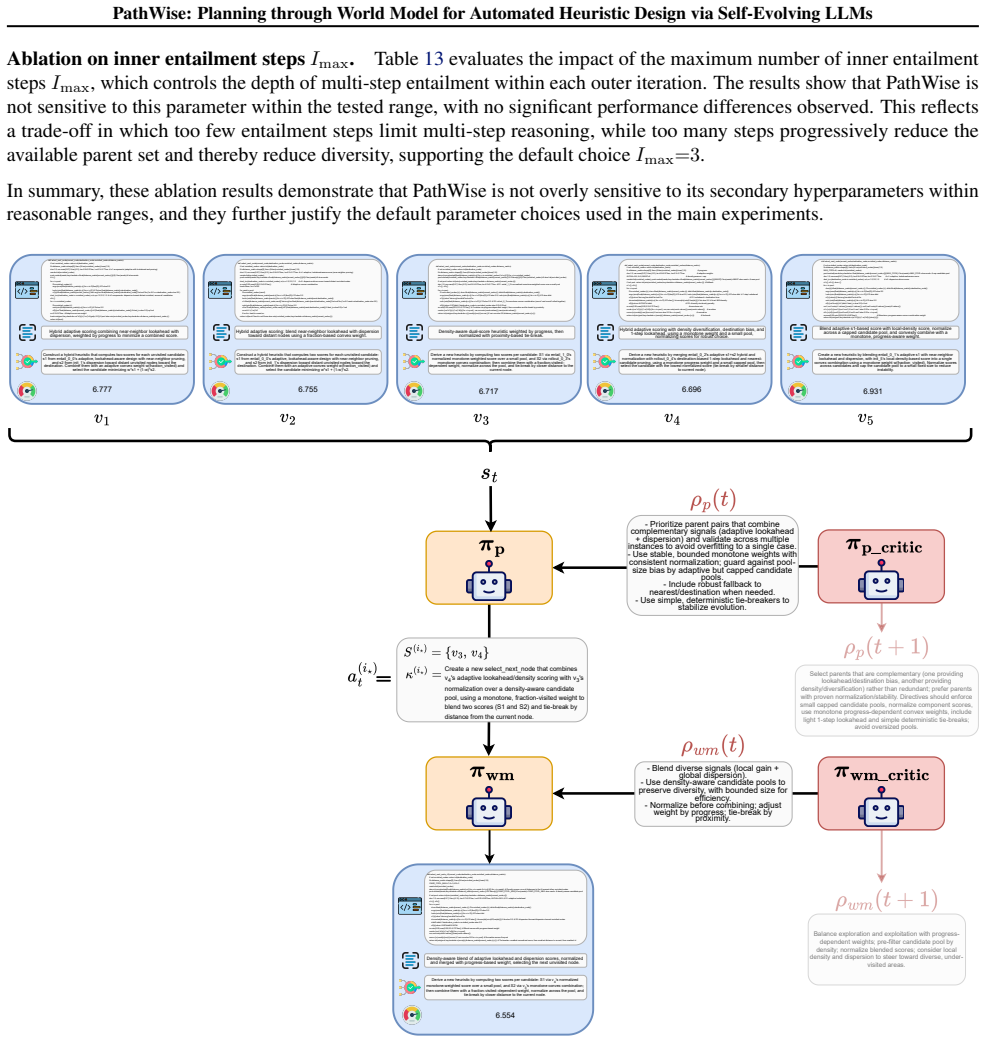
The central claim: heuristic generation can be modeled as a sequential decision process over an entailment graph—nodes store (heuristic code, its natural-language derivation rationale, an algorithmic description, measured performance, and compact parent metadata), and edges record how each child was derived from a parent set. With this stateful memory, a policy agent plans actions (parent selection plus a rationale), a world-model agent executes them by generating heuristic rollouts, and two critic agents route reflections back into the next step. The empirical claim is that this planning loop converges within about 500 evaluations to heuristics that beat population- and tree-based LLM basel
What carries the argument
The load-bearing object is the entailment graph, a stateful, compact memory of the search trajectory. Each node packages heuristic code, its natural-language derivation rationale, an algorithmic description, measured performance, and compressed parent metadata; each edge records a parent set entailing a child under a rationale. The graph sits inside a hybrid two-timescale loop (outer population, inner entailment steps) and serves as the state of an MDP whose transitions are executed by the world-model agent. Equally central is the policy/world-model/critic split: the policy chooses what to derive and why, the world model writes the code, and the critics convert performance outcomes into verb
Load-bearing premise
The framework's load-bearing premise is that the same frozen LLM, prompted as a world model, reliably translates the policy's natural-language derivation rationale into code that genuinely implements the intended transformation and tends to beat its parents—verified only by picking the best of a small set of rollouts on the training data.
What would settle it
A falsification probe: fix a batch of (parent code, derivation rationale) pairs, have the world model generate implementations, and check behaviorally (e.g., with unit tests or equivalence checks) whether the code actually carries out the stated transformation and outperforms the parents more often than chance. If it does not, the entailment graph is encoding noise, and PathWise's reported gains must come from something other than stateful planning.
If this is right
- If the central claim holds, evaluation budgets can be roughly halved: PathWise reaches stronger heuristics at 500 evaluations than baselines operating at 1000, making LLM-based heuristic discovery cheaper per unit of solution quality.
- A stateful derivation history should reduce redundant evaluations: previously tried rationales and parent combinations are recorded in the graph, so the policy can deliberately avoid rediscovering them.
- Performance gains grow with instance size and out-of-distribution shift—e.g., mean relative gap improvement on knapsack rises from about 32% in-domain to about 81% at the largest OOD test set—suggesting the planning signal transfers to harder instances better than fixed operators.
- The same framework improves over baselines with multiple LLM backbones and reasoning levels, implying the mechanism—not a single model's strength—drives the gain.
- Ablations show both critic agents and the prompt-level diversity mechanisms are load-bearing: removing either critic degrades results, removing both is worst, and removing diversity mechanisms drops selection diversity.
Where Pith is reading between the lines
- Editorial extension not tested in the paper: the entailment graph itself, as a written derivation pedigree, could be reused as few-shot context when attacking a new combinatorial problem with a different backbone—effectively transferring search experience across tasks rather than only within one run.
- Another testable extension: because the world-model critic contrasts best and worst rollouts and tends to prefer simpler code, one could add explicit trajectory- or token-cost penalties and ask whether the discovered heuristics shift along a performance-versus-wall-clock Pareto frontier (the paper reports cost but does not optimize it).
- A stress test implied by the paper's structure: probe the fidelity of the world-model handoff by sampling (parent code, rationale) pairs and independently checking whether the generated code actually implements the stated rationale; if fidelity is low, the graph stores noise, and gains would need another explanation.
- The leaf-first population update could be interpreted as an implicit restart-and-refine schedule; a controlled test would be to compare PathWise against a similarly structured method that keeps the same graph memory but replaces the LLM policy with a fixed rule-based parent selector, isolating the contribution of semantic planning from graph topology.
Editorial analysis
A structured set of objections, weighed in public.
Referee Report
Summary. PathWise proposes a multi-agent LLM framework for automated heuristic design (AHD) that replaces fixed evolutionary operators with a planning loop over an entailment graph. A policy agent selects parent heuristics and writes a natural-language derivation rationale; a world-model agent generates heuristic code conditioned on those parents and the rationale; two critic agents produce routed reflections that condition the next step. The graph stores code, rationale, algorithmic description, training performance, and parent metadata, and an outer population loop re-seeds the graph from high-performing leaf nodes. Experiments cover TSP, KP, CVRP, MKP, OP, and offline/online BPP under constructive, ACO, and GLS frameworks, using GPT-4o-mini and GPT-5-nano. The paper reports that PathWise outperforms FunSearch, EoH, ReEvo, HSEvo, and MCTS-AHD within a uniform ne=500 evaluation budget, with larger relative gap improvements on out-of-distribution and larger test sets.
Significance. If the claims hold, the paper makes a useful contribution to LLM-based AHD by showing that a stateful, graph-structured memory of derivations can improve sample efficiency over population- and tree-based baselines. The evaluation is broad: six COPs, three search frameworks, three LLM configurations, in-distribution/out-of-distribution test sets, and TSPLIB instances. The ablations of the two critics and of prompt-level diversity are informative, and Appendix F provides full prompt templates and pseudocode. The main weakness is that the central mechanism — planning through the world model — is not directly verified: the paper does not measure whether the generated code actually implements the policy's stated derivation rationale. A second weakness is statistical: all headline tables report means over only three runs without variances or significance tests, and the convergence figure uses unequal budgets. These issues are fixable and do not, on the current evidence, invalidate the empirical comparisons, but they do need to be addressed before the paper's claims are fully supported.
major comments (3)
- [§3.2 (Eq. 4), §3.4 (Eqs. 6–7), Appendix G] The world-model fidelity to the policy's derivation rationale κ is never measured. Eq. (4) conditions the world model on κ and the selected parents, and §3.1 records κ and parent metadata as if they were the true derivation history; critics then reason over these records. But there is no check that the generated code implements the intended transformation. The only support is anecdotal: Figures 4–5, and Appendix G states that the displayed code is simplified and refactored, so the figures are not raw outputs. If πwm frequently produces plausible but semantically unrelated code, the entailment edges store noise rather than derivation history, and the claimed advantage over trial-and-error evolution reduces to best-of-N sampling with extra context. Please add a quantitative fidelity check (e.g., independent annotation of κ–code alignment, a random-κ ablation, or a measure of how often the
- [§4.1, Tables 1–2; Appendix E; Fig. 1] The empirical support for the headline claims rests on means over three runs without standard deviations, confidence intervals, or significance tests. Given the stochasticity acknowledged in Appendix I.1 ('runs to diverge even under fixed settings'), 3-run means are insufficient for 'consistently outperforms', especially in cells where differences are small (e.g., KP N=100 in Table 1: 40.216 vs 40.215). Figure 1 additionally compares PathWise at 500 evaluations against baselines at 1000; the unequal budget is disclosed in the caption, but an equal-budget curve should also be provided so the 'faster convergence' claim is not conflated with a budget advantage. Please report per-run values or at least error bars, run a paired significance test, and include all-methods-at-500 and all-methods-at-1000 comparisons.
- [§3.1 and Algorithm 3] The notation v⋆ is overloaded: it denotes both the newly entailed node and the global-best node. In Algorithm 3, line 32 overwrites v⋆ with the entailed node, and lines 35–37 contain the update 'v⋆ ← v⋆', which as written does not update the global best. This makes the state-transition rule st+1 = (st ∪ {v⋆}) \ (S(i⋆) \ {v⋆}) ill-defined and harms reproducibility. Please rename the entailed node (e.g., v_new), keep the global-best variable separate, and state explicitly how h⋆ and the retained best node are updated.
minor comments (5)
- [Appendix G] Define 'GPT-5.2' or correct the model name, and make clear that the code shown in Figures 4–5 is simplified/refactored and not verbatim LLM output. Raw outputs should be included in a supplement if space permits.
- [Tables 4, 11] The column header 'TSP50' appears twice; clarify which column is the training set and which is the validation set. The caption should also specify the distinction between TSP20 and the two TSP50 columns.
- [§2.3–3.2] The 'world model' agent is not a learned model that predicts environment transitions; it is the same frozen LLM prompted to generate code. The terminology is a stretch and may mislead readers; consider a name such as 'executor model' or explicitly define in what sense the model simulates rollouts.
- [§4.2] The parameter ablations are performed only on TSP-Constructive. It would be helpful to state whether the chosen default (Na=2, Nw=2, Np=6, Imax=3) was tuned on this task and then fixed across all other problems, or whether it was chosen without per-task tuning. This affects how the reader interprets the top-line gains.
- [D.2] The paper does not mention a code release. Given the complexity of the method and the many prompt templates, I recommend releasing the implementation and raw evaluation logs to support reproducibility.
Circularity Check
No circularity in the empirical results; one self-definitional shortcut in the 'derivation memory' claim does not affect the held-out comparisons.
specific steps
-
self definitional
[Section 2.2 (entailment graph definition) and Section 3.2 (Eq. 4 / graph update)]
"Each node v∈V represents a tuple (h, κ, d, P(h;D), PM), consisting of heuristic code h, a natural-language derivation rationale κ used to generate h... Each directed edge e∈E connects a parent set S to the child node v, encoding how the heuristic was derived from its parents. ... The heuristic is inserted into the entailment graph as an entailed node v⋆ = (h⋆, κ(i⋆), d⋆, P(h⋆;D), PM(i⋆)) and added via the edge S(i⋆) κ(i⋆) ⇒ v⋆."
The graph's 'how' is populated solely from the policy's κ and the LLM's output; no check is made that h actually implements κ. The abstract-level claim that PathWise 'carry[s] forward past decisions and reuse[s] or avoid[s] derivation information' is therefore true by definition of the node tuple, not by demonstrated fidelity. If κ→code translation fails, the stored 'derivation history' is noise, and the claimed planning-over-derivation mechanism degenerates to context-conditioned LLM sampling. This is a self-definitional reduction of the mechanism claim; the empirical gains remain independently selected on Dtrain and evaluated on held-out Dtest.
full rationale
The reported performance numbers are generated by a best-of-N selection loop: rollouts from the world model are evaluated on Dtrain, the best is inserted into the entailment graph, and final heuristics are evaluated on held-out Dtest (Tables 1, 2, 7–9). No parameter is fitted to the test sets; hyperparameters are ablated on training/validation sets. Thus the main empirical claim does not reduce to a fitted input or to the policy's stated rationale. The one definitional shortcut is in the entailment-graph memory: the edge 'S ⇒ v' is created whenever the world model outputs code conditioned on κ, without verifying that the code actually implements κ, so the stored 'derivation history' is by construction the policy's stated rationale. This is a real validity gap for the 'planning' interpretation (only anecdotally supported by Figures 4–5), but it does not make the measured held-out improvements equivalent to the inputs. The self-citations (Xiong et al., 2025a,b) are related-work references for the 'world model'/structure-aware-planning framing and are not load-bearing evidence for the reported gains. Overall severity is low because the empirical derivation is self-contained against external benchmarks.
Axiom & Free-Parameter Ledger
free parameters (7)
- exploration rate schedule ε(ℓ) =
ε_init=0.5, ε_final=0.25, linear decay (Eq. 5)
- number of policy actions Na =
Na=2
- number of world-model rollouts Nw =
Nw=2
- population size Np =
Np=6
- max inner entailment steps Imax =
Imax=3
- exploration phrase inventories Φp, Φwm =
18 phrases for policy, 9 for world model (Appendix F.2)
- sampling temperature =
1.0 for all agents
axioms (5)
- domain assumption Generated heuristic code faithfully implements the policy's derivation rationale κ
- domain assumption Training-set performance P(h;Dtrain) is a reliable reward signal for test-set quality
- ad hoc to paper The state-pruning rule st+1 = (st ∪ {v⋆}) \ (S(i⋆) \ {v⋆}) preserves enough diversity
- domain assumption Verbal reflections from critic agents can steer future LLM generations
- domain assumption The evaluation budget ne=500 is a sufficient common basis for comparing methods
Cite this review
Pith. "Pith review of PathWise: Planning through World Model for Automated Heuristic Design via Self-Evolving LLMs." pith.science (2026). https://pith.science/paper/CXWSJILW
@misc{pith2026260120539,
  author       = {Pith},
  title        = {Pith review of: PathWise: Planning through World Model for Automated Heuristic Design via Self-Evolving LLMs},
  year         = {2026},
  howpublished = {\url{https://pith.science/paper/CXWSJILW}},
  note         = {Machine review of arXiv:2601.20539}
}
read the original abstract
Large Language Models (LLMs) have enabled automated heuristic design (AHD) for combinatorial optimization problems (COPs), but existing frameworks' reliance on fixed evolutionary rules and static prompt templates often leads to myopic heuristic generation, redundant evaluations, and limited reasoning about how new heuristics should be derived. We propose a novel multi-agent reasoning framework, referred to as Planning through World Model for Automated Heuristic Design via Self-Evolving LLMs (PathWise), which formulates heuristic generation as a sequential decision process over an entailment graph serving as a compact, stateful memory of the search trajectory. This approach allows the system to carry forward past decisions and reuse or avoid derivation information across generations. A policy agent plans evolutionary actions, a world model agent generates heuristic rollouts conditioned on those actions, and critic agents provide routed reflections summarizing lessons from prior steps, shifting LLM-based AHD from trial-and-error evolution toward state-aware planning through reasoning. Experiments across diverse COPs show that PathWise converges faster to better heuristics, generalizes across different LLM backbones, and scales to larger problem sizes.
Figures



Forward citations
Cited by 2 Pith papers
-
MuEvo: LLM-Driven Evolution of Multi-Heuristic Ensemble
MuEvo co-evolves multiple heuristics in an optimization solver using ensemble-level feedback and outperforms single-heuristic LLM-AHD baselines across four combinatorial domains.
-
Adaptive Information Control for Search-Augmented LLM Reasoning
DeepControl uses information-utility signals to control when search-augmented reasoning agents stop retrieving and how much evidence they expand, improving QA accuracy across seven benchmarks and two model sizes.
Reference graph
Works this paper leans on
-
[1]
Analyze the outcomes of the taken actions based on current heuristic candidates. Identify patterns behind which actions performed best and which performed worst, evaluate how their rollouts improved upon or became worse than their parent heuristics, and diagnose the key reasons behind these shifts to ground your hints
-
[2]
alpha"],beta=s[
Correlate success with the parent selection strategies and directives above. You respond with concise hints for both improving parent selection and directives toward lower objective values. Do not refer to specific parent IDs, rollout names, or code blocks. Write your reflection using less than 60 words. World Model Critic Prompt [SYSTEM PROMPT] You are a...
2024
-
[366]
Springer, 2024. Levine, J. and Ducatelle, F. Ant colony optimization and local search for bin packing and cutting stock problems. Journal of the Operational Research Society, 55(7):705– 716, 2004. 10 PathWise: Planning through World Model for Automated Heuristic Design via Self-Evolving LLMs Li, Y ., Lin, Z., Zhang, S., Fu, Q., Chen, B., Lou, J.-G., and C...
Pith/arXiv arXiv 2024
This paper was first reviewed by deepseek-v4-flash on August 3, 2026.
discussion (0)
Sign in with ORCID, Apple, or X to comment. Anyone can read and Pith papers without signing in.