Recognition: 2 theorem links
· Lean TheoremATTNPO: Attention-Guided Process Supervision for Efficient Reasoning
Pith reviewed 2026-05-16 02:40 UTC · model grok-4.3
The pith
Attention patterns inside reasoning models identify essential steps and penalize redundant ones during training.
A machine-rendered reading of the paper's core claim, the machinery that carries it, and where it could break.
Core claim
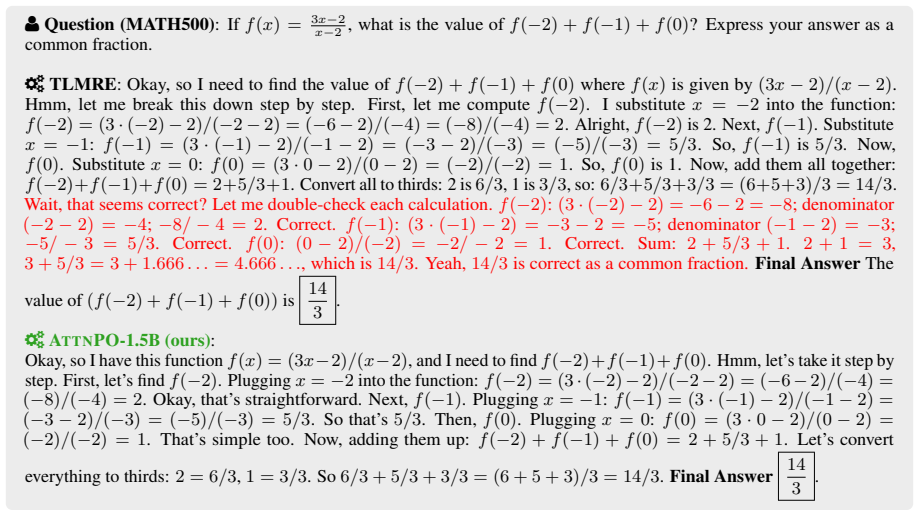
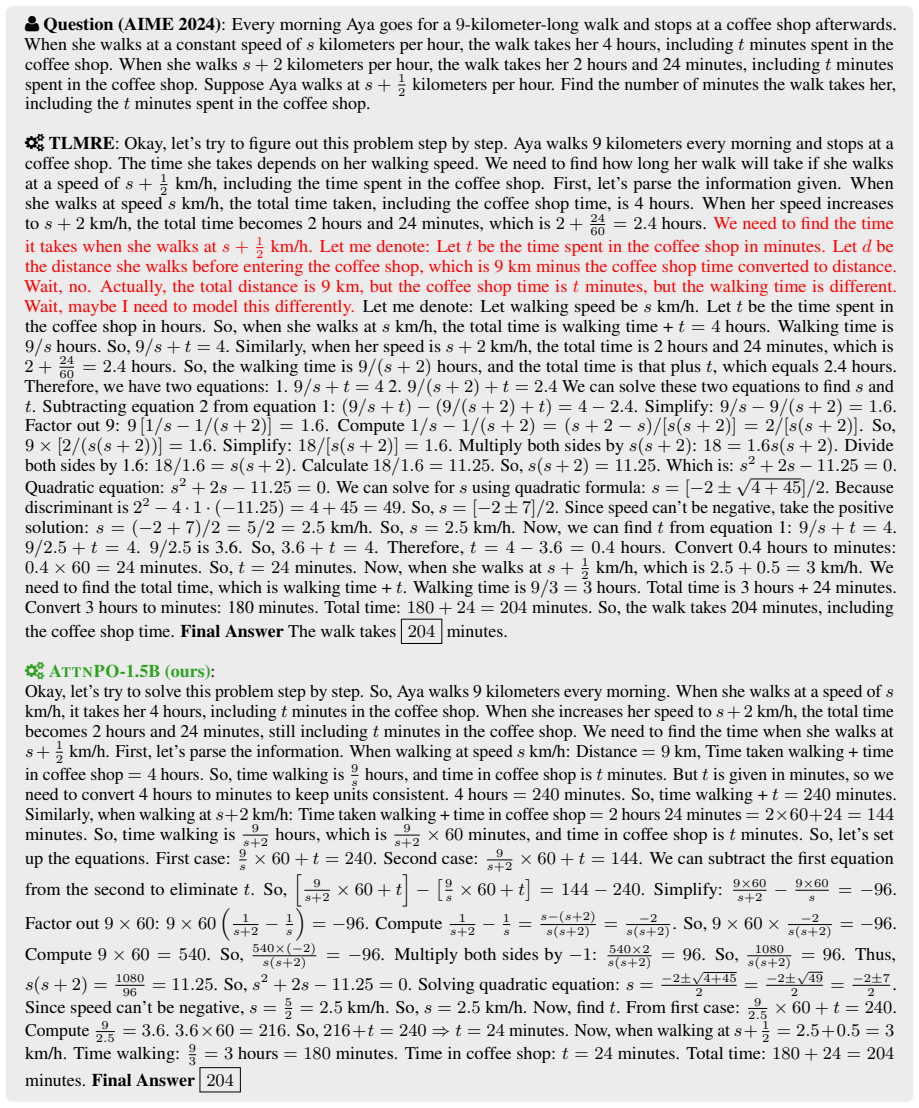
ATTNPO is a low-overhead process-supervised RL framework that first identifies special attention heads whose scores mark essential reasoning steps, then applies two sub-strategies that reduce penalties on those steps while increasing penalties on redundant ones, yielding shorter reasoning chains and higher accuracy across nine benchmarks.
What carries the argument
Special attention heads that naturally focus on essential steps while suppressing redundant ones, whose scores supply step-level credit assignment for process-supervised reinforcement learning.
Where Pith is reading between the lines
- The same heads may exist in other model families, allowing the supervision signal to transfer without retraining the heads themselves.
- Combining attention guidance with existing length-penalty methods could produce even more compact reasoning traces.
- If the heads remain stable at larger scales, the technique could become a default post-training efficiency step for reasoning models.
Load-bearing premise
A fixed set of attention heads reliably marks essential versus redundant steps across tasks and model scales without task-specific retuning.
What would settle it
If the same heads fail to correlate with accuracy-affecting steps when tested on new tasks or after further scaling, applying the penalties would either leave reasoning length unchanged or degrade final performance.
Figures




read the original abstract
Large reasoning models trained with reinforcement learning and verifiable rewards (RLVR) achieve strong performance on complex reasoning tasks, yet often overthink, generating redundant reasoning without performance gains. Existing trajectory-level length penalties often fail to effectively shorten reasoning length and degrade accuracy, as they uniformly treat all reasoning steps and lack fine-grained signals to distinguish redundancy from necessity. Meanwhile, process-supervised methods are typically resource-intensive and suffer from inaccurate credit assignment. To address these issues, we propose ATTNPO, a low-overhead process-supervised RL framework that leverages the model's intrinsic attention signals for step-level credit assignment. We first identify a set of special attention heads that naturally focus on essential steps while suppressing redundant ones. By leveraging the attention scores of these heads, We then employ two sub-strategies to mitigate overthinking by discouraging redundant steps while preserving accuracy by reducing penalties on essential steps. Experimental results show that ATTNPO substantially reduces reasoning length while significantly improving performance across 9 benchmarks.
Editorial analysis
A structured set of objections, weighed in public.
Referee Report
Summary. The paper proposes ATTNPO, a low-overhead process-supervised RL framework for reasoning models that identifies a fixed set of special attention heads whose scores are used for step-level credit assignment. Two sub-strategies then discourage redundant steps while preserving accuracy on essential ones, with the central claim being substantial reductions in reasoning length together with accuracy gains across nine benchmarks.
Significance. If the headline results hold under proper controls, the work would supply a practical, model-intrinsic alternative to expensive process supervision and uniform length penalties, directly addressing overthinking in RLVR-trained models without task-specific retuning or extra training overhead.
major comments (3)
- [Abstract] Abstract: the claim of performance gains on nine benchmarks supplies no baselines, error bars, ablation details, or statistical tests, so the central empirical claim cannot be evaluated from the available text.
- [Method] Method section (identification of special heads): the procedure for selecting the fixed set of attention heads is not described (data-driven, manual, or statistical), and no cross-task or cross-model ablation is reported to test whether these heads reliably distinguish essential from redundant steps without per-task retuning.
- [Experiments] Experimental results: the headline claim of length reduction plus accuracy improvement rests on the assumption that the same heads generalize across tasks and scales, yet the manuscript provides no evidence that the two sub-strategies preserve this property when the heads are held fixed.
minor comments (1)
- [Method] Notation for attention scores and credit-assignment weights should be defined explicitly before the two sub-strategies are introduced.
Simulated Author's Rebuttal
We thank the referee for the constructive feedback, which highlights important areas for improving clarity and completeness. We address each major comment point by point below. Where details were insufficiently described, we will revise the manuscript to incorporate the requested information and evidence.
read point-by-point responses
-
Referee: [Abstract] Abstract: the claim of performance gains on nine benchmarks supplies no baselines, error bars, ablation details, or statistical tests, so the central empirical claim cannot be evaluated from the available text.
Authors: We agree that the abstract should more explicitly reference the supporting evidence. The full manuscript contains tables comparing ATTNPO against RLVR baselines and length-penalized variants, with results averaged over multiple runs that include standard deviations. Ablation studies on head selection and the two sub-strategies appear in Section 4. We will revise the abstract to briefly note these elements (e.g., consistent gains over baselines with reported variance) and will add explicit statistical significance tests to the experiments section, referencing them from the abstract. revision: yes
-
Referee: [Method] Method section (identification of special heads): the procedure for selecting the fixed set of attention heads is not described (data-driven, manual, or statistical), and no cross-task or cross-model ablation is reported to test whether these heads reliably distinguish essential from redundant steps without per-task retuning.
Authors: The selection procedure is data-driven and was performed once on a held-out validation set of reasoning traces: heads were chosen based on statistically higher attention scores on essential steps versus redundant ones, using an entropy-based threshold. We will add a dedicated subsection with the exact algorithm, pseudocode, and hyperparameters. We will also include new cross-task and cross-model ablation results demonstrating that the fixed head set generalizes without retuning, with quantitative metrics across the nine benchmarks and different model scales. revision: yes
-
Referee: [Experiments] Experimental results: the headline claim of length reduction plus accuracy improvement rests on the assumption that the same heads generalize across tasks and scales, yet the manuscript provides no evidence that the two sub-strategies preserve this property when the heads are held fixed.
Authors: The experiments already apply the same fixed heads (identified once) uniformly across all tasks and scales, with the two sub-strategies operating without per-task adjustment, yielding the reported length reductions and accuracy gains. To make this explicit, we will add a targeted ablation subsection that fixes heads from one source task/model and evaluates the sub-strategies on the remaining benchmarks and scales, confirming preservation of the length-accuracy tradeoff. revision: yes
Circularity Check
No significant circularity: derivation relies on intrinsic attention signals
full rationale
The paper's core method identifies special attention heads from the model's existing outputs and applies their scores for step-level credit assignment in RL. No equations, fitted parameters, or predictions are shown to reduce by construction to the target length/accuracy metrics. Attention is an independent forward-pass signal rather than a learned target or self-defined quantity. No load-bearing self-citations, uniqueness theorems, or ansatzes from prior author work are invoked to justify the central claim. The approach remains self-contained against external benchmarks and does not exhibit any of the enumerated circularity patterns.
Axiom & Free-Parameter Ledger
Lean theorems connected to this paper
-
IndisputableMonolith/Foundation/RealityFromDistinction.leanreality_from_one_distinction unclear?
unclearRelation between the paper passage and the cited Recognition theorem.
We first identify a set of special attention heads that naturally focus on essential steps while suppressing redundant ones... S_l,h_sk = 1/|sk| Σ_m∈F Σ_n∈sk a_l,h_m→n
-
IndisputableMonolith/Cost/FunctionalEquation.leanwashburn_uniqueness_aczel unclear?
unclearRelation between the paper passage and the cited Recognition theorem.
ATTNPO scales the outcome-level advantage... γ_sk · A_i where γ_sk ≥ 0
What do these tags mean?
- matches
- The paper's claim is directly supported by a theorem in the formal canon.
- supports
- The theorem supports part of the paper's argument, but the paper may add assumptions or extra steps.
- extends
- The paper goes beyond the formal theorem; the theorem is a base layer rather than the whole result.
- uses
- The paper appears to rely on the theorem as machinery.
- contradicts
- The paper's claim conflicts with a theorem or certificate in the canon.
- unclear
- Pith found a possible connection, but the passage is too broad, indirect, or ambiguous to say the theorem truly supports the claim.
Forward citations
Cited by 2 Pith papers
-
Internalizing Outcome Supervision into Process Supervision: A New Paradigm for Reinforcement Learning for Reasoning
A new RL paradigm for reasoning where models generate their own internal process supervision from outcome feedback by recycling failed trajectories.
-
SHAPE: Stage-aware Hierarchical Advantage via Potential Estimation for LLM Reasoning
SHAPE improves average math reasoning accuracy by 3% while cutting token use by 30% through stage-aware hierarchical advantage and entropy-driven token redistribution.
Reference graph
Works this paper leans on
-
[1]
Evaluating Large Language Models Trained on Code
Evaluating large language models trained on code.Preprint, arXiv:2107.03374. Weize Chen, Jiarui Yuan, Tailin Jin, Ning Ding, Huimin Chen, Zhiyuan Liu, and Maosong Sun. 2025a. The overthinker’s diet: Cutting token calories with difficulty-aware training.NeurIPS. Xingyu Chen, Jiahao Xu, Tian Liang, Zhiwei He, Jianhui Pang, Dian Yu, Linfeng Song, Qiuzhi Liu,...
work page internal anchor Pith review Pith/arXiv arXiv 2026
-
[2]
Training Verifiers to Solve Math Word Problems
Training verifiers to solve math word prob- lems.Preprint, arXiv:2110.14168. Muzhi Dai, Chenxu Yang, and Qingyi Si. 2025. S-grpo: Early exit via reinforcement learning in reasoning models.NeurIPS. Jingcheng Deng, Liang Pang, Zihao Wei, Shichen Xu, Zenghao Duan, Kun Xu, Yang Song, Huawei Shen, and Xueqi Cheng. 2025. Latent reasoning in llms as a vocabulary...
work page internal anchor Pith review Pith/arXiv arXiv 2025
-
[3]
Hasan Abed Al Kader Hammoud, Hani Itani, and Bernard Ghanem
DeepSeek-R1: Incentivizing reasoning capa- bility in llms via reinforcement learning.Nature, 645(8081):633–638. Hasan Abed Al Kader Hammoud, Hani Itani, and Bernard Ghanem. 2025. Beyond the last answer: Your reasoning trace uncovers more than you think. Preprint, arXiv:2504.20708. Chaoqun He, Renjie Luo, Yuzhuo Bai, Shengding Hu, Zhen Thai, Junhao Shen, J...
-
[4]
Measuring Massive Multitask Language Understanding
Measuring massive multitask language under- standing.arXiv preprint arXiv:2009.03300. Bairu Hou, Yang Zhang, Jiabao Ji, Yujian Liu, Kaizhi Qian, Jacob Andreas, and Shiyu Chang
work page internal anchor Pith review Pith/arXiv arXiv 2009
-
[5]
Thinkprune: Pruning long chain-of-thought of llms via reinforcement learning.arXiv preprint arXiv:2504.01296. Naman Jain, King Han, Alex Gu, Wen-Ding Li, Fanjia Yan, Tianjun Zhang, Sida Wang, Armando Solar- Lezama, Koushik Sen, and Ion Stoica. 2025. Live- codebench: Holistic and contamination free evalua- tion of large language models for code. InThe Thir...
-
[6]
InThe Twelfth Inter- national Conference on Learning Representations
Let’s verify step by step. InThe Twelfth Inter- national Conference on Learning Representations. Guoming Ling, Zhongzhan Huang, Yupei Lin, Junxin Li, Shanshan Zhong, Hefeng Wu, and Liang Lin
-
[7]
Neural chain-of-thought search: Searching the optimal reasoning path to enhance large language models.arXiv preprint arXiv:2601.11340. Tianci Liu, Ran Xu, Tony Yu, Ilgee Hong, Carl Yang, Tuo Zhao, and Haoyu Wang. 2026. Open- rubrics: Towards scalable synthetic rubric generation for reward modeling and llm alignment.Preprint, arXiv:2510.07743. Wei Liu, Ruo...
work page internal anchor Pith review Pith/arXiv arXiv 2026
-
[8]
Just enough thinking: Efficient reasoning with adaptive length penalties reinforcement learning. arXiv preprint arXiv:2506.05256. Can Xie, Ruotong Pan, Xiangyu Wu, Yunfei Zhang, Jiayi Fu, Tingting Gao, and Guorui Zhou. 2025. Un- locking exploration in rlvr: Uncertainty-aware advan- tage shaping for deeper reasoning.arXiv preprint arXiv:2510.10649. Lei Yan...
-
[9]
AIME2024, AIME2025(Mathematical As- sociation of America, 2025a,b). These two datasets consist of high-school Olympiad- level assessments from the American Invita- tional Mathematics Examination (AIME) held in 2024 and 2025, respectively. Each dataset contains 30 highly challenging problems span- ning algebra, geometry, and number theory
work page 2024
-
[10]
AMC23(AI-MO, 2024). This dataset is sourced from the American Mathematics Competitions (AMC) system in 2023 and in- cludes 40 problems with mixed and hybrid question formats
work page 2024
-
[11]
OlympiadBench(He et al., 2024). This benchmark comprises a comprehensive col- lection of mathematical Olympiad problems from multiple countries. We select only the English-language math subset and retain prob- lems that require numerical answers, resulting in a total of 581 evaluation problems
work page 2024
-
[12]
MATH500(Lightman et al., 2024). This dataset is an advanced mathematics evalua- tion benchmark curated by OpenAI, contain- ing 500 problems expressed with formal math- ematical notation
work page 2024
-
[13]
GPQA-Diamond(Rein et al., 2024). This dataset is a curated subset of the GPQA (Graduate-Level Google-Proof Q&A) bench- mark and consists of 198 challenging multiple- choice questions authored and verified by do- main experts in biology, physics, and chem- istry
work page 2024
-
[14]
LiveCodeBench(Jain et al., 2025). This benchmark is designed to evaluate the live code generation capabilities of large language models, emphasizing immediate correctness and practical programming skills. We use ver- sion v6 of the dataset, which contains 1,055 problems in total
work page 2025
-
[15]
MMLU(Hendrycks et al., 2020). MMLU is a massive multitask benchmark of multiple- choice questions spanning 57 subjects, in- cluding elementary mathematics, U.S. history, computer science, and law. Achieving high accuracy requires extensive world knowledge and strong problem-solving ability. We sam- ple 50 questions from each category for evalu- ation. B.2...
work page 2020
discussion (0)
Sign in with ORCID, Apple, or X to comment. Anyone can read and Pith papers without signing in.