Recognition: 2 theorem links
· Lean TheoremAI Infrastructure Sovereignty
Pith reviewed 2026-05-16 02:51 UTC · model grok-4.3
The pith
Real AI sovereignty requires joint control over data centers, optical networks, and energy systems to operate within physical and environmental limits.
A machine-rendered reading of the paper's core claim, the machinery that carries it, and where it could break.
Core claim
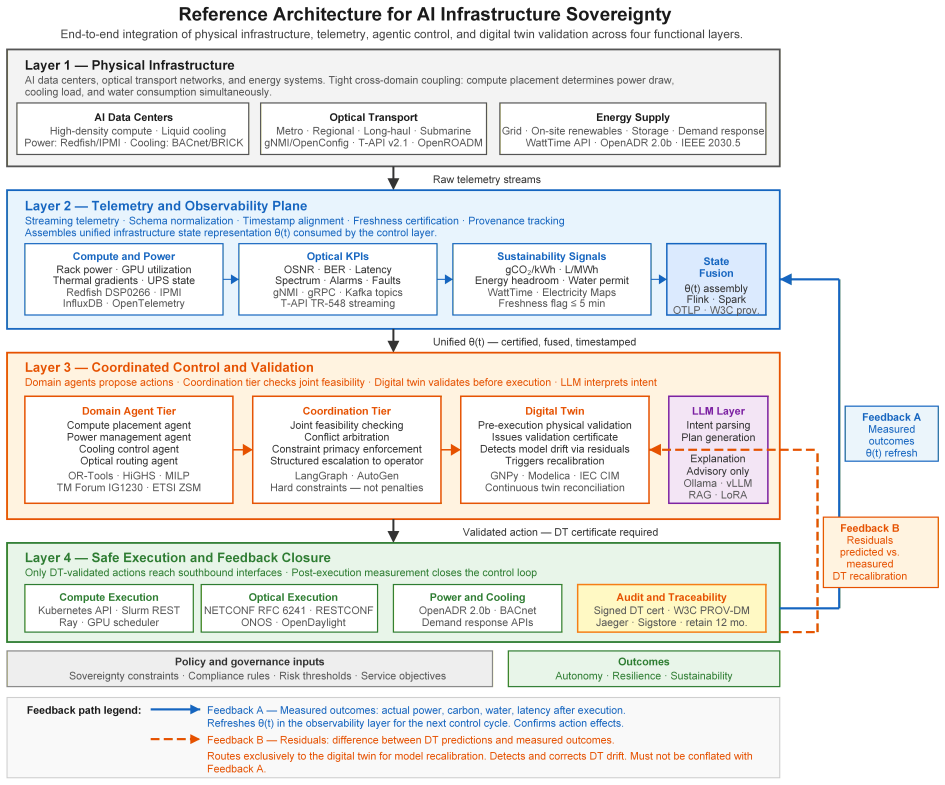
AI infrastructure sovereignty is defined as the ability of a region, operator, or nation to maintain operational control over AI systems within constraints such as energy availability, sustainability requirements, and network reach. Sovereignty emerges from the joint design of three layers: AI-oriented data centers that handle rising power densities and cooling demands, optical transport networks that serve as the backbone for distributed AI with limits on latency and capacity, and control frameworks using telemetry, agentic AI, and digital twins to provide real-time visibility and coordination across compute, network, and energy domains.
What carries the argument
The joint design of AI-oriented data centers, optical transport networks, and control frameworks that enable closed-loop monitoring and coordination across compute, network, and energy domains.
If this is right
- AI workloads will drive data centers toward higher power densities that tie deployment locations directly to local energy systems and metrics such as carbon intensity and water usage.
- Optical networks will set practical bounds on distributed AI through their effects on latency, capacity, failure domains, and cross-border reach.
- Telemetry combined with agentic AI and digital twins will supply the visibility needed to monitor and adjust system behavior across all three layers in real time.
Where Pith is reading between the lines
- Infrastructure planning would need to precede or run in parallel with algorithmic development if regions aim to retain operational AI control.
- Policy discussions on AI would expand to include physical resource mapping, such as siting data centers near reliable low-carbon power sources.
- Testing the idea could involve controlled simulations of energy-constrained distributed training to measure whether closed-loop coordination actually prevents performance collapse.
Load-bearing premise
The three layers of data centers, optical networks, and control frameworks can be jointly designed and operated without unresolved conflicts between energy limits, latency requirements, and jurisdictional boundaries.
What would settle it
A deployed AI system where energy availability or jurisdictional rules force a performance trade-off that no coordination mechanism across the three layers can resolve while still meeting target latency and throughput.
Figures




read the original abstract
Artificial intelligence has shifted from a software-centric discipline to an infrastructure-driven system. Training and inference at scale now depend on tightly connected data centers, high-capacity optical networks, and energy systems operating close to their physical and environmental limits. In this context, control over data and algorithms is not enough. Real AI sovereignty depends on the ability to deploy, operate, and adapt infrastructure under constraints such as energy availability, sustainability requirements, and network reach. This tutorial-survey introduces the concept of AI infrastructure sovereignty, defined as the ability of a region, operator, or nation to maintain operational control over AI systems within these constraints. The central idea is that sovereignty emerges from the joint design of three layers: AI-oriented data centers, optical transport networks, and control frameworks that provide real-time visibility and coordination across them. We first examine how AI workloads are reshaping data center design, pushing power densities higher, increasing cooling demands, and tightening the relationship with local energy systems. In this setting, factors such as carbon intensity and water usage become hard limits on where and how AI can be deployed. We then look at optical networks as the backbone of distributed AI, showing how latency, capacity, failure domains, and jurisdictional boundaries directly influence what can be achieved in practice. Building on this foundation, the paper highlights the role of telemetry, agentic AI, and digital twins as key enablers of operational sovereignty. Together, they make it possible to monitor, coordinate, and validate system behavior across compute, network, and energy domains in a closed loop.
Editorial analysis
A structured set of objections, weighed in public.
Referee Report
Summary. The paper introduces the concept of AI infrastructure sovereignty, defined as the ability of a region, operator, or nation to maintain operational control over AI systems under constraints such as energy availability, sustainability requirements, and network reach. It argues that this sovereignty emerges from the joint design of three layers: AI-oriented data centers (with rising power densities and cooling demands tied to local energy systems), optical transport networks (influenced by latency, capacity, failure domains, and jurisdictional boundaries), and control frameworks using telemetry, agentic AI, and digital twins for real-time visibility and closed-loop coordination across domains. The manuscript is structured as a tutorial-survey examining these elements in sequence without new derivations, data, or predictions.
Significance. If the conceptual framing holds, the paper offers a useful synthesis for connecting AI compute demands with networking and energy infrastructure limits, potentially informing engineering and policy discussions on operational control in distributed AI systems. Its value lies in organizing existing knowledge around a new term rather than advancing testable models or empirical findings, which tempers its technical novelty but supports its role as a high-level survey in the networks field.
minor comments (2)
- Abstract: the definition of AI infrastructure sovereignty is presented clearly but could be strengthened by briefly contrasting it with related terms such as digital sovereignty or data sovereignty to highlight its distinct infrastructure focus.
- The manuscript lacks an explicit roadmap or section outline (typically at the end of the introduction) that maps the discussion of the three layers, which would improve readability for a tutorial-style survey.
Simulated Author's Rebuttal
We thank the referee for the careful reading and positive assessment of the manuscript as a useful high-level synthesis that organizes existing knowledge around the concept of AI infrastructure sovereignty. We appreciate the recommendation for minor revision and note that the referee correctly characterizes the paper as a tutorial-survey without new derivations or empirical predictions. Since no specific major comments were provided, we interpret the minor-revision recommendation as an invitation for any editorial polishing the editor may require; we are prepared to make such adjustments.
Circularity Check
No significant circularity; purely definitional framing
full rationale
The paper is a tutorial-survey that explicitly introduces 'AI infrastructure sovereignty' as a conceptual definition: the ability to maintain operational control under energy, sustainability, and network constraints, emerging from joint design of data centers, optical networks, and control frameworks. No equations, fitted parameters, predictions, simulations, or quantitative derivations appear in the provided text. The central claim is presented as an organizing definition drawing on established infrastructure facts rather than reducing any output to inputs by construction. No self-citation chains, uniqueness theorems, or ansatzes are invoked as load-bearing steps. This matches the default expectation of no circularity for descriptive survey papers.
Axiom & Free-Parameter Ledger
axioms (1)
- domain assumption AI workloads are reshaping data center design by pushing power densities higher and tightening relationships with local energy systems
invented entities (1)
-
AI infrastructure sovereignty
no independent evidence
Lean theorems connected to this paper
-
IndisputableMonolith/Foundation/RealityFromDistinction.leanreality_from_one_distinction unclear?
unclearRelation between the paper passage and the cited Recognition theorem.
Real AI sovereignty depends on the ability to deploy, operate, and adapt infrastructure under constraints such as energy availability, sustainability requirements, and network reach, emerging from the joint design of AI-oriented data centers, optical transport networks, and control frameworks.
-
IndisputableMonolith/Cost/FunctionalEquation.leanwashburn_uniqueness_aczel unclear?
unclearRelation between the paper passage and the cited Recognition theorem.
telemetry, agentic AI, and digital twins as key enablers of operational sovereignty... closed loop
What do these tags mean?
- matches
- The paper's claim is directly supported by a theorem in the formal canon.
- supports
- The theorem supports part of the paper's argument, but the paper may add assumptions or extra steps.
- extends
- The paper goes beyond the formal theorem; the theorem is a base layer rather than the whole result.
- uses
- The paper appears to rely on the theorem as machinery.
- contradicts
- The paper's claim conflicts with a theorem or certificate in the canon.
- unclear
- Pith found a possible connection, but the passage is too broad, indirect, or ambiguous to say the theorem truly supports the claim.
Forward citations
Cited by 1 Pith paper
-
Sustainability-Constrained Workload Orchestration for Sovereign AI Infrastructure: A Joint Compute-Network Optimization Framework
Introduces the Feasible Sovereign Operating Region (FSOR) as a construct for workloads sustainable under physical and regulatory limits, along with a joint compute-network optimization framework that enforces sustaina...
Reference graph
Works this paper leans on
-
[1]
Carbon Emissions and Large Neural Network Training
D. Patterson, J. Gonzalez, Q. Le, C. Liang, L. Munguia, D. Rothchild, D. So, M. Tex- ier, J. Dean, Carbon emissions and large neural network training, arXiv preprint arXiv:2104.10350 (2021)
work page internal anchor Pith review Pith/arXiv arXiv 2021
-
[2]
URL https://www.iea.org/energy-system/buildings/data-centres-and-data- transmission-networks
International Energy Agency (IEA), Data centres and data transmission networks, accessed: 2026-01-30 (2024). URL https://www.iea.org/energy-system/buildings/data-centres-and-data- transmission-networks
work page 2026
- [3]
- [4]
-
[5]
A. Shehabi, S. J. Smith, A. Hubbard, A. Newkirk, N. Lei, M. A. B. Siddik, B. Holecek, J. Koomey, E. Masanet, D. Sartor, 2024 United States Data Center Energy Usage Report, Tech. Rep. LBNL-2001637, Lawrence Berkeley National Laboratory, Berkeley, California, accessed: 2026-01-23 (dec 2024). URL https://eta-publications.lbl.gov/sites/default/files/2024-12/lb...
work page 2024
-
[6]
European Parliament and Council of the European Union, Regulation (EU) 2016/679 of the european parliament and of the council on the protection of natural persons with regard to the processing of personal data (general data protection regulation), Tech. Rep. L 119, Official Journal of the European Union, oJ L 119, 4.5.2016, pp. 1–88 (2016). URL https://eur-...
work page 2016
-
[7]
United States Congress, Clarifying lawful overseas use of data act (CLOUD act), H.R. 4943, 115th Congress, pub. L. No. 115-141, div. V, 132 Stat. 348 (2018). URL https://www.congress.gov/bill/115th-congress/house-bill/4943
work page 2018
-
[8]
FutureCIO, Impact of AI workload scalability and sovereignty on data centre op- erations, https://futurecio.tech/impact-of-ai-workload-scalability-and-sovereignty-on- data-centre-operations/, online article (Sep 2025)
work page 2025
-
[9]
S. Fratini, O. Hine, Digital sovereignty: A descriptive analysis and a critical evaluation of existing models, Digital Society (2024). doi:10.1007/s44206-024-00146-7. URL https://doi.org/10.1007/s44206-024-00146-7
-
[10]
The Green Grid, Green grid metrics: Describing data center power efficiency, Tech. rep., The Green Grid (2007). URL https://www.thegreengrid.org
work page 2007
- [11]
-
[12]
Esposito, Ai geopolitics and data in the era of technological rivalry, https://www
M. Esposito, Ai geopolitics and data in the era of technological rivalry, https://www. weforum.org/stories/2025/07/ai-geopolitics-data-centres-technological-rivalry/, world Economic Forum online article (jul 2025)
work page 2025
-
[13]
J. O’Donnell, C. Crownhart, We did the math on AI’s energy footprint. Here’s the story you haven’t heard, https://www.technologyreview.com/2025/05/20/1116327/ai- energy-usage-climate-footprint-big-tech/ (may 2025)
work page 2025
- [14]
-
[15]
T. Xiao, F. You, Environmental impact and net-zero pathways for sustainable artificial intelligence servers in the USA, Nature Sustainability (2025). doi:10.1038/s41893-025- 01681-y. URL https://www.nature.com/articles/s41893-025-01681-y
-
[16]
DataCenters.com, Inside the AI compute stack: Why infrastructure not models is the real bottleneck, https://www.datacenters.com/news/inside-the-ai-compute-stack-why- infrastructure-not-models-is-the-real-bottleneck, online news article (January 2026)
work page 2026
-
[17]
IBM, Introducing IBM sovereign core: A new software foundation for sovereignty, https://www.ibm.com/new/announcements/introducing-ibm-sovereign-core-a-new- software-foundation-for-sovereignty, product announcement (Jan 2026)
work page 2026
-
[18]
S. Cruzes, Telemetry and agentic AI: Foundations for optical network automation, IEEE Access 14 (2026) 8800–8838. doi:10.1109/ACCESS.2025.3649768
-
[19]
M. Behringer, M. Pritikin, S. Bjarnason, A. Clemm, B. Carpenter, S. Jiang, Autonomic networking: Definitions and design goals, RFC 7575 (June 2015). doi:10.17487/RFC7575. URL https://datatracker.ietf.org/doc/html/rfc7575
-
[20]
M. Kiasari, H. Aly, Agentic artificial intelligence for smart grids: a comprehensive review of autonomous, safe, and explainable control frameworks, Energies 19 (3) (2026)
work page 2026
-
[21]
URL https://doi.org/10.3390/en19030617
doi:10.3390/en19030617. URL https://doi.org/10.3390/en19030617
-
[22]
S. Cruzes, Revolutionizing optical networks: The integration and impact of large language models, Optical Switching and Networking 57 (2025) 100812. doi:https://doi.org/10.1016/j.osn.2025.100812. URL https://www.sciencedirect.com/science/article/pii/S1573427725000190
-
[23]
On the Opportunities and Risks of Foundation Models
R. Bommasani, D. A. Hudson, E. Adeli, R. Altman, S. Arora, S. von Arx, M. S. Bern- stein, J. Bohg, A. Bosselut, E. Brunskill, E. Brynjolfsson, S. Buch, D. Card, R. Castel- lon, N. Chatterji, A. Chen, K. Creel, J. Q. Davis, D. Demszky, C. Donahue, M. Doum- bouya, E. Durmus, S. Ermon, J. Etchemendy, K. Ethayarajh, L. Fei-Fei, C. Finn, T. Gale, L. Gillespie,...
work page internal anchor Pith review Pith/arXiv arXiv 2026
- [24]
-
[25]
E. Choukse, B. Warrier, S. Heath, L. Belmont, A. Zhao, H. A. Khan, B. Harry, M. Kappel, R. J. Hewett, K. Datta, Y. Pei, C. Lichtenberger, J. Siegler, D. Lukof- sky, Z. Kahn, G. Sahota, A. Sullivan, C. Frederick, H. Thai, R. Naughton, D. Ju- rnove, J. Harp, R. Carper, N. Mahalingam, S. Varkala, A. G. Kumbhare, S. Desai, V. Ramamurthy, P. Gottumukkala, G. B...
-
[26]
B. Toni, T. Jones, Sovereignty, security, scale: A UK strategy for AI infrastructure, https://institute.global/insights/tech-and-digitalisation/sovereignty-security-scale-a- uk-strategy-for-ai-infrastructure, policy report (Mar 2025)
work page 2025
- [27]
-
[28]
IPCC, Climate change 2021: The physical science basis. contribution of working group I to the sixth assessment report of the intergovernmental panel on climate change, Tech. rep., Cambridge University Press (2021). doi:10.1017/9781009157896
- [29]
-
[30]
URL https://news.cornell.edu/stories/2025/11/roadmap-shows-environmental- impact-ai-data-center-boom
Cornell Chronicle, Roadmap shows the environmental impact of ai data center boom, accessed: 2026-01-30 (nov 2025). URL https://news.cornell.edu/stories/2025/11/roadmap-shows-environmental- impact-ai-data-center-boom
work page 2026
-
[31]
M. Yñez-Barnuevo, Environmental and Energy Study Institute (EESI), Data centers and water consumption, accessed: 2026-01-30 (jun 2025). URL https://www.eesi.org/articles/view/data-centers-and-water-consumption April 22, 2026
work page 2026
-
[32]
A. Singla, B. Chandrasekaran, P. B. Godfrey, B. Maggs, The Internet at the speed of light, in: Proceedings of the 13th ACM Workshop on Hot Topics in Networks (HotNets- XIII), ACM, Los Angeles, CA, 2014, pp. 1–7. doi:10.1145/2670518.2673876
-
[33]
J. Shalf, The future of computing beyond Moore’s law, Philosophical Transactions of the Royal Society A: Mathematical, Physical and Engineering Sciences 378 (2166) (2020) 20190061. doi:10.1098/rsta.2019.0061. URL https://royalsocietypublishing.org/doi/10.1098/rsta.2019.0061
-
[34]
S. B. Chetty, D. Grace, S. Saunders, P. Harris, E. E. Tsiropoulou, T. Quek, H. Ahmadi, Sovereign AI for 6g: Towards the future of AI-native networks (2025). arXiv:2509.06700, doi:10.48550/arXiv.2509.06700. URL https://arxiv.org/abs/2509.06700
-
[35]
J. J. Tithi, H. Wu, A. Abuhatzera, F. Petrini, Scaling intelligence: De- signing data centers for next-gen language models (2025). arXiv:2506.15006, doi:10.48550/arXiv.2506.15006. URL https://arxiv.org/abs/2506.15006
-
[36]
R. Gu, Z. Yang, Y. Ji, Machine learning for intelligent optical networks: A compre- hensive survey, Journal of Network and Computer Applications 157 (2020) 102576. doi:10.1016/j.jnca.2020.102576
-
[37]
URL https://spectrum.ieee.org/rf-over-fiber
IEEE Spectrum, RF over fiber (2026). URL https://spectrum.ieee.org/rf-over-fiber
work page 2026
-
[38]
scale-out in AI infrastructure (2026)
Naddod, Understanding scale-up vs. scale-out in AI infrastructure (2026). URL https://www.naddod.com/blog/scale-up-vs-scale-out-in-ai-infrastructure
work page 2026
-
[39]
Point2 Technology, Futuring interconnect infrastructure for AI: RF transmission over plastic cable surpasses copper and optics at terabit scale (2026). URL https://www.signalintegrityjournal.com/articles/4011-futuring-interconnect- infrastructure-for-ai-rf-transmission-over-plastic-cable-surpasses-copper-and-optics- at-terabit-scale
work page 2026
-
[40]
AddOn Networks, Data sovereignty and fiber optics, https://www.addonnetworks.com/ solutions/insights/data-sovereignty-fiber-optics-article, accessed 2026 (2024)
work page 2026
-
[41]
J. Ghez, O. Chatain, AI and sovereignty: The geopolitical power of submarine cables, https://www.hec.edu/en/dare/geopolitics-public-affairs/ai-and-sovereignty- geopolitical-power-submarine-cables, research article (Jan 2024)
work page 2024
-
[42]
IEEE Communications Society, Sovereign ai infrastructure for telecom companies: Implementation and challenges, https://techblog.comsoc.org/2025/12/17/sovereign-ai- infrastructure-for-telecom-companies-implementation-and-challenges/, accessed 2026 (2025). April 22, 2026
work page 2025
-
[43]
Cruzes, Failure management overview in optical networks, IEEE Access 12 (2024) 169170–169193
S. Cruzes, Failure management overview in optical networks, IEEE Access 12 (2024) 169170–169193. doi:10.1109/ACCESS.2024.3498704
-
[44]
TM Forum, Autonomous networks technical architecture, https://www.tmforum.org/ resources/toolkit/autonomous-networks-technical-architecture/, technical architecture toolkit, IG1230 (Nov 2024)
work page 2024
-
[45]
A vailable at: https://www.openconfig.net (2016)
OpenConfig Working Group, OpenConfig: Vendor-Neutral, Model-Driven Network Management, open-source data modeling initiative for network device configuration and telemetry. A vailable at: https://www.openconfig.net (2016). URL https://www.openconfig.net
work page 2016
- [46]
-
[47]
R. Enns, M. Björklund, J. Schönwälder, A. Bierman, Network Configuration Protocol (NETCONF), RFC 6241, IETF (Jun. 2011). doi:10.17487/RFC6241. URL https://datatracker.ietf.org/doc/html/rfc6241
-
[48]
J. Case, M. Fedor, M. Schoffstall, J. Davin, Simple network management protocol (snmp), https://datatracker.ietf.org/doc/html/rfc1157, [STANDARDS-TRACK] (May 1990)
work page 1990
-
[49]
Intel Corporation, Hewlett-Packard, NEC, Dell, Intelligent platform management interface specification: Second generation, Tech. Rep. v2.0, Document Revision 1.1, Intel Corporation (Oct 2013). URL https://www.intel.com.tw/content/dam/www/public/us/en/documents/ product-briefs/ipmi-second-gen-interface-spec-v2-rev1-1.pdf
work page 2013
-
[50]
URL https://www.dmtf.org/sites/default/files/standards/documents/DSP0266_1.21
DMTF, Redfish specification, Standard Specification DSP0266, Distributed Manage- ment Task Force (2024). URL https://www.dmtf.org/sites/default/files/standards/documents/DSP0266_1.21. 1.html
work page 2024
-
[51]
rep., American Society of Heating, Refrigerating and Air-Conditioning Engineers (2020)
ASHRAE, ANSI/ASHRAE Standard 135-2020: A Data Communication Protocol for Building Automation and Control Networks (BACnet), Tech. rep., American Society of Heating, Refrigerating and Air-Conditioning Engineers (2020). URL https://www.ashrae.org/technical-resources/bookstore/bacnet
work page 2020
-
[52]
Modbus Organization, Modbus application protocol specification, Tech. Rep. V1.1b, Modbus Organization (Dec 2006). URL https://www.modbus.org/file/secure/modbusprotocolspecification.pdf
work page 2006
-
[53]
Green Software Foundation, Carbon-aware SDK, https://github.com/Green-Software- Foundation/carbon-aware-sdk, accessed: 2026-03-29 (2021). April 22, 2026
work page 2026
-
[54]
A. Mitrovska, B. Shariati, A. Jafari, P. Safari, J. K. Fischer, R. Freund, Network data sharing: A governance framework for ensuring data sovereignty and privacy compli- ance, Journal of Optical Communications and Networking 17 (11) (2025) 1019–1031. doi:10.1364/JOCN.559523
-
[55]
Cloud Security Web, Understanding telemetry for cloud infrastructure optimiza- tion, https://cloudsecurityweb.com/articles/2025/04/13/understanding-telemetry-for- cloud-infrastructure-optimization/, online technical article (Apr 2025)
work page 2025
-
[56]
T. P. Raptis, A. Passarella, A survey on networked data streaming with apache kafka, IEEE Access 11 (2023) 85333–85350. doi:10.1109/ACCESS.2023.3303810
-
[57]
OpenTelemetry, Opentelemetry specification, https://opentelemetry.io/docs/specs/ otel/, accessed: 2026-03-29 (2025)
work page 2026
-
[58]
R. E. Bixby, A brief history of linear and mixed-integer programming computation, in: Documenta Mathematica Extra Volume ISMP (2012), EMS Press, 2012, pp. 107–121. doi:10.4171/DM/2012. URL https://ems.press/content/book-chapter-files/27357
-
[59]
P. Nalage, Agentic digital twins: Self-evolving models for autonomous systems, Well Testing Journal 34 (S3) (2025) 227–244. URL https://welltestingjournal.com/index.php/WT/article/view/183
work page 2025
-
[60]
A. M. Kirubakaran, A. Parthasarathy, N. Saksena, R. S. Bodala, A. Deshpande, S. Malempati, S. K. R. Carimireddy, A. Mazumder, Governing cloud data pipelines with agentic AI, zenodo preprint (2025). doi:10.5281/zenodo.18048728. URL https://zenodo.org/doi/10.5281/zenodo.18048728
-
[61]
Photonics21, Investing in Light: The vision to secure europe’s competitiveness in the global tech race, Tech. rep., Photonics21 (2026). URL https://www.photonics21.org/download/ppp-services/photonics-downloads/ Photonics21_Position_Paper_Investing_in_Light_The_Vision_to_Secure_ Europes_Competitiveness_in_the_Global_Tech_Race.pdf
work page 2026
-
[62]
S. Shekhar, W. Bogaerts, L. Chrostowski, J. E. Bowers, M. Hochberg, R. Soref, B. J. Shastri, Roadmapping the next generation of silicon photonics, Nature Communications 15 (1) (2024) 751. doi:10.1038/s41467-024-44750-0. URL https://doi.org/10.1038/s41467-024-44750-0
-
[63]
W3C, Trace context, https://www.w3.org/TR/trace-context/, accessed: 2026-03-30 (2023)
work page 2026
-
[64]
A. Tandon, A. Dhir, A. N. Islam, M. Mäntymäki, Blockchain in healthcare: A system- atic literature review, synthesizing framework and future research agenda, Computers in Industry 122 (2020) 103290. doi:https://doi.org/10.1016/j.compind.2020.103290. URL https://www.sciencedirect.com/science/article/pii/S0166361520305248 April 22, 2026
-
[65]
P. Fraga-Lamas, T. M. Fernández-Caramés, A review on blockchain technologies for an advanced and cyber-resilient automotive industry, IEEE Access 7 (2019) 17578–17598. doi:10.1109/ACCESS.2019.2895302
-
[66]
E. Androulaki, A. Barger, V. Bortnikov, C. Cachin, K. Christidis, A. De Caro, D. Enyeart, C. Ferris, G. Laventman, Y. Manevich, S. Muralidharan, C. Murthy, B. Nguyen, M. Sethi, G. Singh, K. Smith, A. Sorniotti, C. Stathakopoulou, M. Vukoli, S. W. Cocco, J. Yellick, Hyperledger fabric: a distributed operating system for permis- sioned blockchains, in: Proc...
-
[67]
L. Moreau, P. Missier, K. Belhajjame, R. B’Far, J. Cheney, S. Coppens, S. Cresswell, Y. Gil, P. Groth, G. Klyne, T. Lebo, J. McCusker, D. McGuinness, J. Myers, S. Sahoo, C. Tilmes, PROV-DM: The PROV Data Model, W3c recommendation, World Wide Web Consortium (W3C), w3C Recommendation 30 April 2013 (Apr. 2013). URL https://www.w3.org/TR/prov-dm/
work page 2013
-
[68]
T. I. Project, Technical specification tr-547 – tapi v2.1.3 reference implementation agree- ment, Tech. rep., Open Networking Foundation (Aug 2020). URL https://opennetworking.org/wp-content/uploads/2020/08/TR-547-TAPI-v2.1.3- Reference-Implementation-Agreement-1.pdf
work page 2020
-
[69]
E. B. Sanjuan, I. A. Cardiel, J. A. Cerrada, C. Cerrada, Message queuing telemetry transport (mqtt) security: A cryptographic smart card approach, IEEE Access 8 (2020) 115051–115062. doi:10.1109/ACCESS.2020.3003998
-
[70]
A. Radovanovic, R. Koningstein, I. Schneider, B. Chen, A. Duarte, B. Roy, D. Xiao, M. Haridasan, P. Hung, N. Care, S. Talukdar, E. Mullen, K. Smith, M. Cottman, W. Cirne, Carbon-aware computing for datacenters, https://arxiv.org/abs/2106.11750, arXiv:2106.11750 (2021). arXiv:2106.11750
-
[71]
C. Silva, R. Vilaça, A. Pereira, R. Bessa, A review on the decarbonization of high- performance computing centers, Renewable and Sustainable Energy Reviews 189 (2024) 114019. doi:https://doi.org/10.1016/j.rser.2023.114019. URL https://www.sciencedirect.com/science/article/pii/S1364032123008778
-
[72]
Telecom Infra Project, GNPy: Optical Route Planning and Quality-of-Transmission Estimation, open-source library, Telecom Infra Project. A vailable at: https://gnpy. readthedocs.io (2024). URL https://gnpy.readthedocs.io
work page 2024
-
[73]
URL https://www.ray.io April 22, 2026
Anyscale, Ray: A Unified Framework for Scaling AI and Python Applications (2024). URL https://www.ray.io April 22, 2026
work page 2024
-
[74]
European Commission, Joint Research Centre, 2025 Best Practice Guidelines for the EU Code of Conduct on Data Centre Energy Efficiency, Tech. Rep. JRC141521, Publications Office of the European Union, version 16.1.0, 1 January 2025 (2025). doi:10.2760/9449356. URL https://publications.jrc.ec.europa.eu/repository/handle/JRC141521
-
[75]
Multiplicative Iteration for Nonnegative Quadratic Programming
K. Mayegun, C. Nwanevu, Harnessing big data and AI to revolutionize sustain- ability accounting and integrated corporate financial reporting, International Jour- nal of Computer Applications Technology and Research 14 (6) (2025) 111–128. doi:10.7753/IJCATR1406.1008
work page internal anchor Pith review Pith/arXiv arXiv doi:10.7753/ijcatr1406.1008 2025
-
[76]
M. S. Bakare, A. Abdulkarim, A. N. Shuaibu, M. M. Muhamad, Energy management controllers: strategies, coordination, and applications, Energy Informatics 7 (1) (2024)
work page 2024
-
[77]
doi:10.1186/s42162-024-00357-9. April 22, 2026
discussion (0)
Sign in with ORCID, Apple, or X to comment. Anyone can read and Pith papers without signing in.