Recognition: 1 theorem link
· Lean TheoremThe multi-wavelength vertical structure of the archetypal β Pictoris debris disk
Pith reviewed 2026-05-15 16:02 UTC · model grok-4.3
The pith
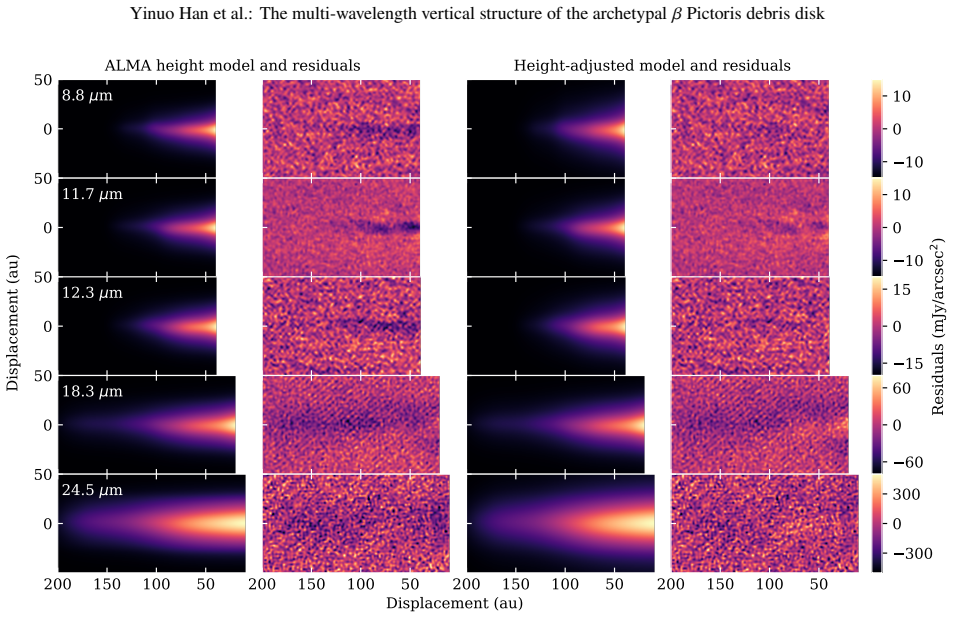
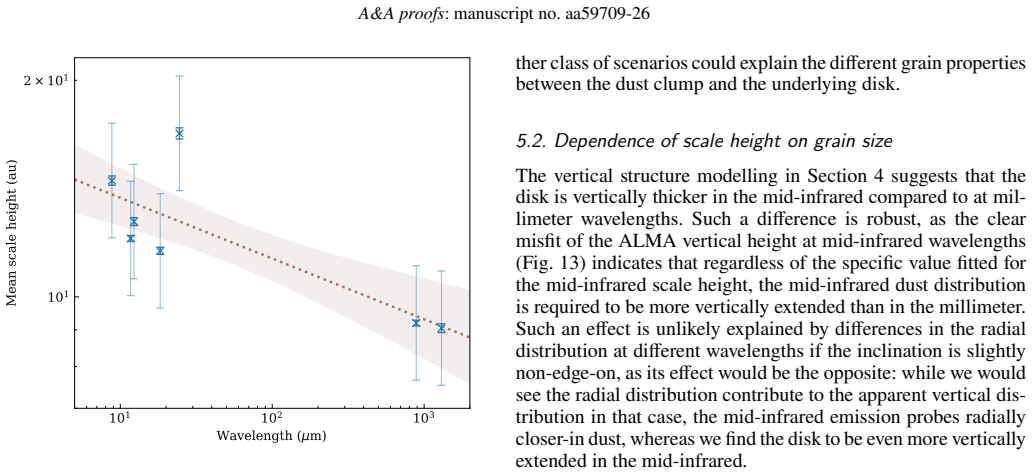
The β Pictoris debris disk is on average 1.5 times thicker vertically in mid-infrared than at millimeter wavelengths.
A machine-rendered reading of the paper's core claim, the machinery that carries it, and where it could break.
Core claim
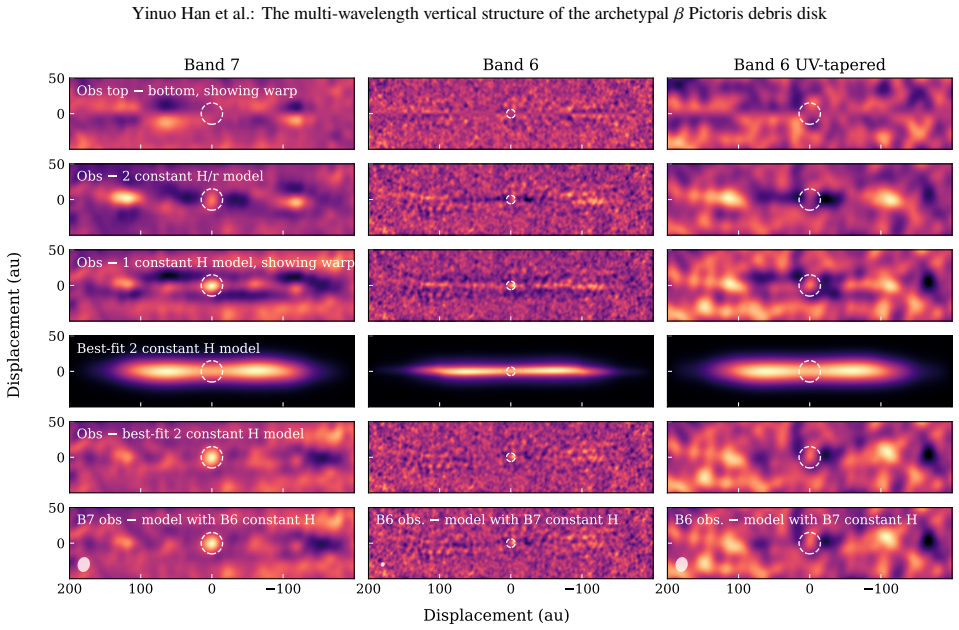
The disk is on average 1.5 times thicker vertically in the mid-infrared compared to the millimeter, with the scale height relatively constant across radius. The decreasing scale height with wavelength contrasts with predictions from collisional damping and may result from the combined effect of radiation pressure and random collisions. The disk is warped at millimeter wavelengths, consistent with secular perturbation by the inner giant planets, which could also explain the constant apparent scale height and the non-Gaussian vertical profile.
What carries the argument
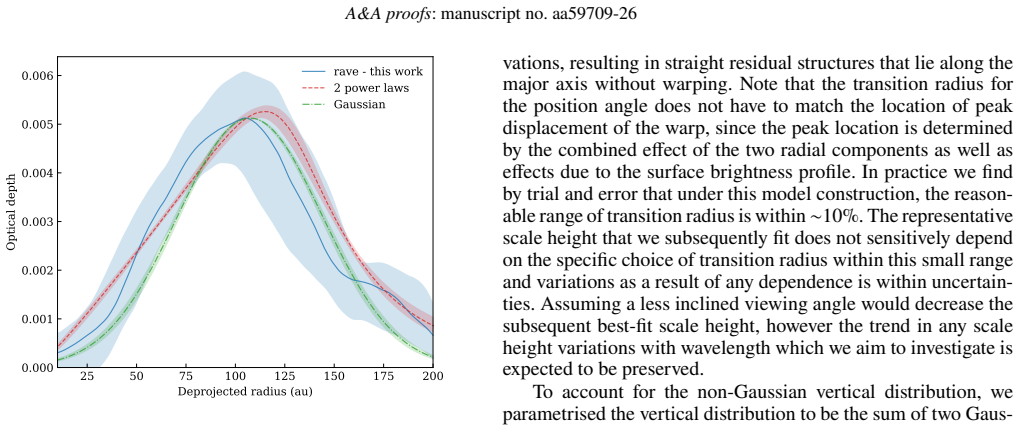
Non-parametric modeling of radial profiles that accounts for vertical warping to isolate intrinsic height at each wavelength.
If this is right
- Constant scale height with radius implies secular perturbations from inner planets dominate the vertical structure over collisional effects.
- Wavelength-dependent thickness indicates radiation pressure and random collisions together set the vertical distribution of different grain sizes.
- Millimeter warping matches scattered-light findings and supports planetary perturbations as the driver of disk dynamics.
- Tentative clumps in ALMA data suggest localized structures that future imaging can confirm or rule out.
Where Pith is reading between the lines
- The same multi-wavelength vertical analysis applied to other edge-on disks could identify the dynamical signatures of unseen planets.
- The results point to grain populations responding differently to radiation and collisions, offering a target for targeted dynamical simulations.
- A uniform scale height across radius may mean the disk's vertical appearance remains stable even as other radial properties change.
Load-bearing premise
The modeling isolates the true vertical height at each wavelength without major biases from grain temperature, optical depth, or the precise shape of the warp.
What would settle it
Higher-resolution vertical profiles at an intermediate wavelength showing a thickness ratio different from 1.5 or a scale height that varies strongly with radius would challenge the central result.
Figures




read the original abstract
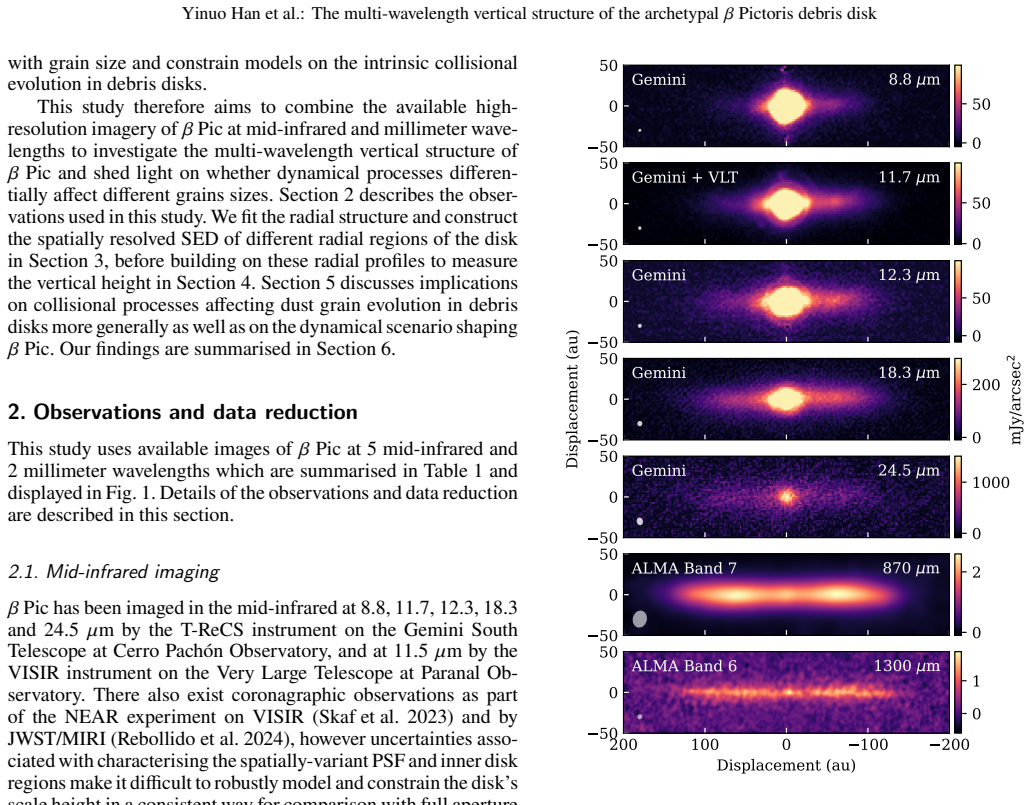
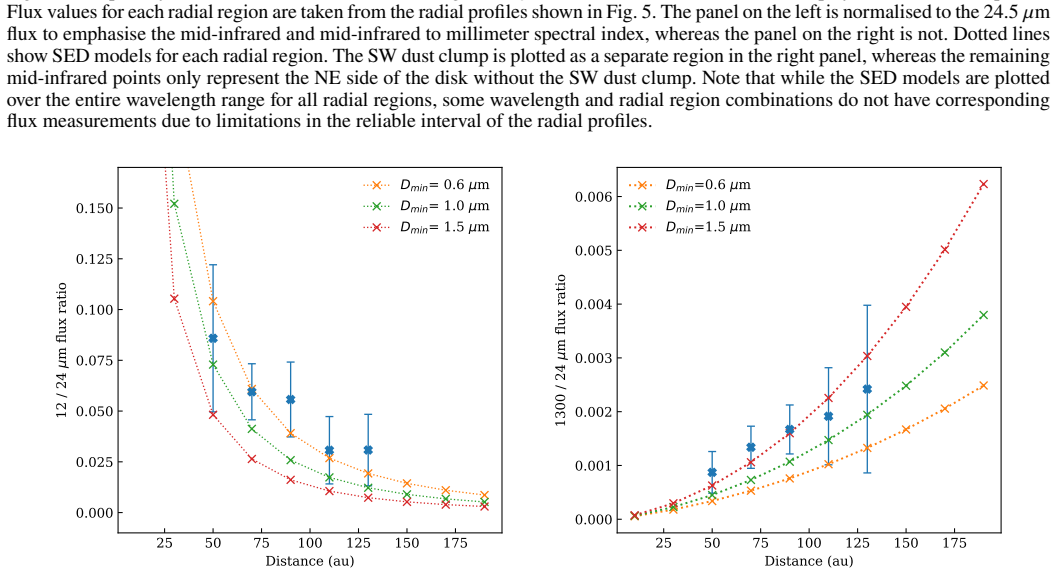
Thermal imaging of debris disks is resolving the vertical height in an increasing number of systems, enabling the use of the vertical structure to decode the dynamical state of the planetary system. In this study, we examine the multi-wavelength structure of the archetypical edge-on debris disk of $\beta$ Pic, extensive imaging of which across mid-infrared to millimeter wavelengths makes it the prime system to study the vertical height across different grain size populations. We non-parametrically modelled the radial profiles and constrained the vertical height at each wavelength while taking into account the vertical warping, finding the disk to be on average 1.5 times thicker vertically in the mid-infrared compared to the millimeter and the scale height to be relatively constant across radius. The decreasing scale height with wavelength is in contrast to predictions from collisional damping, and could be a result of the combined effect of radiation pressure and random collisions. We also show that the disk is warped at millimeter wavelengths and find tentative evidence for clumps in ALMA images which will require follow-up observations to confirm. The millimeter vertical warping is consistent with findings in scattered light and the secular perturbation interpretation due to the inner giant planets, which could also explain the relatively constant apparent scale height across radius, and potentially earlier findings of a non-Gaussian vertical profile which this study confirms.
Editorial analysis
A structured set of objections, weighed in public.
Referee Report
Summary. The manuscript uses non-parametric modeling of radial profiles from multi-wavelength imaging (mid-IR to mm) of the edge-on β Pictoris debris disk, while accounting for vertical warping, to derive the vertical structure. It reports that the disk is on average 1.5 times thicker vertically in the mid-infrared than at millimeter wavelengths, with a relatively constant scale height across radius; the mm warping is consistent with scattered-light results and secular perturbations from the inner giant planets, and tentative clumps are noted in ALMA data.
Significance. If the central claims hold after validation, the work provides valuable multi-wavelength constraints on grain-size-dependent vertical structure in a benchmark debris disk, challenging collisional-damping expectations and supporting combined radiation-pressure and collision effects. The dynamical link to known planets adds interpretive strength and could explain the constant scale height and non-Gaussian profiles.
major comments (2)
- [Modeling section] The non-parametric extraction of vertical heights from radial profiles (described in the modeling section) is load-bearing for the 1.5× thickness ratio and constant-scale-height claims. Explicit tests are needed to show that wavelength-dependent optical depth, temperature gradients, and the exact warp parametrization do not introduce systematic biases in the recovered heights, as the skeptic note correctly flags this as the weakest link.
- [Results section] Results section: the reported average 1.5× mid-IR versus mm thickness and the statement that scale height is 'relatively constant across radius' lack quantitative error bars, radial variation metrics, or statistical tests for constancy. These details are required to assess whether the factor and constancy are robust or sensitive to profile-fitting choices.
minor comments (2)
- [Abstract] Abstract: add a brief statement on error estimation, data exclusion criteria, and any validation tests performed on the non-parametric method.
- [Results] The tentative ALMA clumps are mentioned but not quantified; a short table or figure panel showing their significance would improve clarity.
Simulated Author's Rebuttal
We thank the referee for their thorough review and constructive comments. We address each of the major comments below and outline the revisions we will make to strengthen the manuscript.
read point-by-point responses
-
Referee: [Modeling section] The non-parametric extraction of vertical heights from radial profiles (described in the modeling section) is load-bearing for the 1.5× thickness ratio and constant-scale-height claims. Explicit tests are needed to show that wavelength-dependent optical depth, temperature gradients, and the exact warp parametrization do not introduce systematic biases in the recovered heights, as the skeptic note correctly flags this as the weakest link.
Authors: We agree that validating the non-parametric approach against potential systematics is important. In the revised manuscript, we will add a dedicated subsection in the modeling section presenting explicit tests. These will include: (1) varying the warp parametrization within reasonable bounds and showing the impact on recovered heights; (2) simulating observations with different optical depth and temperature gradient assumptions to quantify biases; and (3) comparing results with and without warp correction. We expect these to confirm the robustness of the 1.5× ratio and constant scale height, but will report any sensitivities found. revision: yes
-
Referee: [Results section] Results section: the reported average 1.5× mid-IR versus mm thickness and the statement that scale height is 'relatively constant across radius' lack quantitative error bars, radial variation metrics, or statistical tests for constancy. These details are required to assess whether the factor and constancy are robust or sensitive to profile-fitting choices.
Authors: We concur that more quantitative support is needed for these key claims. We will revise the Results section to include: error bars on the average 1.5× thickness ratio derived from the profile fits; quantitative metrics of radial variation in scale height (e.g., the standard deviation across radii and any fitted radial slope); and statistical tests for constancy, such as a chi-squared goodness-of-fit test against a constant model or an F-test comparing constant vs. varying models. These additions will allow readers to better evaluate the robustness. revision: yes
Circularity Check
No significant circularity in the derivation chain
full rationale
The paper's central results—the average 1.5x vertical thickness in mid-IR versus millimeter, radially constant scale height, and millimeter warping—are obtained directly from non-parametric modeling of observed radial profiles across wavelengths while explicitly accounting for warping. These quantities are extracted from the data rather than derived as predictions from fitted parameters or self-referential definitions. The interpretive link to secular perturbations by the known inner planets (β Pic b and c) and consistency with prior scattered-light findings references independently established external facts and does not reduce the reported heights or warp to quantities fitted inside this work. No self-definitional, fitted-input-as-prediction, or load-bearing self-citation steps appear in the chain; the derivation remains self-contained against the observational inputs.
Axiom & Free-Parameter Ledger
axioms (1)
- domain assumption Standard assumptions in non-parametric radial profile modeling and vertical height extraction from edge-on disk images
Lean theorems connected to this paper
-
IndisputableMonolith/Foundation/ArithmeticFromLogic.leanreality_from_one_distinction unclear?
unclearRelation between the paper passage and the cited Recognition theorem.
We non-parametrically modelled the radial profiles and constrained the vertical height at each wavelength while taking into account the vertical warping... using the rave algorithm... MCMC sampling of (H1,H2,f1) with constant aspect ratio excluded
What do these tags mean?
- matches
- The paper's claim is directly supported by a theorem in the formal canon.
- supports
- The theorem supports part of the paper's argument, but the paper may add assumptions or extra steps.
- extends
- The paper goes beyond the formal theorem; the theorem is a base layer rather than the whole result.
- uses
- The paper appears to rely on the theorem as machinery.
- contradicts
- The paper's claim conflicts with a theorem or certificate in the canon.
- unclear
- Pith found a possible connection, but the passage is too broad, indirect, or ambiguous to say the theorem truly supports the claim.
Forward citations
Cited by 1 Pith paper
-
Viscously Stirring Particle Disks into Lorentzians and Gaussians to Infer Dynamical and Collisional Masses (ARKS XIII)
Viscous stirring via gravitational scattering produces lognormal inclination distributions that yield Lorentzian vertical density profiles, which relax to Gaussians after equipartition, enabling estimates of perturber...
Reference graph
Works this paper leans on
- [1]
- [2]
-
[3]
Armitage, P. J. 2020, Astrophysics of planet formation, Second Edition Astropy Collaboration, Robitaille, T. P., Tollerud, E. J., et al. 2013, A&A, 558, A33
work page 2020
-
[4]
Binks, A. S. & Jeffries, R. D. 2014, MNRAS, 438, L11 Bohren,C.F.&Huffman,D.R.1983,Absorptionandscatteringoflightbysmall particles (Wiley)
work page 2014
- [5]
-
[6]
2016, A&A, 591, A27 CASA Team, Bean, B., Bhatnagar, S., et al
Brandeker, A., Cataldi, G., Olofsson, G., et al. 2016, A&A, 591, A27 CASA Team, Bean, B., Bhatnagar, S., et al. 2022, PASP, 134, 114501
work page 2016
- [7]
- [8]
-
[9]
Chiang, E., Pearce, T. D., Jankovic, M. R., et al. 2026, Submitted to ApJ, arXiv:2604.19743
work page internal anchor Pith review Pith/arXiv arXiv 2026
-
[10]
Chiang, E. I. & Goldreich, P. 1997, ApJ, 490, 368
work page 1997
-
[11]
Crotts, K. A., Matthews, B. C., Duchêne, G., et al. 2024, ApJ, 961, 245
work page 2024
- [12]
-
[13]
Dawson, R. I., Murray-Clay, R. A., & Fabrycky, D. C. 2011, ApJ, 743, L17
work page 2011
-
[14]
Dent, W. R. F., Wyatt, M. C., Roberge, A., et al. 2014, Science, 343, 1490
work page 2014
-
[15]
Dohnanyi, J. S. 1969, J. Geophys. Res., 74, 2531
work page 1969
-
[16]
I., Shannon, A., & Morrison, S
Dong, J., Dawson, R. I., Shannon, A., & Morrison, S. 2020, ApJ, 889, 47
work page 2020
- [17]
-
[18]
Foreman-Mackey, D., Hogg, D. W., Lang, D., & Goodman, J. 2013, PASP, 125, 306 Gaia Collaboration, Brown, A. G. A., Vallenari, A., et al. 2018, A&A, 616, A1 Gáspár, A., Wolff, S. G., Rieke, G. H., et al. 2023, Nature Astronomy, 7, 790
work page 2013
- [19]
-
[20]
Golimowski, D. A., Ardila, D. R., Krist, J. E., et al. 2006, AJ, 131, 3109
work page 2006
-
[21]
Grigorieva, A., Artymowicz, P., & Thébault, P. 2007, A&A, 461, 537
work page 2007
-
[22]
Hales, A. S., Marino, S., Sheehan, P. D., et al. 2022, ApJ, 940, 161
work page 2022
- [23]
- [24]
- [25]
- [26]
- [27]
-
[28]
M., Duchêne, G., & Matthews, B
Hughes, A. M., Duchêne, G., & Matthews, B. C. 2018, ARAA, 56, 541
work page 2018
-
[29]
Hull, C. L. H., Yang, H., Cortés, P. C., et al. 2022, ApJ, 930, 49
work page 2022
-
[30]
Hunter, J. D. 2007, Computing In Science & Engineering, 9, 90
work page 2007
-
[31]
Jackson, A. P., Wyatt, M. C., Bonsor, A., & Veras, D. 2014, MNRAS, 440, 3757
work page 2014
-
[32]
Jankovic, M. R., Wyatt, M. C., & Löhne, T. 2024, A&A, 691, A302 Jones,E.,Oliphant,T.,Peterson,P.,&Others.2001,SciPy:Opensourcescientific tools for Python
work page 2024
-
[33]
W., Chiang, E., Duchêne, G., Kalas, P., & Esposito, T
Jones, J. W., Chiang, E., Duchêne, G., Kalas, P., & Esposito, T. M. 2023, ApJ, 948, 102
work page 2023
- [34]
-
[35]
Kenyon, S. J. & Bromley, B. C. 2001, AJ, 121, 538
work page 2001
- [36]
-
[37]
M., Bonnefoy, M., Chauvin, G., et al
Lagrange, A. M., Bonnefoy, M., Chauvin, G., et al. 2010, Science, 329, 57
work page 2010
-
[38]
M., Gratadour, D., Chauvin, G., et al
Lagrange, A. M., Gratadour, D., Chauvin, G., et al. 2009, A&A, 493, L21 Lagrange,A.M.,Meunier,N.,Rubini,P.,etal.2019,NatureAstronomy,3,1135
work page 2009
-
[39]
M., Rubini, P., Nowak, M., et al
Lagrange, A. M., Rubini, P., Nowak, M., et al. 2020, A&A, 642, A18
work page 2020
-
[40]
Larwood, J. D. & Kalas, P. G. 2001, MNRAS, 323, 402 Lecavelier des Etangs, A., Vidal-Madjar, A., Roberge, A., et al. 2001, Nature, 412, 706
work page 2001
- [41]
- [42]
-
[43]
Li, D., Telesco, C. M., & Wright, C. M. 2012, ApJ, 759, 81 Lissauer,J.J.&Stewart,G.R.1993,inProtostarsandPlanetsIII,ed.E.H.Levy & J. I. Lunine, 1061
work page 2012
-
[44]
Longarini, C., Lodato, G., Rosotti, G., et al. 2025, ApJ, 984, L17
work page 2025
-
[45]
Lovell, J. B., Hales, A. S., Kennedy, G. M., et al. 2026, A&A, 705, A200
work page 2026
-
[46]
Lovell, J. B., Marino, S., Wyatt, M. C., et al. 2021, MNRAS, 506, 1978
work page 2021
-
[47]
MacGregor, M. A., Wilner, D. J., Chandler, C., et al. 2016, ApJ, 823, 79
work page 2016
-
[48]
Marino, S., Cataldi, G., Jankovic, M. R., Matrà, L., & Wyatt, M. C. 2022, MN- RAS, 515, 507
work page 2022
- [49]
-
[50]
Marino, S., Yelverton, B., Booth, M., et al. 2019, MNRAS, 484, 1257
work page 2019
-
[51]
P., Hengst, S., Young, R., et al
Marshall, J. P., Hengst, S., Young, R., et al. 2026, MNRAS, 545, staf2221
work page 2026
-
[52]
P., Milli, J., Choquet, E., et al
Marshall, J. P., Milli, J., Choquet, E., et al. 2023, MNRAS, 521, 5940 Matrà, L., Dent, W. R. F., Wyatt, M. C., et al. 2017, MNRAS, 464, 1415 Matrà, L., Marino, S., Wilner, D. J., et al. 2025, A&A, 693, A151 Matrà, L., Wyatt, M. C., Wilner, D. J., et al. 2019, AJ, 157, 135
work page 2023
-
[53]
Milli, J., Lagrange, A. M., Mawet, D., et al. 2014, A&A, 566, A91
work page 2014
-
[54]
2026, A&A, 705, A199 Article number, page 21 A&A proofs:manuscript no
Milli, J., Olofsson, J., Bonduelle, M., et al. 2026, A&A, 705, A199 Article number, page 21 A&A proofs:manuscript no. aa59709-26
work page 2026
-
[55]
Mouillet, D., Larwood, J. D., Papaloizou, J. C. B., & Lagrange, A. M. 1997, MNRAS, 292, 896
work page 1997
-
[56]
Murray, C. D. & Dermott, S. F. 1999, Solar System Dynamics
work page 1999
-
[57]
Nesvold, E. R. & Kuchner, M. J. 2015, ApJ, 815, 61
work page 2015
- [58]
-
[59]
Olofsson, J., Samland, M., Avenhaus, H., et al. 2016, A&A, 591, A108
work page 2016
-
[60]
Olofsson, J., Thébault, P., Kral, Q., et al. 2022, MNRAS, 513, 713
work page 2022
-
[61]
Pan, M. & Schlichting, H. E. 2012, ApJ, 747, 113 Pérez, F. & Granger, B. E. 2007, Computing in Science and Engineering, 9, 21
work page 2012
-
[62]
Perrin, M., Chen, C., Gaspar, A., et al. 2024, Catching a cat by the tail: Tracing Dust Dynamics in the Beta Pictoris Debris Disk in the Aftermath of Giant
work page 2024
-
[63]
Rebollido, I., Stark, C. C., Kammerer, J., et al. 2024, AJ, 167, 69
work page 2024
- [64]
-
[65]
Sefilian, A. A., Kratter, K. M., Wyatt, M. C., et al. 2025, MNRAS, 543, 3123
work page 2025
-
[66]
2012, PhD thesis, University of Toronto, Canada
Shannon, A. 2012, PhD thesis, University of Toronto, Canada
work page 2012
- [67]
-
[68]
Smallwood, J. L. 2023, MNRAS, 523, 3526 Smith,K.D.,Matrà,L.,Zhang,K.,etal.2025,arXive-prints,arXiv:2511.01708
work page internal anchor Pith review Pith/arXiv arXiv 2023
- [69]
-
[70]
Stewart, G. R. & Ida, S. 2000, Icarus, 143, 28
work page 2000
-
[71]
Stuber, T. A. & Wolf, S. 2022, A&A, 658, A121
work page 2022
-
[72]
Telesco, C. M., Fisher, R. S., Wyatt, M. C., et al. 2005, Nature, 433, 133
work page 2005
- [73]
- [74]
- [75]
- [76]
- [77]
-
[78]
Wyatt, M. C. 2003, ApJ, 598, 1321
work page 2003
-
[79]
Wyatt, M. C. 2008, ARA&A, 46, 339
work page 2008
-
[80]
Wyatt, M. C. & Dent, W. R. F. 2002, MNRAS, 334, 589
work page 2002
discussion (0)
Sign in with ORCID, Apple, or X to comment. Anyone can read and Pith papers without signing in.