Unified theory of orientation averaging in X-ray spectroscopies: understanding polarization dependence in a Cartesian tensor approach
Pith reviewed 2026-05-15 11:26 UTC · model grok-4.3
The pith
A Cartesian tensor framework unifies orientation averaging for XAS and RIXS intensities in powder samples.
A machine-rendered reading of the paper's core claim, the machinery that carries it, and where it could break.
Core claim
By expressing the orientation average of Cartesian transition tensors in a compact, closed-form manner, the theory produces the powder-averaged intensity for any combination of incident and scattered X-ray polarizations and directions, delivering predictions for XAS and RIXS that match experimental data at the Ce L3 edge.
What carries the argument
The Cartesian transition tensor, which encodes the electronic transition amplitudes in laboratory coordinates and is averaged over all molecular orientations to obtain the observable powder intensity.
Load-bearing premise
The Cartesian tensors obtained from quantum-chemistry calculations faithfully represent the true transition moments and the derived averaging formulas contain no hidden approximations that would alter the powder average.
What would settle it
A high-resolution RIXS experiment on a cerium compound powder at the L3 edge that records a polarization or angular dependence measurably different from the intensities computed from the averaged Cartesian tensors.
Figures


read the original abstract
X-ray absorption spectroscopy (XAS) and resonant inelastic X-ray scattering (RIXS) are powerful probes of electronic structure owing to their chemical and orbital selectivity. For powder samples, however, interpreting RIXS spectral intensities remains challenging as the measured signal is an average over all orientations. Existing theoretical treatments rely largely on spherical-tensor formalisms, which often involve complex derivations and case-specific analyses. Meanwhile, recent advances in quantum-chemistry methods have made the evaluation of transition tensors in Cartesian coordinates both accurate and straightforward. Here, we present a general theoretical framework that translates Cartesian transition tensors into physically meaningful, orientation-averaged intensities for powder samples. The formalism allows predicting angular and polarization dependences \textit{ab initio} for both XAS and RIXS and is extendable to other spectroscopies. The resulting predictions show excellent agreement with RIXS experimental data at the Ce L$_3$ edge.
Editorial analysis
A structured set of objections, weighed in public.
Referee Report
Summary. The manuscript presents a Cartesian-tensor formalism for orientation averaging of X-ray absorption (XAS) and resonant inelastic X-ray scattering (RIXS) intensities in powder samples. It translates transition tensors computed in Cartesian coordinates by quantum-chemistry methods into orientation-averaged signals via explicit integration over the sphere, yielding ab initio predictions of angular and polarization dependences that are shown to match experimental RIXS data at the Ce L3 edge without case-specific adjustments.
Significance. If the central result holds, the work supplies a practical, algebraically equivalent alternative to spherical-tensor treatments that directly exploits the Cartesian tensors now routinely available from quantum-chemistry packages. This removes the need for case-by-case spherical-tensor reductions and extends straightforwardly to other spectroscopies, while the reported experimental agreement at the Ce L3 edge provides a concrete benchmark for the averaging expressions.
minor comments (2)
- [Abstract and experimental comparison section] The abstract states 'excellent agreement' with experiment; the main text should report quantitative measures (e.g., RMS deviation or reduced chi-squared) alongside the visual comparison to allow readers to judge the quality of the match independently.
- [Derivation of averaging contractions] The derivation of the rank-4 tensor averaging contractions is stated to be algebraically equivalent to the spherical-tensor result; an explicit side-by-side comparison of the final averaged intensity expressions (perhaps in an appendix) would make this equivalence immediately verifiable.
Simulated Author's Rebuttal
We thank the referee for the positive assessment of our manuscript and for recommending acceptance. The referee's summary accurately reflects the central contribution of the Cartesian-tensor approach to orientation averaging for XAS and RIXS.
Circularity Check
No significant circularity detected in derivation chain
full rationale
The central derivation integrates rank-2 and rank-4 Cartesian transition tensors over the sphere to obtain orientation-averaged intensities for powder XAS and RIXS. These contractions are standard spherical integrals expressed in Cartesian components and are algebraically equivalent to known spherical-tensor results without introducing case-specific adjustments or hidden parameters. Transition tensors are taken directly from quantum-chemistry output and used to predict angular/polarization dependence; experimental agreement at the Ce L3 edge is presented as validation, not as a fit that defines the averaging expressions. No self-definitional steps, fitted-input predictions, or load-bearing self-citations appear in the formalism. The framework is self-contained against external benchmarks and does not reduce any claimed prediction to its own inputs by construction.
Axiom & Free-Parameter Ledger
axioms (1)
- domain assumption Cartesian transition tensors computed by quantum-chemistry methods accurately represent the physical electronic transitions
Reference graph
Works this paper leans on
-
[1]
can accurately capture these interactions, but they require adjustable parameters. The problem can be tack- ledab-initioby multiconfigurational wavefunction–based quantum-chemistry methods, for example OpenMolcas
-
[2]
and ORCA [21], provided sufficiently large cluster models are employed [20–23]. The codes typically output transition tensors in Cartesian form, which constitutes a further practical consideration motivating our work. Al- though the Cartesian tensor formulation of X-ray spec- troscopy is well established [24, 25], powder averages for two photon processes ...
work page internal anchor Pith review Pith/arXiv arXiv 2026
-
[3]
and expand the exponential to linear order ink·r all by taking into account that momentumpand position roperators do not commute [40]: ˆT=ε·p+ i 2 (ε·p)(k·r) + (ε·r)(k·p) + i 2 (ε·p)(k·r)−(ε·r)(k·p) +O(k·r) 2 (1) The first term in Eq. 1 corresponds to the electric dipole (E1) transition while the second one, symmetric upon exchangingrandp, is the electric...
-
[4]
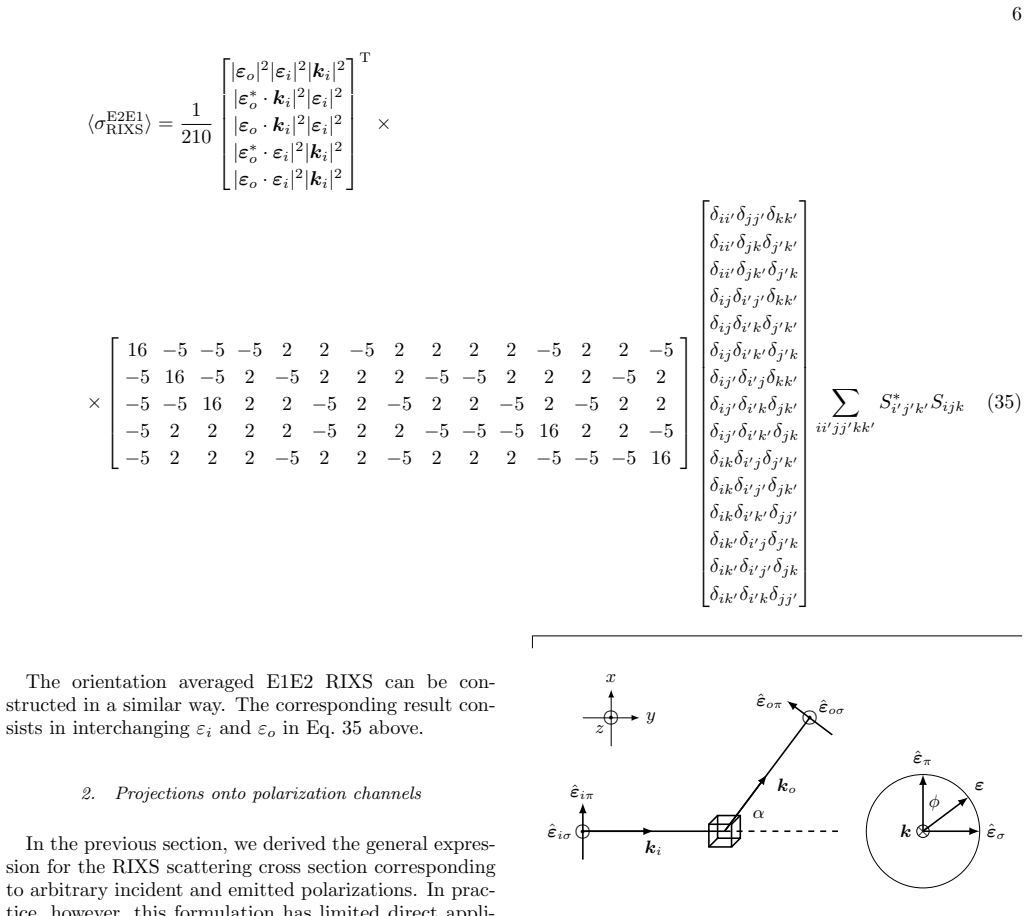
General formalism The E1E1 RIXS term is associated to a rank-4 tensor. Its orientation average is: ⟨σE1E1 RIXS⟩= X ijkl ε∗ i,iεo,j ⟨Q⟩ε i,kε∗ o,l (28) withε i (εo) the incoming (outgoing) polarization. From this point the derivation is similar to the one of E2 XAS: ⟨σE1E1 RIXS⟩= 1 30 |εo|2|εi|2 |ε∗ o ·ε i|2 |εo ·ε i|2 T 4−1−1 −1 4−1 −1−1 4 ...
-
[5]
Projections onto polarization channels In the previous section, we derived the general expres- sion for the RIXS scattering cross section corresponding to arbitrary incident and emitted polarizations. In prac- tice, however, this formulation has limited direct appli- cability, since most experiments employ linearly polar- ized incident light and polarizat...
-
[6]
Scattering from spherically symmetric states Consider the non-resonant scattering cross sectionσT h, i.e. the Thomson term. For linearly polarized light: σTh(q) =r 2 0|f0(q)|2|ˆεo · ˆεi|2 (47) wherer 0 is the classical electron radius,qthe momentum transfer andf 0(q) the atomic form factor. Thomson scat- tering originates from the spherically symmetric pa...
-
[7]
The round analyzer crystals have a diameter of 100mm
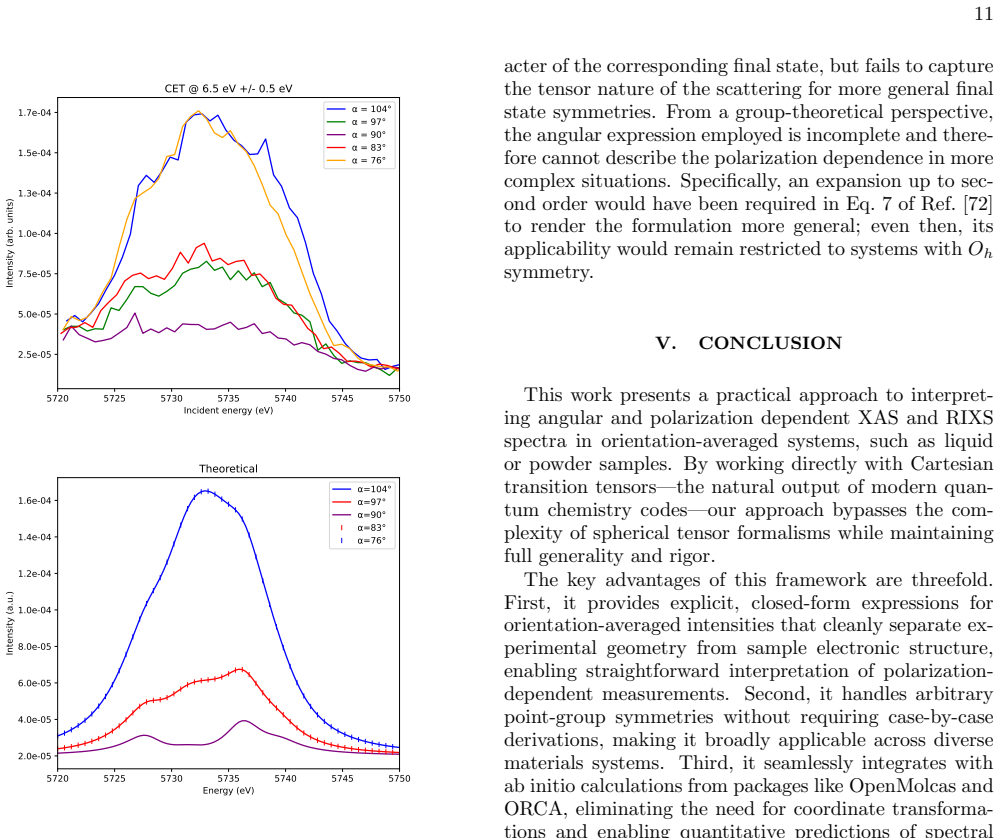
Experiment setup The measurements were performed at beamline ID26 of the European Synchrotron Research Facility, using a spectrometer set in a vertical Rowland geometry [48] with sample, detector and five crystal analyzers arranged on 1m radius circles. The round analyzer crystals have a diameter of 100mm. The incoming X-ray polarization is horizontal, pa...
-
[8]
The embedded cluster model of CeO 2 was constructed based on crystal structures of ICSD 88759 [51]
Computational method Transition tensors were calculated by OpenMolcas v25.06 [20, 50]. The embedded cluster model of CeO 2 was constructed based on crystal structures of ICSD 88759 [51]. Zone 1 (full-basis atoms) consisted of a Ce- centered CeO 8 12 – cluster. Zone 2 contained 400 fixed point charges, while Zone 3 contained 1000 variable point charges use...
-
[9]
3 we show the ctc RIXS plane for one of the analyzers
Core-to-core L 3M5 RIXS In Fig. 3 we show the ctc RIXS plane for one of the analyzers. The main features at 4840 eV emission energy correspond to the L 3M5 resonant emission line (2p 3/2 → 5d5/2), while the weaker features at 4822 eV are the L3M4 (Lα2) line (2p 3/2 →5d 3/2). The transition paths for the L3M5 RIXS process are |g⟩ → |2p 54f 0/15d1⟩ → |3d 94...
-
[10]
Valence-to-core RIXS The measured vtc RIXS planes are shown in Fig. 5. The corresponding theoretical planes were computed by convoluting the transition amplitudes obtained with OpenMolcas for the different analyzer orientations. Rea- sonable agreement is obtained; however, a detailed dis- cussion is deferred to future work, as the present study focuses ex...
-
[11]
M. Abu-Samak, U. Kumar, A. Quraishi, R. Kumar, S. Kumar, S. Dalela, M. A. Ahmad, B. Choudhary, and P. Alvi, Physica B628, 413562 (2022)
work page 2022
-
[12]
F. M. F. de Groot, M. W. Haverkort, H. Elnaggar, A. Juhin, K.-J. Zhou, and P. Glatzel, Nat. Rev. Methods Primers4, 45 (2024)
work page 2024
- [13]
-
[14]
M. Guo, O. Prakash, H. Fan, L. H. M. de Groot, V. F. Hlynsson, S. Kaufhold, O. Gordivska, N. Vel´ asquez, P. Chabera, P. Glatzel, K. W¨ arnmark, P. Persson, and J. Uhlig, Phys. Chem. Chem. Phys.22, 9067 (2020)
work page 2020
-
[15]
H. Y. Huang, A. Singh, C. I. Wu, J. D. Xie, J. Okamoto, A. A. Belik, E. Kurmaev, A. Fujimori, C. T. Chen, S. V. Streltsov, and D. J. Huang, npj Quantum Mater.7, 33 (2022)
work page 2022
-
[16]
H. A. S. Orduz, L. Bugarin, S.-L. Heck, P. Dolcet, M. Casapu, J.-D. Grunwaldt, and P. Glatzel, J. Syn- chrotron Radiat.31, 733 (2024)
work page 2024
-
[17]
A. Svyazhin, V. Nalbandyan, M. Rovezzi, A. Chumakova, B. Detlefs, A. A. Guda, A. Santambrogio, A. Manceau, and P. Glatzel, Inorg. Chem.61, 869 (2022)
work page 2022
-
[18]
A. Beheshti Askari, M. al Samarai, N. Hiraoka, H. Ishii, L. Tillmann, M. Muhler, and S. DeBeer, Nanoscale12, 15185 (2020)
work page 2020
-
[19]
M. L. Traulsen, H. W. P. de Carvalho, P. Zielke, and J. D. Grunwaldt, J. Electrochem. Soc.164, F3064 (2017)
work page 2017
-
[20]
A. Pedersen, K. Kumar, Y.-P. Ku, V. Martin, L. Dubau, K. T. Santos, J. Barrio, V. A. Saveleva, P. Glatzel, V. K. Paidi, X. Li, A. Hutzler, M.-M. Titirici, A. Bonnefont, S. Cherevko, I. E. L. Stephens, and F. Maillard, Energy Environ. Sci.17, 6323 (2024)
work page 2024
- [21]
-
[22]
P. Zasimov, L. Amidani, M. Retegan, O. Walter, R. Caci- uffo, and K. O. Kvashnina, Inorg. Chem.61, 1817 (2022)
work page 2022
-
[23]
S. M. Butorin, K. O. Kvashnina, J. R. Vegelius, D. Meyer, and D. K. Shuh, Proc. Natl. Acad. Sci. U.S.A. 113, 8093 (2016)
work page 2016
-
[24]
L. Amidani, J. J. Joos, P. Glatzel, and J. c. v. Kolorenˇ c, Phys. Rev. Lett.134, 046401 (2025)
work page 2025
-
[25]
T. G. Burrow, N. M. Alcock, M. S. Huzan, M. A. Dun- stan, J. A. Seed, B. Detlefs, P. Glatzel, M. O. J. Y. Hu- nault, J. Bendix, K. S. Pedersen, and M. L. Baker, J. Am. Chem. Soc.146, 22570 (2024)
work page 2024
-
[26]
M. Sundermann, H. Hahn, D. S. Christovam, M. W. Haverkort, R. Caciuffo, B. Keimer, L. H. Tjeng, A. Sever- ing, and H. Gretarsson, Phys. Rev. Res.7, 043081 (2025)
work page 2025
-
[27]
J. C. V´ edrine, Catalysts7, 341 (2017)
work page 2017
-
[28]
F. M. F. de Groot, Coord. Chem. Rev.249, 31 (2005)
work page 2005
- [29]
-
[30]
F. Aquilante, J. Autschbach, A. Baiardi, S. Battaglia, V. A. Borin, L. F. Chibotaru, I. Conti, L. De Vico, M. Delcey, I. Fdez. Galv´ an, N. Ferr´ e, L. Freitag, M. Garavelli, X. Gong, S. Knecht, E. D. Larsson, 17 R. Lindh, M. Lundberg, P. A. Malmqvist, A. Nenov, J. Norell, M. Odelius, M. Olivucci, T. B. Pedersen, L. Pedraza-Gonz´ alez, Q. M. Phung, K. Pie...
work page 2020
- [31]
-
[32]
G. Li Manni, I. Fdez. Galv´ an, A. Alavi, F. Aleotti, F. Aquilante, J. Autschbach, D. Avagliano, A. Ba- iardi, J. J. Bao, S. Battaglia, L. Birnoschi, A. Blanco- Gonz´ alez, S. I. Bokarev, R. Broer, R. Cacciari, P. B. Calio, R. K. Carlson, R. Carvalho Couto, L. Cerd´ an, L. F. Chibotaru, N. F. Chilton, J. R. Church, I. Conti, S. Coriani, J. Cu´ ellar-Zuqui...
work page 2023
- [33]
-
[34]
Y. Joly, S. Di Matteo, and O. Bun˘ au, Eur. Phys. J. Spec. Top.208, 21 (2012)
work page 2012
- [35]
- [36]
-
[37]
G. D¨ oring, C. Sternemann, A. Kaprolat, A. Mattila, K. H¨ am¨ al¨ ainen, and W. Sch¨ ulke, Phys. Rev. B70, 085115 (2004)
work page 2004
-
[38]
R. A. Gordon, M. W. Haverkort, S. S. Gupta, and G. A. Sawatzky, J. Phys.: Conf. Ser.190, 012047 (2009)
work page 2009
-
[39]
G. Chabot-Couture, J. N. Hancock, P. K. Mang, D. M. Casa, T. Gog, and M. Greven, Phys. Rev. B82, 035113 (2010)
work page 2010
-
[40]
M. Kang, J. Pelliciari, Y. Krockenberger, J. Li, D. E. McNally, E. Paris, R. Liang, W. N. Hardy, D. A. Bonn, H. Yamamoto, T. Schmitt, and R. Comin, Phys. Rev. B 99, 045105 (2019)
work page 2019
-
[41]
B. T. Chiogo, J. Okamoto, J.-H. Li, T. Ohkochi, H.-Y. Huang, D.-J. Huang, C.-T. Chen, C.-N. Kuo, C.-S. Lue, A. Chainani, and D. Malterre, Phys. Rev. B106, 075141 (2022)
work page 2022
-
[42]
G. Krieger, L. Martinelli, S. Zeng, L. E. Chow, K. Kum- mer, R. Arpaia, M. Moretti Sala, N. B. Brookes, A. Ar- iando, N. Viart, M. Salluzzo, G. Ghiringhelli, and D. Preziosi, Phys. Rev. Lett.129, 027002 (2022)
work page 2022
- [43]
- [44]
-
[45]
M. Nakazawa, H. Ogasawara, and A. Kotani, J. Phys. Soc. Jpn.69, 4071 (2000)
work page 2000
- [46]
- [47]
-
[48]
M. Tagliavini, F. Wenzel, and M. W. Haverkort, Polar- ization dependency in resonant inelastic x-ray scattering (2025), arXiv:2510.12891v1 [cond-mat.mtrl-sci]
work page internal anchor Pith review arXiv 2025
-
[49]
J. J. Sakurai,Advanced Quantum Mechanics(Addison- Wesley, Reading, Massachusetts, 1967)
work page 1967
-
[50]
R. D. Peacock and B. Stewart, J. Phys. Chem. B105, 351 (2001)
work page 2001
-
[51]
L. J. P. Ament, M. van Veenendaal, T. P. Devereaux, J. P. Hill, and J. van den Brink, Rev. Mod. Phys.83, 705 (2011)
work page 2011
-
[52]
M. A. Rashid, F. Ahmad, and N. Amir, Int. J. Theor. Phys.50, 479 (2011)
work page 2011
- [53]
-
[54]
D. L. Andrews and T. Thirunamachandran, J. Chem. Phys.67, 5026 (1977)
work page 1977
-
[55]
D. L. Andrews and W. A. Ghoul, J. Phys. A: Math. Gen. 14, 1281 (1981)
work page 1981
-
[56]
C. Brouder, A. Juhin, A. Bordage, and M.-A. Arrio, J. Phys.: Condens. Matter20, 455205 (2008)
work page 2008
- [57]
-
[58]
P. Glatzel, A. Harris, P. Marion, M. Sikora, T.-C. Weng, C. Guilloud, S. Lafuerza, M. Rovezzi, B. Detlefs, and L. Ducott´ e, J. Synchrotron Rad.28, 362 (2021)
work page 2021
-
[59]
M. Retegan, DAXS: Data analysis for x-ray spec- troscopy,https://gitlab.esrf.fr/spectroscopy/daxs (2025), accessed: 2025-10-20
work page 2025
-
[60]
I. Fdez. Galv´ an, M. Vacher, A. Alavi, C. Angeli, F. Aquilante, J. Autschbach, J. J. Bao, S. I. Bokarev, N. A. Bogdanov, R. K. Carlson, L. F. Chibotaru, J. Creutzberg, N. Dattani, M. G. Delcey, S. S. Dong, A. Dreuw, L. Freitag, L. M. Frutos, L. Gagliardi, F. Gen- dron, A. Giussani, L. Gonz´ alez, G. Grell, M. Guo, C. E. Hoyer, M. Johansson, S. Keller, S....
work page 2019
- [61]
- [62]
-
[63]
M. Klintenberg, S. Derenzo, and M. Weber, Comput. Phys. Commun.131, 120 (2000)
work page 2000
-
[64]
J. L. Pascual, L. Seijo, and Z. Barandiar´ an, J. Chem. Phys.98, 9715 (1993)
work page 1993
-
[65]
M. A. Nygren, L. G. M. Pettersson, Z. Barandiar´ an, and 18 L. Seijo, J. Chem. Phys.100, 2010 (1994)
work page 2010
- [66]
-
[67]
B. O. Roos, The complete active space self-consistent field method and its applications in electronic structure calculations, inAdvances in Chemical Physics(John Wi- ley & Sons, Ltd, 1987) Chap. 69, pp. 399–445
work page 1987
-
[68]
B. O. Roos, P. R. Taylor, and P. E. Sigbahn, Chem. Phys. 48, 157 (1980)
work page 1980
- [69]
-
[70]
P. E. M. Siegbahn, J. Alml¨ of, A. Heiberg, and B. O. Roos, J. Chem. Phys.74, 2384 (1981)
work page 1981
-
[71]
P. A. Malmqvist, A. Rendell, and B. O. Roos, J. Phys. Chem.94, 5477 (1990)
work page 1990
- [72]
-
[73]
B. A. Hess, Phys. Rev. A32, 756 (1985)
work page 1985
-
[74]
B. A. Hess, Phys. Rev. A33, 3742 (1986)
work page 1986
-
[75]
A. Wolf, M. Reiher, and B. A. Hess, J. Chem. Phys.117, 9215 (2002)
work page 2002
-
[76]
T. B. Pedersen, F. Aquilante, and R. Lindh, Theor. Chem. Acc.124, 1 (2009)
work page 2009
-
[77]
K. G. Dyall and K. Fægri, Chem. Phys. Lett.201, 27 (1993)
work page 1993
-
[78]
P. ˚Ake Malmqvist, B. O. Roos, and B. Schimmelpfennig, Chem. Phys. Lett.357, 230 (2002)
work page 2002
-
[79]
S. Zhang, Polarixs: A python package for angular and po- larization dependent rixs convolution,https://github. com/ZhangHMDS/Polarixs(2025), accessed: 2025-08-27
work page 2025
-
[80]
D.-C. Sergentu, C. H. Booth, and J. Autschbach, Chem. Eur. J27, 7239 (2021)
work page 2021
discussion (0)
Sign in with ORCID, Apple, or X to comment. Anyone can read and Pith papers without signing in.