REVIEW 4 major objections 4 minor 2 cited by
Ultrafast Sampling-based Kinodynamic Planning via Differential Flatness
T0 review · 4 major / 4 minor · reviewed 2026-08-02 · deepseek-v4-flash
Pith's one-line read By planning in a flat-output space where the dynamics are linear, this paper obtains closed-form polynomial local paths that convert back to dynamically feasible robot trajectories, making sampling-based kinodynamic planning fast enough for
desk verdict Useful integration for r=2 systems; quadrotor claims overreach and contradict the paper's own flatness orders. read the letter →
The pith
A machine-rendered reading of the paper's core claim, the machinery that carries it, and where it could break.
The reading
What carries the argument
The enabling object is the flat-state representation z = (y, y_dot, ..., y^(r-1)) with pseudo-control w = y^(r), which turns the nonlinear dynamics into a linear chain-of-integrators system with a nilpotent matrix A. The linear-quadratic minimum-time BVP solution uses the Gramian G_T to give closed-form polynomial local paths, and the nilpotence of A makes e^{At} and G_T polynomials in time. These polynomials are what allow dense time-discretization and SIMD-parallel collision checking.
What would settle it
Take a quadrotor local path generated by the r=2 formula, reconstruct the rotation matrix and angular velocity from the flat-output trajectory at several sample times, and verify the full dynamics against the returned thrust and torque; a violation, or a planned path through a narrow gap whose reconstructed attitude exceeds the vehicle's physical limits, would show that the returned trajectory is not a complete dynamically feasible quadrotor state trajectory.
Extended reading notes
Core claim
The central claim is that differential flatness converts the kinodynamic planning problem into planning in a flat state space with linear dynamics, where the linear-quadratic minimum-time boundary value problem has a closed-form solution: the optimal pseudo-control is a polynomial and the flat trajectory is a piecewise polynomial. Mapping these polynomials back through the flatness equations yields dynamically feasible state trajectories by construction, so collision checking can be done in parallel on sampled states. The paper further claims probabilistic exhaustivity and asymptotic optimality for the resulting planners, with convergence bounds decaying as O((log N / N)^(1/D)).
Load-bearing premise
The load-bearing premise is that planning in the flat space with the chosen number of derivatives is exactly equivalent to planning in the original state space; for quadrotors, the paper uses fewer derivatives than a direct reconstruction of the full state would need, so that equivalence is the first assumption to verify.
Editorial extensions
If this is right
- Any sampling-based planner that uses a CONNECT/EXTEND loop (e.g., RRT-Connect or SST*) can be turned into a kinodynamic planner while keeping trajectories dynamically feasible by construction.
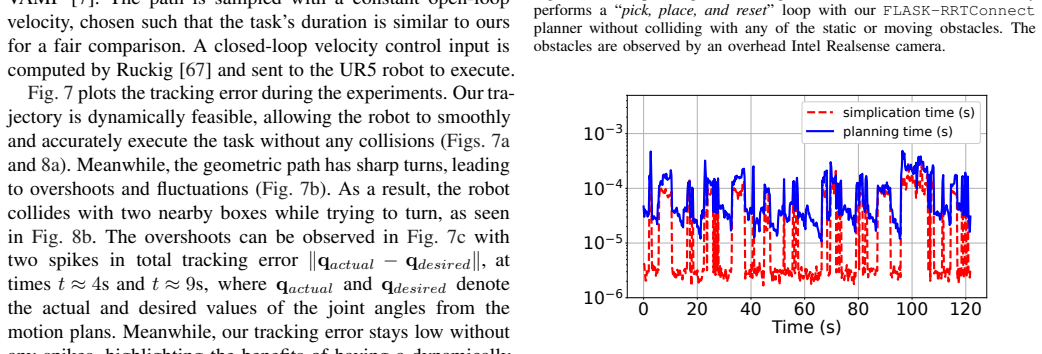
- Planning times drop to the microsecond-to-millisecond range on commodity CPUs, making online reactive replanning in dynamic environments practical; the paper demonstrates about 90 microseconds of planning in a real pick-and-place loop.
- The closed-form BVP solutions allow shortcut-based trajectory simplification, reducing the wandering behavior common in propagation-based kinodynamic planners.
- If the optimality analysis is correct, existing asymptotic optimality guarantees of the host sampling planner are preserved, not broken, by the flat-space reformulation.
- Trajectory postprocessing with BVP shortcuts shortens trajectories without recomputing dynamics numerically.
Reading between the lines
- The speed argument depends on polynomial local paths staying polynomial under the recovery maps alpha and beta; for systems where those maps involve transcendental functions such as arctan2, the closed-form polynomial property may only hold for a restricted set of outputs, which would limit the 'broad class' claim.
- A concrete test of the quadrotor claim: generate a local path with r=2 and reconstruct R and omega from the flat state; if the reconstructed attitude and angular velocity do not satisfy the original dynamics with the returned thrust and torque, then dynamic feasibility for quadrotors is only established for the positional substate, not the full state.
- The probabilistic exhaustivity proof assumes alpha is Lipschitz-continuous, but for rotational states on SO(3) Lipschitz continuity is only local; a global statement would require charts or a metric on SO(3), which the paper leaves implicit.
Editorial analysis
A structured set of objections, weighed in public.
Referee Report
Summary. The paper proposes FLASK, a sampling-based kinodynamic planning framework for differentially flat robot systems. The key idea is to map the planning problem to the flat output space, where the dynamics become a linear nilpotent system. The authors derive a closed-form solution to the linear-quadratic minimum-time boundary value problem (Eqs. 23-25), which yields time-parameterized polynomial local paths. These paths are amenable to SIMD-parallelized collision checking, and the resulting trajectory is converted back to the original state space via the flatness maps α and β. The paper claims this framework is exact, applies to manipulators, ground vehicles, aerial vehicles, and more, and provides probabilistic exhaustivity and asymptotic optimality guarantees. Experiments on unicycles, 2D/3D quadrotors, a 7-DOF Franka manipulator, and a real UR5 platform show planning times in microseconds to milliseconds.
Significance. If the claims are correct, this would be a meaningful advance: it would show that SIMD-accelerated geometric planning techniques can be extended to kinodynamic planning for a broad class of nonlinear systems, with closed-form BVP solutions and theoretical guarantees. The manipulator and unicycle results, and the integration with VAMP/CAPT-style SIMD collision checking, are promising and clearly presented. The closed-form derivation for r=2 systems is clean and follows known LQMT results. However, the aerial-vehicle portion of the paper has a correctness gap that undermines the broad-class claim, and the theoretical analysis is a sketch rather than a complete proof. The contribution is significant but requires substantial revision before it can be accepted.
major comments (4)
- [Sec. V-C1b and Example 3 / Eq. (14)] The statement that quadrotors 'can reduce the pseudo-control order to r=2' directly contradicts Eq. (14), which requires r ≥ max(l,m). Example 3 establishes l=3 (state recovery needs p^(3)) and m=4 (control needs p^(4)). With r=2, the flat state z=(p,ψ,ṗ,ψ̇) and pseudo-control w=(p̈,ψ̈) do not contain the derivatives needed by α and β in Eqs. (11)-(13) to recover R, ω, f, and τ. Consequently the trajectories generated for 2D and 3D quadrotors in Sec. VII-A are not verified dynamically feasible in the original state space, and the stated limits on ω and τ cannot be checked. This also violates Assumption 1 (r>l) in Theorem 1, so the theoretical guarantees do not cover the quadrotor experiments. The broad-class claim including aerial vehicles is therefore unsupported as stated.
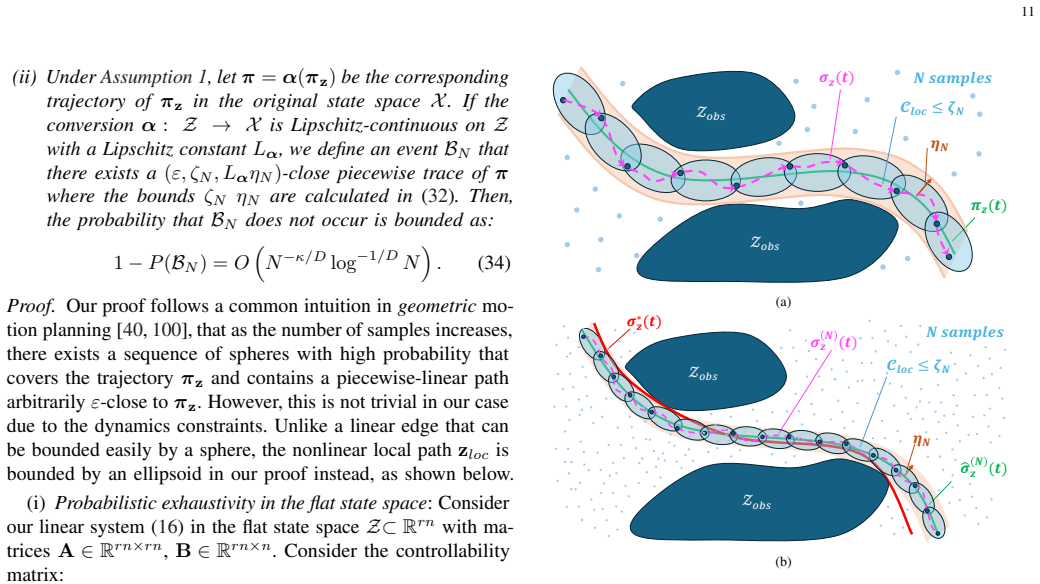
- [Sec. VI-A, Theorem 1 proof] The proof of probabilistic exhaustivity invokes Theorem IV.6 of [103] but does not verify that the graph produced by the actual FLASK algorithm (Alg. 1 + Alg. 2) meets that theorem's hypotheses. Specifically, it must be shown that (i) the optimal-time local path in Eq. (25) has the required cost/ellipsoid scaling and Lipschitz properties, (ii) the node-selection rule in Alg. 2 (cost threshold ζ) accepts the needed connections with high probability, and (iii) the collision-checking step does not reject the connecting paths with probability that destroys the guarantee. The proof only establishes bounds on ellipsoid volumes and then jumps to the external theorem; it does not connect the random geometric graph to the algorithm's sampling and extension procedure. As written, Eqs. (33)-(34) are not a proof for FLASK as specified.
- [Sec. VI-B, Optimality analysis] The asymptotic optimality argument assumes 'there exists a sequence of δ_N-clearance trajectories σ̂_z^(N)(t) with cost converging to C*'. This is an additional regularity assumption on the optimal trajectory that is not derived or discussed. More importantly, the text says the bound ζ_N 'can be used as thresholds for expanding and rewiring the graph' but does not demonstrate that the actual planners used (FLASK-RRTConnect, FLASK-SST*) perform the rewiring or dynamic-programming steps necessary for the standard optimality proof. The claim that the framework 'preserves asymptotic-optimality guarantees' of any sampling-based planner is therefore not substantiated; at most it is an outline of how a proof could proceed.
- [Sec. V-B, Problem 2 equivalence] The equivalence between Problem 1 and Problem 2 hinges on the maps α and β being well-defined on the flat state. For the systems where r≥max(l,m) in Eq. (14), this is mathematically sound. However, for the quadrotor case actually used in the experiments (r=2), the equivalence fails: Problem 2 requires u(t)=β(σ_z(t),w(t))∈U, but β is not defined when the required derivatives are absent. The paper should either restrict the framework to systems with r≥max(l,m), or re-derive the quadrotor experiments using r=4 (or a trajectory representation that retains p^(3), p^(4)).
minor comments (4)
- [General / heading] Typo in Sec. VI heading: 'Probabilistic Exhausitivity' should be 'Exhaustivity'. Also in the introduction, 'high-DOF' is written as 'high-D OF'.
- [Sec. V-C1b] The citation to [21] for the claim that quadrotors can use r=2 should be rechecked; [21] plans with acceleration-level controls for a simplified model and does not provide a full flatness-based state recovery with r=2. This citation does not resolve the contradiction.
- [Table I] In the 3D quadrotor rows, the environment labeled 'Block' appears to correspond to the 'Obstacle' environment in Fig. 5(c). Please make the naming consistent.
- [Alg. 3 / notation] In Alg. 3, the loop bound 'N/K' should likely be '⌈N/K⌉-1' and the batch definition uses ⌈N/K⌉; please clarify the indexing so the total number of samples is exactly N.
Circularity Check
No significant circularity; the quadrotor r=2 reduction is a correctness gap, not circular derivation.
full rationale
The paper's central derivation is self-contained and not circular. The transformation from Problem 1 to the flat-state linear system (Eqs. 14-17) is a coordinate change justified by the standard definition of differential flatness (Def. 1), not a fit that is later renamed as a prediction. The closed-form BVP solution (Eqs. 23-25) follows from the known linear-quadratic minimum-time solution [94], and the conversion back to the original state space (Eqs. 19, 30) is exactly the flatness mapping. The probabilistic exhaustivity proof (Theorem 1) is an adaptation of external random geometric graph theory [103, 104] to the nilpotent linear structure of Eq. (16); it does not assume the conclusion. Self-citations such as VAMP [7], CAPT [8], and MotionBenchMaker [107] are engineering and benchmarking dependencies, not load-bearing assumptions that reduce the proof to the paper's own claims. The most serious issue in the manuscript -- the statement that quadrotors can reduce the pseudo-control order to r=2 (Sec. V-C1b) despite Example 3 requiring l=3, m=4 and Eq. (14) requiring r >= max(l,m)=4 -- is an internal consistency and correctness problem for the aerial-vehicle experiments, but it is not a circular derivation: no parameter is fitted and then 'predicted,' and no load-bearing conclusion is justified solely by an author self-citation. Therefore, per the hard rules, the circularity score is 0.
Assumptions & free parameters
free parameters (6)
- rho (time/control cost weight) =
rho=1 (experiments)
- R weight matrix =
R=I_n (experiments)
- Cost threshold zeta for choosing existing node =
not specified
- Number of collision-checking samples N in Algorithm 3 =
not specified
- Clearance sequence delta_N =
delta_N=O(eta_N) (suggested)
- kappa in Theorem 1 =
kappa>=0, unspecified
assumptions (6)
- domain assumption The robot system is differentially flat with known alpha, beta (Def. 1).
- ad hoc to paper r >= max(l,m) in Eq. (14), and Assumption 1 requires r>l so x=alpha(z).
- domain assumption The conversion alpha is Lipschitz-continuous on Z.
- ad hoc to paper There exists a sequence of delta_N-clearance trajectories sigma_hat_z^(N) with cost -> C* (Sec. VI-B).
- standard math External results: LQMT closed-form solution [94], controllability Gramian scaling Lemma III.4 and Theorem IV.6 from [103].
- domain assumption State/control limits can be checked by finite sampling of converted (x_loc,u_loc) or bounded in flat space.
Cite this review
Pith. "Pith review of Ultrafast Sampling-based Kinodynamic Planning via Differential Flatness." pith.science (2026). https://pith.science/paper/LEL7FYL5
@misc{pith2026260316059,
  author       = {Pith},
  title        = {Pith review of: Ultrafast Sampling-based Kinodynamic Planning via Differential Flatness},
  year         = {2026},
  howpublished = {\url{https://pith.science/paper/LEL7FYL5}},
  note         = {Machine review of arXiv:2603.16059}
}
read the original abstract
Motion planning under dynamics constraints, i.e, kinodynamic planning, enables safe robot operation by generating dynamically feasible trajectories that the robot can accurately track. For high-DOF robots such as manipulators, sampling-based motion planners are commonly used, especially for complex tasks in cluttered environments. However, enforcing constraints on robot dynamics in such planners requires solving either challenging two-point boundary value problems (BVPs) or propagating robot dynamics, both of which cause computational bottlenecks that drastically increase planning times. Meanwhile, recent efforts have shown that sampling-based motion planners can generate plans in microseconds using parallelization, but are limited to geometric paths. This paper develops FLASK, a fast parallelized sampling-based kinodynamic motion planning framework for a broad class of differentially flat robot systems, including manipulators, ground and aerial vehicles, and more. Differential flatness allows us to transform the motion planning problem from the original state space to a flat output space, where an analytical time-parameterized solution of the BVP problem can be obtained. A trajectory in the flat output space is then converted back to a closed-form dynamically feasible trajectory in the original state space, enabling fast validation via ``single instruction, multiple data" parallelism. Our framework is fast, exact, and compatible with any sampling-based motion planner, while offering theoretical guarantees on probabilistic exhaustibility and asymptotic optimality based on the closed-form BVP solutions. We extensively verify the effectiveness of our approach in both simulated benchmarks and real experiments with cluttered and dynamic environments, requiring mere microseconds to milliseconds of planning time.
Figures


Figures from the paper (6 more)


Forward citations
Cited by 2 Pith papers
-
Compliant Sphere Lattice Contact: Distributed Contact Modeling for Sphere-Based Robot Representations
CSLC models sphere-based robot surfaces as a spring lattice, producing distributed contact patches and restoring torque that point contact lacks.
-
Conformal Constraint Tightening for Chance-Constrained Motion Planning with Unknown Dynamics
A conformal-prediction bound on nominal-to-true trajectory deviation is used to tighten motion-planning constraints, yielding a probabilistic task-completion guarantee under model mismatch.
Reference graph
Works this paper leans on
-
[103]
Optimal sampling-based motion planning under differential constraints: The drift case with linear affine dynamics
E. Schmerling, L. Janson, and M. Pavone. “Optimal sampling-based motion planning under differential constraints: The drift case with linear affine dynamics”. In:IEEE Conference on Decision and Control. 2015, pp. 2574–2581
2015
-
[1]
A Re- view of Motion Planning for Highway Autonomous Driving
L. Claussmann, M. Revilloud, D. Gruyer, and S. Glaser. “A Re- view of Motion Planning for Highway Autonomous Driving”. In: IEEE Transactions on Intelligent Transportation Systems21.5 (2020), pp. 1826–1848
2020
-
[2]
Trajectory Planning for Quadrotor Swarms
W. H¨onig, J. A. Preiss, T. K. S. Kumar, G. S. Sukhatme, and N. Ayanian. “Trajectory Planning for Quadrotor Swarms”. In:IEEE Transactions on Robotics34.4 (2018), pp. 856–869
2018
-
[3]
Swarm of micro flying robots in the wild
X. Zhou, X. Wen, Z. Wang, Y . Gao, H. Li, Q. Wang, T. Yang, H. Lu, Y . Cao, C. Xu, et al. “Swarm of micro flying robots in the wild”. In: Science Robotics7.66 (2022)
2022
-
[4]
Lessons from the amazon picking challenge: Four aspects of building robotic systems
C. Eppner, S. H¨ofer, R. Jonschkowski, R. Mart´ın-Mart´ın, A. Sieverling, V . Wall, and O. Brock. “Lessons from the amazon picking challenge: Four aspects of building robotic systems.” In:Robotics: Science and Systems. 2016
2016
-
[5]
Healthcare robotics
L. D. Riek. “Healthcare robotics”. In:Communications of the ACM 60.11 (2017), pp. 68–78
2017
-
[6]
FEAST: A Flexible Mealtime-Assistance System Towards In-the-Wild Personalization
R. K. Jenamani, T. Silver, B. Dodson, S. Tong, A. Song, Y . Yang, Z. Liu, B. Howe, A. Whitneck, and T. Bhattacharjee. “FEAST: A Flexible Mealtime-Assistance System Towards In-the-Wild Personalization”. In:Robotics: Science and Systems. Los Angeles, CA, USA, 2025
2025
-
[7]
Motions in Microsec- onds via Vectorized Sampling-Based Planning
W. Thomason, Z. Kingston, and L. E. Kavraki. “Motions in Microsec- onds via Vectorized Sampling-Based Planning”. In:IEEE Interna- tional Conference on Robotics and Automation. 2024, pp. 8749–8756
2024
Show all 108 references
-
[8]
Collision-Affording Point Trees: SIMD-Amenable Nearest Neighbors for Fast Collision Checking
C. W. Ramsey, Z. Kingston, W. Thomason, and L. E. Kavraki. “Collision-Affording Point Trees: SIMD-Amenable Nearest Neighbors for Fast Collision Checking”. In:Robotics: Science and Systems. 2024
2024
-
[9]
Randomized Kinodynamic Planning
S. M. LaValle and J. J. K. Jr. “Randomized Kinodynamic Planning”. In: The International Journal of Robotics Research20.5 (2001), pp. 378– 400
2001
-
[10]
Randomized Kinody- namic Motion Planning with Moving Obstacles
D. Hsu, R. Kindel, J.-C. Latombe, and S. Rock. “Randomized Kinody- namic Motion Planning with Moving Obstacles”. In:The International Journal of Robotics Research21.3 (2002), pp. 233–255
2002
-
[11]
S. M. LaValle.Planning algorithms. Cambridge University Press, 2006
2006
-
[12]
Generation of collision-free trajectories for a quadrocopter fleet: A sequential convex programming approach
F. Augugliaro, A. P. Schoellig, and R. D’Andrea. “Generation of collision-free trajectories for a quadrocopter fleet: A sequential convex programming approach”. In:IEEE/RSJ International Conference on Intelligent Robots and Systems. 2012, pp. 1917–1922
2012
-
[13]
Motion planning with sequential convex optimization and convex collision checking
J. Schulman, Y . Duan, J. Ho, A. Lee, I. Awwal, H. Bradlow, J. Pan, S. Patil, K. Goldberg, and P. Abbeel. “Motion planning with sequential convex optimization and convex collision checking”. In:The Interna- tional Journal of Robotics Research33.9 (2014), pp. 1251–1270
2014
-
[14]
GuSTO: Guaran- teed Sequential Trajectory optimization via Sequential Convex Pro- gramming
R. Bonalli, A. Cauligi, A. Bylard, and M. Pavone. “GuSTO: Guaran- teed Sequential Trajectory optimization via Sequential Convex Pro- gramming”. In:International Conference on Robotics and Automation. 2019, pp. 6741–6747
2019
-
[15]
Synthesis and stabilization of complex behaviors through online trajectory optimization
Y . Tassa, T. Erez, and E. Todorov. “Synthesis and stabilization of complex behaviors through online trajectory optimization”. In: IEEE/RSJ International Conference on Intelligent Robots and Systems. 2012, pp. 4906–4913
2012
-
[16]
Crocoddyl: An Efficient and Versatile Framework for Multi-Contact Optimal Control
C. Mastalli, R. Budhiraja, W. Merkt, G. Saurel, B. Hammoud, M. Naveau, J. Carpentier, L. Righetti, S. Vijayakumar, and N. Mansard. “Crocoddyl: An Efficient and Versatile Framework for Multi-Contact Optimal Control”. In:IEEE International Conference on Robotics and Automation. ...
2020
-
[17]
iDb-A*: Iterative Search and Optimization for Optimal Kinodynamic Motion Planning
J. Ortiz-Haro, W. H ¨onig, V . N. Hartmann, and M. Toussaint. “iDb-A*: Iterative Search and Optimization for Optimal Kinodynamic Motion Planning”. In:IEEE Transactions on Robotics41 (2025)
2025
-
[18]
Efficient constrained path planning via search in state lattices
M. Pivtoraiko and A. Kelly. “Efficient constrained path planning via search in state lattices”. In:International Symposium on Artificial Intelligence, Robotics, and Automation in Space. 2005, pp. 1–7
2005
-
[19]
Kinodynamic motion planning with state lattice motion primitives
M. Pivtoraiko and A. Kelly. “Kinodynamic motion planning with state lattice motion primitives”. In:IEEE/RSJ International Conference on Intelligent Robots and Systems. 2011, pp. 2172–2179
2011
-
[20]
Search-based planning for manipulation with motion primitives
B. J. Cohen, S. Chitta, and M. Likhachev. “Search-based planning for manipulation with motion primitives”. In:IEEE International Conference on Robotics and Automation. 2010, pp. 2902–2908
2010
-
[21]
Search-based motion planning for quadrotors using linear quadratic minimum time control
S. Liu, N. Atanasov, K. Mohta, and V . Kumar. “Search-based motion planning for quadrotors using linear quadratic minimum time control”. In:IEEE/RSJ International Conference on Intelligent Robots and Systems. 2017, pp. 2872–2879
2017
-
[22]
Search-Based Optimal Motion Planning for Automated Driving
Z. Ajanovic, B. Lacevic, B. Shyrokau, M. Stolz, and M. Horn. “Search-Based Optimal Motion Planning for Automated Driving”. In: IEEE/RSJ International Conference on Intelligent Robots and Systems. 2018, pp. 4523–4530. 19
2018
-
[23]
Kinodynamic RRT*: Asymptotically optimal motion planning for robots with linear dynamics
D. J. Webb and J. van den Berg. “Kinodynamic RRT*: Asymptotically optimal motion planning for robots with linear dynamics”. In:IEEE International Conference on Robotics and Automation. 2013, pp. 5054– 5061
2013
-
[24]
Optimal kinodynamic motion planning using incremental sampling-based methods
S. Karaman and E. Frazzoli. “Optimal kinodynamic motion planning using incremental sampling-based methods”. In:IEEE Conference on Decision and Control. 2010, pp. 7681–7687
2010
-
[25]
Asymptotically Optimal Planning by Feasible Kinodynamic Planning in a State–Cost Space
K. Hauser and Y . Zhou. “Asymptotically Optimal Planning by Feasible Kinodynamic Planning in a State–Cost Space”. In:IEEE Transactions on Robotics32.6 (2016), pp. 1431–1443
2016
-
[26]
Asymptotically optimal sampling-based kinodynamic planning
Y . Li, Z. Littlefield, and K. E. Bekris. “Asymptotically optimal sampling-based kinodynamic planning”. In:The International Journal of Robotics Research35.5 (2016), pp. 528–564
2016
-
[27]
KDF: Kino- dynamic Motion Planning via Geometric Sampling-Based Algorithms and Funnel Control
C. K. Verginis, D. V . Dimarogonas, and L. E. Kavraki. “KDF: Kino- dynamic Motion Planning via Geometric Sampling-Based Algorithms and Funnel Control”. In:IEEE Transactions on Robotics39.2 (2023), pp. 978–997
2023
-
[28]
Kinodynamic motion planning on roadmaps in dynamic environments
J. van den Berg and M. Overmars. “Kinodynamic motion planning on roadmaps in dynamic environments”. In:IEEE/RSJ International Conference on Intelligent Robots and Systems. 2007, pp. 4253–4258
2007
-
[29]
J. C. Butcher.Numerical Methods for Ordinary Differential Equations. John Wiley & Sons, 2016
2016
-
[30]
LQR-RRT*: Optimal sampling-based motion planning with automati- cally derived extension heuristics
A. Perez, R. Platt, G. Konidaris, L. Kaelbling, and T. Lozano-Perez. “LQR-RRT*: Optimal sampling-based motion planning with automati- cally derived extension heuristics”. In:IEEE International Conference on Robotics and Automation. 2012, pp. 2537–2542
2012
-
[31]
RRT- CoLearn: towards kinodynamic planning without numerical trajectory optimization
W. J. Wolfslag, M. Bharatheesha, T. M. Moerland, and M. Wisse. “RRT- CoLearn: towards kinodynamic planning without numerical trajectory optimization”. In:IEEE Robotics and Automation Letters3.3 (2018), pp. 1655–1662
2018
-
[32]
RL-RRT: Kinodynamic motion planning via learning reachability estimators from RL policies
H.-T. L. Chiang, J. Hsu, M. Fiser, L. Tapia, and A. Faust. “RL-RRT: Kinodynamic motion planning via learning reachability estimators from RL policies”. In:IEEE Robotics and Automation Letters4.4 (2019), pp. 4298–4305
2019
-
[33]
Sampling-based kinodynamic motion planning using a neural network controller
D. Zheng and P. Tsiotras. “Sampling-based kinodynamic motion planning using a neural network controller”. In:AIAA Scitech Forum. 2021, p. 1754
2021
-
[34]
Differential flatness of mechanical control systems: A catalog of prototype systems
R. M. Murray, M. Rathinam, and W. Sluis. “Differential flatness of mechanical control systems: A catalog of prototype systems”. In: ASME International Mechanical Engineering Congress and Exposition. 1995, pp. 349–357
1995
-
[35]
Minimum snap trajectory generation and control for quadrotors
D. Mellinger and V . Kumar. “Minimum snap trajectory generation and control for quadrotors”. In:IEEE International Conference on Robotics and Automation. 2011, pp. 2520–2525
2011
-
[36]
H. K. Khalil.Nonlinear systems. Upper Saddle River, NJ: Prentice- Hall, 2002
2002
-
[37]
Trajectory generation and control for precise aggressive maneuvers with quadrotors
D. Mellinger, N. Michael, and V . Kumar. “Trajectory generation and control for precise aggressive maneuvers with quadrotors”. In:The International Journal of Robotics Research31.5 (2012), pp. 664–674
2012
-
[38]
Curobo: Parallelized collision-free robot motion generation
B. Sundaralingam, S. K. S. Hari, A. Fishman, C. Garrett, K. Van Wyk, V . Blukis, A. Millane, H. Oleynikova, A. Handa, F. Ramos, et al. “Curobo: Parallelized collision-free robot motion generation”. In:2023 IEEE International Conference on Robotics and Automation. IEEE. 2023, p...
2023
-
[39]
Optimal sampling-based motion planning under differential constraints: The driftless case
E. Schmerling, L. Janson, and M. Pavone. “Optimal sampling-based motion planning under differential constraints: The driftless case”. In: IEEE International Conference on Robotics and Automation. 2015, pp. 2368–2375
2015
-
[40]
Analysis of prob- abilistic roadmaps for path planning
L. Kavraki, M. Kolountzakis, and J. -C. Latombe. “Analysis of prob- abilistic roadmaps for path planning”. In:IEEE Transactions on Robotics and Automation14.1 (1998), pp. 166–171
1998
-
[41]
RRT-connect: An efficient approach to single-query path planning
J. J. Kuffner and S. M. LaValle. “RRT-connect: An efficient approach to single-query path planning”. In:IEEE International Conference on Robotics and Automation. V ol. 2. 2000, pp. 995–1001
2000
-
[42]
Kinodynamic planning
E. Schmerling and M. Pavone. “Kinodynamic planning”. In:Encyclo- pedia of Robotics. Springer, 2019
2019
-
[43]
Decoupled multiagent path planning via incremental sequential convex programming
Y . Chen, M. Cutler, and J. P. How. “Decoupled multiagent path planning via incremental sequential convex programming”. In:IEEE International Conference on Robotics and Automation. 2015
2015
-
[44]
ALTRO: A Fast Solver for Constrained Trajectory Optimization
T. A. Howell, B. E. Jackson, and Z. Manchester. “ALTRO: A Fast Solver for Constrained Trajectory Optimization”. In:IEEE/RSJ International Conference on Intelligent Robots and Systems. 2019, pp. 7674–7679
2019
-
[45]
A tutorial on Newton methods for constrained trajec- tory optimization and relations to SLAM, Gaussian Process smoothing, optimal control, and probabilistic inference
M. Toussaint. “A tutorial on Newton methods for constrained trajec- tory optimization and relations to SLAM, Gaussian Process smoothing, optimal control, and probabilistic inference”. In:Geometric and Numerical Foundations of Movements(2017), pp. 361–392
2017
-
[46]
Whole-body trajectory optimization for robot multi- modal locomotion
G. L’Erario, G. Nava, G. Romualdi, F. Bergonti, V . Razza, S. Dafarra, and D. Pucci. “Whole-body trajectory optimization for robot multi- modal locomotion”. In:IEEE-RAS 21st International Conference on Humanoid Robots. 2022, pp. 651–658
2022
-
[47]
High Accuracy Aerial Maneuvers on Legged Robots using Variational Inte- grator Discretized Trajectory Optimization
S. Beck, C. Nguyen, T. Duong, N. Atanasov, and Q. Nguyen. “High Accuracy Aerial Maneuvers on Legged Robots using Variational Inte- grator Discretized Trajectory Optimization”. In:IEEE International Conference on Robotics and Automation. 2025, pp. 10253–10260
2025
-
[48]
Motion planning around obstacles with convex optimization
T. Marcucci, M. Petersen, D. von Wrangel, and R. Tedrake. “Motion planning around obstacles with convex optimization”. In:Science Robotics8.84 (2023)
2023
-
[49]
Using Graphs of Convex Sets to Guide Nonconvex Trajectory Optimization
D. von Wrangel and R. Tedrake. “Using Graphs of Convex Sets to Guide Nonconvex Trajectory Optimization”. In:IEEE/RSJ In- ternational Conference on Intelligent Robots and Systems. 2024, pp. 9863–9870
2024
-
[50]
Towards Tight Convex Relaxations for Contact-Rich Manipulation
B. P. Graesdal, S. Y . C. Chia, T. Marcucci, S. Morozov, A. Amice, P. Parrilo, and R. Tedrake. “Towards Tight Convex Relaxations for Contact-Rich Manipulation”. In:Robotics: Science and Systems. Delft, Netherlands, 2024
2024
-
[51]
SRMP: Search-Based Robot Motion Planning Library
I. Mishani, Y . Shaoul, R. Natarajan, J. Li, and M. Likhachev. “SRMP: Search-Based Robot Motion Planning Library”. In:arXiv preprint arXiv:2509.25352(2025)
2025
-
[52]
A formal basis for the heuristic determination of minimum cost paths
P. E. Hart, N. J. Nilsson, and B. Raphael. “A formal basis for the heuristic determination of minimum cost paths”. In:IEEE Transac- tions on Systems Science and Cybernetics4.2 (1968), pp. 100–107
1968
-
[53]
Sampling-Based Motion Planning: A Comparative Review
A. Orthey, C. Chamzas, and L. E. Kavraki. “Sampling-Based Motion Planning: A Comparative Review”. In:Annual Review of Control, Robotics, and Autonomous Systems7.1 (July 2024), pp. 285–310
2024
-
[54]
Parallel Simulation of Contact and Actuation for Soft Growing Robots
Y . Gao, L. Chen, P. Bhovad, S. Wang, Z. Kingston, and L. H. Blumenschein. “Parallel Simulation of Contact and Actuation for Soft Growing Robots”. In:arXiv preprint arXiv:2509.15180(2025)
2025
-
[55]
Robot Motion Planning in Learned Latent Spaces
B. Ichter and M. Pavone. “Robot Motion Planning in Learned Latent Spaces”. In:IEEE Robotics and Automation Letters4.3 (2019), pp. 2407–2414
2019
-
[56]
MPC-MPNet: Model- Predictive Motion Planning Networks for Fast, Near-Optimal Planning Under Kinodynamic Constraints
L. Li, Y . Miao, A. H. Qureshi, and M. C. Yip. “MPC-MPNet: Model- Predictive Motion Planning Networks for Fast, Near-Optimal Planning Under Kinodynamic Constraints”. In:IEEE Robotics and Automation Letters6.3 (2021), pp. 4496–4503
2021
-
[57]
iDb-RRT: Sampling-based Kinodynamic Motion Planning with Motion Primitives and Trajectory Optimization
J. Ortiz-Haro, W. H ¨onig, V . N. Hartmann, M. Toussaint, and L. Righetti. “iDb-RRT: Sampling-based Kinodynamic Motion Planning with Motion Primitives and Trajectory Optimization”. In:IEEE/RSJ International Conference on Intelligent Robots and Systems. 2024, pp. 10702–10709
2024
-
[58]
PINSAT: Parallelized Interleaving of Graph Search and Trajectory Optimization for Kinodynamic Motion Planning
R. Natarajan, S. Mukherjee, H. Choset, and M. Likhachev. “PINSAT: Parallelized Interleaving of Graph Search and Trajectory Optimization for Kinodynamic Motion Planning”. In:IEEE/RSJ International Conference on Intelligent Robots and Systems. 2024
2024
-
[59]
Torque-Limited Manipulation Planning through Contact by Interleaving Graph Search and Trajectory Optimization
R. Natarajan, G. L. Johnston, N. Simaan, M. Likhachev, and H. Choset. “Torque-Limited Manipulation Planning through Contact by Interleaving Graph Search and Trajectory Optimization”. In:IEEE International Conference on Robotics and Automation. 2023
2023
-
[60]
Interleaving Graph Search and Trajectory Optimization for Aggressive Quadrotor Flight
R. Natarajan, H. Choset, and M. Likhachev. “Interleaving Graph Search and Trajectory Optimization for Aggressive Quadrotor Flight”. In:IEEE Robotics and Automation Letters6.3 (2021), pp. 5357–5364
2021
-
[61]
Sampling- based optimal kinodynamic planning with motion primitives
B. Sakcak, L. Bascetta, G. Ferretti, and M. Prandini. “Sampling- based optimal kinodynamic planning with motion primitives”. In: Autonomous Robots43.7 (2019), pp. 1715–1732
2019
-
[62]
Asymptotically optimal kinodynamic planning using bundles of edges
R. Shome and L. E. Kavraki. “Asymptotically optimal kinodynamic planning using bundles of edges”. In:IEEE International Conference on Robotics and Automation. 2021, pp. 9988–9994
2021
-
[63]
BITKOMO: Combining Sampling and Optimization for Fast Con- vergence in Optimal Motion Planning
J. Kamat, J. Ortiz-Haro, M. Toussaint, F. T. Pokorny, and A. Orthey. “BITKOMO: Combining Sampling and Optimization for Fast Con- vergence in Optimal Motion Planning”. In:IEEE/RSJ International Conference on Intelligent Robots and Systems. 2022, pp. 4492–4497
2022
-
[64]
Regionally accelerated batch informed trees (RABIT*): A framework to integrate local information into optimal path planning
S. Choudhury, J. D. Gammell, T. D. Barfoot, S. S. Srinivasa, and S. Scherer. “Regionally accelerated batch informed trees (RABIT*): A framework to integrate local information into optimal path planning”. In:IEEE International Conference on Robotics and Automation. 2016, pp. 4207–4214
2016
-
[65]
Joint sampling and trajectory optimization over graphs for online motion planning
K. V . Alwala and M. Mukadam. “Joint sampling and trajectory optimization over graphs for online motion planning”. In:IEEE/RSJ International Conference on Intelligent Robots and Systems. 2021, pp. 4700–4707
2021
-
[66]
A New Approach to Time-Optimal Path Parameterization Based on Reachability Analysis
H. Pham and Q. -C. Pham. “A New Approach to Time-Optimal Path Parameterization Based on Reachability Analysis”. In:IEEE Transactions on Robotics34.3 (2018), pp. 645–659. 20
2018
-
[67]
Jerk-limited Real-time Trajectory Generation with Arbitrary Target States
L. Berscheid and T. Kr ¨oger. “Jerk-limited Real-time Trajectory Generation with Arbitrary Target States”. In:Robotics: Science and Systems(2021)
2021
-
[68]
A real-time framework for kinodynamic planning in dynamic environments with application to quadrotor obstacle avoidance
R. E. Allen and M. Pavone. “A real-time framework for kinodynamic planning in dynamic environments with application to quadrotor obstacle avoidance”. In:Robotics and Autonomous Systems115 (2019), pp. 174–193
2019
-
[69]
Flat-RRT*: A sampling- based optimal trajectory planner for differentially flat vehicles with constrained dynamics
L. Bascetta, I. M. Arrieta, and M. Prandini. “Flat-RRT*: A sampling- based optimal trajectory planner for differentially flat vehicles with constrained dynamics”. In:IFAC-PapersOnLine50.1 (2017), pp. 6965– 6970
2017
-
[70]
Dynamically Feasible Task Space Planning for Underactuated Aerial Manipulators
J. Welde, J. Paulos, and V . Kumar. “Dynamically Feasible Task Space Planning for Underactuated Aerial Manipulators”. In:IEEE Robotics and Automation Letters6.2 (2021), pp. 3232–3239
2021
-
[71]
Efficient Sampling-based Multirotors Kinodynamic Planning with Fast Regional Optimization and Post Refining
H. Ye, N. Pan, Q. Wang, C. Xu, and F. Gao. “Efficient Sampling-based Multirotors Kinodynamic Planning with Fast Regional Optimization and Post Refining”. In:IEEE/RSJ International Conference on Intel- ligent Robots and Systems. 2022, pp. 3356–3363
2022
-
[72]
Differential Flatness-Based Trajectory Planning for Small Fixed-Wing UA Vs
Y . Wang, W. Zeng, Y . Peng, Q. Yang, and J. Zhou. “Differential Flatness-Based Trajectory Planning for Small Fixed-Wing UA Vs”. In:International Conference on Autonomous Unmanned Systems. Springer. 2024, pp. 360–369
2024
-
[73]
Exact and efficient local planning for orbitally flat systems within the RRT* framework
M. Seemann and K. Janschek. “Exact and efficient local planning for orbitally flat systems within the RRT* framework”. In:International Conference on Control Automation Robotics & Vision. IEEE. 2014, pp. 1631–1636
2014
-
[74]
An efficient spatial-temporal trajectory planner for autonomous vehicles in unstructured environments
Z. Han, Y . Wu, T. Li, L. Zhang, L. Pei, L. Xu, C. Li, C. Ma, C. Xu, S. Shen, et al. “An efficient spatial-temporal trajectory planner for autonomous vehicles in unstructured environments”. In: IEEE Transactions on Intelligent Transportation Systems25.2 (2023), pp. 1797–1814
2023
-
[75]
Differential flatness-based trajectory planning for multiple unmanned aerial vehicles using mixed- integer linear programming
Y . Hao, A. Davari, and A. Manesh. “Differential flatness-based trajectory planning for multiple unmanned aerial vehicles using mixed- integer linear programming”. In:American Control Conference. 2005, pp. 104–109
2005
-
[76]
Optimal control of differen- tially flat systems is surprisingly easy
L. E. Beaver and A. A. Malikopoulos. “Optimal control of differen- tially flat systems is surprisingly easy”. In:Automatica159 (2024), p. 111404
2024
-
[77]
Sampling-based trajectory (re) planning for differentially flat systems: Application to a 3D gantry crane
M. N. Vu, M. Schwegel, C. Hartl-Nesic, and A. Kugi. “Sampling-based trajectory (re) planning for differentially flat systems: Application to a 3D gantry crane”. In:IFAC-PapersOnLine55.38 (2022), pp. 33–40
2022
-
[78]
A little more, a lot better: Improving path quality by a path-merging algorithm
B. Raveh, A. Enosh, and D. Halperin. “A little more, a lot better: Improving path quality by a path-merging algorithm”. In:IEEE Transactions on Robotics27.2 (2011), pp. 365–371
2011
-
[79]
Probabilistic roadmap methods are embarrassingly parallel
N. M. Amato and L. K. Dale. “Probabilistic roadmap methods are embarrassingly parallel”. In:IEEE International Conference on Robotics and Automation. V ol. 1. 1999, pp. 688–694
1999
-
[80]
Parallel sampling-based motion planning with superlinear speedup
J. Ichnowski and R. Alterovitz. “Parallel sampling-based motion planning with superlinear speedup”. In:IEEE/RSJ International Conference on Intelligent Robots and Systems. IEEE. 2012, pp. 1206– 1212
2012
-
[81]
A scalable method for parallelizing sampling-based motion planning algorithms
S. A. Jacobs, K. Manavi, J. Burgos, J. Denny, S. Thomas, and N. M. Amato. “A scalable method for parallelizing sampling-based motion planning algorithms”. In:IEEE International Conference on Robotics and Automation. 2012, pp. 2529–2536
2012
-
[82]
Superfast Configuration-Space Convex Set Computation on GPUs for Online Motion Planning
P. Werner, R. Cheng, T. Stewart, R. Tedrake, and D. Rus. “Superfast Configuration-Space Convex Set Computation on GPUs for Online Motion Planning”. In:Robotics: Science and Systems. Los Angeles, CA, USA, 2025
2025
-
[83]
Sampling-based roadmap of trees for parallel motion planning
E. Plaku, K. E. Bekris, B. Y . Chen, A. M. Ladd, and L. E. Kavraki. “Sampling-based roadmap of trees for parallel motion planning”. In: IEEE Transactions on Robotics21.4 (2005), pp. 597–608
2005
-
[84]
Kino-PAX: Highly Parallel Kinodynamic Sampling-based Planner
N. Perrault, Q. H. Ho, and M. Lahijanian. “Kino-PAX: Highly Parallel Kinodynamic Sampling-based Planner”. In:IEEE Robotics and Automation Letters(2025)
2025
-
[85]
Storm: An integrated framework for fast joint-space model-predictive control for reactive manipulation
M. Bhardwaj, B. Sundaralingam, A. Mousavian, N. D. Ratliff, D. Fox, F. Ramos, and B. Boots. “Storm: An integrated framework for fast joint-space model-predictive control for reactive manipulation”. In: Conference on Robot Learning. PMLR. 2022, pp. 750–759
2022
-
[86]
Motion policy networks
A. Fishman, A. Murali, C. Eppner, B. Peele, B. Boots, and D. Fox. “Motion policy networks”. In:Conference on Robot Learning. PMLR. 2023, pp. 967–977
2023
-
[87]
Global tensor motion planning
A. T. Le, K. Hansel, J. Carvalho, J. Watson, J. Urain, A. Biess, G. Chalvatzaki, and J. Peters. “Global tensor motion planning”. In:IEEE Robotics and Automation Letters(2025)
2025
-
[88]
Model Tensor Planning
A. T. Le, K. Nguyen, M. N. Vu, J. Carvalho, and J. Peters. “Model Tensor Planning”. In:Transactions on Machine Learning Research (2025)
2025
-
[89]
Group Marching Tree: Sampling-Based Approximately Optimal Motion Planning on GPUs
B. Ichter, E. Schmerling, and M. Pavone. “Group Marching Tree: Sampling-Based Approximately Optimal Motion Planning on GPUs”. In:IEEE International Conference on Robotic Computing. 2017, pp. 219–226
2017
-
[90]
Nearest-Neighbourless Asymptotically Optimal Motion Planning with Fully Connected Informed Trees (FCIT*)
T. S. Wilson, W. Thomason, Z. Kingston, L. E. Kavraki, and J. D. Gammell. “Nearest-Neighbourless Asymptotically Optimal Motion Planning with Fully Connected Informed Trees (FCIT*)”. In:IEEE In- ternational Conference on Robotics and Automation. 2025, pp. 14140– 14146
2025
-
[91]
Proba- bilistic roadmaps for path planning in high-dimensional configuration spaces
L. E. Kavraki, P. Svestka, J.-C. Latombe, and M. H. Overmars. “Proba- bilistic roadmaps for path planning in high-dimensional configuration spaces”. In:IEEE Transactions on Robotics and Automation12.4 (2002), pp. 566–580
2002
-
[92]
Vector field following for quadrotors using differential flatness
D. Zhou and M. Schwager. “Vector field following for quadrotors using differential flatness”. In:IEEE International Conference on Robotics and Automation. 2014, pp. 6567–6572
2014
-
[93]
Search-Based Motion Planning for Aggressive Flight in SE(3)
S. Liu, K. Mohta, N. Atanasov, and V . Kumar. “Search-Based Motion Planning for Aggressive Flight in SE(3)”. In:IEEE Robotics and Automation Letters3.3 (2018), pp. 2439–2446
2018
-
[94]
On the linear quadratic minimum-time problem
E. Verriest and F. Lewis. “On the linear quadratic minimum-time problem”. In:IEEE Transactions on Automatic Control36.7 (1991), pp. 859–863
1991
-
[95]
Nocedal and S
J. Nocedal and S. J. Wright.Numerical optimization. Springer, 1999
1999
-
[96]
Algorithm 778: L-BFGS-B: Fortran subroutines for large-scale bound-constrained optimization
C. Zhu, R. H. Byrd, P. Lu, and J. Nocedal. “Algorithm 778: L-BFGS-B: Fortran subroutines for large-scale bound-constrained optimization”. In:ACM Trans. Math. Softw.23.4 (1997), pp. 550–560
1997
-
[97]
The matrix cookbook
K. B. Petersen, M. S. Pedersen, et al. “The matrix cookbook”. In: Technical University of Denmark7.15 (2008), p. 510
2008
-
[98]
Creating high-quality paths for motion planning
R. Geraerts and M. H. Overmars. “Creating high-quality paths for motion planning”. In:The International Journal of Robotics Research 26.8 (2007), pp. 845–863
2007
-
[99]
Fast smoothing of manipulator trajectories using optimal bounded-acceleration shortcuts
K. Hauser and V . Ng-Thow-Hing. “Fast smoothing of manipulator trajectories using optimal bounded-acceleration shortcuts”. In:IEEE International Conference on Robotics and Automation. 2010, pp. 2493– 2498
2010
-
[100]
Asymptotically Optimal Sampling-Based Planners
K. E. Bekris and R. Shome. “Asymptotically Optimal Sampling-Based Planners”. In:Encyclopedia of Robotics. Berlin, Heidelberg: Springer Berlin Heidelberg, 2020, pp. 1–12
2020
-
[101]
Sampling-based algorithms for optimal motion planning
S. Karaman and E. Frazzoli. “Sampling-based algorithms for optimal motion planning”. In:The International Journal of Robotics Research 30.7 (2011), pp. 846–894
2011
-
[102]
Fast marching tree: A fast marching sampling-based method for optimal motion planning in many dimensions
L. Janson, E. Schmerling, A. Clark, and M. Pavone. “Fast marching tree: A fast marching sampling-based method for optimal motion planning in many dimensions”. In:The International Journal of Robotics Research34.7 (2015), pp. 883–921
2015
-
[104]
Penrose.Random Geometric Graphs
M. Penrose.Random Geometric Graphs. Oxford University Press, May 2003
2003
-
[105]
Crazyflie 2.0 quadrotor as a platform for research and education in robotics and control engineering
W. Giernacki, M. Skwierczy ´nski, W. Witwicki, P. Wro ´nski, and P. Kozierski. “Crazyflie 2.0 quadrotor as a platform for research and education in robotics and control engineering”. In:International Conference on Methods and Models in Automation and Robotics (MMAR). 2017, pp. 37–42
2017
-
[106]
The Open Motion Planning Library
I. A. S ¸ucan, M. Moll, and L. E. Kavraki. “The Open Motion Planning Library”. In:IEEE Robotics & Automation Magazine19.4 (Dec. 2012). https://ompl.kavrakilab.org
2012
-
[107]
MotionBenchMaker: A Tool to Generate and Benchmark Motion Planning Datasets
C. Chamzas, C. Quintero-Pe ˜na, Z. Kingston, A. Orthey, D. Rakita, M. Gleicher, M. Toussaint, and L. E. Kavraki. “MotionBenchMaker: A Tool to Generate and Benchmark Motion Planning Datasets”. In: IEEE Robotics and Automation Letters7.2 (Apr. 2022), pp. 882–889
2022
-
[108]
Coumans and Y
E. Coumans and Y . Bai.PyBullet, a Python module for physics simulation for games, robotics and machine learning. http://pybullet. org. 2021
2021
Reviewed August 2, 2026 · model on record in the stance chip above.
Discussion (0). Continue with ORCID to comment.