Recognition: 1 theorem link
· Lean TheoremA Determination of the Top Mass from a Global PDF Analysis
Pith reviewed 2026-05-14 21:34 UTC · model grok-4.3
The pith
A global fit of parton distribution functions determines the top-quark pole mass to 172.80 ± 0.26 GeV.
A machine-rendered reading of the paper's core claim, the machinery that carries it, and where it could break.
Core claim
The central claim is that an indirect determination of the top-quark pole mass within a global PDF analysis, incorporating NNLO QCD matrix elements with EW corrections, toponium contributions, and approximate N3LO PDF evolution with QED, yields mt = 172.80 ± 0.26 GeV. This result is obtained by analyzing single- and double-differential observables from ATLAS and CMS at 8 and 13 TeV, while accounting for missing higher-order uncertainties and using lattice constraints on alpha_s.
What carries the argument
The joint fit of PDFs together with the parameters alpha_s and mt, using the NNPDF framework with toponium corrections around the ttbar threshold.
If this is right
- The inclusion of toponium contributions is essential for accurate modeling near the production threshold.
- Refitting the PDFs is required to correctly correlate uncertainties between the top mass and the parton distributions.
- The combined use of differential cross-section measurements from ATLAS and CMS at different energies provides strong constraints on mt.
- Accounting for missing higher-order QCD uncertainties by default affects the final precision.
- Lattice constraints on alpha_s help stabilize the joint fit with mt.
Where Pith is reading between the lines
- Future direct measurements of the top mass could be compared to this value to test for consistency or hints of new physics.
- This method might be extended to include more data sets or higher-order corrections to further reduce the uncertainty.
- The approach demonstrates how global analyses can extract fundamental parameters beyond just PDFs.
- Discrepancies with other determinations could point to issues in the modeling of top production or PDF uncertainties.
Load-bearing premise
The analysis assumes that the NNLO QCD matrix elements plus EW corrections plus toponium contributions, together with the chosen data selection and missing-higher-order uncertainty prescription, fully capture the sensitivity of the included ATLAS and CMS measurements without significant bias from unmodeled effects.
What would settle it
A new global PDF fit using different data or higher-order calculations that yields a top mass value outside the range 172.54 to 173.06 GeV would challenge the result.
Figures
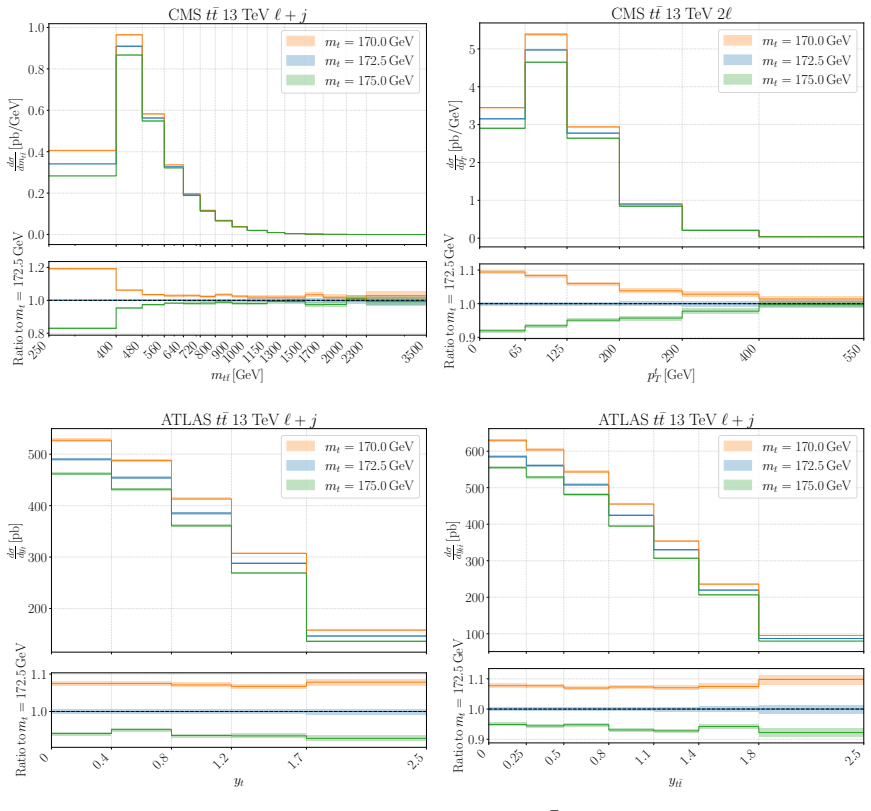


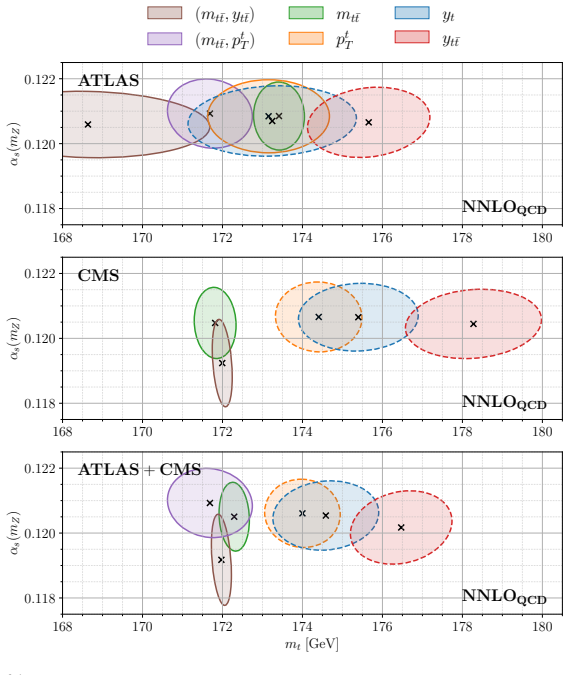

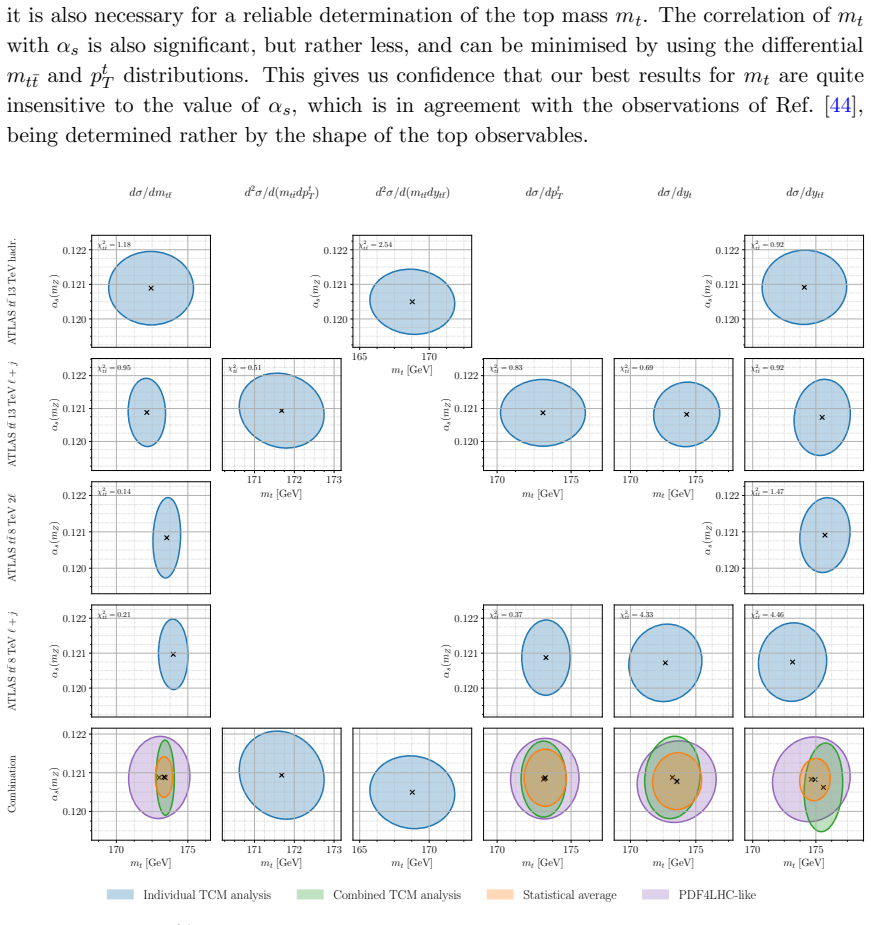


read the original abstract
We present an indirect determination of the top-quark pole mass $m_t$ within a global analysis of parton distribution functions (PDFs), based on the public NNPDF framework. We consider a wide range of measurements, including both single- and double-differential observables, computed at NNLO QCD accuracy with EW corrections, and analyse their individual as well as combined impact on the joint $(\alpha_s, m_t)$ parameter space, while accounting for PDF evolution up to approximate ${\rm N^3LO}$ QCD accuracy with QED corrections. We account for missing higher order QCD uncertainties by default. Unique to our analysis are the inclusion of, first, toponium contributions around the $t\bar{t}$ threshold, second, state-of-the-art constraints on $\alpha_s$ from the lattice, and finally, a detailed sensitivity study of the various ATLAS and CMS differential cross-section measurements at 8 and 13 TeV. We demonstrate explicitly how a combined determination requires the refitting of the PDFs in order to correctly correlate uncertainties. We find $m_t = 172.80 \pm 0.26$ GeV at approximate N$^3$LO QCD including NLO QED, EW and toponium corrections.
Editorial analysis
A structured set of objections, weighed in public.
Referee Report
Summary. The manuscript presents an indirect determination of the top-quark pole mass mt within the NNPDF global PDF framework. It incorporates NNLO QCD matrix elements with NLO EW corrections and toponium contributions for single- and double-differential ttbar observables from ATLAS and CMS at 8 and 13 TeV, approximate N3LO QCD evolution with QED corrections, lattice constraints on αs, and a default missing-higher-order uncertainty prescription. The analysis explicitly refits the PDFs to propagate correlations between mt, αs and the PDFs, yielding the result mt = 172.80 ± 0.26 GeV.
Significance. If the central result holds, the work demonstrates that a global PDF fit can deliver a competitive determination of mt while correctly accounting for PDF uncertainties through refitting. Strengths include the explicit inclusion of toponium threshold contributions, the use of lattice αs constraints, and the demonstration that refitting is required to avoid underestimating correlations. This approach provides a useful cross-check on direct mt measurements and illustrates how higher-order corrections and data sensitivity can be jointly controlled in a global analysis.
major comments (2)
- [Abstract and Section 4] Abstract and Section 4 (results): the quoted uncertainty of ±0.26 GeV relies on the chosen data selection and MHOU prescription fully capturing the sensitivity of the included ATLAS/CMS measurements. The manuscript should provide explicit quantitative tests (e.g., variations of kinematic cuts or alternative MHOU schemes) to confirm that unmodeled effects do not introduce bias at the reported precision.
- [Section 3] Section 3 (methodology): while the necessity of PDF refitting is demonstrated, the propagation of the joint (αs, mt) uncertainties through the approximate N3LO evolution and toponium corrections should be shown in more detail, including the impact on the final error budget, to substantiate that the quoted uncertainty is robust.
minor comments (2)
- [Abstract] Abstract: the phrase 'approximate N3LO QCD' should be clarified with a brief statement of the approximation scheme used for the evolution.
- [Section 5] Figure captions and Section 5: ensure all panels explicitly label the inclusion or exclusion of toponium and EW corrections so that the sensitivity study is immediately readable.
Simulated Author's Rebuttal
We thank the referee for their careful reading of the manuscript and for the positive assessment recommending minor revision. We address each major comment below, indicating the revisions that will be implemented to strengthen the presentation and robustness of the results.
read point-by-point responses
-
Referee: [Abstract and Section 4] Abstract and Section 4 (results): the quoted uncertainty of ±0.26 GeV relies on the chosen data selection and MHOU prescription fully capturing the sensitivity of the included ATLAS/CMS measurements. The manuscript should provide explicit quantitative tests (e.g., variations of kinematic cuts or alternative MHOU schemes) to confirm that unmodeled effects do not introduce bias at the reported precision.
Authors: We agree that additional quantitative tests would further substantiate the robustness of the quoted uncertainty. In the revised manuscript we will add explicit variations of the kinematic cuts on the ATLAS and CMS single- and double-differential ttbar data sets together with results obtained under an alternative MHOU prescription. These tests will be presented in Section 4 and will demonstrate that the central value and uncertainty remain stable within the reported precision, confirming that unmodeled effects do not introduce bias at the quoted level. revision: yes
-
Referee: [Section 3] Section 3 (methodology): while the necessity of PDF refitting is demonstrated, the propagation of the joint (αs, mt) uncertainties through the approximate N3LO evolution and toponium corrections should be shown in more detail, including the impact on the final error budget, to substantiate that the quoted uncertainty is robust.
Authors: We concur that a more detailed account of the uncertainty propagation would improve clarity. In the revised version we will expand Section 3 to include an explicit step-by-step description of how the joint (αs, mt) uncertainties are propagated through the approximate N3LO QCD evolution and the toponium threshold corrections. We will also provide a quantitative breakdown of the individual contributions of these effects to the final error budget on mt, supported by additional tables or figures as appropriate. revision: yes
Circularity Check
No significant circularity in the top mass determination
full rationale
The paper extracts mt by performing a global fit of PDFs and the top mass parameter to independent experimental ttbar cross-section data from ATLAS and CMS, using standard NNLO QCD matrix elements supplemented by EW, QED, and toponium corrections plus approximate N3LO evolution. The central result mt = 172.80 ± 0.26 GeV is the numerical output of this chi-squared minimization against external measurements; it does not reduce by the paper's own equations to a quantity defined in terms of itself, nor is any fitted input relabeled as a prediction. Lattice alpha_s constraints and the MHOU prescription are external inputs. No load-bearing self-citations, uniqueness theorems, or ansatze imported from prior author work are invoked to force the result. The derivation chain is therefore self-contained against external benchmarks.
Axiom & Free-Parameter Ledger
free parameters (2)
- top-quark pole mass mt
- strong coupling αs
axioms (2)
- domain assumption NNLO QCD matrix elements plus EW corrections plus toponium contributions accurately describe the included observables
- domain assumption Missing higher-order QCD uncertainties can be estimated by the chosen prescription
Forward citations
Cited by 1 Pith paper
-
Proton Structure from Neural Simulation-Based Inference at the LHC
Neural simulation-based inference on unbinned top-quark pair data at 13 TeV yields improved gluon PDF precision over traditional binned analyses while incorporating experimental and theoretical uncertainties.
Reference graph
Works this paper leans on
- [1]
-
[2]
J. de Blas, M. Ciuchini, E. Franco, A. Goncalves, S. Mishima, M. Pierini et al.,Global analysis of electroweak data in the Standard Model,Phys. Rev. D106(2022) 033003 [2112.07274]
-
[3]
Z. Kassabov, M. Madigan, L. Mantani, J. Moore, M. Morales Alvarado, J. Rojo et al.,The top quark legacy of the LHC Run II for PDF and SMEFT analyses,JHEP05(2023) 205 [2303.06159]
- [4]
-
[5]
Scale Invariant Instantons and the Complete Lifetime of the Standard Model
A. Andreassen, W. Frost and M. D. Schwartz,Scale Invariant Instantons and the Complete Lifetime of the Standard Model,Phys. Rev. D97(2018) 056006 [1707.08124]
work page internal anchor Pith review Pith/arXiv arXiv 2018
-
[6]
Higgs mass and vacuum stability in the Standard Model at NNLO
G. Degrassi, S. Di Vita, J. Elias-Miro, J. R. Espinosa, G. F. Giudice, G. Isidori et al.,Higgs mass and vacuum stability in the Standard Model at NNLO,JHEP08(2012) 098 [1205.6497]
work page internal anchor Pith review Pith/arXiv arXiv 2012
-
[7]
Higgs boson mass and new physics
F. Bezrukov, M. Y. Kalmykov, B. A. Kniehl and M. Shaposhnikov,Higgs Boson Mass and New Physics,JHEP10(2012) 140 [1205.2893]
work page internal anchor Pith review Pith/arXiv arXiv 2012
-
[8]
A. V. Bednyakov, B. A. Kniehl, A. F. Pikelner and O. L. Veretin,Stability of the Electroweak Vacuum: Gauge Independence and Advanced Precision,Phys. Rev. Lett.115 (2015) 201802 [1507.08833]. [27]CDFcollaboration,Observation of top quark production in¯ppcollisions,Phys. Rev. Lett. 74(1995) 2626 [hep-ex/9503002]. [28]D0collaboration,Observation of the top q...
work page internal anchor Pith review Pith/arXiv arXiv 2015
-
[9]
Parton Distribution Functions, $\alpha_s$ and Heavy-Quark Masses for LHC Run II
S. Alekhin, J. Bl¨ umlein, S. Moch and R. Placakyte,Parton distribution functions,α s, and heavy-quark masses for LHC Run II,Phys. Rev. D96(2017) 014011 [1701.05838]
work page internal anchor Pith review Pith/arXiv arXiv 2017
- [10]
- [11]
-
[12]
T. Cridge and M. A. Lim,Constraining the top-quark mass within the global MSHT PDF fit,Eur. Phys. J. C83(2023) 805 [2306.14885]
- [13]
-
[14]
J. Holguin, I. Moult, A. Pathak, M. Procura, R. Sch¨ ofbeck and D. Schwarz,Using the W Boson as a Standard Candle to Reach the Top: Calibrating Energy-Correlator-Based Top Mass Measurements,Phys. Rev. Lett.134(2025) 231903 [2311.02157]. – 39 –
-
[15]
S. Alekhin, M. V. Garzelli, S. O. Moch and O. Zenaiev,NNLO PDFs driven by top-quark data,Eur. Phys. J. C85(2025) 162 [2407.00545]
-
[16]
S. Forte and Z. Kassabov,Whyα s cannot be determined from hadronic processes without simultaneously determining the parton distributions,Eur. Phys. J. C80(2020) 182 [2001.04986]
-
[17]
S. Forte, J. Rojo and R. Stegeman,Extractions of the strong coupling from collider data without PDF refitting are biased, in2025 European Physical Society Conference on High Energy Physics, 11, 2025,2511.22561. [50]NNPDFcollaboration,A determination ofα s(mZ)at aN 3LOQCD ⊗NLO QED accuracy from a global PDF analysis,Eur. Phys. J. C85(2025) 1001 [2506.13871]
- [18]
-
[19]
R. D. Ball and A. Deshpande,The proton spin, semi-inclusive processes, and measurements at a future Electron Ion Collider,published in‘From My Vast Repertoire ...: Guido Altarelli’s Legacy’, eds A. Levy, S. Forte and G. Ridolfi,, pp. 205–226. World Scientific, 2019.1801.04842. 10.1142/97898132380530011. [53]NNPDFcollaboration,Nuclear Uncertainties in the ...
-
[20]
R. D. Ball and R. L. Pearson,Correlation of theoretical uncertainties in PDF fits and theoretical uncertainties in predictions,Eur. Phys. J. C81(2021) 830 [2105.05114]. [56]NNPDFcollaboration,The path to proton structure at 1% accuracy,Eur. Phys. J. C82 (2022) 428 [2109.02653]. [57]ATLAScollaboration,Observation of a cross-section enhancement near thet ¯t...
-
[21]
L. Del Debbio, T. Giani and M. Wilson,Bayesian approach to inverse problems: an application to NNPDF closure testing,Eur. Phys. J. C82(2022) 330 [2111.05787]
- [22]
-
[23]
A. Barontini, M. N. Costantini, G. De Crescenzo, S. Forte and M. Ubiali,Evaluating the faithfulness of PDF uncertainties in the presence of inconsistent data,2503.17447. – 40 –
- [24]
-
[25]
Fully differential NNLO computations with MATRIX
M. Grazzini, S. Kallweit and M. Wiesemann,Fully differential NNLO computations with MATRIX,Eur. Phys. J. C78(2018) 537 [1711.06631]
work page internal anchor Pith review Pith/arXiv arXiv 2018
-
[26]
S. Carrazza, E. R. Nocera, C. Schwan and M. Zaro,PineAPPL: combining EW and QCD corrections for fast evaluation of LHC processes,JHEP12(2020) 108 [2008.12789]
-
[27]
C. Schwan, T. R. Rabemananjara, A. Candido, F. Hekhorn, T. Sharma, S. Carrazza et al., Nnpdf/pineappl: v1.0.0, June, 2025. 10.5281/zenodo.15635174
- [28]
-
[29]
J. Alwall, R. Frederix, S. Frixione, V. Hirschi, F. Maltoni, O. Mattelaer et al.,The automated computation of tree-level and next-to-leading order differential cross sections, and their matching to parton shower simulations,JHEP07(2014) 079 [1405.0301]. [71]NNPDFcollaboration,Determination of the theory uncertainties from missing higher orders on NNLO par...
work page internal anchor Pith review Pith/arXiv arXiv 2014
-
[30]
A. Candido, F. Hekhorn and G. Magni,EKO: evolution kernel operators,Eur. Phys. J. C 82(2022) 976 [2202.02338]
-
[31]
A. Candido, F. Hekhorn and G. Magni,Nnpdf/eko: v0.14.6, June, 2025. 10.5281/zenodo.15655642. [75]NNPDFcollaboration,Photons in the proton: implications for the LHC,Eur. Phys. J. C 84(2024) 540 [2401.08749]
-
[32]
J. Ablinger, A. Behring, J. Bl¨ umlein, A. De Freitas, A. von Manteuffel, C. Schneider et al., The non-first-order-factorizable contributions to the three-loop single-mass operator matrix elements AQg(3) and∆AQg(3),Phys. Lett. B854(2024) 138713 [2403.00513]
-
[33]
G. Falcioni, F. Herzog, S. Moch, A. Pelloni and A. Vogt,Four-loop splitting functions in QCD – the gluon-gluon case –,Phys. Lett. B860(2025) 139194 [2410.08089]
-
[34]
Top-pair production at the LHC through NNLO QCD and NLO EW
M. Czakon, D. Heymes, A. Mitov, D. Pagani, I. Tsinikos and M. Zaro,Top-pair production at the LHC through NNLO QCD and NLO EW,JHEP10(2017) 186 [1705.04105]
work page internal anchor Pith review Pith/arXiv arXiv 2017
- [35]
- [36]
-
[37]
V. S. Fadin and V. A. Khoze,Threshold Behavior of Heavy Top Production in e+ e- Collisions,JETP Lett.46(1987) 525
work page 1987
-
[38]
V. S. Fadin, V. A. Khoze and T. Sjostrand,On the Threshold Behavior of Heavy Top Production,Z. Phys. C48(1990) 613
work page 1990
-
[39]
F. Maltoni, C. Severi, S. Tentori and E. Vryonidou,Quantum detection of new physics in top-quark pair production at the LHC,JHEP03(2024) 099 [2401.08751]. – 41 –
-
[40]
Bound-state effects on kinematical distributions of top quarks at hadron colliders
Y. Sumino and H. Yokoya,Bound-state effects on kinematical distributions of top quarks at hadron colliders,JHEP09(2010) 034 [1007.0075]
work page internal anchor Pith review Pith/arXiv arXiv 2010
-
[41]
M. A. Braun,Positronium Singularities in Quantum Electrodynamics and Perturbation Theory,Sov. Phys. JETP27(1968) 652
work page 1968
-
[42]
Remarks on the effect of bound states and threshold in g-2
K. Melnikov, A. Vainshtein and M. Voloshin,Remarks on the effect of bound states and threshold in g-2,Phys. Rev. D90(2014) 017301 [1402.5690]
work page internal anchor Pith review Pith/arXiv arXiv 2014
-
[43]
M. I. Eides,Recent ideas on the calculation of lepton anomalous magnetic moments,Phys. Rev. D90(2014) 057301 [1402.5860]
work page internal anchor Pith review Pith/arXiv arXiv 2014
-
[44]
Threshold singularities, dispersion relations and fixed-order perturbative calculations
M. Beneke and P. Ruiz-Femenia,Threshold singularities, dispersion relations and fixed-order perturbative calculations,JHEP08(2016) 145 [1606.02434]
work page internal anchor Pith review Pith/arXiv arXiv 2016
-
[45]
P. Nason, E. Re and L. Rottoli,Spin correlations int tproduction and decay at the LHC in QCD perturbation theory,JHEP10(2025) 149 [2505.00096]. [90]CMScollaboration,Measurement of differential cross sections for the production of top quark pairs and of additional jets in lepton+jets events from pp collisions at √s=13 TeV, Phys. Rev. D97(2018) 112003 [1803...
-
[46]
On the positivity of MSbar parton distributions
A. Candido, S. Forte, T. Giani and F. Hekhorn,On the positivity of MS parton distributions,Eur. Phys. J. C84(2024) 335 [2308.00025]
work page internal anchor Pith review Pith/arXiv arXiv 2024
-
[47]
S. Bailey and L. Harland-Lang,Differential Top Quark Pair Production at the LHC: Challenges for PDF Fits,Eur. Phys. J. C80(2020) 60 [1909.10541]
- [48]
-
[49]
PDF4LHC recommendations for LHC Run II
J. Butterworth et al.,PDF4LHC recommendations for LHC Run II,J. Phys. G43(2016) 023001 [1510.03865]
work page internal anchor Pith review Pith/arXiv arXiv 2016
- [50]
-
[51]
J. C. Collins and R. K. Ellis,Heavy Quark Production in Very High-Energy Hadron Collisions,Nucl. Phys. B360(1991) 3
work page 1991
-
[52]
R. D. Ball and R. K. Ellis,Heavy quark production at high-energy,JHEP05(2001) 053 [hep-ph/0101199]
work page internal anchor Pith review Pith/arXiv arXiv 2001
-
[53]
F. Silvetti and M. Bonvini,Differential heavy quark pair production at small x,Eur. Phys. J. C83(2023) 267 [2211.10142]
-
[54]
Top Quark Pair Production beyond NNLO
C. Muselli, M. Bonvini, S. Forte, S. Marzani and G. Ridolfi,Top Quark Pair Production beyond NNLO,JHEP08(2015) 076 [1505.02006]
work page internal anchor Pith review Pith/arXiv arXiv 2015
-
[55]
C. McNeile, C. T. H. Davies, E. Follana, K. Hornbostel and G. P. Lepage,High-Precision c and b Masses, and QCD Coupling from Current-Current Correlators in Lattice and Continuum QCD,Phys. Rev. D82(2010) 034512 [1004.4285]
work page internal anchor Pith review Pith/arXiv arXiv 2010
-
[56]
High-precision quark masses and QCD coupling from $n_f=4$ lattice QCD
B. Chakraborty, C. T. H. Davies, B. Galloway, P. Knecht, J. Koponen, G. C. Donald et al., High-precision quark masses and QCD coupling fromn f = 4lattice QCD,Phys. Rev. D91 (2015) 054508 [1408.4169]. – 42 – [103]ALPHAcollaboration,Determination ofα s(mZ)by the non-perturbative decoupling method,Eur. Phys. J. C82(2022) 1092 [2209.14204]
work page internal anchor Pith review Pith/arXiv arXiv 2015
-
[57]
P. Petreczky and J. H. Weber,Strong coupling constant from moments of quarkonium correlators revisited,Eur. Phys. J. C82(2022) 64 [2012.06193]
-
[58]
C. Ayala, X. Lobregat and A. Pineda,Determination ofα(M z)from an hyperasymptotic approximation to the energy of a static quark-antiquark pair,JHEP09(2020) 016 [2005.12301]. [106]TUMQCDcollaboration,Determination of the QCD coupling from the static energy and the free energy,Phys. Rev. D100(2019) 114511 [1907.11747]
-
[59]
S. Cali, K. Cichy, P. Korcyl and J. Simeth,Running coupling constant from position-space current-current correlation functions in three-flavor lattice QCD,Phys. Rev. Lett.125 (2020) 242002 [2003.05781]. [108]ALPHAcollaboration,QCD Coupling from a Nonperturbative Determination of the Three-FlavorΛParameter,Phys. Rev. Lett.119(2017) 102001 [1706.03821]. [10...
-
[60]
The Realistic Lattice Determination of alpha_s(M_Z) Revisited
K. Maltman, D. Leinweber, P. Moran and A. Sternbeck,The Realistic Lattice Determination of alpha(s)(M(Z)) Revisited,Phys. Rev. D78(2008) 114504 [0807.2020]
work page internal anchor Pith review Pith/arXiv arXiv 2008
-
[61]
S. Bailey, T. Cridge, L. A. Harland-Lang, A. D. Martin and R. S. Thorne,Parton distributions from LHC, HERA, Tevatron and fixed target data: MSHT20 PDFs,Eur. Phys. J. C81(2021) 341 [2012.04684]. [112]NNPDFcollaboration,Parton distributions from high-precision collider data,Eur. Phys. J. C77(2017) 663 [1706.00428]. [113]ATLAScollaboration,Inclusive and dif...
-
[62]
J. de Blas, M. Pierini, L. Reina and L. Silvestrini,Impact of the Recent Measurements of the Top-Quark and W-Boson Masses on Electroweak Precision Fits,Phys. Rev. Lett.129 (2022) 271801 [2204.04204]
- [63]
discussion (0)
Sign in with ORCID, Apple, or X to comment. Anyone can read and Pith papers without signing in.