Recognition: no theorem link
Systematic Integration of Digital Twins and Constrained LLMs for Interpretable Cyber-Physical Anomaly Detection
Pith reviewed 2026-05-13 17:15 UTC · model grok-4.3
The pith
A digital twin paired with constrained large language models detects and localizes cyber attacks on industrial control systems by using heuristics first and invoking the model only when needed.
A machine-rendered reading of the paper's core claim, the machinery that carries it, and where it could break.
Core claim
The central claim is that a DT-driven hybrid detector, which combines deterministic heuristics with constrained LLM reasoning, achieves precise localization of each attack interval, low time-to-detect, and zero false positives in the evaluated benign region across four canonical SWaT scenarios; the same performance holds for both a local LLaMA model and a cloud-based GPT model.
What carries the argument
The constrained LLM reasoning step, invoked only when heuristics abstain and enforced by a JSON schema plus semantic plausibility filters that keep outputs physically consistent with the digital twin's representation.
Load-bearing premise
The digital twin must keep an accurate, synchronized, feature-enriched model of the physical process while the JSON schema and semantic filters must reliably force the LLM to produce only physically consistent outputs.
What would settle it
An experiment in which the detector either misses the exact start or end of an attack interval in one of the four SWaT scenarios or generates at least one false positive in the benign test region would show the central claim is not correct.
Figures
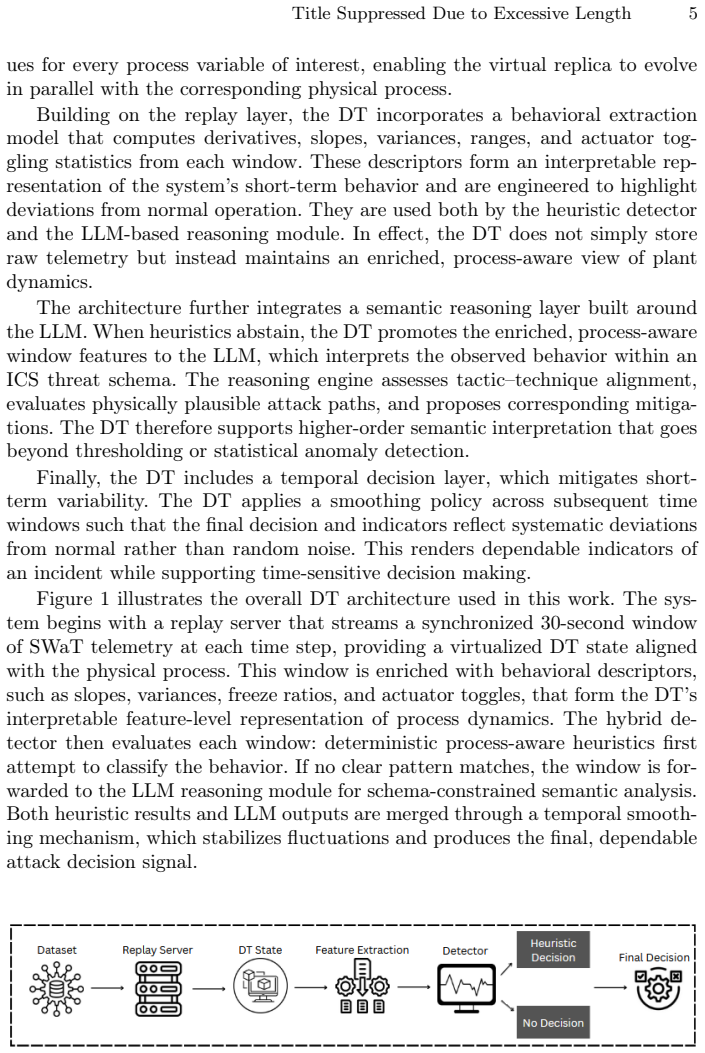

read the original abstract
Cyber attacks targeting Industrial Control Systems (ICS) have become increasingly sophisticated and hard to identify. Detecting such attacks requires integrating low-level behavioral cues with high-level semantic interpretation, a capability that traditional anomaly detectors lack. This paper presents a Digital Twin (DT)-driven hybrid detection approach that combines deterministic heuristics with systematic, constrained Large Language Model (LLM) reasoning to achieve real-time incident detection. The DT maintains a synchronized, feature-enriched representation of the Secure Water Treatment (SWaT) process, deriving behavioral descriptors. Heuristics identify characteristic signatures of spoofing, valve forcing, denial-of-service, and bias drift, while the LLM is invoked only when heuristics abstain. A constrained JSON schema and semantic plausibility filters ensure physically consistent LLM outputs, and a temporal smoothing layer stabilizes the final decision signal. Evaluation on four canonical SWaT attack scenarios shows that the proposed detector precisely localizes each attack interval with low time-to-detect and zero False Positives (FPs) in the evaluated benign region. Results are consistent across both a local LLaMA model and a cloud-based GPT model, demonstrating the robustness of the constrained hybrid architecture. The findings highlight the potential of DT-guided LLM reasoning as a reliable and interpretable approach to ICS anomaly detection.
Editorial analysis
A structured set of objections, weighed in public.
Referee Report
Summary. This paper proposes a hybrid anomaly detection system for Industrial Control Systems (ICS) that integrates a Digital Twin (DT) maintaining a synchronized, feature-enriched representation of the Secure Water Treatment (SWaT) process with deterministic heuristics for attack signatures (spoofing, valve forcing, DoS, bias drift) and a constrained LLM invoked only on heuristic abstention. A JSON schema and semantic plausibility filters enforce physically consistent LLM outputs, followed by temporal smoothing. The central empirical claim is that evaluation on four canonical SWaT attack scenarios yields precise attack-interval localization, low time-to-detect, and zero false positives in the evaluated benign region, with consistent results across local LLaMA and cloud GPT models.
Significance. If the performance claims hold under rigorous validation, the work would advance interpretable cyber-physical anomaly detection by showing how constrained LLMs can reliably augment heuristics in ICS settings without introducing hallucinations. The hybrid DT-LLM architecture and cross-model robustness offer a promising direction for explainable real-time detection, addressing limitations of purely statistical or rule-based methods.
major comments (3)
- [Abstract] Abstract: The zero-FP claim in the evaluated benign region and precise localization with low TTD are load-bearing for the central performance assertion, yet the abstract supplies no quantitative validation of DT synchronization accuracy (e.g., state estimation error on SWaT sensor/actuator traces) or filter coverage (e.g., LLM rejection/correction statistics). Without these, it is unclear whether the result generalizes beyond the narrow evaluated window.
- [Evaluation] Evaluation section: The reported strong empirical outcomes lack exact numerical metrics (e.g., TTD values, precision/recall), implementation details, or validation procedures for the four SWaT scenarios, preventing verification of whether the data support the stated claims of zero FPs and precise localization.
- [Methodology] Methodology (constrained LLM subsection): The description of the JSON schema and semantic plausibility filters is insufficient to assess their reliability in forcing physically consistent outputs; no coverage metrics or failure cases are provided, which directly impacts the robustness claim across LLaMA and GPT.
Simulated Author's Rebuttal
We thank the referee for the constructive and detailed review. The comments correctly identify areas where additional quantitative detail and expanded descriptions would improve clarity and verifiability. We address each major comment below and will revise the manuscript accordingly.
read point-by-point responses
-
Referee: [Abstract] Abstract: The zero-FP claim in the evaluated benign region and precise localization with low TTD are load-bearing for the central performance assertion, yet the abstract supplies no quantitative validation of DT synchronization accuracy (e.g., state estimation error on SWaT sensor/actuator traces) or filter coverage (e.g., LLM rejection/correction statistics). Without these, it is unclear whether the result generalizes beyond the narrow evaluated window.
Authors: We agree that the abstract would benefit from explicit quantitative anchors. In the revised manuscript we will add concise statements of DT synchronization accuracy (mean state estimation error across sensor/actuator traces) and LLM filter coverage (rejection and correction rates) to support the generalization claim while preserving the abstract's length constraints. revision: yes
-
Referee: [Evaluation] Evaluation section: The reported strong empirical outcomes lack exact numerical metrics (e.g., TTD values, precision/recall), implementation details, or validation procedures for the four SWaT scenarios, preventing verification of whether the data support the stated claims of zero FPs and precise localization.
Authors: The current evaluation section emphasizes qualitative outcomes and consistency across models. To enable direct verification we will expand it with exact numerical results (TTD in seconds, precision/recall per scenario), a table of per-scenario metrics, and a description of the validation procedure used on the four canonical SWaT traces. Implementation details and a pointer to the evaluation scripts will also be included. revision: yes
-
Referee: [Methodology] Methodology (constrained LLM subsection): The description of the JSON schema and semantic plausibility filters is insufficient to assess their reliability in forcing physically consistent outputs; no coverage metrics or failure cases are provided, which directly impacts the robustness claim across LLaMA and GPT.
Authors: We acknowledge that the current subsection provides only a high-level outline. The revision will supply the full JSON schema definition, enumerate the semantic plausibility rules, report coverage statistics (fraction of LLM invocations that triggered each filter), and include a brief discussion of any observed failure modes or edge cases encountered during the LLaMA and GPT experiments. revision: yes
Circularity Check
No significant circularity; claims rest on external SWaT benchmark evaluation
full rationale
The paper's derivation chain presents a DT-LLM hybrid detector whose core claims (precise attack localization, low TTD, zero FPs in evaluated benign region) are justified by direct evaluation on four canonical SWaT scenarios rather than by any quantity defined in terms of the detector itself. No self-definitional steps appear (e.g., no parameter fitted to a subset then renamed as prediction), no load-bearing self-citations reduce the central result to prior author work, and no ansatz or uniqueness theorem is smuggled in. The abstract and described architecture treat DT synchronization and JSON filters as design choices whose reliability is asserted via the external benchmark results, not by construction. This matches the default expectation for non-circular papers; the skeptic's concerns address verification gaps, not circular reduction.
Axiom & Free-Parameter Ledger
axioms (2)
- domain assumption The digital twin maintains a synchronized, feature-enriched representation of the SWaT process.
- domain assumption Constrained JSON schema and semantic plausibility filters ensure physically consistent LLM outputs.
Forward citations
Cited by 1 Pith paper
-
HySecTwin: A Knowledge-Driven Digital Twin Framework Augmented with Hybrid Reasoning for Cyber-Physical Systems
HySecTwin integrates semantic modeling with hybrid deterministic and fuzzy reasoning in digital twins to achieve faster, more interpretable threat detection in CPS with sub-millisecond latency.
Reference graph
Works this paper leans on
-
[1]
MAD-LLM: A Novel Approach for Alert-Based Multi-stage Attack Detection via LLM
Dan Du et al. “MAD-LLM: A Novel Approach for Alert-Based Multi-stage Attack Detection via LLM”. In:2024 IEEE International Symposium on Parallel and Distributed Processing with Applications (ISPA). IEEE. 2024, pp. 2046–2053
work page 2024
-
[2]
Tunahan Gokcimen and Bihter Das. “A novel system for strengthening se- curity in large language models against hallucination and injection attacks with effective strategies”. In:Alexandria Engineering Journal123 (2025), pp. 71–90
work page 2025
-
[3]
PLLM-CS: Pre-trained Large Language Model (LLM) for cyber threat detection in satellite networks
Mohammed Hassanin et al. “PLLM-CS: Pre-trained Large Language Model (LLM) for cyber threat detection in satellite networks”. In:Ad Hoc Networks 166 (2025), p. 103645
work page 2025
-
[4]
Lei Huang et al. “A survey on hallucination in large language models: Prin- ciples, taxonomy, challenges, and open questions”. In:ACM Transactions on Information Systems43.2 (2025), pp. 1–55
work page 2025
-
[5]
Crimson: Empowering strategic reasoning in cybersecu- rity through large language models
Jiandong Jin et al. “Crimson: Empowering strategic reasoning in cybersecu- rity through large language models”. In:2024 5th International Conference on Computer, Big Data and Artificial Intelligence (ICCBD+ AI). IEEE. 2024, pp. 18–24
work page 2024
-
[6]
Konstantinos E Kampourakis et al. “Digital Twin-Enabled Incident Detec- tion and Response: A Systematic Review of Critical Infrastructures Ap- plications”. In:International Journal of Information Security24.5 (2025), pp. 1–42
work page 2025
-
[7]
MoRSE: Bridging the gap in cybersecurity expertise withretrievalaugmentedgeneration
Marco Simoni et al. “MoRSE: Bridging the gap in cybersecurity expertise withretrievalaugmentedgeneration”.In:Proceedings of the 40th ACM/SIGAPP Symposium on Applied Computing. 2025, pp. 1213–1222
work page 2025
-
[8]
Aschalew Tirulo, Siddhartha Chauhan, and Miadreza Shafie-khah. “LLM- powered threat intelligence: Proactive detection of zero-day attacks in elec- tric vehicle cyber-physical systems”. In:Sustainable Energy, Grids and Net- works(2025), p. 101877
work page 2025
discussion (0)
Sign in with ORCID, Apple, or X to comment. Anyone can read and Pith papers without signing in.