Recognition: 2 theorem links
· Lean TheoremGROW: A Conversational AI Coach for Goals, Reflection, Optimism, and Well-Being
Pith reviewed 2026-05-10 19:54 UTC · model grok-4.3
The pith
GROW combines the SMART framework with Acceptance and Commitment Therapy principles in a conversational AI coach that helps college students clarify values-aligned goals, break them into steps, and track progress through calendar links and
A machine-rendered reading of the paper's core claim, the machinery that carries it, and where it could break.
Core claim
GROW is a conversational AI coach that puts values-aligned goals at the center of the student experience by combining the SMART framework with Acceptance and Commitment Therapy principles. The system helps students clarify aspirations, break them into concrete steps, reflect on progress, links action plans to Google Calendar with reminders, and supplies a dashboard for progress and engagement. Interviews with clinical psychologists, student-success staff, and faculty followed by a one-week deployment with 30 undergraduates yield design implications for interactive systems that support engagement, accountability, and sense of purpose in higher education.
What carries the argument
GROW, the conversational AI coach that merges the SMART framework with Acceptance and Commitment Therapy principles to guide goal clarification, action planning, reflection, and calendar-linked reminders.
If this is right
- Students gain accountability through calendar-linked action plans and automated reminders.
- A dashboard makes progress and engagement visible to encourage ongoing reflection.
- The approach surfaces concrete design implications for systems that foster a sense of purpose in higher education.
- Structured goal work may complement or reduce reliance on limited counseling resources.
Where Pith is reading between the lines
- The same conversational structure could be tested with working adults or other groups facing goal-related stress.
- Longer deployments would clarify whether calendar integration sustains behavior change beyond one week.
- Adding optional peer or mentor sharing of progress dashboards might increase accountability without adding stigma.
Load-bearing premise
That a one-week deployment with 30 undergraduates, after expert interviews, is sufficient to generate reliable design implications for engagement, accountability, and sense of purpose.
What would settle it
A controlled longer-term study with undergraduates that finds no measurable rise in goal completion rates, self-reported purpose, or engagement metrics for GROW users compared with a non-coach control group would undermine the claim that the system effectively supports well-being.
Figures



read the original abstract
College students face well-being challenges driven by academic pressure, financial strain, and social expectations. While campus counseling and student-success programs offer support, access is often limited by stigma, waitlists, and scheduling constraints. Existing digital tools focus on emotional check-ins or chatbots and may overlook structured goal setting and aligning goals with personal values. We present GROW, a goal-centered well-being coaching system that puts values-aligned goals at the center of the student experience. GROW combines the SMART framework with principles from Acceptance and Commitment Therapy in a conversational AI coach that helps students clarify aspirations, break them into concrete steps, and reflect on progress. The system links action plans with Google Calendar, sends reminders, and provides a dashboard that shows progress and engagement. We evaluated GROW through interviews with clinical psychologists, student-success staff, and faculty, followed by a one-week deployment with 30 undergraduates. Findings offer design implications for interactive systems that support engagement, accountability, and sense of purpose in higher education.
Editorial analysis
A structured set of objections, weighed in public.
Referee Report
Summary. The manuscript presents GROW, a conversational AI coach for college students that integrates the SMART goal-setting framework with Acceptance and Commitment Therapy (ACT) principles. The system helps users clarify values-aligned aspirations, decompose them into concrete steps, link action plans to Google Calendar for reminders, and monitor progress through a dashboard. Evaluation consists of interviews with clinical psychologists, student-success staff, and faculty, followed by a one-week deployment with 30 undergraduates, from which the authors derive design implications for supporting engagement, accountability, and sense of purpose in higher education.
Significance. If the evaluation evidence were stronger, the work would contribute to HCI and digital well-being research by showing how established psychological frameworks can be operationalized in a conversational system with practical integrations like calendar linking. Credit is due for the explicit combination of SMART and ACT, the dashboard visualization of engagement, and the focus on addressing access barriers in campus counseling. These elements provide a concrete prototype that could inform scalable student-support tools.
major comments (2)
- [§4 Evaluation] §4 Evaluation (one-week deployment with 30 undergraduates): The study design lacks a control group, baseline measures, or validated instruments (such as goal-attainment scaling or AAQ-II), so observed patterns in calendar linking, reflection logs, and dashboard use cannot be confidently attributed to the SMART+ACT integration rather than novelty, self-selection, or short-term compliance. This is load-bearing for the central claim that the deployment yields reliable design implications for engagement, accountability, and sense of purpose.
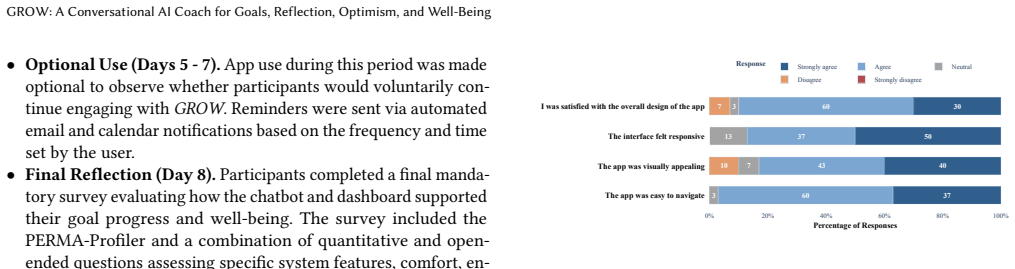
- [§4.3 Findings] §4.3 Findings and abstract: No quantitative usage statistics, qualitative themes with supporting excerpts, or statistical details are reported to substantiate the design implications, despite the abstract stating that the deployment 'findings offer design implications.' Without these data, the implications remain vulnerable to overgeneralization from anecdotal or dashboard-only observations.
minor comments (2)
- The system description would benefit from additional detail on the underlying LLM, prompt engineering strategies used to enforce SMART and ACT principles, and how the conversational flow handles value clarification.
- A brief discussion of ethical considerations (data privacy for calendar access and handling of sensitive well-being reflections) is missing and would strengthen the manuscript.
Simulated Author's Rebuttal
We thank the referee for the constructive feedback on the evaluation and reporting of our one-week deployment study. We address each major comment below and commit to revisions that clarify the exploratory scope of the work while enhancing transparency in the findings.
read point-by-point responses
-
Referee: [§4 Evaluation] §4 Evaluation (one-week deployment with 30 undergraduates): The study design lacks a control group, baseline measures, or validated instruments (such as goal-attainment scaling or AAQ-II), so observed patterns in calendar linking, reflection logs, and dashboard use cannot be confidently attributed to the SMART+ACT integration rather than novelty, self-selection, or short-term compliance. This is load-bearing for the central claim that the deployment yields reliable design implications for engagement, accountability, and sense of purpose.
Authors: We agree that the deployment is exploratory and lacks a control group, baselines, or validated instruments such as AAQ-II or goal-attainment scaling, limiting causal attribution. The study was designed as a formative pilot to surface real-world usage patterns and derive initial design implications for HCI systems, consistent with common practices in the field for early-stage prototypes. We will revise the manuscript to: (1) explicitly label the deployment as exploratory in §4 and the abstract, (2) add a limitations subsection discussing confounds including novelty effects and self-selection, and (3) rephrase claims from 'reliable design implications' to 'preliminary design implications' to avoid overstatement. We cannot add retrospective controls or instruments to the existing dataset. revision: partial
-
Referee: [§4.3 Findings] §4.3 Findings and abstract: No quantitative usage statistics, qualitative themes with supporting excerpts, or statistical details are reported to substantiate the design implications, despite the abstract stating that the deployment 'findings offer design implications.' Without these data, the implications remain vulnerable to overgeneralization from anecdotal or dashboard-only observations.
Authors: We acknowledge that the current §4.3 reporting could be strengthened with more explicit data. While the manuscript draws on dashboard logs and participant reflections, we will expand this section in revision to include: quantitative summaries of available system logs (e.g., goals created, calendar links made, dashboard views, and reminder response rates), qualitative themes with direct supporting excerpts from student reflections and expert interviews, and any descriptive statistics on engagement. These additions will better ground the design implications. Where specific metrics were not systematically captured, we will note this explicitly as a limitation rather than implying stronger evidence. revision: yes
Circularity Check
No significant circularity in this descriptive HCI system paper
full rationale
The paper presents the design of GROW, a conversational AI coach integrating SMART goal-setting with Acceptance and Commitment Therapy principles, followed by expert interviews and a one-week deployment study with 30 undergraduates. No mathematical derivations, equations, fitted parameters, or 'predictions' exist that could reduce to inputs by construction. No self-citations are invoked to justify uniqueness theorems, ansatzes, or load-bearing premises. The evaluation reports observed usage patterns and design implications without internal self-referential logic or renaming of known results as novel derivations. This is a standard empirical system paper whose claims rest on external user data rather than tautological reduction.
Axiom & Free-Parameter Ledger
Lean theorems connected to this paper
-
IndisputableMonolith/Cost/FunctionalEquation.leanwashburn_uniqueness_aczel unclear?
unclearRelation between the paper passage and the cited Recognition theorem.
GROW combines the SMART framework with principles from Acceptance and Commitment Therapy in a conversational AI coach that helps students clarify aspirations, break them into concrete steps, and reflect on progress.
-
IndisputableMonolith/Foundation/RealityFromDistinction.leanreality_from_one_distinction unclear?
unclearRelation between the paper passage and the cited Recognition theorem.
The system links action plans with Google Calendar, sends reminders, and provides a dashboard that shows progress and engagement.
What do these tags mean?
- matches
- The paper's claim is directly supported by a theorem in the formal canon.
- supports
- The theorem supports part of the paper's argument, but the paper may add assumptions or extra steps.
- extends
- The paper goes beyond the formal theorem; the theorem is a base layer rather than the whole result.
- uses
- The paper appears to rely on the theorem as machinery.
- contradicts
- The paper's claim conflicts with a theorem or certificate in the canon.
- unclear
- Pith found a possible connection, but the passage is too broad, indirect, or ambiguous to say the theorem truly supports the claim.
Forward citations
Cited by 2 Pith papers
-
Optimized but Unowned: How AI-Authored Goals Undermine the Motivation They Are Meant to Drive
AI-authored goals are objectively higher quality but produce lower psychological ownership, commitment, importance, and behavioral action than self-authored goals, with ownership as the mediating mechanism.
-
Optimized but Unowned: How AI-Authored Goals Undermine the Motivation They Are Meant to Drive
AI-authored goals produce higher SMART quality scores but lower psychological ownership, commitment, importance, and goal-directed behavior than self-authored goals, with ownership as the mediating mechanism.
Reference graph
Works this paper leans on
-
[1]
Saba Asif, Azka Mudassar, Talala Zainab Shahzad, Mobeen Raouf, and Tehmina Pervaiz. 2020. Frequency of depression, anxiety and stress among university students. Pakistan journal of medical sciences 36, 5 (2020), 971
2020
-
[2]
Zeynab Bahrami, Atena Heidari, and Jacquelyn Cranney. 2022. Applying SMART Goal Intervention Leads to Greater Goal Attainment, Need Satisfaction and Positive A"ect. International Journal of Mental Health Promotion 24 (09 2022), 869–882. https://doi.org/10.32604/ijmhp.2022.018954
-
[3]
Luke Balcombe and Diego De Leo. 2022. Human-Computer Interaction in Digital Mental Health. Informatics 9, 1 (2022), 14. https://doi.org/10.3390/ informatics9010014
2022
-
[4]
Aaron Bangor, Philip T Kortum, and James T Miller. 2008. An empirical evaluation of the system usability scale. Intl. Journal of Human–Computer Interaction 24, 6 (2008), 574–594
2008
-
[5]
Amit Baumel, Frederick Muench, Stav Edan, and John M Kane. 2019. Objective user engagement with mental health apps: systematic search and panel-based usage analysis. Journal of medical Internet research 21, 9 (2019), e14567
2019
-
[6]
Eric PS Baumer, Vera Khovanskaya, Mark Matthews, Lindsay Reynolds, Victoria Schwanda Sosik, and Geri Gay. 2014. Reviewing re#ection: on the use of re#ection 19 Keya Shah, Himanshi Lalwani, and Hanan Salam in interactive system design. In Proceedings of the 2014 conference on Designing interactive systems. 93–102
2014
-
[7]
Marit Bentvelzen, Pawe% W Wo&niak, Pia SF Herbes, Evropi Stefanidi, and Jasmin Niess. 2022. Revisiting re#ection in hci: Four design resources for technologies that support re#ection. Proceedings of the ACM on Interactive, Mobile, Wearable and Ubiquitous Technologies 6, 1 (2022), 1–27. https://doi.org/10.1145/3517233
-
[8]
Olga V Berkout. 2022. Working with values: an overview of approaches and considerations in implementation. Behavior analysis in practice 15, 1 (2022), 104–114
2022
-
[9]
Weird duality
Clio Berry, Emma Phelan, and Daniel Michelson. 2025. “Weird duality”: learning from the experiences of students in university peer support roles during the COVID-19 pandemic. Journal of American College Health 73, 4 (2025), 1328–1335
2025
-
[10]
Timothy W Bickmore and Rosalind W Picard. 2005. Establishing and maintaining long-term human-computer relationships. ACM Transactions on Computer- Human Interaction (TOCHI) 12, 2 (2005), 293–327
2005
-
[11]
Raymond R Bond, Maurice D Mulvenna, Courtney Potts, Siobhan O’Neill, Edel Ennis, and John Torous. 2023. Digital transformation of mental health services. npj Mental Health Research, 2, 13
2023
-
[12]
Virginia Braun and Victoria Clarke. 2006. Using thematic analysis in psychology. Qualitative research in psychology 3, 2 (2006), 77–101
2006
-
[13]
Scott Brave and Cli" Nass. 2007. Emotion in human-computer interaction. In The human-computer interaction handbook . CRC Press, 103–118
2007
-
[14]
Jennifer N Bress, Avital Falk, Maddy M Schier, Abhishek Jaywant, Elizabeth Moroney, Monika Dargis, Shannon M Bennett, Matthew A Scult, Kevin G Volpp, David A Asch, et al . 2024. E$cacy of a mobile app-based intervention for young adults with anxiety disorders: a randomized clinical trial. JAMA network open 7, 8 (2024), e2428372–e2428372
2024
-
[15]
Julie Butler and Margaret L Kern. 2016. The PERMA-Pro!ler: A brief multidi- mensional measure of #ourishing. International journal of wellbeing 6, 3 (2016)
2016
-
[16]
Nicola Byrom. 2018. An evaluation of a peer support intervention for student mental health. Journal of Mental Health 27, 3 (2018), 240–246
2018
-
[17]
Sarah Caimano, Albert Malkin, Patricia Monroy, Denise Horoky, and Jina JY Kum. 2024. A scoping review of acceptance and commitment therapy in higher education. The Psychological Record 74, 1 (2024), 101–132
2024
-
[18]
Foundations,
Silvina Catuara-Solarz, Bartlomiej Skorulski, Iñaki Estella-Aguerri, Claudia Bib- iana Avella-Garcia, Sarah Shepherd, Emily Stott, Nicola R Hemmings, Aleix Ruiz de Villa, Laura Schulze, and Sophie Dix. 2022. The e$cacy of “Foundations, ” a digital mental health app to improve mental well-being during COVID-19: proof-of-principle randomized controlled tria...
2022
-
[19]
Simon Coghlan, Kobi Leins, Susie Sheldrick, Marc Cheong, Piers Gooding, and Simon D’Alfonso. 2023. To chat or bot to chat: Ethical issues with using chatbots in mental health. Digital health 9 (2023), 20552076231183542. https://doi.org/10. 1177/20552076231183542
2023
-
[20]
Janice Connell, Michael Barkham, and John Mellor-Clark. 2008. The e"ectiveness of UK student counselling services: an analysis using the CORE System. British Journal of Guidance & Counselling 36, 1 (2008), 1–18
2008
-
[21]
George T Doran. 1981. There’s a SMART way to write managements’s goals and objectives. Management review 70, 11 (1981)
1981
-
[22]
Ericsson and Herb Simon
K.A. Ericsson and Herb Simon. 1993. Protocol Analysis: Verbal Reports as Data . MIT Press
1993
-
[23]
Panagiotis Fatouros, Charalampos Tsirmpas, Dimitrios Andrikopoulos, Sharon Kaplow, Konstantinos Kontoangelos, and Charalabos Papageorgiou. 2025. Ran- domized controlled study of a digital data driven intervention for depressive and generalized anxiety symptoms. npj Digital Medicine 8, 1 (2025), 113
2025
-
[24]
Kathleen Kara Fitzpatrick, Alison Darcy, and Molly Vierhile. 2017. Delivering cognitive behavior therapy to young adults with symptoms of depression and anxiety using a fully automated conversational agent (Woebot): a randomized controlled trial. JMIR mental health 4, 2 (2017), e7785
2017
-
[25]
Toshi A Furukawa, Aran Tajika, Rie Toyomoto, Masatsugu Sakata, Yan Luo, Masaru Horikoshi, Tatsuo Akechi, Norito Kawakami, Takeo Nakayama, Naoki Kondo, et al . 2025. Cognitive behavioral therapy skills via a smartphone app for subthreshold depression among adults in the community: the RESiLIENT randomized controlled trial. Nature Medicine (2025), 1–10
2025
-
[26]
Sevgi Guney, Temel Kalafat, and Murat Boysan. 2010. Dimensions of mental health: life satisfaction, anxiety and depression: a preventive mental health study in Ankara University students population. Procedia-Social and Behavioral Sciences 2, 2 (2010), 1210–1213
2010
- [27]
-
[28]
Sajanee Halko and Julie A Kientz. 2010. Personality and persuasive technology: an exploratory study on health-promoting mobile applications. In International conference on persuasive technology . Springer, 150–161
2010
-
[29]
Steven C Hayes, Jason B Luoma, Frank W Bond, Akihiko Masuda, and Jason Lillis
-
[30]
Behaviour research and therapy 44, 1 (2006), 1–25
Acceptance and commitment therapy: Model, processes and outcomes. Behaviour research and therapy 44, 1 (2006), 1–25
2006
-
[31]
Steven C Hayes, Kirk D Strosahl, and Kelly G Wilson. 2011. Acceptance and commitment therapy: The process and practice of mindful change . Guilford press
2011
-
[32]
Steven D Hollon and Aaron T Beck. 1994. Cognitive and cognitive-behavioral therapies. (1994)
1994
-
[33]
Alketa Hysenbegasi, Steven L Hass, and Clayton R Rowland. 2005. The impact of depression on the academic productivity of university students. Journal of mental health policy and economics 8, 3 (2005), 145
2005
-
[34]
Eirini Karyotaki, Clara Miguel, Olga M Panagiotopoulou, Mathias Harrer, Nadine Seward, Marit Sijbrandij, Ricardo Araya, Vikram Patel, and Pim Cuijpers. 2023. Digital interventions for common mental disorders in low-and middle-income countries: A systematic review and meta-analysis. Cambridge Prisms: Global Mental Health 10 (2023), e68
2023
-
[35]
Nina Katajavuori, Kimmo Vehkalahti, and Henna Asikainen. 2023. Promoting uni- versity students’ well-being and studying with an acceptance and commitment therapy (ACT)-based intervention. Current Psychology 42, 6 (2023), 4900–4912
2023
-
[36]
Taewan Kim, Seolyeong Bae, Hyun Ah Kim, Su-Woo Lee, Hwajung Hong, Chanmo Yang, and Young-Ho Kim. 2024. MindfulDiary: Harnessing Large Language Model to Support Psychiatric Patients’ Journaling. In Proceedings of the CHI Conference on Human Factors in Computing Systems (CHI ’24) . ACM, 1–20. https://doi.org/10.1145/3613904.3642937
-
[37]
Hannah JP Klug and Günter W Maier. 2015. Linking goal progress and subjective well-being: A meta-analysis. Journal of happiness studies 16, 1 (2015), 37–65
2015
-
[38]
Kurt Kroenke, Robert L Spitzer, and Janet BW Williams. 2001. The PHQ-9: validity of a brief depression severity measure. Journal of general internal medicine 16, 9 (2001), 606–613
2001
-
[39]
Ann-Marie Küchler, Fanny Kählke, Danielle Vollbrecht, Katharina Peip, David D Ebert, and Harald Baumeister. 2022. E"ectiveness, acceptability, and mechanisms of change of the internet-based intervention StudiCare mindfulness for college students: a randomized controlled trial. Mindfulness 13, 9 (2022), 2140–2154
2022
-
[40]
Himanshi Lalwani and Hanan Salam. 2025. Ethically-Aware Participatory Design of a Productivity Social Robot for College Students. In2025 34th IEEE International Conference on Robot and Human Interactive Communication (RO-MAN) . IEEE, 1851–1858
2025
- [41]
-
[42]
Stephen Larmar, Stanislaw Wiatrowski, and Stephen Lewis-Driver. 2014. Ac- ceptance Commitment Therapy: An Overview of Techniques and Applica- tions. Journal of Service Science and Management 07 (01 2014), 216–221. https: //doi.org/10.4236/jssm.2014.73019
-
[43]
Andreas Larsson, Sinéad Hartley, and Louise McHugh. 2022. A randomised controlled trial of brief web-based acceptance and commitment Therapy on the general mental health, depression, anxiety and stress of college Students. Journal of Contextual Behavioral Science 24 (2022), 10–17
2022
-
[44]
Emily G Lattie, Elizabeth C Adkins, Nathan Winquist, Colleen Stiles-Shields, Q Eileen Wa"ord, and Andrea K Graham. 2019. Digital mental health inter- ventions for depression, anxiety, and enhancement of psychological well-being among college students: systematic review. Journal of medical Internet research 21, 7 (2019), e12869
2019
-
[45]
Hyein S Lee, Colton Wright, Julia Ferranto, Jessica Buttimer, Clare E Palmer, Andrew Welchman, Kathleen M Mazor, Kimberly A Fisher, David Smelson, Laurel O’Connor, et al . 2025. Arti!cial intelligence conversational agents in mental health: Patients see potential, but prefer humans in the loop. Frontiers in Psychiatry 15 (2025), 1505024. https://doi.org/1...
- [46]
-
[47]
Michael E Levin, Jack A Haeger, Benjamin G Pierce, and Michael P Twohig. 2017. Web-based acceptance and commitment therapy for mental health problems in college students: A randomized controlled trial. Behavior modi!cation 41, 1 (2017), 141–162
2017
-
[48]
Ian Li, Anind Dey, and Jodi Forlizzi. 2010. A stage-based model of personal informatics systems. In Proceedings of the SIGCHI conference on human factors in computing systems. 557–566
2010
- [49]
-
[50]
Qiang Li, Jiayi Li, and Yisheng Fan. 2025. Addressing mental health in university students: a call for action. Frontiers in Public Health 13 (2025), 1614999
2025
-
[51]
Evdoxia-Eirini Lithoxoidou, Rafail-Evangelos Mastoras, Aris Papaprodromou, Charalampos Georgiadis, Patricia Abril Jimenez, Sergio Gonzalez, Maria Fer- nanda Cabrera-Umpierrez, Maria Loeck, Rosa Carreton, So!a Segkouli, et al. 2022. A virtual coach and a worker dashboard to promote well-being and workability: an acceptance study. In International Conferenc...
2022
-
[52]
Edwin A Locke and Gary P Latham. 2002. Building a practically useful theory of goal setting and task motivation: A 35-year odyssey. American psychologist 57, 9 (2002), 705. 20 GROW: A Conversational AI Coach for Goals, Reflection, Optimism, and Well-Being
2002
-
[53]
Tobias Lundgren, Jason B Luoma, JoAnne Dahl, Kirk Strosahl, and Lennart Melin
-
[54]
Cognitive and Behavioral Practice 19, 4 (2012), 518–526
The bull’s-eye values survey: a psychometric evaluation. Cognitive and Behavioral Practice 19, 4 (2012), 518–526
2012
-
[55]
Mulvenna, Molly Byrne, Margaret M
Alba Madrid-Cagigal, Carmen Kealy, Courtney Potts, Maurice D. Mulvenna, Molly Byrne, Margaret M. Barry, and Gary Donohoe. 2025. Digital Mental Health Interventions for University Students with Mental Health Di$culties: A Systematic Review and Meta-Analysis. Early Intervention in Psychiatry 19, 3 (March 2025). https://doi.org/10.1111/eip.70017
-
[56]
Gabrielle Martins van Jaarsveld, Jacqueline Wong, Martine Baars, Marcus Specht, and Fred Paas. 2025. Goal setting in higher education: how, why, and when are students prompted to set goals? A systematic review. In Frontiers in Education, Vol. 9. Frontiers Media SA, 1511605
2025
-
[57]
Karen McKenzie, Kara R Murray, Aja L Murray, and Marc Richelieu. 2015. The e"ectiveness of university counselling for students with academic issues. Coun- selling and Psychotherapy Research 15, 4 (2015), 284–288
2015
-
[58]
Mehrdad Rahsepar Meadi, Tomas Sillekens, Suzanne Metselaar, Anton van Balkom, Justin Bernstein, Neeltje Batelaan, et al . 2025. Exploring the ethical challenges of conversational AI in mental health care: scoping review. JMIR mental health 12, 1 (2025), e60432. https://mental.jmir.org/2025/1/e60432
2025
-
[59]
Susan Michie, Maartje M Van Stralen, and Robert West. 2011. The behaviour change wheel: a new method for characterising and designing behaviour change interventions. Implementation science 6, 1 (2011), 42
2011
-
[60]
David C Mohr, Stephen M Schueller, Enid Montague, Michelle Nicole Burns, and Parisa Rashidi. 2014. The behavioral intervention technology model: an integrated conceptual and technological framework for eHealth and mHealth interventions. Journal of medical Internet research 16, 6 (2014), e146
2014
-
[61]
MongoDB. [n. d.]. MongoDB. https://www.mongodb.com/
-
[62]
Pradeep Nazareth, GB Nikhil, G Chirag, and NR Prathik. 2024. YouMatter: a conversational AI powered mental health Chatbot. In 2024 15th International Conference on Computing Communication and Networking Technologies (ICCCNT). IEEE, 1–7
2024
-
[63]
OpenAI. [n. d.]. ChatGPT. https://openai.com/
-
[64]
Olugbenga Oti and Ian Pitt. 2021. Online mental health interventions designed for students in higher education: A user-centered perspective. Internet interventions 26 (2021), 100468. https://doi.org/10.1016/j.invent.2021.100468
-
[65]
Alyson Pompeo-Fargnoli. 2020. Mental health stigma among college students: misperceptions of perceived and personal stigmas. Journal of American College Health 70 (07 2020), 1–10. https://doi.org/10.1080/07448481.2020.1784904
-
[66]
Prisma. [n. d.]. Prisma. https://www.prisma.io/
-
[67]
Jingyu Qiang, Xiaowen He, Zheng Xia, Jing Huang, and Cheng Xu. 2024. The association between intolerance of uncertainty and academic burnout among uni- versity students: the role of self-regulatory fatigue and self-compassion. Frontiers in Public Health 12 (2024), 1441465
2024
-
[68]
Cristian Ramos-Vera, Miguel Basauri-Delgado, Yaquelin E Calizaya-Milla, and Jacksaint Saintila. 2025. Exploring the Mediation of Stress and Emotional Ex- haustion on Academic Ine"ectiveness and Cynicism Among University Students. Psychiatry Investigation 22, 4 (2025), 365
2025
-
[69]
Panajiota Räsänen, Päivi Lappalainen, Joona Muotka, Asko Tolvanen, and Raimo Lappalainen. 2016. An online guided ACT intervention for enhancing the psy- chological wellbeing of university students: A randomized controlled clinical trial. Behaviour research and therapy 78 (2016), 30–42
2016
-
[70]
Prabod Rathnayaka, Nishan Mills, Donna Burnett, Daswin De Silva, Damminda Alahakoon, and Richard Gray. 2022. A mental health chatbot with cognitive skills for personalised behavioural activation and remote health monitoring. Sensors 22, 10 (2022), 3653
2022
-
[71]
Jazmin A Reyes-Portillo, Amy So, Kelsey McAlister, Christine Nicodemus, Ash- leigh Golden, Colleen Jacobson, and Jennifer Huberty. 2025. Generative AI– Powered Mental Wellness Chatbot for College Student Mental Wellness: Open Trial. JMIR Formative Research 9, 1 (2025), e71923
2025
-
[72]
Ilaria Riboldi, Angela Calabrese, Susanna Piacenti, Chiara Alessandra Capogrosso, Susanna Lucini Paioni, Francesco Bartoli, Giuseppe Carrà, Jo Armes, Cath Taylor, and Cristina Crocamo. 2024. Understanding university students’ Perspectives to- wards digital tools for mental health support: A cross-country study.Clinical Prac- tice and Epidemiology in Menta...
2024
-
[73]
Richard Ryan and Edward Deci. 2000. Self-Determination Theory and the Facili- tation of Intrinsic Motivation, Social Development, and Well-Being. American Psychologist 55 (01 2000), 68–78. https://doi.org/10.1037/0003-066X.55.1.68
-
[74]
Hamid Reza Saeidnia, Seyed Ghasem Hashemi Fotami, Brady Lund, and Nasrin Ghiasi. 2024. Ethical considerations in arti!cial intelligence interventions for mental health and well-being: Ensuring responsible implementation and impact. Social Sciences 13, 7 (2024), 381. https://doi.org/10.3390/socsci13070381
-
[75]
Hanan Salam, Oya Celiktutan, Isabelle Hupont, Hatice Gunes, and Mohamed Chetouani. 2016. Fully automatic analysis of engagement and its relationship to personality in human-robot interactions. IEEE Access 5 (2016), 705–721
2016
-
[76]
Josina Schriek, Bastian Carstensen, Renate Soellner, and Uta Klusmann. 2024. Pandemic rollercoaster: University students’ trajectories of emotional exhaustion, satisfaction, enthusiasm, and dropout intentions pre-, during, and post-COVID-
2024
-
[77]
Teaching and Teacher Education 148 (2024), 104709
2024
-
[78]
Phyllis Solomon. 2004. Peer support/peer provided services underlying processes, bene!ts, and critical ingredients. Psychiatric rehabilitation journal 27, 4 (2004), 392
2004
-
[79]
Christopher J Soto and Joshua J Jackson. 2013. Five-factor model of personality. Journal of Research in Personality 42, 6 (2013), 1285–1302
2013
-
[80]
Julian Striegl, Maximilan Buchholz, Tillmann Auguszt, and Claudia Loitsch. 2025. Conversational Agent-Based Mental Health Support for Students: Identifying Psychosocial Resources and Stressors with WUM. In International Conference on Human-Computer Interaction. Springer, 268–280. https://doi.org/10.1007/978-3- 031-93505-3_17
discussion (0)
Sign in with ORCID, Apple, or X to comment. Anyone can read and Pith papers without signing in.