Recognition: 2 theorem links
· Lean TheoremTwo-stage disruption of resonant chains
Pith reviewed 2026-05-10 19:10 UTC · model grok-4.3
The pith
Close-in super-Earth resonant chains break in two stages when eccentricity excitation triggers later instability on a 100 Myr timescale.
A machine-rendered reading of the paper's core claim, the machinery that carries it, and where it could break.
Core claim
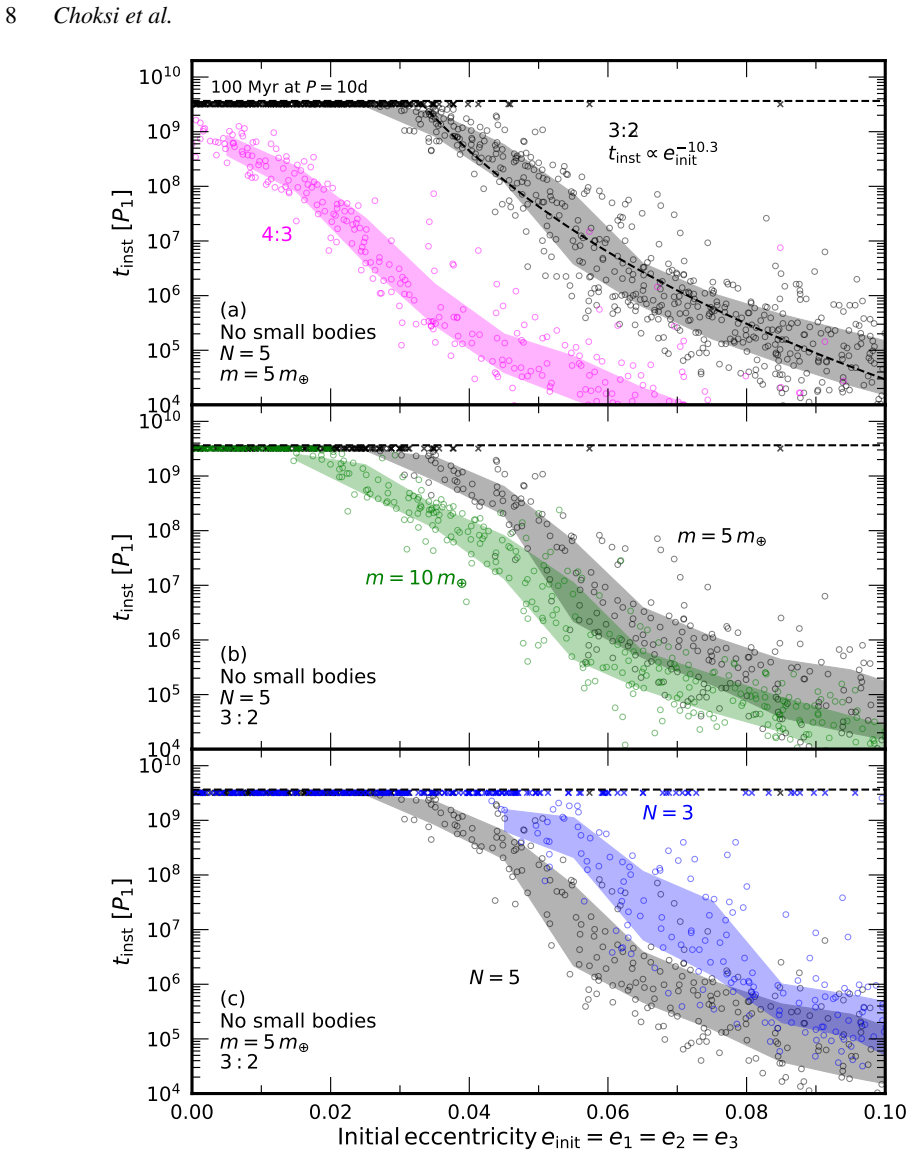
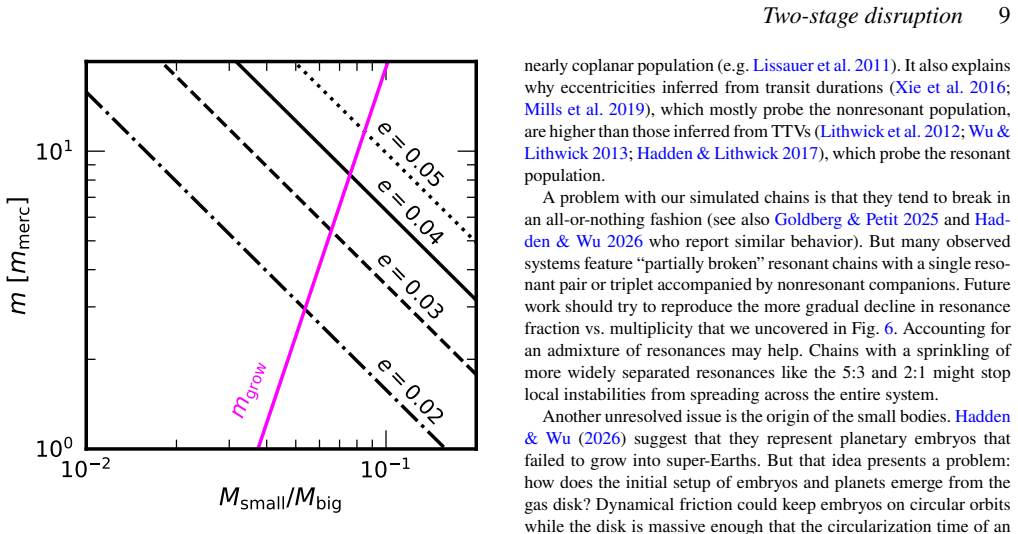
Any mechanism that seeds free eccentricities of a few percent in a resonant chain sets in motion a second stage of dynamical instability on a ~100 Myr timescale, reproducing the observed decline in the incidence of resonance.
What carries the argument
The two-stage disruption process in which initial eccentricity excitation leads to subsequent chaotic instability that breaks mean-motion resonances.
If this is right
- The fraction of planets in resonance decreases with system age as more chains undergo the second-stage instability.
- Planet multiplicity declines on the same ~100 Myr timescale because instabilities cause ejections and collisions.
- Higher-multiplicity systems show a higher fraction of resonances because lower-multiplicity systems are disrupted first.
- Young systems can display period ratios slightly narrower than exact commensurability as a signature of the impactor accretion phase.
Where Pith is reading between the lines
- Leftover debris from early planet formation may continue to shape final orbital architectures through late-stage impacts.
- Eccentricity distributions measured in systems of different ages could directly test the few-percent excitation threshold required.
- The same delayed instability may operate in other compact resonant configurations beyond the super-Earth population.
Load-bearing premise
A process exists that can raise free eccentricities to a few percent while leaving the resonant chain intact long enough for the second instability stage to act after about 100 million years.
What would settle it
Finding that old systems still host intact resonant chains without prior eccentricity excitation, or that young systems lack the predicted slight narrowing of period ratios, would falsify the two-stage model.
Figures



read the original abstract
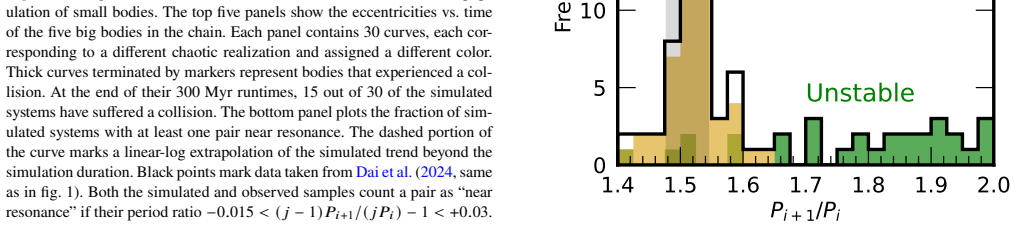
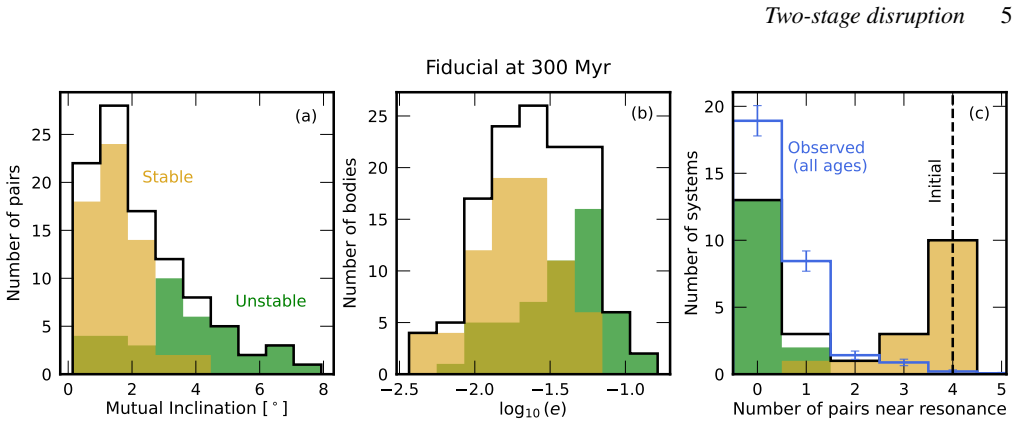
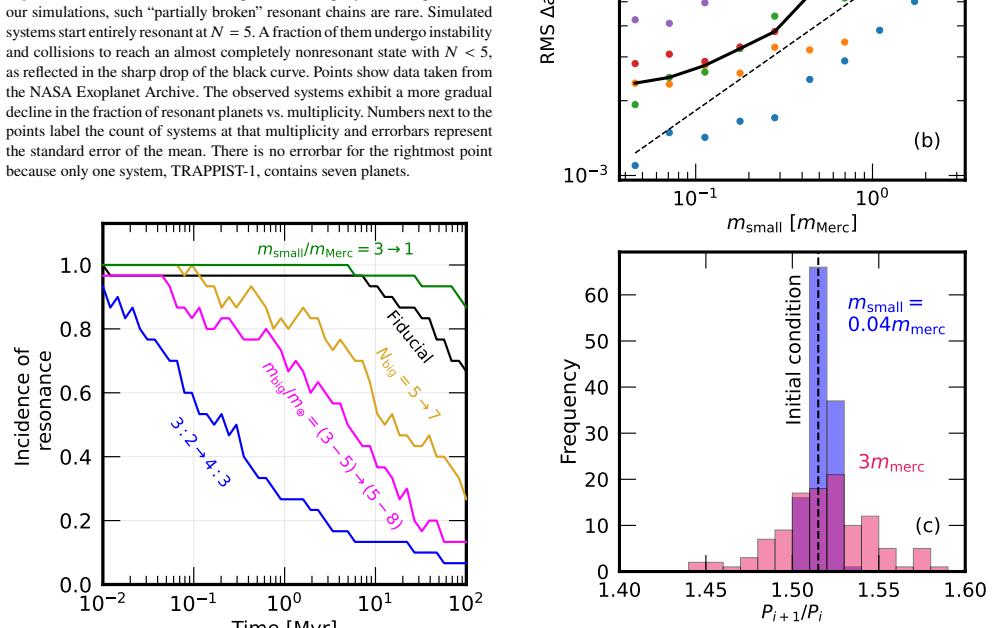
TESS has made clear that most close-in planets were born in chains of mean-motion resonances that break on a characteristic timescale of 100 Myr. This observation is surprising because the same dissipative forces that capture planets into resonance render their orbits long-term stable. We explore a two-stage disruption scenario for resonant chains of super-Earths. First, the chains have their (free) eccentricities excited by some mechanism. We show that any such mechanism that seeds eccentricities of a few percent sets in motion a second stage of dynamical instability on a ~100 Myr timescale. A possible stage-one mechanism is the accretion of a handful of Mercury-sized bodies totaling a few percent of the planetary system mass, which excites the requisite eccentricities and triggers a stage two that reproduces the observed decline in the incidence of resonance. Impacts from such bodies can also explain why some young systems have period ratios narrow of commensurability. We sketch how these impactors may have grown out of debris left over from an earlier epoch of planet formation. We also identify two new trends in the observational data: a decline in multiplicity on the same timescale as the decline in the incidence of resonance, and an increase in the occupation of resonances with multiplicity.
Editorial analysis
A structured set of objections, weighed in public.
Referee Report
Summary. The paper proposes a two-stage disruption mechanism for mean-motion resonant chains of close-in super-Earths. Stage 1 excites free eccentricities to a few percent via some process (e.g., accretion of a small population of Mercury-sized bodies totaling a few percent of system mass); Stage 2 then triggers dynamical instability on a ~100 Myr timescale, reproducing the observed decline in resonant incidence with system age. N-body integrations are used to demonstrate the instability timescale for seeded eccentricities, and the authors identify correlated observational trends in multiplicity decline and resonance occupation with multiplicity.
Significance. If the central claim holds, the work provides a concrete dynamical explanation for the characteristic 100 Myr 'clock' of resonance breaking that is otherwise difficult to reconcile with disk-driven capture and long-term stability. It links late-stage accretion to observable architecture trends and makes falsifiable predictions about period-ratio distributions and multiplicity evolution. The explicit separation of the eccentricity-seeding step from the subsequent instability is a useful conceptual advance.
major comments (3)
- [§4] §4 (N-body experiments): the reported instability timescales for seeded eccentricities of a few percent lack error bars, convergence tests with respect to integration timestep or duration, and statistics over multiple realizations with varied initial phases; without these, the quantitative match to the observed 100 Myr decline cannot be assessed for robustness.
- [§5] §5 (impactor-accretion scenario): the claim that any eccentricity-seeding mechanism preserves the resonant chain long enough for Stage 2 to operate is load-bearing, yet the sketched impactor model involves close encounters and collisions that are expected to scatter semi-major axes and detune period ratios away from commensurability on timescales <<100 Myr; no demonstration is provided that the chain survives Stage 1 intact.
- [Abstract and §3] Abstract and §3: the statement that the mechanism 'reproduces the observed decline' is not supported by a direct, quantitative comparison (e.g., a synthetic age distribution or survival fraction versus observed TESS statistics); the mapping from seeded e to instability time is shown but the overall population-level match remains qualitative.
minor comments (3)
- [Figure 2] Figure 2: axis labels and legend entries are too small for readability; add explicit error bands or shaded regions if multiple runs are shown.
- [§4.1] Notation: the distinction between free and forced eccentricity is introduced but not consistently labeled in the simulation initial conditions; clarify in §4.1.
- [Introduction] References: the discussion of prior resonance-breaking mechanisms omits recent works on post-disk instability (e.g., on secular chaos or external perturbers); add 2-3 key citations for completeness.
Simulated Author's Rebuttal
We thank the referee for their constructive and detailed report. We address each major comment below and have revised the manuscript to incorporate additional analysis and clarifications where feasible.
read point-by-point responses
-
Referee: §4 (N-body experiments): the reported instability timescales for seeded eccentricities of a few percent lack error bars, convergence tests with respect to integration timestep or duration, and statistics over multiple realizations with varied initial phases; without these, the quantitative match to the observed 100 Myr decline cannot be assessed for robustness.
Authors: We agree that the original N-body results would benefit from greater statistical robustness. In the revised manuscript we have added error bars on the reported instability timescales, computed from an ensemble of 20 realizations per eccentricity value with randomized initial orbital phases. We have also performed convergence tests using integration timesteps of 0.01 d and 0.005 d as well as runs extended to 500 Myr; the characteristic ~100 Myr instability timescale for eccentricities of a few percent remains unchanged. These additions are now presented in §4 and the associated figures. revision: yes
-
Referee: §5 (impactor-accretion scenario): the claim that any eccentricity-seeding mechanism preserves the resonant chain long enough for Stage 2 to operate is load-bearing, yet the sketched impactor model involves close encounters and collisions that are expected to scatter semi-major axes and detune period ratios away from commensurability on timescales <<100 Myr; no demonstration is provided that the chain survives Stage 1 intact.
Authors: The referee correctly identifies that the specific impactor-accretion sketch in §5 does not include explicit N-body verification that commensurabilities survive the accretion events. The central claim of the paper, however, is mechanism-independent: any process that raises free eccentricities to a few percent will initiate Stage 2 instability on ~100 Myr timescales (as shown in §4). We have revised §5 to clarify that the impactors are assumed to originate from a cold debris population with low relative velocities, thereby limiting scattering, and we explicitly note that dedicated simulations of Stage 1 are required to confirm chain survival and are reserved for future work. revision: partial
-
Referee: Abstract and §3: the statement that the mechanism 'reproduces the observed decline' is not supported by a direct, quantitative comparison (e.g., a synthetic age distribution or survival fraction versus observed TESS statistics); the mapping from seeded e to instability time is shown but the overall population-level match remains qualitative.
Authors: We accept that the language in the abstract and §3 overstated the degree of quantitative agreement. These sections have been revised to state that the two-stage mechanism 'provides a dynamical explanation for the characteristic ~100 Myr decline' rather than claiming to reproduce the observed statistics. We have added a brief paragraph noting that a full population synthesis would require modeling the distribution of late-stage impactor masses and system ages, which lies beyond the present scope. The demonstrated mapping from seeded eccentricity to instability timescale remains the primary quantitative result. revision: yes
Circularity Check
No significant circularity in the derivation chain
full rationale
The paper's core claim—that seeding free eccentricities of a few percent triggers a second stage of dynamical instability on a ~100 Myr timescale—is obtained via direct N-body integrations that map initial eccentricity to instability time. This dynamical mapping is computed independently of the TESS resonance-incidence data and does not reduce to the observations by construction. The specific eccentricity value is motivated by alignment with the observed clock, but the outcome (instability timescale) is not forced or fitted in a way that makes the result tautological. The stage-one mechanism is presented as a possible sketch (impactor accretion) rather than a derived necessity, and no load-bearing self-citations, uniqueness theorems, or ansatzes are invoked to close the chain. The derivation is self-contained on its dynamical simulations and explains the data without circular reduction.
Axiom & Free-Parameter Ledger
free parameters (2)
- seeded eccentricity amplitude
- impactor total mass fraction
axioms (2)
- standard math Planetary orbits evolve under Newtonian gravity and can be integrated with standard N-body codes once initial conditions are set.
- domain assumption Resonant chains are captured by disk-driven migration and damping before the gas disk dissipates.
Lean theorems connected to this paper
-
IndisputableMonolith/Foundation/RealityFromDistinction.leanreality_from_one_distinction unclear?
unclearRelation between the paper passage and the cited Recognition theorem.
We show that any such mechanism that seeds eccentricities of a few percent sets in motion a second stage of dynamical instability on a ~100 Myr timescale.
-
IndisputableMonolith/Foundation/BranchSelection.leanbranch_selection unclear?
unclearRelation between the paper passage and the cited Recognition theorem.
A possible stage-one mechanism is the accretion of a handful of Mercury-sized bodies totaling a few percent of the planetary system mass
What do these tags mean?
- matches
- The paper's claim is directly supported by a theorem in the formal canon.
- supports
- The theorem supports part of the paper's argument, but the paper may add assumptions or extra steps.
- extends
- The paper goes beyond the formal theorem; the theorem is a base layer rather than the whole result.
- uses
- The paper appears to rely on the theorem as machinery.
- contradicts
- The paper's claim conflicts with a theorem or certificate in the canon.
- unclear
- Pith found a possible connection, but the passage is too broad, indirect, or ambiguous to say the theorem truly supports the claim.
Forward citations
Cited by 1 Pith paper
-
Planetesimal-Driven Instabilities in Resonant Chains of Cold Neptunes and Their Dynamical Outcomes
Planetesimal disks with 1-4% of the planetary mass disrupt resonant Neptune chains, triggering instabilities that scatter planets to ~0.1 au orbits and enable hot Neptune formation on 10-100 Myr timescales.
Reference graph
Works this paper leans on
-
[1]
Batygin K., 2015, MNRAS, 451, 2589 Borderies N., Goldreich P., 1984, Celestial Mechanics, 32, 127 Choksi N., Chiang E., 2020, MNRAS, 495, 4192 Choksi N., Chiang E., 2023, MNRAS, 522, 1914 Dai F., et al., 2024, AJ, 168, 239 Dainese S., Albrecht S. H., 2025, A&A, 695, A253 Dattilo A., et al., 2025, AJ, 170, 318 MNRAS000, 1–11 (2026) Two-stage disruption11 1...
discussion (0)
Sign in with ORCID, Apple, or X to comment. Anyone can read and Pith papers without signing in.