Recognition: 2 theorem links
· Lean TheoremPlanetesimal-Driven Instabilities in Resonant Chains of Cold Neptunes and Their Dynamical Outcomes
Pith reviewed 2026-05-10 17:52 UTC · model grok-4.3
The pith
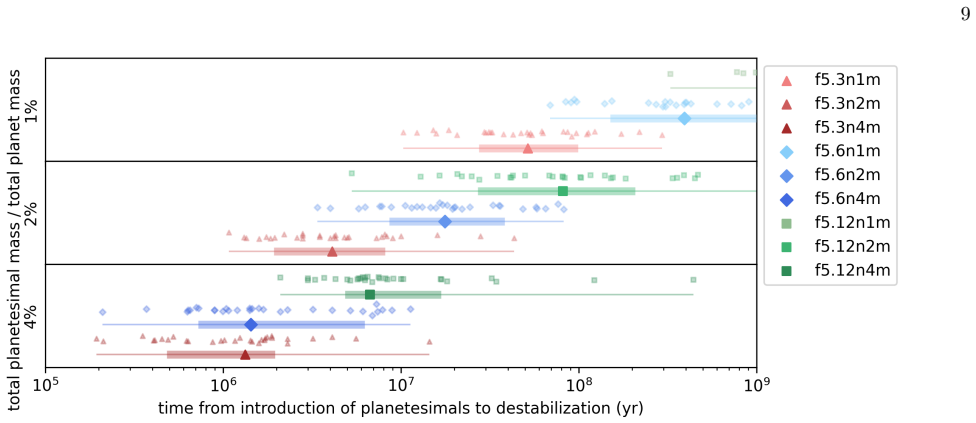
Planetesimal disks with 1-4% of planetary mass disrupt resonant chains of cold Neptunes and trigger instabilities 1 Myr to 1 Gyr after gas dispersal.
A machine-rendered reading of the paper's core claim, the machinery that carries it, and where it could break.
Core claim
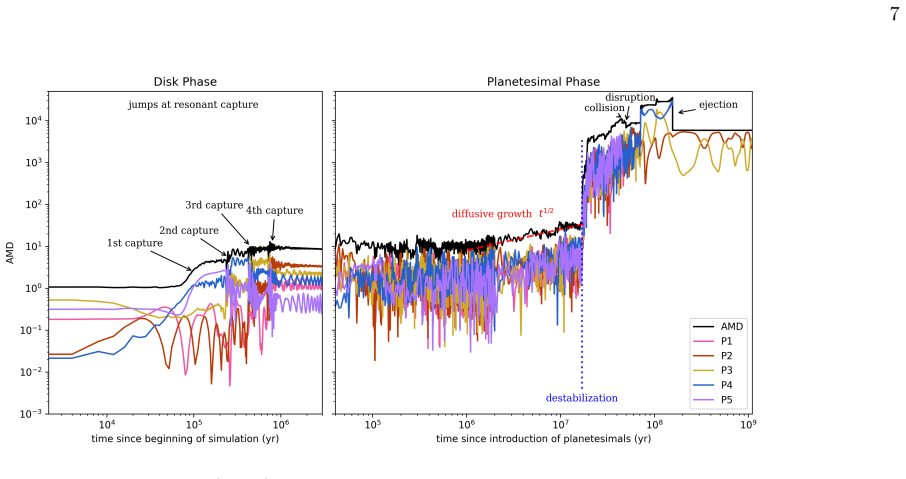
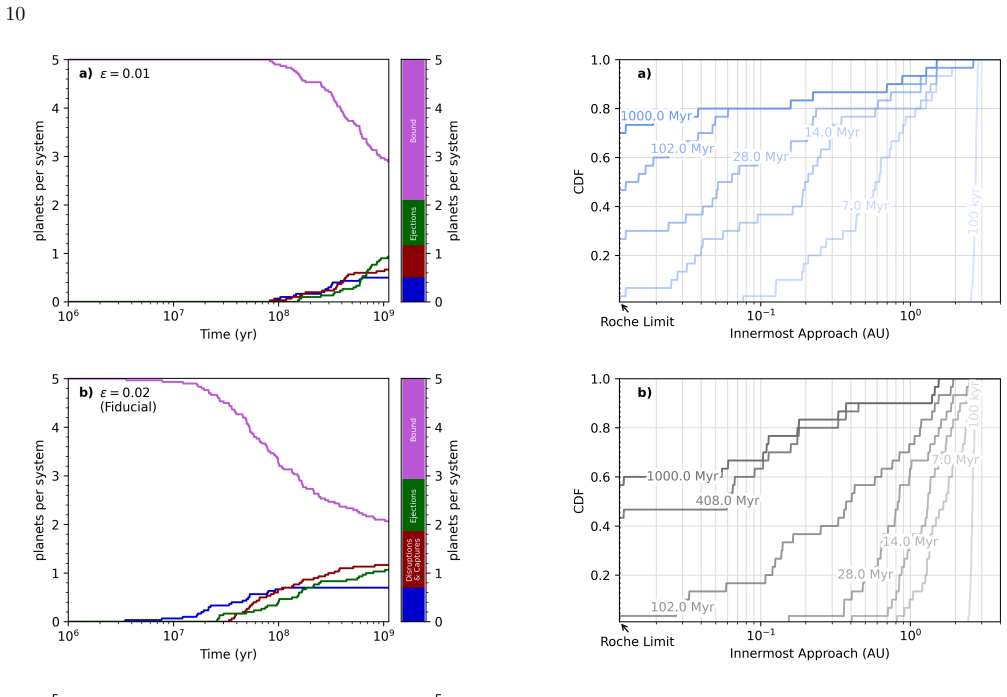
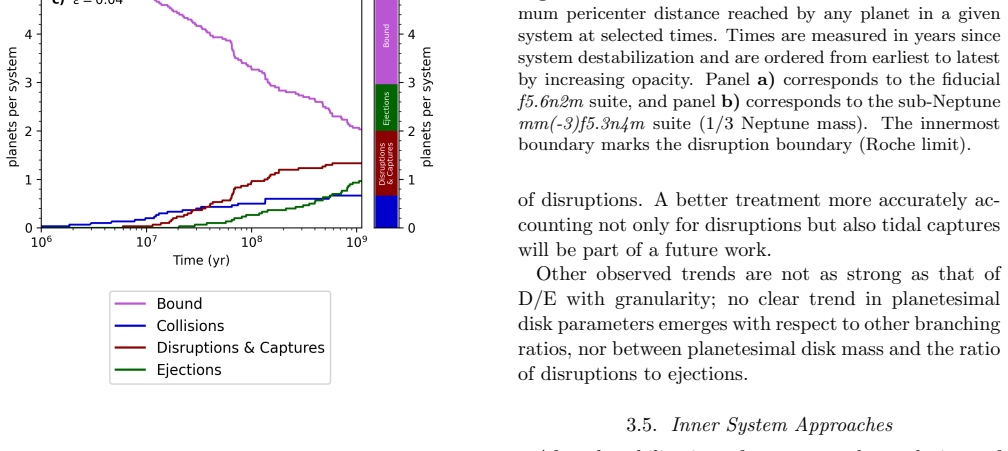
Planetesimal disks containing approximately 1-4 percent of the total planetary mass efficiently disrupt initially resonant chains of cold Neptunes, triggering global dynamical instabilities on timescales of 1 Myr to 1 Gyr. The ensuing instability produces large-scale orbital rearrangement together with planet loss through collisions, tidal disruption, and ejections; in most cases at least one planet reaches approximately 0.1 AU on 10-100 Myr timescales, where tidal capture or disruption can occur.
What carries the argument
N-body simulations tracking gravitational perturbations from remnant planetesimal disks acting on multi-Neptune systems locked in resonant chains during the gas-disk phase.
If this is right
- Compact inner resonant chains are destroyed by cold sub-Neptunes on roughly 100 Myr timescales.
- Tidal capture of scattered planets supplies a formation channel for hot Neptunes.
- The instability produces mass-segregated planets whose relative numbers of cold, wide-orbit, and free-floating planets can be tested directly.
- Instability timescales vary strongly with planetesimal-disk mass, allowing diverse outcomes depending on disk properties.
Where Pith is reading between the lines
- The strong dependence on disk mass implies that modest differences in planetesimal budgets can produce the full range of observed exoplanet architectures.
- If the mechanism operates widely, resonant fractions should decline steadily with system age on 100 Myr timescales.
- Detection of the predicted free-floating and wide-orbit populations would also constrain the typical mass of remnant planetesimal disks.
Load-bearing premise
Resonant chains must assemble during the gas-disk phase and the planetesimal disks must keep realistic masses and radial distributions once the gas has gone.
What would settle it
Microlensing surveys that measure abundances of wide-orbit and free-floating Neptune-mass planets differing substantially from the model's predicted mass-segregated ratios would falsify the disruption pathway.
Figures



read the original abstract
Cold Neptunes and sub-Neptunes are among the most common products of planet formation and likely dominate the angular-momentum budgets in most planetary systems, yet their dynamical impact on planetary architectures remains poorly understood. Using N-body simulations, we investigate the evolution of multi-Neptune systems assembled into resonant chains during the gas-disk phase and later coupled to remnant planetesimal disks. We show that planetesimal disks containing $\simeq 1$-$4\%$ of the planetary mass efficiently disrupt resonant chains and trigger global dynamical instabilities on timescales of $1~\mathrm{Myr}$-$1~\mathrm{Gyr}$, providing a pathway for delayed instability long after gas-disk dispersal, albeit with instability timescales that are highly sensitive to disk mass. The ensuing instability drives large-scale orbital rearrangement and loss of planets through collisions, tidal disruption, and ejections. Notably, in most systems at least one planet is scattered inward to $\sim 0.1~\mathrm{au}$ on $\sim 10$-$100$ Myr timescales (for $\sim 5$-$50\; M_\oplus$ planets) following instability onset, with a substantial fraction undergoing tidal capture or disruption. This tidal capture can provide a natural pathway to hot Neptune formation, while compact inner chains, if present, would be destroyed on $\sim 100~\mathrm{Myr}$ timescales by cold sub-Neptunes, naturally explaining the observed decline in the resonant fraction. We argue that the predictions of our model, which yields mass-segregated planets and corresponding relative abundances of cold, wide-orbit, and free-floating planets, can be tested by ongoing and upcoming microlensing surveys.
Editorial analysis
A structured set of objections, weighed in public.
Referee Report
Summary. The paper uses N-body simulations to investigate the post-gas-disk evolution of resonant chains of cold Neptunes coupled to remnant planetesimal disks. It claims that disks containing ≃1-4% of the total planetary mass efficiently disrupt these chains, triggering global instabilities on timescales of 1 Myr to 1 Gyr. The resulting dynamical rearrangement leads to planet losses via collisions, ejections, and tidal disruptions, with frequent inward scattering of planets to ~0.1 au that can produce hot Neptunes via tidal capture; the model also yields mass-segregated architectures and relative abundances of cold, wide-orbit, and free-floating planets testable by microlensing surveys.
Significance. If the central results hold, the work identifies a viable pathway for delayed instabilities in multi-Neptune systems long after gas dispersal, offering a natural explanation for the observed scarcity of resonant chains and the existence of hot Neptunes. The forward N-body approach generates concrete, observationally testable predictions for planet abundances and orbital distributions. The sensitivity of outcomes to disk mass is explicitly noted, which strengthens the paper's transparency about parameter dependence.
major comments (3)
- [Abstract] Abstract: The central claim that planetesimal disks of ≃1-4% planetary mass disrupt resonant chains on 1 Myr–1 Gyr timescales is load-bearing, yet the text provides no justification from formation models or observations for why this specific mass fraction (and associated radial profile) is realistic after gas dispersal; the abstract itself states that timescales are highly sensitive to disk mass, so the efficiency and window would change substantially under plausible variations.
- [Numerical methods] Numerical methods section: The abstract reports outcomes from N-body simulations but supplies no information on the integrator, timestep, number of realizations per initial condition, or convergence/sensitivity tests with respect to numerical parameters or small perturbations in the initial resonant chains. Given the chaotic nature of the reported instabilities, these details are required to assess robustness of the quoted timescales and scattering statistics.
- [Initial conditions] Initial conditions and setup: The assumption that resonant chains assembled in the gas phase remain intact until the planetesimal disk is introduced after dispersal is taken as given; no tests are described for how the chains respond to small perturbations expected during the final stages of gas-disk dispersal, which could alter the subsequent disruption efficiency.
minor comments (2)
- [Abstract] The abstract uses ≃1-4% without defining the exact total planetary mass reference or showing how this fraction maps onto absolute disk masses for the simulated systems.
- [Figures] Figure captions and text should explicitly state the number of realizations and the range of initial conditions explored for each disk-mass case to allow readers to gauge statistical significance of the reported fractions (e.g., “at least one planet scattered inward”).
Simulated Author's Rebuttal
We thank the referee for their positive assessment of the significance of our work and for the constructive major comments. We address each comment in detail below and have made revisions to the manuscript to incorporate the suggested improvements.
read point-by-point responses
-
Referee: [Abstract] Abstract: The central claim that planetesimal disks of ≃1-4% planetary mass disrupt resonant chains on 1 Myr–1 Gyr timescales is load-bearing, yet the text provides no justification from formation models or observations for why this specific mass fraction (and associated radial profile) is realistic after gas dispersal; the abstract itself states that timescales are highly sensitive to disk mass, so the efficiency and window would change substantially under plausible variations.
Authors: The referee raises a valid point regarding the motivation for the chosen planetesimal disk mass range. Our simulations demonstrate that disks with 1-4% of the planetary mass lead to the reported outcomes, and we explicitly note the high sensitivity to this parameter. To provide better context, we will revise the manuscript to include a discussion in the introduction section referencing relevant planet formation models that predict remnant planetesimal disk masses in the range of a few percent of the total planetary mass after gas dispersal. We will also update the abstract to better reflect that this mass fraction represents a plausible and effective range for triggering the instabilities. revision: yes
-
Referee: [Numerical methods] Numerical methods section: The abstract reports outcomes from N-body simulations but supplies no information on the integrator, timestep, number of realizations per initial condition, or convergence/sensitivity tests with respect to numerical parameters or small perturbations in the initial resonant chains. Given the chaotic nature of the reported instabilities, these details are required to assess robustness of the quoted timescales and scattering statistics.
Authors: We agree that the numerical methods section lacks essential details for reproducibility and robustness assessment. This information was inadvertently omitted. In the revised manuscript, we will expand the Numerical Methods section to specify the N-body integrator employed, the adopted timestep, the number of realizations performed for each initial condition, and the results of convergence and sensitivity tests. These additions will confirm that the instability timescales and dynamical outcomes are not sensitive to small numerical variations or initial perturbations within the explored parameter space. revision: yes
-
Referee: [Initial conditions] Initial conditions and setup: The assumption that resonant chains assembled in the gas phase remain intact until the planetesimal disk is introduced after dispersal is taken as given; no tests are described for how the chains respond to small perturbations expected during the final stages of gas-disk dispersal, which could alter the subsequent disruption efficiency.
Authors: The referee correctly identifies that we did not perform or report tests on the response of the resonant chains to perturbations during the gas-disk dispersal phase. Our study assumes that the chains are stable at the start of the planetesimal disk phase, focusing on the subsequent evolution. To strengthen this, we will add a brief analysis or note in the revised manuscript discussing the expected perturbations and include a small set of test simulations showing that moderate perturbations do not prematurely disrupt the chains before the planetesimal disk takes effect. This will better justify the initial setup. revision: yes
Circularity Check
No circularity: outcomes are direct numerical consequences of input initial conditions
full rationale
The paper reports results exclusively from forward N-body integrations of resonant chains interacting with planetesimal disks of given mass (1-4% of planetary mass) and radial profile. These are exploratory simulations whose outputs (instability timescales, scattering, tidal captures) follow from the chosen physics and initial conditions rather than any algebraic reduction, fitted parameter renamed as prediction, or self-referential definition. The disk mass and resonant-chain setup are explicitly treated as inputs whose variation affects outcomes, with no claim that the results are independent of or derive those inputs. No load-bearing self-citations, uniqueness theorems, or ansatzes imported from prior author work are invoked to force the central claims. The derivation chain is therefore self-contained as a set of numerical experiments.
Axiom & Free-Parameter Ledger
free parameters (1)
- planetesimal disk mass fraction
axioms (2)
- standard math Newtonian gravitational dynamics govern planet-planetesimal interactions
- domain assumption Resonant chains form during the gas-disk phase and persist until planetesimal interactions begin
Lean theorems connected to this paper
-
IndisputableMonolith/Foundation/RealityFromDistinction.leanreality_from_one_distinction unclear?
unclearRelation between the paper passage and the cited Recognition theorem.
planetesimal disks containing ≃1–4% of the planetary mass efficiently disrupt resonant chains... on timescales of 1 Myr–1 Gyr
-
IndisputableMonolith/Cost/FunctionalEquation.leanwashburn_uniqueness_aczel unclear?
unclearRelation between the paper passage and the cited Recognition theorem.
Safronov number Θ = v_esc² / 2 v_orb² ... collisions, scattering, and ejections can occur with comparable probability
What do these tags mean?
- matches
- The paper's claim is directly supported by a theorem in the formal canon.
- supports
- The theorem supports part of the paper's argument, but the paper may add assumptions or extra steps.
- extends
- The paper goes beyond the formal theorem; the theorem is a base layer rather than the whole result.
- uses
- The paper appears to rely on the theorem as machinery.
- contradicts
- The paper's claim conflicts with a theorem or certificate in the canon.
- unclear
- Pith found a possible connection, but the passage is too broad, indirect, or ambiguous to say the theorem truly supports the claim.
Reference graph
Works this paper leans on
-
[1]
Agol, E., Steffen, J., Sari, R., & Clarkson, W. 2005, MNRAS, 359, 567, doi: 10.1111/j.1365-2966.2005.08922.x Astropy Collaboration, Robitaille, T. P., Tollerud, E. J., et al. 2013, A&A, 558, A33, doi: 10.1051/0004-6361/201322068 Astropy Collaboration, Price-Whelan, A. M., Sip˝ ocz, B. M., et al. 2018, AJ, 156, 123, doi: 10.3847/1538-3881/aabc4f Astropy Co...
-
[2]
2026, arXiv e-prints, arXiv:2603.27093
Batygin, K., & Morbidelli, A. 2026, arXiv e-prints, arXiv:2603.27093. https://arxiv.org/abs/2603.27093 Beaug´ e, C., & Nesvorn´ y, D. 2012, ApJ, 751, 119, doi: 10.1088/0004-637X/751/2/119
-
[3]
A., Liquet, M., Signell, J., et al
Bednar, J. A., Liquet, M., Signell, J., et al. 2024, holoviz/colorcet: Version 3.1.0, v3.1.0, Zenodo, doi: 10.5281/zenodo.10729196
-
[4]
Bhaskar, H. G., & Perets, H. B. 2025, ApJ, 991, 132, doi: 10.3847/1538-4357/adf4e2
-
[5]
2023, A&A, 669, A63, doi: 10.1051/0004-6361/202245004
Bourrier, V., Attia, O., Mallonn, M., et al. 2023, A&A, 669, A63, doi: 10.1051/0004-6361/202245004
-
[6]
Cadiou, C. 2022, Matplotlib label lines, v0.5.1, Zenodo, doi: 10.5281/zenodo.7428071 Castro-Gonz´ alez, A., Bourrier, V., Lillo-Box, J., et al. 2024, A&A, 689, A250, doi: 10.1051/0004-6361/202450957
-
[7]
Chatterjee, S., & Ford, E. B. 2015, ApJ, 803, 33, doi: 10.1088/0004-637X/803/1/33
-
[8]
Chatterjee, S., Ford, E. B., Matsumura, S., & Rasio, F. A. 2008, ApJ, 686, 580, doi: 10.1086/590227
-
[9]
Two-stage disruption of resonant chains
Choksi, N., Lithwick, Y., Chiang, E., & Li, R. 2026, arXiv e-prints, arXiv:2604.05035. https://arxiv.org/abs/2604.05035
work page internal anchor Pith review Pith/arXiv arXiv 2026
-
[10]
Dai, F., & Winn, J. N. 2017, AJ, 153, 205, doi: 10.3847/1538-3881/aa65d1
-
[11]
2023, AJ, 165, 33, doi: 10.3847/1538-3881/aca327
Dai, F., Masuda, K., Beard, C., et al. 2023, AJ, 165, 33, doi: 10.3847/1538-3881/aca327
-
[12]
2024, AJ, 168, 239, doi: 10.3847/1538-3881/ad83a6
Dai, F., Goldberg, M., Batygin, K., et al. 2024, AJ, 168, 239, doi: 10.3847/1538-3881/ad83a6
-
[13]
Dawson, R. I., & Johnson, J. A. 2018, ARA&A, 56, 175, doi: 10.1146/annurev-astro-081817-051853
work page Pith review doi:10.1146/annurev-astro-081817-051853 2018
-
[14]
Deck, K. M., & Batygin, K. 2015, ApJ, 810, 119, doi: 10.1088/0004-637X/810/2/119
-
[15]
2025, ApJL, 994, L23, doi: 10.3847/2041-8213/ae18c7
Dugan, E., Wang, X.-Y., Heron, A., et al. 2025, ApJL, 994, L23, doi: 10.3847/2041-8213/ae18c7
-
[16]
1995, ApJ, 455, 640, doi: 10.1086/176611
Eggleton, P., & Kiseleva, L. 1995, ApJ, 455, 640, doi: 10.1086/176611
-
[17]
I., Stef´ ansson, G., Petrovich, C., et al
Espinoza-Retamal, J. I., Stef´ ansson, G., Petrovich, C., et al. 2024, AJ, 168, 185, doi: 10.3847/1538-3881/ad70b8
-
[18]
Fernandez, J. A., & Ip, W.-H. 1984, Icarus, 58, 109, doi: 10.1016/0019-1035(84)90101-5 20 Figure 10.As Figure 5, but across allf5suites of simulations. From left to right, top to bottom, these correspond to the f5.3n1m,f5.3n2m,f5.3n4m,f5.6n1m,f5.6n2m,f5.6n4m,f5.12n1m,f5.12n2m, andf5.12n4msimulations. In other words; total mass of planetesimals increases f...
-
[19]
Ford, E. B., & Rasio, F. A. 2008, ApJ, 686, 621, doi: 10.1086/590926
-
[20]
Meyer Marcy, G.W., Rubenzahl, R.A., Weiss, L.M., Wright, J.T.: California Legacy Survey
Fulton, B. J., Rosenthal, L. J., Hirsch, L. A., et al. 2021, ApJS, 255, 14, doi: 10.3847/1538-4365/abfcc1
-
[21]
Gaudi, B. S. 2010, arXiv e-prints, arXiv:1002.0332, doi: 10.48550/arXiv.1002.0332
-
[22]
2023, ApJ, 943, 8, doi: 10.3847/1538-4357/aca58e
Ghosh, T., & Chatterjee, S. 2023, ApJ, 943, 8, doi: 10.3847/1538-4357/aca58e
-
[23]
Giuppone, C. A., Morais, M. H. M., & Correia, A. C. M. 2013, MNRAS, 436, 3547, doi: 10.1093/mnras/stt1831
-
[24]
2023, ApJ, 948, 12, doi: 10.3847/1538-4357/acc9ae
Goldberg, M., & Batygin, K. 2023, ApJ, 948, 12, doi: 10.3847/1538-4357/acc9ae
-
[25]
2022, Icarus, 388, 115206, doi: 10.1016/j.icarus.2022.115206
Goldberg, M., Batygin, K., & Morbidelli, A. 2022, Icarus, 388, 115206, doi: 10.1016/j.icarus.2022.115206
-
[26]
Goldberg, M., & Petit, A. C. 2025, arXiv e-prints, arXiv:2511.11329, doi: 10.48550/arXiv.2511.11329
-
[27]
2025, arXiv e-prints, arXiv:2507.08968, doi: 10.48550/arXiv.2507.08968 —
Hadden, S., & Wu, Y. 2025, arXiv e-prints, arXiv:2507.08968, doi: 10.48550/arXiv.2507.08968 —. 2026, arXiv e-prints, arXiv:2602.21349, doi: 10.48550/arXiv.2602.21349
-
[28]
Hahn, J. M., & Malhotra, R. 1999, AJ, 117, 3041, doi: 10.1086/300891
-
[29]
1993, Solving Orginary Differential Equations I (Springer), doi: 10.1007/978-3-540-78862-1
Hairer, E., Nørsett, S., & Wanner, G. 1993, Solving Orginary Differential Equations I (Springer), doi: 10.1007/978-3-540-78862-1
-
[30]
Han, C., Gaudi, B. S., An, J. H., & Gould, A. 2005, ApJ, 618, 962, doi: 10.1086/426115
-
[31]
Handley, L. B., & Batygin, K. 2026, arXiv e-prints, arXiv:2601.04140, doi: 10.48550/arXiv.2601.04140
-
[32]
Harris, C. R., Millman, K. J., van der Walt, S. J., et al. 2020, Nature, 585, 357, doi: 10.1038/s41586-020-2649-2
-
[33]
Progress of Theoretical Physics Supplement , year = 1981, month = jan, volume =
Hayashi, C. 1981, Progress of Theoretical Physics Supplement, 70, 35, doi: 10.1143/PTPS.70.35
-
[34]
1983, Celestial Mechanics, 30, 197, doi: 10.1007/BF01234306
Henrard, J., & Lemaitre, A. 1983, Celestial Mechanics, 30, 197, doi: 10.1007/BF01234306
-
[35]
2023, ApJL, 949, L35, doi: 10.3847/2041-8213/acd6f5
Hixenbaugh, K., Wang, X.-Y., Rice, M., & Wang, S. 2023, ApJL, 949, L35, doi: 10.3847/2041-8213/acd6f5
-
[36]
Holland, W. S., Matthews, B. C., Kennedy, G. M., et al. 2017, MNRAS, 470, 3606, doi: 10.1093/mnras/stx1378
-
[37]
Hsu, D. C., Ford, E. B., Ragozzine, D., & Ashby, K. 2019, AJ, 158, 109, doi: 10.3847/1538-3881/ab31ab 21
-
[38]
2026, ApJ, 998, 245, doi: 10.3847/1538-4357/ae394f
Huang, X., & Lai, D. 2026, ApJ, 998, 245, doi: 10.3847/1538-4357/ae394f
-
[39]
Hunter, J. D. 2007, Computing in Science & Engineering, 9, 90, doi: 10.1109/MCSE.2007.55
-
[40]
Izidoro, A., Bitsch, B., Raymond, S. N., et al. 2021, A&A, 650, A152, doi: 10.1051/0004-6361/201935336
-
[41]
Izidoro, A., Ogihara, M., Raymond, S. N., et al. 2017, MNRAS, 470, 1750, doi: 10.1093/mnras/stx1232 Juri´ c, M., & Tremaine, S. 2008, ApJ, 686, 603, doi: 10.1086/590047
-
[42]
2015, arXiv e-prints, arXiv:1509.03700, doi: 10.48550/arXiv.1509.03700
Kovesi, P. 2015, arXiv e-prints, arXiv:1509.03700, doi: 10.48550/arXiv.1509.03700
-
[43]
Krivov, A. V., & Wyatt, M. C. 2021, MNRAS, 500, 718, doi: 10.1093/mnras/staa2385
-
[44]
1997, A&A, 317, L75
Laskar, J. 1997, A&A, 317, L75
1997
-
[45]
Laskar, J., & Petit, A. C. 2017, A&A, 605, A72, doi: 10.1051/0004-6361/201630022
-
[46]
Lee, M. H., Fabrycky, D., & Lin, D. N. C. 2013, ApJ, 774, 52, doi: 10.1088/0004-637X/774/1/52
-
[47]
Lee, M. H., & Peale, S. J. 2002, ApJ, 567, 596, doi: 10.1086/338504
-
[48]
Li, J., O’Connor, C. E., & Rasio, F. A. 2026, ApJL, 998, L5, doi: 10.3847/2041-8213/ae3a9a
-
[49]
2025, AJ, 169, 323, doi: 10.3847/1538-3881/adce0c
Li, R., Chiang, E., Choksi, N., & Dai, F. 2025, AJ, 169, 323, doi: 10.3847/1538-3881/adce0c
-
[50]
J., Ragozzine, D., Fabrycky, D
Lissauer, J. J., Ragozzine, D., Fabrycky, D. C., et al. 2011, ApJS, 197, 8, doi: 10.1088/0067-0049/197/1/8
-
[51]
2012, ApJL, 756, L11, doi: 10.1088/2041-8205/756/1/L11 Lopez Murillo, A
Lithwick, Y., & Wu, Y. 2012, ApJL, 756, L11, doi: 10.1088/2041-8205/756/1/L11 Lopez Murillo, A. I., Mann, A. W., Barber, M. G., et al. 2026, AJ, 171, 63, doi: 10.3847/1538-3881/ae231a
-
[52]
1993, Nature, 365, 819, doi: 10.1038/365819a0 —
Malhotra, R. 1993, Nature, 365, 819, doi: 10.1038/365819a0 —. 1995, AJ, 110, 420, doi: 10.1086/117532
-
[53]
1982, Celestial Mechanics, 26, 311, doi: 10.1007/BF01230725 Matr` a, L., Marino, S., Wilner, D
Marchal, C., & Bozis, G. 1982, Celestial Mechanics, 26, 311, doi: 10.1007/BF01230725 Matr` a, L., Marino, S., Wilner, D. J., et al. 2025, A&A, 693, A151, doi: 10.1051/0004-6361/202451397
-
[54]
2013, , 208, 16, 10.1088/0067-0049/208/2/16
Mazeh, T., Nachmani, G., Holczer, T., et al. 2013, ApJS, 208, 16, doi: 10.1088/0067-0049/208/2/16
-
[55]
2025, A&A, 700, A146, doi: 10.1051/0004-6361/202451142
Mignon, L., Delfosse, X., Meunier, N., et al. 2025, A&A, 700, A146, doi: 10.1051/0004-6361/202451142
-
[56]
Montesinos, B., Eiroa, C., Krivov, A. V., et al. 2016, A&A, 593, A51, doi: 10.1051/0004-6361/201628329 Mo´ or, A., K´ osp´ al,´A., ´Abrah´ am, P., et al. 2016, ApJ, 826, 123, doi: 10.3847/0004-637X/826/2/123 M¨ uller, S., Baron, J., Helled, R., Bouchy, F., & Parc, L. 2024, A&A, 686, A296, doi: 10.1051/0004-6361/202348690
-
[57]
Murphy, M. M., & Armitage, P. J. 2022, MNRAS, 512, 2750, doi: 10.1093/mnras/stac750
-
[58]
2002, ApJ, 565, 608, doi: 10.1086/324536
Murray, N., Paskowitz, M., & Holman, M. 2002, ApJ, 565, 608, doi: 10.1086/324536
-
[59]
2011, ApJ, 742, 72, doi: 10.1088/0004-637X/742/2/72
Nagasawa, M., & Ida, S. 2011, ApJ, 742, 72, doi: 10.1088/0004-637X/742/2/72
-
[60]
2008, ApJ, 678, 498, doi: 10.1086/529369
Nagasawa, M., Ida, S., & Bessho, T. 2008, ApJ, 678, 498, doi: 10.1086/529369
-
[61]
2017, Icarus, 293, 52, doi: 10.1016/j.icarus.2017.04.010
Obertas, A., Van Laerhoven, C., & Tamayo, D. 2017, Icarus, 293, 52, doi: 10.1016/j.icarus.2017.04.010
-
[62]
2026, ApJ, 996, 91, doi: 10.3847/1538-4357/ae1d78
Ogihara, M., & Kunitomo, M. 2026, ApJ, 996, 91, doi: 10.3847/1538-4357/ae1d78
-
[63]
Penny, M. T., Gaudi, B. S., Kerins, E., et al. 2019, ApJS, 241, 3, doi: 10.3847/1538-4365/aafb69
-
[64]
2015, ApJ, 808, 120, doi: 10.1088/0004-637X/808/2/120
Petrovich, C. 2015, ApJ, 808, 120, doi: 10.1088/0004-637X/808/2/120
-
[65]
Petrovich, C. 2024, in IAU Symposium, Vol. 382, Complex Planetary Systems II: Latest Methods for an Interdisciplinary Approach, ed. A. Lemaitre & A.-S. Libert, 30–40, doi: 10.1017/S1743921323004775
-
[66]
2014, ApJ, 786, 101, doi: 10.1088/0004-637X/786/2/101
Petrovich, C., Tremaine, S., & Rafikov, R. 2014, ApJ, 786, 101, doi: 10.1088/0004-637X/786/2/101
-
[67]
2020, MNRAS, 494, 4950, doi: 10.1093/mnras/staa1102
Pichierri, G., & Morbidelli, A. 2020, MNRAS, 494, 4950, doi: 10.1093/mnras/staa1102
-
[68]
2015, ApJ, 807, 44, doi: 10.1088/0004-637X/807/1/44
Pu, B., & Wu, Y. 2015, ApJ, 807, 44, doi: 10.1088/0004-637X/807/1/44
-
[69]
S., Charalambous, C., Ben´ ıtez-Llambay, P., & Beaug´ e, C
Ramos, X. S., Charalambous, C., Ben´ ıtez-Llambay, P., & Beaug´ e, C. 2017, A&A, 602, A101, doi: 10.1051/0004-6361/201629642
-
[70]
Rein, H., & Liu, S. F. 2012, A&A, 537, A128, doi: 10.1051/0004-6361/201118085
-
[71]
Rubenstein, R. I., Jenkins, J. S., Pe˜ na R., P. A., et al. 2025, A&A, 702, A139, doi: 10.1051/0004-6361/202449563
-
[72]
2015, MNRAS, 453, 4089, doi: 10.1093/mnras/stv1924
Silburt, A., & Rein, H. 2015, MNRAS, 453, 4089, doi: 10.1093/mnras/stv1924
-
[73]
Sumi, T., Koshimoto, N., Bennett, D. P., et al. 2023, AJ, 166, 108, doi: 10.3847/1538-3881/ace688
-
[74]
2017, , 840, L19, 10.3847/2041-8213/aa70ea
Tamayo, D., Rein, H., Petrovich, C., & Murray, N. 2017, ApJL, 840, L19, doi: 10.3847/2041-8213/aa70ea
-
[75]
Tamayo, D., Rein, H., Shi, P., & Hernandez, D. M. 2020, MNRAS, 491, 2885, doi: 10.1093/mnras/stz2870
-
[76]
Tanaka, H., Takeuchi, T., & Ward, W. R. 2002, ApJ, 565, 1257, doi: 10.1086/324713
-
[77]
Tanaka, H., & Ward, W. R. 2004, ApJ, 602, 388, doi: 10.1086/380992
-
[78]
1993, in Astronomical Society of the Pacific Conference Series, Vol
Tremaine, S. 1993, in Astronomical Society of the Pacific Conference Series, Vol. 36, Planets Around Pulsars, ed. J. A. Phillips, S. E. Thorsett, & S. R. Kulkarni, 335–344
1993
-
[79]
2023, Dynamics of Planetary Systems (Princeton University Press)
Tremaine, S. 2023, Dynamics of Planetary Systems (Princeton University Press)
2023
-
[80]
Tsiganis, K., Gomes, R., Morbidelli, A., & Levison, H. F. 2005, Nature, 435, 459, doi: 10.1038/nature03539 22
discussion (0)
Sign in with ORCID, Apple, or X to comment. Anyone can read and Pith papers without signing in.