Recognition: no theorem link
Model-independent constraints on generalized FLRW consistency relations with bootstrap-based symbolic regression
Pith reviewed 2026-05-10 19:13 UTC · model grok-4.3
The pith
Bootstrap symbolic regression on supernova and BAO data indicates 2-4 sigma deviations from FLRW consistency relations.
A machine-rendered reading of the paper's core claim, the machinery that carries it, and where it could break.
Core claim
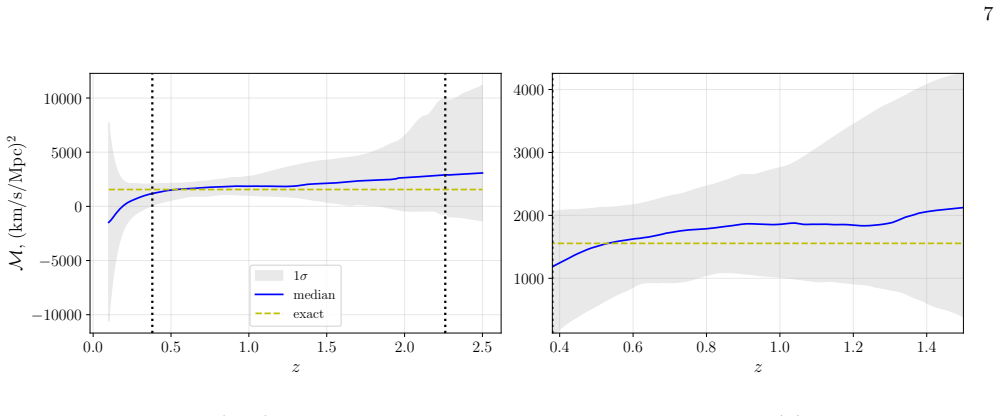
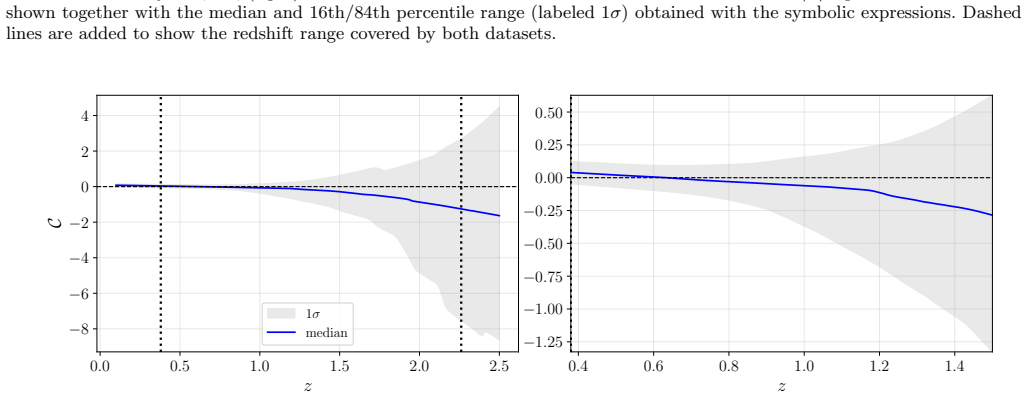
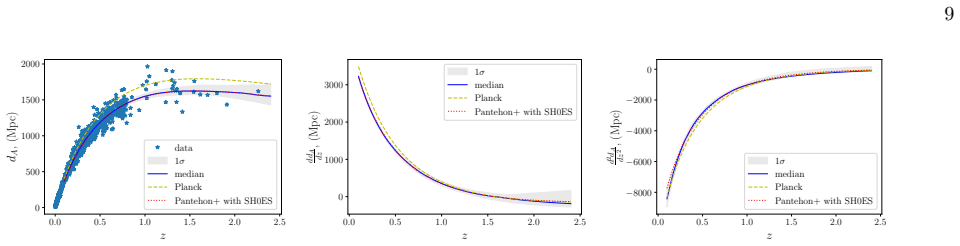
Applying bootstrap-based symbolic regression to current supernova and BAO data reconstructs the angular diameter distance d_A(z), the line-of-sight expansion rate H(z), and their derivatives over z in [0.38, ~2]. These quantities allow model-independent evaluation of generalized FLRW consistency relations and recovery of the sky-averaged density field. The reconstructed consistency tests show deviations from FLRW expectations at the 2-4 sigma level, with significance varying by data selection and reconstruction stability. The density field remains consistent with both Planck and SH0ES LambdaCDM predictions, while current data sparsity limits tight constraints on H(z).
What carries the argument
Bootstrap-based symbolic regression, a non-parametric technique that fits symbolic expressions to data and uses resampling to estimate uncertainties on the reconstructed functions and derivatives.
If this is right
- The reconstructed sky-averaged density field is consistent with both Planck and SH0ES LambdaCDM values.
- Current data remain too sparse to place tight constraints on the line-of-sight expansion rate H(z).
- If the deviations from FLRW expectations are real, most cosmological solutions to the tensions that stay within the FLRW framework are ruled out.
- The method supplies a general-spacetime estimator of the cosmic density field.
Where Pith is reading between the lines
- Comparing this symbolic regression approach against other non-parametric reconstruction techniques could test whether the deviations arise from the specific method.
- Application to denser future datasets would sharpen the constraints and clarify the significance of any departures.
- Confirmed deviations would encourage exploration of cosmological models that drop the FLRW symmetry assumption entirely.
Load-bearing premise
The bootstrap-based symbolic regression accurately reconstructs the true d_A(z) and H(z) functions and derivatives from sparse supernova and BAO data without introducing method-dependent artifacts or spurious deviations.
What would settle it
A future dataset with substantially denser supernova and BAO measurements that produces reconstructions consistent with FLRW relations inside 1 sigma would falsify the current indication of deviations.
Figures



read the original abstract
The standard $\Lambda$CDM cosmological model faces increasing tensions between key observations, motivating tests that probe its underlying assumptions. In a companion letter, we present a model-independent framework that combines derivatives of the angular diameter distance, $d_A(z)$, and the line-of-sight expansion rate, $\mathcal{H}(z)$, to clarify the physical content of FLRW consistency relations and to construct a general-spacetime estimator of the cosmic density field. Here, we apply these tests to data, introducing a non-parametric reconstruction method based on symbolic regression combined with bootstrapping to provide data-driven uncertainty estimates. Using supernova and BAO data, we reconstruct $d_A$, $\mathcal{H}$, and their derivatives, enabling model-independent evaluation of FLRW relations and recovery of the sky-averaged density field over $z \in [0.38, \sim 2]$. Current data are too sparse to tightly constrain $\mathcal{H}(z)$, and the reconstructed density is consistent with both Planck and SH0ES $\Lambda$CDM. Reconstructed FLRW consistency tests show mild to moderate deviations from FLRW expectations at the $\sim 2$-$4\sigma$ level, although their significance depends on data selection and reconstruction stability. If these indicated deviations from an FLRW geometry are real, it would signify that most of the cosmological solutions considered for solving the cosmological tensions (evolving/interacting dark energy, new types of matter/energy, modified gravity, etc., within the FLRW framework) are ruled out. These preliminary indications highlight the importance of future, denser distance and expansion rate measurements, as well as further work toward standardizing uncertainty estimation for symbolic regression reconstructions.
Editorial analysis
A structured set of objections, weighed in public.
Referee Report
Summary. The paper applies bootstrap-based symbolic regression to non-parametrically reconstruct the angular diameter distance d_A(z) and expansion rate H(z) (and their derivatives) from supernova and BAO data. It then evaluates FLRW consistency relations and recovers a sky-averaged density field over z in [0.38, ~2], reporting mild-to-moderate (2-4 sigma) deviations from FLRW expectations. The abstract notes that current data are too sparse for tight H(z) constraints and that the deviation significance depends on data selection and reconstruction stability; if real, the deviations would rule out most FLRW-based solutions to cosmological tensions.
Significance. If the deviations prove robust against reconstruction artifacts, the result would be significant: it supplies a model-independent test capable of excluding broad classes of evolving dark energy, modified gravity, and other FLRW-based tension resolutions. The symbolic-regression-plus-bootstrap pipeline is a novel non-parametric tool for derivative reconstruction and density estimation. However, the explicit caveats on data sparsity and stability, combined with the absence of controlled validation, render the current impact preliminary and dependent on future denser datasets.
major comments (2)
- [Abstract] Abstract: The central claim of ~2-4 sigma deviations from FLRW relations is qualified by the statements that 'their significance depends on data selection and reconstruction stability' and that 'current data are too sparse to tightly constrain H(z)'. This internal tension between the reported deviation level and the acknowledged limitations is load-bearing for the headline implication that most FLRW-based tension solutions are ruled out; a quantitative sensitivity analysis (e.g., variation across data subsets and bootstrap realizations) is required to substantiate the claim.
- [Reconstruction method] Reconstruction method (described after the abstract): No quantitative validation of the symbolic-regression-plus-bootstrap pipeline on controlled mock catalogs generated from known FLRW cosmologies is presented. Because the consistency relations involve ratios and first/second derivatives of sparsely sampled functions, even modest method-dependent curvature or extrapolation bias can produce spurious deviations at the reported 2-4 sigma level; such mock tests are necessary to demonstrate that the pipeline does not introduce artifacts comparable to the claimed signal.
minor comments (1)
- [Abstract] Notation: The symbol H(z) is used interchangeably with the line-of-sight expansion rate script-H(z) in places; a single consistent definition and explicit relation to the usual Hubble parameter would improve clarity.
Simulated Author's Rebuttal
We thank the referee for the thoughtful and constructive report. The comments identify key areas where the presentation and validation can be strengthened, and we have revised the manuscript to address them directly while preserving the original scope and findings.
read point-by-point responses
-
Referee: [Abstract] Abstract: The central claim of ~2-4 sigma deviations from FLRW relations is qualified by the statements that 'their significance depends on data selection and reconstruction stability' and that 'current data are too sparse to tightly constrain H(z)'. This internal tension between the reported deviation level and the acknowledged limitations is load-bearing for the headline implication that most FLRW-based tension solutions are ruled out; a quantitative sensitivity analysis (e.g., variation across data subsets and bootstrap realizations) is required to substantiate the claim.
Authors: We agree that the abstract's caveats create an apparent tension with the headline claim and that a quantitative sensitivity analysis is needed to substantiate the reported deviation levels. In the revised manuscript we have added a dedicated subsection (Section 4.3) that systematically varies data subsets (e.g., Pantheon+ vs. Union3 supernovae, different BAO compilations) and examines the distribution of deviation significances over 1000 bootstrap realizations. The new analysis shows that the 2–4σ deviations persist in the majority of subsets and realizations, with the precise significance depending on the exact data combination as already noted. We have also updated the abstract to reference this new quantitative support while retaining the original cautionary language. revision: yes
-
Referee: [Reconstruction method] Reconstruction method (described after the abstract): No quantitative validation of the symbolic-regression-plus-bootstrap pipeline on controlled mock catalogs generated from known FLRW cosmologies is presented. Because the consistency relations involve ratios and first/second derivatives of sparsely sampled functions, even modest method-dependent curvature or extrapolation bias can produce spurious deviations at the reported 2-4 sigma level; such mock tests are necessary to demonstrate that the pipeline does not introduce artifacts comparable to the claimed signal.
Authors: We concur that explicit validation on mock catalogs is essential to rule out reconstruction artifacts at the reported significance level. Although the bootstrap procedure supplies data-driven uncertainties, it does not automatically quantify possible systematic biases arising from the symbolic-regression step itself. In the revised manuscript we have added a new subsection (Section 3.4) that applies the full pipeline to synthetic catalogs generated from a fiducial flat ΛCDM cosmology (Planck 2018 parameters) with realistic supernova and BAO sampling and noise. The tests recover the input FLRW consistency relations to within 1σ across the redshift range, with no spurious 2–4σ deviations introduced by the method. These results are now presented alongside the real-data analysis to support the robustness of the pipeline. revision: yes
Circularity Check
No significant circularity: data-driven reconstruction independent of target relations
full rationale
The paper reconstructs d_A(z), H(z) and derivatives from external supernova and BAO observations using symbolic regression plus bootstrapping, then evaluates FLRW consistency relations defined in a companion letter. No step fits parameters to the target relations, imports the density field as an input, or renames a fitted quantity as a prediction. The companion framework supplies the theoretical definitions of the tests but does not enter the data reconstruction or uncertainty estimation; the reported deviations therefore arise from the observations and non-parametric method rather than by construction from the inputs.
Axiom & Free-Parameter Ledger
Forward citations
Cited by 2 Pith papers
-
First observational constraints on cosmic backreaction over an extended redshift range
First direct constraints on total cosmic backreaction over a significant redshift range are consistent with vanishing backreaction within 1 sigma but are too weak to exclude meaningful backreaction.
-
Observational Tests for Distinguishing Classes of Cosmological Models
A new null test is proposed to isolate cosmologies with non-FLRW observational relations by characterizing how they violate curvature-consistency tests of the standard FLRW framework.
Reference graph
Works this paper leans on
-
[1]
check-mark
BAO data shown in table I (following [20] for easy comparison with their results) as well as with DESI data release 2 (table IV in [21]). As shown in [11, 12], the radial BAO measurements directly constrainH. Cosmic chronometers data also directly measuresH[10] and as discussed in [10, 22], constraints obtained with cosmic chronometers are entirely indepe...
-
[2]
A new random seed is used for each run
Run cp3-bench for each bootstrap sample and man- ually inspect the mean-square-error andd ′ A, d′′ A of each resulting symbolic expression. A new random seed is used for each run
-
[3]
Retain expressions according tod A criteria I)-III)
-
[4]
Generate new data samples and repeat step 2 and 3 until 200 approved expressions are obtained
-
[5]
cherry picking
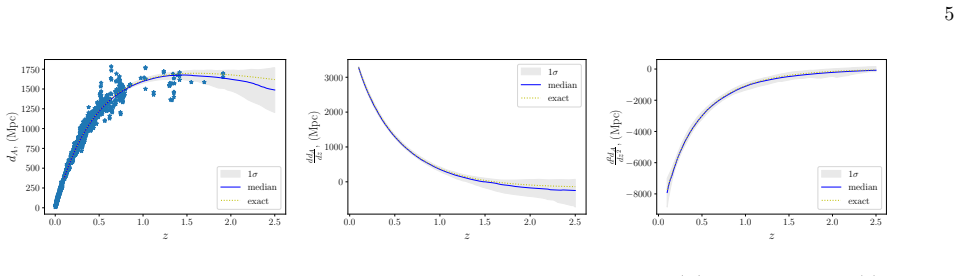
For each expression, calculate the values ofd A, d′ A andd ′′ A on a redshift grid. Calculate the median and 16th/84th percentile range of the values, sampling over all 200 expressions. The results of applying this procedure to mock data are shown in Fig. 1. For all three ofd A, d′ A andd ′′ A, the exact expression for the input ΛCDM model is within one s...
2000
-
[6]
the 16th/84th percentile range)
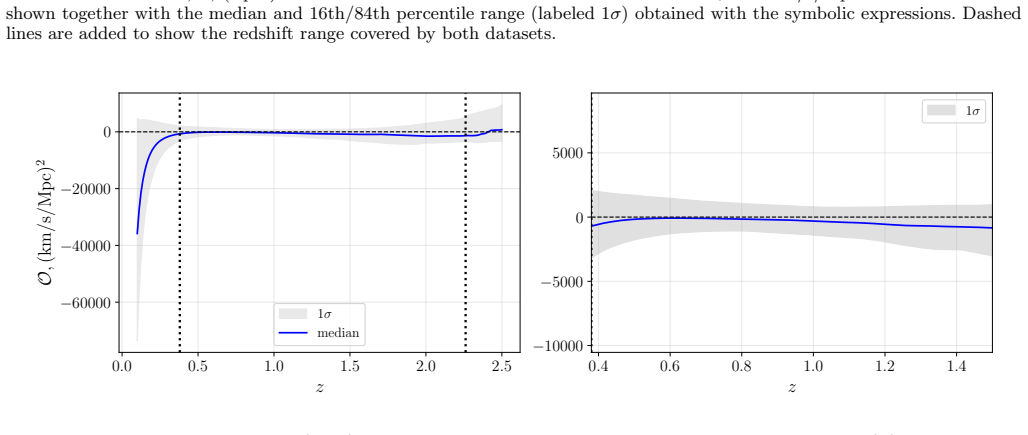
Again, we see that the correct value for the input model,O= 0, is contained within the uncertainty band corresponding to 1σ(i.e. the 16th/84th percentile range). Overall, the FLRW test gives us good reason to expect the true functional relations ford A,H, their derivatives as well asC,OandMwill be correctly constrained by bootstrap-based symbolic regressi...
2000
-
[7]
and eBOSS [44] to obtainHandH ′. As discussed in the previous section, we make two BAO data com- binations: one where parts of the DESI measurements are removed, and one where parts of eBOSS/BOSS data points are removed due to overlap in redshifts of the DESI/eBOSS/BOSS data points. The results from applying the bootstrap-based sym- bolic regression to su...
2000
-
[8]
pathological
to be consistent with FLRW expectations. While the assumption can alleviate the difficulty in reconstructing d′ A, it does not help with reconstructingd ′′ A orH ′ and poor constraints on these may increase the uncertainty bands in [50]. If a Gaussian Process reconstruction struggles to reconstruct derivatives, this instability manifests as broad uncertai...
2000
-
[9]
E. Di Valentino, O. Mena, S. Pan, L. Visinelli, W. Yang, A. Melchiorri, D. F. Mota, A. G. Riess, and J. Silk, In the realm of the Hubble tension—a review of solutions, Class. Quant. Grav.38, 153001 (2021), arXiv:2103.01183 [astro-ph.CO]
-
[10]
S. M. Koksbang and A. Heinesen, Diagnostic Consistency Tests of the Concordance Cosmology (2026), submitted
2026
-
[11]
Beckers, An introduction to gaussian process models (2021), arXiv:2102.05497 [eess.SY]
T. Beckers, An introduction to gaussian process models (2021), arXiv:2102.05497 [eess.SY]
-
[12]
Ebden, Gaussian processes: A quick introduction (2015), arXiv:1505.02965 [math.ST]
M. Ebden, Gaussian processes: A quick introduction (2015), arXiv:1505.02965 [math.ST]
- [13]
-
[14]
Ruchika, P. Mukherjee, and A. Favale, Revisiting Gaus- sian Process Reconstruction for Cosmological Inference: The Generalised GP (Gen GP) Framework (2025), arXiv:2510.03742 [astro-ph.CO]
-
[15]
D. J. Bartlett, H. Desmond, P. G. Ferreira, and G. Kro- nberger, Introduction to symbolic regression in the phys- ical sciences (2025), arXiv:2512.15920 [cs.LG]
work page internal anchor Pith review Pith/arXiv arXiv 2025
-
[16]
C. Clarkson, B. Bassett, and T. H.-C. Lu, A general test of the Copernican Principle, Phys. Rev. Lett.101, 011301 (2008), arXiv:0712.3457 [astro-ph]
-
[17]
A. Heinesen, Multipole decomposition of the general lu- minosity distance ’Hubble law’ – a new framework for ob- servational cosmology, JCAP05, 008, arXiv:2010.06534 [astro-ph.CO]. 20 https://numpy.org/ 21 https://matplotlib.org/ 22 https://pandas.pydata.org/ 23 https://www.sympy.org/en/index.html 24 https://docs.python.org/3/library/pathlib.html 25 https...
-
[18]
Heinesen, Differential age observations and their con- straining power in cosmology, Phys
A. Heinesen, Differential age observations and their con- straining power in cosmology, Phys. Rev. D111, 023539 (2025), arXiv:2412.05020 [gr-qc]
-
[19]
A. Heinesen, C. Blake, and D. L. Wiltshire, Quanti- fying the accuracy of the Alcock–Paczynski scaling of baryon acoustic oscillation measurements, JCAP01, 038, arXiv:1908.11508 [astro-ph.CO]
-
[20]
A. Heinesen, C. Blake, Y.-Z. Li, and D. L. Wiltshire, Baryon acoustic oscillation methods for generic curva- ture: application to the SDSS-III Baryon Oscillation Spectroscopic Survey, JCAP03, 003, arXiv:1811.11963 [astro-ph.CO]
- [21]
-
[22]
Constraining dark matter halo profiles with symbolic regression
A. Mart´ ın, T. Yasin, D. J. Bartlett, H. Desmond, and P. G. Ferreira, Constraining dark matter halo profiles with symbolic regression (2025), arXiv:2511.23073 [astro- ph.CO]
work page internal anchor Pith review Pith/arXiv arXiv 2025
- [23]
- [24]
-
[25]
H. Desmond, (Exhaustive) Symbolic Regression and model selection by minimum description length (2025), arXiv:2507.13033 [astro-ph.IM]
-
[26]
The Pantheon+ Analysis: The Full Dataset and Light-Curve Release
D. Scolnicet al., The Pantheon+ Analysis: The Full Data Set and Light-curve Release, Astrophys. J.938, 113 (2022), arXiv:2112.03863 [astro-ph.CO]
work page internal anchor Pith review arXiv 2022
-
[27]
A. G. Adameet al.(DESI), DESI 2024 VI: cosmologi- cal constraints from the measurements of baryon acous- tic oscillations, JCAP02, 021, arXiv:2404.03002 [astro- ph.CO]
work page internal anchor Pith review arXiv 2024
- [28]
-
[29]
DESI DR2 Results II: Measurements of Baryon Acoustic Oscillations and Cosmological Constraints
M. Abdul Karimet al.(DESI), DESI DR2 results. II. Measurements of baryon acoustic oscillations and cos- mological constraints, Phys. Rev. D112, 083515 (2025), arXiv:2503.14738 [astro-ph.CO]. 19
work page Pith review arXiv 2025
- [30]
-
[31]
D. Camarena and V. Marra, The tension in the absolute magnitude of Type Ia supernovae (2023), arXiv:2307.02434 [astro-ph.CO]
-
[32]
V. Poulin, T. L. Smith, R. Calder´ on, and T. Si- mon, Implications of the cosmic calibration tension be- yond H0 and the synergy between early- and late- time new physics, Phys. Rev. D111, 083552 (2025), arXiv:2407.18292 [astro-ph.CO]
- [33]
-
[34]
McConaghy, Ffx: Fast, scalable, deterministic symbolic regression technology, inGenetic Program- ming Theory and Practice IX, edited by R
T. McConaghy, Ffx: Fast, scalable, deterministic symbolic regression technology, inGenetic Program- ming Theory and Practice IX, edited by R. Riolo, E. Vladislavleva, and J. H. Moore (Springer New York, New York, NY, 2011) pp. 235–260
2011
-
[35]
Virgolin, T
M. Virgolin, T. Alderliesten, C. Witteveen, and P. A. N. Bosman, Improving model-based genetic programming for symbolic regression of small expressions, Evolutionary Computation29, 211 (2021)
2021
-
[36]
Burlacu, G
B. Burlacu, G. Kronberger, and M. Kommenda, Operon c++: An efficient genetic programming framework for symbolic regression, inProceedings of the 2020 Genetic and Evolutionary Computation Conference Companion, GECCO ’20 (Association for Computing Machinery, New York, NY, USA, 2020) p. 1562–1570
2020
-
[37]
Udrescu and M
S.-M. Udrescu and M. Tegmark, Ai feynman: A physics- inspired method for symbolic regression, Science Ad- vances6, eaay2631 (2020)
2020
-
[38]
S.-M. Udrescu, A. Tan, J. Feng, O. Neto, T. Wu, and M. Tegmark, Ai feynman 2.0: Pareto-optimal symbolic regression exploiting graph modularity, arXiv preprint arXiv:2006.10782 (2020)
-
[40]
T. N. Mundhenk, M. Landajuela, R. Glatt, C. P. Santi- ago, D. M. Faissol, and B. K. Petersen, Symbolic regres- sion via neural-guided genetic programming population seeding, inAdvances in Neural Information Processing Systems(2021)
2021
-
[41]
B. K. Petersen, M. L. Larma, T. N. Mundhenk, C. P. Santiago, S. K. Kim, and J. T. Kim, Deep symbolic re- gression: Recovering mathematical expressions from data via risk-seeking policy gradients, inInternational Confer- ence on Learning Representations(2021)
2021
-
[42]
B. K. Petersen, M. Landajuela, T. N. Mundhenk, C. P. Santiago, S. K. Kim, and J. T. Kim, Deep symbolic re- gression: Recovering mathematical expressions from data via risk-seeking policy gradients, inProc. of the Interna- tional Conference on Learning Representations(2021)
2021
-
[43]
Landajuela, C
M. Landajuela, C. Lee, J. Yang, R. Glatt, C. P. Santiago, I. Aravena, T. N. Mundhenk, G. Mulcahy, and B. K. Pe- tersen, A unified framework for deep symbolic regression, inAdvances in Neural Information Processing Systems (2022)
2022
-
[44]
Espada, L
G. Espada, L. Ingelse, P. Canelas, P. Barbosa, and A. Fonseca, Datatypes as a more ergonomic frontend for grammar-guided genetic programming, inGPCE ’22: Concepts and Experiences, Auckland, NZ, December 6 - 7, 2022, edited by B. Scholz and Y. Kameyama (ACM,
2022
-
[45]
G. Dick, C. A. Owen, and P. A. Whigham, Feature standardisation and coefficient optimisation for effective symbolic regression, inProceedings of the 2020 Genetic and Evolutionary Computation Conference, GECCO ’20 (Association for Computing Machinery, New York, NY, USA, 2020) p. 306–314
2020
-
[46]
F. O. de Franca and G. S. I. Aldeia, Interaction- Transformation Evolutionary Algorithm for Sym- bolic Regression, Evolutionary Computation , 1 (2020), https://direct.mit.edu/evco/article- pdf/doi/10.1162/evco a 00285/1888497/evco a 00285.pdf
-
[47]
Interpretable Machine Learning for Science with PySR and SymbolicRegression.jl
M. Cranmer, Interpretable Machine Learning for Sci- ence with PySR and SymbolicRegression.jl (2023), arXiv:2305.01582
work page internal anchor Pith review arXiv 2023
-
[48]
N. J. Christensen, S. Demharter, M. Machado, L. Pedersen, M. Salvatore, V. Stentoft-Hansen, and M. T. Iglesias, Identifying interactions in omics data for clinical biomarker discovery using sym- bolic regression, Bioinformatics38, 3749 (2022), https://academic.oup.com/bioinformatics/article- pdf/38/15/3749/49884306/btac405.pdf
2022
-
[49]
R. Zhouet al.(DESI), Target Selection and Validation of DESI Luminous Red Galaxies, Astron. J.165, 58 (2023), arXiv:2208.08515 [astro-ph.CO]
-
[50]
A. Raichooret al., Target Selection and Validation of DESI Emission Line Galaxies, Astron. J.165, 126 (2023), arXiv:2208.08513 [astro-ph.CO]
-
[51]
S. Alamet al.(BOSS), The clustering of galaxies in the completed SDSS-III Baryon Oscillation Spectroscopic Survey: cosmological analysis of the DR12 galaxy sam- ple, Mon. Not. Roy. Astron. Soc.470, 2617 (2017), arXiv:1607.03155 [astro-ph.CO]
work page Pith review arXiv 2017
- [52]
-
[53]
J. Houet al.(eBOSS), The Completed SDSS-IV extended Baryon Oscillation Spectroscopic Survey: BAO and RSD measurements from anisotropic clustering analysis of the Quasar Sample in configuration space between redshift 0.8 and 2.2, Mon. Not. Roy. Astron. Soc.500, 1201 (2020), arXiv:2007.08998 [astro-ph.CO]
-
[54]
H. du Mas des Bourbouxet al.(eBOSS), The Com- pleted SDSS-IV Extended Baryon Oscillation Spectro- scopic Survey: Baryon Acoustic Oscillations with Lyα Forests, Astrophys. J.901, 153 (2020), arXiv:2007.08995 [astro-ph.CO]
-
[55]
Efron and R
B. Efron and R. Tibshirani, THE BOOTSTRAP METHOD FOR ASSESSING ST ATISTICAL ACCU- RACY, Behaviormetrika , 1 (1985)
1985
-
[56]
Planck 2018 results. VI. Cosmological parameters
N. Aghanimet al.(Planck), Planck 2018 results. VI. Cosmological parameters, Astron. Astrophys.641, A6 (2020), [Erratum: Astron.Astrophys. 652, C4 (2021)], arXiv:1807.06209 [astro-ph.CO]
work page internal anchor Pith review Pith/arXiv arXiv 2018
-
[57]
The Pantheon+ Analysis: Cosmological Constraints
D. Broutet al., The Pantheon+ Analysis: Cosmo- logical Constraints, Astrophys. J.938, 110 (2022), arXiv:2202.04077 [astro-ph.CO]. 20
work page internal anchor Pith review arXiv 2022
- [58]
-
[59]
K. Bolejko, Emerging spatial curvature can resolve the tension between high-redshift CMB and low-redshift distance ladder measurements of the Hubble constant, Phys. Rev. D97, 103529 (2018), arXiv:1712.02967 [astro- ph.CO]
-
[60]
A. Heinesen and T. Buchert, Solving the curvature and Hubble parameter inconsistencies through structure formation-induced curvature, Class. Quant. Grav.37, 164001 (2020), [Erratum: Class.Quant.Grav. 37, 229601 (2020)], arXiv:2002.10831 [gr-qc]
-
[61]
T. Clifton and N. Hyatt, A radical solution to the Hubble tension problem, JCAP08, 052, arXiv:2404.08586 [astro- ph.CO]
-
[62]
S. R¨ as¨ anen, K. Bolejko, and A. Finoguenov, New Test of the Friedmann-Lemaˆ ıtre-Robertson-Walker Metric Using the Distance Sum Rule, Phys. Rev. Lett.115, 101301 (2015), arXiv:1412.4976 [astro-ph.CO]
-
[63]
C. R. e. a. Harris, Array programming with numpy, Na- ture585, 357–362 (2020)
2020
-
[64]
J. D. Hunter, Matplotlib: A 2d graphics environment, Computing in Science & Engineering9, 90 (2007)
2007
discussion (0)
Sign in with ORCID, Apple, or X to comment. Anyone can read and Pith papers without signing in.