Recognition: 1 theorem link
· Lean TheoremQuantum simulation of baryon scattering in SU(2) lattice gauge theory
Pith reviewed 2026-05-10 18:25 UTC · model grok-4.3
The pith
In SU(2) lattice gauge theory, meson-baryon scattering produces entanglement that delocalizes the slower particle while the faster one moves ballistically.
A machine-rendered reading of the paper's core claim, the machinery that carries it, and where it could break.
Core claim
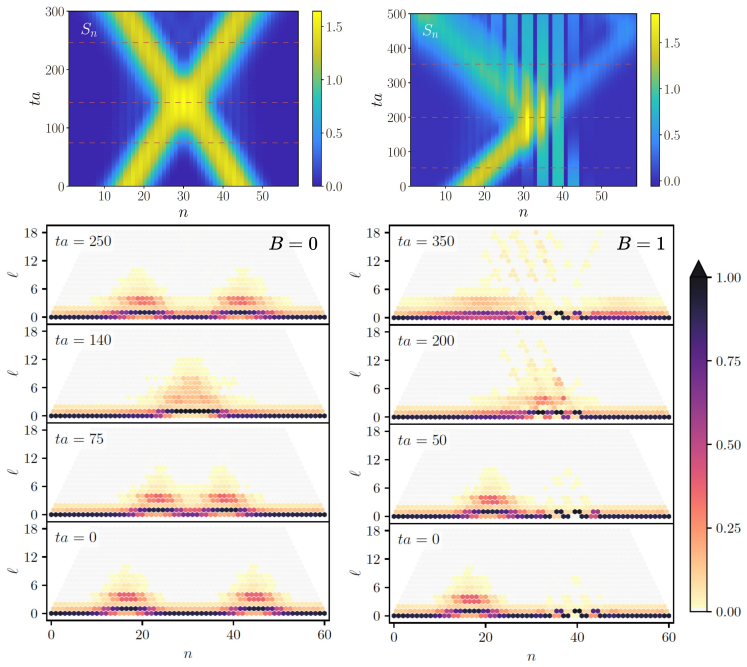
At strong coupling, the B=0 and B=2 channels exhibit predominantly elastic dynamics closely resembling the U(1) Schwinger model. The mixed B=1 sector displays qualitatively new behavior: meson and baryon wavepackets become entangled during the collision, with the slower state becoming spatially delocalized while the faster one propagates ballistically. These processes are characterized through local observables, entanglement entropy, and the information lattice.
What carries the argument
Tensor-network methods applied to the gaugeless Hamiltonian in fixed-baryon-number sectors, tracking real-time wave-packet evolution and entanglement measures.
Load-bearing premise
The tensor-network truncation and gaugeless Hamiltonian formulation reproduce the continuum dynamics of the full SU(2) theory without introducing uncontrolled artifacts in the scattering observables.
What would settle it
A higher-precision simulation with increased bond dimension or restored gauge degrees of freedom that shows no delocalization or entanglement in the B=1 sector would falsify the reported new behavior.
Figures
read the original abstract
We present a first real-time study of hadronic scattering in a $(1+1)$-dimensional SU(2) lattice gauge theory with fundamental fermions using tensor-network techniques. Working in the gaugeless Hamiltonian formulation, we investigate scattering processes across sectors of fixed global baryon number $B = 0, 1, 2$, corresponding respectively to meson--meson, meson--baryon, and baryon--baryon collisions. At strong coupling, the $B = 0$ and $B = 2$ channels exhibit predominantly elastic dynamics closely resembling the U(1) Schwinger model. The mixed $B = 1$ sector displays qualitatively new behavior: meson and baryon wavepackets become entangled during the collision, with the slower state becoming spatially delocalized while the faster one propagates ballistically. We characterize these processes through local observables, entanglement entropy, and the information lattice.
Editorial analysis
A structured set of objections, weighed in public.
Referee Report
Summary. The manuscript presents the first real-time tensor-network simulation of hadronic scattering in (1+1)-dimensional SU(2) lattice gauge theory with fundamental fermions, using the gaugeless Hamiltonian formulation. It examines scattering in fixed baryon-number sectors B=0 (meson-meson), B=1 (meson-baryon), and B=2 (baryon-baryon) at strong coupling. The B=0 and B=2 channels are reported to exhibit predominantly elastic dynamics resembling the U(1) Schwinger model, while the B=1 sector shows qualitatively new behavior: entanglement of meson and baryon wavepackets during collision, with the slower state becoming spatially delocalized and the faster one propagating ballistically. These processes are characterized via local observables, entanglement entropy, and the information lattice.
Significance. If the results are robust against numerical artifacts, this constitutes a significant advance in applying tensor networks to real-time non-Abelian gauge dynamics, providing qualitative insights into baryon scattering beyond exactly solvable Abelian models. The direct numerical evolution without fitted parameters and the cross-check against the Schwinger model in the B=0 and B=2 sectors are strengths that support the methodological contribution.
major comments (1)
- [Abstract and B=1 sector results] Abstract and B=1 sector results: The central claim of qualitatively new behavior in the B=1 channel (entanglement during collision and spatial delocalization of the slower state) rests on the tensor-network simulation faithfully capturing the physics. No convergence tests with bond dimension, lattice spacing, or truncation error estimates are described for the key observables in this sector. In the gaugeless formulation, the constrained fermion Hilbert space combined with finite-bond-dimension MPS/TTN truncation can artificially induce or suppress long-range entanglement, potentially causing the reported delocalization as a numerical artifact. This is load-bearing because the B=0 and B=2 sectors match the Schwinger model but provide no independent cross-check for the mixed B=1 dynamics.
Simulated Author's Rebuttal
We thank the referee for their careful reading of the manuscript, the positive assessment of its significance, and the recommendation for major revision. We address the concerns about convergence and potential numerical artifacts in the B=1 sector below. We will revise the manuscript to incorporate additional numerical details and tests.
read point-by-point responses
-
Referee: No convergence tests with bond dimension, lattice spacing, or truncation error estimates are described for the key observables in this sector.
Authors: We agree that the original manuscript does not provide sufficient detail on these convergence aspects for the B=1 sector. In the revised version we will add a new subsection (or appendix) presenting bond-dimension scaling for the local observables, entanglement entropy, and information lattice in the B=1 channel. We will also report the truncation error thresholds used during time evolution and briefly discuss finite-volume and lattice-spacing considerations at the fixed strong-coupling value employed. revision: yes
-
Referee: In the gaugeless formulation, the constrained fermion Hilbert space combined with finite-bond-dimension MPS/TTN truncation can artificially induce or suppress long-range entanglement, potentially causing the reported delocalization as a numerical artifact. This is load-bearing because the B=0 and B=2 sectors match the Schwinger model but provide no independent cross-check for the mixed B=1 dynamics.
Authors: We agree that finite bond dimension can in principle limit entanglement, but we do not believe the observed delocalization is an artifact. The gaugeless formulation exactly enforces the gauge constraints by construction, working entirely within the physical subspace; no additional gauge-fixing approximations are introduced. The delocalization of the slower wave packet is directly correlated with the dynamical growth of entanglement entropy between the meson and baryon, a feature absent in the Abelian Schwinger model and arising from the SU(2) color structure. The B=0 and B=2 results validate the overall implementation and time-evolution algorithm for elastic processes, while the B=1 channel constitutes a genuine prediction of the non-Abelian theory. To address the concern, the revision will include explicit comparisons at multiple bond dimensions for the B=1 observables, demonstrating that the qualitative delocalization and entanglement features remain stable above a threshold bond dimension. revision: partial
Circularity Check
No significant circularity; results from direct numerical evolution
full rationale
The paper reports outcomes from real-time tensor-network evolution of initial wavepackets in a gaugeless SU(2) Hamiltonian on a lattice. No parameters are fitted to the target scattering observables, no self-referential definitions equate inputs to outputs, and no uniqueness theorems or ansatzes from prior self-citations are invoked to force the reported entanglement or delocalization patterns. The B=0 and B=2 sectors are compared to the known Schwinger model for validation, but the B=1 results stand as independent simulation data without reduction to the input state by construction.
Axiom & Free-Parameter Ledger
axioms (2)
- domain assumption The gaugeless Hamiltonian formulation correctly captures the dynamics of SU(2) lattice gauge theory with fundamental fermions.
- domain assumption Tensor-network truncation errors remain small enough not to alter the qualitative scattering behavior at the chosen bond dimensions.
Lean theorems connected to this paper
-
IndisputableMonolith/Foundation/RealityFromDistinction.leanreality_from_one_distinction unclear?
unclearRelation between the paper passage and the cited Recognition theorem.
We present a first real-time study of hadronic scattering in a (1+1)-dimensional SU(2) lattice gauge theory with fundamental fermions using tensor-network techniques... At strong coupling, the B=0 and B=2 channels exhibit predominantly elastic dynamics closely resembling the U(1) Schwinger model. The mixed B=1 sector displays qualitatively new behavior: meson and baryon wavepackets become entangled...
What do these tags mean?
- matches
- The paper's claim is directly supported by a theorem in the formal canon.
- supports
- The theorem supports part of the paper's argument, but the paper may add assumptions or extra steps.
- extends
- The paper goes beyond the formal theorem; the theorem is a base layer rather than the whole result.
- uses
- The paper appears to rely on the theorem as machinery.
- contradicts
- The paper's claim conflicts with a theorem or certificate in the canon.
- unclear
- Pith found a possible connection, but the passage is too broad, indirect, or ambiguous to say the theorem truly supports the claim.
Forward citations
Cited by 1 Pith paper
-
Tightening energy-based boson truncation bound using Monte Carlo-assisted methods
Monte Carlo-assisted tightening of the energy-based boson truncation bound substantially reduces volume dependence in (1+1)D scalar field theory and (2+1)D U(1) gauge theory.
Reference graph
Works this paper leans on
-
[1]
Maximum Entropy Analysis of the Spectral Functions in Lattice QCD
M. Asakawa, T. Hatsuda, Y . Nakahara, Maximum entropy analysis of the spectral functions in lattice QCD, Prog. Part. Nucl. Phys. 46 (2001) 459–508.arXiv:hep-lat/0011040; M. Bruno, M. T. Hansen, Variations on the Maiani-Testa approach and the inverse problem, JHEP 06 (2021) 043.arXiv:2012.11488
work page Pith review arXiv 2001
-
[2]
E. Zohar, Quantum simulation of lattice gauge theories in more than one space dimension—requirements, chal- lenges and methods, Phil. Trans. A. Math. Phys. Eng. Sci. 380 (2216) (2021) 20210069.arXiv:2106.04609; M. C. Bañuls, et al., Simulating Lattice Gauge Theories within Quantum Technologies, Eur. Phys. J. D 74 (8) (2020) 165.arXiv:1911.00003; L. Funcke...
- [3]
-
[4]
I. Papaefstathiou, J. Knolle, M. C. Bañuls, Real-time scattering in the lattice Schwinger model, Phys. Rev. D 111 (1) (2025) 014504.arXiv:2402.18429; Y . Chai, A. Crippa, K. Jansen, S. Kühn, V . R. Pascuzzi, F. Tacchino, I. Tavernelli, Fermionic wave packet scattering: a quantum computing approach, Quantum 9 (2025) 1638.arXiv:2312.02272; J. Barata, E. Ric...
-
[5]
Hadronic scattering in (1+1)D SU(2) lattice gauge theory from tensor networks
J. Barata, J. Hormaza, Z.-B. Kang, W. Qian, Hadronic scattering in (1+1)D SU(2) lattice gauge theory from tensor networks (10 2025).arXiv:2511.00154
work page internal anchor Pith review arXiv 2025
-
[6]
S. R. Coleman, More About the Massive Schwinger Model, Annals Phys. 101 (1976) 239
1976
-
[7]
J. B. Kogut, L. Susskind, Hamiltonian Formulation of Wilson’s Lattice Gauge Theories, Phys. Rev. D 11 (1975) 395–408; L. Susskind, Lattice Fermions, Phys. Rev. D 16 (1977) 3031–3039
1975
-
[8]
Fishman, S
M. Fishman, S. R. White, E. M. Stoudenmire, The ITensor Software Library for Tensor Network Calculations, SciPost Phys. Codebases (2022) 4. 4
2022
-
[9]
Schollwöck, The density-matrix renormalization group in the age of matrix product states, Annals of physics 326 (1) (2011) 96–192
U. Schollwöck, The density-matrix renormalization group in the age of matrix product states, Annals of physics 326 (1) (2011) 96–192
2011
-
[10]
J. Haegeman, J. I. Cirac, T. J. Osborne, I. Pizorn, H. Verschelde, F. Verstraete, Time-Dependent Variational Principle for Quantum Lattices, Phys. Rev. Lett. 107 (2011) 070601.arXiv:1103.0936
-
[11]
T. K. Kvorning, L. Herviou, J. H. Bardarson, Time-evolution of local information: thermalization dynamics of local observables, SciPost Phys. 13 (4) (2022) 080.arXiv:2105.11206; C. Artiaco, T. Klein Kvorn- ing, D. Aceituno Chávez, L. Herviou, J. H. Bardarson, Universal Characterization of Quantum Many-Body States through Local Information, Phys. Rev. Lett...
discussion (0)
Sign in with ORCID, Apple, or X to comment. Anyone can read and Pith papers without signing in.