Recognition: unknown
Tightening energy-based boson truncation bound using Monte Carlo-assisted methods
Pith reviewed 2026-05-07 16:56 UTC · model grok-4.3
The pith
An improved analytic derivation combined with Monte Carlo sampling tightens energy-based boson truncation bounds and reduces their volume scaling.
A machine-rendered reading of the paper's core claim, the machinery that carries it, and where it could break.
Core claim
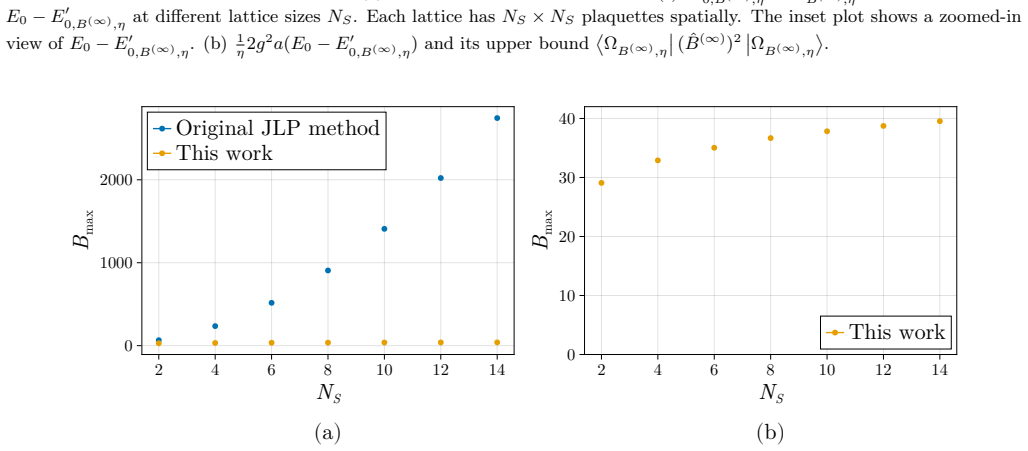
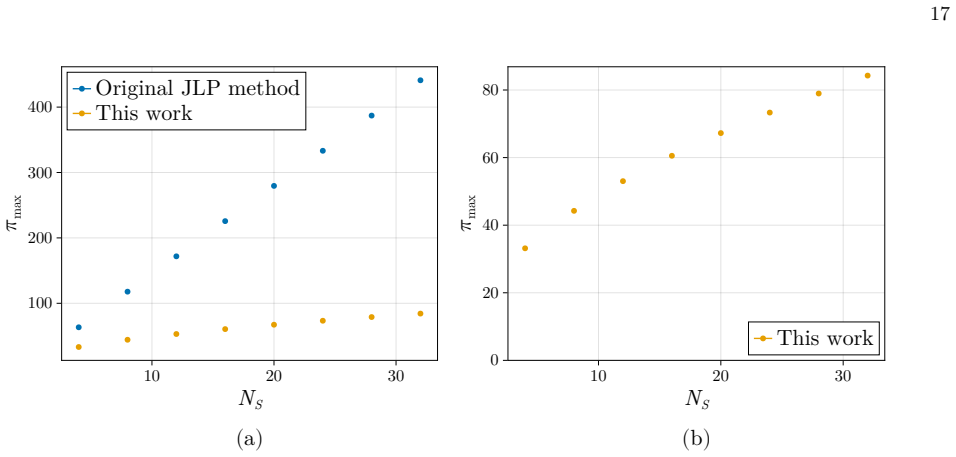
The authors establish that an improved analytic derivation of the energy-based truncation bound, together with Monte Carlo sampling of low-energy states, produces substantially tighter estimates of the required boson cutoff. In the theories examined, the volume dependence of this cutoff is reduced, sometimes proportionally to the volume and sometimes to its square root, while still guaranteeing control of the truncation error for low-energy observables.
What carries the argument
The energy-based boson truncation bound, refined by analytic derivation and Monte Carlo sampling of low-energy states to produce a tighter cutoff.
If this is right
- The required truncation cutoff decreases nearly proportionally to the system volume in some cases.
- The required truncation cutoff decreases proportionally to the square root of the volume in other cases.
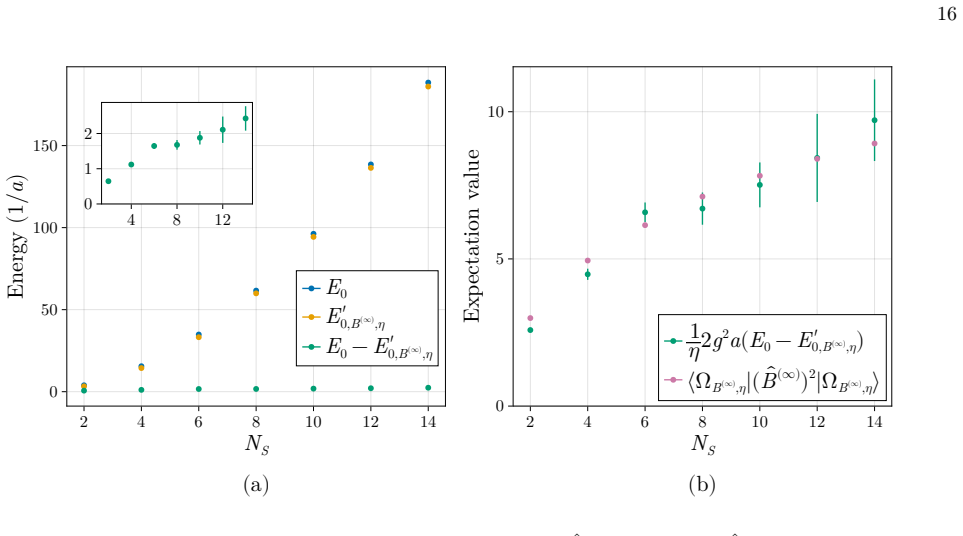
- The method controls truncation error for low-energy states in (1+1)-dimensional scalar field theory.
- The method controls truncation error for low-energy states in (2+1)-dimensional U(1) gauge theory in the dual formalism.
Where Pith is reading between the lines
- Larger-volume quantum simulations of field theories could become practical without a proportional rise in local state dimension.
- The Monte Carlo-assisted tightening technique might extend to other truncation errors that appear in quantum many-body or lattice simulations.
- Direct numerical checks on still larger volumes or different theories would test whether the reduced volume scaling persists.
Load-bearing premise
The Monte Carlo sampling must accurately capture the low-energy states without introducing uncontrolled bias.
What would settle it
A simulation using the new reduced cutoff that produces low-energy observables differing from those obtained with a much larger cutoff reference would show the bound is not tight enough.
Figures




read the original abstract
Quantum simulation offers a promising framework for quantum field theory calculations. Obtaining reliable results, however, requires careful characterization of systematic uncertainties. One important source is the boson truncation error, which arises from representing infinite-dimensional local Hilbert spaces with finite-dimensional ones. Previous studies have examined this problem from several perspectives. In particular, Jordan, Lee, and Prekill (arXiv:1111.3633) derived an energy-based bound applicable to generic low-energy states across a broad class of field theories. However, this approach often yields overly conservative bounds, especially at large volumes. In this work, we introduce a new methodology that significantly tightens the energy-based boson truncation bound through two complementary advances: an improved analytic derivation and a Monte Carlo-based numerical procedure. We demonstrate the method in (1+1)-dimensional scalar field theory and (2+1)-dimensional U(1) gauge theory in the dual formalism. Our approach substantially mitigates the volume dependence of the required truncation cutoff, achieving reductions nearly proportional to the volume in some cases and to the square root of the volume in others.
Editorial analysis
A structured set of objections, weighed in public.
Referee Report
Summary. The manuscript claims to tighten the energy-based boson truncation bound of Jordan, Lee, and Preskill by combining an improved analytic derivation with a Monte Carlo-assisted numerical procedure. It demonstrates the method on (1+1)-dimensional scalar field theory and (2+1)-dimensional U(1) gauge theory in the dual formalism, asserting that the volume dependence of the required truncation cutoff is substantially mitigated, with reductions scaling proportionally to the volume in some cases and to the square root of the volume in others.
Significance. If the final cutoff remains a rigorous upper bound on truncation error for all low-energy states, the work would be significant for quantum simulations of lattice field theories. It could reduce the qubit and gate resources needed for large-volume simulations by lowering the boson truncation cutoff, addressing a key systematic uncertainty in the field.
major comments (2)
- [Abstract] Abstract: The central claim that the Monte Carlo-assisted method produces a 'tightened bound' (rather than a probabilistic estimate) is load-bearing but unsupported by any demonstration that statistical fluctuations or sampling bias in the Monte Carlo step preserve the strict upper-bound property of the original JLP analytic bound for every state below the energy cutoff. This directly affects usability in quantum simulation, where a guaranteed error bound is required.
- [Monte Carlo-based numerical procedure] Monte Carlo-based numerical procedure: The manuscript must explicitly show how quantities estimated from Monte Carlo sampling (e.g., field moments or energy contributions) enter the cutoff selection while keeping the final truncation error rigorously bounded, especially in the large-volume regime where autocorrelation times grow and ergodicity is hardest to ensure. Without such a proof or numerical validation with error bars, the reported volume scalings cannot be taken as guaranteed improvements.
minor comments (2)
- [Abstract] The abstract references the original JLP work only by arXiv number; the introduction should include the full published citation for completeness.
- The description of the 'improved analytic derivation' is too brief; a short outline of the key steps or the modified inequality should be added early in the manuscript to aid readability.
Simulated Author's Rebuttal
We thank the referee for their careful reading of the manuscript and for identifying these critical points about the rigor of the Monte Carlo-assisted tightening procedure. We have revised the manuscript to provide the requested explicit demonstrations and clarifications while preserving the original claims where they are supported.
read point-by-point responses
-
Referee: [Abstract] Abstract: The central claim that the Monte Carlo-assisted method produces a 'tightened bound' (rather than a probabilistic estimate) is load-bearing but unsupported by any demonstration that statistical fluctuations or sampling bias in the Monte Carlo step preserve the strict upper-bound property of the original JLP analytic bound for every state below the energy cutoff. This directly affects usability in quantum simulation, where a guaranteed error bound is required.
Authors: We agree that a strict upper bound is essential for quantum simulation applications. The improved analytic derivation supplies the rigorous JLP-style bound, and the Monte Carlo step is used only to evaluate theory-specific parameters (such as field moments) that are then inserted into the analytic expressions. To preserve the strict bound, the revised manuscript now specifies that we adopt the upper edge of the Monte Carlo statistical error interval when setting the cutoff; this conservative choice ensures the final truncation error remains rigorously bounded for all states below the energy threshold, independent of sampling fluctuations. We have updated the abstract and inserted a new paragraph in Section II that walks through this substitution and the resulting guarantee. revision: yes
-
Referee: [Monte Carlo-based numerical procedure] Monte Carlo-based numerical procedure: The manuscript must explicitly show how quantities estimated from Monte Carlo sampling (e.g., field moments or energy contributions) enter the cutoff selection while keeping the final truncation error rigorously bounded, especially in the large-volume regime where autocorrelation times grow and ergodicity is hardest to ensure. Without such a proof or numerical validation with error bars, the reported volume scalings cannot be taken as guaranteed improvements.
Authors: We accept that the original manuscript did not provide sufficient detail on this mapping. In the revised version we have expanded Section III with an explicit algorithmic description: each Monte Carlo estimate (e.g., <ϕ²> or local energy contributions) is inserted into the analytic bound formula together with its measured standard error; the cutoff is then chosen to satisfy the inequality even after adding the error in quadrature. For the large-volume regime we have added new data sets that include autocorrelation times, integrated autocorrelation lengths, and error bars on the resulting cutoffs. These numerical validations confirm that the reported volume scalings (linear or square-root) remain valid under the conservative error treatment, thereby supporting the claimed improvements as guaranteed bounds. revision: yes
Circularity Check
No significant circularity; derivation uses independent analytic refinement and external Monte Carlo sampling
full rationale
The paper starts from the independent JLP energy-based bound (different authors, cited as arXiv:1111.3633) and applies two separate advances: an improved analytic derivation plus Monte Carlo sampling of low-energy states. No equation or step reduces the tightened cutoff to a quantity defined by the original bound itself, nor does any fitted parameter get relabeled as a prediction. The Monte Carlo step draws from the target theory's dynamics rather than from the bound's functional form, and the analytic improvement is presented as a distinct mathematical tightening. The volume-scaling claims are therefore outputs of these external procedures, not tautological re-expressions of the inputs. This is the normal case of a self-contained derivation against external benchmarks.
Axiom & Free-Parameter Ledger
axioms (1)
- domain assumption The energy-based bound derived by Jordan, Lee, and Preskill applies to generic low-energy states across a broad class of field theories.
Reference graph
Works this paper leans on
-
[1]
As mentioned in Section VB, the maximalλmax such that ˆHU(1) −λ max 1 a g2 2 P p( ˆRp)2 is positive-semidefinite will decrease considerably fast as the lattice size increases
Property ofM p,q matrix at large lattice size To be able to use the energy-based bound for the dual formalism U(1) gauge theory, the properties of theMp,q matrix needs to be studied. As mentioned in Section VB, the maximalλmax such that ˆHU(1) −λ max 1 a g2 2 P p( ˆRp)2 is positive-semidefinite will decrease considerably fast as the lattice size increases...
-
[2]
To convert this into the form of a path integral, we can insert complete bases of states at different time slices
Path integral in scalar field theory Here, let’s first considerTr h e− ˆHT i . To convert this into the form of a path integral, we can insert complete bases of states at different time slices. Firstly, supposeT=N a0, wherea 0 can be interpreted as the temporal lattice spacing, then one can writee− ˆHT = (e− ˆHa 0)N. Then, notice that the identity operato...
-
[3]
Here, we will derive a path integral representation ofTr h e− ˆHU(1)T i andTr h ˆOe− ˆHU(1)T i
Path integral in 2+1D U(1) gauge theory in dual formalism The path integral for the dual formalism of 2+1D U(1) gauge theory can be derived analogously. Here, we will derive a path integral representation ofTr h e− ˆHU(1)T i andTr h ˆOe− ˆHU(1)T i . Once these quantities are derived, the corresponding path integral for the modified HamiltonianˆH ′ B(∞),η ...
- [4]
-
[5]
M. E. Peskin and D. V. Schroeder,An Introduction to Quantum Field Theory(Addison-Wesley Pub. Co, Reading, Mass, 1995)
1995
-
[6]
Shankar,Quantum Field Theory and Condensed Matter: An Introduction(Cambridge University Press, Cambridge, 2017)
R. Shankar,Quantum Field Theory and Condensed Matter: An Introduction(Cambridge University Press, Cambridge, 2017)
2017
-
[7]
Mukhanov,Physical Foundations of Cosmology(Cambridge University Press, Cambridge, 2005)
V. Mukhanov,Physical Foundations of Cosmology(Cambridge University Press, Cambridge, 2005)
2005
-
[8]
Navaset al.(Particle Data Group), Review of particle physics, Phys
S. Navaset al.(Particle Data Group), Review of particle physics, Phys. Rev. D110, 030001 (2024)
2024
-
[9]
R. Alibertiet al., The anomalous magnetic moment of the muon in the Standard Model: An update, Physics Reports 1143, 1 (2025), arXiv:2505.21476 [hep-ph]
-
[10]
K. G. Wilson, Confinement of quarks, Physical Review D10, 2445 (1974)
1974
-
[11]
Z. Fodor and C. Hoelbling, Light Hadron Masses from Lattice QCD, Reviews of Modern Physics84, 449 (2012), 29 arXiv:1203.4789 [hep-lat]
-
[12]
J. N. Guenther, Overview of the QCD phase diagram, The European Physical Journal A57, 136 (2021)
2021
-
[13]
Gattringer and C
C. Gattringer and C. B. Lang,Quantum Chromodynamics on the Lattice, Vol. 788 (Springer, Berlin, 2010)
2010
-
[14]
X. Ji, Y. Liu, Y.-S. Liu, J.-H. Zhang, and Y. Zhao, Large-momentum effective theory, Reviews of Modern Physics93, 035005 (2021)
2021
-
[15]
Lattice Parton Collaboration, F. Yao, L. Walter, J.-W. Chen, J. Hua, X. Ji, L. Jin, S. Lahrtz, L. Ma, P. Mohanta, A. Schäfer, H.-T. Shu, Y. Su, P. Sun, X. Xiong, Y.-B. Yang, and J.-H. Zhang, Nucleon Transversity Distribution in the Continuum and Physical Mass Limit from Lattice QCD, Physical Review Letters131, 261901 (2023)
2023
- [16]
-
[17]
S. Borsanyi, Z. Fodor, J. N. Guenther, C. Hoelbling, S. D. Katz, L. Lellouch, T. Lippert, K. Miura, L. Parato, K. K. Szabo, F. Stokes, B. C. Toth, C. Torok, and L. Varnhorst, Leading hadronic contribution to the muon magnetic moment from lattice QCD, Nature593, 51 (2021), arXiv:2002.12347 [hep-lat]
-
[18]
Y. Aoki, T. Blum, S. Collins, L. D. Debbio, M. D. Morte, P. Dimopoulos, X. Feng, M. Golterman, S. Gottlieb, R. Gupta, G. Herdoíza, P. Hernandez, A. Jüttner, T. Kaneko, E. Lunghi, S. Meinel, C. Monahan, A. Nicholson, T. Onogi, P. Pe- treczky, A. Portelli, A. Ramos, S. R. Sharpe, J. N. Simone, S. Sint, R. Sommer, N. Tantalo, R. V. de Water, A. Vaquero, U. W...
-
[19]
M. Troyer and U.-J. Wiese, Computational complexity and fundamental limitations to fermionic quantum Monte Carlo simulations, Physical Review Letters94, 170201 (2005), arXiv:cond-mat/0408370
-
[20]
V. A. Goy, V. Bornyakov, D. Boyda, A. Molochkov, A. Nakamura, A. Nikolaev, and V. Zakharov, Sign problem in finite density lattice QCD, Progress of Theoretical and Experimental Physics2017, 10.1093/ptep/ptx018 (2017), arXiv:1611.08093 [hep-lat]
-
[21]
Nagata, Finite-density lattice QCD and sign problem: Current status and open problems, Progress in Particle and Nuclear Physics127, 103991 (2022)
K. Nagata, Finite-density lattice QCD and sign problem: Current status and open problems, Progress in Particle and Nuclear Physics127, 103991 (2022)
2022
-
[22]
Wiese, Towards quantum simulating QCD, Nuclear Physics A QUARK MATTER 2014,931, 246 (2014)
U.-J. Wiese, Towards quantum simulating QCD, Nuclear Physics A QUARK MATTER 2014,931, 246 (2014)
2014
- [23]
-
[24]
Byrnes and Y
T. Byrnes and Y. Yamamoto, Simulating lattice gauge theories on a quantum computer, Physical Review A73, 022328 (2006)
2006
-
[25]
C. W. Bauer, Z. Davoudi, A. B. Balantekin, T. Bhattacharya, M. Carena, W. A. de Jong, P. Draper, A. El-Khadra, N. Gemelke, M. Hanada, D. Kharzeev, H. Lamm, Y.-Y. Li, J. Liu, M. Lukin, Y. Meurice, C. Monroe, B. Nachman, G. Pagano, J. Preskill, E. Rinaldi, A. Roggero, D. I. Santiago, M. J. Savage, I. Siddiqi, G. Siopsis, D. Van Zanten, N. Wiebe, Y. Yamauchi...
-
[26]
C. W. Bauer, Z. Davoudi, N. Klco, and M. J. Savage, Quantum simulation of fundamental particles and forces, Nature Reviews Physics5, 420 (2023)
2023
- [27]
- [28]
- [29]
-
[30]
Lloyd, Universal Quantum Simulators, Science273, 1073 (1996)
S. Lloyd, Universal Quantum Simulators, Science273, 1073 (1996)
1996
-
[31]
Nielsen and I
M. Nielsen and I. Chuang,Quantum Computation and Quantum Information, Cambridge Series on Information and the Natural Sciences (Cambridge University Press, 2000)
2000
-
[32]
Kogut and L
J. Kogut and L. Susskind, Hamiltonian formulation of Wilson’s lattice gauge theories, Physical Review D11, 395 (1975)
1975
-
[33]
E. J. Gustafson and H. Lamm, Toward quantum simulations of ${\mathbb{Z}}_{2}$ gauge theory without state prepa- ration, Physical Review D103, 054507 (2021)
2021
- [34]
- [35]
- [36]
-
[37]
J. Bender and E. Zohar, A gauge redundancy-free formulation of compact QED with dynamical matter for quantum and classical computations, Physical Review D102, 114517 (2020), arXiv:2008.01349 [quant-ph]
- [38]
-
[39]
E. Gustafson, Y. Zhu, P. Dreher, N. M. Linke, and Y. Meurice, Real-time quantum calculations of phase shifts using wave packet time delays, Physical Review D104, 054507 (2021), arXiv:2103.06848 [hep-lat]
-
[40]
M. Kreshchuk, J. P. Vary, and P. J. Love, Simulating Scattering of Composite Particles (2023), arXiv:2310.13742 [hep-th, physics:nucl-th, physics:quant-ph]
- [41]
-
[42]
R. Belyansky, S. Whitsitt, N. Mueller, A. Fahimniya, E. R. Bennewitz, Z. Davoudi, and A. V. Gorshkov, High-Energy Collision of Quarks and Mesons in the Schwinger Model: From Tensor Networks to Circuit QED, Physical Review Letters 132, 091903 (2024), arXiv:2307.02522 [quant-ph]
- [43]
- [44]
-
[45]
R. A. Briceño, R. G. Edwards, M. Eaton, C. González-Arciniegas, O. Pfister, and G. Siopsis, Toward coherent quantum computation of scattering amplitudes with a measurement-based photonic quantum processor, Physical Review Research 6, 043065 (2024)
2024
- [46]
- [47]
- [48]
-
[49]
J. Ingoldby, M. Spannowsky, T. Sypchenko, S. Williams, and M. Wingate, Real-Time Scattering on Quantum Computers via Hamiltonian Truncation (2025), arXiv:2505.03878 [quant-ph]
-
[50]
Z. Davoudi, C.-C. Hsieh, and S. V. Kadam, Quantum computation of hadron scattering in a lattice gauge theory (2025), arXiv:2505.20408 [quant-ph]
- [51]
- [52]
- [53]
- [54]
- [55]
-
[56]
P. Guo, P. LeVan, F. X. Lee, and Y. Zhao, Scattering phase shift in quantum mechanics on quantum computers, Physical Review D113, 054512 (2026)
2026
- [57]
-
[58]
Quantum simulation of baryon scattering in SU(2) lattice gauge theory
J. Barata, J. Hormaza, Z.-B. Kang, and W. Qian, Quantum simulation of baryon scattering in SU(2) lattice gauge theory (2026), arXiv:2604.06716 [hep-lat]
work page internal anchor Pith review Pith/arXiv arXiv 2026
-
[59]
Y. Chai, Y. Guo, and S. Kühn, Simulating Meson Scattering in (1+1)D Z2Z2 Lattice Gauge Theory: Efficient Operator Construction and Quantum Circuit Implementation, PoSEPS-HEP2025, 627 (2026)
2026
-
[60]
Hite, Improved Fermionic Scattering for the NISQ Era (2026), arXiv:2505.00476 [quant-ph]
M. Hite, Improved Fermionic Scattering for the NISQ Era (2026), arXiv:2505.00476 [quant-ph]
-
[61]
N. Mueller, A. Tarasov, and R. Venugopalan, Deeply inelastic scattering structure functions on a hybrid quantum com- puter, Physical Review D102, 016007 (2020), arXiv:1908.07051 [hep-th]
-
[62]
N. Mueller, A. Tarasov, and R. Venugopalan, Computing real time correlation functions on a hybrid classical/quantum computer, Nuclear Physics A1005, 121889 (2021), arXiv:2001.11145 [hep-th]
- [63]
- [64]
- [65]
-
[66]
T. Li, X. Guo, W. K. Lai, X. Liu, E. Wang, H. Xing, D.-B. Zhang, and S.-L. Zhu, Exploring Light-Cone Distribution Am- plitudes from Quantum Computing, Science China Physics, Mechanics & Astronomy66, 281011 (2023), arXiv:2207.13258 [hep-ex, physics:hep-ph, physics:nucl-th, physics:quant-ph]
- [67]
-
[68]
S. Grieninger, K. Ikeda, and I. Zahed, Quasiparton distributions in massive QED2: Toward quantum computation, Physical Review D110, 076008 (2024), arXiv:2404.05112 [hep-ph]
- [69]
- [70]
- [71]
-
[72]
J.-W. Chen, Y.-T. Chen, and G. Meher, Parton Distributions on a Quantum Computer (2025), arXiv:2506.16829 [hep-lat]
-
[73]
K. Ikeda, Z.-B. Kang, D. E. Kharzeev, and W. Qian, Quantum simulation of deep inelastic scattering in the Schwinger model (2025), arXiv:2512.18062 [hep-ph]
- [74]
-
[75]
A. K. Jha and A. Chatla, Quantum studies of neutrinos on IBMQ processors, The European Physical Journal Special Topics231, 141 (2022)
2022
-
[76]
V. Amitrano, A. Roggero, P. Luchi, F. Turro, L. Vespucci, and F. Pederiva, Trapped-Ion Quantum Simulation of Collective Neutrino Oscillations, Physical Review D107, 023007 (2023), arXiv:2207.03189 [quant-ph]
- [77]
- [78]
-
[79]
I. Chernyshev, C. E. P. Robin, and M. J. Savage, Quantum Magic and Computational Complexity in the Neutrino Sector (2024), arXiv:2411.04203 [quant-ph]
-
[80]
G. Singh, Arvind, and K. Dorai, Simulating Three-Flavor Neutrino Oscillations on an NMR Quantum Processor (2024), arXiv:2412.15617 [quant-ph]
discussion (0)
Sign in with ORCID, Apple, or X to comment. Anyone can read and Pith papers without signing in.