Recognition: unknown
Equivariant Many-body Message Passing Interatomic Potentials for Magnetic Materials
Pith reviewed 2026-05-10 16:48 UTC · model grok-4.3
The pith
An equivariant message-passing neural network models magnetic materials by treating atomic magnetic moments as explicit variables, learning non-collinear interactions and spin-orbit effects near density-functional theory accuracy.
A machine-rendered reading of the paper's core claim, the machinery that carries it, and where it could break.
Core claim
We introduce an equivariant message-passing graph neural network that embeds atomic magnetic moments as explicit degrees of freedom, enabling the learning of magnetic interactions beyond collinear approximations. The model learns physically consistent and transferable representations of magnetic behaviour and can incorporate spin-orbit coupling, achieving near density-functional-theory accuracy with strong data efficiency across diverse magnetic systems by fine-tuning from a pre-trained model.
What carries the argument
equivariant message-passing graph neural network that embeds atomic magnetic moments as explicit degrees of freedom
If this is right
- Structural transformations in magnetic materials can be modeled directly.
- Finite-temperature magnetic phenomena become accessible to simulation.
- High-throughput screening identifies materials with strong spin-orbit coupling.
- Transferable magnetic behavior supports applications across multiple systems.
- A practical foundation exists for data-driven discovery of complex magnetic materials.
Where Pith is reading between the lines
- The same architecture could be adapted to other coupled degrees of freedom such as orbital moments or charge states.
- Larger-scale molecular dynamics simulations of magnetic dynamics become feasible where full density-functional theory remains prohibitive.
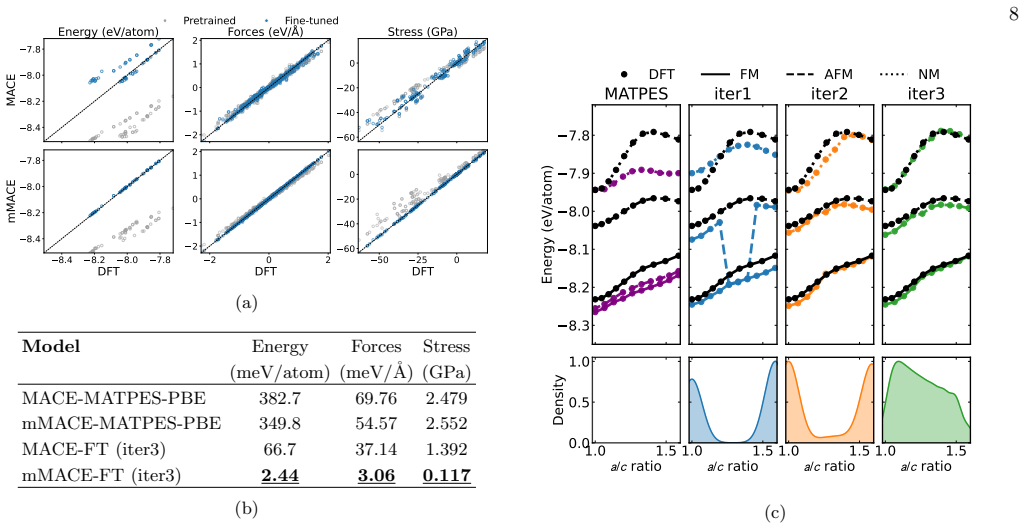
- Integration with experimental magnetic data could close remaining gaps in predictive accuracy for device design.
Load-bearing premise
Fine-tuning a pre-trained equivariant message-passing network on limited magnetic data produces physically consistent predictions of non-collinear magnetic interactions and spin-orbit effects without introducing artifacts.
What would settle it
A comparison in which the model's predicted energies or magnetic moments for a non-collinear configuration in an unseen material deviate substantially from independent density-functional-theory calculations on the same system.
Figures





read the original abstract
Magnetism governs key properties of materials used in energy, data storage, and spintronic technologies, yet its complex coupling to lattice and electronic degrees of freedom challenges conventional first-principles approaches. We introduce an equivariant message-passing graph neural network that embeds atomic magnetic moments as explicit degrees of freedom, enabling the learning of magnetic interactions beyond collinear approximations. The model learns physically consistent and transferable representations of magnetic behaviour and can incorporate spin-orbit coupling, achieving near density-functional-theory accuracy with strong data efficiency across diverse magnetic systems by fine-tuning from a pre-trained model. Applications to structural transformations, finite-temperature magnetic phenomena, and materials screening for strongly spin-orbit coupled materials demonstrate transferable magnetic behaviour, establishing a practical foundation for data-driven, high-throughput discovery of complex magnetic materials.
Editorial analysis
A structured set of objections, weighed in public.
Referee Report
Summary. The manuscript introduces an equivariant message-passing graph neural network for interatomic potentials in magnetic materials, embedding atomic magnetic moments as explicit degrees of freedom to model non-collinear interactions and spin-orbit coupling. It claims that the model learns physically consistent and transferable magnetic representations, achieves near-DFT accuracy with strong data efficiency via fine-tuning from a pre-trained model, and demonstrates applicability to structural transformations, finite-temperature phenomena, and materials screening.
Significance. If the central claims are substantiated with quantitative validation, this would constitute a meaningful advance in data-driven modeling of complex magnetic systems, offering a practical route to high-throughput discovery that combines equivariance for physical consistency with transferability across diverse materials. The fine-tuning strategy and explicit treatment of magnetic degrees of freedom are notable strengths for efficiency and applicability.
major comments (2)
- [Abstract] Abstract: the headline claims of 'near density-functional-theory accuracy' and 'physically consistent and transferable representations' are not accompanied by any quantitative error metrics (e.g., energy/force MAE or RMSE), training/validation protocols, or baseline comparisons, preventing evaluation of whether the data support the assertions.
- [Model architecture and results] Model architecture and results sections: the assertion that fine-tuning on limited magnetic data produces consistent non-collinear and SOC predictions without artifacts requires explicit verification that the equivariant layers preserve continuous spin-rotation invariance, conserve total spin in the absence of external fields, and avoid spurious torques under moment rotations. No such tests are described, which is load-bearing for the transferability claim given the risk of overfitting to collinear configurations.
minor comments (1)
- [Abstract] The abstract is information-dense; breaking out specific quantitative highlights (once added) would improve readability.
Simulated Author's Rebuttal
We thank the referee for the careful review and constructive feedback. We address each major comment point by point below, agreeing where revisions are warranted to strengthen the manuscript.
read point-by-point responses
-
Referee: [Abstract] Abstract: the headline claims of 'near density-functional-theory accuracy' and 'physically consistent and transferable representations' are not accompanied by any quantitative error metrics (e.g., energy/force MAE or RMSE), training/validation protocols, or baseline comparisons, preventing evaluation of whether the data support the assertions.
Authors: We agree that the abstract would be strengthened by the inclusion of quantitative metrics. In the revised manuscript we have updated the abstract to report key energy and force MAEs (with respect to DFT), a brief description of the training/validation protocol, and reference to the baseline comparisons. These values are taken directly from the benchmarks already presented in the Results section and tables. revision: yes
-
Referee: [Model architecture and results] Model architecture and results sections: the assertion that fine-tuning on limited magnetic data produces consistent non-collinear and SOC predictions without artifacts requires explicit verification that the equivariant layers preserve continuous spin-rotation invariance, conserve total spin in the absence of external fields, and avoid spurious torques under moment rotations. No such tests are described, which is load-bearing for the transferability claim given the risk of overfitting to collinear configurations.
Authors: This is a fair and important point. Although the equivariant architecture is constructed to enforce continuous spin-rotation invariance and related symmetries by design (via tensor representations and message functions detailed in the Methods), we did not provide dedicated numerical validation of total-spin conservation or torque-free behavior under moment rotations. We have added these explicit tests as a new subsection in the Results (with further details in the SI), confirming that the fine-tuned model exhibits no discontinuities, conserves total spin in zero-field cases, and produces zero spurious torques. These additions directly support the transferability claims and mitigate concerns about overfitting to collinear data. revision: yes
Circularity Check
No significant circularity; predictions are learned outputs from external DFT data
full rationale
The paper trains an equivariant message-passing network on external reference data from density-functional theory calculations. Claims of physically consistent magnetic representations and near-DFT accuracy arise as emergent properties of the trained model on held-out or application data, not by construction from fitted parameters or self-referential definitions. No load-bearing self-citations for uniqueness theorems, no ansatzes smuggled via prior work, and no renaming of known results as new derivations. The derivation chain is self-contained against external benchmarks.
Axiom & Free-Parameter Ledger
free parameters (1)
- neural network weights and biases
axioms (2)
- standard math The interatomic potential must be equivariant under rotations and translations
- domain assumption Atomic magnetic moments can be represented as explicit vector degrees of freedom on each atom
Forward citations
Cited by 1 Pith paper
-
SLayerGen: a Crystal Generative Model for all Space and Layer Groups
SLayerGen generates crystals invariant to any space or layer group via autoregressive lattice and Wyckoff sampling plus equivariant diffusion, achieving gains over bulk models on diperiodic materials after correcting ...
Reference graph
Works this paper leans on
-
[1]
SOC is included non-self- consistently in all calculations
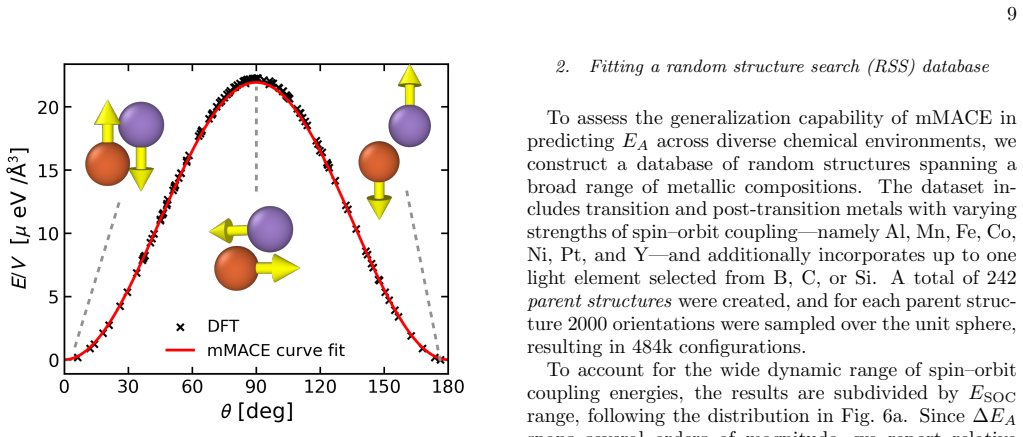
FeMn We consider a ferrimagnetic configuration ofL10 FeMn within a two-atom unit cell. SOC is included non-self- consistently in all calculations. The magnetic anisotropy energy is obtained by rotating the spin axis while keeping the atomic positions fixed. For this uniaxial system, the magnetic anisotropy energyE A can be well approximated by a fourth-or...
-
[2]
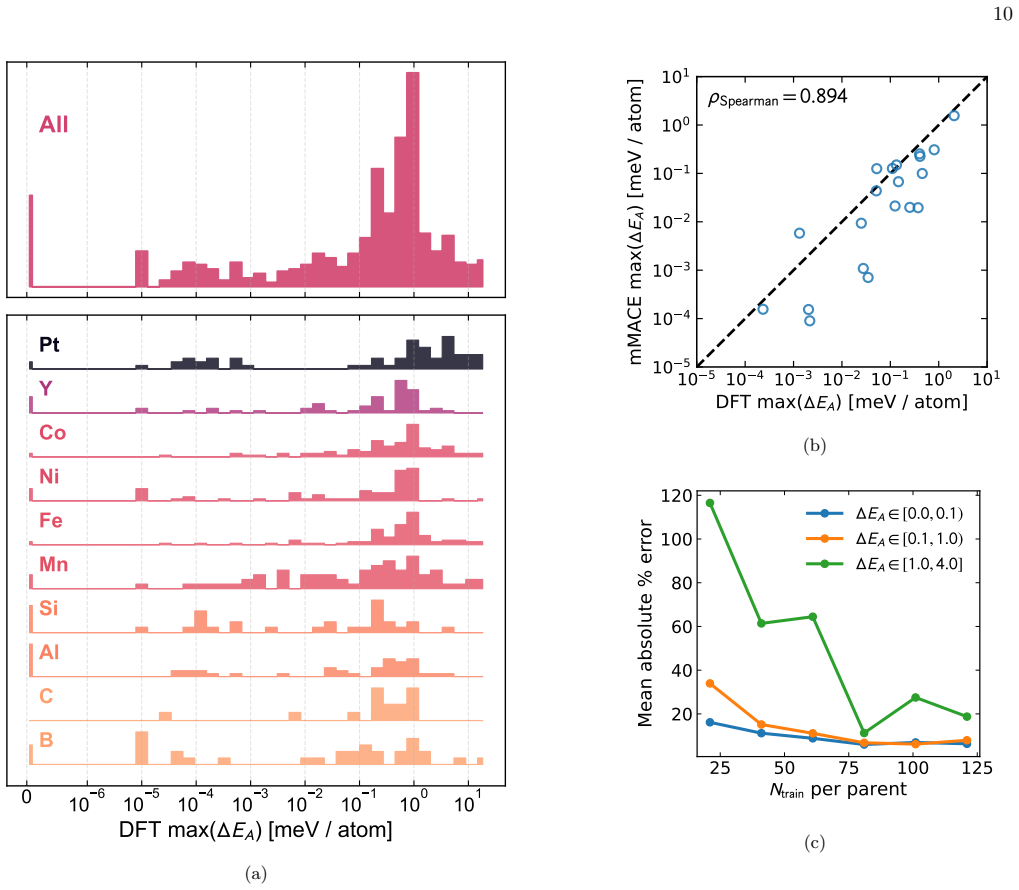
Fitting a random structure search (RSS) database To assess the generalization capability of mMACE in predictingE A across diverse chemical environments, we construct a database of random structures spanning a broad range of metallic compositions. The dataset in- cludes transition and post-transition metals with varying strengths of spin–orbit coupling—nam...
2000
-
[3]
It has been actively used in magnetic materials research and the development of electronic devices [29]
Heisenberg exchange constant A widely used framework for describing magnetism in condensed matter is the classical Heisenberg model H:=H 0 − X ⟨ij⟩ Jij ˆSi · ˆSj (31) where ˆSi are normalized spin vectors andJ ij are ex- change coefficients between pairs of atomic sites. It has been actively used in magnetic materials research and the development of elect...
-
[4]
Curie temperature Iron has an experimental Curie temperature of approx- imately 1043 K [42]. To assess the predictive capabil- ity of different magnetic modeling strategies, we com- pare Curie temperatures obtained from (i) effective Ising models parameterised by Heisenberg exchange constants Js (Figs. 7b and 7a) and simulated usingV ampire, and (ii) dire...
-
[5]
In this appendix, we explain how to obtain a physicalE(m) via regularization
One-body magnetic contribution in MLIPs The fitting of one-body magnetic contributions can suf- fer from overfitting or result in non-smooth curves when optimized directly with gradient-based methods such as Adam or LBFGS, which can compromise the physicality of the model. In this appendix, we explain how to obtain a physicalE(m) via regularization. To co...
-
[6]
The construction of the Bessel functionJis identical to regular, non-magnetic MACE; we refer the reader to [4] for details
Radial basis In this section, we give additional details for the con- struction of the radial bases involved in the above dis- cussion in (13), (14) and (26). The construction of the Bessel functionJis identical to regular, non-magnetic MACE; we refer the reader to [4] for details. For the magnetic radial basis, letm zi ∈Rbe the mag- nitude of the magneti...
-
[7]
Notably, estimatingE 0,zi directly via gradient-based optimization can lead to severe overfit- ting due to the low intrinsic dimensionality of this term
Parameter Estimation The termE 0,zi(|mi|) is a one-dimensional function that depends only on the magnitude of the magnetic mo- ment of atomi. Notably, estimatingE 0,zi directly via gradient-based optimization can lead to severe overfit- ting due to the low intrinsic dimensionality of this term. To mitigate this, we fit the corresponding linear coeffi- cie...
-
[8]
Data Augmentation Given that the model is capable of capturing spin–orbit coupling, fitting to datasets without spin–orbit effects (or collinear DFT data) requires the use of data augmenta- tion. In general, we find that data augmentation ensures the preservation of symmetry, introducing deviations of less than 0.1 meV/atom, with only a few rare outliers ...
-
[9]
Total energy difference method for Heisenberg exchange constant In what follows we describe how Heisenberg exchange constants can be obtained from a trained mMACE model. We consider the Heisenberg Hamiltonian of the system H:=H 0 − X ⟨ij⟩ J ′ ij ˆSi · ˆSj (C1) whereH 0 denotes the non-magnetic part of the energy andJ ′ ij is the exchange interaction betwe...
-
[10]
Adiabatic approximation for Heisenberg exchange constant In the real-space approach of Liechtenstein et al. [25– 27], the adiabatic magnon energy of a spin spiral with wavevectorqis given by E(q) = X j J0j h 1−cos q·r 0j i ,(C8) whereJ 0j are the real–space Heisenberg exchange inter- actions between a reference atom and neighbours at dis- placementr 0j. T...
-
[11]
CrN public benchmark Figure 10 shows a strong concentration of points along the diagonal, indicating excellent agreement between mMACE-predicted and DFT magnetic forces over the full force range. The narrow spread around the iden- tity line, even in the low-force regime, demonstrates that mMACE accurately captures both the magnitude and sign of magnetic f...
-
[12]
The ground-state energy defined for an atomic configuration should be minimized with respect to the underlying internal variable{m i}i representing local magnetic moment
Energy minimization on pre-trained datasets Single-point evaluation metrics do not fully capture the behavior of magnetic degrees of freedom under minimiza- tion of the magnetic moments. The ground-state energy defined for an atomic configuration should be minimized with respect to the underlying internal variable{m i}i representing local magnetic moment....
-
[13]
Elastic constants are reproduced with cor- rect trends and typical deviations of 10%, with larger errors confined to non-magnetic phases due to limited sampling
FeNi lattice parameters As shown in Table IV, equilibrium lattice parameters agree with DFT within 0.01 ˚A across all phases and mag- netic states. Elastic constants are reproduced with cor- rect trends and typical deviations of 10%, with larger errors confined to non-magnetic phases due to limited sampling
-
[14]
We then apply random 3D rotations to the reference mag- netic moments with angles sampled uniformly from [0, π], followed by uniform random scaling from [0,1.5] on each Mn atom
Mn 3Pt relaxations To perform the relaxation experiment, we first set up a fixed atomic configuration from a reference geometry optimization of the standard cubic Mn3Pt structure. We then apply random 3D rotations to the reference mag- netic moments with angles sampled uniformly from [0, π], followed by uniform random scaling from [0,1.5] on each Mn atom....
-
[15]
Curie temperature calculations were performed using a bcc Fe supercell containing 3456 atoms
MDMC simulation details Figure 12 demonstrates convergence of the MC simu- lation in production and burn-in stages as mentioned in Section III F 2. Curie temperature calculations were performed using a bcc Fe supercell containing 3456 atoms. The Curie tem- peratureT C was extracted by fitting (T−T C)β where bothT C and the critical exponentβwere treated a...
2000
-
[16]
Body order correlations are included up to orderν= 3, with a real-space inter- action cutoff ofr max = 5.0 ˚A
FeAl public dataset We employ a single layer model with scalar hidden ir- reducible representation64×0e. Body order correlations are included up to orderν= 3, with a real-space inter- action cutoff ofr max = 5.0 ˚A. Angular dependencies of position and magnetic moments are resolved using spher- ical harmonics up toℓ pos max = 3 andℓ mag max = 1 respective...
-
[17]
Body order correlations are included up to orderν= 3, with a real-space inter- action cutoff ofr max = 5.0 ˚A
CrN public dataset We employ a single layer model with scalar hidden ir- reducible representation64×0e. Body order correlations are included up to orderν= 3, with a real-space inter- action cutoff ofr max = 5.0 ˚A. Angular dependencies of position and magnetic moments are resolved using spher- ical harmonics up toℓ pos max = 3 andℓ mag max = 1 respectivel...
-
[18]
Body order correlations are included up to orderν= 3, with a real- space interaction cutoff ofr max = 6.0 ˚A
Pretrained models on foundational datasets We employ a two layer model with scalar hidden irre- ducible representation128×0e + 128×1o. Body order correlations are included up to orderν= 3, with a real- space interaction cutoff ofr max = 6.0 ˚A. Angular depen- dencies of position and magnetic moments are resolved using spherical harmonics up toℓ pos max = ...
-
[19]
A lower learn- ing rate of 0.0005 and a gradient clip of 10 instead of 100 are applied
FeNi dataset Identical model hyperparameters to the pre-trained model MATPES-PBE are used as the model is fine-tuned from the MATPES-PBE mMACE model. A lower learn- ing rate of 0.0005 and a gradient clip of 10 instead of 100 are applied
-
[20]
Body order correlations are included up to orderν= 3, with a real-space interaction cutoff ofr max = 6.0 ˚A
Magnetocrystalline anisotropy datasets For fitting both FeMn and the general database con- structed from random structure search, we employ a two layer model with scalar hidden irreducible representation 64×0e + 64×1o. Body order correlations are included up to orderν= 3, with a real-space interaction cutoff ofr max = 6.0 ˚A. Angular dependencies of posit...
-
[21]
A lower learn- ing rate of 0.0005 and a gradient clip of 10 instead of 100 are applied
Mn 3Pt dataset Identical model hyperparameters to the pre-trained model MATPES-PBE are used as the model is fine-tuned from the MATPES-PBE mMACE model. A lower learn- ing rate of 0.0005 and a gradient clip of 10 instead of 100 are applied
-
[22]
Body order correlations are included up to orderν= 3, with a real-space inter- action cutoff ofr max = 4.5 ˚A
Fe dataset We employ a single layer model with scalar hidden ir- reducible representation64×0e. Body order correlations are included up to orderν= 3, with a real-space inter- action cutoff ofr max = 4.5 ˚A. Angular dependencies of position and magnetic moments are resolved using spher- ical harmonics up toℓ pos max = 3 andℓ mag max = 3 respectively. The r...
-
[23]
Configurations with forces larger than 20 eV/ ˚A are removed from the dataset
Pretrained models on foundational datasets A filtering process was performed to filter configura- tions that contain extreme DFT ground truth forces, as we found it improves the stability of the model in each corresponding reference dataset in [20] and [23] respec- tively. Configurations with forces larger than 20 eV/ ˚A are removed from the dataset. For ...
-
[24]
FeNi dataset First, we generate a broad family of unit-cell–distorted structures by applying random perturbations to an or- dered bcc FeNi alloy unit cell, with Fe and Ni arranged in an Fe–Ni–Fe–Ni sequence. The fcc base structures and a structure with cell ratioa/c= 1.6 are used to generate 5 variants by applying an isotropic volume scal- ing with a rand...
2000
-
[25]
Magnetic anisotropy constant When generating data in this section, for each dataset all angles are defined with a fixed coordinate frame, i.e., ϕandθare always pointing toxandzrespectively as it has to be consistent over different parent configurations for the fitting to make sense. In the experiment that follows, for each parent config- uration, we unifo...
2025
-
[26]
We first per- formed a reference density-functional theory (DFT) cal- culation by fully relaxing the structure initialized accord- ing to Ref
Mn 3Pt dataset Training structures were generated from the four-atom primitive unit cell of Mn3Pt, comprising three Mn atoms forming the frustrated kagome sublattice and one Pt atom occupying the face-centered position. We first per- formed a reference density-functional theory (DFT) cal- culation by fully relaxing the structure initialized accord- ing to...
-
[27]
Challenges and strategies for first- principles simulations of two-dimensional magnetic phe- nomena.Nanoscale, 17(43):24955–24989, 2025
Jaime Garrido Aldea, Dorye L Esteras, Stephan Roche, and Jose H Garcia. Challenges and strategies for first- principles simulations of two-dimensional magnetic phe- nomena.Nanoscale, 17(43):24955–24989, 2025
2025
-
[28]
A foundation model for atomistic materi- als chemistry.The Journal of chemical physics, 163(18), 2025
Ilyes Batatia, Philipp Benner, Yuan Chiang, Alin M Elena, D´ avid P Kov´ acs, Janosh Riebesell, Xavier R Ad- vincula, Mark Asta, Matthew Avaylon, William J Bald- win, et al. A foundation model for atomistic materi- als chemistry.The Journal of chemical physics, 163(18), 2025
2025
-
[29]
A general frame- work for equivariant neural networks on reductive lie groups.Advances in Neural Information Processing Sys- tems, 36:55260–55284, 2023
Ilyes Batatia, Mario Geiger, Jose Munoz, Tess Smidt, Lior Silberman, and Christoph Ortner. A general frame- work for equivariant neural networks on reductive lie groups.Advances in Neural Information Processing Sys- tems, 36:55260–55284, 2023
2023
-
[30]
MACE: Higher order equiv- ariant message passing neural networks for fast and ac- curate force fields.Advances in neural information pro- cessing systems, 35:11423–11436, 2022
Ilyes Batatia, David P Kovacs, Gregor Simm, Christoph Ortner, and G´ abor Cs´ anyi. MACE: Higher order equiv- ariant message passing neural networks for fast and ac- curate force fields.Advances in neural information pro- cessing systems, 35:11423–11436, 2022
2022
-
[31]
E (3)-equivariant graph neural networks for data-efficient and accurate interatomic potentials.Nature communica- tions, 13(1):2453, 2022
Simon Batzner, Albert Musaelian, Lixin Sun, Mario Geiger, Jonathan P Mailoa, Mordechai Kornbluth, Nicola Molinari, Tess E Smidt, and Boris Kozinsky. E (3)-equivariant graph neural networks for data-efficient and accurate interatomic potentials.Nature communica- tions, 13(1):2453, 2022
2022
-
[32]
Graph atomic cluster expansion for semilocal interactions beyond equivariant message passing.Physical Review X, 14(2):021036, 2024
Anton Bochkarev, Yury Lysogorskiy, and Ralf Drautz. Graph atomic cluster expansion for semilocal interactions beyond equivariant message passing.Physical Review X, 14(2):021036, 2024
2024
-
[33]
Permanent magnet materials and their application
Peter Campbell. Permanent magnet materials and their application. 1994
1994
-
[34]
General- ized form of the magnetic anisotropy field in micromag- netic and atomistic spin models.Physical Review B, 107(6):064413, 2023
Jack B Collings, Ricardo Rama-Eiroa, Rub´ en M Otxoa, Richard FL Evans, and Roy W Chantrell. General- ized form of the magnetic anisotropy field in micromag- netic and atomistic spin models.Physical Review B, 107(6):064413, 2023
2023
-
[35]
Current progress and future challenges in rare-earth-free permanent magnets
Jun Cui, Matthew Kramer, Lin Zhou, Fei Liu, Alexan- der Gabay, George Hadjipanayis, Balamurugan Balasub- ramanian, and David Sellmyer. Current progress and future challenges in rare-earth-free permanent magnets. Acta Materialia, 158:118–137, 2018
2018
-
[36]
Deringer, G´ abor Cs´ anyi, and Christoph Ortner
James Darby, Joe David Morrow, Albert Bart´ ok, Volker L. Deringer, G´ abor Cs´ anyi, and Christoph Ortner. Regularity priors for the linear atomic cluster expansion. Machine Learning: Science and Technology, 2026
2026
-
[37]
Atomic cluster expansion of scalar, vecto- rial, and tensorial properties including magnetism and charge transfer.Physical Review B, 102(2):024104, 2020
Ralf Drautz. Atomic cluster expansion of scalar, vecto- rial, and tensorial properties including magnetism and charge transfer.Physical Review B, 102(2):024104, 2020
2020
-
[38]
High-dimensional neu- ral network potentials for magnetic systems using spin- dependent atom-centered symmetry functions.npj Com- putational Materials, 7(1):170, 2021
Marco Eckhoff and J¨ org Behler. High-dimensional neu- ral network potentials for magnetic systems using spin- dependent atom-centered symmetry functions.npj Com- putational Materials, 7(1):170, 2021
2021
-
[39]
Electronic structure and magnetic properties of l 1 0 binary alloys.Physical Review B, 90(1):014402, 2014
Alexander Edstr¨ om, Jonathan Chico, Adam Jakobsson, Anders Bergman, and Jan Rusz. Electronic structure and magnetic properties of l 1 0 binary alloys.Physical Review B, 90(1):014402, 2014
2014
-
[40]
Gemnet: Universal directional graph neural networks for molecules.Advances in Neural Information Processing Systems, 34:6790–6802, 2021
Johannes Gasteiger, Florian Becker, and Stephan G¨ unnemann. Gemnet: Universal directional graph neural networks for molecules.Advances in Neural Information Processing Systems, 34:6790–6802, 2021
2021
-
[41]
Quantum ESPRESSO: a modular and open-source software project for quantumsimulations of materials.Journal of physics: Condensed matter, 21(39):395502, 2009
Paolo Giannozzi, Stefano Baroni, Nicola Bonini, Mat- teo Calandra, Roberto Car, Carlo Cavazzoni, Davide Ceresoli, Guido L Chiarotti, Matteo Cococcioni, Is- maila Dabo, et al. Quantum ESPRESSO: a modular and open-source software project for quantumsimulations of materials.Journal of physics: Condensed matter, 21(39):395502, 2009
2009
-
[42]
Willard, Ekkes Br¨ uck, Christina H
Oliver Gutfleisch, Matthew A. Willard, Ekkes Br¨ uck, Christina H. Chen, S. G. Sankar, and J. Ping Liu. Magnetic materials and devices for the 21st century: Stronger, lighter, and more energy efficient.Advanced 25 Materials, 23(7):821–842, 2011
2011
-
[43]
NewtonNet: a newtonian message pass- ing network for deep learning of interatomic potentials and forces.Digital Discovery, 1(3):333–343, 2022
Mojtaba Haghighatlari, Jie Li, Xingyi Guan, Oufan Zhang, Akshaya Das, Christopher J Stein, Farnaz Heidar-Zadeh, Meili Liu, Martin Head-Gordon, Luke Bertels, et al. NewtonNet: a newtonian message pass- ing network for deep learning of interatomic potentials and forces.Digital Discovery, 1(3):333–343, 2022
2022
-
[44]
Magnetic mace branch
Cheuk Hin Ho. Magnetic mace branch. https://github.com/CheukHinHoJerry/mace/tree/ 2fc7d9b305f012c5b1a59c5b92f2d132888b7d75, 2026. Commit 2fc7d9b305f012c5b1a59c5b92f2d132888b7d75
2026
-
[45]
Das Sarma
Igor ˇZuti´ c, Jaroslav Fabian, and S. Das Sarma. Spintron- ics: Fundamentals and applications.Rev. Mod. Phys., 76:323–410, Apr 2004
2004
-
[46]
arXiv preprint arXiv:2503.04070 , year=
Aaron D Kaplan, Runze Liu, Ji Qi, Tsz Wai Ko, Bowen Deng, Janosh Riebesell, Gerbrand Ceder, Kristin A Pers- son, and Shyue Ping Ong. A foundational potential energy surface dataset for materials.arXiv preprint arXiv:2503.04070, 2025
-
[47]
Constrained DFT-based magnetic machine- learning potentials for magnetic alloys: a case study of Fe–Al.Scientific Reports, 13(1):19728, 2023
Alexey S Kotykhov, Konstantin Gubaev, Max Hodapp, Christian Tantardini, Alexander V Shapeev, and Ivan S Novikov. Constrained DFT-based magnetic machine- learning potentials for magnetic alloys: a case study of Fe–Al.Scientific Reports, 13(1):19728, 2023
2023
-
[48]
Actively trained magnetic moment tensor potentials for mechanical, dynamical, and thermal properties of paramagnetic CrN.Physical Review B, 111(9):094438, 2025
Alexey S Kotykhov, Max Hodapp, Christian Tantar- dini, Konstantin Kravtsov, Ivan Kruglov, Alexander V Shapeev, and Ivan S Novikov. Actively trained magnetic moment tensor potentials for mechanical, dynamical, and thermal properties of paramagnetic CrN.Physical Review B, 111(9):094438, 2025
2025
-
[49]
MP-ALOE: an r2SCAN dataset for universal machine learning interatomic poten- tials.npj Computational Materials, 11(1):352, 2025
Matthew C Kuner, Aaron D Kaplan, Kristin A Persson, Mark Asta, and Daryl C Chrzan. MP-ALOE: an r2SCAN dataset for universal machine learning interatomic poten- tials.npj Computational Materials, 11(1):352, 2025
2025
-
[50]
Magnetocrystalline anisotropy of Fe, Co, and Ni slabs from density functional theory and tight-binding models.Physical Review B, 100(17):174426, 2019
Ludovic Le Laurent, Cyrille Barreteau, and Troel Markussen. Magnetocrystalline anisotropy of Fe, Co, and Ni slabs from density functional theory and tight-binding models.Physical Review B, 100(17):174426, 2019
2019
-
[51]
Local spin density functional approach to the theory of exchange interactions in ferromagnetic metals and alloys.Journal of Magnetism and Magnetic Materials, 67(1):65–74, 1987
A Il Liechtenstein, MI Katsnelson, VP Antropov, and VA Gubanov. Local spin density functional approach to the theory of exchange interactions in ferromagnetic metals and alloys.Journal of Magnetism and Magnetic Materials, 67(1):65–74, 1987
1987
-
[52]
LSDF-approach to the theory of exchange interactions in magnetic metals.Journal of magnetism and magnetic materials, 54:965–966, 1986
AI Liechtenstein, MI Katsnelson, VP Antropov, and VA Gubanov. LSDF-approach to the theory of exchange interactions in magnetic metals.Journal of magnetism and magnetic materials, 54:965–966, 1986
1986
-
[53]
Ex- change interactions and spin-wave stiffness in ferromag- netic metals.Journal of Physics F: Metal Physics, 14(7):L125, 1984
AI Liechtenstein, MI Katsnelson, and VA Gubanov. Ex- change interactions and spin-wave stiffness in ferromag- netic metals.Journal of Physics F: Metal Physics, 14(7):L125, 1984
1984
-
[54]
PET-MAD as a lightweight universal interatomic potential for ad- vanced materials modeling.Nature Communications, 16(1):10653, 2025
Arslan Mazitov, Filippo Bigi, Matthias Kellner, Paolo Pegolo, Davide Tisi, Guillaume Fraux, Sergey Pozd- nyakov, Philip Loche, and Michele Ceriotti. PET-MAD as a lightweight universal interatomic potential for ad- vanced materials modeling.Nature Communications, 16(1):10653, 2025
2025
-
[55]
Two- dimensional magnetic materials for spintronic devices
Mengjuan Mi, Han Xiao, Lixuan Yu, Yingxu Zhang, Yuanshuo Wang, Qiang Cao, and Yilin Wang. Two- dimensional magnetic materials for spintronic devices. Materials Today Nano, 24:100408, 2023
2023
-
[56]
Understanding magnetocrystalline anisotropy based on orbital and quadrupole moments.Journal of Physics: Condensed Matter, 34(47):473001, 2022
Yoshio Miura and Jun Okabayashi. Understanding magnetocrystalline anisotropy based on orbital and quadrupole moments.Journal of Physics: Condensed Matter, 34(47):473001, 2022
2022
-
[57]
GPAW: An open python package for electronic structure calculations
Jens Jørgen Mortensen, Ask Hjorth Larsen, Mikael Kuisma, Aleksei V Ivanov, Alireza Taghizadeh, An- drew Peterson, Anubhab Haldar, Asmus Ougaard Dohn, Christian Sch¨ afer, Elvar¨Orn J´ onsson, et al. GPAW: An open python package for electronic structure calculations. The Journal of Chemical Physics, 160(9), 2024
2024
-
[58]
Magnetic moment tensor potentials for collinear spin-polarized materials reproduce different magnetic states of bcc Fe.npj Computational Materials, 8(1):13, 2022
Ivan Novikov, Blazej Grabowski, Fritz K¨ ormann, and Alexander Shapeev. Magnetic moment tensor potentials for collinear spin-polarized materials reproduce different magnetic states of bcc Fe.npj Computational Materials, 8(1):13, 2022
2022
-
[59]
Chevrier, Kristin A
Shyue Ping Ong, William Davidson Richards, Anubhav Jain, Geoffroy Hautier, Michael Kocher, Shreyas Cholia, Dan Gunter, Vincent L. Chevrier, Kristin A. Persson, and Gerbrand Ceder. Python materials genomics (py- matgen): A robust, open-source python library for mate- rials analysis.Computational Materials Science, 68:314– 319, 2013
2013
-
[60]
Role of substitution in mitigating the supply pressure of rare earths in electric road trans- port applications.Sustainable materials and technologies, 12:62–72, 2017
Claudiu C Pavel, Christian Thiel, Stefanie Degreif, Da- rina Blagoeva, Matthias Buchert, Doris Sch¨ uler, and Evangelos Tzimas. Role of substitution in mitigating the supply pressure of rare earths in electric road trans- port applications.Sustainable materials and technologies, 12:62–72, 2017
2017
-
[61]
Generalized gradient approximation made simple.Phys- ical review letters, 77(18):3865, 1996
John P Perdew, Kieron Burke, and Matthias Ernzerhof. Generalized gradient approximation made simple.Phys- ical review letters, 77(18):3865, 1996
1996
-
[62]
OstravaJ: a tool for calculating magnetic exchange interactions via DFT
Jan Priessnitz and Dominik Legut. OstravaJ: a tool for calculating magnetic exchange interactions via DFT. arXiv preprint arXiv:2501.08251, 2025
-
[63]
PhD thesis, Dissertation, Bochum, Ruhr-Universit¨ at Bochum, 2022, 2023
Matteo Rinaldi.Modelling magnetism from the electronic structure to continuum for iron and its alloys. PhD thesis, Dissertation, Bochum, Ruhr-Universit¨ at Bochum, 2022, 2023
2022
-
[64]
Non-collinear magnetic atomic cluster expansion for iron.npj Computational Materials, 10(1):12, 2024
Matteo Rinaldi, Matous Mrovec, Anton Bochkarev, Yury Lysogorskiy, and Ralf Drautz. Non-collinear magnetic atomic cluster expansion for iron.npj Computational Materials, 10(1):12, 2024
2024
-
[65]
E (n) equivariant graph neural networks
Vıctor Garcia Satorras, Emiel Hoogeboom, and Max Welling. E (n) equivariant graph neural networks. InIn- ternational conference on machine learning, pages 9323–
-
[66]
Anomalous phonon lifetime shortening in paramagnetic CrN caused by spin-lattice coupling: A combined spin and ab initio molecular dy- namics study.Phys
Irina Stockem, Anders Bergman, Albert Glensk, Tilmann Hickel, Fritz K¨ ormann, Blazej Grabowski, J¨ org Neuge- bauer, and Bj¨ orn Alling. Anomalous phonon lifetime shortening in paramagnetic CrN caused by spin-lattice coupling: A combined spin and ab initio molecular dy- namics study.Phys. Rev. Lett., 121:125902, Sep 2018
2018
-
[67]
Editorial for the topic on magnetic ma- terials and devices, 2025
Viktor Sverdlov. Editorial for the topic on magnetic ma- terials and devices, 2025
2025
-
[68]
Application of physical- empirical models to calculate a fragment of the phase diagram and the physical properties of bcc Fe–Cr alloys: I
AL Udovskii and DA Vasil’ev. Application of physical- empirical models to calculate a fragment of the phase diagram and the physical properties of bcc Fe–Cr alloys: I. formulation of a model and the estimation and ap- proximation of experimental data.Russian Metallurgy (Metally), 2015(3):237–243, 2015
2015
-
[69]
Magnetic actuation based motion con- trol for microrobots: An overview.Micromachines, 6(9):1346–1364, 2015
Tiantian Xu, Jiangfan Yu, Xiaohui Yan, Hongsoo Choi, and Li Zhang. Magnetic actuation based motion con- trol for microrobots: An overview.Micromachines, 6(9):1346–1364, 2015
2015
-
[70]
Spin-informed universal 26 graph neural networks for simulating magnetic order- ing.Proceedings of the National Academy of Sciences, 122(27):e2422973122, 2025
Wenbin Xu, Rohan Yuri Sanspeur, Adeesh Kolluru, Bowen Deng, Peter Harrington, Steven Farrell, Karsten Reuter, and John R Kitchin. Spin-informed universal 26 graph neural networks for simulating magnetic order- ing.Proceedings of the National Academy of Sciences, 122(27):e2422973122, 2025
2025
-
[71]
Spin- dependent graph neural network potential for magnetic materials.Physical Review B, 109(14):144426, 2024
Hongyu Yu, Yang Zhong, Liangliang Hong, Changsong Xu, Wei Ren, Xingao Gong, and Hongjun Xiang. Spin- dependent graph neural network potential for magnetic materials.Physical Review B, 109(14):144426, 2024
2024
-
[72]
Daye Zheng, Xingliang Peng, Yike Huang, Yinan Wang, Duo Zhang, Zhengtao Huang, Linfeng Zhang, Mohan Chen, Ben Xu, and Weiqing Zhou. Integrating deep- learning-based magnetic model and non-collinear spin- constrained method: Methodology, implementation and application.arXiv preprint arXiv:2501.14382, 2025
-
[73]
Observation of an anomalous hall effect in single-crystal Mn3Pt.New Journal of Physics, 25(2):023029, 2023
Bel´ en E Zuniga-Cespedes, Kaustuv Manna, Hilary ML Noad, Po-Ya Yang, Michael Nicklas, Claudia Felser, An- drew P Mackenzie, and Clifford W Hicks. Observation of an anomalous hall effect in single-crystal Mn3Pt.New Journal of Physics, 25(2):023029, 2023
2023
discussion (0)
Sign in with ORCID, Apple, or X to comment. Anyone can read and Pith papers without signing in.