Recognition: 2 theorem links
· Lean TheoremSLayerGen: a Crystal Generative Model for all Space and Layer Groups
Pith reviewed 2026-05-12 00:52 UTC · model grok-4.3
The pith
SLayerGen generates crystals invariant under any space or layer group for better diperiodic material creation.
A machine-rendered reading of the paper's core claim, the machinery that carries it, and where it could break.
Core claim
By embedding explicit layer-group and space-group equivariance into every stage of generation, SLayerGen produces crystals that are guaranteed to respect the chosen symmetry while still sampling new, chemically plausible structures. The same architecture works for all 230 space groups and all 80 layer groups, and the corrected equivariant diffusion step removes a source of bias that previously affected hexagonal systems.
What carries the argument
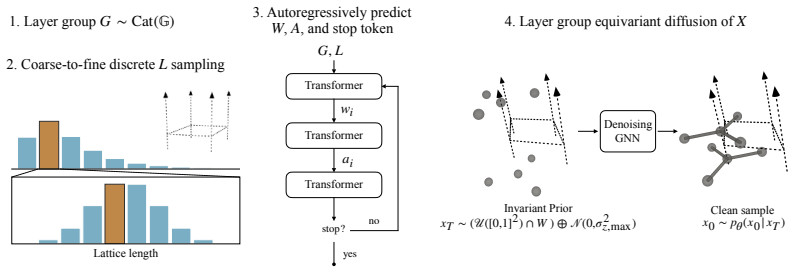
Space- or layer-group-equivariant diffusion of atomic coordinates, integrated with autoregressive lattice and Wyckoff-position generation.
If this is right
- Targeted generation of thin films and 2D superconductors becomes feasible while automatically satisfying the correct layer-group symmetries.
- Joint training on bulk and diperiodic data no longer degrades performance on either domain.
- New evaluation metrics and symmetry representations become available as benchmarks for future diperiodic generative models.
- The loss correction for non-orthogonal hexagonal groups improves coordinate accuracy in any fractional-coordinate diffusion model.
Where Pith is reading between the lines
- The same symmetry-constrained pipeline could be adapted to generate one-dimensional chain materials or other reduced-symmetry families.
- Higher-fidelity symmetry enforcement may raise the fraction of generated candidates that remain stable after relaxation, shortening discovery pipelines for 2D electronics.
- The corrected diffusion loss is a general fix that could be back-ported to earlier bulk crystal generators that also use fractional coordinates.
Load-bearing premise
The assembled monolayer and bilayer datasets are representative of real diperiodic materials and the equivariant diffusion can be trained consistently across all 80 layer groups without introducing new biases.
What would settle it
Generating structures for a held-out layer group and finding that a non-negligible fraction violate the symmetry operations of that group, or that SLayerGen shows no performance advantage over bulk models on diperiodic test sets.
Figures


read the original abstract
Crystal generative models have shown rapid progress for accelerating the discovery of bulk, periodic materials. However, many material systems such as 2D superconductors, thin film semiconductors, and catalytic surfaces are diperiodic, i.e., aperiodic along one of the lattice directions. These systems are invariant under the layer groups, which are known to influence materials properties yet not considered by existing models. In this paper, we propose SLayerGen, a generative model that produces crystals constrained to be invariant to any space or layer group. SLayerGen consists of coarse-to-fine discrete autoregressive lattice generation; transformer-based autoregressive sampling of Wyckoff positions, elements, and numbers of symmetrically unique atoms; and space or layer group equivariant diffusion of atomic coordinates. For the diffusion component, we corrected an inconsistency in the loss from prior work arising from hexagonal groups being non-orthogonal in fractional coordinates. To facilitate progress in generative modeling of diperiodic materials, we assembled and filtered datasets of monolayers and bilayers, propose relevant evaluation metrics, and developed novel representations for layer group symmetries. For de novo generation of diperiodic materials, SLayerGen achieves consistent performance gains over bulk crystal generative models and is competitive when training jointly on bulk and diperiodic materials.
Editorial analysis
A structured set of objections, weighed in public.
Referee Report
Summary. The manuscript introduces SLayerGen, a generative model for producing crystal structures invariant under any chosen space or layer group. It employs coarse-to-fine discrete autoregressive generation for lattices, transformer-based autoregressive sampling of Wyckoff positions, elements, and atom counts, and space/layer-group equivariant diffusion for atomic coordinates, with a correction to the diffusion loss to address non-orthogonality in hexagonal fractional coordinates. The authors assemble and filter monolayer and bilayer datasets, propose evaluation metrics, and introduce novel representations for layer group symmetries, claiming consistent performance gains over bulk crystal generative models for de novo diperiodic material generation.
Significance. If the central claims are substantiated with detailed validation, this work could meaningfully advance generative modeling for diperiodic materials (e.g., 2D superconductors and thin films) by explicitly incorporating layer group symmetries that influence properties but are ignored by existing bulk-focused models. The loss correction for hexagonal groups and the release of datasets plus metrics represent concrete contributions that could enable community progress. The approach of combining autoregressive and equivariant diffusion components is technically sound in principle.
major comments (2)
- [Abstract] Abstract (dataset assembly paragraph): The claim that SLayerGen generates valid crystals 'constrained to be invariant to any space or layer group' is load-bearing for the paper's primary contribution. However, the assembled monolayer and bilayer datasets are described only at a high level with no details on the number of structures per layer group, coverage of all 80 groups (including rare ones), or filtering criteria that ensure representativeness. This directly impacts whether the equivariant diffusion can be trained without group-specific biases or mode collapse, as noted in the stress-test concern.
- [Abstract] Abstract (performance claims): The statement that 'SLayerGen achieves consistent performance gains over bulk crystal generative models' for de novo diperiodic generation is central to the significance but is presented without any quantitative metrics, baselines, error bars, ablation results, or specific improvements. This absence makes it impossible to evaluate whether the gains are robust or limited to well-represented subsets of layer groups.
minor comments (1)
- The abstract is information-dense; including at least one concrete performance number or metric definition would improve readability and allow readers to immediately gauge the scale of the reported gains.
Simulated Author's Rebuttal
We thank the referee for their constructive feedback and for recognizing the potential significance of SLayerGen for diperiodic materials. We address each major comment below with specific responses and indicate the revisions we will make to the manuscript.
read point-by-point responses
-
Referee: [Abstract] Abstract (dataset assembly paragraph): The claim that SLayerGen generates valid crystals 'constrained to be invariant to any space or layer group' is load-bearing for the paper's primary contribution. However, the assembled monolayer and bilayer datasets are described only at a high level with no details on the number of structures per layer group, coverage of all 80 groups (including rare ones), or filtering criteria that ensure representativeness. This directly impacts whether the equivariant diffusion can be trained without group-specific biases or mode collapse, as noted in the stress-test concern.
Authors: We agree that the abstract is high-level by design. The full manuscript provides the requested details in Section 3 (Dataset Assembly), including per-layer-group structure counts, explicit coverage of all 80 layer groups (with statistics on rarer groups), and the precise filtering criteria (e.g., removal of duplicates, symmetry validation, and minimum atom-count thresholds) used to promote representativeness. These choices were made to mitigate group-specific biases. Our stress tests (Section 4.3) further confirm that the model avoids mode collapse and generalizes across groups due to the equivariant architecture. To improve accessibility, we will revise the abstract to include a concise summary of dataset scale and coverage. revision: partial
-
Referee: [Abstract] Abstract (performance claims): The statement that 'SLayerGen achieves consistent performance gains over bulk crystal generative models' for de novo diperiodic generation is central to the significance but is presented without any quantitative metrics, baselines, error bars, ablation results, or specific improvements. This absence makes it impossible to evaluate whether the gains are robust or limited to well-represented subsets of layer groups.
Authors: We acknowledge that the abstract would benefit from quantitative support. The main text already contains these elements: Table 2 reports validity, uniqueness, and coverage metrics with error bars from multiple runs; Figure 4 and Section 4.2 provide per-layer-group breakdowns and ablation studies (including removal of layer-group equivariance) showing consistent gains over bulk baselines across both frequent and rare groups. We will revise the abstract to incorporate a brief quantitative summary of these key results so that the performance claims are substantiated at the abstract level. revision: yes
Circularity Check
No significant circularity detected
full rationale
The paper proposes an empirical generative architecture (autoregressive lattice and Wyckoff sampling plus equivariant diffusion) for producing symmetry-constrained crystals, with one explicit correction to a loss inconsistency in prior (non-self) work for hexagonal coordinates. All performance claims are presented as training outcomes on newly assembled monolayer/bilayer datasets evaluated with proposed metrics; no derivation step reduces a claimed prediction or invariance guarantee to a fitted parameter, self-citation chain, or definitional tautology. The model is self-contained against external benchmarks and the results remain falsifiable.
Axiom & Free-Parameter Ledger
axioms (1)
- domain assumption Standard assumptions of generative models that training data distribution can be learned and sampled from while respecting symmetry constraints.
invented entities (1)
-
Novel representations for layer group symmetries
no independent evidence
Lean theorems connected to this paper
-
IndisputableMonolith/Foundation/AlexanderDuality.leanalexander_duality_circle_linking unclearSLayerGen consists of coarse-to-fine discrete autoregressive lattice generation; transformer-based autoregressive sampling of Wyckoff positions, elements, and numbers of symmetrically unique atoms; and space or layer group equivariant diffusion of atomic coordinates.
Reference graph
Works this paper leans on
-
[1]
Mohammad A. Akhound, Tara M. Boland, Mikkel O. Sauer, Matthias Batzill, Moses A. Bokinala, Stela Canulescu, Yury Gogotsi, Philip Hofmann, Andras Kis, Jiong Lu, Thomas Michely, Søren Raza, Wencai Ren, Joshua A. Robinson, Zdenek Sofer, Jing H. Teng, Søren Ulstrup, Meng Zhao, Xiaoxu Zhao, Jens J. Mortensen, Thomas Olsen, and Kristian S. Thygesen. Large-scale...
-
[2]
Omar Allam, Brook Wander, SungYeon Kim, Rudi Plesch, Tyler Sours, Jia-Min Chu, Thomas Ludwig, Jiyoon Kim, Rodrigo Wang, Shivang Agarwal, Alan Rask, Alexandre Fleury, Chuhong Wang, Andrew Wildman, Thomas Mustard, Kevin Ryczko, Paul Abruzzo, AJ Nish, and Aayush R. Singh. Aqcat25: Unlocking spin-aware, high-fidelity machine learning potentials for heterogene...
-
[3]
M.I. Aroyo, H. Burzlaff, G. Chapuis, W. Fischer, H.D. Flack, A.M. Glazer, H. Grimmer, B. Gru- ber, Th. Hahn, H. Klapper, E. Koch, P. Konstantinov, V . Kopsky, D.B. Litvin, A. Looijenga- V os, K. Momma, U. Mueller, U. Shmueli, B. Souvignier, J.C.H. Spence, P.M. de Wolff, H. Wondratschek, and H. Zimmerman.International Tables for Crystallography: Space- gro...
-
[4]
Nonlinear optics with 2d layered materials.Advanced Materials, 30(24):1705963, 2018
Anton Autere, Henri Jussila, Yunyun Dai, Yadong Wang, Harri Lipsanen, and Zhipei Sun. Nonlinear optics with 2d layered materials.Advanced Materials, 30(24):1705963, 2018. doi: https://doi.org/10.1002/adma.201705963. URL https://advanced.onlinelibrary. wiley.com/doi/abs/10.1002/adma.201705963
-
[5]
Woohyeon Baek, Sambit Das, Shibo Tan, Vikram Gavini, and Wenhao Sun. Quasicrystal stability and nucleation kinetics from density functional theory.Nature Physics, 21(6):980–987, June 2025
work page 2025
-
[6]
Luis Barroso-Luque, Muhammed Shuaibi, Xiang Fu, Brandon M. Wood, Misko Dzamba, Meng Gao, Ammar Rizvi, C. Lawrence Zitnick, and Zachary W. Ulissi. Open materials 2024 (omat24) inorganic materials dataset and models, 2024. URLhttps://arxiv.org/abs/2410.12771
-
[7]
Structural relaxation made simple.Phys
Erik Bitzek, Pekka Koskinen, Franz Gähler, Michael Moseler, and Peter Gumbsch. Structural relaxation made simple.Phys. Rev. Lett., 97:170201, Oct 2006. doi: 10.1103/PhysRevLett.97. 170201. URLhttps://link.aps.org/doi/10.1103/PhysRevLett.97.170201
-
[8]
Lili Cai, Connor J McClellan, Ai Leen Koh, Hong Li, Eilam Yalon, Eric Pop, and Xiaolin Zheng. Rapid flame synthesis of atomically thin MoO3 down to monolayer thickness for effective hole doping of WSe2.Nano Lett., 17(6):3854–3861, June 2017
work page 2017
-
[9]
Graphnorm: A principled approach to accelerating graph neural network training, 2020
Tianle Cai, Shengjie Luo, Keyulu Xu, Di He, Tie yan Liu, and Liwei Wang. Graphnorm: A principled approach to accelerating graph neural network training, 2020
work page 2020
-
[10]
Yuan Cao, Valla Fatemi, Shiang Fang, Kenji Watanabe, Takashi Taniguchi, Efthimios Kaxi- ras, and Pablo Jarillo-Herrero. Unconventional superconductivity in magic-angle graphene superlattices.Nature, 556(7699):43–50, April 2018
work page 2018
-
[11]
Space group informed transformer for crystalline materials generation, 2024
Zhendong Cao, Xiaoshan Luo, Jian Lv, and Lei Wang. Space group informed transformer for crystalline materials generation, 2024. 10
work page 2024
-
[12]
Van der waals heterostructures.Nature Reviews Methods Primers, 2(1):58, July 2022
Andres Castellanos-Gomez, Xiangfeng Duan, Zhe Fei, Humberto Rodriguez Gutierrez, Yuan Huang, Xinyu Huang, Jorge Quereda, Qi Qian, Eli Sutter, and Peter Sutter. Van der waals heterostructures.Nature Reviews Methods Primers, 2(1):58, July 2022
work page 2022
-
[13]
Gouri Chakraborty, In-Hyeok Park, Raghavender Medishetty, and Jagadese J Vittal. Two- Dimensional Metal-Organic framework materials: Synthesis, structures, properties and appli- cations.Chem. Rev., 121(7):3751–3891, April 2021
work page 2021
-
[14]
Rees Chang, Yu-Xiong Wang, and Elif Ertekin. Towards overcoming data scarcity in materials science: unifying models and datasets with a mixture of experts framework.npj Computational Materials, 8(1):242, November 2022
work page 2022
-
[15]
Space group equivariant crystal diffusion
Rees Chang, Angela Pak, Alex Guerra, Ni Zhan, Nick Richardson, Elif Ertekin, and Ryan P Adams. Space group equivariant crystal diffusion. InThe Thirty-ninth Annual Conference on Neural Information Processing Systems, 2025. URL https://openreview.net/forum? id=NWP8KYKC0c
work page 2025
-
[16]
Gowoon Cheon, Karel-Alexander N Duerloo, Austin D Sendek, Chase Porter, Yuan Chen, and Evan J Reed. Data mining for new two- and One-Dimensional weakly bonded solids and Lattice-Commensurate heterostructures.Nano Lett., 17(3):1915–1923, March 2017
work page 1915
-
[17]
Stanley S Chou, Na Sai, Ping Lu, Eric N Coker, Sheng Liu, Kateryna Artyushkova, Ting S Luk, Bryan Kaehr, and C Jeffrey Brinker. Understanding catalysis in a multiphasic two-dimensional transition metal dichalcogenide.Nature Communications, 6(1):8311, October 2015
work page 2015
-
[18]
Torchsim: an efficient atomistic simulation engine in pytorch.AI for Science, 1(2):025003, nov 2025
Orion Cohen, Janosh Riebesell, Rhys Goodall, Adeesh Kolluru, Stefano Falletta, Joseph Krause, Jorge Colindres, Gerbrand Ceder, and Abhijeet S Gangan. Torchsim: an efficient atomistic simulation engine in pytorch.AI for Science, 1(2):025003, nov 2025. doi: 10.1088/ 3050-287X/ae1799. URLhttps://doi.org/10.1088/3050-287X/ae1799
-
[19]
Langmuir-blodgett assembly of graphite oxide single layers.J
Laura J Cote, Franklin Kim, and Jiaxing Huang. Langmuir-blodgett assembly of graphite oxide single layers.J. Am. Chem. Soc., 131(3):1043–1049, January 2009
work page 2009
-
[20]
Pattern Recognition 127 (2022), 108611
Daniel W Davies, Keith T Butler, Adam J Jackson, Andrew Morris, Jarvist M Frost, Jonathan M Skelton, and Aron Walsh. Computational Screening of All Stoichiometric Inorganic Ma- terials.Chem, 1(4):617–627, 2016. ISSN 2451-9294. doi: https://doi.org/10.1016/j. chempr.2016.09.010. URL https://www.sciencedirect.com/science/article/pii/ S2451929416301553
work page doi:10.1016/j 2016
-
[21]
Giovanni Di Liberto, Ángel Morales-García, and Stefan T Bromley. An unconstrained approach to systematic structural and energetic screening of materials interfaces.Nature Communications, 13(1):6236, October 2022
work page 2022
-
[22]
Rongzhi Dong, Yuqi Song, Edirisuriya M.D. Siriwardane, and Jianjun Hu. Discovery of 2d materials using transformer network-based generative design.Advanced Intelligent Systems, 5: 2300141, 2023. doi: 10.1002/aisy.202300141
-
[23]
Luojun Du, Tawfique Hasan, Andres Castellanos-Gomez, Gui-Bin Liu, Yugui Yao, Chun Ning Lau, and Zhipei Sun. Engineering symmetry breaking in 2D layered materials.Nature Reviews Physics, 3(3):193–206, March 2021
work page 2021
-
[24]
Malliaros, Yoshua Bengio, and David Rolnick
Alexandre Duval, Victor Schmidt, Alex Hernández-García, Santiago Miret, Fragkiskos D. Malliaros, Yoshua Bengio, and David Rolnick. Faenet: Frame averaging equivariant gnn for materials modeling. InICML, pages 9013–9033, 2023. URL https://proceedings.mlr. press/v202/duval23a.html
work page 2023
-
[25]
M E Dávila, L Xian, S Cahangirov, A Rubio, and G Le Lay. Germanene: a novel two- dimensional germanium allotrope akin to graphene and silicene.New Journal of Physics, 16 (9):095002, sep 2014. doi: 10.1088/1367-2630/16/9/095002. URL https://doi.org/10. 1088/1367-2630/16/9/095002. 11
-
[26]
Residual pathway priors for soft equivariance constraints
Marc Anton Finzi, Gregory Benton, and Andrew Gordon Wilson. Residual pathway priors for soft equivariance constraints. In A. Beygelzimer, Y . Dauphin, P. Liang, and J. Wortman Vaughan, editors,Advances in Neural Information Processing Systems, 2021. URL https: //openreview.net/forum?id=k505ekjMzww
work page 2021
-
[27]
Scott Fredericks, Kevin Parrish, Dean Sayre, and Qiang Zhu. PyXtal: A Python library for crystal structure generation and symmetry analysis.Computer Physics Communications, 261:107810, 2021. ISSN 0010-4655. doi: https://doi.org/10.1016/j.cpc.2020.107810. URL https://www.sciencedirect.com/science/article/pii/S0010465520304057
-
[28]
Jingheng Fu, Mikael Kuisma, Ask Hjorth Larsen, Kohei Shinohara, Atsushi Togo, and Kristian S Thygesen. Symmetry classification of 2d materials: layer groups versus space groups.2D Materials, 11(3):035009, apr 2024. doi: 10.1088/2053-1583/ad3e0c. URL https://doi.org/10.1088/2053-1583/ad3e0c
-
[29]
Jaakkola, and Jake Allen Smith
Xiang Fu, Tian Xie, Andrew Scott Rosen, Tommi S. Jaakkola, and Jake Allen Smith. MOFDiff: Coarse-grained diffusion for metal-organic framework design. InThe Twelfth International Conference on Learning Representations, 2024. URL https://openreview.net/forum? id=0VBsoluxR2
work page 2024
-
[30]
Shikun Gao, Qinyuan Huang, Chen Huang, Cheng Li, Kaihao Liu, Baisheng Sa, Yadong Yu, Dezhen Xue, Zhe Liu, and Mengyan Dai. Deep generative model for the inverse design of van der waals heterostructures.Scientific Reports, 15(1):23023, July 2025
work page 2025
- [31]
-
[32]
Eli Gerber, Steven B Torrisi, Sara Shabani, Eric Seewald, Jordan Pack, Jennifer E Hoffman, Cory R Dean, Abhay N Pasupathy, and Eun-Ah Kim. High-throughput ab initio design of atomic interfaces using InterMatch.Nature Communications, 14(1):7921, December 2023
work page 2023
-
[33]
2D Materials8(4), 044002 (2021) https://doi.org/10.1088/2053-1583/ac1059
Morten Niklas Gjerding, Alireza Taghizadeh, Asbjørn Rasmussen, Sajid Ali, Fabian Bertoldo, Thorsten Deilmann, Nikolaj Rørbæk Knøsgaard, Mads Kruse, Ask Hjorth Larsen, Simone Manti, Thomas Garm Pedersen, Urko Petralanda, Thorbjørn Skovhus, Mark Kamper Svendsen, Jens Jørgen Mortensen, Thomas Olsen, and Kristian Sommer Thygesen. Recent progress of the comput...
-
[34]
Automatic chemical design using a Data-Driven continuous representation of molecules.ACS Cent
Rafael Gómez-Bombarelli, Jennifer N Wei, David Duvenaud, José Miguel Hernández-Lobato, Benjamín Sánchez-Lengeling, Dennis Sheberla, Jorge Aguilera-Iparraguirre, Timothy D Hirzel, Ryan P Adams, and Alán Aspuru-Guzik. Automatic chemical design using a Data-Driven continuous representation of molecules.ACS Cent. Sci., 4(2):268–276, February 2018
work page 2018
-
[35]
Toberer, and Vladan Stevanovi ´c
Prashun Gorai, Eric S. Toberer, and Vladan Stevanovi ´c. Computational identification of promising thermoelectric materials among known quasi-2d binary compounds.J. Mater. Chem. A, 4:11110–11116, 2016. doi: 10.1039/C6TA04121C. URL http://dx.doi.org/10.1039/ C6TA04121C
-
[36]
Stefan Grimme, Stephan Ehrlich, and Lars Goerigk. Effect of the damping function in dispersion corrected density functional theory.Journal of Computational Chemistry, 32(7): 1456–1465, 2011. doi: https://doi.org/10.1002/jcc.21759. URL https://onlinelibrary. wiley.com/doi/abs/10.1002/jcc.21759
-
[37]
Grosse-Kunstleve, Buddy Wong, Marat Mustyakimov, and Paul D
Ralf W. Grosse-Kunstleve, Buddy Wong, Marat Mustyakimov, and Paul D. Adams. Exact direct-space asymmetric units for the 230 crystallographic space groups.Acta Crystallogr A, 67(3):269–275, 2011. ISSN 0108-7673. doi: 10.1107/S0108767311007008. URL // journals.iucr.org/paper?pz5088
-
[38]
Lawrence Zitnick, and Zachary Ward Ulissi
Nate Gruver, Anuroop Sriram, Andrea Madotto, Andrew Gordon Wilson, C. Lawrence Zitnick, and Zachary Ward Ulissi. Fine-tuned language models generate stable inorganic materials as text. InThe Twelfth International Conference on Learning Representations, 2024. URL https://openreview.net/forum?id=vN9fpfqoP1. 12
work page 2024
-
[39]
2D Materials5(4), 042002 (2018) https://doi
Sten Haastrup, Mikkel Strange, Mohnish Pandey, Thorsten Deilmann, Per S Schmidt, Nicki F Hinsche, Morten N Gjerding, Daniele Torelli, Peter M Larsen, Anders C Riis-Jensen, Jakob Gath, Karsten W Jacobsen, Jens Jørgen Mortensen, Thomas Olsen, and Kristian S Thygesen. The computational 2d materials database: high-throughput modeling and discovery of atom- ic...
-
[40]
Bowen Han and Yongqiang Cheng. Benchmarking universal machine learning interatomic potentials for rapid analysis of inelastic neutron scattering data*.Machine Learning: Science and Technology, 6(3):030504, aug 2025. doi: 10.1088/2632-2153/adfa68. URL https: //doi.org/10.1088/2632-2153/adfa68
-
[41]
Equivariant Many-body Message Passing Interatomic Potentials for Magnetic Materials
Cheuk Hin Ho, Cas van der Oord, James P. Darby, Theo Keane, Raz L. Benson, Cristian Re- bolledo Espinoza, Rutvij Kulkarni, Elina Spinu, Michail Papanikolaou, Richard Tomsett, Robert M. Forrest, Jonathan J. Bean, Gábor Csányi, and Christoph Ortner. Equivariant many-body message passing interatomic potentials for magnetic materials, 2026. URL https://arxiv....
work page internal anchor Pith review Pith/arXiv arXiv 2026
-
[42]
Data-driven approach to encoding and decoding 3-D crystal structures, 2019
Jordan Hoffmann, Louis Maestrati, Yoshihide Sawada, Jian Tang, Jean Michel Sellier, and Yoshua Bengio. Data-driven approach to encoding and decoding 3-D crystal structures, 2019. URLhttps://arxiv.org/abs/1909.00949
-
[43]
Tadmor, and Stefano Martiniani
Philipp Höllmer, Thomas Egg, Maya Martirossyan, Eric Fuemmeler, Amit Gupta, Zeren Shui, Pawan Prakash, Adrian Roitberg, Mingjie Liu, George Karypis, Mark Transtrum, Richard Hennig, Ellad B. Tadmor, and Stefano Martiniani. Open materials generation with stochastic interpolants. InAI for Accelerated Materials Design - ICLR 2025, 2025. URL https: //openrevie...
work page 2025
-
[44]
Equivariant diffusion for molecule generation in 3D
Emiel Hoogeboom, Víctor Garcia Satorras, Clément Vignac, and Max Welling. Equivariant diffusion for molecule generation in 3D. In Kamalika Chaudhuri, Stefanie Jegelka, Le Song, Csaba Szepesvari, Gang Niu, and Sivan Sabato, editors,Proceedings of the 39th International Conference on Machine Learning, volume 162 ofProceedings of Machine Learning Research, p...
work page 2022
-
[45]
Anubhav Jain, Ping Ong, Geoffroy Hautier, Wei Chen, William Davidson Richards, Stephen Dacek, Shreyas Cholia, Dan Gunter, David Skinner, Gerbrand Ceder, and Kristin A Persson. Commentary: The Materials Project: A materials genome approach to accelerating materials innovation.APL Mater, 1:11002, 2013. doi: 10.1063/1.4812323. URL https://doi.org/ 10.1063/1.4812323
-
[46]
Junyi Ji, Guoliang Yu, Changsong Xu, and H. J. Xiang. General theory for bilayer stacking ferroelectricity.Phys. Rev. Lett., 130:146801, Apr 2023. doi: 10.1103/PhysRevLett.130. 146801. URLhttps://link.aps.org/doi/10.1103/PhysRevLett.130.146801
-
[47]
Crystal Structure Prediction by Joint Equivariant Diffusion
Rui Jiao, Wenbing Huang, Peijia Lin, Jiaqi Han, Pin Chen, Yutong Lu, and Yang Liu. Crystal Structure Prediction by Joint Equivariant Diffusion. InThirty-seventh Conference on Neural Information Processing Systems, 2023
work page 2023
-
[48]
Space group constrained crystal generation
Rui Jiao, Wenbing Huang, Yu Liu, Deli Zhao, and Yang Liu. Space group constrained crystal generation. InThe Twelfth International Conference on Learning Representations, 2024. URL https://openreview.net/forum?id=jkvZ7v4OmP
work page 2024
- [49]
-
[50]
URLhttps://openreview.net/forum?id=w6fj2r62r_H
-
[51]
Chaitanya K. Joshi, Xiang Fu, Yi-Lun Liao, Vahe Gharakhanyan, Benjamin Kurt Miller, Anuroop Sriram, and Zachary Ward Ulissi. All-atom diffusion transformers. InAI for Accelerated Materials Design - ICLR 2025, 2025. URL https://openreview.net/forum? id=mXApCXR2lF. 13
work page 2025
-
[52]
Elucidating the design space of diffusion-based generative models
Tero Karras, Miika Aittala, Timo Aila, and Samuli Laine. Elucidating the design space of diffusion-based generative models. In Alice H. Oh, Alekh Agarwal, Danielle Belgrave, and Kyunghyun Cho, editors,Advances in Neural Information Processing Systems, 2022. URL https://openreview.net/forum?id=k7FuTOWMOc7
work page 2022
-
[53]
Wyckofftransformer: Generation of symmetric crystals
Nikita Kazeev, Ruiming Zhu, Ignat Romanov, Andrey E Ustyuzhanin, Shuya Yamazaki, Wei Nong, and Kedar Hippalgaonkar. Wyckofftransformer: Generation of symmetric crystals. In AI for Accelerated Materials Design - NeurIPS 2024, 2024. URL https://openreview. net/forum?id=Jcy1bPOqrY
work page 2024
-
[54]
Filip Ekström Kelvinius, Oskar B. Andersson, Abhijith S. Parackal, Dong Qian, Rickard Armiento, and Fredrik Lindsten. Wyckoffdiff – a generative diffusion model for crystal symmetry, 2025. URLhttps://arxiv.org/abs/2502.06485
-
[55]
Atommof: All-atom flow matching for mof-adsorbate structure prediction, 2026
Nayoung Kim, Honghui Kim, Sihyun Yu, Minkyu Kim, Seongsu Kim, and Sungsoo Ahn. Atommof: All-atom flow matching for mof-adsorbate structure prediction, 2026. URL https://arxiv.org/abs/2602.07351
-
[56]
Sungwon Kim, Juhwan Noh, Geun Ho Gu, Alán Aspuru-Guzik, and Yousung Jung. Generative Adversarial Networks for Crystal Structure Prediction.ACS Central Science, 6(8):1412–1420,
- [57]
-
[58]
Adam: A Method for Stochastic Optimization
Diederik P. Kingma and Jimmy Ba. Adam: A method for stochastic optimization. InICLR (Poster), 2015. URLhttp://arxiv.org/abs/1412.6980
work page internal anchor Pith review Pith/arXiv arXiv 2015
-
[59]
Equivariant flows: Exact likelihood generative learning for symmetric densities
Jonas Köhler, Leon Klein, and Frank Noe. Equivariant flows: Exact likelihood generative learning for symmetric densities. In Hal Daumé III and Aarti Singh, editors,Proceedings of the 37th International Conference on Machine Learning, volume 119 ofProceedings of Machine Learning Research, pages 5361–5370. PMLR, 13–18 Jul 2020. URL https: //proceedings.mlr....
work page 2020
-
[60]
Def- inition of a scoring parameter to identify low-dimensional materials components.Phys
Peter Mahler Larsen, Mohnish Pandey, Mikkel Strange, and Karsten Wedel Jacobsen. Def- inition of a scoring parameter to identify low-dimensional materials components.Phys. Rev. Mater., 3:034003, Mar 2019. doi: 10.1103/PhysRevMaterials.3.034003. URL https: //link.aps.org/doi/10.1103/PhysRevMaterials.3.034003
-
[61]
Levine, Muhammed Shuaibi, Evan Walter Clark Spotte-Smith, Michael G
Daniel S. Levine, Muhammed Shuaibi, Evan Walter Clark Spotte-Smith, Michael G. Taylor, Muhammad R. Hasyim, Kyle Michel, Ilyes Batatia, Gábor Csányi, Misko Dzamba, Peter Eastman, Nathan C. Frey, Xiang Fu, Vahe Gharakhanyan, Aditi S. Krishnapriyan, Joshua A. Rackers, Sanjeev Raja, Ammar Rizvi, Andrew S. Rosen, Zachary Ulissi, Santiago Vargas, C. Lawrence Zi...
work page 2025
-
[62]
SymmCD: Symmetry-preserving crystal generation with diffusion models
Daniel Levy, Siba Smarak Panigrahi, Sékou-Oumar Kaba, Qiang Zhu, Kin Long Kelvin Lee, Mikhail Galkin, Santiago Miret, and Siamak Ravanbakhsh. SymmCD: Symmetry-preserving crystal generation with diffusion models. InThe Thirteenth International Conference on Learn- ing Representations, 2025. URLhttps://openreview.net/forum?id=xnssGv9rpW
work page 2025
-
[63]
Equivariant diffusion for crystal structure prediction
Peijia Lin, Pin Chen, Rui Jiao, Qing Mo, Cen Jianhuan, Wenbing Huang, Yang Liu, Dan Huang, and Yutong Lu. Equivariant diffusion for crystal structure prediction. InForty-first International Conference on Machine Learning, 2024. URL https://openreview.net/ forum?id=VRv8KjJNuj
work page 2024
-
[64]
D.B. Litvin and V . Kopský.International Tables for Crystallography Volume E: Subperiodic groups, volume E. International Union of Crystallography, 2 edition, 2010. ISBN 978-0-470- 68672-0. doi: 10.1107/97809553602060000109. URLhttps://it.iucr.org/Eb/
-
[65]
Antoine Loew, Dewen Sun, Hai-Chen Wang, Silvana Botti, and Miguel A L Marques. Universal machine learning interatomic potentials are ready for phonons.npj Computational Materials, 11(1):178, June 2025. 14
work page 2025
-
[66]
P. Lyngby and Thygesen K.S. Data-driven discovery of 2d materials by deep generative models. npj Computational Materials, 8:232, 2022. doi: 10.1038/s41524-022-00923-3
-
[67]
Chen, Anuroop Sriram, and Brandon M
Benjamin Kurt Miller, Ricky T.Q. Chen, Anuroop Sriram, and Brandon M. Wood. FlowMM: Generating Materials with Riemannian Flow Matching.Proceedings of Machine Learning Research, 235:35664–35686, 2024. ISSN 26403498. URL https://arxiv.org/abs/2406. 04713v1
work page 2024
-
[68]
Meeussen, Katia Bertoldi, Peter Orbanz, and Ryan P Adams
Mehran Mirramezani, Anne S. Meeussen, Katia Bertoldi, Peter Orbanz, and Ryan P Adams. Designing mechanical meta-materials by learning equivariant flows. InThe Thirteenth Inter- national Conference on Learning Representations, 2025. URL https://openreview.net/ forum?id=VMurwgAFWP
work page 2025
-
[69]
Crystal-GFN: sampling materials with desirable properties and constraints
Mistal, Alex Hernández-García, Alexandra V olokhova, Alexandre AGM Duval, Yoshua Ben- gio, Divya Sharma, Pierre Luc Carrier, Michał Koziarski, and Victor Schmidt. Crystal-GFN: sampling materials with desirable properties and constraints. InAI for Accelerated Materials Design - NeurIPS 2023 Workshop, 2023. URL https://openreview.net/forum?id= l167FjdPOv
work page 2023
-
[70]
P. Motamarri, M.R. Nowak, K. Leiter, J. Knap, and V . Gavini. Higher-order adaptive finite- element methods for kohn–sham density functional theory.Journal of Computational Physics, 253:308–343, 2013. ISSN 0021-9991. doi: https://doi.org/10.1016/j.jcp.2013.06.042. URL https://www.sciencedirect.com/science/article/pii/S0021999113004774
-
[71]
Phani Motamarri, Sambit Das, Shiva Rudraraju, Krishnendu Ghosh, Denis Davydov, and Vikram Gavini. Dft-fe – a massively parallel adaptive finite-element code for large-scale density functional theory calculations.Computer Physics Communications, 246:106853,
-
[72]
doi: https://doi.org/10.1016/j.cpc.2019.07.016
ISSN 0010-4655. doi: https://doi.org/10.1016/j.cpc.2019.07.016. URL https://www. sciencedirect.com/science/article/pii/S0010465519302309
-
[73]
Nicolas Mounet, Marco Gibertini, Philippe Schwaller, Davide Campi, Andrius Merkys, Antimo Marrazzo, Thibault Sohier, Ivano Eligio Castelli, Andrea Cepellotti, Giovanni Pizzi, and Nicola Marzari. Two-dimensional materials from high-throughput computational exfoliation of experimentally known compounds.Nature Nanotechnology, 13(3):246–252, March 2018
work page 2018
-
[74]
Inverse Design of Solid-State Materials via a Con- tinuous Representation.Matter, 1:1370–1384, 2019
Juhwan Noh, Jaehoon Kim, Helge S Stein, Benjamin Sanchez-Lengeling, John M Gregoire, Alan Aspuru-Guzik, and Yousung Jung. Inverse Design of Solid-State Materials via a Con- tinuous Representation.Matter, 1:1370–1384, 2019. doi: 10.1016/j.matt.2019.08.017. URL https://doi.org/10.1016/j.matt.2019.08.017
-
[75]
K. S. Novoselov, A. K. Geim, S. V . Morozov, D. Jiang, Y . Zhang, S. V . Dubonos, I. V . Grigorieva, and A. A. Firsov. Electric field effect in atomically thin carbon films.Science, 306 (5696):666–669, 2004. doi: 10.1126/science.1102896. URL https://www.science.org/ doi/abs/10.1126/science.1102896
work page internal anchor Pith review doi:10.1126/science.1102896 2004
-
[76]
K. S. Novoselov, A. Mishchenko, A. Carvalho, and A. H. Castro Neto. 2d materials and van der waals heterostructures.Science, 353(6298):aac9439, 2016. doi: 10.1126/science.aac9439. URLhttps://www.science.org/doi/abs/10.1126/science.aac9439
-
[77]
Shyue Ping Ong, William Davidson Richards, Anubhav Jain, Geoffroy Hautier, Michael Kocher, Shreyas Cholia, Dan Gunter, Vincent L. Chevrier, Kristin A. Persson, and Gerbrand Ceder. Python Materials Genomics (pymatgen): A robust, open-source python library for materials analysis.Computational Materials Science, 68:314–319, 2013. ISSN 09270256. doi: 10.1016/...
-
[78]
Sahar Pakdel, Asbjørn Rasmussen, Alireza Taghizadeh, Mads Kruse, Thomas Olsen, and Kristian S Thygesen. High-throughput computational stacking reveals emergent properties in natural van der waals bilayers.Nature Communications, 15(1):932, January 2024
work page 2024
-
[79]
Hyunsoo Park, Anthony Onwuli, and Aron Walsh. Exploration of crystal chemical space using text-guided generative artificial intelligence.Nature Communications, 16(1):4379, 2025. doi: 10.1038/s41467-025-59636-y. URL https://doi.org/10.1038/s41467-025-59636-y . 15
-
[80]
K. Parlinski, Z. Q. Li, and Y . Kawazoe. First-principles determination of the soft mode in cubic zro2.Phys. Rev. Lett., 78:4063–4066, May 1997. doi: 10.1103/PhysRevLett.78.4063. URLhttps://link.aps.org/doi/10.1103/PhysRevLett.78.4063
discussion (0)
Sign in with ORCID, Apple, or X to comment. Anyone can read and Pith papers without signing in.