NCCRs of cones over del Pezzo surfaces
Pith reviewed 2026-05-10 16:22 UTC · model grok-4.3
The pith
All NCCRs of anticanonical cones over del Pezzo surfaces arise from geometric helices on the surface and connect via mutations.
A machine-rendered reading of the paper's core claim, the machinery that carries it, and where it could break.
Core claim
Every NCCR of an anticanonical del Pezzo cone arises from a geometric helix on the corresponding del Pezzo surface. All such geometric helices are connected to each other by mutations, up to simple operations which include tensoring by line bundles and shifts. The classification and connectivity are established using polygons associated to exceptional collections on del Pezzo surfaces.
What carries the argument
The geometric helix on the del Pezzo surface, which parametrizes the NCCRs through exceptional collections and their polygons.
If this is right
- Every NCCR arises from some geometric helix on the del Pezzo surface.
- Mutations connect the NCCRs corresponding to different helices after tensoring by line bundles and shifting.
- The problem of classifying NCCRs reduces to classifying geometric helices up to these operations.
- Polygons from exceptional collections on del Pezzo surfaces play a key role in proving the connections.
Where Pith is reading between the lines
- Similar classifications might hold for other types of canonical singularities using analogous geometric objects.
- This could allow explicit computation of mutation graphs for specific del Pezzo surfaces.
- The observations on polygons may help in studying exceptional collections more broadly.
Load-bearing premise
That the polygons associated to exceptional collections suffice to classify and connect all NCCRs without additional hidden assumptions on the del Pezzo surface or the cone singularity.
What would settle it
Discovering an NCCR of such a cone singularity that does not correspond to any geometric helix, or finding two helices where the associated NCCRs cannot be transformed into each other by mutations combined with tensoring by line bundles and shifts.
Figures







read the original abstract
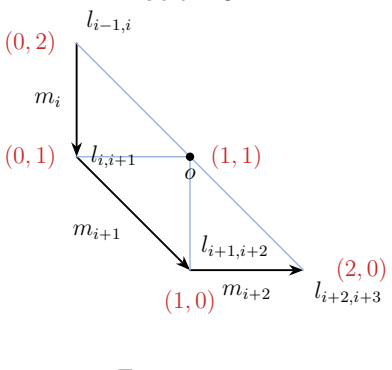
Non-commutative crepant resolutions (NCCRs) are non-commutative versions of classical crepant resolutions in algebraic geometry. For 3-dimensional terminal Gorenstein singularities Iyama and Wemyss proved that all NCCRs are connected by mutations, which may be viewed as a non-commutative analogue of Kawamata's result that all crepant resolutions are connected by flops. In this paper we prove the corresponding result for a class of canonical Gorenstein singularities which are not terminal, namely anticanonical cones over del Pezzo surfaces. More precisely, we first obtain a classification of NCCRs of anticanonical del Pezzo cones, showing that every NCCR arises from a geometric helix on the corresponding del Pezzo surface. We then prove that all such geometric helices are connected to each other by mutations, up to simple operations which include tensoring by line bundles and shifts. A crucial ingredient in our proofs is the polygons that can be associated to exceptional collections on del Pezzo surfaces following the works of Hille and Perling. We obtain some interesting observations about these polygons which may be of independent interest.
Editorial analysis
A structured set of objections, weighed in public.
Referee Report
Summary. The paper classifies NCCRs of anticanonical cones over del Pezzo surfaces by establishing a correspondence with geometric helices on the surface, using polygons associated to exceptional collections following Hille-Perling. It then proves that all such helices are connected by mutations, up to tensoring by line bundles and shifts. This extends the Iyama-Wemyss connectivity theorem from terminal Gorenstein 3-fold singularities to this class of canonical singularities.
Significance. If the classification and connectivity results hold, the work is significant for providing a combinatorial model of NCCRs via Hille-Perling polygons and establishing mutation connectivity in a non-terminal setting. The observations on the polygons may be of independent interest for the theory of exceptional collections on del Pezzo surfaces. The approach is internally consistent and builds on standard mutation theory and external polygon constructions without introducing free parameters or circular reductions.
minor comments (3)
- Clarify in the introduction or §1 the precise list of 'simple operations' (beyond tensoring by line bundles and shifts) under which the helices are considered connected, as this is central to the connectivity statement.
- In the section discussing the polygons (likely §3 or §4), explicitly state whether the observations about these polygons are new or follow directly from Hille-Perling, to highlight any independent contributions.
- Ensure that the statement of the main classification theorem includes a clear reference to the precise del Pezzo degree or Picard rank assumptions under which the helix-NCCR bijection holds, even if they are general.
Simulated Author's Rebuttal
We thank the referee for their positive summary of our manuscript and for highlighting its significance in classifying NCCRs for anticanonical del Pezzo cones and extending mutation connectivity results beyond the terminal case. The recommendation for minor revision is noted. No specific major comments were provided in the report, so we have no point-by-point revisions to address at this stage.
Circularity Check
No significant circularity detected
full rationale
The derivation proceeds by classifying NCCRs via a direct correspondence to geometric helices on del Pezzo surfaces (using external Hille-Perling polygons as combinatorial model for exceptional collections) and then showing mutation-connectivity within that set up to tensoring and shifts. This extends the cited Iyama-Wemyss result for terminal singularities without any reduction of the central claims to self-defined quantities, fitted parameters renamed as predictions, or load-bearing self-citations. The polygons and mutation operations serve as independent inputs, and the abstract indicates the proofs are direct rather than conditional on unverified internal assumptions. No quoted step exhibits the specific reduction required to flag circularity under the enumerated patterns.
Axiom & Free-Parameter Ledger
axioms (2)
- domain assumption Existence and properties of geometric helices on del Pezzo surfaces corresponding to NCCRs
- domain assumption Polygons associated to exceptional collections on del Pezzo surfaces (Hille-Perling) capture mutation relations
Forward citations
Cited by 1 Pith paper
-
Geometric helices on del Pezzo surfaces from tilting
All geometric helices on del Pezzo surfaces are related by elementary operations including tilting, implying that non-commutative crepant resolutions of their affine cones are related by mutations.
Reference graph
Works this paper leans on
-
[1]
48, 2000, Dedicated to William Fulton on the occasion of his 60th birthday, pp
Arnaud Beauville,Determinantal hypersurfaces, vol. 48, 2000, Dedicated to William Fulton on the occasion of his 60th birthday, pp. 39–64
work page 2000
-
[2]
Raf Bocklandt,Graded Calabi Yau algebras of dimension 3 (with an appendix by Michel Van den Bergh), J. Pure Appl. Algebra212(2008), no. 1, 14–32. 11Recall that according to Proposition 5.10 relations in the quiver corresponding toEcorrespond to reverse arrows inQ. NCCRS OF CONES OVER DEL PEZZO SURF ACES 81
work page 2008
-
[3]
Alexey Bondal,Representations of associative algebras and coherent sheaves, Izv. Akad. Nauk SSSR Ser. Mat.53(1989), no. 1, 25–44
work page 1989
-
[4]
,A symplectic groupoid of triangular bilinear forms and the braid group, Izv. Ross. Akad. Nauk Ser. Mat.68(2004), no. 4, 19–74. MR 2084561
work page 2004
-
[5]
Alexey Bondal and Dmitri Orlov,Semiorthogonal decomposition for algebraic varieties, 1995
work page 1995
-
[6]
Alexey Bondal and Alexander Polishchuk,Homological properties of associative algebras: the method of helices, Izv. Ross. Akad. Nauk Ser. Mat.57(1993), no. 2, 3–50
work page 1993
-
[7]
Alexey Bondal and Michel Van den Bergh,Generators and representability of functors in commutative and noncommutative geometry, Mosc. Math. J.3(2003), no. 1, 1–36, 258
work page 2003
-
[8]
Pierrick Bousseau,Geometric helices on del Pezzo surfaces from tilting, 2026
work page 2026
-
[9]
Tom Bridgeland,t-structures on some local Calabi-Yau varieties, J. Algebra289(2005), no. 2, 453–483
work page 2005
-
[10]
Tom Bridgeland and David Stern,Helices on del Pezzo surfaces and tilting Calabi-Yau alge- bras, Adv. Math.224(2010), no. 4, 1672–1716
work page 2010
-
[11]
Louis de Thanhoffer de V¨ olcsey and Michel Van den Bergh,Some new examples of nondegen- erate quiver potentials, Int. Math. Res. Not. IMRN (2013), no. 20, 4672–4686
work page 2013
-
[12]
,On an analogue of the Markov equation for exceptional collections of length 4, 2016
work page 2016
-
[13]
Harm Derksen, Jerzy Weyman, and Andrei Zelevinsky,Quivers with potentials and their representations. I. Mutations, Selecta Math. (N.S.)14(2008), no. 1, 59–119
work page 2008
-
[14]
150, Springer- Verlag, New York, 1995, With a view toward algebraic geometry
David Eisenbud,Commutative algebra, Graduate Texts in Mathematics, vol. 150, Springer- Verlag, New York, 1995, With a view toward algebraic geometry
work page 1995
-
[15]
A. L. Gorodentsev,Exceptional bundles on surfaces with a moving anticanonical class, Izv. Akad. Nauk SSSR Ser. Mat.52(1988), no. 4, 740–757, 895
work page 1988
-
[16]
Herzog,Seiberg duality is an exceptional mutation, Journal of High Energy Physics08(2004), no
Christopher P. Herzog,Seiberg duality is an exceptional mutation, Journal of High Energy Physics08(2004), no. 064, 1–30
work page 2004
-
[17]
Lutz Hille and Markus Perling,Exceptional sequences of invertible sheaves on rational surfaces, Compos. Math.147(2011), no. 4, 1230–1280
work page 2011
-
[18]
D. Huybrechts,Fourier-Mukai transforms in algebraic geometry, Oxford Mathematical Mono- graphs, The Clarendon Press, Oxford University Press, Oxford, 2006
work page 2006
-
[19]
Osamu Iyama and Idun Reiten,Fomin-Zelevinsky mutation and tilting modules over Calabi- Yau algebras, Amer. J. Math.130(2008), no. 4, 1087–1149
work page 2008
-
[20]
Osamu Iyama and Michael Wemyss,Maximal modifications and Auslander-Reiten duality for non-isolated singularities, Invent. Math.197(2014), no. 3, 521–586
work page 2014
-
[21]
,Singular derived categories ofQ-factorial terminalizations and maximal modification algebras, Adv. Math.261(2014), 85–121
work page 2014
-
[22]
,Tits cones intersections and applications, 2023
work page 2023
-
[23]
B. V. Karpov and D. Yu. Nogin,Three-block exceptional sets on del Pezzo surfaces, Izv. Ross. Akad. Nauk Ser. Mat.62(1998), no. 3, 3–38
work page 1998
-
[24]
Alexander Kasprzyk, Benjamin Nill, and Thomas Prince,Minimality and mutation- equivalence of polygons, Forum Math. Sigma5(2017)
work page 2017
-
[25]
Yujiro Kawamata,Flops connect minimal models, Publ. Res. Inst. Math. Sci.44(2008), no. 2, 419–423. MR 2426353
work page 2008
-
[26]
Bernhard Keller,Deformed Calabi-Yau completions, J. Reine Angew. Math.654(2011), 125– 180
work page 2011
-
[27]
Bernhard Keller, Daniel Murfet, and Michel Van den Bergh,On two examples by Iyama and Yoshino, Compos. Math.147(2011), no. 2, 591–612. 82 ANYA NORDSKOV A AND MICHEL V AN DEN BERGH
work page 2011
-
[28]
Bernhard Keller and Dong Yang,Derived equivalences from mutations of quivers with poten- tial, Adv. Math.226(2011), no. 3, 2118–2168
work page 2011
-
[29]
Johannes Krah,Mutations of numerically exceptional collections on surfaces, Math. Z.307 (2024), no. 4, Paper No. 78, 28
work page 2024
-
[30]
S. A. Kuleshov and D. O. Orlov,Exceptional sheaves on Del Pezzo surfaces, Izv. Ross. Akad. Nauk Ser. Mat.58(1994), no. 3, 53–87
work page 1994
-
[31]
A. G. Kuznetsov,Exceptional collections in surface-like categories, Mat. Sb.208(2017), no. 9, 116–147
work page 2017
-
[32]
Seraphina Eun Bi Lee, Tudur Lewis, and Sidhanth Rama,Cyclic Nielsen realization for del Pezzo surfaces, arXiv e-prints (2008)
work page 2008
-
[33]
Methods Appl.20(2024), Paper No
Wendelin Lutz,Mirrors to del Pezzo surfaces and the classification ofT-polygons, SIGMA Symmetry Integrability Geom. Methods Appl.20(2024), Paper No. 095, 20
work page 2024
-
[34]
Manin,Cubic forms, second ed., North-Holland Mathematical Library, vol
Yu.˜I. Manin,Cubic forms, second ed., North-Holland Mathematical Library, vol. 4, North- Holland Publishing Co., Amsterdam, 1986, Algebra, geometry, arithmetic, Translated from the Russian by M. Hazewinkel
work page 1986
-
[35]
Yuma Mizuno,q-Painlev´ e equations on cluster Poisson varieties via toric geometry, Selecta Math. (N.S.)30(2024), no. 2, Paper No. 19, 37
work page 2024
-
[36]
Anya Nordskova and Michel Van den Bergh,Full exceptional collections on Fano threefolds and groups generated by spherical twists on K3 surfaces, 2025
work page 2025
-
[37]
NCCRs of cones over del Pezzo surfaces
,SageMath scripts for the paper “NCCRs of cones over del Pezzo surfaces”,https: //github.com/cantate-be/mutations2026
-
[38]
Markus Perling,Combinatorial aspects of exceptional sequences on (rational) surfaces, Math. Z.288(2018), no. 1-2, 243–286
work page 2018
-
[39]
Alexander Polishchuk and Michel Van den Bergh,Semiorthogonal decompositions of the cate- gories of equivariant coherent sheaves for some reflection groups, J. Eur. Math. Soc. (JEMS) 21(2019), no. 9, 2653–2749
work page 2019
-
[40]
A. N. Rudakov,Markov numbers and exceptional bundles onP 2, Izv. Akad. Nauk SSSR Ser. Mat.52(1988), no. 1, 100–112, 240
work page 1988
-
[41]
ˇSpela ˇSpenko and Michel Van den Bergh,Non-commutative crepant resolutions for some toric singularities. II, J. Noncommut. Geom.14(2020), no. 1, 73–103
work page 2020
-
[42]
The Sage Developers,SageMath, the Sage Mathematics Software System, 2026, DOI 10.5281/zenodo.6259615
-
[43]
Michel Van den Bergh,Non-commutative crepant resolutions, The legacy of Niels Henrik Abel, Springer, Berlin, 2004, pp. 749–770
work page 2004
-
[44]
,Calabi-Yau algebras and superpotentials, Selecta Math. (N.S.)21(2015), no. 2, 555– 603
work page 2015
-
[45]
,Noncommutative crepant resolutions, an overview, ICM—International Congress of Mathematicians. Vol. 2. Plenary lectures, EMS Press, Berlin, [2023]©2023, pp. 1354–1391
work page 2023
-
[46]
Michael Wemyss,A lockdown survey on cDV singularities, McKay correspondence, mutation and related topics, Adv. Stud. Pure Math., vol. 88, Math. Soc. Japan, Tokyo, [2023]©2023, pp. 47–93. Email address:anya.nordskova@ipmu.jp Email address:michel.vandenbergh@uhasselt.be NCCRS OF CONES OVER DEL PEZZO SURF ACES 83 (Michel Van den Bergh)V akgroep Wiskunde en D...
work page 2023
discussion (0)
Sign in with ORCID, Apple, or X to comment. Anyone can read and Pith papers without signing in.