Recognition: unknown
Quantum Charge-4e Superconductivity and Deconfined Pseudocriticality in the Attractive SU(4) Hubbard Model
Pith reviewed 2026-05-10 12:04 UTC · model grok-4.3
The pith
The attractive SU(4) Hubbard model supports a stable charge-4e superconducting phase at zero temperature reached by suppressing charge-2e pairing.
A machine-rendered reading of the paper's core claim, the machinery that carries it, and where it could break.
Core claim
In the attractive SU(4) Hubbard model, quantum Monte Carlo simulations identify a charge-2e superconducting phase at weaker interactions that gives way to a charge-4e superconducting phase at stronger interactions. Charge-4e correlations converge with system size while charge-2e correlations are suppressed to zero, and single-particle excitations remain gapped throughout. The transition exhibits charge-2e scaling that cannot be described by conventional Landau theory. These observations are explained by an Sp(4) gauge-Higgs theory in which the charge-2e order parameter is a composite operator coupled to an emergent non-Abelian gauge field; the theory produces deconfined quantum pseudocentral
What carries the argument
The Sp(4) gauge-Higgs theory, which treats the physical charge-2e order parameter as a composite field coupled to an emergent non-Abelian gauge structure and realizes deconfined quantum pseudocriticality via a fixed-point collision between the Higgs and confined phases.
If this is right
- Charge-4e superconductivity is realized as a bona fide zero-temperature phase with long-range quartet order.
- The charge-2e to charge-4e transition proceeds through deconfined pseudocriticality rather than a conventional Landau critical point.
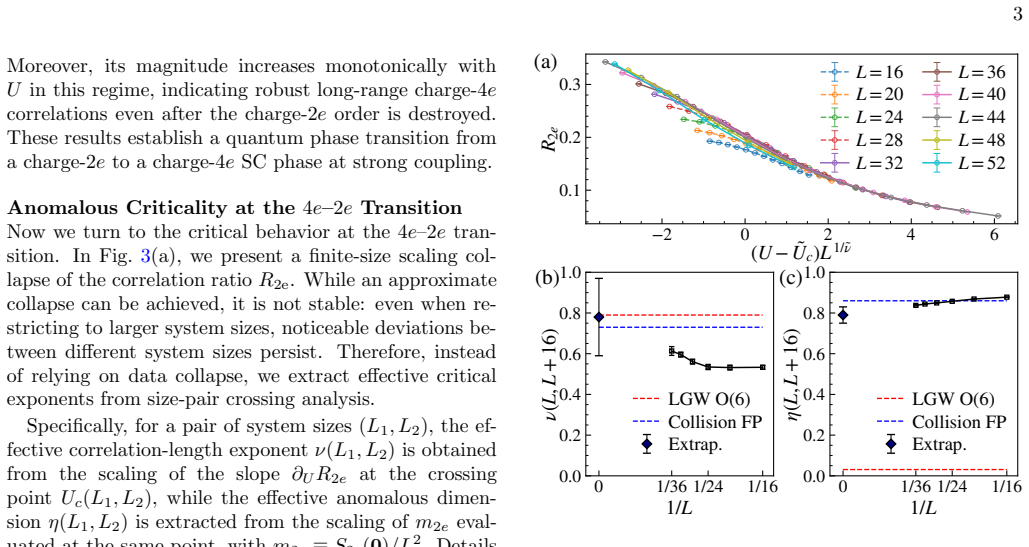
- One-loop exponents computed from the Sp(4) gauge-Higgs theory quantitatively match the quantum Monte Carlo scaling.
- The model provides a controlled, numerically exact platform for studying quartet condensation and related fractionalized superconducting states.
Where Pith is reading between the lines
- Similar composite-order mechanisms may stabilize charge-4e phases in other multi-flavor attractive Hubbard models or in doped systems with approximate SU(4) symmetry.
- Dynamical probes such as the single-particle spectral function or current-current correlations could reveal signatures of the emergent gauge structure that differ from Landau-Ginzburg predictions.
- Finite-temperature extensions of the same model may host a pseudocritical regime whose width is controlled by the fixed-point collision distance.
Load-bearing premise
The quantum Monte Carlo simulations have fully overcome the fermion sign problem and finite-size effects sufficiently to distinguish charge-2e from charge-4e channels and to establish that the observed scaling is not a finite-size artifact.
What would settle it
Numerical data at substantially larger system sizes showing that charge-2e correlations continue to decay or that the extracted scaling exponents deviate systematically from the one-loop collision-point values predicted by the Sp(4) gauge-Higgs theory.
Figures





read the original abstract
Unlike conventional charge-2e superconductors, a charge-4e superconductor exhibits long-range coherence of electron quartets rather than Cooper pairs. Clear zero-temperature realizations of charge-4e superconductivity remain rare. Here, we investigate the zero-temperature phase diagram of the attractive SU(4) Hubbard model with numerically exact, large-scale quantum Monte Carlo (QMC) simulations overcoming major technical hurdles. We identify both charge-2e and charge-4e superconducting phases. Upon increasing interaction, charge-2e correlations are suppressed and eventually vanish, while the charge-4e correlations remain robust and converge with system size, signaling the onset of a quartet-condensed phase. Interestingly, across the charge-2e--charge-4e transition, single electrons remain gapped, while charge-2e correlations exhibit a scaling behavior inconsistent with a conventional Landau description. These features are naturally captured by a fractionalized framework in which the physical charge-2e order parameter is a composite field coupled to an emergent non-Abelian gauge structure. We formulate an Sp(4) gauge-Higgs theory that realizes deconfined quantum pseudocriticality between the Higgs (charge-2e) phase and the confined (charge-4e) phase. The Sp(4) gauge-Higgs theory yields pseudocriticality through a fixed-point collision, and its one-loop collision-point exponents quantitatively track the QMC results. Our results establish charge-4e superconductivity as a bona fide zero-temperature phase, provide a simple model for future studies in a numerically exact framework, and reveal an unconventional route to superconducting criticality.
Editorial analysis
A structured set of objections, weighed in public.
Referee Report
Summary. The manuscript reports large-scale QMC simulations of the attractive SU(4) Hubbard model that identify a charge-2e superconducting phase at weak coupling and a charge-4e phase at strong coupling. Charge-2e correlations are suppressed and vanish with increasing interaction while charge-4e correlations remain robust and converge with system size; single-particle excitations stay gapped across the transition, whose scaling deviates from Landau theory. These features are interpreted via an emergent Sp(4) gauge-Higgs theory that realizes deconfined quantum pseudocriticality through a fixed-point collision, with one-loop exponents stated to track the QMC data.
Significance. If the numerical evidence is robust, the work would establish a simple, numerically exact lattice model for stable zero-temperature charge-4e superconductivity and provide a concrete example of deconfined pseudocriticality arising from non-Abelian gauge structure, with potential implications for fractionalized superconducting criticality.
major comments (2)
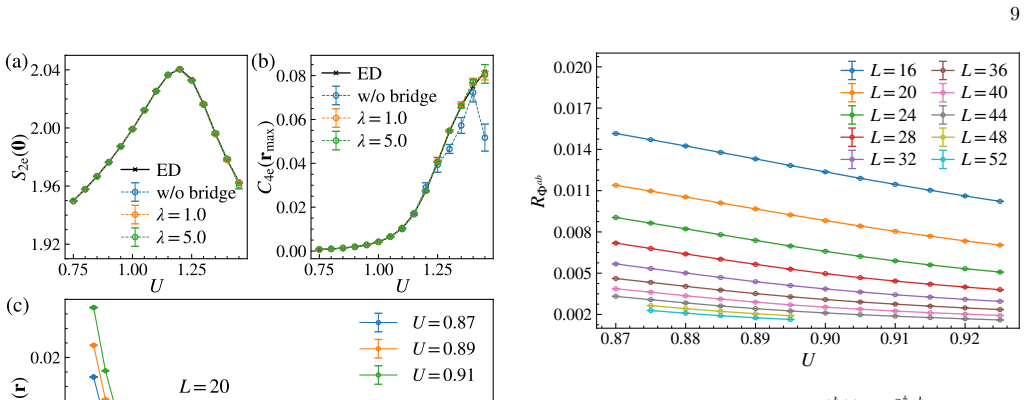
- [Abstract and numerical results] Abstract and numerical-results section: the central claim that charge-4e correlations 'converge with system size' while charge-2e correlations 'vanish' (signaling true LRO and the quartet phase) is load-bearing, yet the manuscript supplies no explicit values for maximum linear sizes L_max, extrapolation protocols to the thermodynamic limit, or quantitative error bars on the susceptibilities or correlation lengths in either channel. Without these, it is impossible to rule out finite-size saturation or channel-dependent sign-problem artifacts as the origin of the reported distinction.
- [Sp(4) gauge-Higgs theory] Sp(4) gauge-Higgs theory section: the effective theory is constructed specifically to reproduce the QMC-observed gapped electrons and anomalous scaling. The statement that the one-loop collision-point exponents 'quantitatively track' the QMC results therefore risks circularity; a direct, tabulated comparison of the numerical exponent values from both the simulation and the one-loop calculation is required to substantiate the claim of quantitative agreement.
minor comments (2)
- [Introduction] The definition of the charge-4e order parameter and its relation to the composite charge-2e field could be stated more explicitly with an equation in the introduction or theory section.
- [Figures] Figure captions and text should consistently report the precise system sizes and statistical errors used for each data point to allow readers to assess convergence.
Simulated Author's Rebuttal
We thank the referee for the careful reading and constructive comments on our manuscript. We address each major comment point by point below. We will revise the manuscript to incorporate the requested details and clarifications, which will strengthen the presentation of our numerical results and the comparison with the effective theory.
read point-by-point responses
-
Referee: [Abstract and numerical results] Abstract and numerical-results section: the central claim that charge-4e correlations 'converge with system size' while charge-2e correlations 'vanish' (signaling true LRO and the quartet phase) is load-bearing, yet the manuscript supplies no explicit values for maximum linear sizes L_max, extrapolation protocols to the thermodynamic limit, or quantitative error bars on the susceptibilities or correlation lengths in either channel. Without these, it is impossible to rule out finite-size saturation or channel-dependent sign-problem artifacts as the origin of the reported distinction.
Authors: We agree that explicit documentation of these technical details is necessary to fully substantiate the central claims. In the revised manuscript, we will add to the numerical-results section the maximum linear sizes L_max used in the QMC simulations, the specific finite-size extrapolation protocols applied to the susceptibilities and correlation lengths (including functional forms and fitting ranges), and quantitative error bars on all reported quantities. These additions will allow readers to directly assess the convergence behavior and rule out finite-size saturation or sign-problem artifacts as alternative explanations for the observed distinction between channels. revision: yes
-
Referee: [Sp(4) gauge-Higgs theory] Sp(4) gauge-Higgs theory section: the effective theory is constructed specifically to reproduce the QMC-observed gapped electrons and anomalous scaling. The statement that the one-loop collision-point exponents 'quantitatively track' the QMC results therefore risks circularity; a direct, tabulated comparison of the numerical exponent values from both the simulation and the one-loop calculation is required to substantiate the claim of quantitative agreement.
Authors: We appreciate the referee's concern about potential circularity. Although the Sp(4) gauge-Higgs theory was motivated by the gapped single-particle spectrum and the anomalous scaling observed in QMC, the one-loop exponents are computed independently from the effective field theory. To eliminate any ambiguity, we will add a direct tabulated comparison in the Sp(4) gauge-Higgs theory section that lists the one-loop collision-point exponents alongside the corresponding numerical values extracted from the QMC simulations, together with a brief description of how the numerical exponents were obtained. This will provide a transparent, side-by-side assessment of the quantitative agreement. revision: yes
Circularity Check
No significant circularity in derivation chain
full rationale
The paper's primary evidence derives from independent large-scale QMC simulations of the attractive SU(4) Hubbard model, which directly compute correlation functions and scaling behaviors for charge-2e and charge-4e channels. These numerical results stand on their own as first-principles data from the microscopic Hamiltonian. The subsequent formulation of an Sp(4) gauge-Higgs theory is introduced as an effective description that accounts for the observed gapped electrons and non-Landau scaling; its one-loop fixed-point collision calculation then provides exponents that are compared to the QMC data as a consistency check. No quoted step reduces by construction to a self-definition, a fitted parameter relabeled as a prediction, or a load-bearing self-citation whose content is unverified. The chain remains self-contained against external numerical benchmarks.
Axiom & Free-Parameter Ledger
axioms (2)
- domain assumption The attractive SU(4) Hubbard model admits sign-problem-free QMC simulations at zero temperature
- domain assumption Charge-2e correlation scaling is inconsistent with conventional Landau theory
invented entities (1)
-
Emergent non-Abelian Sp(4) gauge structure
no independent evidence
Forward citations
Cited by 2 Pith papers
-
Demonstration of a fermion Quadrupling Condensate via Quantum Monte Carlo Simulation
Large-scale quantum Monte Carlo simulations provide direct microscopic evidence for a fermion-quadrupling condensate with transition temperature on the scale of the hopping energy.
-
Gauging in superconductors and other electronic systems
Superconductors are bosonic at low energy yet carry a gravito-magnetic anomaly from fermion parity gauging that forbids trivial massive phases in 3D and 4D.
Reference graph
Works this paper leans on
-
[1]
P. Schlottmann, Ground-state and elemental excitations of the one-dimensional multicomponent fermi gas with delta -function interaction, Journal of Physics: Con- densed Matter6, 1359 (1994)
1994
-
[2]
Babaev, A
E. Babaev, A. Sudbø, and N. W. Ashcroft, A superconductor-to-superfluid phase transition in liquid metallic hydrogen, Nature431, 666 (2004)
2004
-
[3]
Wu, Competing orders in one-dimensional spin-3/2 fermionic systems, Phys
C. Wu, Competing orders in one-dimensional spin-3/2 fermionic systems, Phys. Rev. Lett.95, 266404 (2005)
2005
-
[4]
Capponi, G
S. Capponi, G. Roux, P. Lecheminant, P. Azaria, E. Boulat, and S. R. White, Molecular superfluid phase in systems of one-dimensional multicomponent fermionic 6 cold atoms, Phys. Rev. A77, 013624 (2008)
2008
-
[5]
E. Berg, E. Fradkin, and S. A. Kivelson, Charge-4e superconductivity from pair-density-wave order in cer- tain high-temperature superconductors, Nature Physics 5, 830 (2009)
2009
-
[6]
Radzihovsky, Fluctuations and phase transitions in Larkin-Ovchinnikov liquid-crystal states of a population- imbalanced resonant Fermi gas, Phys
L. Radzihovsky, Fluctuations and phase transitions in Larkin-Ovchinnikov liquid-crystal states of a population- imbalanced resonant Fermi gas, Phys. Rev. A84, 023611 (2011)
2011
-
[7]
E. V. Herland, E. Babaev, and A. Sudbø, Phase transi- tions in a three dimensionalU(1)×U(1) lattice London superconductor: Metallic superfluid and charge-4esuper- conducting states, Physical Review B82, 134511 (2010)
2010
-
[8]
R. M. Fernandes and L. Fu, Charge-4esuperconductivity from multicomponent nematic pairing: Application to twisted bilayer graphene, Physical Review Letters127, 047001 (2021)
2021
-
[9]
S.-K. Jian, Y. Huang, and H. Yao, Charge-4esupercon- ductivity from nematic superconductors in two and three dimensions, Physical Review Letters127, 227001 (2021)
2021
-
[10]
Hecker, R
M. Hecker, R. Willa, J. Schmalian, and R. M. Fernandes, Cascade of vestigial orders in two-component supercon- ductors: Nematic, ferromagnetic,s-wave charge-4e, and d-wave charge-4estates, Physical Review B107, 224503 (2023)
2023
-
[11]
Hecker and R
M. Hecker and R. M. Fernandes, Local condensation of charge-4esuperconductivity at a nematic domain wall, Physical Review B109, 134514 (2024)
2024
-
[12]
G. E. Volovik, Fermionic Quartet and Vestigial Gravity, JETP Letters119, 330 (2024)
2024
- [13]
-
[14]
Zhou and Z
S. Zhou and Z. Wang, Chern Fermi pocket, topological pair density wave, and charge-4eand charge-6esupercon- ductivity in kagom´ e superconductors, Nature Communi- cations13, 7288 (2022)
2022
-
[15]
Maccari, J
I. Maccari, J. Carlstr¨ om, and E. Babaev, Prediction of time-reversal-symmetry breaking fermionic quadrupling condensate in twisted bilayer graphene, Physical Review B107, 064501 (2023)
2023
-
[16]
Y.-B. Liu, J. Zhou, C. Wu, and F. Yang, Charge 4esuper- conductivity and chiral metal in the 45 ◦-twisted bilayer cuprates and related bilayers, Nature Communications 14, 7926 (2023)
2023
-
[17]
Wu and Y
Y.-M. Wu and Y. Wang,d-wave charge-4esuperconduc- tivity from fluctuating pair density waves, npj Quantum Materials9, 1 (2024)
2024
-
[18]
J. Ge, P. Wang, Y. Xing, Q. Yin, A. Wang, J. Shen, H. Lei, Z. Wang, and J. Wang, Charge-4eand charge-6e flux quantization and higher charge superconductivity in kagome superconductor ring devices, Physical Review X 14, 021025 (2024)
2024
-
[19]
R. Liu, W. Wang, and X. Cui, Quartet superfluid in two- dimensional mass-imbalanced Fermi mixtures, Physical Review Letters131, 193401 (2023)
2023
-
[20]
M. O. Soldini, M. H. Fischer, and T. Neupert, Charge-4e superconductivity in a Hubbard model, Physical Review B109, 214509 (2024)
2024
-
[21]
Primary charge-4e superconduc- tivity from doping a featureless Mott insulator,
Z.-Q. Gao, Y.-Q. Wang, Y.-H. Zhang, and H. Yang, Primary charge-4e superconductivity from doping a fea- tureless Mott insulator (2026), arXiv:2602.03925 [cond- mat.str-el]
-
[22]
Jiang, Z.-X
Y.-F. Jiang, Z.-X. Li, S. A. Kivelson, and H. Yao, Charge- 4esuperconductors: A Majorana quantum Monte Carlo study, Physical Review B95, 241103 (2017)
2017
-
[23]
You, Y.-C
Y.-Z. You, Y.-C. He, C. Xu, and A. Vishwanath, Sym- metric fermion mass generation as deconfined quantum criticality, Phys. Rev. X8, 011026 (2018)
2018
-
[24]
Khalaf, P
E. Khalaf, P. Ledwith, and A. Vishwanath, Symme- try constraints on superconductivity in twisted bilayer graphene: Fractional vortices, 4econdensates, or nonuni- tary pairing, Phys. Rev. B105, 224508 (2022)
2022
-
[25]
N. V. Gnezdilov and Y. Wang, Solvable model for a charge-4esuperconductor, Physical Review B106, 094508 (2022)
2022
-
[26]
Topological Charge-2ne Superconduc- tors,
Z.-Q. Gao, Y.-Q. Wang, H. Yang, and C. Wu, Topological charge-2ne superconductors, arXiv:2512.21325 (2025)
-
[27]
Samoilenka and E
A. Samoilenka and E. Babaev, Microscopic theory of elec- tron quadrupling condensates, Physical Review Research 8, 013139 (2026)
2026
-
[28]
Shi and S
H. Shi and S. Zhang, Infinite variance in fermion quan- tum Monte Carlo calculations, Phys. Rev. E93, 033303 (2016)
2016
-
[29]
Wan and S
Z.-Q. Wan and S. Zhang, Addressing the infinite vari- ance problem in fermionic Monte Carlo simulations: Ret- rospective error remediation and the exact bridge link method, Phys. Rev. E112, 065309 (2025)
2025
-
[30]
Fradkin and S
E. Fradkin and S. H. Shenker, Phase diagrams of lattice gauge theories with Higgs fields, Physical Review D19, 3682 (1979)
1979
-
[31]
Hikami, Non-linearσmodel of Grassmann Mani- fold and non-Abelian gauge field with scalar coupling, Progress of Theoretical Physics64, 1425 (1980)
S. Hikami, Non-linearσmodel of Grassmann Mani- fold and non-Abelian gauge field with scalar coupling, Progress of Theoretical Physics64, 1425 (1980)
1980
-
[32]
Senthil, A
T. Senthil, A. Vishwanath, L. Balents, S. Sachdev, and M. P. A. Fisher, Deconfined quantum critical points, Sci- ence303, 1490 (2004)
2004
-
[33]
C. Wang, A. Nahum, M. A. Metlitski, C. Xu, and T. Senthil, Deconfined quantum critical points: Symme- tries and dualities, Phys. Rev. X7, 031051 (2017)
2017
-
[34]
Gorbenko, S
V. Gorbenko, S. Rychkov, and B. Zan, Walking, weak first-order transitions, and complex CFTs, Journal of High Energy Physics2018, 108 (2018)
2018
-
[35]
Bonati, A
C. Bonati, A. Pelissetto, I. Soler Calero, and E. Vi- cari, Charged critical behavior and nonperturbative con- tinuum limit of three-dimensional lattice SU(N c) gauge Higgs models, Phys. Rev. D110, 094504 (2024)
2024
-
[36]
Ihrig, N
B. Ihrig, N. Zerf, P. Marquard, I. F. Herbut, and M. M. Scherer, Abelian Higgs model at four loops, fixed-point collision, and deconfined criticality, Phys. Rev. B100, 134507 (2019)
2019
-
[37]
Ma and C
R. Ma and C. Wang, Theory of deconfined pseudocriti- cality, Phys. Rev. B102, 020407 (2020)
2020
-
[38]
Nahum, Note on Wess-Zumino-Witten models and quasiuniversality in 2 + 1 dimensions, Phys
A. Nahum, Note on Wess-Zumino-Witten models and quasiuniversality in 2 + 1 dimensions, Phys. Rev. B102, 201116 (2020)
2020
-
[39]
Z. Zhou, L. Hu, W. Zhu, and Y.-C. He, SO(5) deconfined phase transition under the fuzzy-sphere microscope: Ap- proximate conformal symmetry, pseudo-criticality, and operator spectrum, Phys. Rev. X14, 021044 (2024)
2024
- [40]
-
[41]
Loison, A Monte Carlo study for the critical exponents of the three-dimensional O(6) model, Physica A271, 157 (1999)
D. Loison, A Monte Carlo study for the critical exponents of the three-dimensional O(6) model, Physica A271, 157 (1999)
1999
-
[42]
S. A. Antonenko and A. I. Sokolov, Critical exponents for a three-dimensional O(n)-symmetric model withn >3, 7 Phys. Rev. E51, 1894 (1995)
1995
-
[43]
How- ever, it is well-known that the one-loop results signifi- cantly overestimate the critical flavor atϵ= 1 [35, 36]
Our one-loop calculation givesN ∗ f = 399.83+O(ϵ). How- ever, it is well-known that the one-loop results signifi- cantly overestimate the critical flavor atϵ= 1 [35, 36]. Our analysis of the collision fixed point, together with its excellent agreement with the DQMC results, suggests thatN ∗ f lies close to the physical valueN f = 4 atϵ= 1
-
[44]
Nauenberg and D
M. Nauenberg and D. J. Scalapino, Singularities and scaling functions at the Potts-model multicritical point, Phys. Rev. Lett.44, 837 (1980)
1980
-
[45]
J. L. Cardy, M. Nauenberg, and D. J. Scalapino, Scaling theory of the Potts-model multicritical point, Phys. Rev. B22, 2560 (1980)
1980
-
[46]
D. T. Son, Superconductivity by long-range color mag- netic interaction in high-density quark matter, Phys. Rev. D59, 094019 (1999)
1999
-
[47]
Zou and D
L. Zou and D. Chowdhury, Deconfined metallic quantum criticality: AU(2) gauge-theoretic approach, Phys. Rev. Res.2, 023344 (2020)
2020
-
[48]
J. L. Bohn, A. M. Rey, and J. Ye, Cold molecules: Progress in quantum engineering of chemistry and quan- tum matter, Science357, 1002 (2017)
2017
-
[49]
Mukherjee, J
B. Mukherjee, J. M. Hutson, and K. R. A. Hazzard, SU(N) magnetism with ultracold molecules, New Jour- nal of Physics27, 013013 (2025)
2025
-
[50]
Shi, Z.-Z
S.-H. Shi, Z.-Z. Wu, J. Hu, and Z.-X. Li, High- temperature charge-4e superconductivity in su(4) inter- acting fermions, arXiv (2026). 8 METHOD DQMC Algorithm.The SU(4) Hubbard model de- fined in Eq. (1) reads ˆH=−t X a,⟨ij⟩ (ca i †ca j + h.c.)−U X i ( X a ˆna i −2) 2 = ˆK+ ˆV , (5) where ˆKand ˆVdenote the kinetic and interaction terms, respectively. To ...
2026
discussion (0)
Sign in with ORCID, Apple, or X to comment. Anyone can read and Pith papers without signing in.